
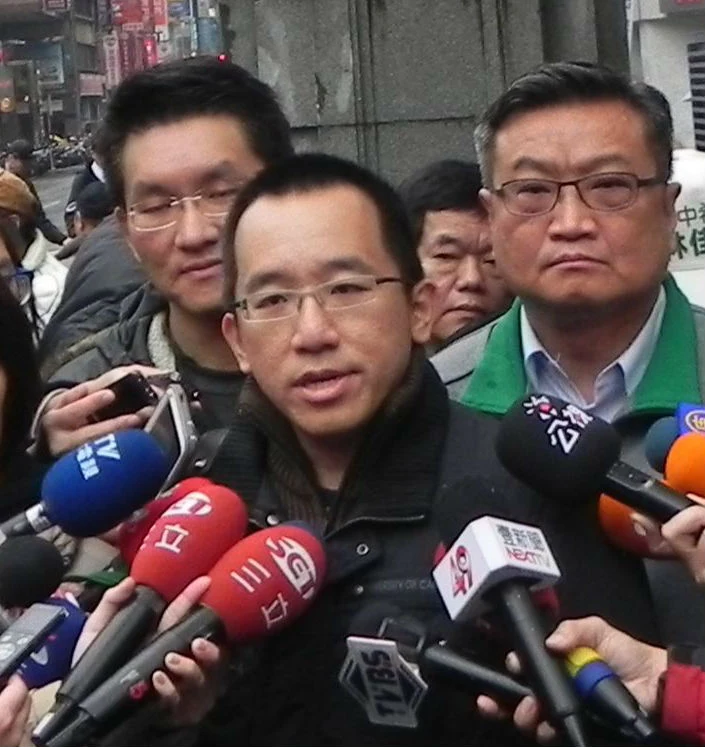
30-second overview: Chen Chih-chung is the son of former President Chen Shui-bian, a law graduate of National Taiwan University, and holds master's degrees in law from both UC Berkeley and NYU. From 2010 to 2022, he was elected three times to the Kaohsiung City Council representing the Xinzheng-Xiaogang district, with two of those terms ending prematurely in their 8th and 4th months respectively, both dismissed under Article 79 of the Local Government Act via Executive Yuan orders. The April 26, 2023 judgment in the money laundering case did not include a forfeiture of public rights. A month later, the Legislative Yuan passed the "anti-gang provisions" amendment to the election law, which added money laundering to the list of offenses barring candidacy. The text contains no mention of "lifetime" nor any provision for restoration of rights.
On August 18, 2008, the University of Virginia School of Law on the U.S. East Coast began its orientation for new students. On the roster was a student from Taiwan who did not show up.
Virginia Orientation He Never Attended
The student was named Chen Chih-chung, and he was pursuing a J.D. degree. University of Virginia Office of Communications senior director Hannah Kahn later explained to Taiwanese media: "Because Chen Chih-chung failed to attend the orientation program that began yesterday, he has not completed the registration process and has already lost his eligibility to enroll at the University of Virginia School of Law." If he wants to re-enroll, "he can only start from the next academic year."1
He never returned to Virginia. The two law master's degrees from Berkeley and New York University were the real ones he earned; the Virginia J.D. never actually began2.
Before that, his path was a standard legal career trajectory: Taipei Municipal Chenggong High School, graduated from the Department of Law, Judicial Group, National Taiwan University in 2001, Master of Laws at the University of California, Berkeley in 2005, second Master of Laws at New York University in 2006, then returned to the United States to prepare for his doctorate3. At that time, his life plan did not include elections.
What prevented him from going was an ongoing legal proceeding. His father Chen Shui-bian ran with Liu Hsiu-yen and won the presidential and vice-presidential election in 2000, marking Taiwan's first peaceful transition of political parties. After stepping down in May 2008, the family's overseas financial flows came under investigation. The state affairs expenditure case, the Longtan land purchase case, and the Nangang Exhibition Center case successively entered the courts. Fifteen years later, the money laundering aspects of the latter two cases would determine whether he could still serve as a Kaohsiung city councilor4.
For someone studying law, the first time the law rewrote his path was by making him miss a registration deadline.
The Same District, Three Times Sending Him to Office
Two years later, he appeared on the list of candidates for Kaohsiung City Councilor.
On November 27, 2010, running as an independent candidate in Kaohsiung's 10th Electoral District (Xinzhuang and Xiaogang), he won 32,947 votes with a vote share of 16.83%, ranking first in that district5. This was a multi-member district where several seats were up for election at once, with over a dozen names competing on the same ballot. In the 2022 election, 17 candidates vied for 8 seats6. In this electoral system, the threshold for "first place" is typically just over 10% of the vote.
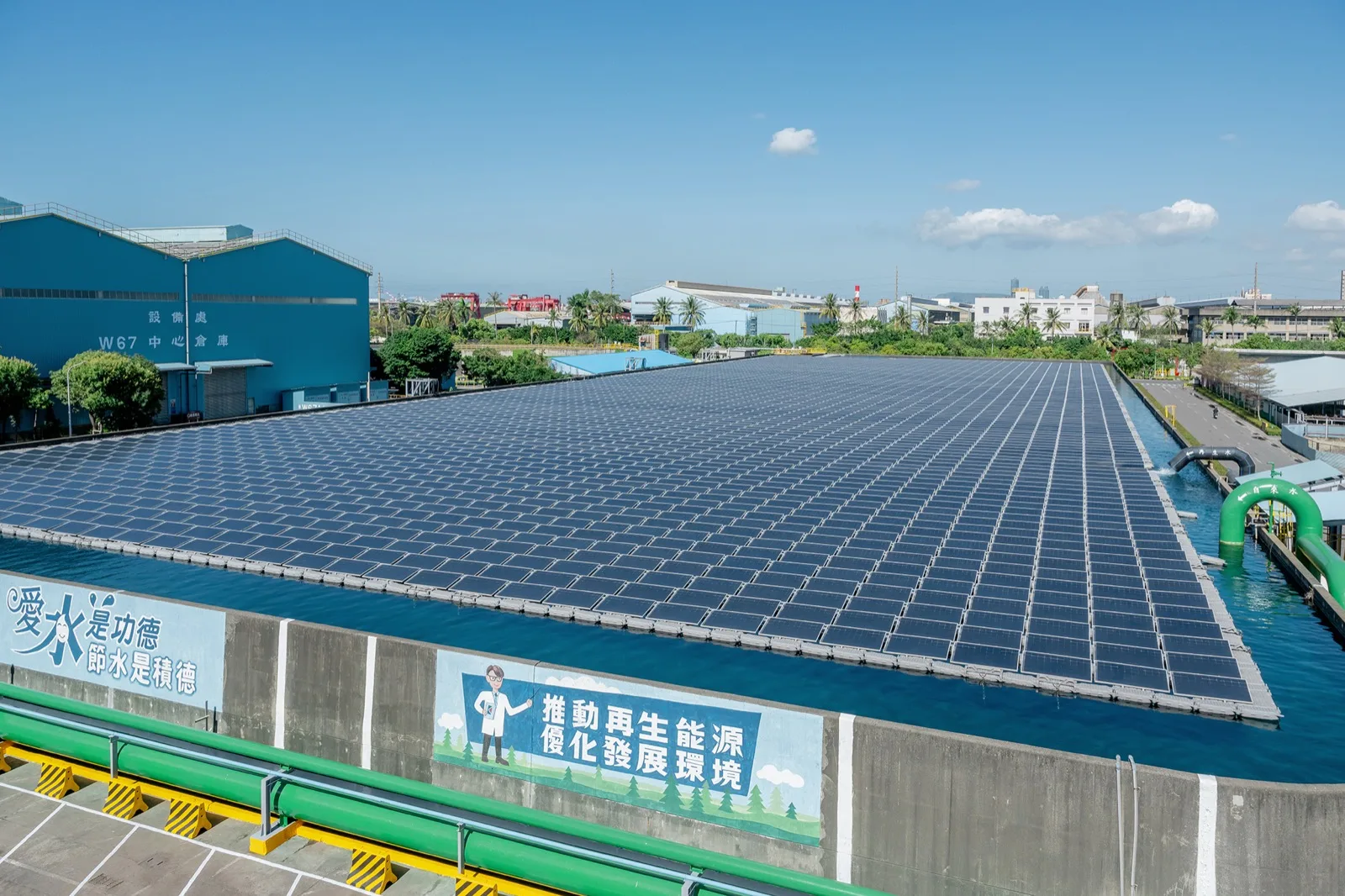
The steel plant area in Xiaogang. Xinzhuang and Xiaogang are Kaohsiung's heavy-industrial zones, with the coastal industrial park spanning both districts, home to Taipower's Dalin Power Plant and CPC's Dalin Refinery. This is where the voters he faced four times live. Photo: Makoto Lin / Office of the President, CC BY 2.0 via Wikimedia Commons
The year after securing first place, he raised the stakes and announced in September 2011 his bid for a seat in the Legislative Yuan, contesting Kaohsiung's 9th Electoral District. When the votes were counted in January 2012, he received 48,941 votes and lost, while DPP Legislator-elect Kuo Wen-cheng got 59,258 votes—also losing. KMT candidate Lin Kuo-chung won with 70,600 votes7. Public Television Service's report at the time described it as "the pan-green camp staging a split performance," and Kuo, in a post-election interview, attributed the defeat to Chen Zhongzhong splitting the vote8. This loss left him in an awkward position within the DPP: in 2013, he applied to rejoin the party, but the central party secretariat rejected his application under the "five-year clause" of the Party Membership Registration Rules. It wasn't until February 17, 2015, that the DPP Arbitration Committee overturned this discretionary decision and he returned to the party9.
In 2018, he returned to the 10th District, running under the DPP banner with 15,938 votes, winning the 6th seat in the district10. That was the year Han Kuo-yu was elected Kaohsiung mayor, and his vote count had dropped by half.
Source: Liberty Times, Newtalk selected reports (individual vote count sheets from the Central Election Commission not publicly obtained)
Halfway through his term, someone moved to remove him. In August 2020, a "Zhenggang Pest Control Team" composed of residents from Xinzhuang and Xiaogang launched a recall effort, submitting 3,500 petitions in the first stage and passing review on 3,300 of them, easily clearing the threshold11. His response at the time was brief—just two sentences: "Respecting different public opinions and diligently fulfilling the duties of a municipal representative" and "Working twice as hard to deliver results and repay the electorate"11. The second stage was less smooth: 29,018 signatures were submitted, but over 13,000 were disqualified due to duplicate signatures or because the signatories were not registered voters in this electoral district. With 12,417 votes still needed to reach the legal threshold of 28,062, the recall effort fell short. The group's spokesperson, Kuo Lun-hao, was blunt: "Originally the invalid rate in the first stage was only around 10%, but surprisingly the invalid rate in the second stage exceeded 40%" and "The political landscape in the Xiaogang area is quite deeply green; it's quite unfortunate to push for a recall of Chen Zhongzhong here—we respect that choice." The Central Election Commission announced on December 25, 2020, that the recall motion had failed12.
In the same electoral district, one side kept sending him to office while the other tried to remove him—neither managed to decisively defeat the other.
On November 26, 2022, he won 18,545 votes with a vote share of 11.53%, returning to first place in the district13. Across these three election nights, the real power truly lies in the hands of the people.
Sixth, Seventy Thousand People, One Hundred and Fifty-Four Parking Spaces
At 9 a.m. on November 24, 2020, the 35th meeting of the 4th regular session of the 3rd Kaohsiung City Council convened for the annual municipal question-and-answer session. When it was his turn, the first thing he asked about was parking: "Take Zhenggang Mountain as an example... there are 60,000 to 70,000 people there, but only 154 public roadside parking spaces." He then compared the pre-construction parking budgets across the six major cities: Kaohsiung applied for over 1.3 billion, approved for 800 million, while in the same batch of funding, New Taipei applied for over 9 billion, Taichung over 3 billion, and Tainan over 2 billion—Kaohsiung was the lowest among the six cities. Mayor Chen Qi-mai responded that the urban renewal plan for the former TRA Kaohsiung Machinery Factory site had already required increased parking space, and promised to inventory city-owned land to increase supply14.
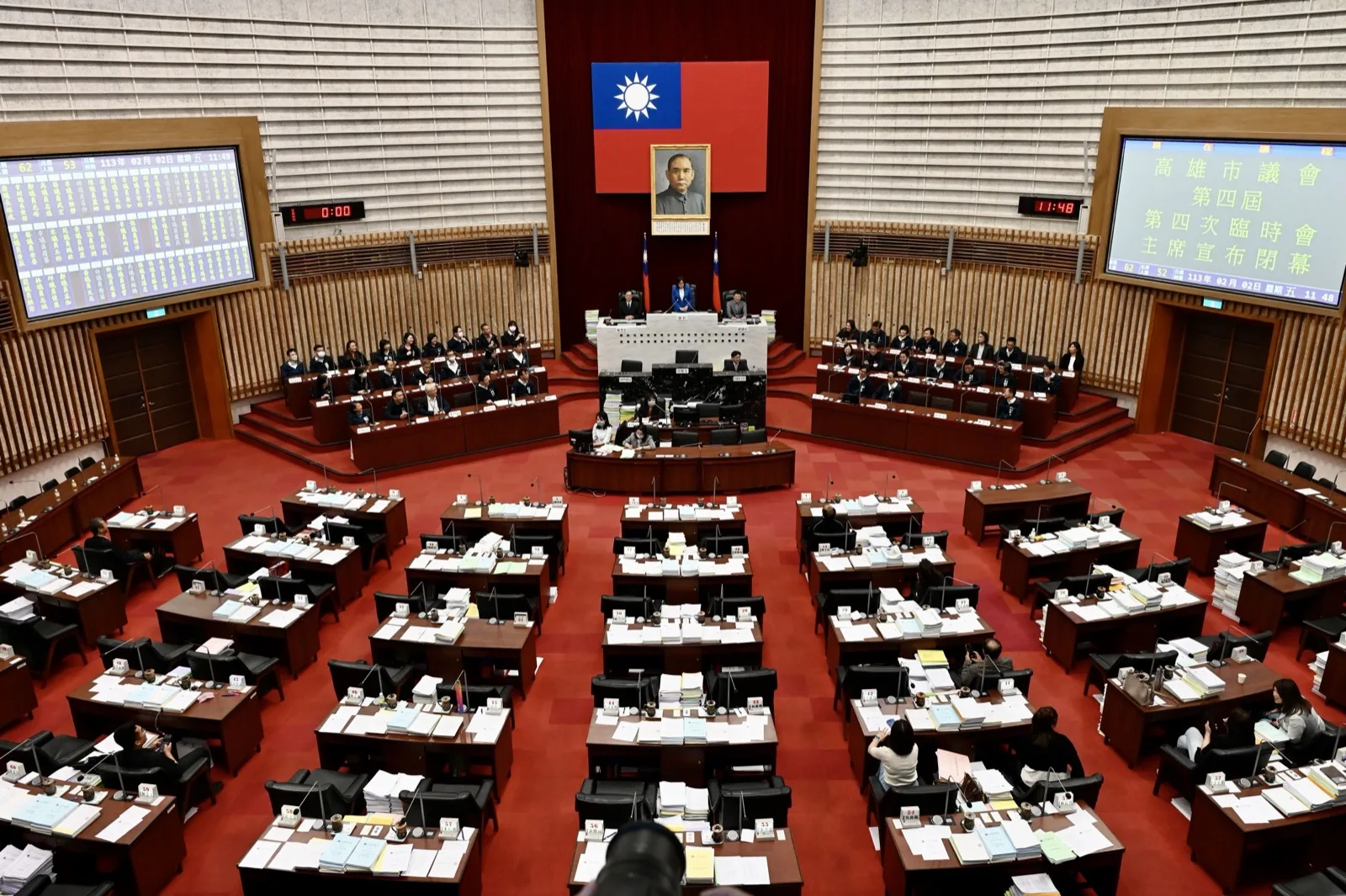
Kaohsiung City Council chamber. The verbatim record of that November 24, 2020 municipal question-and-answer session is filed in the Kaohsiung City Council Proceedings, Volume 34, Issue 5. Photo: Kaohsiung City Government News Bureau via Wikimedia Commons, Attribution
The real highlight of that question-and-answer session was Dapengpu in the southernmost part of Xiaogang District. It and Fengbi Head are surrounded by three sides—CPC's Dapengpu Refinery, Taipower's Dapengpu Power Plant, and the Linhai Industrial Park. The village relocation discussion had been ongoing since the mid-2010s. On the question-and-answer stage, he pursued health investigations and compensation conditions following residents' arsenic levels exceeding standards. When it came to funding, he asked: "If the central government doesn't have the money, do we budget it ourselves?" The mayor's response was: "If the funding truly falls short, the city government will take responsibility." The mayor then made a series of promises: housing compensation would be rebuilt with new prices and original materials, "you won't pay a single cent," the floor area ratio could be relaxed to 300, the city government would coordinate low-interest loan projects with Kaohsiung Bank, pollution compensation funds and state-owned enterprise community employment slots would continue to be coordinated with the Ministry of Economic Affairs, and the original Dapengpu residents would be guaranteed priority employment15.
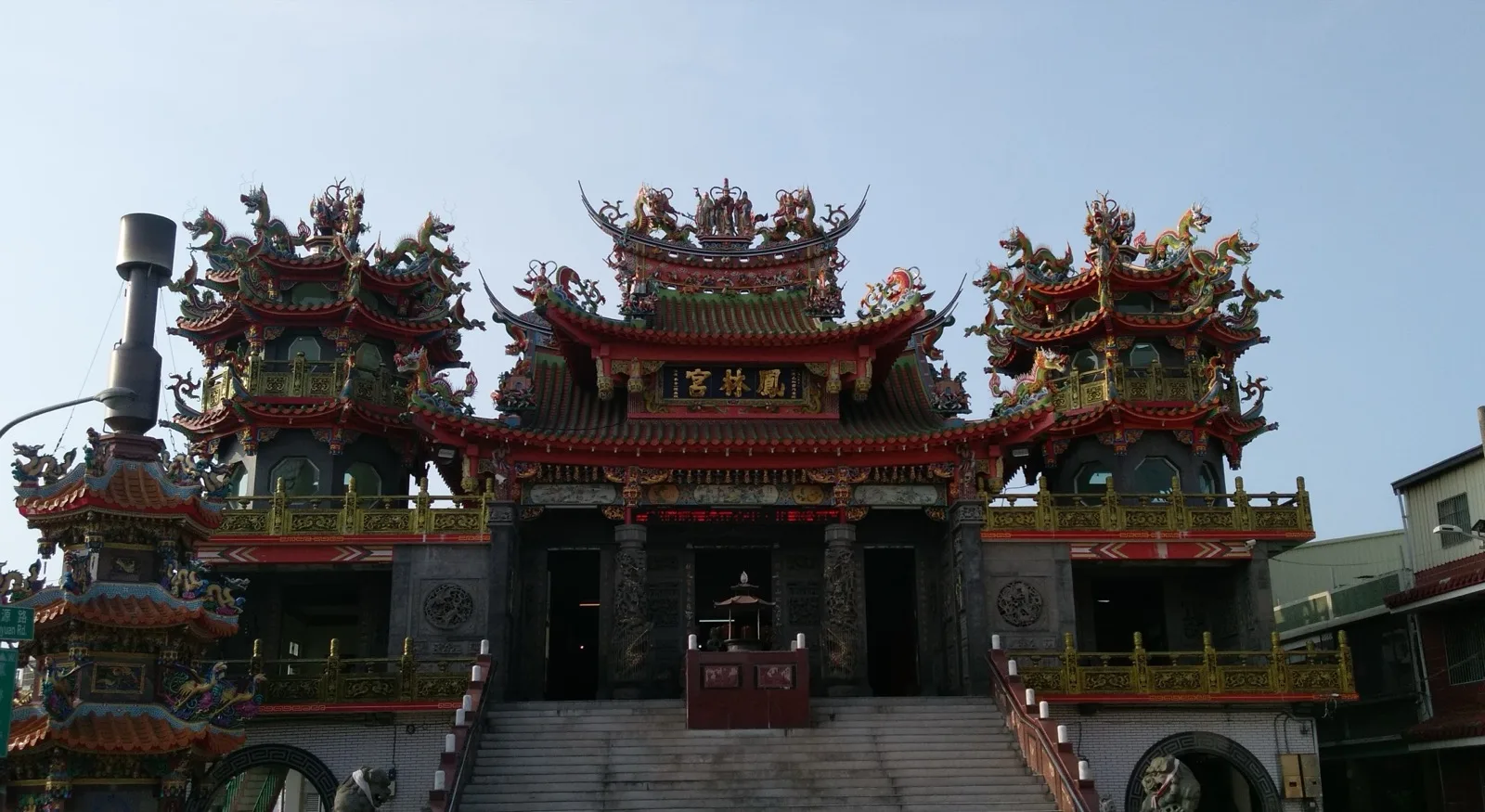
Dapengpu's Fenglin Temple. The relocation area covers six villages including Dapengpu and Fengbi Head. How the temples within the settlement will be relocated together is one of the residents' greatest concerns. Photo: Wikimedia Commons, CC BY-SA 4.0
In the same question-and-answer session, he also raised five other issues: establishing a labor condition evaluation system ("The Labor Bureau selects happy enterprises, but the awarded companies only receive trophies, then what?"), setting up the Kaohsiung 228 Memorial Hall, the teacher-to-student ratio in special education, nutritious lunch subsidies for disadvantaged high school students, and investment and employment figures following the expansion of the Asia New Bay Area 5G+AIoT Park. Regarding the 228 issue, he spoke about the memories of the 1947 suppression left in Kaohsiung: "Many 228 victims' families, these groups and associations also hope that Kaohsiung has its own 228 Memorial Hall, especially since our sacrifices were the heaviest, and there are also moving stories like the Beimen Middle School Self-Defense Team"15 (Regarding 228 and subsequent political purges, see Taiwan's Transitional Justice). The mayor did not respond individually to the special education teacher-to-student ratio and high school lunch issues on the spot.
These were the promises he secured on the question-and-answer stage. Six years later, they each ended up in different places. The Dapengpu funding did indeed increase along the way. On October 8, 2019, the Executive Yuan approved the "New Materials Circular Industry Park" project, with an overall total budget of NT$10.54 billion, of which NT$58.981 billion was allocated for village relocation and resettlement. On December 4, 2023, the Executive Yuan increased the village relocation and resettlement special fund to NT$80 billion, and the overall revised project total budget was simultaneously raised to NT$151.998 billion. The Central News Agency's report at the time detailed the city government's advocacy path: "The Dapengpu village relocation case, from the Executive Yuan's original approval of NT$58.981 billion for village relocation funds, was advocated by the city government to increase to NT$69.431 billion, and then further advocated to today's Executive Yuan approval of NT$80 billion"16.
Source: Central News Agency report on the Executive Yuan's December 4, 2023 approval
With the funding in place, the timeline continued to move forward. According to the Kaohsiung City Government's statement in August 2026, the park's "report compilation" entered the central review process, the new roads for the resettlement site were scheduled to begin construction in June 2026 and complete in August 2027, and the lottery-based land allocation and compensation fee distribution would only start in 2027. The city government also disclosed the agreement rates for the compensation plan: 94.8% for commercial and residential landowners, 92.7% for non-commercial and residential landowners, 95.5% for land improvement property owners, with over 2,500 landowners having signed the agreement to purchase by the end of July 202617. These figures were the city government's own disclosed figures.
The same batch of reports did not include residents' voices. Their dissatisfaction was left in earlier times. On May 9, 2024, over 300 residents from Dapengpu and Fengbi Head gathered outside the Kaohsiung City Council to petition, saying that the conditions in the resettlement plan did not match what was explained in the initial meetings. Hong Hsiu-ju, leader of the "Healthy Mamas and Papas Team," spoke about the issue of irregular land exchange not getting land. Zhang Chiaoming, director of Xiaogang Fenglin Village, calculated for the media: "The land we collect from our people is NT$147,000 per ping, but we don't have enough area, so we have to buy from the city government at NT$200,000 per ping."18 In June 2025, Public Television Service's "Our Island" revisited this case, with Hong Hsiu-ju stating: "The village relocation issue has been raised for 14 years, not only has the relocation been stuck, but local public construction has also nearly stalled"19. In the 2026 progress report, there was no opposing voice interviewed at the same time.
📝 Curator's Note
What a city council member can obtain on the question-and-answer stage is promises and timelines. What he cannot obtain is whether he is still in office before that timeline is completed. The Dapengpu land allocation lottery is scheduled for 2027, which is the seventh year since he pursued that matter in 2020—and his term as councilor ended in April 2023. Local representatives' terms are four years, while major projects have cycles of over ten years. This time gap is the common situation for all local representatives.
The other two issues he raised in 2020 had different outcomes. Starting from the 2026 academic year, Kaohsiung's public elementary and junior high school nutritious lunch program became fully free, but this policy explicitly does not include high schools and vocational schools. In January 2026, reports revealed the controversy of "two systems in one school" appearing in public senior high schools—junior high section free, senior high section paid—and the report only quoted an anonymous high school principal suggesting "first targeting disadvantaged high school and vocational school students" to include in the subsidy, with the city government not making a decision20. He said in 2020 that "support should not stop at high school"15, six years later, that line remained in its original position. The follow-up on the special education teacher-to-student ratio was not explained in the city government and council's public records.
_The CTS News report from May 16, 2019, showing him questioning then-mayor Han Guoyu at the Kaohsiung City Council.
The content of this job was his choice. Whether it can be completed is not up to him.
Sentenced to Three Months, Yet Still Lost His Seat
The first time it was decided for him, it happened during his eighth month in office as a city councilor.
On August 17, 2011, the Supreme Court concluded the perjury case involving the Pan family: Wu Shuzhen was sentenced to nine months, while Chen Zhongzhong, Chen Xingyu, and Zhao Jianming each received three months, with only Chen Xingyu granted a suspended sentence21. The perjury itself had nothing to do with money: when the Kaohsiung District Prosecutors Office investigated the "State Affairs Expenses" case, they discovered that the invoices submitted for reimbursement came from these three individuals. When questioned, they claimed the invoices were for hosting banquets for their parents or giving gifts, but it was later confirmed to be personal consumption21.
A three-month sentence is, by most people's intuition, the lightest category, usually resolved by paying a fine. He lost his seat because of how Article 41, Paragraph 1 of the Criminal Code is written. That article sets the threshold for substituting imprisonment with a fine as two conditions that must be met simultaneously: the maximum statutory sentence for the crime must be five years or less of fixed-term imprisonment, and the sentence imposed by the judge must be six months or less22. The first condition looks at the crime itself, regardless of how long the judge actually sentences. Perjury is governed by Article 168 of the Criminal Code, with a statutory sentence of "up to seven years of fixed-term imprisonment"23. Seven years exceeds the five-year threshold, so this crime never fell within the range eligible for fine substitution from the start, regardless of the three-month sentence.
What he encountered was Article 79, Paragraph 1, Subparagraph 4 of the Local Government Act. The text reads: "A public servant who has been convicted of any of the crimes specified in the preceding three subparagraphs, whose judgment has become final, and who has not been granted a suspended sentence, has not had a fine substituted for imprisonment, or is not eligible for community service." Taipei city councilors fall under this provision, and their removal from office is handled by the Executive Yuan24. He had no suspended sentence, could not substitute a fine for imprisonment, and with all three conditions met, his eligibility as a councilor ceased the moment the judgment became final—not waiting for official documents to reach the council25. His tenure lasted eight months.
Two of his responses at the time were recorded. Upon receiving the verdict, he said, "The political manipulation is too despicable, absolutely unacceptable"25. To reporters, he simply said four words: "Fabricated charges, no shortage of excuses."26
Article 41, Paragraph 3 of the Criminal Code opens another path: those sentenced to six months or less who do not meet the fine substitution requirements may still apply for community service22. He proactively reported to the district prosecutor's office to apply, and was approved27. The total hours amounted to 546 hours, calculated as 91 days over three months multiplied by 6 hours per day. The execution location was Dapeng Prison, with his work being teaching English classes and organizing library archives when there were no classes. The prosecution considered his dual master's degrees from Berkeley and NYU, his strong foreign language skills, and arranged this assignment accordingly, while excluding legal consultation-type work28.
A person with complete legal training, teaching English in prison, because his foreign language skills were more useful than his legal knowledge. These 546 hours provided no help whatsoever to his status as a councilor: removal is based on the state at the time the judgment became final, and community service granted afterward does not retroactively apply24.
The first time, the law decided for him. It looked at the maximum penalty for the crime, regardless of how heavily he was actually sentenced.
The Verdict Didn't Say It — the Legislature Wrote It a Month Later
On April 26, 2023, the Supreme Court's 111st Instance Case No. 4948 judgment dismissed the appeal on the money-laundering portions of the Taipei Nangang Exhibition Center land-purchase case and the Longtan land-purchase case. Chen Chih-chung was sentenced to one year in prison, fined NT$1.5 million, and ordered to forfeit US$8,169,015.30 in seized foreign currency. His wife, Huang Rui-chiung, was sentenced to ten months in prison on the same charges, fined NT$1 million, granted a four-year suspended sentence, and ordered to pay NT$1 million to the public treasury29. The same machine turned once more: Article 79, Paragraph 1, Subparagraph 4 of the Local Government Act, and the Executive Yuan's removal order. By the time the Kaohsiung City Council received the official documents, his tenure as councilor had already expired30. That term lasted four months. He entered prison on May 11, paying the full NT$1.5 million fine on the same day, and began serving his sentence at Kaohsiung Prison No. 230.
The official press release issued by the Judicial Yuan for this judgment listed verbatim only the sentence, the fine, and the forfeiture29. The next day, The Taipei Times' summary of the judgment also listed only those three items31. Neither document mentioned "disenfranchisement." A month later, he himself stated it more directly: "The court sentenced me to one year in prison without disenfranchisement, but under the anti-gang provisions of the election law, I am stripped of my political rights for life."32 During that month, the Legislative Yuan did something else.
Source: Judicial Yuan press release, Central News Agency, Public Television Service News Network, United Daily News
On May 26, 2023, the Legislative Yuan passed the third reading of the amendments to Article 26 of the Public Servants Election and Recall Law, widely referred to by the media as the "anti-gang provisions." The law excluded anyone with a finalized criminal conviction for a list of offenses from eligibility to run as a candidate: national security, vote-buying, corruption, organized crime, drugs, firearms, and money laundering under Articles 14 and 15 of the Anti-Money Laundering Act. The vote tally was 89 attendees, 56 in favor, 30 against, and 3 abstentions33, figures consistently reported by The Taipei Times34. The law applied to legislators, local elected representatives, and local chief executives; presidential and vice-presidential elections are governed separately by the Presidential and Vice Presidential Election and Recall Law, which was correspondingly amended the same year35.
There is a gap between the law's text and the media's characterization. The body of Article 26 contains no mention of "lifetime." The opening sentence reads: "Any person who falls under any of the following circumstances shall not be eligible to register as a candidate." The relevant provision for him is Paragraph 6, phrased as "who has been convicted of... and the judgment has become final," with no time qualifier attached36. The text on both the National Laws and Regulations Database and the Central Election Commission's statutory management system is identical37. The media's common refrain of "lifetime ban on running for office" is a summary of the practical effect: this provision lacks a recovery clause or time limit, so the exclusion persists indefinitely. A remaining clue in the text: among the 16 grounds listed in Article 26, Paragraph 16, four entries—bankruptcy, suspension of duties, disenfranchisement, and guardianship—all include phrases such as "not yet restored," "not yet expired," or "not yet revoked," implying that the status can be lifted upon resolution. All of the first nine provisions, including Paragraph 6, lack such qualifying language36.
What this provision stripped away was the right to be elected. Article 26 governs only the act of "registering as a candidate"; Article 14 of the Election and Recall Law, which states "All nationals of the Republic of China who have reached the age of twenty enjoy the right to vote," was not altered by either round of amendments38. He can still vote today.
Source: Criminal Code Article 37, Public Servants Election and Recall Law Article 26; Judicial Yuan press release on Supreme Court 111st Instance Case No. 4948
📝 Editor's Note
The prevailing narrative is: "He was sentenced to prison for money laundering, so he is banned from running for life." This sentence connects two events into a single causal chain, omitting the intervening month and the legislative vote. Disenfranchisement under the Criminal Code is a judicial penalty imposed case-by-case, with a defined term and automatic restoration upon completion. Article 26 of the Election and Recall Law is a legislative line drawn around categories of offenses; it takes effect without the court ever referencing it, and it contains no restoration timeline. The same person can be sentenced without disenfranchisement, yet still be barred from registering as a candidate.
The rationale behind this law is easy to find. Taiwan's entrenched problem of "black-gold" politics—politics dominated by organized crime and corruption—has been building for decades. The 2023 amendments aimed to keep individuals with convictions for organized crime, vote-buying, and drug offenses out of the candidate pool, drawing cross-party support with 56 votes in favor. DPP Legislator Wu Li-hua said on the day of the third reading: "The purpose of this amendment is to prevent those convicted of black-gold, firearms, and drug offenses from obtaining the mandate of the people through elections and causing further harm."39 Three years later, at the June 2026 amendment, KMT Legislator Weng Hsin-ling used the same framework, this time adding new crime categories: "This third reading amends the Election and Recall Law to uphold the proportional principle of constitutional political rights. In recent years, fraud has shattered many families, so those convicted should not be allowed to register as candidates."40 The same amendment also relaxed restrictions for those granted suspended sentences or alternative service for minor offenses.
This law was not designed to exclude only one person. KMT non-constituency legislator Lin Wen-rui withdrew from the Yunlin county legislative election in 2023 due to a 2004 vote-buying conviction (8 months imprisonment, 2-year suspended sentence, 2-year disenfranchisement, judgment finalized in 2005), and was replaced by Huwei Mayor Ding Hsueh-chung as the candidate.41
Critics focused their fire on the method. At the time, TPP Legislator Chiu Hsien-chih called it "a major step backward for democracy," arguing that eligibility restrictions should be based on sentence length rather than the nature of the offense.39 DPP Legislator Chang Chi-lu questioned whether the law violated principles of unlimited liability and the presumption of innocence and proportionality.39 Associate Professor Liao Yuan-hao of the Department of Law at National Chengchi University wrote a commentary using the example of former Tainan city councilor Wang Chia-chen: when she committed her offense, the law allowed suspended sentences without affecting candidacy; after she chose a suspended sentence and paid the fine, the law changed to bar suspended sentences from candidacy. His argument was that this violated the principle of legality—"punishment for an act shall be limited to what the law prescribed at the time the act was committed"—and that disenfranchisement is an accessory penalty under Criminal Code Article 36, making the anti-gang provisions an additional punishment not present at the time of the offense.42 Wu Wei-chi of the National Policy Foundation offered a different angle: "Anyone who has not yet had their sentence finalized for ten years or more is deprived of political rights, which clearly violates the presumption of innocence and the principle of administrative proportionality."43
Article 26, Paragraph 6 of the Election and Recall Law still reads "Articles 14 and 15 of the Anti-Money Laundering Act" today36, even though the Anti-Money Laundering Act was fully revised on August 1, 2024, into 31 articles, with the original money-laundering offenses now falling under Article 194445. Both of these can be verified in the official text. The citation has not been updated to match the new law—a gap left by legislative drafting. As for the practical effect of this gap on those whose convictions were finalized under the old article numbers, neither the Central Election Commission nor the Ministry of the Interior has issued any public interpretation, and the legal community has not publicly discussed it.
On June 12, 2026, the Legislative Yuan amended the Election and Recall Law once more: Paragraph 6 of Article 26 added "offenses under the Fraud Prevention and Control Act," and Paragraph 9 added "provided that those granted a suspended sentence or alternative service of a fine are not subject to this restriction." The presidential decree was promulgated on July 14046. This amendment became colloquially known as the "high-hong an clause"—a reference to the controversy surrounding Kaohsiung Mayor Han Kuo-yu's candidacy. DPP Legislator Li Pei-yi accused the TPP of drafting the law for a specific individual during party negotiations, while TPP Legislator Hsu Chung-hsin countered that the DPP was the one tailoring laws to individuals, simultaneously arguing that "Article 17 of the Constitution guarantees citizens' right to vote and be elected... restricting people's right to run through administrative law violates the Constitution."40 The back-and-forth between the two parties is irrelevant to him: the list of serious offenses in Paragraph 6 remained unchanged, and he is still on it.
His own words, left behind in 2023, say it all. During his imprisonment, he issued a statement: "The goal of the anti-gang provisions is obviously correct, but the method cannot violate the Constitution," and added: "If advocating for Chen Chih-chung's political death serves the greater good, then what can I say? 'Speechless, tears without end.'"47 The debate ends here. More than three years have passed since this law took effect, and no one—not even him—has ever filed a petition with the Constitutional Court in the public record.48 So the shape of this matter is this: on one side, the legitimacy of the anti-gang legislation, its cross-party passage, and its broad application beyond a single individual; on the other, the argument that a categorical, permanent exclusion based on criminal conviction violates the principles of proportionality and legality. Both sides have made their public statements, and the institution capable of answering has received no petition from anyone. As for the long-term residents and taxpayers in Taiwan who have never held the right to vote or stand for election—the migrant workers—their questions lie outside this debate entirely.
Cannot Register, Now Reading Others' Votes
On the morning of August 17, 2026, he sat at the main table of a press conference and released a poll on the Taichung mayoral race.
KMT candidate Chiang Chi-chen had 42.8% support, DPP candidate Ho Hsin-chun had 36.1%, a gap of 6.7 percentage points. The likelihood of winning was 48.2% for Chiang Chi-chen versus 23.6% for Ho Hsin-chun. His comment was that "the gap has narrowed, showing that the oil scandal has hurt the blue camp's chances in Taichung," and that "Taichung is very likely to change hands, with much to be done"49.
Source: New Taiwan National Development Research Institute, commissioned by the Kadaguan Foundation, surveyed by phone from August 11 to 13, 2026
The New Taiwan National Development Research Institute that released this poll was founded by Kurt Ku in January 2010. On September 1, 2016, Kurt Ku donated the institute to the Kadaguan Foundation, and since then Chen Chih-chung has served as its executive director, remaining in the position until August 202650. The legal representative of the Kadaguan Foundation is Legislative Yuan member Chen Ting-fei, whose title at the foundation is executive director—this represents two different positions51.
In February of the same year, he appeared twice on the streets of Zhuolan Township, both times not for himself. On February 5th in the afternoon, he spoke at a campaign event for city council candidate Huang Yan-xu in Cuiheng North Road, saying: "Whether in a sedan or a sedan chair, he will play the best role"52. On February 23rd, he accompanied Legislative Yuan member Lai Rui-long in supporting Huang Yan-xu's campaign parade, stating "not running, fully supporting Huang Yan-xu" and calling out "from March 2nd to March 8th, 6 PM to 10:30 PM, please everyone stay home and answer the phone"—that was the time slot for the party's primary phone poll53. The vacant seat he left behind allowed the DPP to enter the race in District 10 with six potential candidates54.
📝 Editor's Note
The only action specified by Article 26 of the Election and Recall Law is: registering as a candidate. It does not specify who cannot host a press conference, release a poll, stand on the street to campaign for others, or serve as the executive director of a foundation. The legislators originally drew the line at the action of "registering." They could have drawn the line at political participation, but the text says registration. A person who is permanently barred from registering as a candidate can maintain almost unchanged political influence. Is this line drawn in the right place? This is a question that the text itself cannot answer.
Outside the legislative chamber and press conferences, he has another public identity. His Threads account bio reads: single father, former Kaohsiung City Council member, executive director of Kadaguan Foundation and New Taiwan National Development Research Institute. On April 28, 2026, he posted a photo of himself taking away Chen Shui-bian's phone in a car, saying he had done "a righteous act of sacrificing kinship," with the caption: "The most effective trick for treating phone addiction is to directly take it away—no use controlling phones." Chen Shui-bian replied underneath with "Coming again" and posted a photo to counterattack. He responded with: "This time I lost, shouldn't have been in a closed space, next time I'll take it away~~~run"55. In March of the same year, Chen Shui-bian said on his own Threads that Chen Chih-chung calls him "water" directly at home, just like calling his mother, and has never called him "dad"56.
The law prohibits him from registering, but it does not prohibit him from reading others' votes, nor does it prohibit him from fighting with his own father over a phone on the internet.
Is the Problem Political Dynasties? Taiwan Still Lacks Its Own Research
Taking it from the personal to a broader question: to what extent does family background matter in a country's politics, and is that influence positive or negative?
There is no consensus in the international political science community. A Taiwan case study by Christian Schafferner published in the Asian Journal of Comparative Politics in 2023 concludes that "legacy politicians are not per se the Pandora's box of low-quality politics." Politicians from political families are not necessarily equivalent to low-quality politics; their behavioral patterns are no different from other social networks. The real variable is whether the degree of political modernization can prevent them from turning public resources into family prey57. Nathan Batto conducted a systematic study in 2018 in Asian Survey on the scale of family politicians at the central and local levels in Taiwan, finding that legacy candidates tend to avoid fiercely competitive constituencies and perform best in mildly competitive environments58.
The conclusions of the literature on the other side are opposite. Using the term limits of Philippine local officials as research subjects, Querubin found in 2016 that term limits actually strengthened the persistence of political families, because when incumbents cannot be re-elected, the family would put forward spouses or children to take over59. Tusalem, based on Philippine provinces in 2013, found that provinces dominated by political families performed worse in governance indicators such as infrastructure, public health expenditure, public security, and employment60. Also in the same body of literature, Dal Bó et al. studied 200 years of data on the U.S. Congress in 2009, concluding that the longer the family stays in power, the stronger the self-reinforcing advantage of their descendants entering Congress.
These studies are based on data from the Philippines and the United States. There is currently no local empirical study in Taiwan that directly answers how many political families exist, how they compete in their constituencies, and whether they have a measurable impact on local governance. Taiwan's political scientists have discussed this phenomenon, but mostly in descriptive comments, not data that can be used for judgment.
How the rules are written depends on how reliable the understanding of the phenomenon is. The list in Article 26 of the Election and Recall Law, whether there is a door for political restoration, and which year the door should be opened, are all based on such judgments. The way Taiwan makes these judgments now is by relying on the Legislative Yuan's vote count in almost the absence of local empirical evidence (see other aspects of the same issue in Taiwan Elections and Party Politics and Taiwan Judicial Reform and Pre-trial Detention System).
This issue has a more common version in everyday life. Should ex-offenders disclose their criminal records when seeking employment, how many years should criminal records be kept, and when can professionals whose licenses have been revoked reapply for their licenses—all asking the same question: after a person has done what the law requires of them, when does society consider them to have completed their obligation? His case is just the most visible form of this question.
At 8:30 p.m. on the evening of February 6, 2024, after serving 272 days in prison, he walked out of the gate of Kaohsiung Prison No. 2 with his personal belongings, saying only "thank you" to the media, and his wife Huang Ruijing drove him home61. That evening he wrote two sentences on Facebook: "Back home, like a dream" "I haven't used a mobile phone for a long time, and it still feels a bit awkward"62.
The day the sentence ends arrived, the fine was paid in full on the day of imprisonment, and confiscation was also executed. The Dapengpu relocation lottery won't be drawn until 2027, and the matter he pursued on the questioning panel is still time-consuming. Only one date has not yet ended.
Further Reading:
- Chen Shui-bian — From lawyer outside the party to the president who led Taiwan's first peaceful transition of power, this line is the background for understanding all the case names in this article
- Chen Hsin-yi — The sister who was sentenced in the same perjury case, later opened a dental clinic in Tainan, and was watched in a different way
- Taiwan Elections and Party Politics — How multi-member constituencies, party nominations, and local factions determine who gets on the ballot
- Taiwan Judicial Reform and Pre-trial Detention System — The design and controversy of the criminal process, the judgments and removal mechanisms in this article operate within this framework
- Taiwan Transitional Justice — The history of February 28th and the subsequent political purge; the Kaohsiung February 28th Memorial Hall he raised on the questioning panel comes from this line
- Kaohsiung City — The industrial areas of Zhenzhen and Xiaogang, and the rest of this city
Image Credits
This article uses 3 Wikimedia Commons licensed images, cached at public/article-images/people/ to avoid hotlinking to source servers:
- Facilities of China Steel in Siaogang — Photo: Makoto Lin / Office of the President, CC BY 2.0 (Siaogang China Steel plant area)
- Kaohsiung City Council Chamber — Kaohsiung City Government News Bureau, Attribution (council chamber)
- Dapengpu Fonglin Temple — CC BY-SA 4.0 (Dapengpu settlement)
The video embedded in the article is a news report uploaded to the CTS News CH52 official channel, presented via iframe embedding. Copyright belongs to China Television Company, used under YouTube's standard embedding service terms.
References
- Liberty Times: Chen Zhongzhong Fails to Register, Loses UVA Admission Eligibility — Reported on August 19, 2008, in the Focus section, quoting Hannah, senior director of public relations at the University of Virginia, regarding absenteeism from new student training and the invalidation of registration. This is currently the only contemporary firsthand account of the incident.↩
- TVBS: Report on Chen Zhongzhong's Educational Background — Lists his academic sequence: Berkeley and NYU as completed law master's degrees, while the J.D. from the University of Virginia was planned for 2008 but never attended due to failure to register.↩
- Kaohsiung City Council Member Personal Page: Chen Zhongzhong — The education and experience section on the council's official website, corroborating the academic credentials listed in other sources.↩
- Judicial Yuan Press Release: Supreme Court 111st Instance Case No. 4948 — The case concerns money laundering related to the Nangang Exhibition Center and Longtan land purchase cases, clarifying the connection between these cases and his personal judicial responsibility.↩
- Liberty Times: Chen Zhongzhong Announces Candidacy for 2018 City Council — Includes a retrospective figure from his 2010 election win: 'Won with 32,947 votes (16.83% vote share), the highest in the local district.' All four election vote counts in this article come from media retrospectives; official CEC vote-by-vote tallies were not obtained.↩
- NextApple: Report on Chen Zhongzhong's 2022 Re-election — Verbatim record of the 2022 election results: 18,545 votes, 11.53% vote share, highest vote-getter, along with the electoral context of 17 candidates competing for 8 seats in the district.↩
- ETtoday: 2012 Legislative Election Vote Count for Kaohsiung District 9 — Lists the vote counts: Chen Zhongzhong with 48,941 votes, Guo Wencheng with 59,258 votes, and Lin Guozheng with 70,600 votes.↩
- PTS News Network: 2012 Legislative Election Coverage for Kaohsiung District 9 — Documents the electoral context of the DPP's internal split and Guo Wencheng's post-election attribution of defeat to vote splitting among allies.↩
- Liberty Times: Chen Zhongzhong's Re-application to Join the Party — Full account of being rejected by the central party committee under the 'Party Membership Admission Regulations' five-year clause in 2013, and having the decision overturned by the DPP Arbitration Council on February 17, 2015.↩
- Liberty Times: Chen Zhongzhong Elected City Councilor in 2018 — Verbatim record stating: 'Won with 15,938 votes, ranking 6th, elected as city councilor.'↩
- Central News Agency: Chen Zhongzhong Recall Motion Passes First Stage — Reported on August 27, 2020, documenting 3,500 submitted proposals, 3,300 reviewed and approved, along with his personal response verbatim.↩2
- NextApple: Chen Zhongzhong Recall Motion Fails — Complete second-stage signature numbers (29,018 submitted, over 13,000 invalidated, still 12,417 short of the 28,062 threshold; the original report uses approximate figures for invalidated count, and the CEC announcement text in the PDF attachment was not obtained verbatim) along with spokesperson Guo Lunhao's verbatim statement. See the CEC announcement at web.cec.gov.tw/central/article/33273, with the full text in the PDF attachment.↩
- NextApple: Chen Zhongzhong Re-elected with Highest Vote in 2022 — Same as note 6: 2022 election results and district seat structure.↩
- Kaohsiung City Council Proceedings, Vol. 34, No. 5 (3rd Session, 4th Regular Session, 35th Meeting, pp. 10320–10360) — Official verbatim transcript of the city council's comprehensive question session on November 24, 2020. Includes original text on the Gangshan parking lot issue ('60,000 to 70,000 people living there, but only 154 public roadside parking spaces') and comparisons of parking budgets across the six major cities. Also available for reference on the council's official website summary page (https://www.kcc.gov.tw/News_Content.aspx?n=47&s=13278).↩
- Kaohsiung City Council Proceedings, Vol. 34, No. 5 (Same Session Transcript) — Other topics from the same question session, including arsenic exceeding standards at Dalinpu relocation and compensation, labor condition evaluations, Kaohsiung 228 Memorial Hall, special education teacher-student ratios, disadvantaged high school student nutrition lunch programs, and the 5G+AIoT zone. Mayor Chen Chi-mai's verbatim responses, including 'If the budget truly falls short, I, the mayor, take responsibility' and 'You can rebuild with new prices using the same materials and design without spending a single cent,' are all from this record.↩23
- Central News Agency: Executive Yuan approves Dapengpu relocation village budget increased to NT$80 billion — Reported on December 4, 2023, the day of approval, documenting the budget increase path from NT$589.81 million to NT$694.31 million to NT$800 million, a contingency fund of NT$40.45 million, and the total revised project budget of NT$1,519.99 million.↩
- Focus Times: Relocation progress and compensation agreement rate for Dapengpu relocation village — Reported on August 6, 2026, disclosing the city government's timeline and agreement rate figures. These numbers were unilaterally published by the city government without a second independent source for cross-verification. The 2025 meeting resolutions of the Relocation Project Office are also reported by Taiwan Good News (https://www.taiwanhot.net/news/1111887/).↩
- Public Television Service News Network: Dapengpu residents petition at city council — Live report on May 9, 2024, including verbatim responses from resident representative Hong Xiuju, Zhang Xiaoling Village Chief of Xiaogang Fenglin, and Mayor Chen Qimai, as well as historical relocation intention survey data.↩
- Public Television Service 'Our Island': Fourteen Years of Dapengpu Relocation — Reported on June 29, 2025, documenting the long-term perspective on the stalled relocation, residents' situation of being able to move to new land but unable to afford housing construction, and three new development projects approaching simultaneously.↩
- Commercial Times: Kaohsiung's nutritious lunch program is free but does not include high schools — Reported on January 6, 2026, documenting the scope of free nutritious lunches for public elementary and junior high schools starting from the 115th academic year, the controversy over the 'one school, two systems' policy for complete middle schools, and the undecided status of high schools. The existing free lunch regulations for elementary and junior high schools are available on the Kaohsiung City Government's shared legal database (https://outlaw.kcg.gov.tw/LawContent.aspx?id=GL000058).↩
- Liberty Times: Convicted of perjury, ruling finalized in March, Councilor Chen Zhiqizhong removed from office — Reported in August 2011, documenting the prison sentences for each individual in the Pan family perjury case concluded by the Supreme Court, the facts behind the perjury, and the basis and effective date for removal from office.↩2
- National Legal Database: Article 41 of the Criminal Code of the Republic of China — Paragraph 1 sets the threshold for commutation of sentence to fines with two concurrent conditions: the statutory maximum penalty for the crime committed is five years or less of fixed-term imprisonment, and the sentence imposed is six years or less of fixed-term imprisonment or criminal detention; Paragraph 3 allows those sentenced to six years or less but not meeting the conditions of Paragraph 1 to apply for social labor instead. The full text is available on the linked page. These two provisions are key to understanding why a three-month sentence still does not qualify for commutation to fines.↩2
- National Legal Database: Article 168 of the Criminal Code of the Republic of China — The statutory penalty for perjury is fixed-term imprisonment of seven years or less, which is higher than the five-year threshold set in Paragraph 1 of Article 41 of the Criminal Code.↩
- National Legal Database: Article 79 of the Local Government Act — The verbatim text of the removal grounds under Paragraph 1, Item 4, and the division of authority between the Executive Yuan and directly elected city councilors.↩2
- Liberty Times: Chen Zhiqizhong removed from office and his personal response — Same as note 21, documenting that the removal takes effect from the date the judgment becomes final, and his verbatim response upon receiving the ruling notification: 'The political manipulation is too despicable, absolutely unacceptable.'↩2
- TVBS: Chen Zhiqizhong responds to perjury case ruling — Both the headline and the article include his verbatim response: 'If you want to charge me with a crime, there are plenty of excuses.'↩
- Public Television Service News Network: Perjury case sentenced to three months, Chen Zhiqizhong applies for social labor instead — Documents his proactive registration with the district prosecutor's office to apply for social labor and the approval process, as well as the calculation method for six hours of labor offsetting one day of sentence.↩
- Virgo Legal Network: Chen Zhiqizhong serves social labor, teaches English in prison — Documents the calculation basis for a total of 546 hours of social labor, the arrangement for teaching English at Daliao Prison, and the prosecution's consideration in excluding legal consultation-type work.↩
- Judicial Yuan Press Release: Wu Shuzhen, Chen Zhiqizhong, and Huang Ruiliang cases involving violation of the Anti-Money Laundering Act — Official press release from the Supreme Court's 111th year, Taipei Upper Court Case No. 4948, verbatim listing of judgment date, charges, sentences, fines, and confiscation amounts. The press release does not include a forfeiture of public rights declaration.↩2
- Central News Agency: Chen Zhiqizhong to be imprisoned, Kaohsiung City Council has received the Executive Yuan's removal order — Documents that his councilor status had already expired when the council received the official document, his scheduled imprisonment on May 11th, and the payment of a NT$1.5 million fine on the day of imprisonment.↩2
- Taipei Times: Kaohsiung's Chen Chih-chung loses seat, sentenced — April 29, 2023 English report; the judgment summary lists a one-year prison term, a NT$1.5 million fine, and approximately US$816,900 in forfeiture, but makes no mention of deprivation of political rights.↩
- Central News Agency: Amendments to election law strip political rights; Chen Chih-chung says nothing — Report dated May 30, 2023, quoting his verbatim remarks that 'the court sentenced him to one year in prison without deprivation of political rights' and raising questions about the proportionality principle.↩
- Central News Agency: Election and recall law amendments pass third reading to expand anti-gang provisions — Report from the third reading on May 26, 2023, recording the vote results: 89 attendees, 56 in favor, 30 against, and 3 abstentions.↩
- Taipei Times: Amendments bar convicts from politics — English report cross-confirming the same set of vote counts (56 versus 30, with 3 abstentions) and the scope of offenses covered by the amendments.↩
- National Database of Laws and Regulations: Article 2 of the Act Governing Elections and Recalls of Public Servants — Defines the scope of 'public servants' under this Act: legislators, municipal and county/city councilors, and municipal, county/city, and township/village chiefs. The President and Vice President are not subject to this Act, which is separately governed by the Act Governing Presidential and Vice Presidential Elections and Recalls; Article 26 of that Act was amended and promulgated on June 9, 2023, in sync with this Act.↩
- National Database of Laws and Regulations: Article 26 of the Act Governing Elections and Recalls of Public Servants — Full text of the current article, including the list of offenses under paragraph 6 and the syntactic differences among the 16 grounds; the main text does not contain the word 'lifetime,' and the four grounds of bankruptcy, suspension, deprivation of political rights, and guardianship all carry the qualifier 'not yet.'↩23
- Joint System of Statutory Provisions under the Central Election Commission: Act Governing Elections and Recalls of Public Servants — Second official legal source; the text of Article 26 and Article 14 matches the National Database of Laws and Regulations, used for cross-checking whether the word 'lifetime' appears in the provisions.↩
- National Database of Laws and Regulations: Article 14 of the Act Governing Elections and Recalls of Public Servants — 'All nationals of the Republic of China who have reached the age of twenty enjoy the right to vote.' This article was not altered by either the 2023 or 2026 amendments; the Act separately regulates the right to vote and the right to be elected.↩
- Public Television Service News Online: Anti-gang provisions of the Election and Recall Law pass third reading — Contains the verbatim speeches delivered on the day of the third reading by DPP Legislator Wu Li-hwa, TPP Legislator Chiu Hsien-chih, and KMT Legislator Chang Chi-lun.↩23
- United Daily News: 'High Hong-an clause' passes; Legislative Yuan gives third reading to amend the Election and Recall Law — Amendments enacted on June 12, 2026 (paragraph 6 adds fraud crimes, paragraph 9 relaxes probation and community service eligibility), along with the verbatim remarks of Legislators Weng Hsiao-ling, Li Po-yi, and Hsu Chung-hsin.↩23
- United Daily News: Lin Wen-rui shot down by anti-gang clause — Records the full sequence of events in which KMT non-constituency legislator candidate Lin Wen-rui withdrew from the Yunlin county legislator election due to a 2004 election bribery case (judgment finalized in 2005), and was succeeded by Ding Hsueh-chung.↩
- CommonWealth Magazine: Liao Yuan-hao's view — the 'anti-gang clause' violates the proportionality principle — Commentary by Associate Professor Liao Yuan-hao of the Department of Law, National Chengchi University, discussing concerns about the principle of legality in criminal law using the Wang Chia-chen case as an example, and noting that deprivation of political rights is a supplementary punishment under Article 36 of the Criminal Code.↩
- Institute for National Policy: Wu Wei-chi, 'Unconstitutional anti-gang provisions trigger a rule-of-law storm' — Criticism from the perspective of the presumption of innocence and the proportionality principle, including concerns about criminal sentence thresholds and the failure to distinguish between serious and minor offenses.↩
- Legal Resources Network: Amendments to the Anti-Money Laundering Act fully promulgated in 2024 — Records the amendments promulgated by presidential order on July 31, 2024 (Minguo 113), comprising the full text of 31 articles, along with the implementation date.↩
- National Database of Laws and Regulations: Article 19 of the Anti-Money Laundering Act — Current provisions on money laundering offenses and penalties. Article 26, paragraph 6 of the Election and Recall Law still cites the pre-amendment Articles 14 and 15; there is no official interpretation clarifying the correspondence between the two.↩
- China Times News Network: Third Reading of the 'High Hong-an Provision' Expanding Candidacy Eligibility Presidential Decree Announced — Records the timeline of the third reading on June 12, 2026, and the presidential decree announcement on July 1.↩
- Taiwan Good News: Legislative Yuan Passes Anti-Cheating Provisions in Electoral Law Amendment - Chen Zhi-zhong: Speechless Under the Sky — Includes the full text of a statement released during his imprisonment, featuring his verbatim quote: 'The target of anti-cheating is of course correct, but the method cannot violate the constitution.'↩
- Constitutional Court: Case Acceptance and Judgment Inquiry — The Constitutional Court's public case page. As of August 2026, there are no publicly recorded constitutional interpretation requests or rulings regarding Article 26 of the Public Officials Election and Recall Law.↩
- ETtoday: New Taiwan National Strategy Institute Taichung Mayor Opinion Poll Press Conference — Reported on August 17, 2026, including support ratings, election prospects, survey methodology (August 11-13, landline interviews, 1,159 valid samples, margin of error ±2.88 percentage points at 95% confidence level), and his personal verbatim comments.↩
- New Taiwan National Strategy Institute Official Website: About the Institute — Verbatim history of the institute: founded by Kurt M. Gau in January 2010, originally under the New Taiwan Peace Foundation, moved to the Kadaghan Foundation on September 1, 2016, current executive director is Chen Zhi-zhong. See Wikipedia's 'New Taiwan National Strategy Institute' entry (https://zh.wikipedia.org/zh-tw/%E6%96%B0%E5%8F%B0%E7%81%A3%E5%9C%8B%E7%AD%96%E6%99%BA%E5%BA%AB) for additional year details.↩
- Taiwan Legal Person Network: Registration Information of Kadaghan Foundation — Legal registration shows the representative is Chen Ting-fei, a different position from Chen Zhi-zhong's executive director title. Financial reports of the foundation and the institute are not found in public systems.↩
- United News Network: Restricted by Anti-Cheating Provisions, Chen Zhi-zhong Supports Huang Yan-xu — Reported on February 5, 2026, at a campaign event on Cuiheng North Road in Zonghe District, including his verbatim quote 'Whether in sedan chair or carried on shoulders' and the background of reduced electoral districts.↩
- Wind Media: Lai Rui-long and Chen Zhi-zhong Accompany Huang Yan-xu on Street Parade — Reported on another campaign event on February 23, 2026, including his verbatim chant 'Not running, fully supporting Huang Yan-xu' and the time slot for primary phone polls.↩
- China Times: Chen Zhi-zhong's Resignation Leaves One Seat Vacant - Green Camp Races for Nomination — Records the political situation in the 10th electoral district where six potential candidates from the Democratic Progressive Party competed after his resignation left one seat vacant.↩
- Sanli News Network: Chen Zhi-zhong's 'Righteousness Over Family' Takes Chen Shui-bian's Phone — Reported on April 28, 2026, quoting verbatim the complete exchange of posts between him and Chen Shui-bian on Threads.↩
- ETtoday: Chen Shui-bian Reveals Chen Zhi-zhong Calls Him 'water' Instead of 'Dad' — Reported in March 2026, quoting Chen Shui-bian's own words on Threads. This is the only source with firsthand evidence of the origin of this nickname.↩
- Schafferer, C. (2023). Political dynasties and democratization: A case study of Taiwan — Asian Journal of Comparative Politics 8(3): 708–726. The abstract argues that being born into a political dynasty does not necessarily equate to low-quality politics; the key variable is the degree of political modernization.↩
- Batto, N. F. (2018). Legacy Candidates in Taiwan Elections, 2001–2016 — Asian Survey 58(3): 486–510. The first systematic empirical study on the scale of family political figures at both central and local levels in Taiwan.↩
- Querubin, P. (2016). Family and Politics: Dynastic Persistence in the Philippines — Quarterly Journal of Political Science 11(2): 151–181. Using the research design of term limits for Philippine local officials, it finds that term limits actually strengthen the persistence of political dynasties.↩
- Tusalem, R. F. (2013). The Effect of Political Dynasties on Effective Democratic Governance — Asian Politics & Policy 5(3). At the provincial level in the Philippines, it finds that provinces dominated by political dynasties have lower governance quality indicators.↩
- PTS News Network: Chen Chih-chung served 272 days before parole — Records the incarceration date of May 11, 2023, the parole date of February 6, 2024, 272 days served, and the High Court's approval of parole supervision.↩
- Epoch Times: Chen Chih-chung posted on social media the night of his release — Includes his full verbatim Facebook posts from the evening of February 6, 2024: 'I'm home, like a dream' and 'It's been a long time since I used a phone, still a bit clumsy.' For details at the scene of his release, see the Central News Agency report (https://www.cna.com.tw/news/asoc/202402070048.aspx).↩