
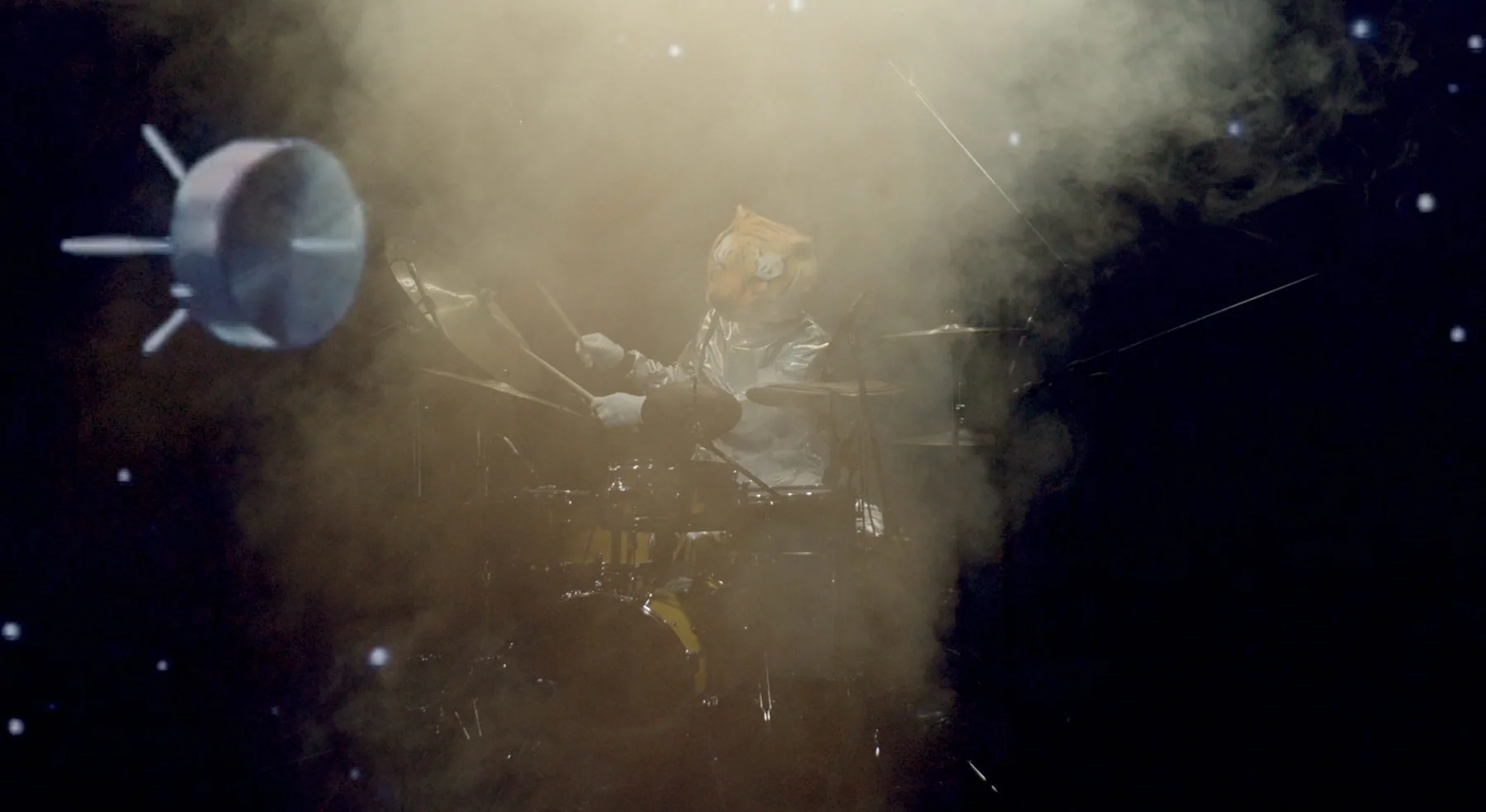
30-second overview: Au Sow Yee was born in Kuala Lumpur in 1978 and came to Taiwan in 2003 to study at Taipei National University of the Arts. Since then, for 23 years, she has treated both Kuala Lumpur and Taipei as “places of dwelling.” Her work has shifted the coordinate axis of Taiwan’s art world: using the Malay term “Nusantara,” or “archipelago,” in place of “Southeast Asia,” a Cold War-era term named by the U.S. military, so that Taiwan can be seen as the northeastern end of the Malay Archipelago rather than a “Chinese island” or “the other of Western Southeast Asia.” Her The Mengkerang Project trilogy, The Kris Project (now in the Singapore Art Museum collection), her broadcasting project for the 2018 Taipei Biennial, and her 2024 collaboration with Chen Yow-Ruu interviewing stateless children in Malaysia, The Rocking Dream (shortlisted for the 24th Taishin Arts Award), all grow out of a counterintuitive position. In 2015, she told Cheng Wen-Chi: “It is precisely because of my ‘absence’ that I could make this work.”
That Afternoon in Kampung Attap, Kuala Lumpur, in 2017
In 2017, a row of old 1950s shophouses in Kampung Attap, Kuala Lumpur, opened their doors1. A space called “Rumah Attap Library and Collective” was born there. It held 5,000 books, two-thirds in Chinese and the rest in English and Malay, operated by volunteers, non-profit, and free to read. The three co-founding units were Amateur, In Between Cultura, and Au Sow Yee Studio2.
The person behind that studio was Au Sow Yee: a Malaysian Chinese artist born in Kuala Lumpur in 1978, who went north to Taipei in 2003 to study at Taipei National University of the Arts and had lived in Taiwan for 14 years since then3. She did not move back to Kuala Lumpur. She continued working, teaching, and making art in Taipei, but from Taipei she remotely built that library together with the other two groups.
The library describes itself as a “living coordinate.” It connects geography, history, time, society, politics, culture, and art to build an “open and critical alternative knowledge system”4.
That sentence describes more than a library. It also describes Au Sow Yee herself.
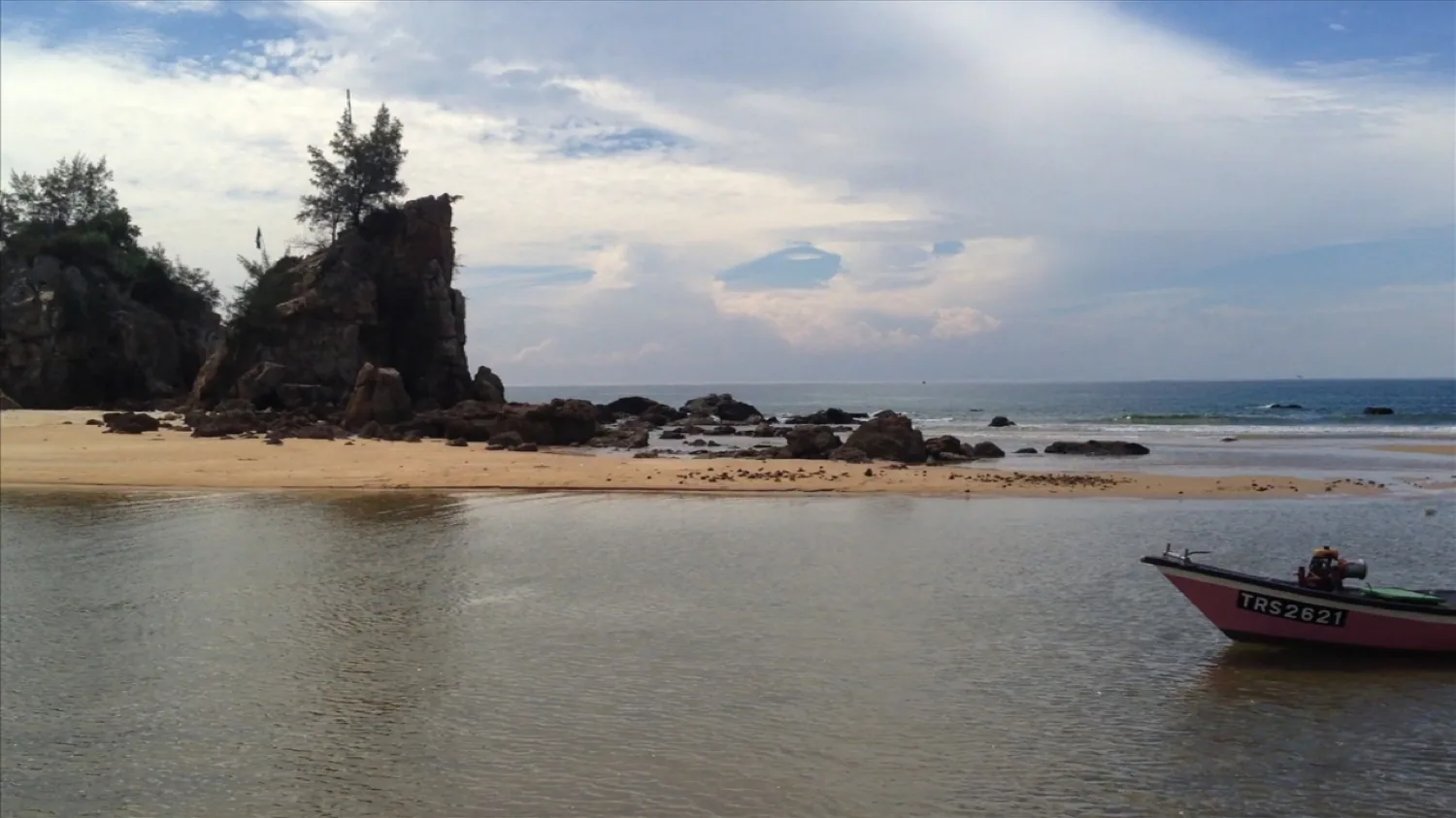
Still from Au Sow Yee’s A Day Without Sun in Mengkerang (Chapter One) (2013). Fair use editorial commentary on Au Sow Yee's work. Source: artist's official portfolio.
Why a Malaysian Chinese Artist Would Do This in Taiwan
To answer that question, one has to return to Kuala Lumpur in 2013.
That year, Malaysia held its 13th general election. After the results were announced, racial discourse erupted across Malaysian society on a large scale: the election result was steered toward the claim that “one particular race was responsible for the election outcome,” Bangladeshi migrant workers were singled out as “phantom voters,” and hate speech fermented on Facebook and in the media for weeks5.
By then, Au Sow Yee had already been back working in Kuala Lumpur for several years. In a 2015 interview with Cheng Wen-Chi, editor-in-chief of No Man’s Land, she said directly:
“At that time I was extremely angry, and also very curious. It felt as if, from childhood to adulthood, beginning with the education system I received, our recognition or framing of race, or our understanding of particular races, all came from life and from the education system.”6
But she refused to turn that anger into another posture of appeal. She continued:
“I grew up within the Chinese-language education system, and I also know that the so-called ‘Chinese community’ likes to use a certain kind of appeal, presenting itself as very tragic... Personally, I don’t really like that posture of placing oneself in a tragic position and making a certain appeal to voters. To me, it is very contradictory.”6
She did not want to make work from the position of “Malaysian Chinese tragedy.” But she also could not pretend she had not seen what emerged after the 2013 general election.
She chose a third path: to invent a place name.
Mengkerang: A Nonexistent Place More Real Than Reality
The Mengkerang Project began in 2013 with a single-channel video7.
Mengkerang is a place name invented by Au Sow Yee, but it sounds almost too real. It recalls Medan in Indonesia and Pengarang at the southern end of Malaysia. She explained in an interview:
“I only wanted an exotic name. Mengkerang directly gives you a kind of Nanyang imagination.”6
But this fake place name quickly became sharper than a real one.
The first chapter was A Day Without Sun in Mengkerang Chapter One (2013). She found Malaysians of different ethnicities, educational backgrounds, and ages, and asked them to play “exquisite corpse”: each person continued from the previous person’s description of Mengkerang, eventually weaving together a strange narrative in which fact and fiction were hard to separate7. She refused to make a documentary, because a documentary “has more or less already chosen an angle from which to stand”6.
The second chapter, completed in 2015, was Sang Kancil, Hang Tuah, Raja Bersiong, Bomoh, the Missing Jet and Others. The Malay folklore she gathered included the epic hero Hang Tuah, the clever mousedeer Sang Kancil (the most common animal in Malay folktales), the fanged tyrant Raja Bersiong, and the bomoh, or shaman, in whom people still believe. The “missing jet” in the title refers to Malaysia Airlines Flight MH370 in 20148.
The third chapter was Pak Tai Foto (2015). She went to an old photo studio on Petaling Street in Kuala Lumpur that was about to be demolished for the construction of the MRT, and interviewed Bangladeshi, Burmese, and Chinese migrant workers employed in the area9.
But she did not film the migrant workers’ faces. She filmed the empty interior of the photo studio, leaving only their voices.
📝 Curator’s Note
“Absence” is the key word of this work. Viewers hear voices but do not see people: a group of Bangladeshi, Burmese, and Chinese migrant workers speaking about how they came to Kuala Lumpur and where they hope to go. At the same time, the photo studio itself is also about to become “absent” from Kuala Lumpur’s geography, as the MRT is being built through the area. A double absence takes place in a single space.
Au Sow Yee’s insistence on “absence” has historical roots. Petaling Street was the earliest point of settlement for Kuala Lumpur’s Chinese community, and it was also a place she often visited as a child; bookstores, record shops, and fast-food restaurants were all there. “But because urban renewal was bringing in the MRT, that place was about to be demolished”6. She wanted to film something that was disappearing, but did not want the method of filming to become a posture of “speaking for the disadvantaged.”
After seeing the exhibition Habitation and Elsewhere: A Video Survey Project at Lostgens’ in Kuala Lumpur, Malaysian curator Sharon Chin wrote an English-language review that captured the core of Au Sow Yee’s methodology:
"She's interested in the politics of images, instead of political images."10
She is interested in “how images operate politically,” rather than “images that shoot political subjects.” The difference is that the former asks, “Why can a photograph persuade people?” while the latter merely points the camera at a protest site.
Sharon Chin also said that the strength of Pak Tai Foto was that it did not “speak for migrant workers”; “rather than 'giving voice' to migrant workers, their narratives integrate naturally into Malaysia's larger story”10. The migrant workers’ voices are woven into the story of Malaysia as a whole, rather than isolated as “stories of outsiders.”
This is one of Au Sow Yee’s most important methodologies: opposing the curatorial posture of “speaking for” someone.
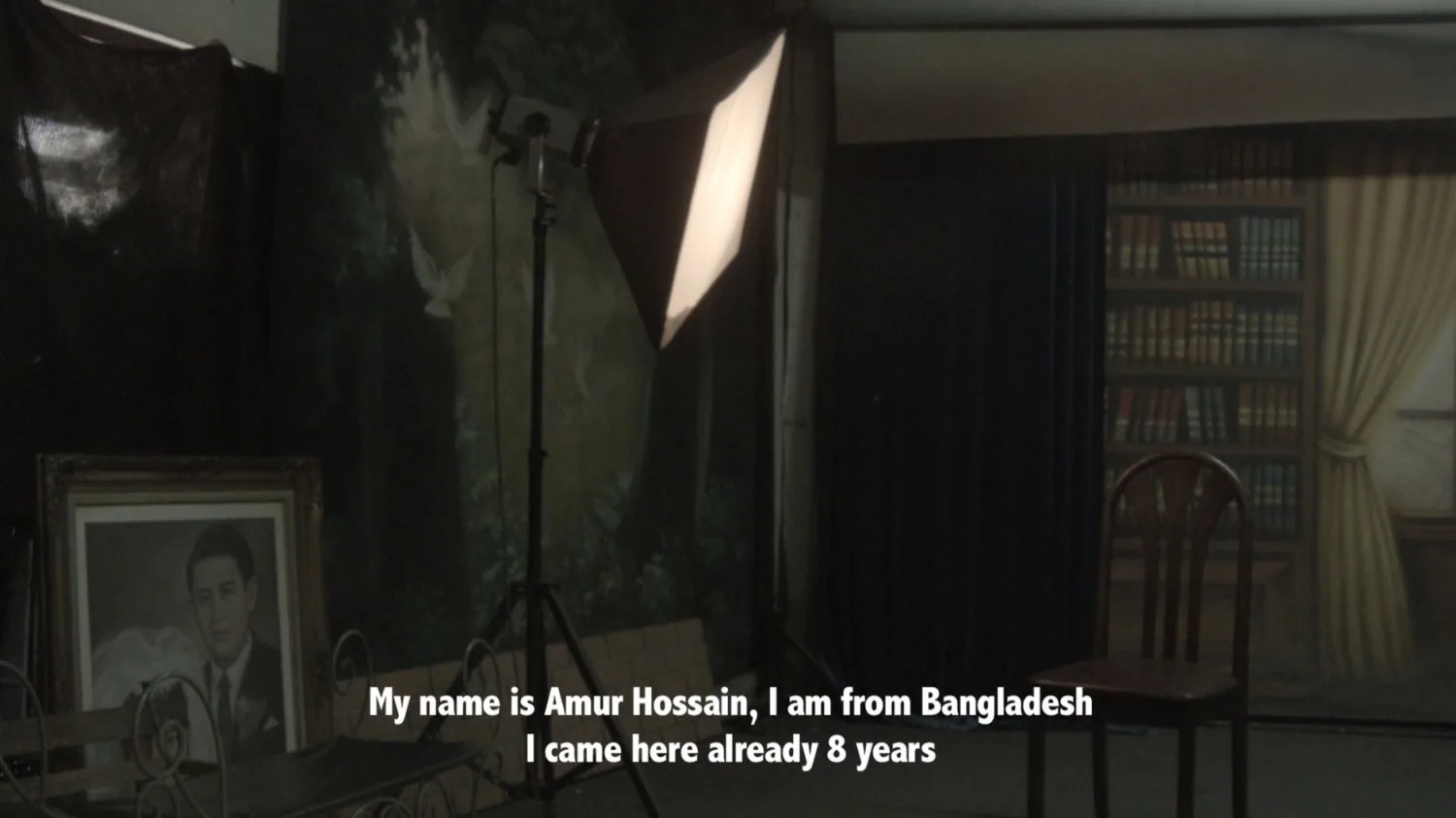
Still from Au Sow Yee’s Pak Tai Foto (2015). The old shop on Petaling Street was about to be demolished because of MRT construction; migrant workers’ voices echo through the empty shop. Fair use editorial commentary on Au Sow Yee's work. Source: artist's official portfolio.
“Absence” as the Position of Creation
But where did The Mengkerang Project trilogy first premiere?
Taipei11.
In the 2015 interview, she explained why:
“What I want to express is that if I were still in Malaysia now, I would not have made something like this. It is precisely because of my ‘absence’ that I could make this work.”6
This statement overturns the common assumption that an artist writing about a homeland must experience it in person. Distance itself becomes a condition of creation: only after leaving Malaysia for 14 years could she write a Malaysia seen from an external perspective.
Her refusal of a “tragic appeal” also extends to “authenticity.” She said:
“Where exactly is ‘purity’? Or perhaps it was never pure in the first place. Yet many people emphasize that kind of ‘authenticity’; it seems to form a kind of protection, as if you keep hanging it on your lips precisely because you cannot do something.”6
Her upbringing had already prepared this position: “In the background I grew up in, language was always in a very mixed state; at any moment you might have to speak English or Malay with someone, and seeing a Chinese face did not necessarily mean Chinese would work”6. Malaysian Chinese people have never existed within a pure culture, so she is naturally immune to claims of “pure Malayness” or “pure Chineseness.”
✦ The phrase she introduced in that 2015 interview, “only through absence can one create,” later became the cornerstone of her entire creative path: only by not being in Malaysia could she write Malaysia; only by not being in the Chinese community could she see the Chinese community clearly; only by not being in the mainstream curatorial center could she see the periphery.
From Individual Works to Archipelagic Discourse
2017 was a crucial year for Au Sow Yee.
That year, she and Cheng Wen-Chi, editor-in-chief of No Man’s Land, launched the “Nusantara Archive” project12.
The Chinese term “qundao,” or “archipelago,” corresponds in Malay to Nusantara: nusa means “island,” and antara means “between” or “among others”; together, the term means “between islands.” It is a word from medieval Javanese sources, a self-naming that crosses the entire Malay world of Malaysia, Indonesia, Singapore, and the Philippines. No island is the center; every island is the “other” of some other island12.
The term it seeks to replace is “Southeast Asia.” The latter came from the 1943 establishment of the Allied South East Asia Command, and only after the war was it adopted as a regional label. In other words, “Southeast Asia” is a Cold War term for viewing this geography from the outside13.
Changing the framework means changing the coordinates: replacing a colonial naming with a self-naming in a local language, and replacing the binary opposition between “center” and “periphery” with an “inter-island continuum.” For Taiwan’s art world, this shift matters: Taiwan can be understood as the northeastern end of the Malay Archipelago, rather than “the other of Southeast Asia” or “an island of the Chinese world.”
In the first year of the Nusantara Archive (2017-2018), Malaysian artists Okui Lala and Hoo Fan Chon were invited to Taiwan for residencies, with a grant of NT$350,000 from the National Culture and Arts Foundation14. Au Sow Yee served as one of the seven members of NML’s editorial advisory committee15; the other six were Huang Wen-Hao, Yeh Shao-Bin, Takamori Nobuo, Luo Shih-Tung, Wu Ting-Kuan, and Huang Ching-Ying.
NML is not an anonymous platform. It is the writing organ of a transnational curatorial network. In 2018, the Digital Art Foundation published Nusantara Archive 03: Au Sow Yee, turning all of her work since Mengkerang in 2013 into discourse and making it into an independent publication16. This book was the first time the “Nusantara” framework was institutionalized in the form of a monograph on an individual figure.
💡 Did You Know
Before the 2017 Nusantara Archive, the two coordinates Taiwan’s art discourse most often used when discussing “Southeast Asia” were “the West” (New York, Berlin, Paris) and “the Sinosphere” (cross-strait exchange, the rise of Chinese contemporary art). Malaysian, Indonesian, and Singaporean artists were almost invisible in Taiwan’s art world. After the Nusantara Archive, a later generation, including Okui Lala, Hoo Fan Chon, Tan Zi Hao, and Nguyen Trinh Thi, gradually appeared at Taipei National University of the Arts, TheCube Project Space, and the Taipei Biennial. Au Sow Yee was not the only force behind this shift, but she was one of its most important nodes.
The Kris Project Enters the Singapore Art Museum
In 2015-2016, Au Sow Yee made another important series: The Kris Project17.
The kris is a traditional Malay dagger, but more importantly, this series turns the camera toward the golden age of Southeast Asian Chinese-language cinema in the 1950s and 1960s. She drew found footage from the Malay film archive of Cathay-Keris, a Singapore film company co-founded in 1951 by Loke Wan Tho and Ho Ah Loke; Cathay-Keris was one of the most important Southeast Asian film studios of the era, competing with Shaw Brothers, and was later inscribed in UNESCO’s Memory of the World Asia-Pacific Register18.
Using these old film reels, she reorganized narrative and excavated the memory of Southeast Asian Chinese-language cinema from the historical continuum linking Singapore, Malaysia, Hong Kong, and Taiwan.
In 2016, the work was acquired by the Singapore Art Museum19. For a 38-year-old Malaysian Chinese woman artist, this was a position not directly reachable from Kuala Lumpur.
She did not first establish a reputation in Malaysia and then become visible to Singapore. She first built a discourse in Taiwan, and then Singapore, Hong Kong, Seoul, Tokyo, Berlin, Shanghai, Bangkok, Busan, and Sharjah took turns inviting her20.
The 2018 Taipei Biennial: Bringing the Japanese Colonial-Era Southern Pavilion into a Contemporary Museum
In 2018, she formally entered Taiwan’s largest stage for contemporary art for the first time: the Taipei Biennial Post-Nature: A Museum as an Ecosystem21.
Her work had a very long title: A Coconut Grove, Penang’s Beauty and The Irrevocable Love of Agents in a Doomed Tryst: A Broadcasting Project (2018). It was a three-channel video and sound installation that imitated the spatial arrangement of the Southern Pavilion at the 1935 Taiwan Exposition22.
The 1935 Taiwan Exposition was a discursive stage through which the Japanese Empire extended its imagination of the “Southern Co-Prosperity Sphere” toward Southeast Asia. As Japan’s southernmost broadcasting node, Taiwan in that year transmitted imperial imagination by radio waves to the Malay Peninsula, the Indonesian archipelago, and the Philippines23. Au Sow Yee used this 1935 historical structure as the spatial skeleton of a 2018 contemporary artwork, so that viewers walking into it were entering an imperial southern imagination from 83 years earlier.
The work also had a theatrical version, Nanyang Intelligence Exchange, staged in October 2018 in collaboration with the Riverbed Theatre24. The same historical structure appeared as a video installation in the contemporary museum and as bodily performance in the black box theater.
She began expanding her work from “a single video work” into an integrated project that was cross-media, cross-venue, and cross-temporal.
STILL ALIVE: The Kris Project II and the Silent Ocean Warriors
On November 28, 2019, TheCube Project Space in Liuzhangli, Taipei, opened her solo exhibition STILL ALIVE25, which ran until January 19, 2020.
It featured three works:
- The Kris Project II: If the Party Goes On, which continued the 2016 Kris Project while digging another layer deeper
- Palaces, Valleys, Islands and Their Lunar Journey, which connected the Malay world with lunar mythology
- Silver Noise: The Extreme Journey of the Silent Warriors of the Ocean (Prelude: Songs of Voyaging), a sonic mnemonics of the ocean
TheCube Project Space was founded in 2010 by Amy Cheng and Jeph Lo in an old apartment tucked into the lanes of Liuzhangli, Taipei, and is one of Taiwan’s most important non-commercial contemporary art spaces. It was no accident that Au Sow Yee held a solo exhibition there. For years, TheCube has deeply supported “Nusantara”-related curation, making it another node of the Malay world in Taiwan’s art scene beyond NML.
In 2021, she received an Honorable Mention at the Taipei Arts Awards for an extension of this series26. That was also the year she began receiving consecutive invitations from international biennials: the 2022 Busan Biennale and, in 2023, Sharjah Biennial 15 in the United Arab Emirates, Thinking Historically in the Present27.
Retelling Si Tanggang with Stateless Children
But her most substantial work only appeared in 2024.
That year, she and theater creator Chen Yow-Ruu, working together as “Her Lab Space,” were commissioned by the Singapore Art Museum to create The Rocking Dream28.
During production, they flew back to Malaysia and collaborated with an NGO called BJCK, an organization dedicated to assisting stateless children in Malaysia. On April 7, 2024, they interviewed these children at the BJCK office, guiding them to reinterpret the Malay legend Si Tanggang in their own words29.
Si Tanggang is a famous folktale in the Malay world: a poor child from a fishing village leaves home, becomes successful, and rises to become a captain. When he returns home and his mother comes to recognize him, he is ashamed to acknowledge his poor mother and claims not to know her. His mother curses him to turn into stone, and the entire ship becomes a stone island30.
This legend is known throughout the Malay world. It is a motif of “forgetting one’s roots,” “leaving home,” and “denying identity.”
Au Sow Yee chose this legend and asked stateless children in Malaysia to reinterpret it. These children’s legal identity is itself denied by the Malaysian state. They are the reverse version of the Si Tanggang story: in the original, the child forgot the mother; in the contemporary version, the state has forgotten the child.
The work juxtaposes archival footage from the 1961 black-and-white film Si Tanggang with the voices of contemporary stateless children31. That 1961 film belongs to the golden age of Cathay-Keris. Au Sow Yee lets a Malay film from 60 years ago converse in the same space with Malaysian children who have lost nationality 60 years later.
⚠️ Contested View
The issue of “stateless children” is politically extremely sensitive in Malaysia. Bumiputera preferential policies, Islamic law versus civil law, children born of interethnic marriages, and children of foreign workers are all historical wounds that Malaysian politics never confronts directly. For a Malaysian Chinese woman artist to make this work in Taipei and then exhibit it in Singapore represents a particular political possibility that can only be done from “outside” Malaysia.
The Rocking Dream was first exhibited in 2024 at the Singapore Art Museum in a single-channel version, and in the same year TheCube Project Space reconfigured it into a 2.5-channel version (two screens plus miniature-model projection) for a full solo exhibition32. The work was shortlisted for the 24th Taishin Arts Award33.
Why an Artist Would Open a Library
Return now to the Rumah Attap Library in 2017.
To understand why Au Sow Yee would do this, one has to look at the entire axis of her work. She has never been someone who “only makes artworks.” She is an institution builder.
- 2011-: Long-term contributor and editorial advisor to No Man’s Land15
- 2017: Co-founder of Rumah Attap Library and Collective in Kuala Lumpur
- 2017-: Co-initiator of the Nusantara Archive with Cheng Wen-Chi
- 2018: Independent publication of Nusantara Archive 03: Au Sow Yee
- 2019-: Lecturer at the Center for General Education, Taipei National University of the Arts (science and technology field)34
- 2024-: Member of the creative collective Her Lab Space
NML editing, library founding, publication planning, and teaching at Taipei National University of the Arts are all labors that can be underestimated if one looks only at an exhibition résumé. But they are the material basis that allows Au Sow Yee’s “Nusantara” framework to actually operate.
Artworks are individual images. Libraries, publications, residency programs, and editorial labor are the infrastructure that allows those images to be read, extended, and passed on to the next generation.
📝 Curator’s Note
Treating “Nusantara” as a framework is one thing; turning it into a functioning institution is another. A lecture can advocate Nusantara, and an essay can analyze Nusantara, but bringing 14 artists for residencies, accumulating 384 NML articles into discourse, and turning a book like Nusantara Archive 03 into something that can sit on a library shelf requires a different kind of labor. Au Sow Yee has never worked only inside the studio.
The Major Taichung Art Museum Exhibition in 2025
On December 13, 2025, the newly opened Taichung Art Museum (TAM), a landmark museum in the Taichung Green Railway Cultural Park that opened only in 2024, launched her major solo exhibition A Call of All Beings: See you tomorrow, same time, same place, which ran until April 12, 202635.
This was her first large-scale solo exhibition in Taiwan at the scale of a national-level art museum. In the past, her main stages were single works in biennial group exhibitions, or refined independent exhibitions at TheCube Project Space. What Taichung Art Museum gave her was an entire hall in a new 20,000-square-meter museum.
The exhibition title “A Call of All Beings” responds to what she has accumulated over the past decade: the fictional Malay geography of The Mengkerang Project, the Southeast Asian Chinese-language film memory of The Kris Project, the 1935 imperial southern imagination of A Coconut Grove, Penang’s Beauty, the South China Sea pirate legends of Pirates, the Trembling Ship, and the voices of stateless children in The Rocking Dream. What she has always been doing is calling into the contemporary museum those presences that have not been heard.
The subtitle “See you tomorrow, same time, same place” reads like a farewell, but also like a continuation. For someone who has lived between Taipei and Kuala Lumpur for 23 years, the phrase “see you tomorrow” means something different than it does for most people.
The Plane from Kuala Lumpur to Taipei in 2003
The story returns to 2003.
That year, Au Sow Yee was 25 years old and boarded a flight from Kuala Lumpur to Taipei. She had originally planned to study experimental film in the United States, and had already spent half a year studying general education at a private college in Malaysia, but in the end she chose Taipei National University of the Arts6.
At the time, she probably did not imagine that 22 years later, she would use the Malay term “Nusantara” from Taipei to change the coordinate system of Taiwan’s entire art world. Nor did she imagine that she would return to Kampung Attap in Kuala Lumpur to build a library, then go back to Taipei to continue working on a Singapore Art Museum commission, and then be invited by Taichung Art Museum to mount a major solo exhibition.
She may not have expected to stay for so long. But in that 2015 interview with Cheng Wen-Chi, she offered the sentence: “It is precisely because of my ‘absence’ that I could make this work.” That sentence eventually became the core methodology of her entire 23-year career.
Only by not being in Malaysia could she write Malaysia.
Only by not being in the Chinese community could she see the Chinese community clearly.
Only by not being in the mainstream curatorial center could she see the periphery.
Only by not being in “home” could she recognize “dwelling.”
She has never occupied a fixed position. She writes Malaysia from Taipei, Southeast Asian Chinese-language cinema from Malaysia, stateless children from Singapore, and the Malay Archipelago from Sharjah.
But the final sentence of that 2015 NML interview was written by the interviewer, Cheng Wen-Chi. After Au Sow Yee finished her account, he added a note:
“Perhaps through this project, we discover that in fact there is no place that is truly ‘elsewhere’; in other words, ‘elsewhere’ is also ‘dwelling.’”6
For someone born in Kuala Lumpur in 1978, who came to Taiwan in 2003, returned to Kuala Lumpur in 2017 to open a library, and held a solo exhibition at Taichung Art Museum in 2025, no place is truly elsewhere.
But no place is completely a dwelling, either.
She is just sufficiently at home, and just sufficiently absent. She makes work between two coordinates. This is the shape that the anger after Malaysia’s 2013 general election finally took.
Image Sources
This article uses one still image of a living artist’s work within the scope of fair use editorial commentary, pursuant to Article 65, Subparagraph 2 of Taiwan’s Copyright Act (“fair use for educational purposes”) and the four factors of fair use under 17 U.S.C. § 107 in the United States: non-commercial educational nature / published work / small proportion quoted / no substantial market substitution effect. The image is cached in public/article-images/people/ to avoid hotlinking from the source server:
- hero: Still from Au Sow Yee’s Prelude: Interstellar and the Battle Drum (2024) — © Au Sow Yee. Fair use editorial commentary on Au Sow Yee's work for non-commercial educational purpose. Source: artist's official cargo.site portfolio.
If Au Sow Yee herself or her representatives have any concerns regarding the use of this image, please contact Taiwan.md (github.com/frank890417/taiwan-md), and we will immediately remove or adjust it.
Further Reading
- Cheng Wen-Chi — NML editor-in-chief and co-initiator of the Nusantara Archive. From the founding of NML in 2011 to the launch of Nusantara in 2017 and their continued collaboration in 2024, he has been her most important working partner in Taiwan’s art world
- Taiwanese Curators and the Construction of Art and Culture — The discursive development of a generation of Taiwanese curators, including Takamori Nobuo, one of NML’s editorial advisors; their work has formed an ongoing dialogue with Au Sow Yee’s Nusantara discourse at the Taipei Biennial and the Asian Art Biennial
- Taiwanese New Media Art — Au Sow Yee’s primary medium is video installation; this thread offers historical context for video and media art in Taiwan
- Contemporary Art — An overview of Taiwan’s contemporary art ecology; with Au Sow Yee’s “Nusantara” framework added, one can see the Southeast Asian and Southern axis of Taiwanese contemporary art
References
- Rumah Attap Library & Collective official website — Official website of Rumah Attap Library, clearly recording its founding in 2017 in 1950s shophouses in Kampung Attap, Kuala Lumpur, with volunteer shifts and a non-profit model.↩
- Rumah Attap About page — The library’s self-description as a living coordinate, and the three co-founding units: “founded by Amateur, In Between Cultura and Au Sow Yee Studio in 2017.”↩
- Au Sow Yee profile, 2018 Taipei Biennial — Official artist page of Taipei Fine Arts Museum, stating verbatim: “Au Sow Yee was born in Malaysia in 1978 and currently lives and works in Taipei.”↩
- Rumah Attap Library self-description — Official introduction page, proposing the conceptual framework of an “open and critical alternative knowledge system” and “living coordinate.”↩
- “The Night Facebook Profile Pictures Suddenly Turned Black: Remote Research on Malaysia’s 2013 General Election” — A 2013 field observation record from Guava Anthropology, documenting the proliferation of racial discourse after the election and the incident in which Bangladeshi migrant workers were named as phantom voters.↩
- Cheng Wen-Chi’s 2015 interview with Au Sow Yee, “In Search of Habitation in Images” — Published by No Man’s Land on 2015-04-15, an in-depth interview conducted by editor-in-chief Cheng Wen-Chi, recording Au Sow Yee’s account of the origins of The Mengkerang Project, the education system, her creative methodology, and the concept of “absence.” It is currently the most complete publicly accessible Chinese-language primary interview with Au Sow Yee.↩2345678910
- The Mengkerang Project I: A Day Without Sun in Mengkerang Chapter One — Artist’s website work page, recording the 2013 single-channel video as the first part of The Mengkerang Project, using exquisite-corpse-style interviews with respondents of different ethnicities.↩2
- The Mengkerang Project II (2015) on artist site — Au Sow Yee’s personal WordPress page introducing the second chapter, completed in 2015, whose title includes the mousedeer, Hang Tuah, Raja Bersiong, bomoh, and the missing jet, referring to Malay folktales and contemporary events such as Malaysia Airlines Flight MH370 in 2014.↩
- The Mengkerang Project III: Pak Tai Foto (2015) — Artist’s website page for the third chapter, recording that Pak Tai Foto was located on Petaling Street, Kuala Lumpur, and that the work interviewed Bangladeshi, Burmese, and Chinese migrant workers while making the absence of the visual subjects central to the design.↩
- Sharon Chin: Notes on Au Sow Yee's "Habitation and Elsewhere" — A review by Malaysian curator and artist Sharon Chin of the 2015 exhibition Habitation and Elsewhere, proposing the framing of “politics of images, instead of political images” and observing the methodology of “rather than 'giving voice' to migrant workers.”↩2
- Curatorial information for Habitation and Elsewhere: A Video Survey Project (note 3 in the 2015 NML interview) — Note 3 in the NML interview states that the exhibition was curated by Kuo Chao-Lan as part of EX!T 6, the 6th Taiwan International Experimental Media Art Exhibition (2015-04-05 to 04-26 at Guling Street Avant-Garde Theatre / August 2015 at Lostgens’, Kuala Lumpur), with the first presentation in Taipei.↩
- Hermeneutics of Nusantara, NML Issue 34 editor’s note — Curated and written by Cheng Wen-Chi, published in September 2017, the first full self-interpretation of the hermeneutics of Nusantara, including an explanation of the term’s etymology (nusa + antara).↩2
- No Man’s Land ABOUT page — The platform’s full Chinese-English self-introduction, recording NML’s self-positioning as a “borderland” and the philosophical basis of its Nusantara framework.↩
- No Man’s Land residency and Nusantara Archive project, first-year NCAF archive — National Culture and Arts Foundation grant results archive, recording project details from May 2017 to the end of April 2018, including a NT$350,000 grant and one-month research residencies in Taiwan by Malaysian artists Okui Lala and Hoo Fan Chon.↩
- No Man’s Land ABOUT page editorial advisory list — Full list of the seven members of the editorial advisory committee: Huang Wen-Hao, Au Sow Yee, Yeh Shao-Bin, Takamori Nobuo, Luo Shih-Tung, Wu Ting-Kuan, and Huang Ching-Ying. Au Sow Yee has served as an author since NML’s founding period in 2011 and later became a long-term advisor.↩2
- Publication information for Nusantara Archive 03: Au Sow Yee — Digital Art Foundation publication page, issued in 2018, authored by Au Sow Yee and Wang Po-Wei and edited by Cheng Wen-Chi. It is Au Sow Yee’s first independent monograph, turning her works since Mengkerang in 2013 into discourse.↩
- The Kris Project (2015 – ) — Au Sow Yee’s personal WordPress work page, introducing The Kris Project as a reconstruction of the film history of Southeast Asia, Hong Kong, and Taiwan through found footage drawn from the golden age of Chinese-language cinema in the 1950s and 1960s.↩
- Asian Film Archive: Cathay-Keris Malay Classics Collection introduction — Official page of the Asian Film Archive in Singapore, recording that Cathay-Keris was co-founded by Loke Wan Tho and Ho Ah Loke in 1951 and was one of Southeast Asia’s two major film studios alongside Shaw Brothers in the 1950s and 1960s.↩
- Singapore Art Museum: The Kris Project (2016) by Au Sow Yee — Singapore Art Museum collection page, recording that The Kris Project I, II and III were collected in 2016 as a complete installation work.↩
- Au Sow Yee – Ocula Artist profile — International art platform Ocula’s artist profile, recording her international exhibition history, including MMCA Seoul, Mori Art Museum in Tokyo, HKW Berlin, Rockbund Art Museum in Shanghai, Singapore Art Museum, BACC Bangkok, Busan Biennale, and Sharjah Biennial.↩
- Artist page for the 2018 Taipei Biennial Post-Nature: A Museum as an Ecosystem — TFAM official page, recording Au Sow Yee’s participating work A Coconut Grove, Penang’s Beauty and The Irrevocable Love of Agents in a Doomed Tryst: A Broadcasting Project (2018) as a three-channel video and sound installation.↩
- 2018 Taipei Biennial work description — TFAM official page stating verbatim that the work “takes the ‘life-and-death romance’ of the disappeared agent and Penang’s Beauty as its narrative core, imitating the deployment of the Southern Pavilion at the 1935 Taiwan Exposition.”↩
- Cheng Wen-Chi, 2022, “The Piracy, the Radiowave, the Bubble,” section on radio history — NML 2022 curatorial editor’s note, recording the historical context in which the Japanese Empire used radio broadcasting in the late 1930s to propagandize the Greater East Asia Co-Prosperity Sphere toward South China and Nanyang, with Taiwan serving as the empire’s southernmost broadcasting node.↩
- 2018 Nanyang Intelligence Exchange performance information (NML Au Sow Yee article cross-reference) — Au Sow Yee’s 2019 NML essay “Silver Noise” notes how the creative axis that began with her 2017 collaboration with Chen Yow-Ruu, When We Are All Gone, How Can Memory Exist Without Passing Into Silence, later extended into the theater work Nanyang Intelligence Exchange.↩
- Au Sow-Yee Solo Exhibition: STILL ALIVE — Official exhibition page of TheCube Project Space, recording the exhibition dates from 2019-11-28 to 2020-01-19 and the three works shown.↩
- 2021 Taipei Arts Awards TFAM official page — Taipei Fine Arts Museum official information for the 2021 Taipei Arts Awards, recording that the year received 346 submissions, that Au Sow Yee was one of 11 shortlisted artists, and that she received an Honorable Mention.↩
- Sharjah Biennial 15: Au Sow Yee artist page — Sharjah Art Foundation official page, recording Au Sow Yee’s participation in Sharjah Biennial 15, Thinking Historically in the Present, held from 2023-02-07 to 06-11.↩
- The Rocking Dream: Au Sow Yee × Chen Yow-Ruu Solo Exhibition — Official page of TheCube Project Space, recording the 2024 joint solo exhibition by Au Sow Yee and Chen Yow-Ruu, who formed the creative group Her Lab Space, extending from a 2024 commission by the Singapore Art Museum.↩
- “Essence and Transmission Through the Other Feel Very Different,” report on The Rocking Dream solo exhibition — A 2024 report by ARTouch, recording that on 2024-04-07, Au Sow Yee and Chen Yow-Ruu interviewed stateless children at the Malaysian NGO BJCK and guided them in reinterpreting the Si Tanggang legend.↩
- Si Tanggang Malay folktale Wikipedia introduction — Si Tanggang is a well-known Malay folktale about “forgetting one’s roots”: a poor child from a fishing village leaves home, becomes a captain, refuses to acknowledge his poor mother upon returning, and under his mother’s curse the ship and its people turn into stone islands.↩
- The Rocking Dream exhibition description (typoarchive) — TheCube Project Space exhibition description, recording the work’s narrative structure juxtaposing archival footage from the 1961 black-and-white film Si Tanggang with the voices of contemporary stateless children.↩
- The Rocking Dream Singapore Art Museum commissioned version and Taipei 2.5-channel version — TheCube Project Space page recording the transition from the 2024 Singapore SAM-commissioned single-channel version to TheCube’s reconfiguration as a 2.5-channel version with two screens and miniature-model projection.↩
- 24th Taishin Arts Award shortlisted artist interview for The Rocking Dream — Artist interview report by Art Emperor for the 24th Taishin Arts Award, recording that The Rocking Dream — Au Sow Yee × Chen Yow-Ruu Solo Exhibition was shortlisted for the 24th Taishin Arts Award.↩
- Center for General Education, Taipei National University of the Arts: Au Sow Yee profile — Official page of the TNUA Center for General Education, recording Au Sow Yee as a lecturer whose teaching field is science and technology.↩
- Recent solo exhibition information on Au Sow Yee’s personal website — Au Sow Yee’s official cargo.site website, recording A Call of All Beings: See you tomorrow, same time, same place at Taichung Art Museum from 2025-12-13 to 2026-04-12.↩