
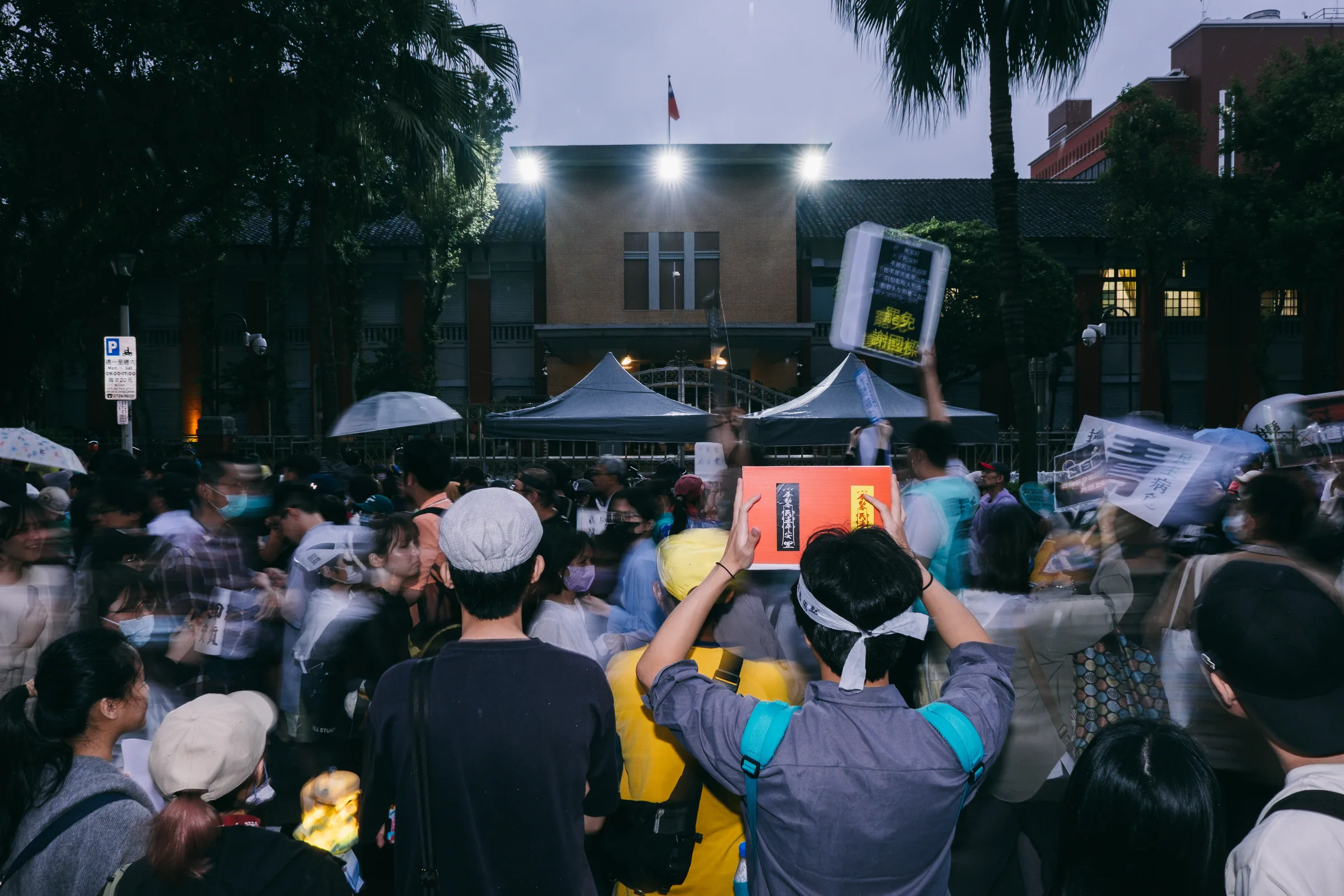
30-Second Overview: In 2025, Taiwan did something rare in the world: it used the constitutional power of recall to hold a referendum-style accountability vote against more than a quarter of its legislators. In three waves of voting from July to August, none of the 33 recall cases passed—the largest recall wave in history removed not a single seat. But if you zoom out: this movement was more like a stress test of direct democracy. On the night of July 26, a 55.83% turnout set a new record in recall history, simultaneously measuring how high the recall threshold is and how much a polarized society must pay. It removed zero, but measured a great deal.
On the night of July 26, 2025, vote count results poured in from across the island. On this day, the fates of 24 Kuomintang (KMT) legislators and Hsinchu Mayor Gao Hung-an were decided at once by voters casting ballots—25 cases voted on simultaneously, the most recall votes ever held in Taiwan at one time. In the early evening, some districts saw consent votes take the lead, and voices were heard shouting in the recall groups' live streams. But by late night, as the 25 report cards were completed one by one, the conclusion was consistent: all failed1.
The turnout that night reached 55.83%, a new high in Taiwan’s recall history2. A civic mobilization of the largest scale in history yielded a result of "not a single seat removed." A night that removed nothing measured things that filled the entire negative.
This movement was later commonly referred to as the "Great Recall." To understand what it measured, we must first understand the ticks on the ruler.
Three Gates to Recall: 1%, 10%, and One-Quarter
In Taiwan, recalling an elected official requires crossing three numerical thresholds in sequence. The first is "proposal": the number of proposers must reach 1% of the total number of voters in the original electoral district. The second is "signature": the number of signatories must reach 10%. Only after crossing these two gates does the case become established and enter voting. The third gate is the vote itself—the consent votes must exceed the dissent votes, and the consent votes must also reach one-quarter of the total number of voters in the original electoral district for the recall to pass3.
These three gates also determine who has the opportunity to be put on the recall stand. Legislators elected via the National Not-at-District (NAD) proportional representation system are allocated seats based on party vote shares and have no "original electoral district"; institutionally, they cannot be recalled4. This is why all 31 legislators put up for recall votes in 2025 were district legislators. Those eligible to vote were voters aged 20 and above who had registered their residence in the district for at least four months. Eighteen-year-old high school students could not vote, nor could overseas citizens without Taiwanese household registration5.
The height of the third gate was adjusted to its current form only in 2016. Before that, recall adopted a "double 21" threshold: a turnout of over 50% and consent votes exceeding half of the valid votes were required for passage. In the 2015 "Cut the Tail" action recalling legislator Tsai Cheng-yuan, the turnout was only 24.98%, failing even the turnout gate, causing the recall to automatically fail6. In November 2016, the Legislative Yuan changed the threshold to "consent votes must exceed dissent votes and reach one-quarter of the voters," removing the hard requirement for a 50% turnout7. The proposal for this amendment came from several versions by the Times Party caucus and Democratic Progressive Party (DPP) legislators, passed after joint review.
Ironically, one of the parties that proposed lowering the threshold, the Times Party, saw its representative Huang Kuo-chang become the first legislator put on the recall stand after the new system took effect in 2017. That time, he received 48,693 consent votes, failing to cross the 63,888-vote threshold, and kept his seat8. Those who lowered the threshold became the first test subjects of the new system. That time, the threshold was not crossed. This debate on "how easily incumbents should be challenged" had already gone through a round before the Great Recall, laying the groundwork for the 25% threshold in 2025 (see also Taiwan Elections and Party Politics).
Source: Public Officials Election and Recall Act, Law Source Legal Network
The ruler is set. The next question is: why did the energy accumulate to the point of using this ruler? That starts with a difference of one seat in the Legislative Yuan.
A Legislature with a One-Seat Difference
The January 2024 legislative election produced a Legislative Yuan where no single party held a majority. The KMT won 52 seats, the DPP 51, the Taiwan People's Party (TPP) 8, plus 2 non-aligned seats leaning pan-blue, totaling 113 seats9. The KMT had only one seat more than the DPP, but through cooperation with the TPP, it placed Han Kuo-yu in the chair of the Legislative Yuan president on February 1 with a vote of 54 to 5110. A legislature with three parties under 50% has been a tug-of-war from day one.
The tug-of-war quickly spread from personnel to legislation. In May 2024, the KMT and TPP pushed through amendments to the Legislative Yuan Act, expanding the legislature's investigative and inquiry powers and adding a "Contempt of Parliament" crime. On the day of the third reading at the end of May, large crowds gathered outside the Legislative Yuan to protest, marking the starting point of the subsequent "Bluebird Movement." The Executive Yuan requested a review, which the Legislative Yuan rejected on June 21 by a vote of 62 to 5111. The dispute went all the way to the Constitutional Court. On October 25 of the same year, Constitutional Judgment No. 9 ruled that several articles (the Contempt of Parliament crime, some inquiry and investigation provisions) were unconstitutional and invalid, but simultaneously ruled that while the legislative procedure had flaws, it had not reached the level of unconstitutionality. This was a "partially unconstitutional" ruling, not a total overturning12.
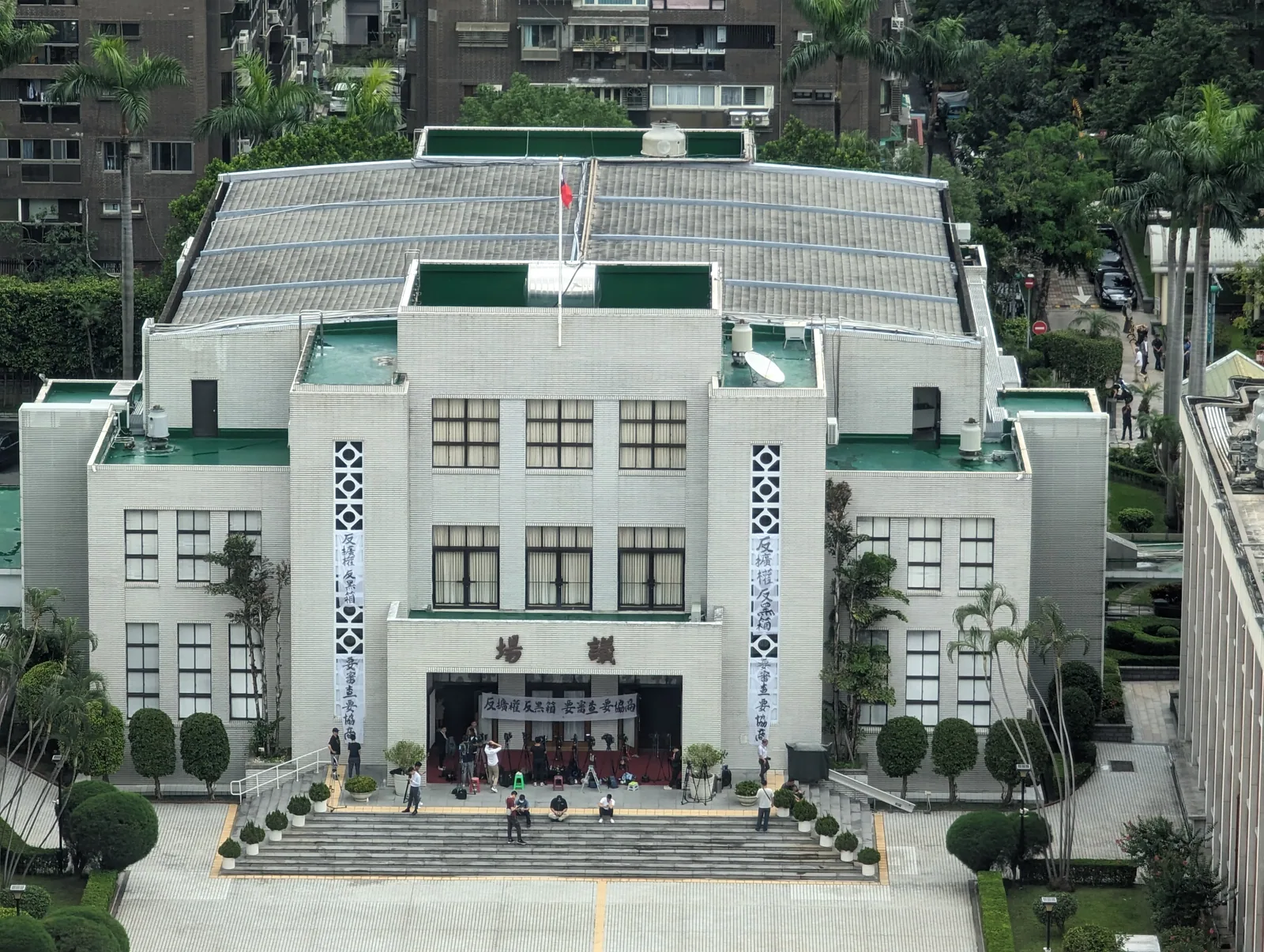
The Legislative Yuan chamber during the power amendment battle on May 21, 2024. Photo: QuYi96 / Wikimedia Commons, CC BY-SA 4.0.
What truly fanned the flames was the night of December 20, 2024. The KMT and TPP jointly passed three laws in third reading: the Recall Act required recall signatures to include photocopies of ID cards front and back, and increased the penalty for forged signatures to a maximum of five years. The Constitutional Court Procedure Act raised the threshold for the Constitutional Court's deliberation to ten or more justices. The Revenue Distribution Act significantly adjusted the revenue distribution between the central and local governments; according to Ministry of Finance estimates, the central government would release an additional 375.3 billion NTD to local governments1314. One month later, on January 21, 2025, the Legislative Yuan also passed the third reading of the 2025 Central Government General Budget, cutting 207.5 billion NTD and freezing 260 billion NTD (these are two different actions and cannot be added together)1516. Over the entire session, the battles over these bills and budgets turned the legislature into a pressure cooker.
Before the ruler started reading, the ticks were already shaking. The pressure accumulated in the chamber for a year overflowed the walls, first turning into bluebirds outside the legislature, then into signature books mailed into mailboxes one by one.
Source: Central Election Commission, Legislative Yuan, The Reporter compilation
1,300 Signature Books in the Mailbox
The energy of the Bluebird Movement did not directly translate into recalls. Chen Hsiao-wei, the lead petitioner of the Taoyuan recall against Niu Hsi-tsing, is a pastor. He remembers that curve: "Taoyuan started collecting recall signatures last July, but within 4.5 months, the mailbox only received 9 signatures for Tu Chuan-chi and 11 for Niu Hsi-tsing. After the December winter Bluebird Movement, we could receive 100 to 400 per day. In early February this year, after the Lunar New Year, opening the mailbox revealed it was overflowing with over 1,300 copies."17 The sea of mobile phone lights on the streets took nearly seven months to settle into signature books with attached ID photocopies mailed into mailboxes.
On January 22, 2025, Foxconn founder Terry Gao (Tsao Hsing-cheng) mobilized the Southern Society, the Taiwan Professors Association, and other groups to establish the "Anti-Communist Taiwan Defense Volunteer Alliance," creating an umbrella organization for scattered local recall groups18. Terry Gao himself played two roles in this: convener of the alliance, and lead petitioner of the "Remove Black Core" team for the Hsiao Bi-khim recall case. The latter was just one of the more than 30 recall groups, not all of them.

Terry Gao speaking at a protest outside the Legislative Yuan on May 21, 2024; eight months later, he mobilized local recall groups to form the Volunteer Alliance. Photo: TMYAO / Wikimedia Commons, CC BY-SA 4.0.
The volunteers catching this wave looked different from before. Field observations by The Reporter found that the proportion of female volunteers in each district reached 70% to 90%, whereas in past recall efforts, volunteers were "at most 60-70%"17. The age demographic also shifted from the high school students of the 2015 "Cut the Tail" action and the fresh graduates of the 2020 anti-Kao campaign, to the main force of 2025: the generation in their 30s and 40s, described by interviewees as "almost all mid-level managers in various fields"—from the Sunflower Movement to the Bluebird Movement and then to the recall groups, a clear curve of street generations de-studentizing and moving toward middle age is visible (see also Social Movements and Civic Participation). Some recall groups had very strict vetting; "Mountain Remove Wei Harm" required applicants to record a video of themselves saying "Xi Jinping steps down" to be archived for review17.
This batch of new volunteers brought two faces. One is an efficiency-oriented organizational culture. Alliance advisor Chien Chia-yu described: "We used to discuss theory, talking with everyone 'why we should recall this legislator'; but now recall groups seem like companies, focusing on KPI thinking." The other is a very personal belief. A volunteer for the Banqiao "Great Delete Yuan" group, Bang Mang Mang, remembered that when she said she was going to volunteer, her husband initially asked: "It won't pass, right? What can you change alone?" Hsiao Shih, a Hong Kong immigrant and co-petitioner for the Taoyuan recall group, said that participating in the recall was the third time she felt like a Taiwanese. The first sentence of Taiwanese she learned was "Recall saves Taiwan"17.
The cultural sector was also swept up. Writer Yang Shuang-tzu launched a signature campaign that grew from over 200 people in early February to 1,043 writers, with the signature statement quoting Brodsky: "Literature has the right to interfere in politics, until politics stops interfering in literature"19.
The first tick of the ruler came out: the mobilization energy was real, and it set a record. With great energy, both sides started using the system as a weapon against each other.
Who Launched the Great Recall: Different Answers from Both Sides
The most basic thing about this movement is who launched it, and the two camps gave completely different answers.
The self-narrative of the recall groups is: this was a citizen-initiated action independent of the DPP, with the core axis being "anti-communist, defend Taiwan." This statement was also echoed by some external observers; the University of Nottingham's Taiwan Insight academic blog described it as a "citizen-initiated" movement, not just a party confrontation20.
The opposing narrative is different. KMT legislator Hsiao Bi-khim pointed the finger at the ruling party in her recall defense book, alleging that "DPP Legislative Yuan party leader Ko Chien-ming repeatedly admitted in person that the Great Recall action was planned and launched by him hand-in-hand," and called it a "fake civic movement manipulated by the DPP"21.
It must be noted that this is Ko Chien-ming's narrative-style allegation against Ko Chien-ming in Hsiao Bi-khim's defense book, belonging to the opposing camp's narrative. As for Ko Chien-ming's own publicly spoken, verifiable related remarks, there is only one sentence after the vote on August 24: "The Great Recall is still a great success; 1.3 million signature books prove that public opinion has risen"22. The recalled legislators mostly responded with performance records; Fu Kun-chi listed in his defense book "77.2% governance satisfaction" and "created the only five-star nine-peat in the country"23. KMT Chairman Chu Li-lun set the tone at a rally in Banqiao on July 19: "No ruler in Taiwan's history has ever launched a great recall against the opposition; you cannot find any democratic country in the world... Only President Lai dares to do this"24.
What can be confirmed is only the structural fact: for the 33 recall cases, the statutory proposers and lead petitioners were all individual citizens. The KMT's "recall to check recall" action against DPP legislators came from a resolution of the KMT party caucus meeting25. The forms of launch were different; as for whether this counts as "party manipulation," the judgment is left to the reader.
The People's Party stood in its own position. They publicly opposed this action they called "evil recall," but also refused to cooperate with the KMT to raise the recall threshold26. During the voting period, party chairman Ko Wen-je, who was detained in the Tucheng Detention House, received a recall voting notice. Huang Kuo-chang asked on Facebook: "May I ask Lai Ching-te: what kind of black humor is this? Notifying Ko Wen-je that he has the right to vote, but I won't let him vote!"27
The second tick of the ruler starts reading from here—measuring the depth of polarization: halfway through the test, there was no consensus on who pressed the start button. And the most fiercely fought battlefield was the signature books themselves.
1,784 Dead Signatures vs. 160 Forgeries
Let's clarify one thing first: the signature books of both camps were found to have problems, but the two ledgers record different things.
One is "dead signatures": people who have already passed away appear in the signature book, the problem lies in the清查 (check and comparison) of household registration data, not necessarily involving active forgery by anyone. The other is "forgery": someone used another person's personal data to forge signatures to fill out signature books, which is an active act of forgery. The legal nature of the two is different and cannot be conflated.
In April 2025, the Central Election Commission (CEC) sent 41 recall cases involving forgery or dead signatures to the Supreme Procuratorate for prosecution, of which 15 were cases recalling pan-blue legislators, 17 recalling DPP legislators, 8 recalling pan-green councilors, and 1 was the Gao Hung-an case28. Here is a口径 (口径/trap) that must be laid out: the same thing, calculated at different stages of verification and using different units, rolls out several numbers. By "copies," the 17 cases recalling greens involved 1,784 dead signatures and 42 forgeries in the first-stage signature check in April. The cases recalling blues had 12 dead signatures and 160 forgeries, with Lin Pei-hsiang's case having the most at 116 forgeries29. But by June 21, when the CEC officially certified, the unit changed to "cases"—16 cases involved dead signatures, and 12 involved forgeries30. "Copies" and "cases" are not the same thing; any number must be labeled with which stage and which unit.
The denominator must also be looked at together: all 17 cases recalling greens were found to have dead signatures, while among the 35 cases recalling blues, only 15 were involved. These numbers placed together allow readers to judge their meaning themselves; this article does not draw a conclusion for them.
One case has reached a conviction. Chuang Chan-kuei, deputy chairman of the KMT Tainan City Party Committee, along with 11 other party workers, used party member lists to fill in personal data without consent and forge signatures to make up 3,000 proposal copies each for the recalls of Lin Chün-hsien and Wang Ting-yu within ten days, totaling 3,663 forgeries. On July 10, 2026, the Tainan District Court sentenced Chuang Chan-kuei to two years in prison with a five-year probation, and required payment of 600,000 NTD to the public treasury under the Personal Data Protection Act. The other ten received sentences ranging from six months to one year and seven months, with two to five years probation. The judgment reasoning pointed out that such behavior not only infringes on the information privacy of the forged but also destroys the legitimacy of the democratic recall system31. It must be distinguished that what was prosecuted was the act of forgery; ordinary citizens participating normally in signatures do not involve criminal liability.
The KMT questioned the prosecutors for "handling blues but not greens," pointing out that the second-stage signatures for the recalls of blue legislators totaled over 150,000不合格 (unqualified), asking why they were not investigated with the same force32. The CEC responded: "As long as there are pre-signature deaths or forgery incidents, we will依法 (according to law) follow routine procedures to report for prosecution," emphasizing "no differential treatment"30. At the time of this article's verification, convicted and prosecuted cases were concentrated on the KMT party worker side. But this may also reflect that most green-recall cases were not sent for prosecution, resulting in a smaller sample base; both interpretations require more complete judicial statistics to conclude.
Source: Yahoo News March 2025 report (1,543), ETtoday March 14, 2025 (1,737), Liberty Times April 17, 2025 (1,784)
The second tick is completed here—the cost of polarization: even the numbers have two ledgers, and social trust depreciates along with it. The battle raged for half a year, and finally, supporters, opponents, and the accused all walked into the same polling station.
PTS Evening News report on July 23, 2025: Three days before the July 26 vote, pro and con camps took turns fighting for volume at roadstops, urging dissent and consent votes.
Consent Votes Crossed the Threshold, but Still Lost to Dissent Votes
The voting was divided into three waves. The first wave was July 13, the recall case of Nantou County Councilor Chen Yu-ling—this was the only case that became established under the KMT's "recall to check recall" strategy, targeting the green camp, opposite in direction to the next two waves. The result was 12,160 consent votes and 5,867 dissent votes; the consent votes did not reach the one-quarter threshold of voters, and it failed33.
The second wave was the 25 cases on July 26: 24 KMT legislators plus Hsinchu Mayor Gao Hung-an. The national turnout was 55.83%, a new high in recall history. The consent mobilization rate was 23.75%, dissent 32.08%2. All 25 cases failed.
The motives for those 2.18 million dissent votes were not singular: there was the base supporting their own district's legislator—these districts were places the KMT had won in 2024; there was reservation toward recall as a political tool; and there was the exhaustion of wanting life to return to normal.
In this wave, the consent votes of seven cases actually crossed the 25% threshold, but the dissent votes were higher, keeping the seats. The vote margins for these seven people formed a spectrum: the most precarious defense was Yeh Yuan-chih in New Taipei, with only 3,560 more votes. The widest gap was Cheng Cheng-chien in Hsinchu, with 29,335 more votes34. Even though they all "crossed the threshold but were not recalled," the tightness of their fates differed by more than eight times.
Source: Central Election Commission, CNA
Source: CNA
Gao Hung-an's case had two clocks running. She was sentenced guilty in the first instance for corruption and suspended from office under the Local Government Act; she was a "mayor on suspension" during the recall vote. This recall consent was 86,291 votes, dissent 124,360 votes, and it did not pass35. If the recall had passed, she would have been removed from office directly and would not have been reinstated even if the case was overturned later. The fact that the recall failed instead preserved the space for her to wait for the judicial result—on December 16, 2025, the second instance changed the corruption part to a not-guilty verdict, allowing her to apply for reinstatement36. The political clock and the judicial clock intersected on one person for a year and a half.
The third wave was the seven cases on August 23, all KMT legislators, voting on the same day as the Nuclear 3 extension referendum. It must be clearly distinguished: on July 26, there were "7 cases that crossed the threshold but were still vetoed"; on August 23, it was another 7 people, 7 cases that "didn't even cross the threshold." The two sets of seven cases were completely different people. The Nuclear 3 referendum on the same day received over 4.34 million consent votes, accounting for 74.17%, far more than dissent votes, but failed to pass because it did not reach the national voter one-quarter threshold (about 5 million votes), with a turnout of only 29.53%37.
The vote count process that night was live-streamed by TTV News in its entirety. The third tick of the ruler appeared on voting day: the threshold is not an abstract number; it is 2.18 million dissent votes. After voting, the bills and reports were just beginning to arrive.
The Battlefield Moves Back to the Legislative Yuan
The voting ended, and the stress test report was released. This report has four pages: the bill, the stalemate, the laws not yet amended, and the external reading.
The first page is the bill. The election expenses for the 31 legislative recall cases totaled approximately 400 million NTD; the Nuclear 3 referendum on the same day cost another 1.14 billion NTD; the Gao Hung-an case's 31.01 million NTD was funded by the Hsinchu city government's local budget38. A movement that did not recall a single person sent out a stack of invoices first.
📝 Curator's Note: Reading the Great Recall as "a failed mobilization that changed nothing" is the most convenient通行 (common) narrative—the map didn't move, seats didn't change, but the bill was sent to the whole table. But this narrative treats "results" as the only ruler, exactly missing what the stress test was truly doing: it measured how much weight a bridge can bear. Zero war results and record-breaking turnout coexist; this is the most honest set of readings for this test.
The second page is the stalemate. Ko Chien-ming called the result "the Great Recall is still a great success"22. Critics within the green camp, You Ying-lung, chairman of the Taiwan Public Opinion Foundation, described it as a "disastrous democratic civil war," demanding the ruling party apologize to society39. The political map actually did not change: Lai Ching-te announced "four adjustments"40; the Zhuo Ying-tai cabinet reshuffled 16 cabinet members41; Cheng Li-wen was elected KMT chairman in October42; and Ko Chien-ming, amidst review criticism, completed his term and handed over to Tsai Chi-chang in February 2026 as usual4344, but the opposition alliance still held the legislative majority. The most concrete consequence of the stalemate fell on livelihood: the 115th Central Government General Budget crossed the year for the first time without being paid, and government policy execution was stuck45.
The third page is the laws not yet amended. The threshold articles that caused the greatest controversy, such as "recall consent votes must be higher than the number of votes for election," were not addressed in the late 2024 amendment wave46. By July 2026, when this article was verified, the related drafts were still listed on the Legislative Yuan's pending list and had not entered the plenary agenda47. Brookings scholar Kharis Templeman judged after the vote that the "Pandora's box" of the recall tool has been closed again, and it will be used less in the future26. The box may have closed, but the lock of the threshold hasn't been changed.
The fourth page is the external reading. International analysis mostly focused on the "executive-legislative stalemate": the government was divided before and after the recall. Templeman warned, "Taiwan cannot afford another 30 months of political stalemate"26. As for external reactions, they must be viewed independently and clearly marked as their nature—this is the stance of foreign governments on Taiwan's internal affairs, not listed alongside Taiwan's internal perspectives. The Taiwan Affairs Office of the PRC spokesperson repeatedly called the Great Recall "green terror" in the island starting from April 3048. The Mainland Affairs Council (MAC) refuted this on July 23, pointing out that Beijing was "赤裸裸 (nakedly) intervening publicly, without disguise"49. After turning the last page of the report, there are still things that numbers cannot measure.
Taiwan Developed on the Negative
Three waves of voting, 33 cases, none passed.
In terms of war results, this largest recall wave in Taiwan's history was almost empty. The number of legislators successfully recalled in Taiwan's constitutional history remains only one to this day—Chen Po-wei in 202150. Calculated by "how many people were recalled," the limit of this tool is clear.
But on the same negative, other things developed. The 55.83% turnout on the night of July 26 was a new high in recall history. Observers from the Taiwan Democracy Lab found that as recall groups mobilized, they gradually realized that the "anti-China, defend Taiwan" narrative was too far from the general public, so they shifted the focus of dialogue to livelihood issues like rental subsidies, long-term care, and education, actively contacting people of different layers. This was uncommon in past election battlefields51. This entire generation, which learned to organize and also learned to speak with people of different stances, where will they go after the movement exits? The Reporter still lists it as an open observation topic today; no one can write the answer dead for them52.
The authors of Taiwan Insight borrowed an old saying from 170 years ago to summarize that complex mood. In 1848, U.S. President Polk (James K. Polk) described the territorial expansion after the Mexican-American War: "Everyone was glad with it, but no one was proud of it." The author said this sentence holds true for Taiwan today as well53.
On the late-night vote count screens, the three characters "Not Passed" lit up one by one. The next day, the signature tents were taken down one by one. What remained was the record-breaking turnout number and a whole generation of volunteers who learned for the first time how to organize strangers. Thirty-three "Not Passed" were the result of this test. The true value of the test lies in that it measured so much at once—the energy of mobilization, the height of the threshold, the cost of polarization. What was measured ultimately exceeded what was recalled.
Further Reading:
- Taiwan Elections and Party Politics — From the Zhongli Incident to the three-party standoff, the long-term evolution of Taiwan's electoral system and voting culture
- Democratization — Before the recall power was written into constitutional daily life, that generation's journey from martial law to direct elections
- Taiwan's Democratic Transition — How authoritarianism gradually handed ruling power back to the people
- Social Movements and Civic Participation — From the Sunflower Movement to the Bluebird Movement, the mobilization genealogy of street generations
- Taiwan's Political Environment and Electoral System — The institutional depth of the recall system and threshold design
Image Sources
This article uses 3 CC-licensed images, all cached in public/article-images/history/ to avoid hotlinking to the source server:
- Bluebird Movement Crowd Outside the Legislative Yuan 2024 — Photo: Fujifilmuser Taiwan, 2024-05-28, CC BY-SA 4.0, Wikimedia Commons
- Legislative Yuan Chamber 2024-05-21 — Photo: QuYi96, 2024-05-21, CC BY-SA 4.0, Wikimedia Commons
- Terry Gao 521 Rally Speech 2024 — Photo: TMYAO, 2024-05-21, CC BY-SA 4.0, Wikimedia Commons
- 26 Legislative Recall Cases Vote Results All Vetoed — CNA, 2025/7/26, Compilation of the day's results for 24 KMT legislators plus Gao Hung-an recall cases all failing.↩
- 【2025 Great Recall Vote Count Key】726 Recall National Compilation — The News Lens Vote Count Special, 726 National Compilation: Voters 6,799,977, Turnout 55.83%, Consent 1,614,772, Dissent 2,181,474.↩2
- Public Officials Election and Recall Act Chapter 13 — National Regulations Database, Articles 76, 81, 90 verbatim text: Proposal 1%, Signature 10%, Passage Threshold consent exceeds dissent and reaches 1/4 of voters.↩
- Can National Not-at-District Legislators Be Recalled? — Plain Law Movement, explaining that NAD legislators have no original electoral district and the recall system does not apply institutionally.↩
- Public Officials Election and Recall Act — National Regulations Database, Articles 14, 15: Age 20 with voting rights, residing continuously for 4 months or more as an elector of that electoral district.↩
- Recall Failed... Cut the Tail: Democracy with Gaps — The News Lens, 2015 Tsai Cheng-yuan recall case turnout only 24.98%, failing the old "Double 21" threshold.↩
- 2016 November Legislative Yuan Third Reads Recall Act Amendment — Law Source Legal Network, recall passage threshold changed from "Double 21" to consent votes reaching 1/4 of voters; passed by Times Party caucus and DPP joint review.↩
- Consent Votes Failed to Reach 63,888 Threshold, Huang Kuo-chang Recall Case Failed — Liberty Times, 2017 Huang Kuo-chang became the first legislator under the new system to face a recall vote, consent 48,693 votes failed to reach 63,888 threshold, not recalled.↩
- 2024 Legislative Election Three Parties Under 50%, KMT 52 Seats, DPP 51 Seats — CNA, 2024/1/13, Legislative Yuan 113 seats distributed 52:51:8:2.↩
- Han Kuo-yu Elected Legislative Yuan President, Second Round 54 to 51 Defeats Yu Shyi-kun — CNA, 2024/2/1 Legislative Yuan President and Vice President election verbatim vote count.↩
- Legislative Yuan Vetoed Executive Yuan Review Request 62 to 51, Maintains Original Resolution — The Reporter, June 21, 2024 Legislative power amendment review request vote result.↩
- Constitutional Court 113th Constitutional Judgment No. 9 Judgment Summary — Judicial Yuan Constitutional Court official page, October 25, 2024 announcement, several articles of power amendment partially unconstitutional, legislative procedure flaws did not reach unconstitutionality.↩
- KMT-TPP Third Reads Recall Act, Constitutional Court Procedure Act, Revenue Distribution Act — The Reporter, December 20, 2024 three laws third reading verbatim text and cross-party statements.↩
- Revenue Distribution Act Third Reads, Ministry of Finance: Central Will Release Additional 375.3 Billion — CNA, Ministry of Finance official estimate that the central government must release an additional 3,753 billion NTD to localities after the amendment.↩
- Legislative Yuan Third Reads 2025 Central Government General Budget — The Reporter, the process of cutting 207.5 billion and freezing 260 billion in the general budget and cross-party battles.↩
- 2025 Republic of China Government General Budget Cuts — Wikipedia, January 21, 2025 third reading: cut about 207.5 billion, freeze about 260 billion, March 12 review request vetoed.↩
- Great Recall Wave Observation: Why Are Core Volunteers in Their 30s and Mostly Female? — The Reporter deep dive, including Chen Hsiao-wei's mailbox curve, female volunteers 7–90%, Chien Chia-yu's KPI, Bang Mang Mang, Hsiao Shih, etc., with named verbatim quotes.↩234
- Local Societies Establish Anti-Communist Taiwan Defense Volunteer Alliance to Support Great Recall Action — CNA, January 22, 2025 Terry Gao mobilizing Southern Society, Taiwan Professors Association, etc., to form the alliance.↩
- Interview with Yang Shuang-tzu on Thousands of Writers Signing Recall of Unfit Legislators — The Reporter, writer signatures grew from about 200 to 1,043, statement quotes Brodsky's famous saying.↩
- Stress-Testing Democracy: Taiwan's 2025 Recall — Taiwan Insight (University of Nottingham), evaluating the movement with over 1.2 million signatures and organizationally independent of the DPP.↩
- Hsiao Bi-khim Recall Case Reasons and Defense Book Full Text — CNA reprint of CEC announcement, containing Hsiao Bi-khim's "fake civic movement" and verbatim narrative-style allegations against Ko Chien-ming.↩
- Ko Chien-ming: Great Recall is Still a Great Success — Newtalk News, August 24, 2025 Ko Chien-ming's post-vote response verbatim.↩2
- Fu Kun-chi Recall Case Reasons and Defense Book Full Text — CNA reprint of CEC announcement, Fu Kun-chi defense book "77.2% governance satisfaction" "five-star nine-peat" verbatim.↩
- Chu Li-lun Banqiao Rally: Only President Lai Dares to Do This — CNA, July 19, 2025 "Anti-Evil Recall, Fight Dictatorship" rally Chu Li-lun speech verbatim.↩
- "Recall to Check Recall" Timeline — CommonWealth Magazine, KMT party caucus meeting resolution to launch counter-recall against DPP legislators.↩
- Taiwan after the Great Recalls: Toward a New Political Equilibrium — Kharis Templeman, Brookings, August 15, 2025, containing TPP's refusal to cooperate with KMT to raise threshold, "Pandora's box has closed," "Taiwan cannot afford another 30 months of stalemate" verbatim.↩23
- Huang Kuo-chang Criticizes Ko Wen-je Receiving Recall Voting Notice — United Daily News Online, July 21, 2025 Huang Kuo-chang's Facebook "what kind of black humor" verbatim.↩
- CEC: Recall Cases Involving Dead Signatures or Forgery Will Be Prosecuted According to Law — CNA, April 16, 2025, 41 prosecution cases distributed: 15 recalling blue legislators, 17 recalling green legislators, 8 recalling green councilors, 1 Gao Hung-an case.↩
- CEC Prosecutes 41 Recall Cases, Greens 1,784 vs Blues Dead Signatures Disparity — Liberty Times, April 17, 2025, greens 17 cases 1,784 dead signatures, blues 12 dead + 160 forgeries, Lin Pei-hsiang 116 (first-stage signature verification time point).↩
- CEC: No Differential Treatment for Signature Forgery, June 21 Certification Result — CNA, June 21 certification: 16 cases involved dead signatures, 12 involved forgeries; "no differential treatment" verbatim.↩2
- Recall Signatures Involve Illegality, KMT Tainan Party Committee's Chuang Chan-kuei and 10 Others First Instance Probation — CNA, July 10, 2026, 3,663 forgeries, five-year probation, 600,000 NTD to public treasury, judgment reasoning verbatim.↩
- Blue Legislators Claim 150,000 Unqualified Blue Recall Signatures, CEC Responds — RW News, KMT caucus claims over 150,000 unqualified second-stage signatures for blue recalls, questioning "handling blues but not greens," CEC responds that duplicate signatures and forgery incidents are unrelated.↩
- Nantou County Councilor Chen Yu-ling Recall Case Not Passed — CNA, July 13, 2025 Chen Yu-ling case consent 12,160, dissent 5,867, consent votes failed to reach threshold.↩
- 726 Recall 25 Cases All Vetoed, 7 Cases Crossed Threshold but Still Vetoed — CNA, list of 7 cases that crossed 25% threshold but were still vetoed and vote margin spectrum (Yeh Yuan-chih 3,560 to Cheng Cheng-chien 29,335).↩
- Hsinchu Mayor Gao Hung-an Recall Case Not Passed, Over 120,000 Dissent Votes — CNA, Gao Hung-an case consent 86,291, dissent 124,360, turnout 58.84%, threshold 90,078.↩
- MOI: Gao Hung-an Corruption Changed to Not Guilty in Second Instance, Reinstated According to Law After Receiving Application — CNA, December 16, 2025 second instance corruption part changed to not guilty, eligible to apply for reinstatement.↩
- Nuclear 3 Extension Referendum Turnout 29.53%, Consent Votes Break 70% but Fail Threshold — CNA, Nuclear 3 referendum consent 4,341,432 (74.17%), dissent 1,511,693, threshold 5,005,23.↩
- Great Recall, Nuclear 3 Referendum Election Expense Statistics — CNA, 31 legislative recall cases about 400 million NTD, Nuclear 3 referendum about 1.14 billion NTD, Gao Hung-an case about 31.01 million NTD (local budget).↩
- You Ying-lung: Disastrous Democratic Civil War, Urges DPP to Apologize — United Daily News Online, August 27, 2025 You Ying-lung commentary verbatim and three demands to the ruling party.↩
- Lai Ching-te Announces Four Adjustments — United Daily News Online, August 24, 2025 Lai Ching-te's "adjust formation / policy sequence / executive-legislative interaction / fiscal quality" four adjustments.↩
- Zhuo Cabinet Reshuffles 16 Names — United Daily News Online, Zhuo Cabinet 2.0 sixteen cabinet member changes, including Olympic badminton gold medalist Li Yang appointed as Minister of Sports.↩
- Cheng Li-wen Elected KMT Chairman — CNA, October 18, 2025 Cheng Li-wen elected, Lu Hsiu-yen did not run.↩
- DPP Great Recall Review, Ko Chien-ming Becomes Focus of Accountability — Radio Taiwan International, August 2025 post-recall internal party accountability criticism and Ko Chien-ming's departure controversy.↩
- DPP Legislative Yuan Party Cadre Reselection, Tsai Chi-chang Elected Party Leader — CNA, February 24, 2026 Ko Chien-ming steps down, Tsai Chi-chang succeeds as party leader.↩
- 115th General Budget Crossed Year Without Being Paid, Delayed Nearly 300 Days — Business Today, general budget crossed year without being paid for the first time in history, policy execution delayed.↩
- Legislative Yuan Third Reads Tightens Recall Signature Threshold — Focus Taiwan, December 20, 2024 only third-read signature procedure articles, threshold articles like "consent votes must be higher than election votes" were not yet on the agenda at that time.↩
- Public Officials Election and Recall Act Amendment Draft Review Progress — Legislative Yuan Bill Zone, recall threshold related amendment drafts had not yet entered plenary agenda by July 2026 verification.↩
- Taiwan Affairs Office Claims Great Recall Created Green Terror — CNA, April 30, 2025 onwards Taiwan Affairs Office Zhu Fenglian repeatedly attacked with "green terror" (foreign government stance, not a factual source).↩
- MAC: Beijing Nakedly Intervened Publicly in 726 Recall — VOA Chinese, July 23, 2025 MAC response verbatim (our response to foreign intervention allegations).↩
- Chen Po-wei Becomes First Recalled Legislator in History — CNA, October 23, 2021 Chen Po-wei recall passed, still the only legislator successfully recalled in Taiwan's constitutional history to this day.↩
- Cross-Bubble Civic Dialogue: 2025 Great Recall Strategic Communication Exploration — Taiwan Democracy Lab, recall groups shifted anti-China defend Taiwan narrative to rental, long-term care, education and other livelihood issues, actively crossing bubbles for dialogue.↩
- 2025 Great Recall Special — The Reporter special page, listing "where the civic power shown by recall groups will go" as a continuous tracking open observation indicator.↩
- A Vote of Gladness, A Moment of Disquiet — Taiwan Insight, August 15, 2025 review article; "Everyone was glad with it, but no one was proud of it." is the 1848 U.S. President Polk quote cited in the article, used by the author for analogy.↩