
30-Second Overview:
The Yushan Weather Station is situated on the summit of Yushan North Peak in Xinyi Township, Nantou County, at an altitude of 3,858 meters. It is not only Taiwan's highest man-made landmark and administrative agency but also one of the few high-mountain meteorological observation stations in Northeast Asia. Established during the Japanese colonial period in 1943, it has endured decades of severe tests from war, lightning strikes, blizzards, and extreme weather. Generations of observers and workers have defended this scientific outpost above the clouds with a rotation schedule of "three people per team, one shift per month," amidst extreme solitude and the threat of altitude sickness. When modern automated instruments fail due to icing or lightning, the guardians here still de-ice the equipment using their hands and hot water to keep Taiwan's meteorological pulse alive.
On October 1, 1943, while the sounds of World War II echoed across East Asia, the Japanese Governor-General's Office established the "New High Mountain Observatory" on Yushan North Peak at an altitude of 3,858 meters 1 2 3. This wooden structure, isolated between cliffs, was initially built for military and high-altitude aircraft meteorological intelligence 3. After the war, the Republic of China government took over and reorganized it into the Central Weather Bureau Yushan Weather Station 1 4. Over eight decades later, while the plains below are filled with skyscrapers and digital networks are ubiquitous, this white dome and weather station atop Yushan North Peak maintains a primitive and solitary rhythm: observers take turns guarding, measuring wind speed, atmospheric pressure, and rainfall day after day above the clouds, serving as Taiwan's first line of defense against extreme climate 5 6.
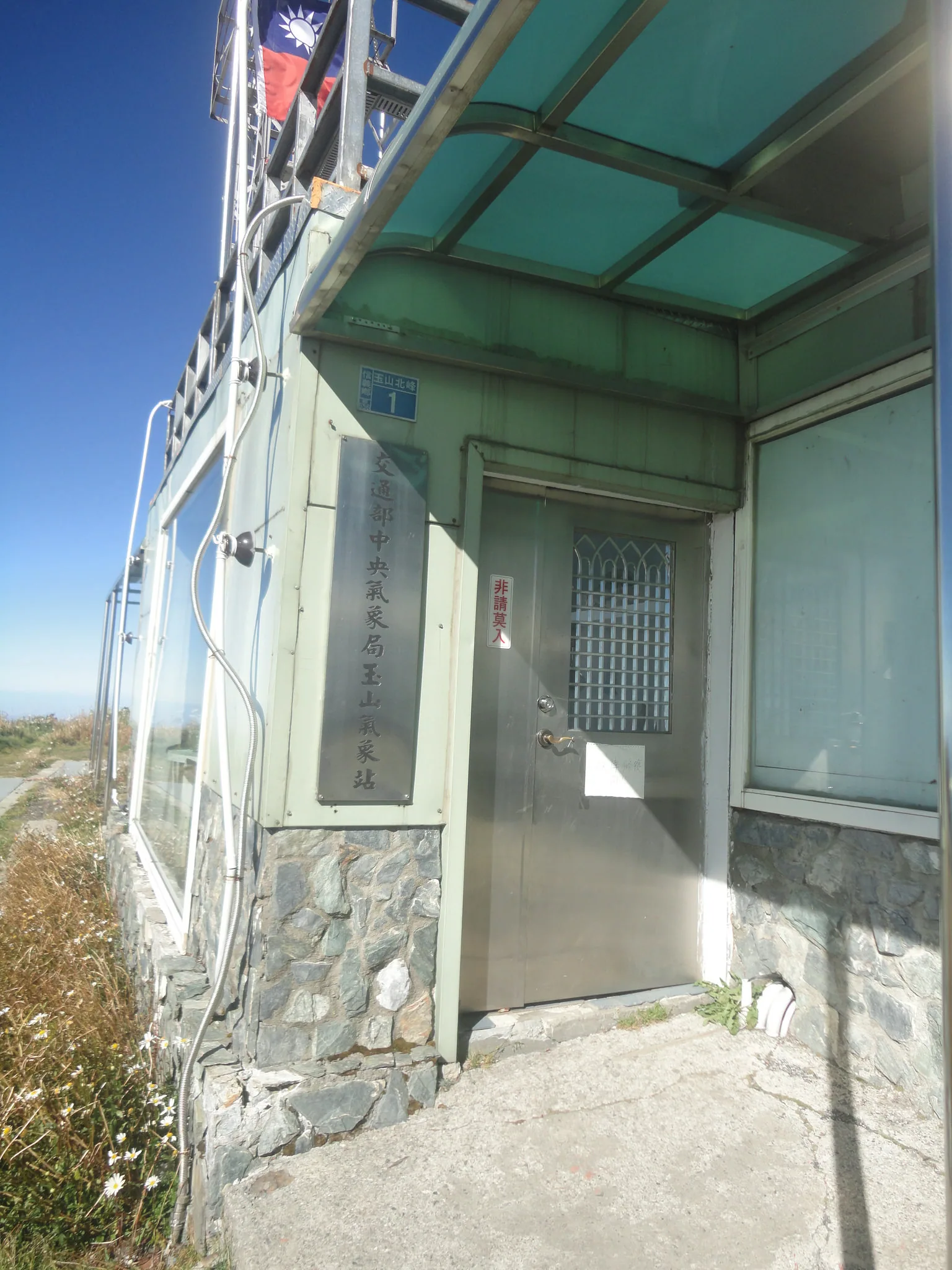
Exterior view of Yushan Weather Station. Photo: Chungeric0713/Wikimedia Commons, Public Domain.
The Island in the Clouds and Daily Life: A Test for Modern Humans
For most people, Yushan North Peak is a magnificent sight glimpsed by hikers challenging Taiwan's highest peak; but for the observers and workers stationed there, it is the highest-altitude office and living quarters in all of Taiwan 7 6. The weather station typically maintains a three-person crew—one observer and two workers. Each person stays on the mountain for one month before descending for a month's rest, operating in shifts of three 6.
At an altitude of 3,858 meters, the air is thin, with pressure only half that of the plains; altitude sickness and headaches are the first tests for newcomers. However, what is more suffocating than oxygen deprivation is solitude. There is no convenience store here, nor readily available fresh water; domestic water relies entirely on filtering rainwater and snowmelt collected from the roof. Bathing and cooking require meticulous rationing of every drop of water and gas 8. Whenever a winter blizzard strikes, icing and landslides cut off the weather station from the world, and observers feel as if they are wrestling with death between cliffs just to commute or check instruments 9.
In terms of supplies, early operations relied entirely on human carrying. Each monthly shift change and resupply is an extreme test of physical strength and willpower. Workers must carry dozens of kilograms of rice, gas cylinders, vegetables, and instrument parts, climbing up from the Tatag trail entrance along steep scree slopes and wind tunnels. In recent years, although some heavy supplies and emergency parts have been airlifted, helicopters often cannot land smoothly due to the unpredictable air currents at Yushan North Peak, meaning a significant portion of daily consumables must still be maintained by human labor 1.
📝 Curator's Note: In today's era of digitized and automated meteorological observation, many ask: why are people still risked their lives to guard the summit? The answer lies in moments of extreme weather. When instruments freeze or are paralyzed by lightning strikes, automated equipment cannot self-rescue; only hands standing in the wind and snow can de-ice the instruments with hot water and hammers, ensuring that Taiwan's typhoon warnings and heavy rain forecasts do not go silent 10 8.
To help readers more intuitively understand the spatial configuration and daily challenges of the Yushan Weather Station, we can examine its core characteristics through the following comparison table:
| Item | Historical Development and Actual Operation | Core Challenges and Response Strategies |
|---|---|---|
| Geographical Coordinates | Yushan North Peak in Xinyi Township, Nantou County (3,858 meters) | Surrounded by steep cliffs; isolated terrain with extremely high winds 2 5. |
| Construction History | October 1, 1943 (New High Mountain Observatory during Japanese rule) | Established for WWII military meteorological needs; taken over by the Central Weather Bureau post-war 1 3. |
| Personnel Structure | Three-person crew (1 observer, 2 workers) | Shift system of 1 month on duty, 1 month off 6. |
| Supply Logistics | Early reliance on human carrying; currently supplemented by helicopter resupply | Water relies on rainwater and snowmelt collection; power and communication require high self-sufficiency 1 8. |
The Scientific Frontline Battling Lightning: Manual Vigil in Snow and Wind
Yushan North Peak is not only high but is also a famous "lightning zone" in Taiwan. Due to its prominent location and unique terrain, summer afternoon thunderstorms and convection are vigorous, making the weather station a frequent target for lightning strikes 11.

Landscape around Yushan North Peak. Photo: Dragons70c/Wikimedia Commons, CC BY-SA 4.0 12.
Senior observation technician Hsieh Chin-tian recalled during an interview that over decades of service at the station, he experienced countless heart-stopping thunderstorms 9 11. The most severe incident occurred in April 2003, when a powerful lightning bolt directly struck the weather station. The massive roar instantly shattered indoor equipment, causing total electrical failure and leaving scorch marks on the walls 11. However, after the strike, the observer's first instinct was not to retreat but to immediately check instruments, manually record data, and try to transmit real-time meteorological data back to the Taipei headquarters via backup communication. To them, a break in meteorological data could mean countless people below cannot prevent disasters in time; this sense of mission far outweighs the fear for their own safety.
Besides lightning, winter snow is another long battle. When temperatures drop below freezing, strong cold fronts carrying moisture wrap the anemometer, rain gauge, and antenna outside the station in thick rime ice and frost. At this time, observers must wear heavy cold-weather gear and risk falling off a cliff while holding kettles and tools to knock off and melt the ice layers on the instruments. This high-mountain life, jokingly dubbed "modern primitive," is filled with hardships and dangers that outsiders can hardly imagine 7 10.
To alleviate the long and highly tense mountain life, observers have developed a unique aesthetic and human touch at the North Peak. The station has an inside joke nickname: "3858 CAFE." Occasionally, visiting friends or superiors get to drink hot tea in this corner—the highest and most isolated place in Taiwan 13 9.
| Period/Year | Historical Evolution and Name Change | Core Function and Historical Significance |
|---|---|---|
| October 1943 | Established as "New High Mountain Observatory" during Japanese rule 1 2 3 | First observation post established at 3,858 meters to meet military and high-altitude aviation meteorological needs 3. |
| Early Post-War Period | Renamed "Taiwan Provincial Weather Bureau Yushan Observatory" 1 4 | The ROC government took over and continued high-mountain meteorological observation, gradually transforming into a core for civil life and weather forecasting. |
| August 1989 | Officially renamed "Central Weather Bureau Yushan Weather Station" 1 4 | Included in the national meteorological observation network; the building was renovated and a helicopter pad was added in the 1990s 1. |
| Contemporary | Central Weather Administration Yushan Weather Station 1 | The highest weather station and administrative agency in Northeast Asia, combining automation and manual maintenance to guard Taiwan's extreme climate defense line 7 6. |
The Scientific Frontline Battling Lightning: Manual Vigil in Snow and Wind
The establishment of the Yushan Weather Station is not just an extension of science and technology; it is a microcosm of Taiwan's modern political and social changes. During the Japanese colonial period, the Governor-General selected Yushan North Peak as the observation site to control high atmospheric circulation across Taiwan and East Asia. The construction materials and precision instruments at the time were carried up step-by-step by hundreds of Taiwanese indigenous people and Japanese technicians. This arduous project laid the foundation for high-mountain meteorological observation in Taiwan.
After the war, the ROC government took over the weather facilities, renaming and reincorporating them into the Central Weather Bureau's jurisdiction. As Taiwan's economy boomed and technology advanced, the mission of the Yushan Weather Station gradually evolved from simple manual visual observation to a comprehensive base that includes automated meteorological sensing, satellite imagery reception, high-mountain environmental monitoring, and earthquake reporting. However, technological upgrades have not replaced human value. Because the climate at Yushan North Peak is extremely severe—winds often reach light typhoon levels or higher, and heavy snow falls in winter—any automated instrument is highly susceptible to failure when faced with hail, lightning, or blizzards. The presence of observers is precisely to manually repair and visually calibrate equipment during critical moments when technology fails, ensuring the continuity and accuracy of the national meteorological database 11 8.

View of Yushan North Peak Weather Station from the ridge. Photo: Wen Wenyou/Wikimedia Commons, CC BY-SA 4.0.
The Nameless Heroes Behind the Meteorological Data: Solitude, Dedication, and Historical Inheritance
In the work logs of the Yushan Weather Station, every page is densely recorded with temperature, atmospheric pressure, relative humidity, wind direction, and wind speed. These seemingly dry data are indispensable keys for Taiwan to prevent natural disasters such as typhoons, heavy rains, and cold waves. Whenever the Central Weather Administration issues a maritime or land typhoon warning, the Yushan Weather Station—located at the first point of landfall or in the outer circulation zone—becomes Taiwan's most frontline "whistleblower."
Yet, outsiders often only see the results of meteorological forecast accuracy but rarely grasp the cost required to maintain this data. Observers on the mountain must face severe physiological limits. Living long-term at high altitudes not only places a great strain on the heart and lungs but also significantly reduces sleep quality due to low pressure. But the deeper test is the psychological pressure of isolation. In an era before communication equipment was as advanced as it is today, the weather station's link to below was only by radio; when heavy snow seals off access or helicopters cannot land, personnel may be unable to descend for shift changes on schedule, having to survive for several weeks at the summit with limited rations.
Because of this, every staff member at the Yushan Weather Station has left an indelible mark in Taiwan's meteorological history. They are not heroes under the spotlight; they are nameless guardians who silently build a windbreak for this island with their flesh and blood.
Modernization and Future Challenges of High-Mountain Meteorology: Guarding Taiwan Amid Global Change
Entering the 21st century, global climate change has intensified, leading to frequent extreme weather events, making the role of high-mountain meteorological stations more critical than ever. The Yushan Weather Station not only continuously provides ground meteorological elements but is also gradually expanding its participation in international atmospheric and environmental change research networks. Through long-term monitoring of temperature, precipitation, and atmospheric components, scientists can accurately analyze the specific rate at which Taiwan's high-mountain ecosystems are impacted by global warming.
Looking ahead, the Yushan Weather Station continues to introduce digital automated sensing and satellite communication equipment with higher weather resistance to reduce the risk of observers having to frequently go out for maintenance during extreme weather; simultaneously, the Weather Administration actively promotes the preservation of high-mountain meteorological history and popular science education, allowing the public to see how this scientific fortress, hidden in the clouds at 3,858 meters, protects the safety of all Taiwanese citizens through documentaries and special reports. This long-term observation also means that high-mountain precipitation data is no longer just a record kept inside the weather station but forms the basis for understanding Yushan's hydrology and mountain environment 1.
Why Meteorological Data Cannot Be Interrupted: The Public Nature of a Mountain Station
The importance of the Yushan Weather Station lies not only in its proximity to Taiwan's highest peak but also in the fact that it connects an observation altitude unavailable on flat ground into the national meteorological network. The Weather Administration lists the Yushan Station as one of its affiliated stations, and the station affairs page records its location, altitude, and administrative history; the Taiwan National Science Education Center places it within the historical context of central and southern Taiwanese observation stations, noting that it is also the highest building and administrative agency in Taiwan 1 2. In other words, this place is not just a scenic spot for hikers, but where meteorological data continuously accumulates at an extreme altitude under extreme weather.
This altitude changes the meaning of "routine work." On flat ground, checking sensors might just mean opening the equipment room door; on North Peak, checking instruments means first assessing the wind, snow, visibility, and ground icing conditions before deciding whether to leave the station building. When ice covers the instruments, observers cannot just wait for the weather to recover; they must process the equipment according to the local conditions and cross-check manual observations with instrument readings 2 5. These actions do not have a dramatic endpoint, only the arrival of the next observation time; the value of the weather station lies in this inconspicuous continuity.
The work at high-mountain stations thus requires both professional training and life skills. Station staff do not just read meteorological elements; they must understand the high-mountain environment, maintain communication, manage supplies and equipment, and adjust daily routines when resupply or shift changes are hindered. Field reports from Taiwan Lianhe and United Daily News focus on these details: how personnel face snow, lightning, supply limitations, and long periods away from home, rather than just writing Yushan as a "successful challenge" summit 7 13 9. The observation numbers and life experiences meet in the same station building; the former enters the forecasting system, while the latter determines whether the data can be generated on time.
Still Human After Automation
Modern meteorological observation heavily utilizes automated sensors and remote transmission, but "automated" does not mean "maintenance-free." Wind and snow change the state of exposed equipment parts; lightning may damage power and communication systems; and extreme environments require manual interpretation of sensor readings. The history of the Yushan Weather Station is not one where human observation was replaced by technology, but rather a process where humans and automation gradually specialized: instruments are responsible for stable recording, while staff are responsible for verification, repair, and on-site judgment during anomalies 1 2.
This is why the Yushan Weather Station should not be understood merely as "the highest building." The building keeps people and equipment on the peak, and the data links the peak's forecasts, research, and disaster prevention to the plains; without both, the post is just a geographical record. From the New High Mountain Observatory in 1943, to the Yushan Observatory post-war, and to today's Weather Station, changes in names reflect shifts in administrative systems, while continuous observation maintains a scientific context that transcends these systems 1 4 3.
Therefore, what the staff guards is not an abstract "first place," but a public service that must be completed anew every day. People below do not need to know at what time each de-icing occurred or what weather was encountered during each shift change; they only need to receive reliable information before typhoons, cold waves, or heavy rains arrive. This information can be trusted only if someone completes the observation work in the most difficult-to-access location 14 5. Thus, what is most worth remembering about the Yushan Weather Station is not its "highest" title, but how it transforms arduous fieldwork into public data that everyone can use: the wind and snow on the summit eventually become a forecast, a warning, or an early evacuation decision below, bringing abstract meteorological data back into people's daily lives and public safety.
How a Mountain Station Becomes a Node of Long-Term Data
Another time scale in weather station work is often overlooked: a single observation can only answer the weather at that moment; it is the accumulation of observations over many years that can answer seasonal variations, cold/warm changes, and precipitation distribution. The inclusion of the Yushan Station in the meteorological network means that high-altitude data is not scattered anecdotal accounts from hikers but records generated according to a system, preserved, and comparable with other stations 1 2. This comparison requires a stable station location, fixed observation procedures, and someone who leaves notes when equipment malfunctions, rather than treating incomplete data as complete results.
The altitude of Yushan North Peak gives it special observational value, making the cost of obtaining data far higher than on the plains. Official materials from the Weather Administration provide administrative positioning for the station, while historical articles supplement the background of its establishment and high-mountain environment; viewing both types of material allows one to understand that the Yushan Station is not merely a commemorative building but a continuously operating public infrastructure 1 4 3. Its "height" is not the end of the story, but the starting point for why it must be established here and why maintenance work is so difficult.
In terms of data quality, manual observation still has a function that automated equipment cannot fully replace: when readings do not match local weather conditions, staff can record details about rime ice, icing, lightning strikes, or equipment status to provide context for subsequent interpretation. Interviews from United Daily News and Taiwan Guanghua make this context concrete through the daily details of shift changes, resupply, maintenance, and waiting for weather permission 5 13. These are not columns on a meteorological data sheet, but crucial background information for judging how data was generated and at what moments it might have been interrupted.
From Observatory to Network: The Journey of One Data Point
Placing the Yushan Weather Station back into Taiwan's meteorological history reveals that it is not an isolated summit facility. The Taiwan National Science Education Center organizes the construction history of the weather station network, placing the Yushan Station within the context of the gradual formation of stations in central and southern Taiwan; official materials from the Weather Administration place current station affairs, administrative affiliation, and observation functions within a single administrative system 1 2. The station thus has two identities: it is a workplace on the high mountain site, and it is a node in the national observation network at a high altitude.
When a piece of observational data leaves Yushan North Peak, it does not lose its field background just by entering a digital system. It still needs to know the altitude where the station is located, the condition of the instruments, the weather at the time of observation, and whether the data was affected by icing, lightning strikes, or communication failures. These conditions show that the credibility of meteorological data comes not only from the numbers themselves but also from the traceability of the process that generated those numbers. Official affairs pages, historical materials, and interviews with staff each provide different levels of evidence, which together form a more complete record of the Yushan Station 1 2 5.
This multi-layered data chain reminds readers not to misunderstand "automated observation" as "unmanned observation." Automated equipment can shorten transmission time, but it cannot replace frozen parts, judge the status of equipment after lightning strikes, or reschedule life when resupply is delayed. The maintenance performed by on-site personnel is not just about forecast content; it directly affects whether data continues to appear. The repeated mentions of de-icing, repair, shift changes, and resupply in interviews are the actual costs of this system 7 13 9.
From a preservation perspective, the Yushan Weather Station should also be understood as a "historically used place." The name and system established in 1943 were later changed, but the station's function has been continuously carried on across different eras. This makes it not just an exhibit of past architecture, but a place that is still related to public forecasting, disaster prevention, and climate research every day 4 3. The weather warnings seen below are actually part of the same public service chain as the observations, maintenance, and records kept in the station building on the summit.
Conclusion: Eternal Vigil in Wind and Snow
From the wooden house during Japanese rule to today's robust modern observation station, the Yushan Weather Station has witnessed the trajectory of Taiwan's meteorological science from zero to one. Behind every temperature, atmospheric pressure, and wind direction reading uploaded are the footprints left by countless observers in sub-zero temperatures, strong winds and snow, and solitude. When people on the plains close their doors during a typhoon and live peacefully thanks to weather forecasts, few remember that at 3,858 meters above the clouds, several "modern humans" are silently de-icing the frozen anemometer while wrapped in heavy clothes with kettles 7 10. The Yushan Weather Station is not just a collection point for cold scientific instruments; it is a spiritual coordinate on Taiwanese land, reminding people to maintain reverence before nature and to uphold their duties amidst extremes and solitude.
Further Reading
- Yushan: From "New High Mountain" to the Highest Point of Taiwan's Soul — A deep dialogue exploring the natural ecology of Yushan peaks, the history of indigenous sacred mountains, and contemporary mountaineering ethics.
- Taiwan Official Website Resources — Information on various public data from Taiwanese government agencies and official data sources for meteorological and geographical observation networks.
Image Sources
All three images are freely licensed materials; authors, licensing terms, and original file pages are listed below. The first image (hero) is cached in public/article-images/geography/ to avoid hotlinking to the source server, while the other two still link directly to the original files on Wikimedia Commons.
- Yushan Weather Station.jpg — Chungeric0713, 2016, Public Domain; local cache file used in the body text.
- Yushan Main Peak 07.jpg — Dragons70c, CC BY-SA 4.0; original Wikimedia Commons link used in the body text.
- Yu-Shan National Park(WDPA-9030)-PeterWen-4.jpg — Wen Wenyou, CC BY-SA 4.0; the image page states that the content is Yushan North Peak Weather Station, and the original file link was used in the body text.
References
- Central Weather Administration: Yushan Weather Station — Official station affairs page detailing the altitude, history, administrative affiliation, and renovation information of the Yushan Weather Station.↩23456789101112131415161718
- Taiwan National Science Education Center: Construction and Evolution of Our Country's Meteorological Observation Network (II) — A special article from the National Taiwan Science Education Center compiling the establishment history of central and southern Taiwanese observation stations and the high-mountain working environment of the Yushan Station.↩23456789
- Taiwan Guanghua Magazine: The "Highest" Agency—Yushan Weather Station — A special feature in Taiwan Guanghua recalling the background of the observatory's establishment, early personnel structure, and living conditions at the high-mountain station.↩2345678
- Central Weather Administration: Promotion and Cultural Heritage — Official promotional materials from the Weather Administration introducing the history of meteorological services in Taiwan and the preservation context of weather buildings.↩23456
- United Daily News Online: Guarding the Yushan Weather Station for 30 Years, Commuting is a Gamble — An interview and field report recording the experience of long-term observers, resupply, and extreme weather risks.↩23456
- United Daily News Online: Guarding the Yushan Weather Station for 30 Years, Commuting is a Gamble — An in-depth interview that supplements firsthand accounts of observer shifts, environmental risks, and high-mountain station affairs.↩2345
- United Daily News: Different Reunion! Taiwan's Highest Dinner at 3858 Meters, Yushan Weather Personnel — A report on the shift life, holiday duties, and high-mountain working environment of the stationed personnel.↩23456
- Taiwan Guanghua Magazine: The "Highest" Agency—Yushan Weather Station — A historical feature article recording the early establishment, supply transport, and living conditions inside the observatory.↩234
- Wagas: Guarding the Yushan Weather Station for Thirty Years, Revealing Hardship and Glory — An article page featuring a senior observer, supplementing the observation work, service years, and high-mountain living experience of the Yushan Station.↩2345
- Taiwan Guanghua Magazine: Modern Humans—A Record of Life at Yushan Weather Station — A field record article explaining the de-icing, lightning strikes, and daily life details of observers at the high-mountain station.↩23
- Central Weather Administration: Yushan Weather Station — Official station affairs page providing data on the establishment, administrative history, and institutional positioning of the Yushan Station.↩234
- Wikimedia Commons: File: Yushan Main Peak 07.jpg — English Wikimedia Commons file page recording the image creator, the original file, and the Creative Commons Attribution-ShareAlike 4.0 license.↩
- Taiwan Guanghua Magazine: Modern Humans—A Record of Life at Yushan Weather Station — A field record from Taiwan Guanghua depicting the maintenance, photography, and daily life details of observers on the mountain.↩234
- United Daily News: Chen Shih-kai Consoles Yushan Weather Station Personnel with Promise to Continue Providing Resources — A news report from 2026 recording the modern administrative functions of the Yushan Weather Station and the working conditions of its personnel.↩
