
In 1909, the Wan Zhuang Soy Sauce Factory was established in Xiluo, Yunlin. More than a century later, soy sauce continues to flow through the kitchens of Taiwanese families.1
A vat of black-bean miang oil typically requires four to six months of sun-curing, yet there is also an industrial line of soybean-wheat soy sauce that relies on automated equipment and stable mass production.2
The same dark brown liquid may be the base flavor of braised pork rice, the final spoonful of a soy sauce egg, or the convergence point of a local factory, farmers’ contracts, and an imagined taste of the “old days.”
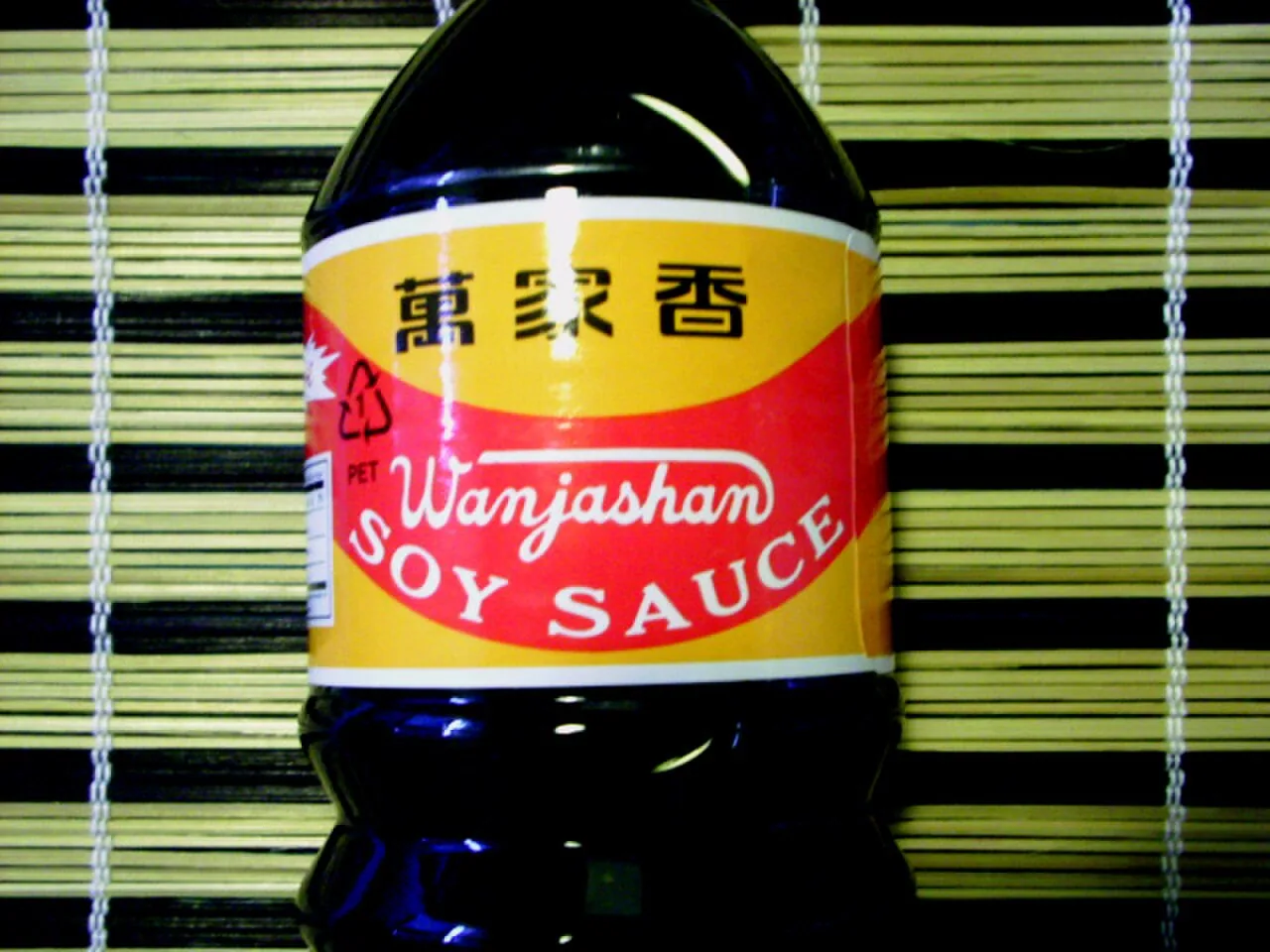
Caption: A bottle of Wanjashan soy sauce made in Taiwan. Photo by VeganWarrior, Wikimedia Commons, CC BY 2.0. See “Image Sources” at the end of the article for full source and licensing information.
Soy Sauce Is Not a Flavor
Taiwanese cuisine rarely puts soy sauce in the spotlight. Unlike main dishes, it is not served on the table, and unlike chili peppers, it does not loudly announce its presence. It usually just drizzles over vegetables, seeps into stews, or waits to be dipped alongside dumplings. Yet in Taiwanese daily language, the words “braise” (lu), “stew” (kao), and “deep-fry” (e) all point to cooking methods where soy sauce serves as a key seasoning base.2
Taiwanese soy sauce has at least two major lineages: the traditional fermented product centered on black beans, often called miang oil, and the soybean-wheat soy sauce. The former is usually made with whole black beans, yeast cultures, salt, and sunlight, slowly aged. The latter was established through industrialization, creating a more easily stabilized and scalable production method.23
This distinction is not simply “handmade is better, factory-made is worse.” The time and locality of black-bean miang oil allow it to retain strong flavor memories. Soybean-wheat soy sauce responds to the needs of urban families, the catering industry, and large-scale supply. The story of Taiwan soy sauce is precisely that both lines coexist, rather than one replacing the other.
📝 Curator’s note: If we simply write soy sauce as “the taste of Taiwan,” we miss a more interesting question — which soy sauce, from which place, and from which era determined what people call the “taste of Taiwan”?
How a Single Black Bean Becomes Miang Oil
Food science papers studying Taiwan’s black-bean miang oil break the process into: soaking beans, making yeast cultures, washing yeast, temperature control, salting and filling vats, sealing, and sun-fermenting to maturity. These steps sound simple, yet together they determine how microorganisms, temperature, moisture, and time transform into aroma.4
In the traditional narrative of Xiluo soy sauce, the process also includes stirring yeast, adding water, filling jars, two rounds of wood-fired heating, filtering, pressing, bottling, and high-temperature sterilization — nearly twenty steps in total.5 “Slow” does not mean doing nothing. It is a series of actions that require watching, adjusting, and waiting.
Sun-curing is not romantic background. Xiluo soy sauce makers treat the irrigation of the Zhuoshui River, groundwater, low rainfall, and not overly humid environments as suitable conditions for brewing.5 Light, climate, and containers are therefore not merely natural factors outside production equipment, but part of the flavor itself.
However, Taiwan does not have a single unchanging “traditional method.” The Liberty Times reported that small soy sauce factories in Yilan time their brewing to the clearer weather between the Dragon Boat Festival and Mid-Autumn Festival. Factories in Dongshi, Taichung, adopt brine brewing that requires daily stirring due to differences in sunlight exposure. The sweeter taste of southern Taiwan also shows up in soy sauce recipes and usage habits.1
During the Japanese Colonial Period, Another Kind of Soy Sauce Entered Taiwan
The black-bean brewing tradition did not cover all of Taiwan’s soy sauce. Food culture research points out that during the Japanese colonial period, the Japanese introduced soybean-wheat soy sauce techniques and established larger-scale soy sauce factories.2 After the war, these techniques overlapped with existing local brewing industries and other imported factory experiences.2
The advantages of soybean-wheat soy sauce lie in scale, stability, and supply speed. Papers studying black-bean yeast cultures also note that soybean-wheat soy sauce adopted automated equipment introduced from Japan earlier, while miang oil still relied more on traditional manual yeast-making, thus facing limitations in output and labor costs.4
This makes “tradition” no longer simply a synonym for “ancient.” It also means who has the capacity to endure long fermentation, who can maintain hygiene and storage conditions, and who can deliver sufficient quantities when the market demands it.
In the 1980s, urbanization and food safety incidents changed consumers’ trust in soy sauce. Large-scale soybean-wheat soy sauce factories were favored due to their production lines and quality control advantages. On the other hand, when additives and the food industry came under scrutiny, consumers once again sought the “pure fermentation” and local memories represented by miang oil.2
📝 Curator’s note: Taiwanese nostalgia for miang oil is sometimes not a memory brought directly from farmhouse soy sauce vats, but a memory preserved and returned to us by advertisements, media, and local brands.
Why Xiluo Became the “Soy Sauce Capital”
Xiluo’s soy sauce landscape gives a bottle of seasoning a destination. A report by The World of Soochow University noted that Xiluo once had more than ten soy sauce factories. Local businesses treated the irrigation of the Zhuoshui River, groundwater, and climate conditions as important foundations for the development of the soy sauce industry.5
Local industries did not survive on natural conditions alone. Competition among factories drove differences in quality and branding. Factory tours turned processes once hidden in the back into observable and experiential culture.5 Soy sauce thus transformed from a transparent bottle in the kitchen into a jar that tourists could visit, a fermenting mash they could smell, and a souvenir they could take home.
This transformation also appears in schools. The food and agriculture education program at Xinzhuang Wenchang Elementary School in Xiluo lets students grow black beans, brew soy sauce, and then practice marketing and sales. By the time the report was published, the curriculum had already run for eight years.5 Here, inheritance is not about sealing “traditional methods” in a museum, but letting the next generation understand which people, which lands, and which steps are needed for a bottle of soy sauce.
The photo of a soy sauce bottle taken in 2006 captures another side beyond the production site: the brand label, the shape of the bottle, and the “Made in Taiwan” text are all ways of identifying soy sauce after it enters households. It is not proof of the brewing process in Xiluo’s soy vats, nor can it alone prove the history of any particular brand. It is more like a slice of an everyday object, reminding us that local flavors must ultimately be recognized through packaging, distribution channels, and consumption habits.
The connection between place of origin and raw materials is also changing. The Ministry of Agriculture’s Southern District Office compiled cases of domestically produced soybean soy sauce in southern Taiwan, introducing soybeans from Pingtung, Tainan, Chiayi, and Kaohsiung, as well as how organic or traceable soybeans are woven into narratives from farm to table.3
Taiwan soy sauce is therefore not limited to the geographical imagination of “Xiluo black beans.” It can also be the contract soybeans of southern Taiwan, the short-term brewing of Yilan, the technical choices formed by Dongshi’s sunlight exposure, or the local brand that a household has consistently purchased for years.13
Reading the Words on the Bottle
When facing soy sauce on supermarket shelves, the most common misunderstanding is to equate “black bean” directly with flavor, or to equate “traditional” directly with quality. A more reliable way to read it is to break the bottle down into several questions: What is the main ingredient — black beans, soybeans, or wheat? Is it primarily brewed through fermentation, or does it contain added seasonings, thickeners, or sweeteners? Does the labeled salt content and usage context fit one’s dietary habits?
“Miang oil,” “soy sauce paste,” and “seasoned soy sauce” cannot be distinguished by color alone. The Liberty Times classified them as different product types in the Taiwan market. Their differences in ingredients, concentration, sweetness, and usage will directly change the amount needed when dipping, drizzling, braising, or stir-frying.1 Names are just an entry point; the actual labeling and culinary usage are the basis for choice.
This is also why a seemingly ordinary bottle of soy sauce in a photograph cannot be used to represent all of Taiwan’s soy sauce. The bottle only presents a moment of brand and product. The complete cultural context can only be read by placing it back into raw materials, microorganisms, local factories, and family dining tables.
“Pure Fermentation” Cannot Replace All Answers
Food labeling and production technology allow consumers to distinguish between different products. However, cultural memory often compresses complex choices into the two words “traditional” and “chemical.” A report by Soochow University pointed out that businesses do not necessarily frame the two methods as mutually exclusive, but rather place the need for quick production alongside the flavors of traditional brewing, leaving the final judgment to consumers.5
What truly needs to be seen is the cost behind each choice. Long fermentation requires space, labor, and waiting. Large-scale production pursues stability, price, and supply. Salt reduction involves trade-offs between shelf life and flavor balance. The Food Culture Foundation summarized today’s soy sauce challenges as a tug-of-war between salt reduction, taste, and preservation.2
Therefore, reading “black bean,” “soybean-wheat,” “brewed,” or “low-sodium” on a bottle is not just about choosing flavor, but also about understanding a system of production relationships. The Ministry of Agriculture’s emphasis on traceability and non-GMO appeals for domestic soybeans also shows that choices in soy sauce can be traced all the way back to where the raw materials come from, how they are verified, and who benefits from the industry.3
The Taiwan Society of Food Science and Technology recorded that the Wan Zhuang factory, founded in 1909, simultaneously preserved both black-bean and soybean-wheat brewing techniques, and in 2008 established a soy sauce industry sightseeing factory.6 This case shows that preserving tradition and facing the modern market do not necessarily contradict each other. Tradition can also be reorganized through branding, education, tourism, and new products.
Soy Sauce Also Deals with the Contradiction of “Salt”
The most direct sensation of soy sauce is saltiness, but its role in cooking goes beyond that. It provides color, aroma, umami after fermentation, and a matured sense after caramelization. When people demand salt reduction, the issue is not simply lowering the number, but how to preserve the recognition that “a drop of soy sauce makes the dish taste like home.” The Food Culture Foundation regards salt reduction, taste, and storage conditions as ongoing challenges for the soy sauce industry.2
For families, this contradiction can be translated into more concrete usage: treat soy sauce as the final aroma adjustment, rather than letting the saltiness of an entire pot of soup depend on it. Taste the original first, then decide whether low-salt, miang oil, or soy sauce paste is needed. This is not a recommendation for any particular brand, but rather pulling the act of “choosing soy sauce” back to the cooking scene.
From the long-term fermentation in black-bean vats to the easily readable labels on bottles, Taiwan soy sauce has always been working between two speeds: brewing requires waiting, but eating only takes one second. Its cultural weight comes precisely from this gap.
Three Kinds of Time in One Bottle of Soy Sauce
The history of soy sauce can be read through three kinds of time. The first is brewing time: soaking black beans, making yeast, filling vats, and sun-curing, handing the raw materials over to microorganisms and seasons to slowly change. The second is industrial time: the soybean-wheat techniques introduced during the Japanese colonial period, post-war factoryization, and later concerns about food safety and salt reduction, constantly rearranging “how things are made.” The third is table time: a bottle of soy sauce poured into a bowl in one second, compressing the first two kinds of time into a familiar aroma.24
| Time Scale | Key Actions in the Article | Cultural Meaning Visible to Readers |
|---|---|---|
| Brewing Time | Making yeast, filling vats, sun-curing, aging | Terroir and microorganisms jointly shaping flavor45 |
| Industrial Time | Technology introduction, automation, branding and tourism | Tradition is not stuck in the past, but continuously adjusting26 |
| Table Time | Dipping, drizzling, braising, stir-frying, and salt-reduction choices | Local industry finally entering family daily decisions13 |
These three kinds of time also explain why soy sauce is worth writing about as a cultural article. If we only talk about the process, it becomes a food craft; if we only talk about brands, it becomes a product introduction; if we only talk about nostalgia, it is easy to romanticize a complex industry. Only by putting the three kinds of time together can we see how Taiwan soy sauce is simultaneously technology, commodity, and memory.
What One Bottle of Soy Sauce Leaves Behind
Returning to the dining table, soy sauce still seems unimportant. It does not need to be tasted on its own, yet it leaves traces in the color of braised pork rice, the edges of fried eggs, and the aroma of blanched vegetables. The Liberty Times classified black-bean soy sauce, soybean-wheat soy sauce, soy sauce paste, and seasoned soy sauce as different types commonly found in the Taiwan market, also reminding us that “soy sauce” has never been a single flavor.1
It is more like a reduced map of Taiwan: the brewing context brought by Hokkien immigrants, the soybean-wheat techniques introduced during the Japanese colonial period, post-war industrialization, the local industries along the Zhuoshui River, the soybeans of southern Taiwan, and the urban families’ re-evaluation of safety and health — all meet in the same bottle.234
So, the next time you pick up a bottle of soy sauce, don’t rush to ask whether it is “the oldest.” A better question is: what beans does this bottle use? Where was it brewed? How long did it take? Which cooking method does it serve, and whose life does it carry forward?
When a bottle of soy sauce allows us to see sunlight, microorganisms, factories, schools, and families — and not just saltiness — it is no longer merely a supporting role. It is the common language left behind by Taiwan’s constant adjustment of immigrant techniques, local terroir, and daily choices.
Image Sources
Photo: Wanjashan soy sauce VeganWarrior.jpg, by VeganWarrior (Flickr user page credited to Virginia García), Wikimedia Commons; original file: 640 × 480 JPEG, licensed under Creative Commons Attribution 2.0 Generic (CC BY 2.0). This article did not modify the image content.
Sources
- Su Liying, “ — Taiwan Liberty Times feature article↩23456
- Chen Jianyuan, “ — China Times Food & Culture Foundation column↩234567891011
- Ministry of Agriculture Southern District Office, “ — see original link for supplementary text data↩23456
- Lv Weichen, “ — see original link for supplementary text data↩2345
- Wang Ziying, Su Peiyu, “ — see original link for supplementary text data↩234567
- Taiwan Society of Food Science and Technology, “ — see original link for supplementary text data↩2