
30-second overview: The axis on which Taiwanese beef noodle soup emerged was the waishengren immigrant communities that arrived after 1949. Veterans from Sichuan, Shandong, and Hunan brought beef-cooking techniques from different Chinese provinces, which fused with local tastes into styles such as braised, clear-broth, and tomato beef noodle soup. In 2005, the Taipei International Beef Noodle Festival launched a city-branding campaign; in 2018, Taiwan’s first Michelin Guide included Liu Shandong, Niu Ba Ba, and Jian Hong among its recommendations; and the name “California Beef Noodle” entered North America. A bowl of noodles carries 75 years of shifting taboos, provincial intermingling, and sensory memory.
A steaming bowl of beef noodle soup, with its rich broth, tender beef, and springy noodles, has become one of Taiwan’s most representative national foods. This seemingly simple noodle dish carries the nostalgic memories of waishengren immigrants and bears witness to the history of ethnic integration in Taiwan. It rose from a street snack to a bright star on the international culinary stage: within a single bowl lies the pluralism and inclusiveness of Taiwanese food culture.
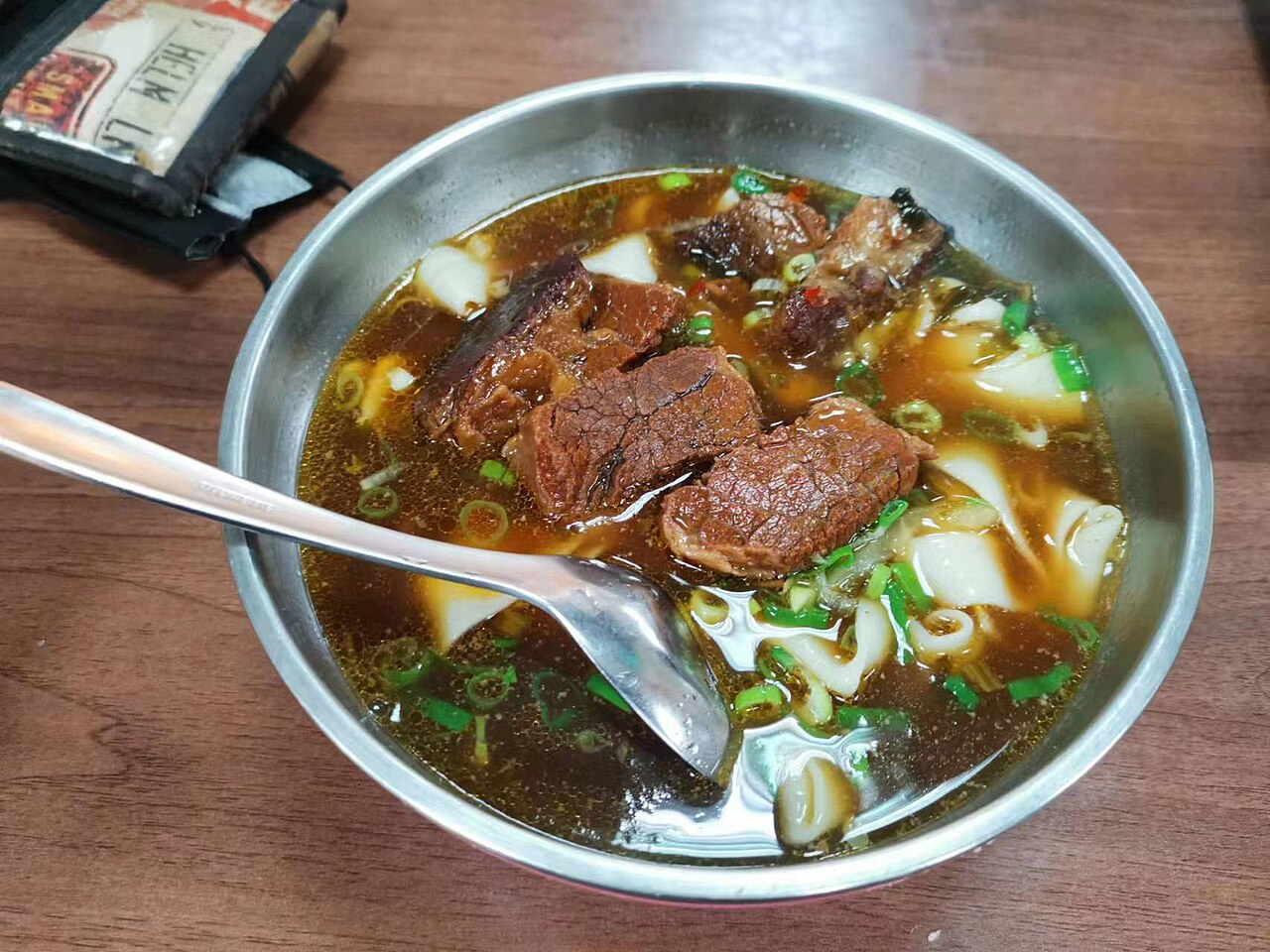
Image source: Wikimedia Commons | CC BY-SA 2.0 | Photographer unknown
Historical Origins and Cultural Context
From Taboo to Delicacy
During Taiwan’s agrarian period, there was a traditional belief that “cattle are helpers and must not be eaten.” Cattle were important partners in farming, and the folk custom of “not eating beef” was widespread. There was even a proverb, “Not eating beef is better than eating one’s own flesh,” reflecting deep respect for cattle.1
This dietary taboo underwent a major transformation after 1949. As the Nationalist government relocated to Taiwan, large numbers of soldiers and dependents migrated from various Chinese provinces, bringing different food cultures and cooking techniques, including the habit of eating beef.
A Nostalgic Creation of Waishengren Immigrants
The birth of beef noodle soup was a process of fusion and innovation. In the military, beef was an important source of protein. Retired soldiers brought stewing techniques learned in the army into civilian life and began preparing beef dishes in Taiwan. Military dependents’ villages became settlements for migrants from different provinces. Military families from Sichuan, Shandong, Hunan, and elsewhere exchanged hometown seasonings and cooking skills, gradually developing a version with distinctively Taiwanese features. Economically, early conditions were difficult, and many veterans made a living as street vendors. Beef noodle soup was relatively inexpensive to produce; one bowl could provide starch, protein, and vegetables at once, offering both nutrition and satiety, and it quickly became popular among the public.
The Fusion of Regional Flavors
Taiwanese beef noodle soup combines characteristics from multiple regional cuisines. Sichuan flavors use doubanjiang, or fermented broad-bean chili paste, and a range of spices, producing a bright red, numbing, spicy, and aromatic Sichuan style. Sichuanese veterans in Gangshan, Kaohsiung, were the main promoters of this school.2 Shandong people excelled at noodle-making and contributed high-quality noodle techniques to Taiwanese beef noodle soup; the pairing of Shandong flatbread and beef also became a classic combination. Hunan characteristics appear in the use of chili peppers and stewing methods, adding layers associated with Hunan cuisine. The final step was localization: in response to Taiwanese taste preferences, excessive heat was reduced while the balance of sweetness and umami was increased.
Major Schools and Flavor Profiles
After decades of development, Taiwanese beef noodle soup has formed several different schools and styles.
Braised beef noodle soup is a classic associated with the Taoyuan Street area of Taipei. Its broth is deep reddish brown; seasonings include soy sauce, doubanjiang, chili peppers, star anise, cassia bark, and other spices; and its flavor is savory, mildly spicy, and robust. In preparation, the beef is first stir-fried with soy sauce and spicy doubanjiang to develop color, then stewed in stock for two to three hours so the spices fully permeate the meat and the broth takes on a deep amber hue.
Clear-broth beef noodle soup takes a clean, transparent route. It uses only ginger, scallions, rice wine, and similar ingredients to remove gaminess and heighten freshness. Its flavor is fragrant, clean, and gently sweet on the finish, emphasizing the intrinsic taste of beef; this style has often been carried forward by halal shops run by Muslims. Beef-bone stock is simmered for a long time, with all impurities removed to keep the broth clear. The beef is stewed until tender while still retaining a fibrous meaty texture.
Tomato beef noodle soup is a relatively modern branch of innovation. It incorporates Western ingredients such as tomatoes, onions, and carrots, producing a bright red, tangy-sweet broth with rich textural layers. It represents a dialogue between Taiwanese food culture and Western ingredients while preserving the structure of an Eastern noodle soup. Original-broth beef noodle soup takes a minimalist route, using only beef, beef bones, water, and a small amount of seasoning. Its broth is milky white and rich, pursuing the purest possible beef flavor. Sichuan-style mala beef noodle soup uses authentic Sichuan doubanjiang and Sichuan peppercorns. It is numbing, spicy, fresh, aromatic, and clearly layered, retaining traditional Sichuan culinary traits.
Craft and Quality Factors
A good bowl of beef noodle soup requires a perfect balance among three elements: broth, meat quality, and noodles.
Making the Broth
Beef-bone stock:
Gelatin-rich parts such as leg bones and ribs are selected and simmered from cold water for six to eight hours. During this period, foam must be skimmed continuously to keep the broth clear.
Spice ratios:
More than a dozen spices, including star anise, cassia bark, Sichuan peppercorns, cloves, and tsaoko, must be precisely proportioned. Every shop has its own proprietary formula, a trade secret not shared with outsiders.
Seasoning balance:
The balance of salty, sweet, sour, and spicy is crucial. Taiwanese palates tend to prefer a slight sweetness, so seasoning must account for local taste expectations.
Selecting and Handling the Beef
In terms of cuts, beef shank, with its tendons and strong beef aroma, becomes springy after stewing and is the most common choice. Beef short rib fingers have a moderate balance of fat and lean meat and become tender and juicy after stewing. Pure lean beef cubes have a firmer texture. Gelatin-rich beef tendon requires longer stewing to reach a melt-in-the-mouth consistency. In the stewing process, the beef must first be blanched to remove blood and impurities, then stewed with spices for two to three hours until chopsticks can easily pierce it.
Choosing the Noodles
For noodle thickness, wide noodles suit rich braised broths, while thin noodles suit lighter clear broths. The springy texture of knife-cut noodles forms a school of its own and is widely loved. In noodle-making technique, good noodles need chew without hardness. Cooking time is controlled at two to three minutes to maintain the best texture.
Taipei Beef Noodle Festival and Internationalization
The Founding of the Beef Noodle Festival
In 2005, the Taipei City Government founded the “Taipei International Beef Noodle Festival” to promote Taiwanese beef noodle culture and raise its international visibility.3 Annual events include beef noodle competitions in categories such as braised, clear-broth, and creative styles; showcases of famous shops from across Taiwan; cultural activities such as exhibitions on beef noodle history and cooking demonstrations; and international promotion segments that invite foreign media and food writers to taste the dish. In competition standards, judges score broth, meat quality, noodles, and overall performance, selecting gold, silver, and bronze winners each year.
International Media Attention
International media attention:
Taiwanese beef noodle soup has received recognition from multiple international media outlets and food guides. As one of the key entry points for understanding Taiwan, its international visibility continues to rise.4
Michelin Guide:
After the Taiwan Michelin Guide was published in 2018, several beef noodle shops received recommendations, including:
- Liu Shandong Beef Noodles: Bib Gourmand
- Niu Ba Ba Beef Noodles: Michelin recommended
- Jian Hong Beef Noodles: recommended for local character
Overseas development:
Taiwanese beef noodle shops have opened branches in the United States, Canada, Australia, and elsewhere. There is even a “California Beef Noodle” brand, which in practice refers to Taiwanese-style beef noodle soup.
Diplomatic Soft Power
Beef noodle soup occupies a clear place in Taiwan’s cultural diplomacy:
- The Overseas Community Affairs Council promotes Taiwanese beef noodle soup abroad
- The Ministry of Foreign Affairs organizes Taiwanese food festivals overseas
- The Tourism Bureau lists beef noodle soup as a must-try food
Regional Characteristics and Famous-Shop Culture
The Taipei area is the central battleground of Taiwanese beef noodle soup. Taoyuan Street was a gathering place for halal beef noodle stalls in the 1950s and later gradually developed a Sichuan-style profile. The Yongkang Street commercial district is known for long-established shops such as Yongkang Beef Noodles, Lao Zhang Beef Noodles, and Pin Chuan Lan Beef Noodles. The Ximending area centers on beef noodle stalls around Lao Tian Lu braised foods and innovative flavors aimed at younger diners.
In New Taipei, Yonghe developed a distinctive business model combining soy milk shops with beef noodle soup, with 24-hour service meeting demand at different times of day. Around Fuzhong Station in Banqiao, multiple long-established shops gather, following an affordable route connected to night market culture.
In Taichung, beef noodle soup tends toward a cleaner flavor. The broth is lighter than Taipei’s but still layered. Representative shops include the chain Duan Chun Zhen Beef Noodles and the local long-established Fuhong Beef Noodles. In Tainan, because the old capital has a preference for sweetness, beef noodle seasoning also leans sweet. In Kaohsiung, Gangshan is the birthplace of Sichuan-style beef noodle soup. Sichuanese veterans founded an authentic Sichuan style there, with a higher level of numbing heat, and the area still preserves a heavier Sichuan profile today.
Cultural Meaning and Social Impact
The development of beef noodle soup fully presents the trajectory of Taiwan’s multicultural fusion. It broke the agrarian dietary taboo against eating beef and is a concrete example of Taiwan’s social openness and inclusiveness. The cooking techniques of waishengren immigrants combined with the taste preferences of benshengren, local Taiwanese, creating a distinctive Taiwanese flavor. Second- and third-generation immigrants inherited family businesses while continuing to innovate on traditional foundations in response to changing times.
Economically, the beef noodle industry has driven multiple layers of restaurant development, ranging from street stalls to high-end restaurants and serving every consumption level. It has also promoted a complete industry chain that includes Taiwan’s beef cattle farming, noodle-making, and seasoning industries. For tourism, beef noodle soup is also a must-try food for visitors and one of the core selling points of Taiwanese tourism.
In everyday culture, beef noodle soup is a dependable choice for lunch, dinner, and late-night meals in Taiwan. “Let’s go eat beef noodle soup” has also become a common invitation for gatherings with friends and business conversations. For many Taiwanese people, this bowl of noodles carries emotional value, including childhood memories and family warmth.
Innovation and Future Trends
In recent years, the beef noodle industry has extended in multiple directions. In the area of health, “healthy versions” with reduced salt and oil, organic ingredients, and a higher proportion of vegetables have appeared one after another. Flavor diversification has brought Japanese, Thai, Italian, and other international variants, as well as vegetarian versions using plant-based meat or mushrooms and extended versions that replace beef with seafood. On the service side, chain branding, more refined packaging and dining environments, and the spread of delivery platforms have all broadened the consumption settings for beef noodle soup.
In technological applications, some shops use equipment to control cooking temperature and time, ensuring quality consistency. Frozen packaging technology allows high-quality beef noodle soup to be delivered to homes or exported overseas. Social media and food apps have become major marketing channels for attracting younger consumers.
Challenges of Internationalization
Beef noodle soup outside Taiwan faces three layers of challenges. In cultural adaptation, overseas promotion must consider local taste preferences and eating habits. In ingredient sourcing, obtaining authentic seasonings and ingredients overseas remains a major difficulty. In brand protection, the name “Taiwanese beef noodle soup” is often misappropriated, and maintaining the reputation of authentic Taiwanese-style flavor is a long-term battle.
Tasting Culture and Etiquette
The authentic way to eat it follows a certain order: first taste the broth to sense the layers of spice, then taste the beef to evaluate the stewing, and finally eat it with the noodles to experience the overall coordination. For accompaniments, common side dishes include pickled vegetables, braised eggs, and dried tofu. Drinks may include hot tea or beer, and some shops also serve plain rice on the side.
Shop culture is also inseparable from Taiwanese beef noodle soup. Owners often have their own personalities and convictions, giving each shop a distinctive character. Famous shops often require queuing, which has itself become part of Taiwan’s food culture. Traditional master-apprentice transmission of skills supports the chain of handcraft processes that are difficult to reproduce industrially.
Inside a steaming bowl of beef noodle soup: the broth is historical memory after 1949, the noodles are the trajectory of provincial intermingling, and the chili oil is the homesickness brought by Sichuanese veterans in Gangshan, Kaohsiung.
From the halal stalls of Taipei’s Taoyuan Street, the long-established shops of Yongkang Street, and the Sichuan-style beef noodle soup of Gangshan, to Taiwan’s first Michelin Guide in 2018 listing Liu Shandong, Niu Ba Ba, and Jian Hong among its recommendations, and then to the name “California Beef Noodle” entering North America: this bowl of noodles has traveled across 75 years, turning taboo into everyday life and homesickness into a national food.
Further Reading
- Overview of Taiwanese Cuisine — A panoramic map from Indigenous peoples to Michelin: the place of beef noodle soup within four centuries of hybridized taste
- Taiwanese Breakfast Culture — Shaobing, youtiao, and soy milk, likewise brought by waishengren immigrants after 1949, stand alongside beef noodle soup as representative symbols of postwar culinary fusion
- Taiwanese Braised Pork Rice — Another path from military dependents’ village kitchens to national cuisine, sharing with beef noodle soup the dual lineage of immigrant nostalgia and localization
- The Nationalist Government’s Relocation to Taiwan and Postwar Reconstruction — The culinary-cultural turn brought by the southward migration of 1.2 million soldiers and civilians is the historical background for the birth of beef noodle soup
- Taiwanese Night Market Culture — Night markets, the core popular circulation space after beef noodle soup left the military dependents’ villages
References
- Wikipedia: History of Taiwanese beef noodle soup — Includes research by historian Lu Yaodong: Wikipedia entry↩
- The News Lens: The historical connection between Gangshan doubanjiang and beef noodle soup — Historical research on the origins of braised beef noodle soup among Sichuanese veterans in Gangshan, Kaohsiung↩
- Official website of the Taipei International Beef Noodle Festival — Official materials on the city-branding event promoted by the Taipei City Government since 2005↩
- Michelin Guide: Must-eat Taiwanese beef noodle soup recommendations — The official Michelin Guide Taiwan page compiles a list of must-eat beef noodle shops, including Bib Gourmand and starred selections, documenting beef noodle soup’s international positioning as a representative Taiwanese food.↩