
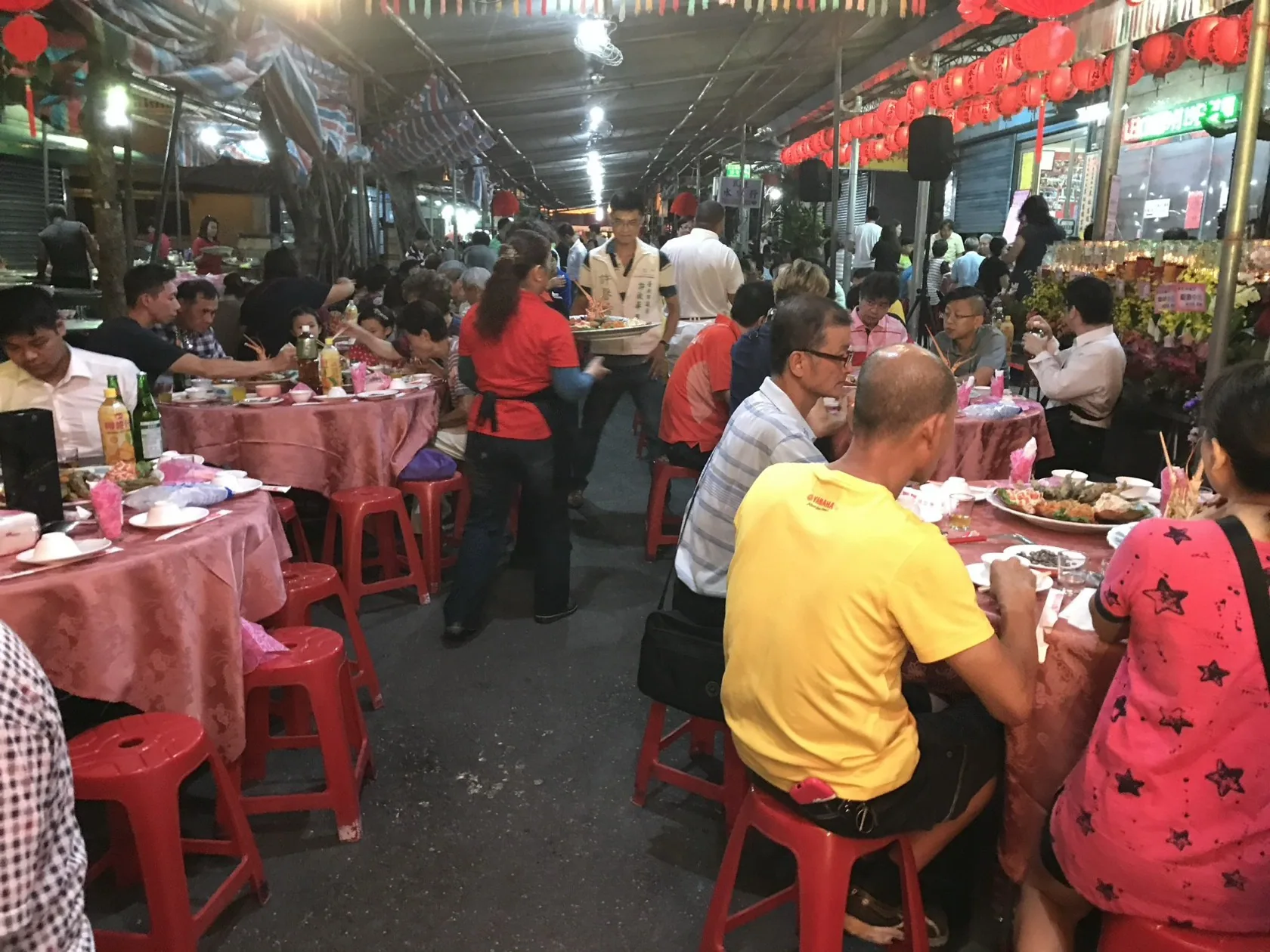
Taiwan's Pān-toh Banquets: A Rain-Soaked Works That Still Opens, and a Three-Realm Ritual System Quietly Folding Up
30-second overview: Pān-toh isn't a modern invention — the Taiwan County Gazetteer from the late Kangxi era (Qing) already recorded that Taiwanese "whenever a family has a celebration or the seasons turn, they must feast guests lavishly"1. Neimen District in Kaohsiung, a stretch of mudstone badlands where even crops struggle, once supported roughly 150 teams of head chefs among just 14,000 residents — the densest concentration on the island2. Today the craft is splitting in two: banquet cuisine has entered five-star hotels and the Michelin Guide, even booming overseas3; meanwhile the ritual knowledge that once mobilized entire villages, with head chefs serving as folklore consultants bridging the human, divine, and ghost realms, is quietly vanishing for lack of successors4. What's disappearing isn't the flavor — it's the tacit understanding behind it.
An evening downpour arrived sudden and fierce; within minutes calf-deep water covered the ground.
It was the night veteran Tainan head chef Wang Yi-yong had committed to a 120-table banquet. The canvas frame buckled under the weight of rain, stoves were doused one by one, pots and pans floated on the water's surface, and even the trout waiting to go into the wok swam out of their basins — over a dozen escaped in one go5. Most people would have called it off.
Wang arrived on his rounds, didn't call it off. He had the crew slash the canopy to drain the flood, moved every piece of kitchen gear under the eaves, rolled up his own sleeves, and waded in to catch the fish. That night they lost only a single trout, made up from the reserve-table ingredients. Every guest ate5.
For three centuries pān-toh has run on this logic: as long as the host family doesn't say stop, the tables open. That mission-must-succeed discipline has carried every major Taiwanese milestone from birth to funeral, from god-worship to ghost-offering. And now it's moving in two directions at once — one up, one down.
Restaurants Are the Bûn-tiûnn; Roadside Banquets Are the Bú-tiûnn
The trade has a common metaphor: chefs who command a fixed restaurant — with air-conditioning and a complete kitchen workflow — work the bûn-tiûnn (文場, “civil arena”). Those who haul their gear to roadsides, temple plazards, or community centers and erect temporary kitchens work the bú-tiûnn (武場, “martial arena”) 5.
The difference between bûn-tiûnn and bú-tiûnn is not culinary skill; it is uncertainty. A restaurant’s location, equipment, and staff are the same every day. For a roadside banquet, the venue, the timing, and the crew are all different every time. The same head banquet chef (tsong-phoo-su, 總鋪師) might oversee a deity’s birthday banquet (sîn-bîn, 神明生) at a Tainan temple plaza this week, and a funeral feast at a mountain clan hall next week. The canvas canopy must be rebuilt, the burners reconnected, the kitchen assistants (tsuí-kha, 水腳) reassigned. From a management perspective, this is the highest-difficulty off-site catering model: for a single complete banquet, the tsong-phoo-su is simultaneously executive chef, event director, and logistics coordinator — canvas canopies, tables and chairs, bowls and plates, ingredient suppliers, and the entire labor crew all fall under one person’s command 5.
That is why cooking technique is merely the baseline; crisis management is the true core competency.
✦ “What I fear most is guests waiting in vain. The moment I got home I rushed to the phone.” — Neimen tsong-phoo-su Hsueh Meng-hui (薛孟輝), recalling the night of Typhoon Morakot 6
On the night Typhoon Morakot struck, Hsueh Meng-hui was in Fengshan wielding the ladle (chhiong-phio, 掌杓) for a deity’s peace banquet. Wind howled and rain lashed down; the canvas canopy collapsed, an iron frame struck a chef in the head, and the host (chú-ke, 主家) finally called off the event 6. He sent each kitchen assistant home to Chwei (旗尾) and Shanlin (杉林), then tried to return to Neimen — only to find every bridge washed out. He spent the entire night trapped in a 7-ELEVEN, watching the torrent of the Nanzihsian Creek (楠梓仙溪) surge like an open sea 6. What kept him awake all night were the guests who had waited in vain for the banquet to begin: the moment he reached home he rushed to make calls. And the very next day, he still had a Guanyin birthday banquet to execute 6.
Whether gale-force winds and torrential rain, or bridges severed and roads collapsed — as long as the host does not cancel, the tsong-phoo-su must find a way to put the dishes on the table. “Mission accomplished” has been this trade’s real barrier to entry for three hundred years, long before culinary skill ever was.
Where Only Thorny Bamboo Survives, a Kingdom of Head Banquet Chefs Grew
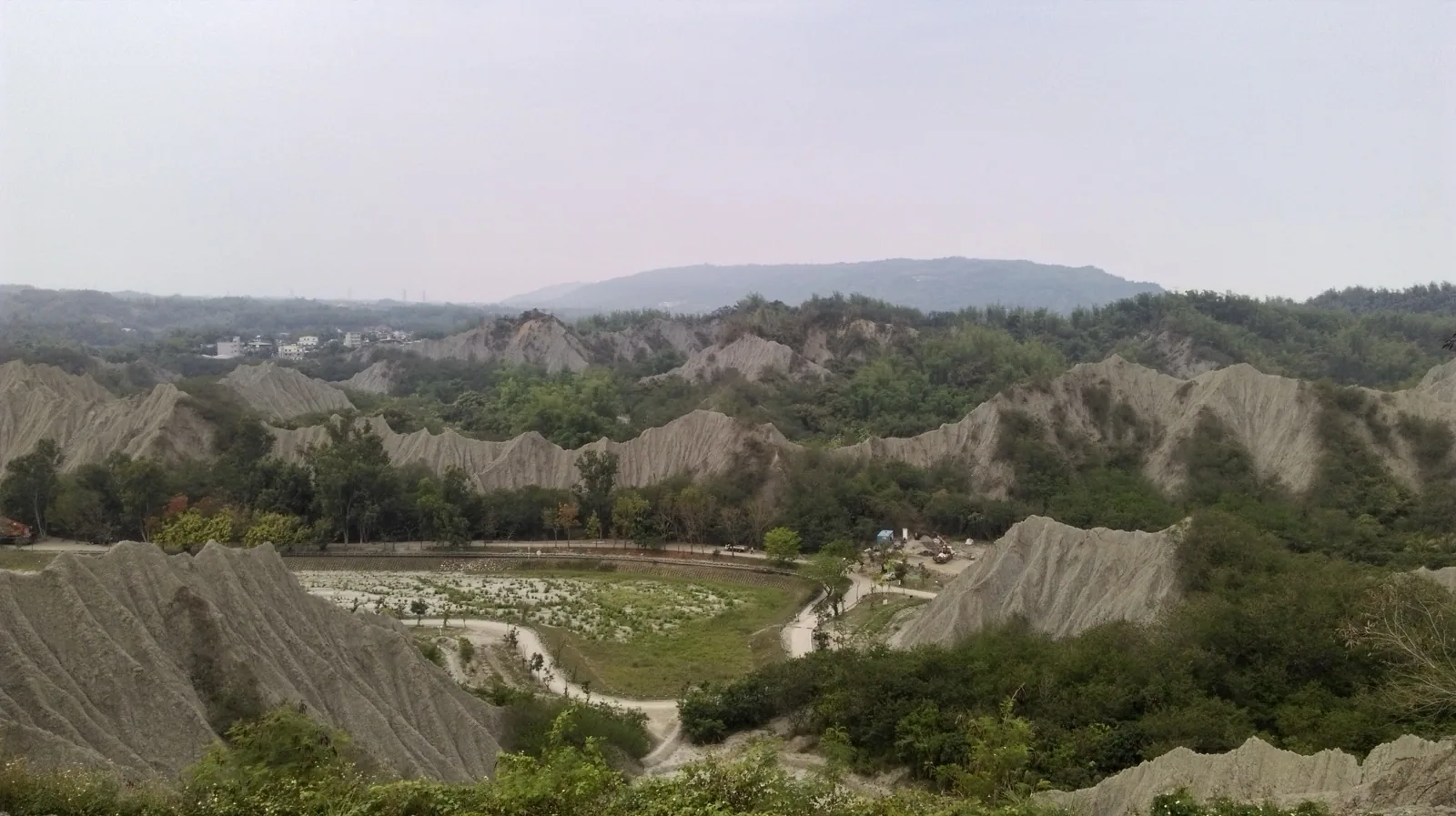
The mudrock badlands of the Gutingkeng Formation in the Kaohsiung area, commonly known as the "Moon World." Neimen sits on the edge of this landscape where even crops struggle to grow. Photo: StevenK234, 2019. CC BY-SA 4.0 via Wikimedia Commons.
To understand how this banquet-field discipline was forged, one must first look at a piece of land where little grows.
The place with the densest concentration of Taiwan's head banquet chefs (zǒng pù shī) is Neimen, Kaohsiung. Neimen sits on the mudrock badlands of the Gutingkeng Formation — the landscape commonly called the "Moon World" — where gray-white slopes lie bare, almost devoid of vegetation, stretching across Neimen, Tianliao, and Yanchao. Taiwan Panorama describes this geology: "Mudrock has low cohesion and permeability; it softens into mire when wet, cracks and flakes when dry, and the high salinity of the marine sedimentary soil makes plant growth difficult."7 On these barren badland slopes where even crops struggle, almost only drought-resistant thorny bamboo (cì zhú) survives. Only in areas with thicker chalky soil can mangoes and bananas be grown — and because they grow slowly, they are even sweeter.7
The land doesn't sustain people, so people must find another way.
Two coexisting explanations, each with its own sources, account for why Neimen became the hometown of head banquet chefs. One comes from an interview by The Reporter: early on, Neimen residents made a living weaving bamboo baskets, supplying banana farmers in Qishan for export packing. When cardboard boxes seized the market in the 1960s, the bamboo-weaving industry declined, just as banquet catering (bàn zhuō) was taking off — so large numbers of craftsmen switched to the kitchen.8 The other, from local officials and cultural historians: Neimen has many temples and parade troupes (zhèn tóu); the Song Jiang Battle Array alone is a local trademark, and every festival required feeding large numbers of participants — this recurring need to "provide meals" (bàn huǒ shí) gave rise to professional head banquet chefs.9 Whether it was the bamboo-weaving pivot or the temple-festival feeding, both threads point to the same thing: this land forced people to develop a trade lived by hand skill.
At its peak, Neimen's roughly 14,000 residents included about 150 head banquet chef teams — nearly one in five households made a living from banquet catering, with simultaneous capacity to handle over 20,000 tables.2 This was the densest concentration of head banquet chefs in all of Taiwan. (This figure comes from research compiled in master's theses by Zhang Yuxin (2007) and Tang Yuning (2016) at I-Shou University, not a recent census.2)
This craft is passed down through apprenticeship. Once a kitchen assistant (shuǐ jiǎo) accumulates enough experience, they can graduate; second and third chefs then set up their own shops. Early on, through a "braised pig trotter" (tāng zhū jiǎo) style of master-apprentice succession (master takes disciple, disciple later takes their own), banquet-catering skills spread across Taiwan generation by generation.8
The key step that turned Neimen from a group of craftsmen into an industry happened in 1976: Xue Qing-ji and several partners (including Deng Zheng-ping, plus a butcher and a vegetable vendor) formed a "four-in-one" company, integrating ingredient supply, cooking, and table-and-chair rental. From then on, banquet catering became a business with a complete supply chain — ingredients, cooking, tables and chairs, all handled in one package.8
Today, Xue Meng-hui estimates Neimen has only about 30 to 40 head banquet chefs left, roughly one-quarter of the peak.8 The kingdom remains, but the people are scattering.
Three Hundred Years Ago, Account Books Already Recorded "Hiring the Head Chef to Banquet"
Many people think pān-toh (roadside banquets) only appeared in Taiwan after the war. Not so. Its roots can be traced all the way back to the Qing dynasty.
The Taiwan Prefecture Gazetteer (compiled by Chen Wen-da, completed 1720), from the late Kangxi era of the Qing, already recorded that Taiwanese "whenever a family has a celebration or a seasonal festival, they must feast guests lavishly." By the Daoguang era, the Changhua County Gazetteer (compiled by Chou Hsi, 1835) described banquets with "delicacies exhausting mountains and seas"1.
In 1902, early in the Japanese colonial period, an essay titled "Miscellaneous Notes on Banquets and Dishes" formally included the term "pān-toh" in the documentary record, explaining clearly: "Setting up tables, preparing food and drink, hosting a banquet is called 'pān-toh'."10 This article came from the Taiwan Customs Chronicle: a monthly journal published by the Taiwan Customs Research Society (note: this is a different institution from the contemporaneous "Temporary Taiwan Old Customs Investigation Society," often confused with it)10.
So when exactly did this pān-toh business begin?
Associate Research Fellow Tseng Pin-tsang of the Institute of Taiwan History, Academia Sinica, based on Qing-era account books and diaries, points out that Qing-era Taiwanese already commissioned professional chefs to handle banquets for weddings, funerals, and sacrificial rites11. The evidence lies in the account books: for instance, the late-Qing Wufeng Lin family ledgers clearly record entries like "hired the 'tsóng-phòo' (head chef/contractor) to banquet, how much per table"11. Tseng infers that this custom of commissioning professional chefs for banquets can be traced back to the Kangxi period11. Tracing further back, the origins of pān-toh lie in Minnan and Guangdong: the banquet culture traditionally called "bān-jiǔ" or "dào-huì" in the Fujian and Guangzhou regions crossed the sea to Taiwan with Qing-era migrants12.
However, from the Qing dynasty up to the 1960s (the 50th year of the Republic), pān-toh looked very different from today. Back then, cities relied on restaurants to provide outside catering, while rural areas mostly had to find villagers with slightly better cooking skills to moonlight, with limited dishes, and often the host family prepared the ingredients themselves. Wealthier households would have dedicated "cháu-hā-bú" (kitchen helpers) to manage things13. True professionalization only began around the 1960s. When villagers discovered "moonlighting as a banquet cook pays better than farming," this craft gradually turned professional, peaking in the 1970s and 80s13.
💡 Did you know: Pān-toh is pronounced pān-toh in Taiwanese, and the head chef is called tsóng-phòo-sai. The character "師" (master/craftsman) is an honorific for professional artisans in Taiwanese folk custom14 — just like "thóo-tsuí-sai" (plasterer) and "ba̍k-sai" (carpenter), it's evidence that this craft was respected as an "art."
Source: Taiwan Customs Chronicle, Tseng Pin-tsang research, The Reporter, Ministry of Economic Affairs, TaiwanPlus
The Sequence of Twelve Dishes Holds an Entire System of Invisible Knowledge
If the discipline of the kitchen crew is the backbone of a banquet, what follows is its soul.
A standard banquet typically runs twelve to fourteen courses, arranged with a clear narrative arc: cold appetizers arrive first to whet the appetite while guests settle in. Next come soups to warm the stomach. Then the climax — the most luxurious seafood or meat: lobster, hong-kam (red crab / mud crab), Buddha Jumps Over the Wall — all appear here, calibrated to each table's budget in "common" and "premium" tiers. After the peak, a palate-cleansing soup is served, followed by rich, heavy flavors — dried bamboo shoots with braised pork belly or pork ribs — to rekindle the appetite. The meal closes with a final chicken soup, then dessert and fruit15. (This serving sequence reflects the long-standing consensus of head banquet chefs and food media.)
Worth noting: lobster is not a "traditional" banquet dish. It only took center stage after the Ten Major Construction Projects and the economic takeoff of the 1960s. In earlier decades, banquet tables more commonly featured stir-fried rice noodles, poached chicken, celery squid soup, and meatball soup — for many people, a banquet was one of the few occasions they could eat meat16. Even the grandest dish, Buddha Jumps Over the Wall, was originally called "Full Fortune and Longevity" (hok-siû-choân), originating from a Fuzhou official's family banquet in the Qing Guangxu era17.
But the true uniqueness of the banquet lies behind the dishes: they are embedded in a cosmology of commensality. Research from the National Museum of Taiwan History categorizes banquet commensality into three types — the analytical skeleton for understanding the banquet's "soul"[^15]:
The first is human–deity commensality. Seasonal festival banquets are where people and deities share the offerings; Taiwanese call this "eating the deity's blessings" (i-sîn chia̍h-hok): what goes down the throat is divine protection15. The second is human–ghost commensality. Ancestral association gatherings, ritual corporate feasts, and the Ghost Festival universal salvation banquets are where people dine with ancestors and "good brothers," honoring forebears and establishing harmony with the other world15. The third is the familiar host–guest commensality: life-ritual banquets celebrating life's passages, and association banquets cementing social bonds15. A single banquet may span the human, divine, and ghost realms simultaneously.
This is why the head banquet chef is also the host family's folk customs consultant. In an interview with The Reporter, an industry insider described the role: "How to prepare a full-moon ceremony? How to arrange the offerings? Which foods are taboo for a given occasion? They know best."5
📝 Curator's Note
It's easy to think of a banquet as just "a bigger meal," but that framing misses what matters most. What a banquet really sells is a mapping of timing to meaning — which life moment calls for which tier of banquet, which dish is auspicious, inauspicious, or taboo in which setting. This mapping exists in no cookbook; it lives in the head chef's mind, in the muscle memory of one execution after another. When we later see "banquet dishes enter five-star hotels," remember: hotels can buy the recipes, but they cannot buy this mapping. What is being lost is the latter.
What does this mapping look like in concrete terms? Folklore scholar Chang Yun-shu's compilation reveals its granularity[^18]: a full-moon banquet uses a whole chicken, signifying "completeness" and symbolizing perfection (though the true core of the one-month celebration is actually sesame oil rice, sesame oil chicken, and red-dyed eggs). Funeral banquets must have an odd number of courses — seven or nine — and the table includes a piece of "triangular pork" (sann-kak-bah) with a missing corner; the shape's imperfection mirrors the bereaved family's grief, while lotus seeds, bitter melon, and pineapple are avoided for their homophonic or symbolic associations. Wedding banquets must include chicken (establishing the household), fish (surplus/abundance), braised pork belly (promotion), and pig stomach (wishing the bride a "big belly" / pregnancy), while the sticky rice with red crab must use roe-heavy female crabs to invoke "early birth of a noble son"18.
⚠️ Contested View: Several circulating banquet taboos lack folkloric basis. For example, "funeral banquets must have gua bao" — gua bao ("tiger bites pig") is actually a year-end banquet (Weiya, lunar 12/16) custom, symbolizing biting down on a year's bad luck, and has nothing to do with funerals. Another: "housewarming banquets avoid meatballs because 'ball' (oân) sounds like 'finished' (oân-liáu)," a claim with thin evidence that directly contradicts the custom of serving tangyuan at housewarmings to symbolize completeness19. Writing about banquets means verifying even the taboos — because an error damages the credibility of this entire knowledge system.
The other face of the soul appears after the feast ends. When the banquet is over, the head chef combines the remnants of each dish into a "leftover medley soup" (also called mixed vegetable soup), distributing it to the neighbors who helped out20. This is not mere leftover disposal; it is an act of cherishing blessings and giving thanks: Taiwan Panorama describes it as a symbol of reciprocity20. From start to finish, a banquet is the whole village's affair — the host family never does it alone. And the leftover medley soup itself is now on the verge of disappearing20.
The "Heisong Grand Hotel" on Auspicious Lunar Calendar Days
Older-generation masters often use presidential terms to track the rise and fall of the industry.
The 12 years from 1988 to 2000, when Lee Teng-hui served as president, are regarded as the golden age of roadside banquets. It wasn't just the era of the traditional "eight celebrations and one funeral" (engagement, wedding, full-month celebration, return visit, business opening, birthday banquet, housewarming, funeral); it was an era when even a child earning a doctorate or winning money from pigeon racing called for a banquet21. Whenever an auspicious lunar calendar day arrived, temple forecourts and roadsides were filled with "Heisong Grand Hotels." The name's origin is distinctly Taiwanese: early canvas tents were often provided by beverage companies, bearing advertisements for Heisong Sarsaparilla; over time, "Heisong Grand Hotel" became a synonym for roadside banquets21.
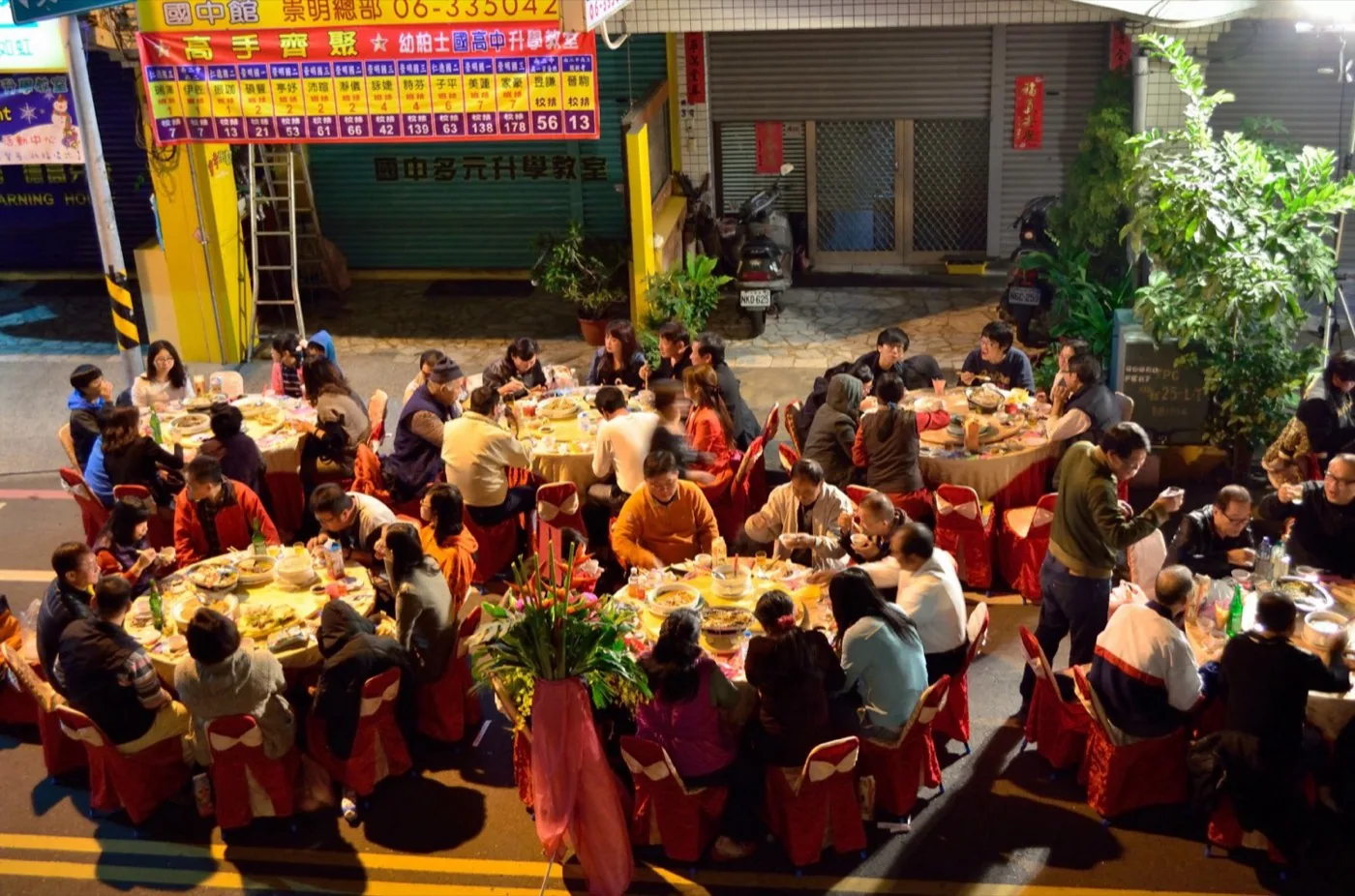
2014, Tainan, a roadside banquet held right on the street. Closing the road, setting up tables, starting the feast — this is the most ordinary scene of the "Heisong Grand Hotel." Photo: 測鏡者, 2014. CC BY-SA 2.0 via Wikimedia Commons.
Just how prosperous those days were, Hsueh Meng-hui remembers most clearly through the work logs left by his father, Hsueh Ching-chi.
✦ 「The entire calendar was filled; 25,000 tables in a year.」——Hsueh Meng-hui recalling his father Hsueh Ching-chi's work logs21
In Hsueh Ching-chi's era, even during slow months, there were still an average of 1,000 tables21. By contrast, in Hsueh Meng-hui's own pre-pandemic period, a big month reaching 500 tables was cause for quiet celebration, and the yearly total was only a few thousand[^21]: in a single generation, the scale had shrunk several times over.
The turning point fell around 2003 (the third year of Chen Shui-bian's administration). Taiwan's industries moved westward en masse, and SME clients disappeared one by one. Some long-time clients hadn't ordered a banquet for two years running; upon inquiry, it turned out their companies had folded21. The twilight of the golden age began with one unconnected phone call after another.
Forty Counts as Young: A Generation That Is Breaking
An industry can shrink due to economic conditions and wait for the next cycle. But what roadside banquets face is something harder to reverse: a generational rupture in succession.
Master chef Li Chun-hsiang from New Taipei puts it bluntly: "For roadside banquet chefs, 40 counts as young — mostly only those with family connections take it up. You can't find 2 out of 10 chefs in their 30s; the kitchen assistants are universally aging."22 Another master chef, Chiang Yi-yung, offers a more concrete observation: only about 2% of culinary school graduates end up in roadside banquets.23 The reason isn't hard to understand: "For a lunch banquet, you have to leave at 3:30 AM — long hours, hot stoves."23 Given a choice, young people would rather work in air-conditioned restaurants.
Talent is draining away, and skills are breaking with it. The older generation of masters did everything themselves — from slaughtering pigs and chickens to making pudding and baking cakes. Now with outsourced frozen foods, apprentices in the kitchen can't learn the complete craft, and those most labor-intensive "hand-passed dishes" are disappearing one by one.24.
The legendary "chicken-pig stomach-softshell turtle" from the film The Master Chef is the perfect example — stuffing a softshell turtle into a free-range chicken, then stuffing the whole chicken into a pig stomach, slow-braised for three hours, a process so elaborate almost no one is willing to do it.25 The "chestnut chicken" that was popular 40 years ago, young chefs no longer know how to make; others like deboned whole eel, bag chicken, and five-willow branches are also on the verge of being lost.24 (Note: sealed meat and red crab sticky rice, though labor-intensive, remain common today and are not among the lost dishes.) The person who has left the most records of these dishes is Huang Wan-ling, the "godmother of Taiwanese cuisine" — she served as the culinary consultant for the film The Master Chef, spending over a decade traveling the countryside to seek out and preserve those vanishing Taiwanese dishes.25.
📝 Curator's Note
Notice there's an unspoken choice here. The market has actually given the roadside banquet industry an easy path: use frozen meal kits, use semi-finished products, and you can still put 12 dishes on the table — most guests can't tell the difference. Take this path, and the industry can survive longer. But the cost is that those hand-passed dishes, which can only be learned through oral instruction and hands-on teaching between master and apprentice, will quietly die on this road — not because no one likes eating them, but because no one needs to learn them anymore. Crafts are rarely eliminated by something new; more often, they are bypassed bit by bit by "good enough."
The Longest Winter
If the generational rupture is a chronic illness, then the 2020 pandemic was an acute crisis.
The Reporter interviewed nearly 10 head chefs from north to south at the time, and the consensus was: the number of banquet tables shrank by at least 90% starting from the Lunar New Year (this is the consensus from interviews, not official statistics)26. Hsieh Meng-hui alone had over 500 tables cancelled just in the second and third lunar months; a second-generation heir to a banquet family, who normally wielded a large spatula for stir-frying in huge woks, could only grip a small soup spoon during that period, packing lunchboxes one by one just to survive26.
Official figures couldn't hold up either. Ministry of Economic Affairs statistics show that in April 2020, revenue for "outdoor catering and group meal contracting" fell 32.3% year-on-year, with monthly revenue of approximately NT$2.5 billion27. However, this figure must be read carefully: it was mainly dragged down by airline catering, and the vast majority of outdoor banquets lack business registration and fall outside the statistical scope—so for outdoor banquets, this figure actually underestimates the impact they suffered27.
Beyond the pandemic, northern Taiwan's banquets face another structural dilemma—space. Lee Chun-hsiang describes that northern banquets must first close roads, apply for road-use permits, and are still frequently reported by neighbors: "Even when we're deep-frying, residents next door yell at us, threatening to report us to the Environmental Protection Bureau for air pollution. The more agitated ones even throw things from upstairs to drive us away."28 Meanwhile, Taipei City's activity centers and elementary school auditoriums almost never lend themselves out for banquets28. In a city where every inch of land is at a premium, outdoor banquets find it increasingly difficult to locate even a single place where they can legally set up tables.
Are these pressures entirely bad? Cultural historian Yen Chen-yu has a different view. He believes the pandemic was both a blow and a stimulus, forcing head chefs to raise hygiene standards and seriously consider transformation29. But the deepest fear of the interviewed head chefs is something else: "We're not just worried about this year; we're more worried that not holding banquets will become a habit."29 The Reporter's conclusion is sober: banquets are tightly bound to the economy, and a recovery in the short term is unlikely29.
The Dishes Remain, but the Soul Is Scattering
But if the story ends here, it would be spectacularly wrong.
Because looking back from 2025, the roadside banquet hasn't been dying in a straight line. It is actually bifurcating — as "dishes" and "brand," it is moving upmarket; as "the whole-village-mobilized ritual," it is sinking downward.
The upward branch is gaining staggering momentum. The Michelin Guide Tainan incorporated roadside banquet cuisine into its formal discourse, and three restaurants serving banquet fare — A-Hsia Restaurant, Hsin Hsin Restaurant, and Tung Shang Taiwanese Cuisine — all earned Bib Gourmand selections30. The Palais de Chine Hotel in Taipei launched "Taiwanese Roadside Banquet," helmed by Executive Chef Lin Ming-tsan, priced at NT$22,800 per table plus 10% service charge, billing itself as the first five-star hotel in Taiwan to formally pay tribute to banquet culture31. The next generation is also taking the baton: TaiwanPlus reported in August 2025 under the headline "Bando Is Back," describing how a "next-gen marketing × parent-gen craftsmanship" model is bringing banquets back into vogue — like tofu master Huang Mao-yuan and his daughter Huang Chia-yu, Master A-Long and his son A-Hsiang32. The English coverage put it this way: "Once fading from Taiwan's cultural fabric, this legendary banquet tradition is making a dynamic comeback…"32
Even overseas, the current is flowing back. At Good To Eat in Emeryville, California, Taiwanese Chef Tony Tung (who runs the wife-wife team with partner Angie Lin) treats the roadside banquet as a love letter to Taiwan; the menu is simply called jan ba bae (roadside banquet)33. On January 4, 2025, she invited Neimen Master Chef A-Can (Master A-Càn) to Taipei to host a traditional roadside banquet for over 400 people, drawing diners from California who flew back to Taiwan just for the experience33.
Place these two branches side by side and the shape of the bifurcation becomes clear. What is being revived is the "cuisine" and the "brand" — they have entered five-star hotels, Michelin tables, and restaurants in California. What is being lost is that entire system of ritual knowledge. A five-star ballroom can replicate a pot of Buddha Jumps Over the Wall, but it cannot replicate the whole tacit understanding of "the whole village mobilizes, the master chef serves as folk consultant, leftover dishes are distributed to neighbors." Scarcity has turned banquet cuisine into a kind of cultural pilgrimage; California diners are willing to fly halfway around the world to eat one banquet in Taiwan — but the object of their pilgrimage is losing the very habitat it depends on for survival: the badlands that produced the master chefs, the temple festivals that came one after another, the village that would summon every neighbor to help.
Air-conditioned restaurants can cultivate the dishes, but they cannot cultivate the soul.
That Well-Worn Farmer's Almanac
Back to Hsueh Ching-chi's farmer's almanac diary, filled cover to cover with writing.
It is the object Hsueh Meng-hui treasures most, and also the most authentic archaeological site of this industry21. Those dense orders in the diary — celebration banquets for winning pigeon races, thanksgiving banquets for earning doctorates, peace banquets for Mazu's birthday at the temple — record a whole set of conventions that Taiwan people once collectively recognized: which moments were worth everyone putting down their work to gather together, what should be eaten at that moment, who should preside, and how to properly bid farewell.
The cuisine has already proven it can enter five-star hotels, fly to California, and be Michelin-recognized. But that set of tacit understandings written in that farmer's almanac — which moment calls for what kind of banquet table, which dish is auspicious or inauspicious for which occasion, after the banquet which neighbors who helped out should receive the leftover portions — how many people still remember, how many can still carry it on?
Further Reading:
Image Sources
This article uses 3 public domain / CC-licensed images, all cached in public/article-images/food/ to avoid hotlinking the source servers:
- Ghost Festival Pudu Temple Square Banquet (hero) — Photo: Xuan Shisheng, 2017-09-19, CC0 1.0
- Kaohsiung Gutingkeng Mudstone Badlands (Moon World) — Photo: StevenK234, 2019-04-01, CC BY-SA 4.0
- Tainan Street Banquet — Photo: Cejingzhe, 2014-12-07, CC BY-SA 2.0
References
- Banquet (Wikipedia) — Includes the etymology of 'banquet', literary records from the Qing-era 'Taiwan County Gazetteer' (1720) and 'Changhua County Gazetteer' (1835) on Taiwanese customs of 'when a family has a celebration or seasonal festival, they must host a lavish banquet' and 'delicacies from mountains and seas', as well as the historical context of the professionalization of banquet catering.↩2
- Banquet (Wikipedia) — Includes data on the scale of the Neimen head chef settlement: at its peak about 14,000 people, about 150 head chef teams, one in five households made a living from banquet catering, capable of simultaneously preparing over 20,000 tables; figures compiled from research by Zhang Yuxin (2007) and Tang Yuning (2016 I-Shou University master's thesis).↩23
- Bando Is Back: Taiwan's Roadside Banquet Tradition Makes a Comeback (TaiwanPlus, 2025) — August 2025 report on the resurgence of Taiwan's roadside banquet culture under the leadership of Michelin-starred restaurants, five-star hotels, and a new generation.↩
- After the Pandemic, the Gradually Disappearing Taste of Taiwan — Roadside Banquet Culture (The Reporter) — A 2020 in-depth report by The Reporter, interviewing nearly ten head chefs from north and south, documenting the crisis of loss and generational gap of banquet catering as ritual knowledge.↩
- After the Pandemic, the Gradually Disappearing Taste of Taiwan — Roadside Banquet Culture (The Reporter) — Includes on-site records of Tainan head chef Wang Yiyong catching fish for 120 tables in a torrential rain, the metaphor of restaurant 'civil field' vs. banquet 'martial field', and the multiple roles of head chefs as executive chef, event director, logistics coordinator, and folk customs consultant.↩2345
- After the Pandemic, the Gradually Disappearing Taste of Taiwan — Roadside Banquet Culture (The Reporter) — Includes Neimen head chef Xue Menghui's account of cooking in Fengshan on the night of the 88 Typhoon, a collapsed shed injuring people with iron frames, being stranded at a 7-Eleven due to a broken bridge, and his statement: 'I'm most afraid of guests waiting anxiously; as soon as I get home I rush to the phone.'↩234
- Taiwan Panorama Magazine: Reports on Mudstone Badlands — Describes the geological characteristics of the Kaohsiung Gutingkeng Formation mudstone badlands (Moon World): 'Mudstone has low cohesion and permeability, softens into mud when wet, cracks and peels when dry, and the high salinity of marine sedimentary soil makes plant growth difficult,' as well as the agricultural distribution where only thorny bamboo tolerates drought on bare badland slopes, while mangoes and bananas can be grown in chalky soil areas.↩2
- After the Pandemic, the Gradually Disappearing Taste of Taiwan — Roadside Banquet Culture (The Reporter) — Includes the origin story of Neimen bamboo weaving supplying Qishan banana farmers, switching to banquet catering after cardboard boxes took over the market in the 1960s, the master-apprentice 'stewed pig's feet' style of recruitment spreading across Taiwan, Xue Qingji forming the 'Four-in-One' company in 1976 to industrialize, and the estimate that Neimen now has only about 30-40 head chefs left.↩234
- Neimen District Office Official Website — Official information from the Kaohsiung City Neimen District Office, recording the local historical account that Neimen's many temples and prevalent performance troupes (Songjiang arrays) created demand for head chefs to feed members during festivals, a view also held by cultural historian Chen Congxian.↩
- pān-toh Banquet: Taiwanese Banquet Culture (StoryStudio) — Includes the earliest literary definition of 'banquet' from the 1902 'Miscellaneous Talks on Banquets and Dishes': 'preparing tables, arranging food and drink, hosting a feast is called banquet', sourced from the monthly 'Taiwan Customs Records' published by the Taiwan Customs Research Association.↩2
- pān-toh Banquet: Taiwanese Banquet Culture (StoryStudio) — Includes research by Associate Researcher Zeng Pincang of the Academia Sinica Institute of Taiwan History based on Qing-era account books (e.g., the late Qing Wufeng Lin family account book recording 'hiring a head chef to cater a banquet') and diaries, pointing out that Qing-era Taiwanese entrusted professional chefs for weddings, funerals, and festivals, and inferring the practice dates back to the Kangxi period.↩23
- Banquet (Wikipedia) — Includes the historical background that banquet culture originated in Minnan and Guangdong, with Fujian and Guangzhou traditions of 'banjiu' or 'daohui' banquet hosting brought to Taiwan by Qing-era immigrants.↩
- Banquet (Wikipedia) — Records the evolution before professionalization (Qing dynasty to 1960s): cities relied on restaurant outside catering, villages on part-time villagers, ingredients often provided by the host family, wealthy families had 'kitchen maids'; from the 1960s villagers found banquet catering more profitable than farming and turned professional, peaking in the 1970s-80s.↩2
- Ministry of Education Taiwan Southern Min Common Vocabulary Dictionary: Banquet — The Ministry of Education's official dictionary includes the entry 'banquet' (pān-toh) with definition and Tâi-lô romanization; 'head chef' in Taiwanese is pronounced tsóng-phòo-sai, where 'shi' is a folk honorific for professional artisans.↩
- Commensality in Banquet Culture (National Museum of Taiwan History, Lin Xiangyao) — A research article from the National Museum of Taiwan History proposes a three-type framework of commensality in banquet culture: human-deity commensality (seasonal festivals 'eating blessings from the gods'), human-ghost commensality (ancestral associations and Ghost Festival universal salvation), and host-guest commensality (life rituals and social gatherings), and explains the relationship between the sequence of dishes served at banquets and life rituals.↩234
- Banquet (Wikipedia) — Records that high-end seafood such as lobster only became the stars of banquets after the economic takeoff from the Ten Major Construction Projects in the 1960s; early banquets commonly featured stir-fried rice noodles, poached chicken, celery squid soup, and meatball soup, which were among the few occasions to eat meat at the time.↩
- Banquet (Wikipedia) — Includes the origin of 'Buddha Jumps Over the Wall', originally named 'Fortune, Longevity, and Completeness', stemming from an anecdote about a household banquet of a Fuzhou official during the Qing Guangxu era.↩
- Tainan Community University: Wedding Banquets and the Symbolism of Dishes in Life Rituals (Zhang Yunshu) — Folklore researcher Zhang Yunshu compiles the symbolism of dishes in life-ritual banquets: a whole chicken for the full-month celebration symbolizing 'completeness'; funeral banquets use an odd number of dishes and 'triangular meat' (sann-kak-bah) with a missing corner; lotus seeds, bitter melon, and pineapple are taboo; wedding banquets must have chicken (starting a household), fish (surplus), sealed meat (promotion), pig stomach (big belly), and red crab rice cake using female crabs (early birth of a noble son).↩
- pān-toh Banquet: Taiwan's Banquet Culture (StoryStudio) — Reference for folklore verification of banquet taboos; gua bao is a Tail Ya (16th day of the 12th lunar month) 'tiger bites pig' custom, not a funeral dish; the saying 'moving into a new house forbids ball-shaped foods' contradicts the use of tangyuan to symbolize completeness during housewarming; neither has support in banquet folklore sources.↩
- Taiwan Panorama: Banquet and 'Cai Wei Tang' Culture — Reports on the banquet 'cai wei tang' (mixed vegetable soup) as a symbol of cherishing blessings and gratitude, made by mixing leftovers from various dishes after the feast and distributed to neighbors who helped voluntarily; it is a reciprocal community culture that also faces the risk of being lost.↩23
- After the Pandemic, the Gradually Disappearing Taste of Taiwan — Roadside Banquet Culture (The Reporter) — Includes the heyday of banquets during Lee Teng-hui's tenure with 'eight celebrations for one funeral', the origin of the 'HeySong Grand Hotel' canvas tents provided by beverage companies, oral accounts from Xue Qingji's work diary '25,000 tables a year', 'average 1,000 tables in a slow month', and the turning point of client loss after industries moved west in 2003.↩23456
- After the Pandemic, the Gradually Disappearing Taste of Taiwan — Roadside Banquet Culture (The Reporter) — Includes oral account from New Taipei head chef Li Junxiang: 'A 40-year-old external catering chef is considered young; out of ten chefs in their 30s, you can't find two; the kitchen helpers are generally aging,' reflecting a generational gap in the banquet industry.↩
- After the Pandemic, the Gradually Disappearing Taste of Taiwan — Roadside Banquet Culture (The Reporter) — Includes head chef Jiang Yiyong's observation that only about 2% of culinary school graduates enter external catering, and a description of working conditions: 'For a noon banquet, you have to depart at 3:30 AM; long hours, hot stove feet.'↩2
- After the Pandemic, the Gradually Disappearing Taste of Taiwan — Roadside Banquet Culture (The Reporter) — Records how old masters made everything from scratch, from slaughtering pigs and chickens to pudding cakes; outsourcing frozen foods prevents apprentices from learning hand-made dishes; hand-made dishes like chestnut chicken, deboned whole eel, bag chicken, and five-willow branches are on the verge of being lost.↩2
- After the Pandemic, the Gradually Disappearing Taste of Taiwan — Roadside Banquet Culture (The Reporter) — Includes the intricate process of 'chicken in pig stomach in softshell turtle' (softshell turtle stuffed with free-range chicken, chicken stuffed in pig stomach, stewed for 3 hours) from the film 'The Head Chef', and the efforts of Taiwanese cuisine matriarch Huang Wanling (film's culinary director) who spent over a decade visiting rural areas to preserve disappearing Taiwanese dishes.↩2
- After the Pandemic, the Gradually Disappearing Taste of Taiwan — Roadside Banquet Culture (The Reporter) — Interviews with nearly 10 head chefs from north and south reveal that external catering table counts have shrunk by at least 90% since the Lunar New Year (interview consensus, not official statistics); Xue Menghui had over 500 tables canceled in the 2nd and 3rd lunar months; the second generation of banquet families now hold small soup spoons packing lunchboxes.↩2
- Department of Statistics, Ministry of Economic Affairs: Wholesale, Retail, and Food Service Industry Revenue Statistics (April 2020) — According to MOEA statistics, in April 2020, the 'external catering and group meal contracting industry' revenue fell 32.3% year-on-year to about NT$2.5 billion; this figure is mainly dragged down by idle kitchens, and a large number of unregistered open-air banquets are not included in the statistics, so the actual situation for open-air banquets is underestimated.↩2
- After the Pandemic, the Gradually Disappearing Taste of Taiwan — Roadside Banquet Culture (The Reporter) — Includes Li Junxiang's description of the spatial politics of northern banquets: must apply for road closure permits, reported by neighbors for causing air pollution, even having things thrown from upstairs to drive them away; Taipei City activity centers and elementary school auditoriums almost never lend out for banquets.↩2
- After the Pandemic, the Gradually Disappearing Taste of Taiwan — Roadside Banquet Culture (The Reporter) — Includes cultural historian Yan Zhenyu's view that the pandemic is both a blow and a stimulus (forcing head chefs to improve hygiene and consider transformation), as well as the deepest fear of interviewed head chefs (afraid that 'everyone not holding banquets' becomes a habit) and the reporter's conclusion that 'banquets are tied to the economy and unlikely to recover in the short term.'↩23
- Michelin Guide Tainan: Banquet Dishes and Bib Gourmand Recommendations — The Michelin Guide Tainan incorporates banquet dishes into its discussion; three restaurants serving banquet dishes — A-Xia Restaurant, Xin Xin Restaurant, and Dong Shang Taiwanese Cuisine — are selected for the Bib Gourmand.↩
- Palais de Chine Hotel: Taiwanese Roadside Banquet — The Taipei Palais de Chine Hotel launches "Taiwanese Roadside Banquet" (roadside banquet), helmed by Chef Lin Ming-can, priced at NT$22,800 per table plus 10% service charge, claiming to be the first five-star hotel in Taiwan to formally pay tribute to roadside banquet culture.↩
- Bando Is Back: Taiwan's Roadside Banquet Tradition Makes a Comeback(TaiwanPlus, 2025) — August 2025 report on the new generation reviving roadside banquets through a "next-generation marketing × parent-generation craftsmanship" model (tofu master Huang Mao-yuan and daughter Huang Chia-yu, Master A-Long and son A-Hsiang), with the original text stating: "Once fading from Taiwan's cultural fabric, this legendary banquet tradition is making a dynamic comeback".↩2
- Roadside Banquet in Taiwan(Good To Eat) — California's Emeryville restaurant Good To Eat, where Taiwanese chef Tony Tung and partner Angie Lin treat roadside banquets as a love letter to Taiwan (menu name 'jan ba bae'), invited Neimen master chef A-Can (Master A-Càn) to host a traditional roadside banquet for over 400 people in Taipei on January 4, 2025, attracting California diners to return to Taiwan specifically for it.↩2