
Dan Zai Noodles: How a Noodle Dish Created to Survive the Off-Season Became a Tainan Daily Staple
30-Second Overview: Dan Zai noodles were not originally invented to become a "Tainan specialty." Its story begins with a port, a typhoon season, and a fisherman who had to find a way to make a living: less noodles, more flavorful shrimp broth, fragrant minced pork. Served just right, it leaves you wanting another bowl after finishing the first. Later, it was passed down by shopkeepers, written into the city’s culinary memory, and compared with Xiamen shrimp noodles and Penang Hokkien mee. What remains is not just a recipe, but the ability to cook a piece of local life for strangers. 1 2
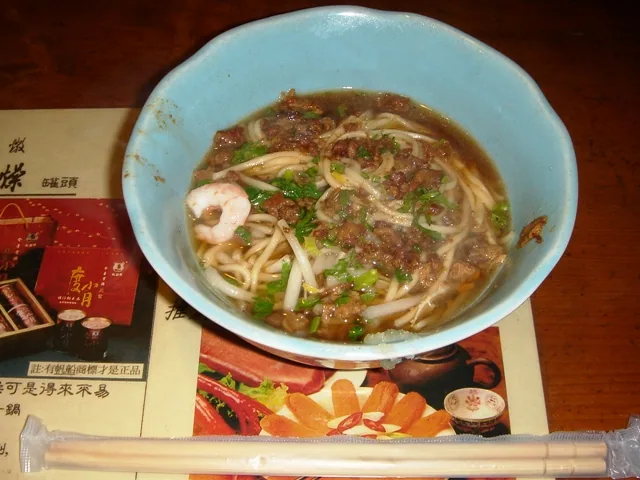
Image: Shoestring / Wikimedia Commons file page, CC BY-SA 4.0, unmodified; this article uses only public hot links, no images were downloaded.
A Bowl of Noodles Must First Solve One Person’s Off-Season
In 1969, Lian Jingchu wrote "The History of Dan Zai Noodles" in Tainan Culture, opening not by listing ingredients, but by placing Dan Zai noodles within Tainan’s snack map: this city was once the Fu City (Prefecture City), where water and land transport brought people and goods, leaving various eating habits on the streets. The article records Hong Yutou’s story with "it is said"—in the late Qing dynasty, he originally made a living by paddling a small boat to transport goods. During the windy and rainy season, boat trips decreased, and income also entered the off-season. Relatives and friends advised him to sell his family’s minced pork mixed noodles, so he carried a shoulder pole with noodles to set up a stall in front of the Shui Xian Palace. 3
This version is important, but it cannot be written as a seamless birth certificate. The 1969 article preserved in the National Museum of Taiwan History database itself begins with "it is said." The Tainan City West Central District Office’s local introduction also connects Hong Yutou, the fishing off-season, Shui Xian Palace, and the shoulder-pole street vending. Both point to a local memory: the name Dan Zai noodles is related to the "shoulder pole" (dan), and the brand "Du Xiaoyue" turns the "off-season" into a period that can be survived. 3 4
📝 Curator’s Note
The most touching aspect of Dan Zai noodles is not that the question "who was the first inventor" finally has a standard answer, but that it preserves the earliest reality of street food: first, a person needs to make a living, then a city later says "this is our flavor."
In Hong Yutou’s story, there is a very Tainan scene: Shui Xian Palace is not an abstract "surroundings of an ancient monument," but a place where the port, boats, goods, and vendors intersect. Local cultural data places early snacks in the context of temple courtyards and market fronts, because when people arrive there, the faith, home-cooked dishes, and business methods brought by immigrants also appear together. Dan Zai noodles therefore did not grow out of a kitchen in isolation. It was first cooked bowl by bowl for people to eat on a road where people walked and goods moved. 2 4

Image: Pbdragonwang / Wikimedia Commons file page, CC BY-SA 4.0, unmodified; this article uses only public hot links, no images were downloaded.
"Small Bowl" Is Not Stinginess, It’s Its Origin
People eating Dan Zai noodles for the first time often first notice the small bowl. Agricultural Media’s food culture article places this small bowl back into the structure of the dish: the noodle portion of Taiwan’s Dan Zai noodles is about 50 grams, not aiming to fill you up like a bowl of Japanese ramen. It retains a space for "eating less has flavor, eating more has no interest." This is the author’s observation of local eating habits, but it hits the posture of Dan Zai noodles—you do not sit down to finish a large meal, but approach the noodle stall, eat one bowl, and then decide if you want another. 1
The preparation of Dan Zai noodles is also like a miniature stage. The oil noodles are first blanched in a strainer, followed by bean sprouts. After the noodles are poured into the bowl, garlic paste, black vinegar, minced pork, and shrimp broth are added, finally topped with shrimp and cilantro. Agricultural Media lists Tainan Dan Zai noodles alongside Xiamen shrimp noodles and Penang Hokkien mee: all three places use alkaline noodles, shrimp shell broth, and shrimp as a common skeleton, but the Taiwan version puts minced pork into the bowl and developed the "sitting cook" posture. 1

Image: Opponent / Wikimedia Commons file page, CC BY 2.0, unmodified; this article uses only public hot links, no images were downloaded.
The "sitting cook" is not a slow motion deliberately performed by the cook. The noodle portion is small, and the alkaline noodles are already cooked; they only need to be shaken up and down a few times in hot water. The noodle cook sits in front of the stall, with a small stove, soup pot, bowls, and ingredients at hand, performing short, precise, and continuous movements. The Cultural Bank interview describes this form as a show: the master’s hands repeat the same sequence of actions, but customers stare because every bowl is completed right in front of them. 1 5
| Things in a Bowl of Dan Zai Noodles | The Flavors They Bring | Meaning in the Articles |
|---|---|---|
| Alkaline noodles | Chewy, easy to quickly blanch | Suitable for cooking and eating immediately at the stall |
| Shrimp broth and shrimp | Umami of port and coastal ingredients | Keeps the "sea-faring" local background in the soup |
| Minced pork | Oily fragrance, salty-sweet, and homey taste | Puts immigrant family seasoning into public food |
| Bean sprouts, garlic paste, black vinegar, cilantro | Crisp, sour, spicy, and fragrant | Ensures complete flavor transitions in the small bowl |
Minced Pork Is the Protagonist Who Never Exits
Shrimp broth easily becomes the first impression of Dan Zai noodles, but minced pork gives it a recognizable homey direction. The Cultural Bank interviewed Du Xiaoyue’s fifth-generation successor, Li Cheng-yu, recording his call for minced pork as "the soul of Dan Zai noodles." The same article also writes that old shops use shallots and pork to stir-fry minced pork, summarizing the early stalls’ need for "five fires and twelve ingredients" (stoves and materials). These are not common specifications for all Dan Zai noodle shops, but rather Du Xiaoyue family’s statement of their own craft. 5
The Cultural Bank’s Du Xiaoyue interview lists oil noodles, minced pork, shrimp broth, and the small bowl, also connecting the market in front of Shui Xian Palace, the ship’s foot at the dock, and the work gap of "small month." This is the shopkeeper’s narrative of inheritance, which cannot replace early historical materials. But it explains one thing: old shops preserve not just a pot of minced pork, but how customers approach the stall, how noodles are completed in front of them, and why a bowl of noodles can only be that big. 5
The "Tainan flavor" of Dan Zai noodles is not a pure local residue left after washing away all external influences. Agricultural Media places it on the same Minnan immigrant path with Xiamen and Penang shrimp noodles. All three places obtain shrimp at the port, and all make alkaline noodles and shrimp broth into their daily routine. The Taiwan version adds minced pork, retains the small bowl and sitting cook, so the same seafood skeleton grows three different personalities at different ports. 1
From Shoulder Pole to Storefront, the Noodle Stall Learns to Inherit
When a person carries a shoulder pole selling noodles on the street, the craft relies on body memory. When it becomes a storefront, it must face another question: how to let the next generation cook the bowl customers recognize without completely copying the previous generation? The Cultural Bank’s interview writes that old customers once only wanted "Grandpa" to cook, while the young successor re-gains trust through repeated trial cooking. Here, inheritance is not sealing the flavor in a glass case, but giving customers the opportunity to point out "this bowl has less cilantro," "that bowl is not cooked too soft." 5
This is also the difference between snack shops and factory food. Dan Zai noodles can have a recipe, but cannot rely only on a recipe. It also needs a noodle cook who reads customers, a stall that places actions on the street, and a city willing to treat old shops as daily life rather than only visiting them in tourism itineraries. The Tainan City Cultural Bureau’s publication Food in the Fu City lists Dan Zai noodles in the Central District’s food map, juxtaposed with shops like Du Xiaoyue and Minzhong Qikan Dan Zai Noodle Shop. It presents how a city treats food as an index of local culture. 6
✦ "The bowl of Dan Zai noodles is small, but it holds a path from the port to the market, from family minced pork to street-side service."
Today, Dan Zai noodles are also brought into new tourism scenes. Tainan City Government’s 2026 press release records that a Singaporean creator visited Tainan to film food tourism, challenging himself to eat 30 bowls at the over-70-year-old Xiaogongyuan Dan Zai Noodle Shop. The city government places this event in the context of Tainan snacks and city tourism. This exposure can let more people know about Dan Zai noodles, but also reminds us: what is truly worth watching is not how many bowls were eaten at once, but how old shops still cook a small bowl of noodles in traditional ways. 7
Tainan Flavor Is Not a Fixed Answer
The Foundation for Seeing Taiwan’s local food introduction describes Du Xiaoyue Dan Zai noodles as a Fu City representative snack founded in 1895, located next to Chihkan Tower, listing oil noodles, minced pork, shrimp, and cilantro as components. The Travel Reading Tainan snack article connects Hong Yutou, the fishing off-season, street-side shoulder pole carrying, and the old shop at Xiaogongyuan to form local food memory. These articles have different purposes: one leans toward local food recommendations, the other toward tourism narratives. They can help readers find contemporary flavors, but should not be used to eliminate the "it is said" tone in early historical materials. 8 9
This uncertainty makes Dan Zai noodles more like a true local food. It does not have a central kitchen issuing the same standard answer for all stalls, nor an ingredient list that explains why everyone remembers it. Some remember the stall in front of Shui Xian Palace, some remember the small bowl next to Chihkan Tower, some remember the minced pork fragrance arriving first, with shrimp broth slowly catching up. Legends, families, storefronts, local government, and food authors each leave their own versions, overlapping and reminding each other of boundaries.
Dan Zai noodles may have originally been just to help a fisherman or transporter survive the off-season. Later it became a Fu City snack, a branch of immigrant cuisine, a name travelers seek when coming to Tainan. But it did not become grander because of this. It still needs to put a small pinch of noodles into a strainer, let bean sprouts pass through hot water nearby, scoop a spoonful of minced pork, and finally place shrimp on top.
That action is still there, the off-season is still there, only today what we eat is no longer just one person’s survival method. It is Tainan shrinking the port, immigrants, homey flavors, and street-side encounters into a bowl of noodles that is just enough to finish, and just enough to miss.
Further Reading
- Tainan City West Central District: Du Xiaoyue Dan Zai Noodles
- National Museum of Taiwan History Tainan Cultural History Research Database: The History of Dan Zai Noodles
- Agricultural Media: A Bowl of Dan Zai Noodles Connects Cross-Border Cultural Footprints
Image Sources
- Hero: A bowl of Tainan Du Xiaoyue Dan Zai noodles, photography by Shoestring (Wikivoyage), Wikimedia Commons, CC BY-SA 4.0.
- 【Oh! Tainan Flavor Is Like This】A Bowl of Dan Zai Noodles Connects Cross-Border Cultural Footprints — Agricultural Media article, explaining the common skeleton of Taiwan, Xiamen, and Penang shrimp noodles, Dan Zai noodles sitting cook, noodle portion, and production sequence.↩2345
- Fu City Ancient Food: Fragrant for a Century, the Elegance of Dan Zai Noodles by Anping Port — Cultural Bank article, detailing the local context of Tainan’s port, temple courtyards, and snack stalls.↩2
- The History of Dan Zai Noodles — 1969 Tainan Culture article recorded in the National Museum of Taiwan History Tainan Cultural History Research Database, recording Hong Yutou and the "it is said" version of "Du Xiaoyue."↩2
- Du Xiaoyue Dan Zai Noodles — Tainan City West Central District Office local introduction, explaining Hong Yutou, Shui Xian Palace, and the off-season noodle vending local narrative.↩2
- Fu City Ancient Food: Fragrant for a Century, the Elegance of Dan Zai Noodles by Anping Port — Cultural Bank interview with Du Xiaoyue descendants and shopkeepers, providing details on sitting cook, five fires and twelve ingredients, minced pork, and master inheritance.↩234
- Food in the Fu City — Tainan City Cultural Bureau publication detail page, listing shops and cultural context in the Fu City food map such as Dan Zai noodles and Du Xiaoyue.↩
- Singaporean Internet Celebrity Big Eater Zermatt Neo Challenges 30 Bowls of Tainan Dan Zai Noodles! Huang Wei-zhe Visits and Invites Longqi Kongshan Festival — Tainan City Government 2026 press release, recording Xiaogongyuan Dan Zai Noodles, over-70-year shop history, and contemporary city tourism context.↩
- Du Xiaoyue Dan Zai Noodles — Foundation for Seeing Taiwan local food introduction, listing the 1895 founding claim, shop address, and components such as oil noodles, minced pork, shrimp, and cilantro.↩
- Have a Bowl of Tainan Soul’s Dan Zai Noodles! Fu City Snack Invention Record, Let You Know Tainan from "Eating" — Travel Reading article, placing Hong Yutou, fishing off-season, 1895 Du Xiaoyue, and Tainan old shops into snack tourism narratives.↩