
30-Second Overview: The predecessor of Taiwan Beer can be traced back to the Formosa Brewery established in 1919. After the war, beer was integrated into the Tobacco and Alcohol Monopoly system, with the state controlling manufacturing, distribution, and sales. The Jianguo Brewery, located in central Taipei, preserves the material traces of this industrial line through its red and green buildings, equipment, and yeast. Foreign alcohol imports were allowed in 1987, and the monopoly system ended in 2002; only then did Taiwan Beer truly have to convince consumers in a competitive market.
Three Greens in the Cooler
On the tables of stir-fry restaurants, beer bottles often appear before the menu. The cap is pried off, foam slides down the neck, and guests need not ask for the origin or explain the brand. The Golden, Classic, and 18-Day Fresh beers each have their own color, yet the bottles all place the words "Taiwan Beer" in the most prominent position. This is a commodity that no longer needs to introduce itself.
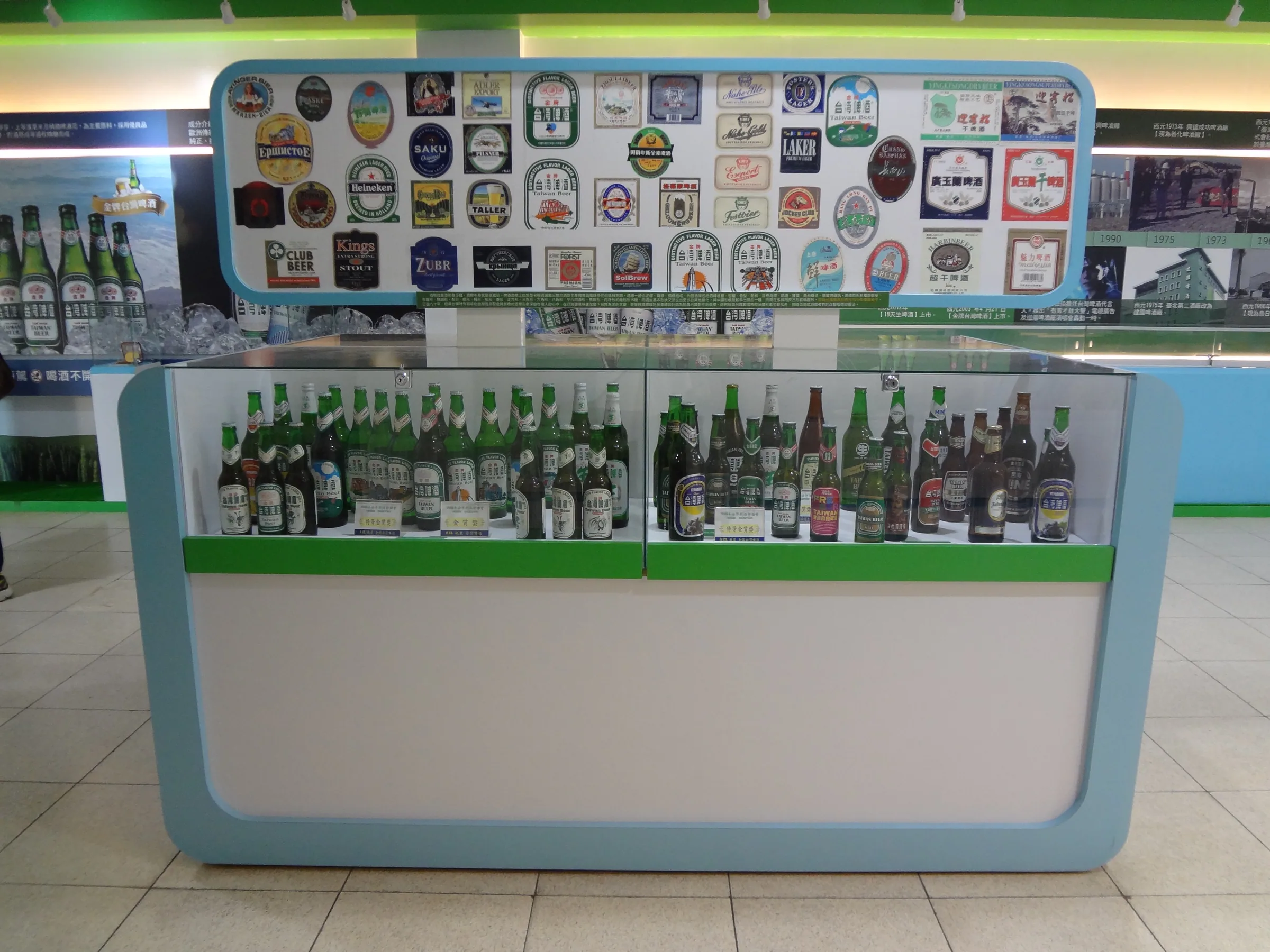
Shifting the gaze from the dining table to the museum at the Zhunan Brewery, the scene suddenly resembles an archive: rows of bottles leave their role as dinner accompaniments to become packaging, labels, and flavor choices from different eras. A photo taken at the Taiwan Tobacco and Liquor (TTL) Beer Museum on Wikimedia Commons captures precisely this arrangement. The bottles do not just hold beer; they exhibit how a brand has crossed generations of consumers. 1
Taiwan Beer’s official narrative places the starting point of this line at the 1919 Formosa Beer, listing the Japanese colonial period, post-war monopoly, the market opening of the 1980s, and today’s competitive market side by side as brand history. This is the company’s self-narrative, worth reading but insufficient as an industrial history on its own. The uniqueness of this brand lies in the fact that it was once placed by the state into a visible, everyday regulatory machine. 2
A Factory Built in the City
The predecessor of the Taipei Jianguo Brewery was the beer factory of the Formosa Brewery Co., Ltd. The National Cultural Heritage Network records that the factory was established in 1919 as a key facility for Taiwan’s early beer industry. After the war, it was taken over and became the beer factory of the Taiwan Provincial Tobacco and Alcohol Monopoly Bureau. In 2000, part of the site was designated as a historic monument, not only for its red brick exterior but because it witnessed both industrial history and Taipei’s urban development. 3
The factory is located in today’s central Taipei. This location easily makes one forget that it was once a complete production system. Beer must move continuously within the factory grounds, from mashing and fermentation to filtration and packaging. Workers, pipelines, wooden crates, glass bottles, and transport vehicles connect the factory to restaurants and grocery stores in the city. The value of the architecture lies in its ability to allow one to imagine how a bottle of beer is delivered from one corner of the city to another.
When Public Television’s Our Island visited the Jianguo Brewery, it interviewed staff about the 49 strains of yeast preserved on-site, five of which are believed to date back to the Japanese colonial period. Quality control personnel regularly renew the yeast; this work pulls the "monument" back from a mere wall to a technology still being operated. As the production line shrinks and staff numbers decrease, the yeast must still be cared for, because without it, only the architectural shell remains. 4
Figure 1 | Taiwan Beer bottles and logo displays in the Zhunan TTL Beer Museum.
Source: Wikimedia Commons Image File Page, photographer Solomon203, licensed CC BY-SA 4.0.
Beer Was Once a Pipeline for State Revenue
Today, speaking of "monopoly" often brings to mind only old signs or red seals. The description in the Ministry of Finance’s Historical Materials Exhibition Room places tobacco and alcohol monopoly back into its institutional context: production, circulation, and fiscal revenue were bound together in the same machine from the beginning. During the Japanese colonial period, alcohol was already included in the monopoly. After the war, the government continued the system due to fiscal needs, making Taiwan Beer, rice wine, and Shaoxing wine simultaneously commodities and sources of state revenue. 5
Archives compiled by the Archives and Research Bureau of the National Development Council give this system more concrete objects: monopoly vouchers, boxed beer bottles, photos of employees and factories, and distribution data from different periods. The Monopoly Bureau did not only brew beer in the factory; it also delivered alcohol across Taiwan through licenses, distribution networks, and retail rules. As beer bottles entered dining tables, the state’s hand also entered the table. 6
Historical reports in the Taipei Times indicate that from 1922 to 2002, the government controlled the manufacturing, distribution, and sales of local Taiwanese alcohol, and foreign alcohol was subject to import restrictions before 1987. The Tobacco and Alcohol Administration Act established a new legal framework in 1999. After Taiwan joined the WTO in 2002, the Taiwan Provincial Tobacco and Alcohol Monopoly Bureau was restructured into the Taiwan Tobacco and Liquor Corporation, bringing an eighty-year period of state dominance to a close. 7
This timeline does not equal a straight line from a bad system to a good market. The monopoly system could provide stable revenue and large-scale distribution, but it also allowed a single producer to exclude other brewers. When foreign beer suddenly appeared in the market, consumers gained more choices, but Taiwan Beer had to face a problem it had never needed to face before: if it no longer relied on the system to deliver to every table, could it stay on its own? The answer requires looking at both channels and taste. It had to maintain the familiar supply speed of the catering market while responding to consumers through different lines such as Golden, Classic, and Fresh Beer. The conditions for the brand’s survival thus included production efficiency, refrigerated distribution, packaging recognition, and a taste that could be re-accepted by the next generation.
From Formosa Brewery to Taiwan Beer
The 1919 Formosa Brewery factory faced a city consumer market still in formation. Beer required imported or locally sourced raw materials, stable water sources, cooling equipment, glass bottles, and transportation capable of sending the finished product out. These conditions would not appear automatically just because the bottle was printed with the word "beer." The Jianguo Brewery is important precisely because it fixed an imported brewing technology into an industry that could continuously operate in Taipei. 3
After the post-war takeover, the factory’s name, management, and institutional position changed, but the production site did not completely sever ties with the previous history. Pipelines, boilers, fermentation spaces, and bottling equipment may have been repaired, expanded, or replaced, and workers’ hands continued to handle the same material in the new organization. This means Taiwan Beer’s history cannot be summarized as "Japan left, Taiwan took over." What truly continued was a set of production capabilities requiring long-term accumulation, maintained jointly by personnel and equipment.
The brand name also gradually solidified through these institutional changes. When the Monopoly Bureau controlled manufacturing and distribution, shelf choices were relatively concentrated, and the same public brand was recognizable across Taiwan. This ubiquity established a common consumer vocabulary: when a shopkeeper called out "beer," the table often understood which bottle was to be served. This ubiquity made the brand familiar and set a preconceived daily standard for later market competition. 5 6
"Fresh" Is a Technology and a Slogan
The official English page of Taiwan Beer writes the brand story as a cross-generational line: from Formosa Beer and the Tobacco and Alcohol Monopoly Bureau to the cheers in stir-fry restaurants, and finally to the 18-Day Fresh Beer. It emphasizes breweries across the island, quality management, and tourist factories, and mentions bottle/can recycling and sports sponsorships. These contents present how the enterprise wishes to be seen today, but they also reveal one thing: after liberalization, the brand had to rewrite the distribution capabilities left by the system into quality, locality, and memory. 8
Business data from the Taiwan Tobacco and Liquor Corporation shows that beer is still sold through channels covering the island, catering delivery, and regional logistics networks. "Freshness" does not only happen in the glass; it requires the factory, refrigeration, fleets, distributors, and restaurants to cooperate simultaneously. After the market opened, Taiwan Beer did not lose all its old machines; instead, it transformed part of them into the infrastructure of a competitive market. 9
Figure 2 | Exterior of the Jianguo Brewery, a red brick and steel-reinforced urban industrial relic.
Source: CNA Article Page, image is the accompanying photo for the report. Image file, usage status, and rights description are also available in public/article-images/economy/taiwan-beer-images.txt.
The Hardest Thing to Preserve in a Living Monument Is "Still Working"
The easiest version of preserving the Jianguo Brewery is to enclose the red and green buildings and old equipment, hang explanation signs, and let visitors recall the industrial age in a space that has stopped operating. A more laborious task is to understand the still-producing factory as a factory: inside, there are employees, raw materials, and work rhythms that may not suit tourist routes.
Our Island’s report captures this contradiction clearly: when old employees lead tours, they can name which processes correspond to which buildings and point to the mashing kettles and packaging equipment once used. The same interview notes that factory output and staff numbers are far below peak levels. Preserving the production line does not guarantee that the line will continue to operate at its original scale. 4
The Jianguo Brewery faced controversies over land and school land planning. The Cultural Heritage Network lists it as a historic monument, citing the origin of the beer industry in Taiwan, architectural technology, and urban development as the values for designation. This designation cannot automatically solve all problems: which scope to preserve, whether the production line continues, and whether the factory can simultaneously become a cultural park all require negotiation between different rights and uses. 3
Preserving only the architecture risks reducing Taiwan Beer to a set of pretty old photos. Only by bringing in the yeast, workflows, bottles, delivery, and workers’ memories can we explain how a brand truly lived for a century. This is the least romantic aspect of a "living monument": it must continuously handle decline, transformation, and trade-offs.
Outside the Factory, There Is an Entire Network of People
The impact of the monopoly system cannot be measured solely by factory output. Photos and documents preserved by the Archives and Research Bureau of the National Development Council often bring the lens to boxing, transport, retail, and employee activities. For beer to become a daily staple, it relies on many jobs that do not appear on the brand bottle: someone cleans recycled bottles, someone loads wooden crates onto trucks, someone counts quantities at the back door of restaurants, and someone handles how a batch of alcohol maintains quality in hot weather. These labors transform brewing technology into a repeatable rhythm of life. 6
The Monopoly Bureau’s corporate culture also appeared on the streets through basketball teams and local activities. Archival materials place Taiwan Beer, the Monopoly Bureau basketball team, and employee life in the same narrative, showing that the brand was not only recognized on advertising billboards. The team name on the court, the factory uniform, and the bottle on the table made the Monopoly Bureau a public enterprise managing both commodities and social image. This image had cohesion but also exclusivity. When other beers and different brewers could not enter the market equally, familiarity was simultaneously an advantage left by the system. 6
The bottle itself also has its own lifecycle. Glass bottles are delivered to restaurants, recovered by the shop after consumption, and then cleaned, inspected, and refilled. In this cycle, the bottle becomes a reversible container connecting the factory, logistics, and consumers. Taiwan Beer’s official history mentions empty bottle recovery and channel services; these data can be read as explanations of corporate responsibility or as infrastructure left from the monopoly era. Today, people are accustomed to buying single canned beers in convenience stores, which highlights how cases of glass bottles once supported the catering market. This conversion also changed the distance between consumers and the brand. Convenience stores allow buying a single can, while restaurants still maintain the rhythm of gathering meals with shared glass bottles. The same trademark plays different roles in two scenarios. As packaging, venue, and payment methods change, consumers’ memories of the brand are rearranged. 2
After Liberalization, the Brand Must Re-prove Itself
The gradual entry of foreign alcohol into the market in 1987 brought pressure to Taiwan Beer that was more than just a few more colors on the shelf. New imported beers brought different bottle shapes, origin stories, and drinking contexts; restaurants and consumers began to have the opportunity to compare prices, tastes, and brand images. The stable channels formed during the monopoly era still existed, but they no longer guaranteed every purchase. The brand needed to transform "everyone has drunk it" into "it is still worth choosing today." 6 7
This conversion also changed how the enterprise explains its history. The official website emphasizes a century of heritage, quality awards, tourist factories, and empty bottle recycling; these elements turn beer from a monopoly commodity into a cultural product that can be visited, collected, and repackaged. The problem is that if the brand story only retains the Golden bottle and the cheering scene, it overlooks the time-consuming work in the factory and the equipment aging, talent gaps, and market differences that must still be addressed after liberalization. 2 8
Therefore, Taiwan Beer’s competitiveness cannot be judged solely by advertising volume. It also includes whether it can stably maintain processes, deliver different products to different scenarios, retain technologies sufficient to support taste, and ensure the Jianguo Brewery is more than just a nostalgic background. Market liberalization stripped the brand of institutional protection and forced it to dismantle the trust previously provided by the state, rebuilding it item by item.
After the Beer Bottle Leaves the Factory
Once a bottle of beer leaves the factory, it undergoes a series of easily overlooked judgments. Whether the bottle is intact, whether the neck is clean, whether the transport process maintains appropriate temperature, and whether the restaurant can restock quickly during peak hours—these details jointly determine whether the consumer drinks a brand promise or a failed delivery. The large-scale network of the Monopoly Bureau standardized these judgment criteria, allowing Taiwan Beer to maintain similar recognizability across different cities. 6 9
Glass bottles especially illustrate how this system enters daily life. After consumption, they must be recovered, cleaned, inspected, and returned to the production line, becoming work objects jointly maintained by restaurants, drivers, warehouse staff, and factory quality control. As canned beer and single-bottle consumption in convenience stores increase, the visibility of this cycle decreases; consumers are more likely to see only the products in the cooler and forget the logistics and cleaning rules behind the bottles. 2 6
For the preservation of the Jianguo Brewery, this also raises a question of scale. If only the exterior of the red building is restored, visitors see architecture. If the relationships between fermentation, bottling, recycling, and delivery are explained clearly, visitors have the opportunity to understand how this factory operates jointly with the city. The value of industrial heritage lies not only in leaving behind a few old houses but in making work methods, equipment uses, and human collaboration still understandable. 3 4
Reading the Scale of the System from a Bottle
The flow of the bottle provides an entry point to understanding Taiwan Beer. It moves repeatedly in different hands: the factory fills it with beer, logistics personnel deliver it to restaurants, shops let it enter gatherings, consumers leave empty bottles after drinking, and the recycling system returns it to the production end. When this path is displayed in a museum, arranging bottles and labels only presents the brand’s era. If the exhibition also explains cleaning, inspection, boxing, and delivery, the audience can see how the monopoly system entered daily life through objects. The preservation work of the Jianguo Brewery therefore involves an entire set of collaborative relationships, extending from architecture and equipment to workers’ technology and the city’s consumption habits.
A National History in a Beer Bottle Cannot Be Only Nostalgia
This industrial line also reminds us that daily commodities are rarely determined by a single brand. They are usually shaped simultaneously by law, factory space, transportation conditions, employee skills, and consumption habits. The question left by Taiwan Beer is therefore larger than whether the brand is successful: in a system once centrally established by the state, after exiting market management, which capabilities are still retained, and which costs are transferred to workers, localities, and preservation work?
The cultural weight of Taiwan Beer does not lie in whether it tastes better than other beers. Its importance lies in the fact that for a long time, the beer Taiwanese people drank almost all arrived at the table through the same state system. That system once earned money for the government, provided scale for factories, established channels for retail, and decided for consumers what was easier to buy.
After 2002, the system retreated behind the brand, and competitors moved in front of the shelves. Taiwan Beer remains because of its familiar label, stable supply, technical promise of freshness, and the history of the Jianguo Brewery that can still be walked into. This history presents the process by which a commodity re-acquires everyday trust after the public system withdraws.
So, the next time a bottle cap falls on the table of a stir-fry restaurant, you can see it as an object where two directions happen simultaneously. It connects forward to the refrigerated coolers of convenience stores, logistics vehicles, and the free market; it connects backward to the 1919 factory, yeast cultivation, the hands of old employees, and a state machine that once dictated who could brew and who could sell. Foam disappears quickly, but the taste left by the system does not dissipate so easily.
Image Sources
| Image File | Display Purpose | Source Article / Archive Page | Author & License / Usage Description |
|---|---|---|---|
taiwan-beer-bottles.webp |
Figure 1: Bottled display at Zhunan TTL Beer Museum | Wikimedia Commons Image File Page | Solomon203; CC BY-SA 4.0 |
Further Reading
- Ministry of Culture, National Cultural Heritage Network, "Jianguo Brewery": View the designated scope of the historic monument, architectural history, and cultural heritage value.
- Archives and Research Bureau of the National Development Council, "Taiwan Tobacco and Liquor Industry: From Monopoly to Liberalized Operation": View the monopoly system, archival objects, and the timeline of liberalization.
- Public Television Our Island, "The Century-Old Taste of Beer": View yeast preservation, factory labor, and revitalization controversies.
References
- Solomon203, "Taiwan Beer glass bottles at TTL Jhunan Brewery Museum 20151017", Wikimedia Commons, CC BY… — See original link for supplementary content data↩
- About Taiwan Beer — See original link for supplementary content data (Taiwan Beer)↩234
- Ministry of Culture, National Cultural Heritage Network, "Jianguo Brewery" — See original link for supplementary content data↩234
- "Burying or Revitalizing?" Part 1: The Century-Old Taste of Beer | What Difficulties Does Industrial Living Preservation Encounter? — Public TV Our Island Special Report (Public Television Our Island)↩23
- Tobacco and Alcohol Administration Explanation Text — See original link for supplementary content data (Ministry of Finance Historical Materials Exhibition Room)↩2
- Taiwan Tobacco and Liquor Industry: From Monopoly to Liberalized Operation — Archives and Research Bureau of the National Development Council (Archives and Research Bureau of the National Development Council)↩234567
- Han Cheung, "Taiwan in Time: Monopolizing booze for 80 years", Taipei Times, 2024-06-02 — See original link for supplementary content data↩2
- About Taiwan Beer — See original link for supplementary content data (Taiwan Beer)↩2
- Division of Marketing & Sales / Division of Beer — See original link for supplementary content data (Taiwan Tobacco and Liquor Corporation)↩2
