
30-Second Overview
30-Second Overview: The Hsinchu City God Temple was established in 1748, preceding the completion of the Tamsui Magistrate's Office in 1756, reflecting how Zhaqiang transitioned from a settlement to an administrative city. During the Qing Dynasty, its divine rank rose and fell with the administrative region; around 1889, it became the only City God Temple in Taiwan. The renovations between 1924 and 1926 left behind the woodwork by Wang Yi-shun and the stonework by Xin A-jiu. The Zhaqiang Zhongyuan City God Festival every seventh lunar month transforms this ancient monument from a building into an urban route walked by residents, merchants, ritual teams, and volunteers.1 2 3
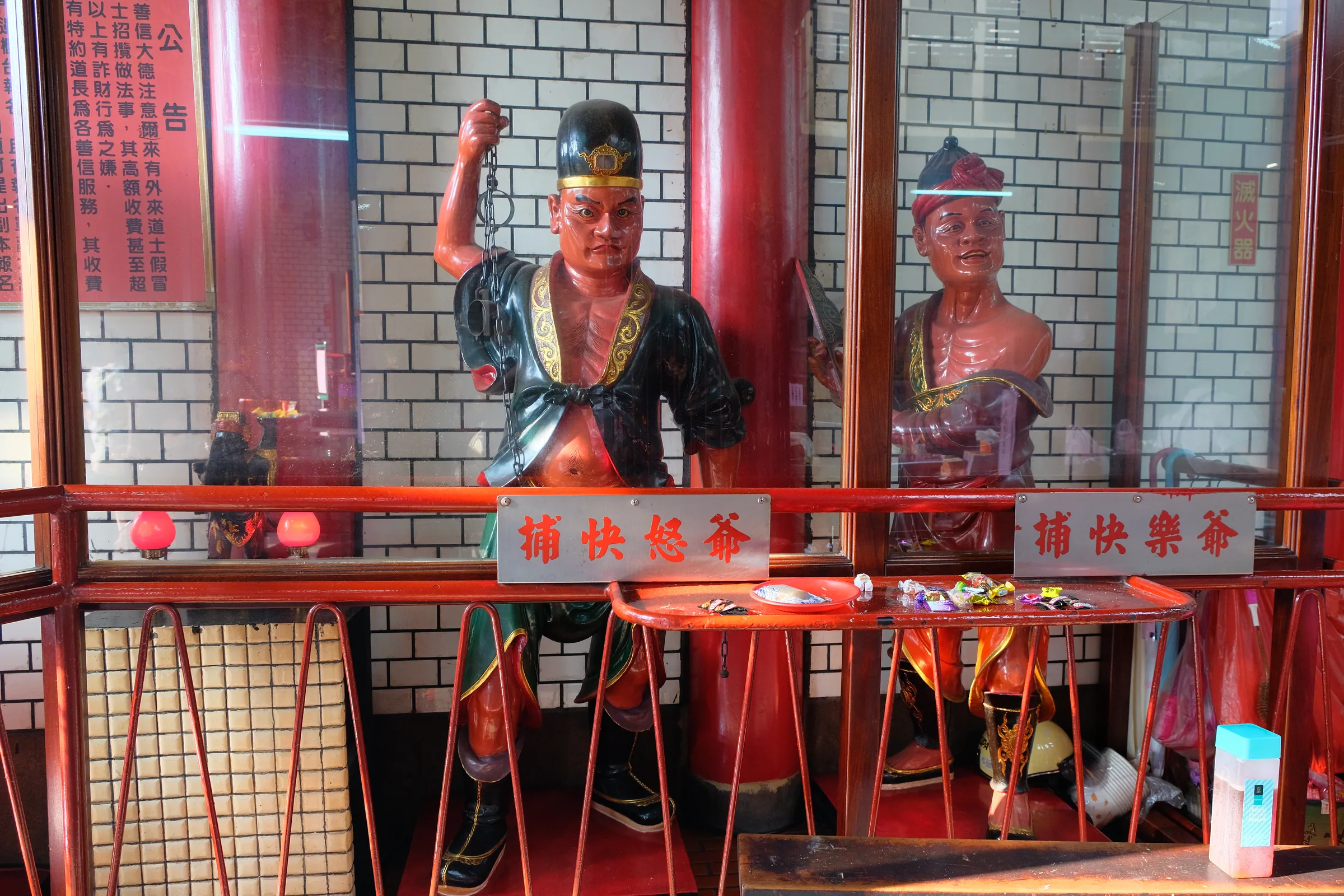
Image: Taiwankengo, CC BY-SA 4.0; Wikimedia Commons file page.
In 1747, the Tamsui Magistrate, Tseng Yue-ying (曾曰瑛), decided to move the administrative seat from Tamsui to Zhaqiang. In 1748, the Hsinchu City God Temple was completed; the Tamsui Magistrate's Office was not finished until 1756. Today, those standing on No. 75 Zhongshan Road in Hsinchu City are looking not at a temple that "grew with the city," but at a public center that stabilized the city even before the government did.1 2
This sequence is counter-intuitive: usually, there is a government first, followed by guardian deities; yet Zhaqiang built the City God Temple first, and the official administrative office later. This is not proof of divine miracle, but a historical trace where local governance, immigrant cultivation, and spiritual space formed simultaneously in Zhaqiang during the Qing Dynasty.
Curator's Note: What is most memorable about the Hsinchu City God Temple is not its "miraculous power," but that people established a place to collectively face order and anxiety before the city even had a complete government.
The Temple Came First, Then the Administration

Image: Adao, CC BY-SA 4.0; Wikimedia Commons file page.
The initial form of Zhaqiang's city appeared in 1733. The Tamsui Magistrate, Xu Zhi-min (徐治民), planted prickly ash and built four wooden towers here; in 1747, Tseng Yue-ying decided to move the Tamsui administrative seat from Shalu to Zhaqiang and proposed building a City God Temple next to the planned office. The temple was completed in 1748, while the magistrate's office was not finished until 1756.1
This history makes the status of the City God Temple different from that of a mere local shrine. Upon completion, it was officially recognized and housed the county-level "Xianyou Bo" (顯佑伯). The City God here is not just a deity in folk religion but also part of the Qing Dynasty's administrative imagination: the government managed the mortal realm, while the City God represented another judicial order that imagined good and evil, appeals, and border protection. The National Cultural Heritage website describes the establishment of the City God Temple and Zhaqiang city as "inseparable," listing the roles of magistrates, gentry, and local families in its construction. In other words, the temple's public nature was not added later by tourism or cultural policy; it carried both religious and local organizational functions from its initial construction phase.1
The National Cultural Heritage website places the temple's construction within the context of Zhaqiang City's establishment, detailing contributions of the Wang Shijie (王世傑) family with land and the participation of local gentry in the construction. From these records, the temple is not an isolated religious object but a node where the official administration, local families, immigrant society, and urban space intersect.1
The Rank of a Temple Followed the City's Administrative Changes
The rank of the Hsinchu City God changed with administrative shifts. In 1875, Taipei was upgraded to a prefecture (府), but while the Taipei Prefecture administration was not complete, it still used the original Tamsui Magistrate's Office; thus, the Hsinchu City God was promoted from "Xianyou Bo" in the county context to the prefectural "Suijing Hou" (綏靖侯). By around 1889, historical documents record that He became the "City God of Hsinchu County," regarded as the only City God Temple in Taiwan.1 2
"City God" is not merely a title; it is a way of inscribing urban power into the deity's rank. The Ministry of the Interior's religious culture map introduced it as "Taiwan's only provincial-level City God Temple," noting that its judicial imagination once covered the entire island during the Qing Dynasty. This description refers to historical institutional and religious order, not necessarily modern administrative jurisdiction.2 4
In 1887, Hsinchu suffered a great drought. Ministry of the Interior records state that local officials prayed for rain from the City God, Dragon King, and Guanyin; subsequently, Liu Ming-chuan (劉銘傳) reported to Emperor Guangxu, and the temple received the plaque "Kinmen Protection." This plaque is still hung in the main hall today, serving as both a religious object and historical evidence of how the Qing state responded to local disasters and local deities.4
1924: Local Gentry Renovate the Temple into Today's Form
The Qing Dynasty left the starting point of administration and religion; the Japanese colonial period left the most striking architectural expression we see today. These two layers cannot be merged into a vague "ancient": the founding date is 1748, but the main structure that survives today largely dates from the 1920s.2
The Investigation and Restoration Plan for the Third-Grade Ancient Monument Hsinchu City God Temple in 2005 was completed by research leader Li Qianlang (李乾朗) and others, commissioned by the Hsinchu City Government. The study did not just measure the roof structure but also included religious activities, surrounding environment, stonework, woodwork, murals, jiannian (cut-and-paste decoration), plaques, statues, altars, tiles, and wood deterioration. The report separately addressed "Architectural Features," "Architectural Art," "Damage and Current Status Survey," and "Restoration and Landscape Planning Recommendations," explaining that monument restoration is not just about making the exterior look beautiful in one go, but first deconstructing a still-in-use building into evidence that can be investigated, compared, and maintained.5
The temple's most visible appearance today was primarily established during the 1924–1926 renovations. The renovation was initiated by local gentry from North Gate Hsinchu, Cheng Zhaoqi (鄭肇基), who added a surrounding wall to the temple precinct and reorganized the rear hall area with Falian Temple; photos from the Hsinchu City Cultural Affairs Bureau in 1930 show the appearance of the City God Temple after the 1926 reconstruction.6 7
The architectural form is a continuous gabled, three-hall structure, featuring three open bays, three entrances, and two corridors, with Falian Temple connected to the left. Ministry of the Interior records note that the temple was aligned with Falian Temple and the guard rooms, forming a wider facade and continuous temple precinct—a configuration not common in Taiwan.2
The craftsmanship from the 1920s is also preserved in the wood and stone. The major woodwork was handled by master carpenter Wang Yi-shun from Huian Creek, Quanzhou; the main hall features an octagonal zaojing (藻井 - ceiling medallion), flat dark ceilings, and complex dougong (bracket sets); the dragon pillars were crafted by stonemason Xin A-jiu. The stone lions in the main hall use blue-and-white bricks from Huangtang, Huian, Quanzhou; Ministry of the Interior records also mention that these lions were later featured on stamps.2 4 Records from the Hsinchu City Cultural Affairs Bureau regarding woodwork restoration from 2008 to 2010 noted prior issues such as leaks, termites, and wood decay, which were systematically inspected in the major wooden structure and wood carvings.8
The "Carving" data page shows another dimension of craft preservation: restorers must not only identify motifs but also handle the relationship between wood, components, joinery, and carved surfaces. When the National Cultural Heritage website places technical preservers, woodwork restoration projects, and ancient monument components in one record, preservation is no longer just writing a craftsman's name on an explanatory plaque; it means treating the knowledge that can be judged, operated, and taught as part of cultural heritage. This is what makes the Hsinchu City God Temple worth further reading: it preserves not just a single "beautiful carving," but a set of working knowledge that still requires successors.9

Image: Adao, CC BY-SA 4.0; Wikimedia Commons file page. Architectural restoration information is available on the Hsinchu City Cultural Affairs Bureau webpage.
Curator's Note: This temple did not seal "tradition" in the Qing era. Its status as a Qing official temple, its reconstruction craftsmanship during the Japanese period, and its post-war festivals all overlap under one roof.
A Month of Festivals: Re-walking the City
The Zhaqiang Zhongyuan City God Festival is not a single day procession but a series of rituals extending from the sixth lunar month to the end of July. The National Cultural Heritage website registers it as a folk custom, noting that the festival is held annually by the Hsinchu City God Temple, with the Hsinchu City Government serving as the competent authority.3
The festivals involve summoning the Yin-Yang officials on the 12th day of the sixth lunar month, opening the Tiger Gate and conducting hangjia (paper shackle ceremony) on the first day of the seventh lunar month, night patrols on the 13th, a processional blessing on the 15th, and general deliverance on the 19th, with the gate closing at the end of the month. These rituals extend the internal order of the temple to the streets, the North Altar, affiliated temples, and residents' gates.3 4
The most visceral element is the hangjia. Participants wear paper shackles and walk with the procession toward the North Altar, where they are removed and burned by Taoist priests. The Cultural Heritage website notes that this ritual symbolizes removing karmic obstacles and escaping disaster; Ministry of the Interior English materials explain its symbolism as "paper shackles bearing sin." This is a public ceremony that turns abstract sins, wishes, and prayers into a physical journey carried on one's shoulders.3 4
The processional blessing on the 15th is the core of the festival. The procession generally covers the four ancient city gates and multiple temples, spanning about 7 to 8 kilometers; local households and businesses set up incense tables along the route to greet the procession, which returns gifts using talismans and water cakes. This makes the procession not just a display of temple carriages but an urban collaboration completed by residents, merchants, volunteers, ritual teams, and affiliated temples.3 Research from the Hsinchu City Cultural Affairs Bureau also points out that the temple simultaneously served religious, entertainment, economic, and educational functions, documenting the transformation where the Hsinchu City God Temple collaborated with the Beigan (北管) troupe to attempt to carry on traditional opera.10
The Hsinchu City Cultural Affairs Bureau has described the Zhaqiang Zhongyuan City God Festival as a daily culture recognized by citizens; academic research analyzes how it transformed from a temple fair into the "City God Festival" brand, linking it with Beigan opera and intangible cultural heritage registration. Viewing both perspectives together reveals two sides of the festival: it is the faith that devotees participate in annually, and it is a public activity repackaged by local government and cultural institutions.11 12
Not Treating Legends as Evidence
The Hsinchu City God Temple has many legends concerning Japanese rule, wartime bombings, miraculous appearances of statues, and divine mandates protecting the temple. The temple's own history page also reminds visitors that some stories are oral traditions, and it does not encourage superstition, viewing certain phenomena as coincidences.3
Therefore, a more reliable reading is not to write legends directly as historical facts—such as "the Japanese dared not demolish the temple for fear of the deities"—but to treat them as material showing how local society understood preservation, danger, and the continuation of faith. Dates, architecture, and festivals that can be supported by data from cultural heritage registrations, local cultural affairs bureau images, or academic research can be stated clearly. Miracles that cannot be cross-verified should remain legends.
This distinction is important. The value of cultural heritage does not need supernatural events to exist. Architectural preservation is not just about fixing a building until it "looks new." The Hsinchu City Cultural Affairs Bureau recorded inviting professionals in 2005 to inspect the entire wood structure and carvings, followed by maintenance from 2008 to 2010. Major woodwork was maintained through structural replacement, and smaller woodwork was restored according to different craftsmen's work. These efforts turned "preservation" into a series of judgments: which components to keep, which structures must be replaced, and which traces should be visible to people.8
Similarly, the festival is not simply an ancient ritual transplanted unchanged to today. Academic research points out that in recent years, the temple has used the collective term "City God Festival" for July activities, linking it with cultural heritage registration by the Hsinchu City Government, Beigan opera, and local marketing. This transformation may make culture visible, but it might also compress complex faith into a tourism brand. What is worth retaining is not a single evaluation of the transition, but seeing how tradition continues to negotiate within new public contexts.11
The true weight of the Hsinchu City God Temple lies in its urban position preceding the magistrate's office, the divine rank that rose and fell with administrative systems, the works of craftsmen from the 1920s, and the festival that walks the city every year.
If these layers are arranged on a timeline, it becomes clearer that it is not a static relic:
| Time | Event | Significance Left Behind |
|---|---|---|
| 1733 | Zhaqiang begins building prickly ash walls and wooden towers | Settlement first formed defensive and public space |
| 1747–1756 | Tseng Yue-ying proposes temple construction; Tamsui administration moves in and completes the office | City God Temple and administrative city form simultaneously |
| Post-1875 | Taipei established as a prefecture; administration still in Hsinchu; City God rank is raised to prefectural level | Divine rank reflects administrative changes |
| 1924–1926 | Cheng Zhaoqi oversees renovation, leaving the main surviving structure | Local gentry and craftsmen reshape the temple's appearance |
| 1985–2009 | Temple listed as a monument; festival registered as folk custom | Architecture and ritual separately enter cultural heritage systems |
This table does not slice history into easily memorable years but reminds readers that each period of "preservation" has different subjects, and it reminds us not to mix the responsibilities of different eras. The Qing officials and local gentry cared about urban order and ritual rank; the 1920s builders dealt with woodcraft, stone craftsmanship, temple precinct scale, and family prestige. The modern cultural heritage system must deal with structural safety, ritual inheritance, public participation, and documentary evidence. Only by laying out the choices of different eras can we avoid mislabeling a temple as an unchanging time capsule.1 2 3 8
This is also where the title "City God" deserves understanding. It does not simply claim that Hsinchu's deity is higher than others, but explains how a Qing administrative and ritual order borrowed language from each other. When the systems of prefectures, counties, and magistrates change, the City God's title and the local imagination of Him adjust accordingly. When the temple was renovated in the 1920s, craftsmanship inscribed a new era's aesthetic into the old spiritual space. The title, architecture, and festival are actually three ways the same city answered "who guards this place" at different times.1 2
From a research perspective, this temple also teaches how to handle local data. Official registration pages are suitable for verifying dates, designated categories, and preservation scope. Articles from the local cultural affairs bureau are useful for understanding restoration projects, Beigan activities, and photographic context. Academic papers can provide conceptual analysis of festival transformation. Each has its use but cannot replace the others. Treating descriptive words from tourism pages as historical evidence exaggerates claims like "No. 1 in Taiwan" or "largest." Reading only engineering reports fails to show why people are willing to participate in the festivals. A more balanced approach is to let different types of data answer what they can best answer, and offer limited interpretations where clearly marked.1 7 11 8
This division of labor also means that "important" does not have to mean "most lively." The importance of the Hsinchu City God Temple can be seen through three interconnected scales: first, the local scale, which is connected to Zhaqiang City, the magistrate's office, and the old city's commercial life. Second, the craft scale, where woodwork, stonework, plaques, and restoration records turn abstract history into recognizable objects. Third, the community scale, where hangjia, processions, Beigan, and temple precinct life require cultural heritage to be sustained through people's actual use. Only when these three scales exist together does the temple avoid being reduced to a photo spot, and the festival avoids being simplified to an annual performance.2 3 8 10
What City Life Leaves Behind
The temple precinct has never been a blank forecourt of a building. The Hsinchu Tourism website lists the temple market and snack stalls as Hsinchu specialties, explaining that religious space, food, commerce, and foot traffic have long overlapped. A 2025 cultural introduction by the Hsinchu City Cultural Affairs Bureau also uses the City God Temple as a starting point for the old city's culinary and life culture. These materials should not be interpreted as "street snacks at the temple represent all of Hsinchu," but they serve to remind us: local culture is often not placed in a display case, but is repeatedly created during time spent waiting, buying food, watching processions, and greeting neighbors.7 12
The public nature of the City God Festival is not just about the number of participants. The registration reasons on the National Cultural Heritage website include traditionality, locality, historicity, cultural value, and exemplary status—words that seem administrative but are actually answering a very lived question: how does a place prove that something is not just an activity of the temple itself, but a memory shared by the community for a long time? When the festival requires volunteers to guide traffic, merchants to set up incense tables, affiliated temples to organize teams, the answer is not hidden in the shrine but appears in the coordination of the entire city.3
This also explains why architectural preservation and folk custom preservation must be viewed together. Preserving only Wang Yi-shun's zaojing and Xin A-jiu's dragon pillars results in a beautiful ancient monument. Preserving only the hangjia, night patrols, and processions might lose the spatial order that carries the rituals. The case of the Hsinchu City God Temple layers two time periods: woodwork requires periodic inspection and maintenance, while the festival restarts every seventh lunar month. It does not preserve the past as it was; rather, it allows the past to remain usable.8 10
Curator's Note: Evidence that a temple is alive is not how ancient it looks, but whether people still know when to return, which path to take, and what to pass on to the next generation.
Curator's Note: Preserving a temple does not mean endorsing all legends; on the contrary, knowing what belongs in the archives and what is oral tradition is how local memory stays alive longer.
Conclusion: The Precinct Is Not Beside the City
In 1985, the Hsinchu City God Temple was designated as an ancient monument; in 2009, the Zhaqiang Zhongyuan City God Festival was registered as a folk custom. The former preserves woodwork, stonework, space, and historical layers; the latter preserves time, body, route, and shared participation. Only when combined do they approach the temple's true function in Hsinchu.1 3
It was once the location of an officially recognized City God, later becoming a spiritual center for local residents and a geographical center for urban cultural activities. The temple precinct contains incense offerings, Beigan opera, paper shackles, temple carriages, vendors, volunteers, and people waiting for processions. These cannot be neatly categorized as a simple "tradition," but can be seen as the city still using its own history.
The next time you walk into the Hsinchu City God Temple, look up at the zaojing first, then look at the stone lions at the entrance, and finally think one thing on the festival route: the center of a city is not necessarily where the government office begins. Sometimes, it starts with a temple that people are willing to jointly maintain and walk back to.
Further Reading
To understand the Hsinchu City God Temple beyond its architecture, first read the "Zhaqiang Zhongyuan City God Festival" registration data from the National Cultural Heritage website, then cross-reference it with the woodwork restoration and Beigan research collected by the Hsinchu City Cultural Affairs Bureau. The former provides systematic records of rituals; the latter two place preservation work back into concrete people, objects, and time.3 8 10
Image Sources
This article uses three original photos from Wikimedia Commons under CC BY-SA 4.0, with authors, licenses, and file pages cited in the text. The first photo was taken by Taiwankengo in 2018 of the Hsinchu City God Temple; the second and third photos were taken by Adao in 2023 of the temple gate and main hall. Images are directly linked from original files on Wikimedia Commons, without downloading, modifying, or hosting elsewhere.
References
- Ministry of Culture, Ministry of Cultural Affairs Bureau / National Cultural Heritage Website: Hsinchu City God Temple — Cultural heritage registration, construction history, administrative rank, renovation, and architectural features.↩2345678910
- Ministry of the Interior, National Religious Information Network / Taiwan Gods: Hsinchu City God Temple — Architectural typology, craftsmen, Qing dynasty history, monument designation, and historical origins.↩2345678910
- Ministry of Culture, Ministry of Cultural Affairs Bureau / National Cultural Heritage Website: Zhaqiang Zhongyuan City God Festival — Folk custom registration data, festival history, ritual schedule, hangjia, and procession content.↩234567891011
- Ministry of the Interior, National Religious Information Network / Taiwan Gods: Hsinchu Cheng Huang Temple and Chuchang Zhongyuan City God Festival — English article page from the Ministry of the Interior, cross-explaining temple history, architectural features, festival schedule, and hangjia rituals.↩2345
- Hsinchu Local Treasure Database: Investigation and Restoration Plan for the Third-Grade Ancient Monument Hsinchu City God Temple — The 2005 investigation and restoration plan commissioned by the Hsinchu City Government, led by Li Qianlang et al.↩
- Hsinchu Local Treasure Database: City God Temple — 1930 image, post-1926 appearance, and documentary clues compiled by the local cultural affairs bureau.↩
- Hsinchu Tourism Website: Ancient Monument History - Hsinchu City God Temple — Historical background, architectural features, and festival overview from the Hsinchu City Government tourism page.↩23
- Hsinchu Local Treasure Database: Woodwork Restoration of Hsinchu City God Temple — Article page from the Hsinchu City Cultural Affairs Bureau regarding major and minor woodwork inspection and restoration from 2008 to 2010.↩234567
- National Cultural Heritage Website: Wood Carving Technique — Technical data page on cultural heritage, including the context of woodwork carving restoration at the Hsinchu City God Temple.↩
- Hsinchu Local Treasure Database: From the Relationship Between Temples and Opera—Looking at the Interactions of Beigan Xuan She and Temples in Different Development Stages in Hsinchu City — Article page from the Hsinchu City Cultural Affairs Bureau regarding Beigan and temple research.↩234
- Hua Yi Online Library: Viewing the "City God Festival" Activities of Hsinchu City God Temple from a Cultural Marketing Perspective — Huang Yun-xi, Philosophy of Religion, Vol. 52, 2010, pp. 123–136; provides an abstract of festival history and cultural marketing research.↩23
- Hsinchu City Cultural Affairs Bureau: Zhaqiang Zhongyuan City God Festival and Local Life Culture — Explanation from the Hsinchu City Cultural Affairs Bureau regarding the festival, urban identity, and daily culture.↩2