
30-second overview: Computex, the Taipei International Computer Show, turns 45 this year. It began in 1981 as an export trade show for small and medium-sized enterprises beside Songshan Airport, and grew into the stage that global AI giants must visit every year in late May and early June. Its two major contemporaneous rivals, Germany’s CeBIT and the United States’ COMDEX, have both shut down; only Computex has kept getting bigger. The theme for 2026 is “AI Together.” Jensen Huang took the stage in Taipei, and his first words were: “It is good to be home.” Why does the global technology industry fly to Taipei every year in late May? The answer is hidden in a hard, cold number: research institutions estimate that nearly 90 percent of the world’s AI servers are assembled on this island.
It Is Good to Be Home
On the morning of June 1, 2026, in Taipei, Jensen Huang took the stage. His first words were: “It is good to be home.”1
On the large presentation backdrop behind him were not chip model numbers, but the names of Taiwanese snack shops such as Wangji Fucheng Rice Dumplings and Fu Ba Wang Pork Knuckle.1 A boy from Tainan who moved to the United States at age nine and later founded, in California, the company with the world’s highest market capitalization2 had returned to Taipei and called this place “home,” and “where it all began.”1
In that speech, he unveiled the next-generation computing chip codenamed Vera Rubin, announced that it had “fully entered production,” and showed a chip called N1X, describing it as “the world’s most amazing chip.” He spoke of “useful AI” having arrived, and of “agentic AI” arriving.1 But what the audience may remember most clearly was still the backdrop filled with rice dumplings and pork knuckle.
The show where he stood is called COMPUTEX, the Taipei International Computer Show. This year it is 45 years old. And he was not the only one who poured into Taipei that week: AMD’s Lisa Su, Intel’s Lip-Bu Tan, and Qualcomm’s Cristiano Amon joined him, with the CEOs of four global technology giants speaking on the same stage. TAITRA chairman James Huang did the math: the combined market capitalization of the companies represented by the four keynote speakers and nearly 30 forum speakers exceeded US$10 trillion.3
📝 Curator’s Note
One question is worth pausing over: why do several of the world’s most valuable technology companies choose Taipei, and choose a computer show that began beside Songshan Airport in 1981, to announce their most important products? The conventional explanation is the “Jensen Huang effect”: a Taiwanese American star CEO brought the world’s attention to Taiwan. But this explanation gets cause and effect backward. Huang returned to a place that was already impossible to bypass. To understand this, we have to begin with the small exhibition 45 years ago that no one expected much from.
The Export Trade Show Beside Songshan Airport
In 1981, Taiwan’s personal computer industry was just beginning to sprout. That year’s first exhibition had a plain name: the “Taipei Computer Show.” It was held at the TAITRA Exhibition Hall beside Songshan Airport, and organized by the Taipei Computer Association.45
Its initial function was practical: to give Taiwan’s newly emerging small and medium-sized computer companies booth space, so they could lay out motherboards and components and sell them to foreign buyers visiting Taiwan for procurement.5 This was the era of “Taiwan money flooding up to the ankles,” when the electronic parts culture of Guanghua Market was about to spill outward into an export business. This show was the annual gathering point for that business.
At the second edition, there were only 40 exhibitors.4 No one would have imagined that, more than four decades later, that number would become 1,500 companies and 6,000 booths.6
The Year Stan Shih Changed the Name
1984 was a turning point. According to Wikipedia and multiple reports, Stan Shih, then chairman of the Taipei Computer Association and later the founder of Acer, made the decision to formalize the show’s English name as “COMPUTEX TAIPEI.”45 A naming act by a local engineer gave an exhibition originally meant only for Taiwanese manufacturers a signboard facing the world.
The following year, beginning with the fifth edition in 1985, the semi-official Taiwan External Trade Development Council, or TAITRA, joined as co-organizer, and the Chinese name was changed to “Taipei International Computer Show.”4 From then on, Computex had two engines: an industry association that understood the sector and stayed close to manufacturers’ needs, and a trade promotion organization with the resources to push the exhibition international. With both engines turning, the show began to climb.
By 1989, it was already Asia’s largest computer show and the world’s third largest, behind only CeBIT in Hanover, Germany, and COMDEX in the United States.4 That was the golden age of Taiwan’s PC contract manufacturing. ASUS, Gigabyte, MSI, and other later global brands all walked out from the booths of this show.
💡 Did You Know?
Computex’s venues were not “moved” into existence; they grew. From the Songshan Airport venue in 1981, to the World Trade Center Exhibition Hall on Xinyi Road from 1986, then the Taipei International Convention Center, World Trade Center Hall 2, and Hall 3, and from 2008 Taipei Nangang Exhibition Center Hall 1 and later Hall 2 as well.4 It expanded its exhibition grounds outward all the way, like a tree gradually growing new branches without ever changing pots.
Three Major Computer Shows; Two Died
Entering the 2000s, the balance among the world’s three major computer shows began to tilt.
The first to fall was COMDEX in the United States. In 2003, as COMDEX declined, Computex’s organizers officially incorporated Taipei World Trade Center Hall 3 into the exhibition area. That year, Computex formally climbed to become the world’s second-largest computer show, behind only CeBIT, and in 2004 it established the scale of operating across four halls at once.45
Germany’s CeBIT lasted longer. CeBIT was spun off from the long-running Hannover Messe in 1986, and at the height of the internet bubble it once reached 850,000 visitors, making it indisputably the world’s number one.7 But after reaching its peak it declined. Visitor and exhibitor numbers fell year after year, while the market was carved up piece by piece by CES in January, MWC in February, Computex in June, and IFA in September. In November 2018, the organizer announced that CeBIT would pass into history.7
In its report on CeBIT’s closure, Taiwan’s Central News Agency made one pointed observation: “The Taipei International Computer Show (Computex), held every June, has a geographic advantage for Asian manufacturers seeking orders, and its scale has continued to expand.”7
The phrase “geographic advantage” is the key to the whole matter.
Of the three major computer shows, COMDEX closed in 2003, CeBIT closed in 2018, and the one that remains grew in Taipei. Why was Computex the one that survived?
📝 Curator’s Note
The common online claim is that “Jensen Huang made Computex great again.” But this gets the chronology backward. COMDEX and CeBIT had already died before the AI wave arrived, while Computex had been expanding long before that. What do exhibitions follow? They follow orders, and orders follow manufacturing. The shows in Germany and the United States were held where “demand” was: buyers, media, product launches. The show in Taipei was held where “supply” was, meaning where things were actually made. When an industry enters a stage in which “who can build it” becomes scarcer than “who can imagine it,” the exhibition held at the manufacturing end wins. Exhibitions do not grow out of thin air. They grow where things are actually made.
The Six Thousand Booths No One Photographs
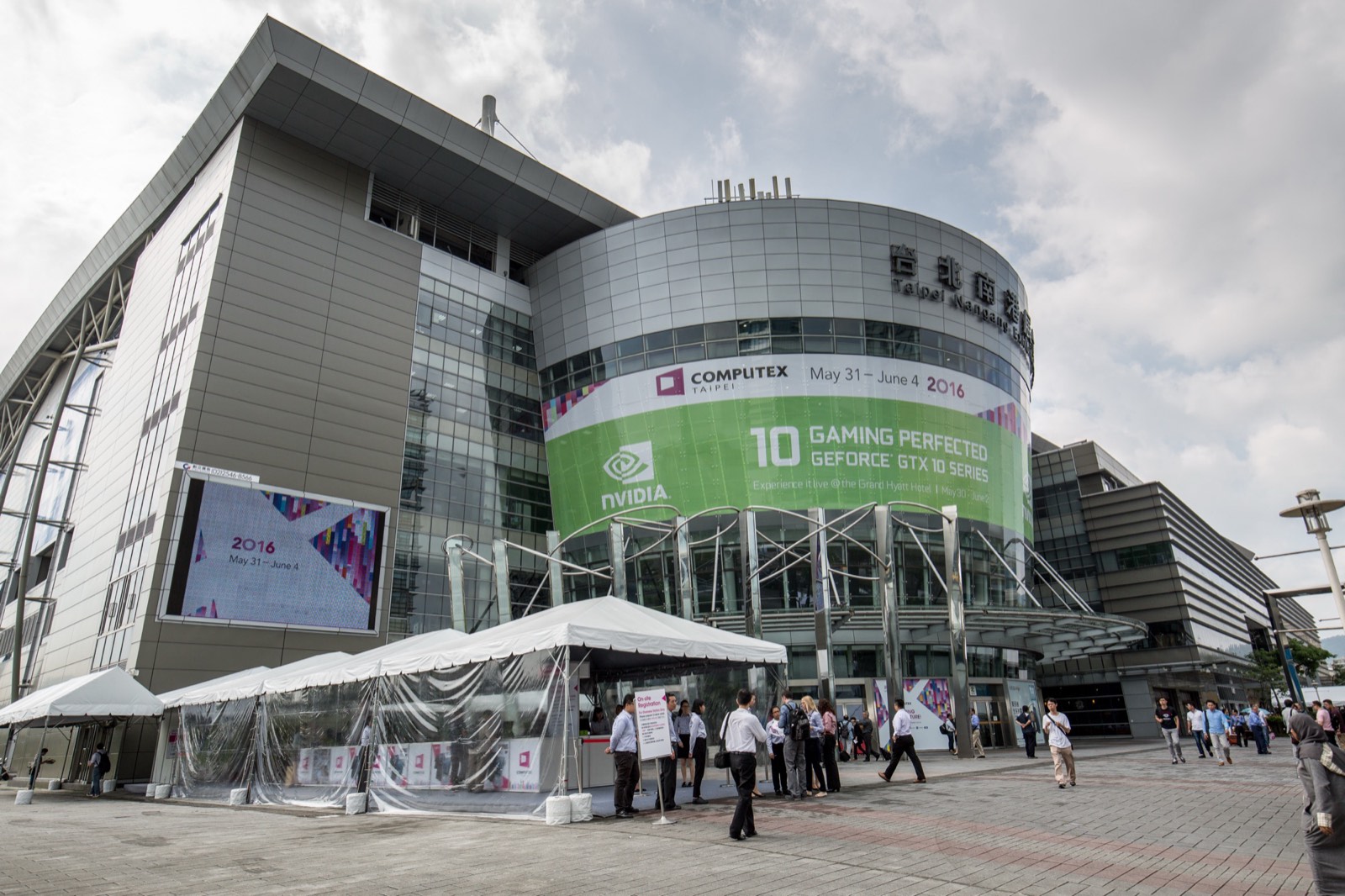
Taipei Nangang Exhibition Center, COMPUTEX’s main venue in recent years. Every year in late May and early June, buyers from more than a hundred countries crowd into this place. Photo: NVIDIA Taiwan, 2016-05-31. License via Wikimedia Commons.
The media’s cameras are always aimed at the keynote stage, at those few CEOs. But Computex’s real body is its 6,000 booths.6
Most of those booths do not belong to any brand you can name. They are small and medium-sized companies making cases, cooling systems, power supplies, and connectors. No one will write a feature story about them, but without them, an AI server cannot be assembled. Starting with the export trade show beside Songshan Airport in 1981, these “unphotographed” small and medium-sized enterprises have always been the skeleton of the show. Take, for example, Auras and Shuang Hong, which make cold plates and quick connectors. Ordinary people may never have heard their names, but they are indispensable cooling links inside NVIDIA’s scorching AI racks.
This is precisely what makes Computex most different from other technology shows. In essence, it is a B2B procurement site. Foreign buyers come here to place orders. Because the show is held on the island where the supply chain is densest, buyers can walk a few booths and assemble the components of an entire machine. That kind of efficiency cannot be offered by a Silicon Valley launch event.
The Decade When “The PC Is Dead”
Computex, however, did not have only smooth sailing.
In 2012, global PC shipments declined for the first time, and this show that had begun with the PC entered a downturn with them.5 The claim that “the PC is dead” began to spread, while smartphones carried away consumers’ attention wholesale. In 2014, even Lenovo, the leading PC maker, was absent, and some began questioning whether Computex had been reduced to a feel-good event for Taiwan’s own brands. In 2015, an article circulating in technology circles across Taiwan and China put it bluntly in the headline: “The Declining ComputeX, a Game Close to Self-Amusement.”5
That was also the most awkward era for Computex’s image. In its early years, it was famous for halls full of show girls. In 2018, this drew criticism from foreign media for objectifying women and for marketing attitudes stuck in the previous century. The following year, TAITRA stepped in and encouraged exhibitors to use more creative marketing. Although it did not issue an explicit ban, show girls became noticeably fewer on the exhibition floor.8
Crisis forced transformation. In 2016, Computex established the startup exhibition InnoVEX, extending the show’s reach from mature PC hardware toward artificial intelligence, the Internet of Things, and startup teams.6 The show’s official positioning was also quietly rewritten from a “computer show” into a “leading global AIoT and startup industry show.”4 In 2020, the pandemic interrupted the physical exhibition, and the organizers moved it online, surviving the hardest year.4
No one knew that this transformation, made in order to survive, would happen to prepare the beach for the tsunami that arrived three years later.
The Year Jensen Huang Came Back
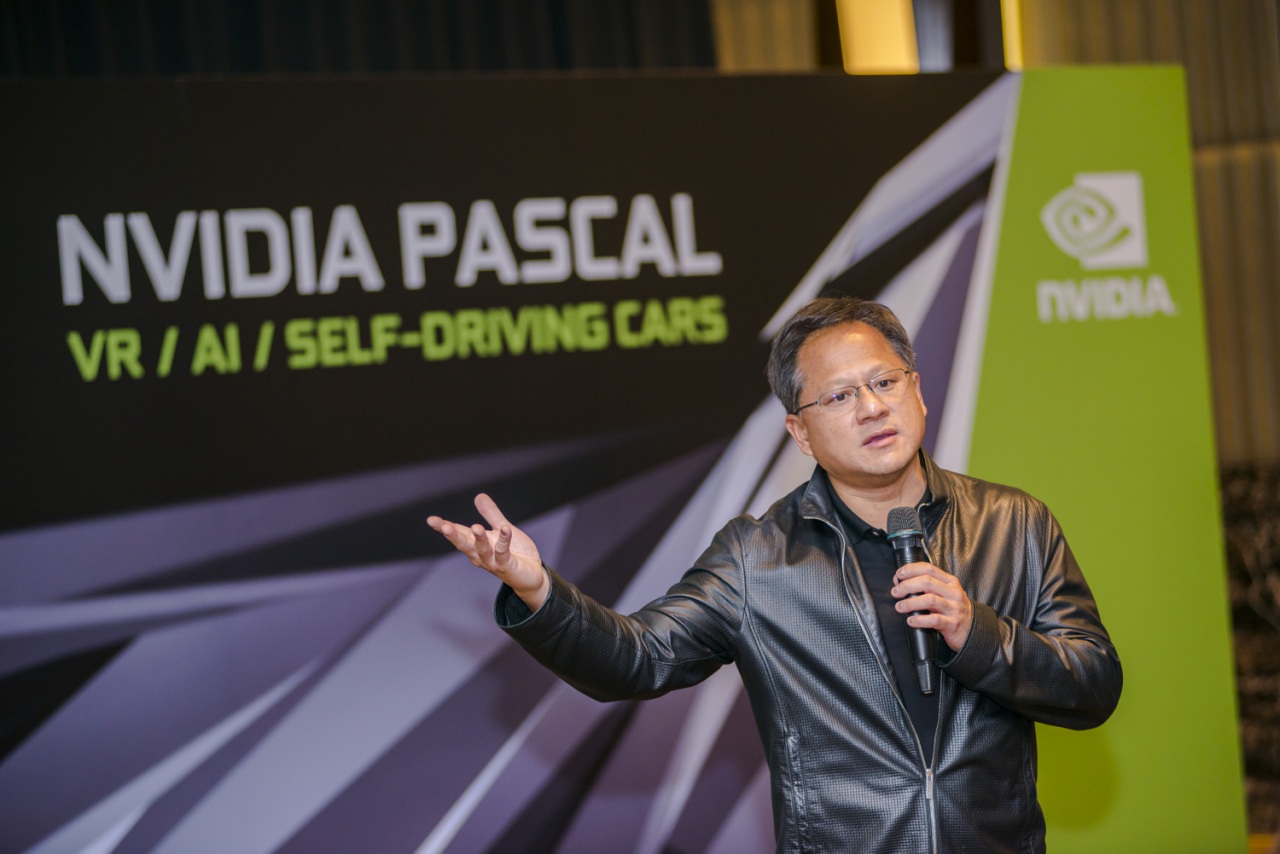
Jensen Huang speaking at Computex Taipei in 2016. Starting in 2023, he has returned to this show almost every year to announce NVIDIA’s latest AI chips. Photo: NVIDIA Taiwan, 2016-05-31. License via Wikimedia Commons.
On May 29, 2023, Jensen Huang took the Computex stage to deliver his first in-person keynote after the pandemic, and his first public speech in nearly four years.9 He brought the Grace Hopper Superchip, announced its formal mass production, and unveiled the DGX GH200 supercomputer, which could connect 256 chips through NVLink and reach one exaflop of computing power, with Google, Meta, and Microsoft as its first customers.9 His main message could be reduced to one sentence: bring generative AI into every data center.
The wave of generative AI thus pulled Computex out from under the shadow of “the PC is dead.”
✦ A computer show that had been running for 40 years and written off for nearly a decade did not rely on becoming stronger by itself. The world suddenly needed the place where it was located.
In 2024, more technology-giant CEOs than ever gathered in Taipei. That year’s opening keynote was delivered by AMD’s Lisa Su, followed by the CEOs of Qualcomm, Intel, MediaTek, and Supermicro, while Jensen Huang appeared in conversation with the CEO of ARM.3 Outside the exhibition speeches, Huang also held a solo talk that year at National Taiwan University Sports Center, on how AI would drive a new global industrial revolution. At the end, he thanked Taiwan and said a line that would later be quoted repeatedly: “Taiwan is an unsung hero, yet a pillar of the world.” He also said: “Without Taiwan, NVIDIA’s vision would be an unrealizable dream.”10
During those days, he went with the 92-year-old Morris Chang and Quanta’s Barry Lam to Ningxia Night Market, eating oyster omelets and tofu pudding, in images that spread across Taiwan.11 Two years later, in 2026, he appeared at a night market again, this time with his parents, taking out cash to buy tofu pudding for people waiting in line and laughing as he said, “This is on me, sorry, sorry, I brought my father and mother here.”12 One of the world’s most powerful technology CEOs treated Taipei’s night markets as his own backyard.
By 2025, Computex had become entirely AI’s main stage. That year’s theme was “AI NEXT.” Huang spoke at the Taipei Music Center, which seats 5,000, to a full house, announcing the next-generation GB300 chip and working with Foxconn, the National Science and Technology Council, and TSMC to build AI infrastructure for Taiwan.13
Taipei This Year: AI Together
And so we arrive in 2026.
TAITRA chairman James Huang described this year’s Computex as “adopting a dual-exhibition-area model for the first time. In addition to Nangang Exhibition Center Halls 1 and 2, it returns to World Trade Center Hall 1, making it the largest edition in history.”14 Thirty-three countries, 1,500 exhibitors, and 6,000 booths; the show runs from June 2 to 5 and is estimated to attract 40,000 international buyers.615
This year’s theme is “AI Together.” Huang said this represents not only a new intersection between humans and AI, but “also symbolizes Taiwan joining hands with the global technology industry to jointly create a new chapter in future AI civilization.”14 The exhibition revolves around three major axes: AI and computing, robotics and mobility, and next-generation technology.6
The most notable new focus is robotics. This year, the returning World Trade Center Hall 1 has three specially planned zones: an AI Robotics Area, an E-Paper Industry Zone, and the TechXperience pavilion, focusing on “physical AI” and the “embodied intelligence” of robots.14 For the past few years, AI still lived inside servers in data centers. This year it is to grow hands and feet and enter the physical world. Taiwan’s supply chain has sensed the wind: Foxconn, Pegatron, and other contract manufacturers that had originally assembled AI servers have begun showing robots on the exhibition floor.16
The main stage remains star-studded. Jensen Huang spoke first on June 1, unveiling the Vera Rubin chip already in mass production; Qualcomm’s Cristiano Amon gave an opening keynote the same day; AMD’s Lisa Su and Intel’s Lip-Bu Tan each led their own appearances; and the CEOs of Marvell and NXP each gave speeches on AI infrastructure and physical AI.317 On the exhibition floor, as GPU computing power stacks higher and higher and air cooling has reached its physical limits, liquid cooling became standard equipment at major contract manufacturers’ booths for the first time.16
📝 Curator’s Note
Pay attention to Jensen Huang’s backdrop this year, with rice dumplings and pork knuckle, and to his line, “Taipei is where it all began.” A technology CEO announcing a chip did so against a background of night market snacks. This image tells the world that the chip he is discussing, from design to becoming a usable machine, depends at every step on this island. The pork knuckle on the backdrop and the 6,000 booths below making cooling systems and power supplies are speaking about the same thing.
Ninety Percent of the Servers, Three Percent Gross Margin
Pull the camera back from the stage, and you can see Computex’s real confidence, as well as its hidden worries.
For an NVIDIA AI chip to become a server that can operate in a data center, almost every intermediate process is completed in Taiwan. The chip is produced by TSMC, which makes more than 90 percent of the world’s most advanced chips. The chip must be packaged, relying on TSMC’s CoWoS advanced packaging, a process that is now the choke point in the shortage of AI computing power.18 The server must be assembled, relying on contract manufacturers such as Foxconn, Quanta, and Wistron. Foxconn alone holds about 40 percent of the global AI server contract manufacturing market.19 Power supplies depend on Delta Electronics, which holds about half of the global server power supply market; cooling systems, connectors, and cases are also almost entirely covered by Taiwanese manufacturers.18 Research institutions estimate that nearly 90 percent of global AI servers are assembled and shipped by Taiwanese companies.18
This is Computex’s geographic advantage. The design end is in the United States, the manufacturing end is in Taiwan, and every year in late May and early June, the place where the design end flies in to shake hands with the manufacturing end is this show.
But beneath the halo of this “home court” is a shadow very familiar to people in Taiwan. Gross margins in assembly contract manufacturing have long been only 3 to 5 percentage points, leading the industry to joke in Chinese about “gross three to four,” and about being “Maoshan priests,” a pun on “gross margin” and a term for ritual specialists.19 In the same supply chain, TSMC’s gross margin exceeds 50 percent, and NVIDIA’s exceeds 70 percent. What Taiwan earns is the hard money of assembling parts. The core intellectual property and design tools are still controlled by a few foreign companies upstream. The world’s most watched AI show is held in Taipei, yet Taiwan stands at a position in the value chain that is “irreplaceable, but not necessarily taking the largest share.”
⚠️ Controversies and Worries
Two even heavier stones weigh on this position. The first is geopolitics: in the past, the idea of a “silicon shield” held that Taiwan’s irreplaceability in semiconductors was a barrier deterring military force against Taiwan. But beginning in 2025, international think tanks started talking in the opposite direction, arguing that “the silicon shield is turning into a target.”20 The second is energy. Here is a counterintuitive number worth remembering. According to an investigation by The Reporter, in 2025 Taiwan’s data centers accounted for only about 0.5 percent of national electricity consumption. The real electricity guzzler was semiconductor manufacturing, which used nearly 15 percent of the country’s power.21 In other words, what truly supports Taiwan’s home-field status in AI is the fabs that run day and night, etching chips into existence, and their enormous appetite for electricity. The servers on the exhibition floor are merely the end of this long electricity chain. As for the loudly proclaimed slogans of supply-chain “de-Sinicization,” the reality is that contract manufacturers such as Compal operate factories simultaneously in Taiwan, China, Vietnam, Thailand, India, Mexico, and the United States. This is a dispersed “China plus N” layout, not a real withdrawal from China.15
The halo and the shadow are two sides of the same thing. Taiwan is Computex’s home court precisely because it has made “manufacturing,” something many advanced countries outsourced, irreplaceable. The price of that irreplaceability is staking the island’s electricity, geopolitical risk, and industrial center of gravity on this supply chain.
Taipei Is Where It All Began
In 1984, Stan Shih gave the “Taipei Computer Show” an English name facing the world. Taiwan at that time was still a small island making motherboards under contract for major international brands.
Forty-two years later, in 2026, Jensen Huang stood at the same show, with rice dumplings and pork knuckle behind him, and said, “It is good to be home,” and “Taipei is where it all began.”1 In the 42 years between, COMDEX closed, CeBIT closed, and computer shows around the world shut their doors one after another. Only this show, which grew out from beside Songshan Airport, has kept getting larger.
It did not become smarter than everyone else. It simply grew in the right place. Exhibitions follow orders, orders follow manufacturing, and manufacturing remained on this island. The next time you see news that “Jensen Huang has come to Taiwan,” you can read it this way: the infrastructure of global computing returns once a year to the place where it is actually assembled, to make a pilgrimage.
Further Reading:
- The Semiconductor Industry: A 50-Year Materials Revolution from RCA Technology Transfer to Gallium Nitride and Quantum Packaging — The materials science battlefield behind TSMC and CoWoS advanced packaging, which support Computex’s home-field status
- Taiwan’s Artificial Intelligence Development and Future Strategy — From hardware supply chains to AI applications, Taiwan’s position and choices in this wave
- Taiwan’s Robotics Industry — The “physical AI” and embodied intelligence highlighted at Computex 2026, and the foundations of Taiwan’s robotics supply chain
- Development of Taiwan’s Electric Vehicle Industry Chain — How the same electronics contract manufacturers extended from assembling computers to assembling cars and robots
Image Sources
This article uses three Wikimedia Commons images under CC licenses, all cached in public/article-images/technology/ to avoid hotlinking source servers:
- Computex Taipei sign inside Taipei Nangang Exhibition Center — Photo: Masaru Kamikura, 2011-05-31, CC BY 2.0 (hero image: the COMPUTEX exhibition floor and signage inside Nangang Exhibition Center)
- Computex Taipei at Taipei Nangang Exhibition Center — Photo: NVIDIA Taiwan, 2016-05-31, CC BY 2.0 (exterior of the main Nangang Exhibition Center venue)
- Jensen Huang at Computex Taipei — Photo: NVIDIA Taiwan, 2016-05-31, CC BY 2.0 (Jensen Huang speaking on the Computex stage)
References
- United Daily News: Jensen Huang’s GTC Taipei 2026 keynote, “It is good to be home” (2026) — Reports on Jensen Huang’s GTC Taipei keynote during Computex on June 1, 2026, including verbatim lines such as “It is good to be home,” “useful AI has arrived,” and “agentic AI is arriving,” the Vera Rubin/Vera CPU/N1X product announcements, and the backdrop listing Taiwanese food vendors including Wangji Fucheng Rice Dumplings and Fu Ba Wang Pork Knuckle.↩
- Wikipedia: Jensen Huang — Records biographical information on Jensen Huang, including his birth in 1963, upbringing in Tainan, move to the United States in 1973 at age nine, education in electrical engineering at Oregon State University and Stanford, and co-founding of NVIDIA in 1993 with Chris Malachowsky and Curtis Priem.↩
- Business Today: Four major CEOs on stage at COMPUTEX 2026, companies’ market capitalization exceeds US$10 trillion (2026) — Reports on the four CEO keynotes in 2026 by Jensen Huang (NVIDIA), Lisa Su (AMD), Lip-Bu Tan (Intel), and Cristiano Amon (Qualcomm), as well as verbatim remarks by TAITRA chairman James Huang that the companies represented by the four CEOs and nearly 30 forum speakers have a combined market capitalization exceeding US$10 trillion, and that “this wave of AI momentum is real.”↩
- Wikipedia: Taipei International Computer Show — Records the full development of Computex since the first “Taipei Computer Show” in 1981: the 1984 renaming, TAITRA’s entry in 1985 and the change to “Taipei International Computer Show,” annual scale figures, changes in world ranking, the venue expansion timeline, and the establishment of InnoVEX.↩
- Jiemian News: Forty Years of the Taipei Computer Show (Computex history review) — Details the full trajectory of Computex from an export trade show in 1981, Stan Shih’s 1984 renaming, TAITRA becoming an organizer in 1985, its rise in 1989 to Asia’s largest computer show, its ascent to the world’s second largest in 2003, and its downturn after PC shipments declined in 2012, with annual scale figures.↩
- Economic Daily News: COMPUTEX 2026 reaches a new scale record (2026) — Reports that the 2026 show runs from June 2 to 5, spans four exhibition halls, includes 1,500 exhibitors from 33 countries and 6,000 booths, and centers on three major themes (AI and computing / robotics and mobility / next-generation technology), as well as the new AI Robotics Area, E-Paper Industry Zone, and TechXperience in World Trade Center Hall 1, and a new 11-year high for InnoVEX with nearly 500 startups from 23 countries.↩
- Central News Agency: Germany’s CeBIT computer show passes into history (2018) — Reports that CeBIT in Hanover, Germany, announced its closure in November 2018, analyzes the decline in visitor and exhibitor numbers and the division of the market by CES / MWC / Computex / IFA, and specifically notes that “the Taipei International Computer Show every June has a geographic advantage for Asian manufacturers seeking orders, and its scale has continued to expand.”↩
- TechNews: Computex 2019 InnoVEX and the transformation of show girls — Reports on InnoVEX, Computex’s innovation and startup exhibition area established in 2016, its focus on AI and IoT, and provides a point of comparison for foreign media criticism of show girl culture in 2018 and TAITRA’s 2019 transformation direction of “encouraging creative marketing but not mandating it.”↩
- NVIDIA Blog: Jensen Huang Computex 2023 Keynote — NVIDIA’s official blog, recording Jensen Huang’s May 29, 2023 Computex keynote, his first in-person keynote after the pandemic, where he announced mass production of the Grace Hopper Superchip and the DGX GH200 supercomputer (256 chips connected by NVLink, 1 exaflop), with the main theme of bringing generative AI into every data center.↩
- Economic Daily News: Jensen Huang’s NTU speech, “Taiwan is an unsung hero” (2024) — Reports on Jensen Huang’s speech on the evening of June 2, 2024, at National Taiwan University Sports Center, recording verbatim lines including “Taiwan is an unsung hero, yet a pillar of the world,” “Without Taiwan, NVIDIA’s vision would be an unrealizable dream,” and “You are the backing of the AI industry’s innovation; no matter how great the storm, you have always stood firm as a rock.”↩
- United Daily News: Jensen Huang visits Ningxia Night Market with Morris Chang and Barry Lam (2024) — Reports the details of Jensen Huang’s May 29, 2024 visit with 92-year-old Morris Chang and his wife and Quanta’s Barry Lam to Ningxia Night Market after dining at Zou Ji, where they tasted oyster omelets and tofu pudding.↩
- EBC News: Jensen Huang takes his parents to Ningxia Night Market and buys tofu pudding for others (2026) — Reports that during his 2026 Taiwan visit, on May 25 Jensen Huang took his parents to a tofu pudding shop beside Ningxia Night Market, took out cash to buy tofu pudding for people waiting in line, and records verbatim: “This is on me, sorry, sorry, I brought my father and mother here; we won’t eat for too long, let me treat everyone.”↩
- TechNews: Key points from Jensen Huang’s Computex 2025 keynote (2025) — Reports on Computex 2025’s theme “AI NEXT,” Jensen Huang’s speech at the Taipei Music Center, the GB300 announcement, cooperation with Foxconn / the National Science and Technology Council / TSMC to build Taiwan’s AI infrastructure, and planning for NVIDIA’s Taiwan office in Beitou-Shilin.↩
- United Daily News: James Huang discusses COMPUTEX 2026’s dual exhibition areas and AI Together (2026) — Records verbatim remarks by TAITRA chairman James Huang: “adopting a dual-exhibition-area model for the first time. In addition to Nangang Exhibition Center Halls 1 and 2, it returns to World Trade Center Hall 1, making it the largest edition in history,” and “AI Together symbolizes Taiwan joining hands with the global technology industry to jointly create a new chapter in future AI civilization,” as well as plans for the AI Robotics Area, E-Paper Industry Zone, and TechXperience in World Trade Center Hall 1, with a focus on physical AI and embodied intelligence.↩
- TechNews: AI server capacity relocation and Taiwanese manufacturers’ multi-location layouts (2025) — Reports on Taiwanese AI server contract manufacturers’ global capacity layouts, including Wiwynn having 70% of its capacity in Mexico, Wistron and Quanta building factories in the United States, and Compal’s “China plus N” diversified strategy of operating factories in Taiwan, China, Vietnam, Thailand, India, Mexico, and the United States.↩
- Commercial Times: Taiwanese manufacturers’ booths at COMPUTEX 2026 and liquid cooling as standard equipment (2026) — Reports that in 2026 Foxconn uses the largest booth to exhibit the Vera Rubin NVL72 computing rack and robots, the booth scales of Quanta and Wistron, and how, as GPU computing power rises and air cooling reaches physical limits, liquid cooling has become a standard exhibit for major contract manufacturers, with the supply chain extending from assembling AI servers to assembling AI robots.↩
- Commercial Times: COMPUTEX 2026 is the largest in history and is expected to attract 40,000 international buyers (2026) — Reports that Computex 2026 is the largest edition in history, including dates, scale figures, an estimated 40,000 international buyers, and speeches by CEOs from Marvell and NXP on AI infrastructure and physical AI.↩
- EE Times Taiwan: Taiwanese contract manufacturers account for nearly 90 percent of global AI server shipments (2024) — Cites research institution estimates that Taiwanese manufacturers (including Quanta, Wistron, Wiwynn, Inventec, and Foxconn) account for nearly 90 percent of global AI server shipments, and explains the supply-chain position of TSMC producing more than 90 percent of the world’s most advanced chips and CoWoS advanced packaging as a bottleneck in AI computing power.↩
- Anue: Foxconn’s AI server contract manufacturing market share and analysis of contract manufacturing gross margins — Reports that Foxconn holds about 40 percent of the global AI server contract manufacturing market and ranks first globally, and explains the low-margin structure of electronics contract manufacturing, described in Chinese industry jokes as “gross three to four” and “Maoshan priests,” in contrast to the high gross margins upstream at TSMC and NVIDIA.↩
- Lawfare: Taiwan's Silicon Shield Is Turning Into a Target (2025) — An analysis by the U.S. legal and policy publication Lawfare arguing that, beginning in 2025, the concept of the “silicon shield” has inverted: Taiwan’s semiconductor irreplaceability is turning from a barrier deterring force into a strategic target.↩
- The Reporter: Data center electricity consumption and Taiwan’s energy challenge (2025) — An in-depth investigation of data center electricity consumption in Taiwan, including the counterintuitive contrast that in 2025 data centers accounted for about 0.5 percent of national electricity consumption while semiconductor manufacturing accounted for about 15 percent, Taipower’s suspension from 2024 of new electricity applications for data centers above 5MW north of Taoyuan, and analysis of Taiwan’s energy mix after the shutdown of Maanshan Nuclear Power Plant eliminated nuclear power.↩