
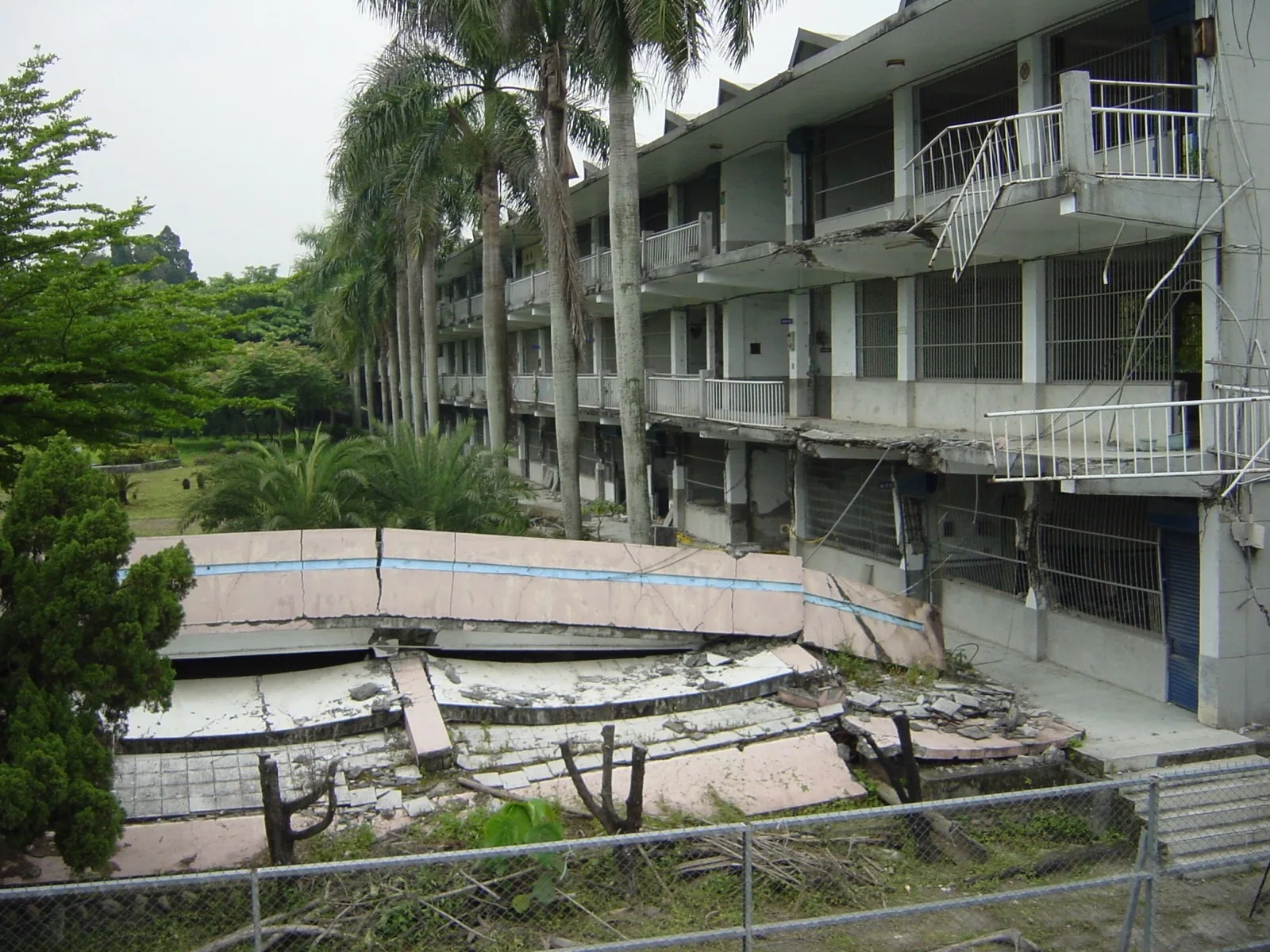
Damaged school buildings at Guang Fu Junior High School, Wufeng, Taichung, 2003. Photo: Hsu.shihhung. CC BY 2.0 via Wikimedia Commons. Note that "Guang Fu" here refers to an old place name in Wufeng, Taichung, which is a different location from Guangfu Township in Hualien where the 2025 floods occurred; both places carry representative memories of two major post-war disasters in Taiwan.
30-Second Overview: In September 2025, the overflow of the Matawan (Matawan) reservoir triggered a flood of 15.4 million cubic meters that rushed into Guangfu Township, Hualien, within 30 minutes. During the Teachers' Day long weekend, over 60,000 volunteers carrying shovels flooded into the disaster area via the Taiwan Railways Administration (TRA) northbound and southbound, earning the media moniker "Shovel Supermen." This mobilization builds upon the tradition of civil-government cooperation established by the 1999 Jiji earthquake and utilizes decentralized social media dispatching technologies; it has been hailed as "Taiwan's strongest national defense." Yet, within this same disaster, three different forward command centers—from the county government, the central government, and a political party—clashed within 500 meters of Guangfu Station, and the self-rescue energy of indigenous tribes was often overshadowed by the narrative of external aid. The "Shovel Supermen" represent both a victory for grassroots vitality and evidence of state emergency response failure; one must examine both sides to understand how this island of Taiwan pieces together "who we are" amidst repeated earthquakes, floods, and air blasts.
At 2:50 PM on September 23, 2025, the reservoir upstream on the Matawan River overflowed and breached its dam under heavy rainfall from the outer circulation of Typhoon Vagasa. Within 30 minutes, 15.4 million cubic meters of lake water surged downstream at a flow rate of 9,000 to 10,000 cubic meters per second1. At 3:30 PM that same day, the flood swept away the Matawan River Bridge on Provincial Highway 9, and black mud accumulated up to 2 meters high when it flooded Fuzu Street in Guangfu Township. A tally conducted over a month after the disaster revealed 19 deaths, 157 injuries, and 5 people missing across the three townships of Guangfu, Fenglin, and Wanrong, with over 8,000 people evacuated1.
The most memorable image of this disaster, however, was that of Guangfu Station in the following week. During the three-day Teachers' Day long weekend, over 60,000 volunteers arrived from across Taiwan via train, bringing their own shovels, rain boots, and waterproof bags into the muddy streets. On September 29 alone, the number of people entering and exiting the station surged to 44,5002. A month later, "Shovel Supermen" became a synonym for this disaster: no government press conferences, no promises from ministers—only the sight of a group of strangers carrying shovels on electric multiple units (EMUs) to clear silt.
The joke circulating on social media, "Taiwan's strongest national defense is the shovel," reveals more than just grassroots warmth; it uncovers a deeper question: why does the post-disaster response of a modern nation rely on strangers bringing their own shovels to save others?
From Matawan to the Island: The Sociology of Disaster Mobilization
The Human Side Behind the Numbers
The scale of the Matawan reservoir in 202<0xA0>25 was world-class: the dam stood 200 meters high, with a maximum capacity of 91 million cubic meters1. After the overflow and breach, the peak flood flow was more than four times the normal carrying capacity of the Matawan River. From a monitoring perspective, the first wave of evacuation recommendations by the Forestry and Nature Conservation Agency on September 17 involved only 45 people; this changed to 180 households on the morning of September 21, before abruptly escalating to over 8,000 people by that evening1. The scale of evacuation jumped 178-fold in just four days—a figure that is itself a test of alert transmission and administrative decision-making.
The speed of civilian response was of another magnitude. On the first day of the Teachers' Day long weekend, a massive influx of volunteers arrived at Guangfu Station; over 60,000 person-trips accumulated over the three-day holiday, with more than 40,000 people arriving on September 29 alone2. These individuals had no uniforms and no formal organization, forming an invisible disaster relief network through Facebook groups, LINE groups, and Instagram Stories3. As the TRA added extra train services, convenience stores could not restock fast enough; residents of Guangfu Township set up tables with drinks and supplies at their doorsteps, taking turns washing rain boots for volunteers in the afternoon. A resident surnamed Hsu told a volunteer at his door: "Thank you, Supermen, for your help!" followed by, "I am truly moved"2.
Matawan Tribe: The Historical Roots of Resilience Culture
To understand the underlying structure of this mobilization, one must return to the cultural context of the disaster site. The Matawan (Fata'an) tribe is one of the largest Amis (Pangcah) tribes. In the Amis language, "Fata'an" means "jicama"—the alluvial plain of the Matawan River was once covered in jicama, which became the name of the tribe45.
Regarding floods, the tribe has two versions of their creation myth. One version tells of an ancient great flood that submerged the world; a brother and sister hid inside a long wooden mortar used for pounding grain and drifted with the current to the summit of Cacora'ahn Mountain, descending after the waters receded to settle and multiply in the Matawan area4. Another version records that a woman of unparalleled beauty, Tiyamacan, captured the heart of the Sea God, whose resulting tsunami submerged the tribe; only a man and a woman survived by drifting in a wooden mortar resembling a canoe, eventually becoming husband and wife on that same mountain summit4. The commonality between both versions: flood is destruction, but also the starting point for a new beginning. To some extent, the 2025 dam breach disaster reenacted this ancient structure in a contemporary setting.
The social organization of the Matawan tribe also echoes this resilient structure. The age-set system allows clan members from different areas to bridge kinship differences and cooperate. The leadership system selects local leaders for each area, who then elect a supreme leader for the entire community5. This is a decentralized yet mobile and integrative organizational model—separated by a millennium, yet sharing a similar skeletal logic with the way volunteers self-organized into rescue teams in Facebook groups in 2025.
📝 Curator's Note: The Amis age-set system and contemporary volunteer self-organization present a fascinating dialogue. Both emphasize horizontal collaboration and collective responsibility; the former is based on kinship and geography, while the latter operates through digital networks. Disaster serves as a testing ground where two types of social organizational logic—traditional and modern—meet simultaneously.
A History of Disaster Volunteers: The Evolutionary Path from 921 to Guangfu
1999: The 921 Jiji Earthquake and the Birth of Civilian Mobilization
At 1:47 AM on September 21, 1999, the magnitude 7.3 Jiji earthquake changed Taiwan's disaster management landscape. This disaster, which caused 2,415 deaths, led to the passage of the Disaster Prevention and Protection Act in 2000 and formally gave birth to the prototype of contemporary Taiwan's civilian disaster relief mobilization6.
The Tzu Chi Foundation demonstrated incredible organizational capacity during 921. Within hours of the earthquake, Tzu Chi mobilized the emergency procurement of 1,600 body bags and white cloths to cover the deceased; volunteers organized cooking utensils to provide continuous hot meals to survivors on roadsides and in classrooms7. This "first-on-the-scene" capability did not happen by chance: following the devastation of Typhoon Herb in 1996, Tzu Chi began promoting "volunteer community-ization," rooting rescue energy into local hubs in various townships—maintaining forces during peacetime to be used during war7. The "Blue Sky with White Clouds" volunteer uniform has since become the most recognizable visual symbol at disaster sites in Taiwan.
921 also established the institutional foundation for civilian participation in disaster relief. The government integrated civil defense teams, reservists, the military, and community organizations into the response system; "civil-government cooperation" thus became a keyword in disaster governance. However, the deeper impact may not lie in legal clauses, but in the two to three years of reconstruction following 921, when countless small volunteer groups remained stationed in the central mountain regions for months or even years, planting the seeds for the next generation6.
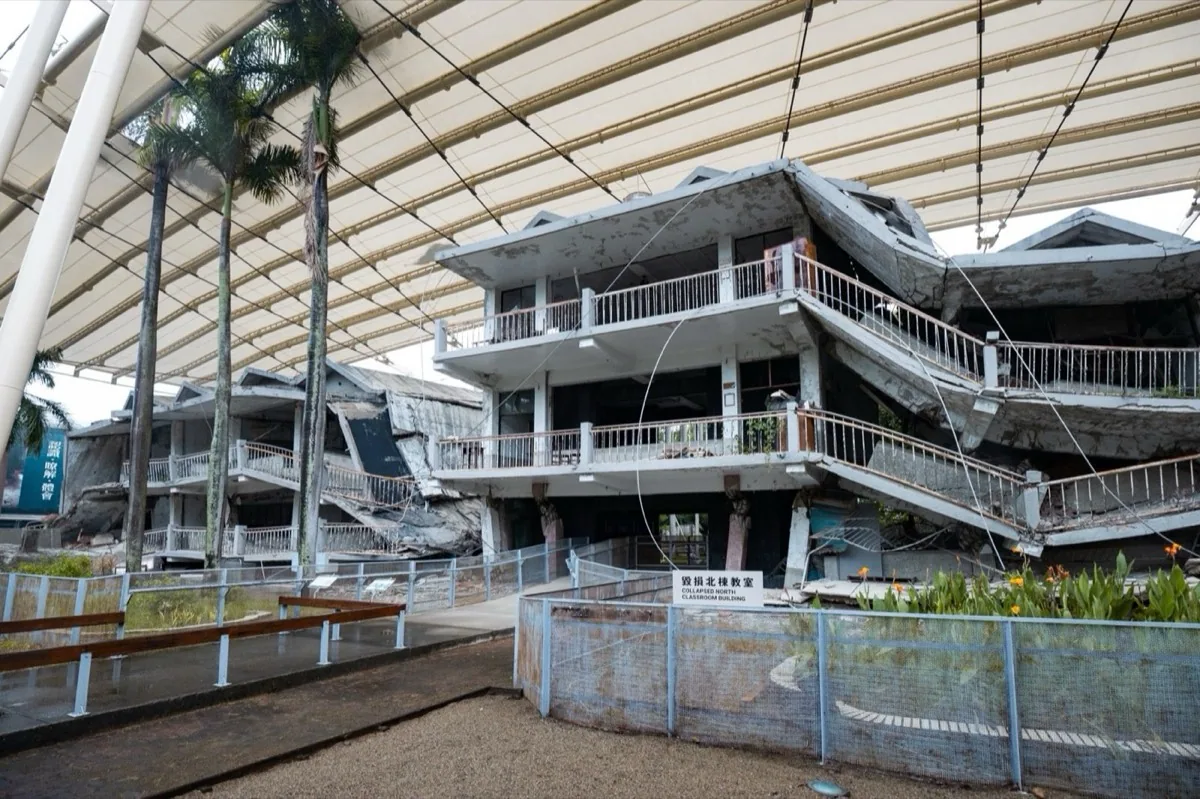
Damaged classrooms preserved within the 921 Earthquake Education Park, Wufeng, Taichung, September 2024. Photo: Liu Shu fu / Office of the President. CC BY 2.0 via Wikimedia Commons. This school building was directly torn apart by the Chelungpu Fault in the early hours of September 21, 1999, and was later preserved as a concrete carrier of disaster memory.
2009: Typhoon Morakot and the Maturation of Civil Society
Typhoon Morakot was another watershed moment. Unlike 921, which relied primarily on large charitable organizations, the Morakot typhoon demonstrated a more diverse and decentralized civilian response. The destruction of Xiaolin Village triggered widespread empathy across Taiwan; countless individual volunteers and small NGOs engaged in relief—from immediate supply delivery to post-disaster community companionship—as the muscles of civil society began to manifest8.
This disaster also highlighted the vulnerability and resilience of indigenous tribes. The casualties and displacement pressures caused by the typhoon were much higher in proportion within indigenous communities; however, the traditional mutual aid organizations within the tribes also showed powerful recovery capabilities. The dual-track resilience structure of "Civil Society + Tribal Tradition" was widely discussed for the first time after Typhoon Morsoak8.
2014: Kaohsiung Gas Explosion and New Challenges in Urban Disasters
Late on the night of July 31, 2014, an explosion caused by a leak of propylene from underground pipelines at the border of Qianzhen and Lingya districts in Kaohsiung resulted in 32 deaths and 321 injuries9. This disaster introduced a new type of catastrophe: man-made technological disaster. Volunteer organizations demonstrated a higher degree of professionalism during this event—not only providing supplies and labor but also participating in chemical risk assessment, post-disaster psychological counseling, and long-term rehabilitation companionship for the injured. Taiwan's disaster volunteer landscape expanded from "shovels and lunchboxes" to "professionalism and certification."
2024–2025: From the Hualien 0403 Earthquake to the Guangfu Floods
The April 3, 2024, Hualien earthquake (magnitude 7.2) previewed the mobilization pattern of the Guangfu floods one year later. At the time of the earthquake, social media became the primary axis for disaster information dissemination and volunteer mobilization: LINE groups forwarded real-time disaster reports from various areas, Facebook groups announced supply shortages, and Instagram Stories provided on-site imagery. Disaster response shifted from "waiting for news reports" to "second-level diffusion"3.
The 2025 Guangfu floods took this foundation a step further. The title "Shovel Supermen" blended heroism with grassroots humor: the name itself was forged by social media, and its dissemination path followed social media—from IG Stories to news headlines in less than 24 hours. For the first time, disaster narratives were collectively digested by the entire island at such speed.
📝 Curator's Note: From the "shock" of 921, the "pathos" of Typhoon Morakot, and the "anger" of the Kaohsiung gas explosion, to the "warmth" of the Guangfu floods—the emotional tone of disaster narratives reflects the generational shift in Taiwan's social psychology. The title "Shovel Supermen" is a fusion of heroism and grassrootsness, representing a positional shift from "we are victims" to "we are actors."
Island Synchronicity: Media, Memory, and Community Mobilization
One River, the Whole Island Watching Simultaneously
The concept of "imagined communities" in contemporary political philosophy emphasizes that nations are maintained through shared memories and rituals10. Taiwan's disaster volunteer culture is a contemporary, concrete version of this mechanism: disasters become a shared experience for the whole island, creating a "simultaneous" collective memory through media dissemination.
During the September 2025 Guangfu floods, even Taiwanese people in Taipei, Taichung, Kaohsiung, or even overseas, were tracking the Matawan River during the same week, on the same channels, under the same hashtag. This "island synchronicity"—where citizens across the island focus on the same event and generate the same actions at the same time—effectively strengthens the boundaries of Taiwan as a political community in practice.
Social Media: The Technology of the New Era's Community
Traditional disaster management relies on hierarchical bureaucracies and large charitable organizations, whereas social media creates the possibility for "networked governance." In the Hualien floods, platforms such as Facebook, LINE, and Instagram simultaneously played three roles[^3]:
First, Information Hub: real-time disaster updates, need lists, traffic conditions, and TRA schedules. Second, Mobilization Tool: volunteer recruitment, supply collection, and ride-sharing. Third, Emotional Connection: stories of disaster victims, volunteer diaries, and messages of gratitude.
This decentralized organizational model makes disaster response more agile but also brings new challenges. At the end of September, the central government once announced, "We do not need Shovel Supermen right now; we urgently need Spoon Supermen," attempting to direct the influx of manpower toward indoor silt clearing; however, this signal triggered a new wave of confusion and misunder
understanding on social media11. Difficulty in verifying information, redundant rescues, resource waste, and gaps in volunteer insurance—each is a cost of decentralization.
Media Narratives and the Question of "Who We Are"
Disaster reporting does more than disseminate facts; it is also a process of constructing values and identity. The spread of the "Shovel Supermen" title reflects the ability of Taiwanese media to create warm, positive disaster narratives, elevating volunteer actions into an embodiment of collective values.
This narrative strategy forms an interesting contrast with other countries. Japan's popularity of kizuna (bonds) after the 311 earthquake emphasized the rediscovery of traditional social connections; US narratives after 9/11 focused on national security and retribution. Taiwan's disaster narratives emphasize "grassroots vitality" and "social resilience"—relying on the government yet not fully trusting it, thus developing a strong civil society as a supplement10.
The Tzu Chi Model and Multiple Command Centers: Two Sides of the Same Disaster
The Standardized Mobilization of Tzu Chi
The development of Taiwan's disaster volunteer culture is inseparable from the Buddhist Tzu Chi Foundation. The "Blue Sky with White Clouds" uniform system, standardized operating procedures, and global mobilization network established by Tzu Chi during various disasters are key components of Taiwan's disaster management structure7. The characteristics of the Tzu Chi model can be broken down into four elements: immediate response based on routine volunteer training; professional division of labor among volunteers in medical, engineering, and psychological counseling fields; a long-term commitment that involves not just emergency rescue but also post-disaster reconstruction; and the network energy to export Taiwan's experience to international sites like the 311 earthquake in Japan and the Sichuan earthquake.
However, the Tzu Chi model also faces criticism: issues such as heavy religious coloring, lack of transparency in decision-making processes, and overly close ties with the government are frequently raised. These controversies reflect the complex attitude of Taiwanese society toward the participation of private organizations in public affairs—thanking it at the disaster site, yet remaining wary of it at the level of public policy.
Three Command Centers Within 500 Meters
If the Tzu Chi model represents the high degree of organization in grassroots mobilization, the Guangfu scene exposed the other side of coordination. One week after the disaster, three forward command centers appeared within 500 meters of Guangfu Station: one from the county government, one from the central government, and one from the Democratic Progressive Party (DPP) headquarters12. Adding to this were the bases of self-organized rescue groups, religious groups, and charitable foundations—the topics of daily arguments on-site included where supplies should be sent, how manpower should be allocated, and who would coordinate it all.
This "multiple-driver" phenomenon reflects, on one hand, the political fragmentation in Taiwan (particularly evident during major disasters when central and local governments belong to different parties), and on thely, demonstrates the powerful energy of social self-organization. Critics call this a failure of state emergency response; supporters call it the diverse flexibility of a democratic society. The same phenomenon supports two readings—and this is the most overlooked side of the "Shovel Supermen" myth: the celebration of grassroots vitality and the criticism of state response failure must be viewed together to be complete; one cannot simply take one side.
⚠️ Controversial Viewpoint: The phrase "Taiwan's strongest national defense is the shovel" was widely circulated in 2025. From a grassroots perspective, it is pride in one's own resilience; from a government perspective, it is a blunt irony—if the state response were sound, the shovel should be merely an aid rather than the main force. The two readings of the same sentence are a contemporary portrait of the relationship between Taiwan's civil society and the state machinery.
International Comparison: Kizuna vs. Shovels
Japan's Kizuna and the Restoration of Order
After the 2011 311 earthquake, kizuna (bonds) became Japan's word of the year, symbolizing the deep connections between people10. Japan's disaster narrative emphasizes social order, collective discipline, and the traditional values of mutual aid; disasters are interpreted as opportunities to awaken the traditional virtues of the Japanese people.
Taiwan's aid to 311—estimated at approximately 20 billion yen in donations, the largest global source at the time—also deepened the grassroots connection between Taiwan and Japan13. In a situation where official diplomacy was difficult, disaster aid became a way to demonstrate international presence; "disaster diplomacy" began to become a tool of soft power for small nations.
India's SEWA and Grassroots Mobilization
Sociological studies of the Self-Employed Women's Association (SEWA) in India regarding its role in disaster reconstruction found that organizations based on gender and class consciousness demonstrate unique resilience during disasters. SEWA's success lies in integrating disaster relief with everyday socio-economic development, creating a community resilience model capable of long-term operation14.
While Taiwan's disaster volunteers do not have distinct gender or class characteristics, they similarly embody the power of grassroots mobilization. To some extent, Taiwan's disaster volunteer culture is a "de-classed" social mobilization—transcending Blue/Green politics, provincial differences, and urban-rural gaps. However, this "de-classing" also has blind spots: when the mainstream narrative focuses on the heartwarming images of "universal Shovel Supermen," the self-rescue and local knowledge of indigenous tribes are often relegated to the sidelines.
"We Are All People of This Land": The Prophecy of Chen Chien-nian
In his June 1999 album Ocean, the Bunun singer Chen Chien-nian (Paudull) included the song "We are Compatriots" (lyrics by Lin Chih-hsing, composed by Chen Ch namely)15. The lyrics sing: "Whether mountain people or plain people, we are all people of this land. Whether indigenous or later settlers, we are all residents of this land. We are not enemies, so please respect me and let me appreciate you."
This album was released in the same year as the 921 Jiji earthquake (the earthquake occurred in September, Ocean in June), making Chen Chien-nian the first indigenous singer to win Best Mandarin Male Singer at the Golden Melody Awards in 200015. Nearly 30 years later, these lyrics became a concrete practice in the Matawan disaster area in 2025—moving beyond the level of political slogans and textbook catchphrases, during the week when thousands of strangers carried shovels on EMUs into the tribes, indigenous tribes proactively opened churches as shelters, and victims came out to wash rain boots for volunteers, these lyrics became action.
The Matawan tribe also presented a new dimension of ethnic relations after the flood. The disaster transcended the binary of "helper" and "helped"—the indigenous tribe was both a victim and an important force in relief. With the Presbyterian Church proactively opening shelters and tribal youth participating in frontline rescue work, the true face of a multicultural Taiwan was laid bare in this flood5.
✦ Curator's Note: The year Chen Chien-nian released "We are Compatriots" was 1999, only three months before 921. A song about the coexistence of indigenous and Han peoples unexpectedly became a real-world scene in a flood 26 years later. This is one of those rare moments when popular music directly engages with contemporary politics and society.
Disaster Democracy in the Digital Age
Participatory Relief: From Passive Recipient to Active Collaborator
Traditional disaster management follows the hierarchical logic of "command from above, execution from below," where victims are viewed as subjects waiting for rescue. Disaster relief in the digital age demonstrates the characteristics of "participatory governance": victims speak through social media, and volunteers self-organize via the internet, forming a multi-centric relief network3.
In the Guangfu floods, residents of the disaster area did not just wait for help; they used the internet to publish needs, report situations, and thank volunteers. This two-way interaction model changed the power dynamics during disasters, making the relief process more democratic.
Information Transparency and Accountability Mechanisms
Social media also creates new oversight mechanisms. Government disaster response performance, volunteer organization efficiency, and the fairness of resource allocation are all scrutinized under the internet's magnifying glass. Issues such as the improper site selection by the Hualien County government (both the command center and shelters were within the evacuation zone) and poor coordination between central and local governments were widely discussed in online public opinion12.
This "oversight-based participation" makes disaster management more transparent but also brings new challenges: cyberbullying, the spread of misinformation, and populist tendencies. How to strike a balance between open participation and maintaining professionalism is an open question for disaster governance in the digital age.
Conclusion: What Shovels Can Lift, and What They Cannot
On an afternoon in October 2025, the platform at Guangfu Station was crowded with "Shovel Supermen" preparing to take the local train back. They were covered in black mud, their rain boots still dripping, with shovels hanging from their backpacks that had just been washed by an elderly woman that day. One volunteer leaned a shovel against an automatic ticket machine and crouched down to untie his shoelaces. Another volunteer nearby handed him two bottles of 7-Eleven Sprite. The two did not speak—they likely hadn't spoken all day. The platform announcement rang out: "The 13:42 local train bound for Shulin is arriving."
This image will not appear in any government post-disaster report, but it is one of the most memorable images of Taiwan in 202_5. "Shovel Supermen" are not some mysterious, Taiwan-specific kindness; a more accurate description is the long-term accumulation of results from civil society, social media, and public transportation networks since the 921 earthquake in 1999. Without the network density of the MRT and TRA, volunteers could not reach Hualien; without the coordination of Facebook and LINE, shovels would not make it onto the EMUs; without the 26 years of "volunteer community-ization" training since 921, no one would remember to bring gloves, water, or ID.
Yet, this same image cannot lift other things: the political fragmentation of three command centers within 500 meters, the way indigenous tribes are often relegated to the sidelines in mainstream narratives, and the four-day window where alert transmission jumped from 45 people to 8,000. The phrase "Taiwan's strongest national defense is the shovel" lifts up grassroots vitality, but it also raises an unfinished question: why does the disaster response of a modern nation still rely on strangers bringing their own shovels?
Chen Chien-nian's line, "We are all people of this $\text{this}$ land," was both an answer and a question in Matawan in 2025. The answer lies in this: during that week, those words became concrete action. The question lies in this: when the next disaster comes, besides the shovels, what other systems must we build together?
The next disaster will inevitably come. The platform at Guangfu Station will again be crowded with strangers, and shovels will once again be raised. What remains is whether this island has enough time, before the next 14:50, to mend the things that those shovels cannot lift.
Further Reading:
- Contemporary Indigenous Singer-Songwriters — How indigenous musicians like Chen Chien-nian and Hudup incorporate tribal experiences into the contemporary soundscape of Taiwan.
- Taiwanese Volunteer Culture and Philanthropy — The ecosystem of Taiwan's civil society, from Tzu Chi to countless small NGOs.
- Indigenous Mythology — From the Matawan creation myth to the flood motifs of the Truku and Paiwan tribes and the geographical memory of the island of Taiwan.
- Land Justice and Traditional Territories of Taiwan's Indigenous Peoples — Tribal autonomy, the demarcation of traditional territories, and indigenous agency in post-disaster reconstruction.
Image Sources
This article uses 2 images under CC BY 2.0 license, cached at public/article-images/society/ to avoid hotlinking to source servers:
- Guang Fu 921 — Photo: Hsu.shihhung, 2003-05-03, CC BY 2.0, Wikimedia Commons File:Guang_Fu_921.JPG. Memorial site of the damaged school buildings at Guang Fu Junior High School, Wufeng, Taichung.
- Destructed classroom buildings preserved in the 921 Earthquake Museum of Taiwan — Photo: Liu Shu fu / Office of the President, 2024-09-21, CC BY 2_0, Wikimedia Commons. Damaged classroom buildings preserved within the 921 Earthquake Education Park, Wufeng, Taichung.
References
This article EVOLVED from a community submission to Taiwan.md, originally submitted by Burger King ([email protected]). 2026-05-17 EVOLVE: All 12 ## References integrated into inline [^N] footnotes; corrected Chen Chien-nian's release company (Rock Records $\rightarrow$ We Music); corrected the number of person-trips during the holiday (originally 20k / 41k / 44.5k changed to the CNA-confirmed cumulative 60k / 44,500 on the 29th); added Typhoon Vagasa + disaster area scope (Guangfu + Fenglin + Wanrong); added timeline of Matawan River Bridge destruction; added the core conflict section "Tzu Chi Model vs. Multiple Command Centers"; changed the conclusion from a rhetorical ending to a concrete scene at Guangfu Station platform. Full EVOLVE research record available at reports/research/2026-05/disaster-volunteer-culture-evolve.md.
- Matawan River Reservoir Breach: 19 Dead—From Monitoring and Disaster Prevention Advocacy to Evacuation, How to Learn Lessons? — The Reporter (2025). A full reconstruction of the timeline of the September 23 overflow, reservoir scale, evacuation decision reversals, and monitoring controversies.↩234
- Over 60,000 "Shovel Supermen" Head to Hualien During Long Weekend; Affected Households Express Gratitude by Washing Rain Boots — CNA (2025-09-30). Statistics on the number of people at Guangfu Station during the Teachers' Day holiday and records of quotes from disaster victims.↩23
- Tech Panorama (202 $4$). "Racing Ahead of the Disaster: The Phenomenon of Rapid Information Spread via Social Media." An analysis of the role of social media in information diffusion and mobilization during the 2024 Hualien 0403 earthquake and subsequent disasters.↩23
- Matawan Tribe — Wikipedia. Details on the Amis meaning of "Fata'an," the two versions of the creation myth, and the tribal geographic range.↩23
- Connecting Heritage and Transformation — Exhibition of Matawan (Amis) Tribal Artifacts Returning to the Village — Academia Sinica Research Matters (2025). An academic compilation of the Matawan tribe's age-set system, leadership system, and contemporary tribal autonomous structure.↩23
- 921 Earthquake — Wikipedia. A summary of the magnitude, casualties, post-disaster reconstruction, and the legislative context of the Disaster Prevention and Protection Act following the earthquake on September 21, 1999.↩2
- Documentary of Tzu Chi's 921 Relief — Tzu Chi Foundation (updated since 1999). Records the emergency procurement of 1,600 body bags, the promotion of "volunteer community-ization" after Typhoon Herb, and the mobilization of 100,000 volunteers after 921.↩23
- Looking at NGO Integration and Support After Major Disasters via Japan's 311 Earthquake — Right Plus (2016). Looking back from the 311 experience at the maturation process of Taiwan's NGO integration after Typhoon Morakot, including the Xiaolin Village rescue case.↩2
- Executive Yuan (2014). "Report on Disaster Response and Review of the Kaohsiung Gas Explosion Incident." Records the casualties (32 dead, 321 injured) of the propylene leak explosion in Qianzhen and Lingya, Kaohsiung, late on July 31, 2014, and subsequent institutional reviews.↩
- Anderson, Benedict (1983). Imagined Communities: Reflections on the Origin and Spread of Nationalism. London: Verso. The classic discourse on imagined communities; contemporary applications in the Taiwanese context can be found in the translation by Wu Juei-ren and its influence on post-martial law Taiwanese national discourse.↩23
- Don't Bring the Wrong Tools! Central Government Announces: We Don't Need Shovel Supermen Right Now, We Urgently Need "Spoon Supermen" — United Daily News (2025-10). Records of official signals and social media reactions calling for adjustments in volunteer tools during the second week after the disaster.↩
- 70 Minutes, 200 Centimeters—A Fatal Error! Who Caused the Hualien Reservoir Tragedy? — Business Weekly (2025). Cross-examination of the multiple command centers in Guangfu Township, evacuation decision timelines, and satellite/flood simulations.↩2
- Ministry of Foreign Affairs, ROC (2011-2012). "Records of Taiwan-Japan 311 Earthquake Relief." A summary of the scale of donations, technical support, and the subsequent deepening of Taiwan-Japan relations during the 311 earthquake relief.↩
- Sabhlok, A. (2010). "Grassroots organizing and disaster management: Lessons from community-based approaches." International Journal of Emergency Management, 7(2), 112-128. Research on the role of India's SEWA grassroots women's organization in the 2001 Gujarat earthquake and subsequent relief.↩
- Chen Chien-nian / Ocean — We are Compatriots — We Music (Released June 1999). "We are Compatriots" (lyrics by Lin Chih-hsing, composed by Chen Chien-nian), included in Chen Chien-nian's first solo album Ocean, which won Best Mandarin Male Singer at the 11th Golden Melody Awards in 2000.↩2