
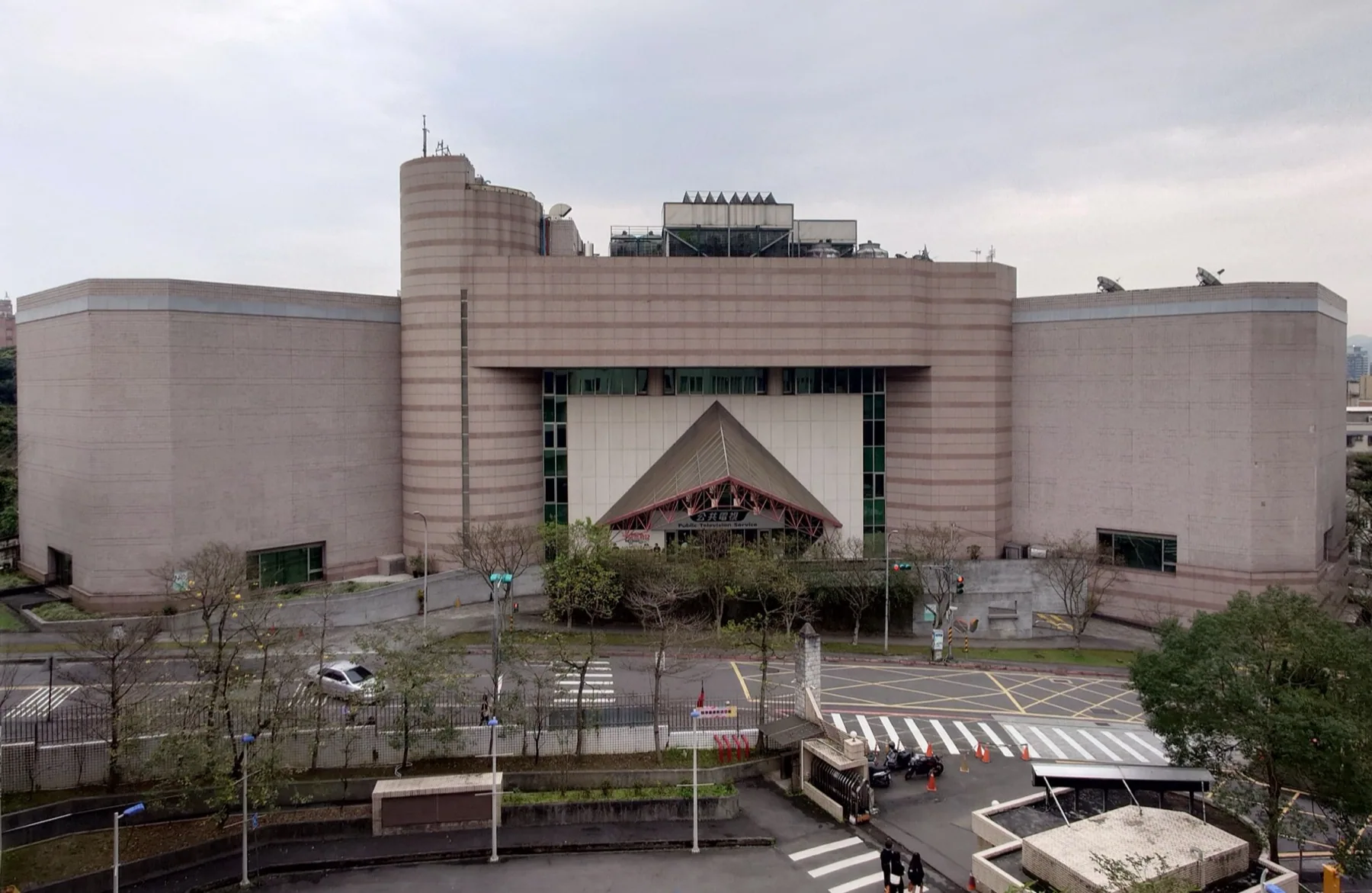
30-second overview:
When PTS went on air in 1998, the Public Television Act required government-donated funding to decrease year by year and eventually froze it at NT$900 million annually. That provision bound PTS for 23 years. In the meantime, PTS nurtured The World Between Us, Gold Leaf, The Teenage Psychic, Wake Up, and A Touch of Green.
In May 2023, legal amendments lifted the golden headband. The budget more than doubled to NT$2.3 billion, but 19 months later, 1% of the budget was cut and 25% frozen; another year later, in May 2026, the chairperson was asked to leave the Legislative Yuan chamber.
Removing the golden headband does not mean independence has been built. Twenty-eight years into Taiwan's public-media experiment, the same question remains: are we mature enough to sustain a public space that serves neither advertising nor the government?
On May 7, 2026, before a meeting of the Legislative Yuan's Education and Culture Committee, Kuomintang legislator Lo Chih-chiang demanded that PTS Chairperson Hu Yuan-hui leave the room.1 The reason was that after Hu's term expired in May 2025, legal amendments had deleted the original holdover clause; as an "expired chairperson," Hu was deemed unqualified to sit at the dais and answer questions. Minister of Culture Li Yuan protested on the spot. A standoff followed, and Hu eventually stood up and left.
That night, he wrote on Facebook: "My personal experience is a small matter, but the value and dignity of public media must be defended" and "Public media should never become the object of political struggle, still less the victim of political calculation."1
That scene came exactly 28 years after PTS officially began broadcasting on July 1, 1998. In between were 23 years of the "NT$900 million golden headband," three years of legal thaw, and then, 19 months later, a budget-cutting turmoil. From the NT$900 million golden headband to expulsion from the chamber, this 28-year arc is the entire story of Taiwan's public media.
"Everyone Is a Wave-Maker" and 19 Months
Rewind 1,016 days.
On May 26, 2023, the Legislative Yuan passed partial amendments to the Public Television Act on third reading, deleting the provision that had sat atop PTS since the 1997 legislation: "government-donated funding shall decrease year by year." The threshold for selecting directors and supervisors was lowered from three-fourths to two-thirds, and one employee director seat was added.2 At the press conference, then Minister of Culture Shih Che said: "In two months, we reversed more than twenty years of difficulty... everyone is a wave-maker."3
In the first year after the amendments, the Ministry of Culture budgeted NT$2.3 billion in donated funding for PTS for fiscal year 2024, a 1.5-fold increase over the NT$900 million that had been frozen for 23 years.4 The NT$2.3 billion included NT$900 million for the PTS main channel, Hakka TV, NT$805.1 million for TaiwanPlus and other Taiwanese-language channels, NT$600 million for PTS XS, and other diversified channels.
Nineteen months later, on January 16, 2025.
Kuomintang legislator Chen Yu-jen proposed in the Legislative Yuan's Education and Culture Committee that the entire NT$2.3 billion PTS donation budget be deleted, citing allegedly biased wording in TaiwanPlus coverage of Trump, historical distortion in Three Tears in Borneo, and an unreasonable budget surge.5 On the morning of January 17, the KMT caucus withdrew the proposal, calling it an "individual act," but evening negotiations ultimately passed a 1% cut (NT$23 million) and froze NT$570 million, about 25% of the budget.5 6 Film and television workers who signed a petition against the cut included screenwriter Chen Shih-chieh and directors Wang Shau-di and Lin Hsi-hsuan. Their argument was that "cutting the budget could cause Taiwan's film and television industry to collapse within two years."7
Nineteen months. Only 19 months separated the removal of the golden headband from the beginning of a new incantation.
📝 Curator's note: What everyone thought was a victory on the day of the legal amendments was, in essence, a change of battlefield. The NT$900 million ceiling was deleted, but the political structure of "government budget plus Legislative Yuan majority party" did not change. A majority party using legislative power to reduce the budget is the other side of the same power logic that previously used legislative power to nail down the NT$900 million ceiling.
How the NT$900 Million Ancestral Spell Was Nailed Down
On May 31, 1997, the Legislative Yuan passed the Public Television Act on third reading. The original provision stated that government-donated funding "shall decrease year by year, by ten percent of the first year's amount each year, and from the sixth year onward shall be less than fifty percent of the first year's amount."8
This provision was not simply the result of "the government not taking PTS seriously." It was a compromise produced by a three-way struggle during Taiwan's media democratization: a scholars' version proposed that the three terrestrial television stations contribute 10% of revenue to PTS, which drew protests from employees of the three stations; no license fee would be collected from the public, to avoid a backlash resembling opposition to the BBC model; the final arrangement was "government-budgeted donations, with PTS required to raise its own funds in the long term."8
Go further back. In 1984, the Government Information Office established a "Public Television Production and Broadcasting Team"; in 1986, it was transferred under the Broadcasting Development Foundation.9 In the 1980s, the word "public" carried a strong state coloration. Programming was aligned with national policy and appointed by the Government Information Office. In March 1992, students from communication departments across universities formed the "PTS Legislation Observation Group" to monitor legislation; in June of the same year, more than 100 scholars and figures from the arts and culture sector formed the "Public Television Civil Preparatory Committee," demanding that political and commercial forces withdraw from media.10
From this 1992 movement for "party, government, and military withdrawal from media," to the compromise legislation of 1997, to the official launch on July 1, 1998, PTS traveled a six-year legislative road, a 14-year preparatory period, and a 74-year historical delay behind NHK, which began radio in 1925 and television in 1953. On its first day on air, PTS launched the forum program Roundtable, the news magazine The Great Century, and the documentary program Global Tribe; Global Tribe became Taiwan's first regular documentary television program.11
From 1998 to 2000, the budget decreased year by year; from 2001 onward, it was frozen at NT$900 million annually, where it remained for 23 years.4 During that period, PTS successively took on Hakka TV (joined in 2007), Taiwan Indigenous TV (2007-2014), Taiwanese-language TV (launched on July 1, 2019), PTS XS, and TaiwanPlus (launched in 2021 and upgraded in 2022 into a 24/7 international English-language channel).12 Its mission expanded several times over, while its budget did not move.
"You reap as you sow! The people of Taiwan should first give PTS adequate financial support!" Lo Shih-hung, professor in the Department of Communication at National Chung Cheng University, wrote this during the 2023 amendment debate.13 He compared: "Japan's NHK and Britain's BBC each have annual funding of nearly NT$200 billion, and South Korea's KBS has more than NT$30 billion"; PTS "should at least double its annual funding, raising it from the current NT$3 billion, which barely supports its various missions, to more than NT$6 billion."13
A Channel Nobody Watches Made Dramas That Healed a Society
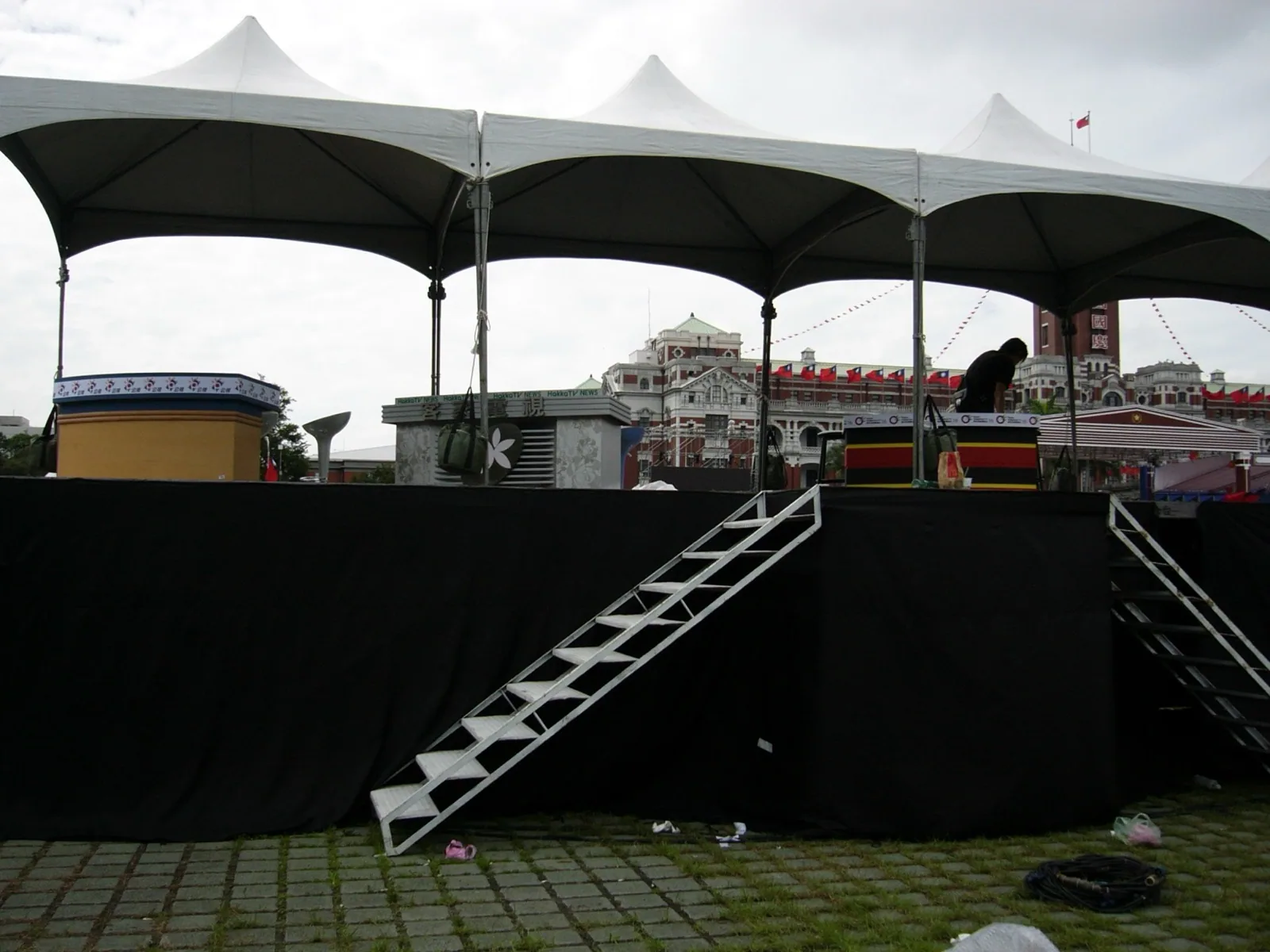
On October 10, 2010, Taiwan's National Day, anchors from PTS, Hakka TV, and Taiwan Indigenous TV at the joint-broadcast anchor desk inside the Taiwan Broadcasting System building. Photo: Solomon203. CC BY 3.0 via Wikimedia Commons.
The PTS main channel's all-day average rating has long been below 0.5. This figure has long been cited as evidence that "nobody watches PTS," and a 2024 corrective case by the Control Yuan also noted that PTS's market-share ranking among terrestrial stations had remained stagnant.14
But the same PTS did the following.
On April 2, 2017, The Teenage Psychic, co-produced by PTS, HBO Asia, and Singapore's InFocus Asia, premiered in English. Episode 5 recorded an average rating of 3.7, the finale averaged 4.4, and the instantaneous peak reached 4.61, setting a new PTS drama record.15 In the same period, its premiere on Singapore's StarHub surpassed every previous HBO Asia original Asian series in viewership, and it also broke records in Malaysia and the Philippines. The official PTS trailer is available to watch inline.
On the night of April 21, 2019, The World Between Us aired its finale. Episodes 9 and 10 were broadcast back to back, reaching ratings of 2.91 and 3.4, the fifth highest in PTS drama history; 9,860 people flooded PTT's Taiwanese drama board to discuss it simultaneously.16 Screenwriter Lu Shih-yuan conducted four months of fieldwork for the series, interviewing more than 40 lawyers, judges, legislators, psychiatrists, and media workers. She said: "It is not that Taiwan has no directors or screenwriters willing to engage with socially realistic subjects... but for dramas on such issues to truly enter the industry and get filmed, it still depends on whether a platform has the courage to take responsibility. This time it was very simple: the key was that PTS stepped forward; PTS was willing to tell this story."17 The line at the beginning of the first episode, "I am afraid my own child might be the killer," was repeatedly quoted across Taiwan's social media that night. Viewers can watch PTS's official EP01 or the official trailer inline.
On November 13, 2021, Gold Leaf premiered with 12 episodes. It was Taiwan's first 4K/UHD HDR drama series and the first major drama in the Hailu dialect of Hakka, directed by Lin Chun-yang of The World Between Us. Episodes 5 and 6 recorded ratings of 1.44 and 1.50, ranking first among drama programs across all channels that day.18 PTS official EP3 trailer.
Go back to 2015. Wake Up, a six-episode miniseries starring Huang Chien-wei and Wu Kang-ren, grew from screenwriter Huang Chien-ming's interviews, during which he noticed that "anesthesiologists were exhausted in ways people did not understand" and that "Taiwan had only about a thousand anesthesiologists." From there came the story's central reflection on the medical system. At the 50th Golden Bell Awards that year, it won four awards: Miniseries, Supporting Actor, Screenwriting, and Directing.19 A 20-minute advance preview is available online.
The same year's A Touch of Green was adapted from Pai Hsien-yung's novel of the same name and directed by Tsao Jui-yuan. It received NT$60 million in Ministry of Culture subsidies and had a total production budget of NT$180 million; it won the 2016 Golden Bell Awards for Drama Program, Drama Directing, Leading Actor (Wu Kang-ren), and New Actor (Lien Yu-han).20 Tsao Jui-yuan documented the full creative process in PTS's highlight tribute to the wartime generation.
The list could be much longer: Documentary Viewpoint has premiered more than 500 domestic documentaries since its launch in 1999,21 and at the 60th Golden Bell Awards for Radio and Television in 2023, the Taiwan Broadcasting System won 32 awards, with the PTS main channel taking 19.22 What the NT$900 million budget sustained was the fifth-highest ratings peak in Taiwan drama history, 40,000 petitioning viewers, and a collective discussion on PTT with 9,860 people online at the same time.
📝 Curator's note: A rating of 0.5 and a peak rating of 4.61 are not contradictory figures. They are two sides of the same PTS: overlooked in everyday life, seen by the whole society at critical moments. Commercial television stations cannot do this, because what advertising mainly needs is a stable ratings floor. What PTS can shoulder is the peak created by culturally sensitive subjects.
From the Feng Hsien-hsien Dismissal to a 957-Day Delay
The "arm's-length principle" is the core concept of public-media governance: the government budgets funding, but cannot interfere with content. The BBC established this through its 1926 Royal Charter, NHK indirectly maintains it through receiving contracts, and PBS dilutes influence through mixed funding sources. Taiwan's PTS follows a model of "government budget plus legal guarantees," closest to PBS.
But legal guarantees cannot block the infiltration of political structures.
On September 19, 2010, the PTS board of directors, despite "insufficient attendance," nevertheless resolved to dismiss President Feng Hsien-hsien and Executive Vice President Chung Yu-yuan. Feng wrote in Apple Daily: "PTS belongs to all citizens; only when it is independent, autonomous, and free from interference are viewers truly our bosses" and "Isn't insisting on professional management and safeguarding the public interest exactly the attitude PTS should have?"23 Two years later, on June 5, 2012, the High Court issued a final ruling against PTS, finding the dismissal invalid because it clearly violated the Public Television Act. She won the lawsuit, but she was no longer in the position.
Deadlock over the selection of directors and supervisors became another norm.
The fourth PTS board served as holdovers for a record 968 days: its term expired on December 3, 2010, and it was not fully replenished until 2013. The fifth board was delayed 58 days; after the sixth board's term expired on September 25, 2019, it continued as holdovers for 567 days;24 the seventh board was delayed 957 days, nearly breaking the fourth board's record.25 In 2013, during KMT rule, the Executive Yuan and Ministry of Culture were corrected by the Control Yuan because the selection of PTS's fifth board and supervisors had been delayed for two and a half years.26
The root cause of these deadlocks was not administrative efficiency, but the structural result of an excessively high review threshold (three-fourths, lowered to two-thirds after the 2023 amendments) combined with partisan political combat. Both the blue and green camps have blocked appointments. Behind this lies the tug-of-war between "publicness" and "politicization." The amendments lowered the threshold, but the 2026 chamber expulsion showed that legal provisions are only one side; political structure is the other.
CTS's 17 Years of Being Neither Public Nor Private
In 2006, under the movement for "party, government, and military withdrawal from media," Chinese Television System (CTS) was incorporated into the Taiwan Broadcasting System. But because the legal framework was incomplete, CTS fell into an intermediate state of being "neither public nor private": it had to operate under the Company Act and bear profit-and-loss responsibility, while also carrying public missions.27
From 2006 to 2014, CTS accumulated losses of NT$2.27 billion; by 2014, CTS, with capital of NT$1.6 billion, had accumulated losses of NT$3 billion.28 After 17 years, CTS's "publicization" remained stuck in this awkward position: neither a purely commercial television station nor a purely public television station.
"The unclear positioning certainly harms CTS, but it is also not an excuse for CTS to completely avoid transformation," current PTS Chairperson Hu Yuan-hui said when facing the difficulty of transforming CTS, proposing "strategic change" as a way forward.29 At present, in addition to traditional advertising, CTS is also trying to find a new balance between commercial competition and public value through asset activation and digital transformation.
But this 17-year intermediate state itself poses a question: should Taiwan's public-media map follow the BBC's single-institution model, or the PBS model of federal dispersion? The 2023 amendments deleted the NT$900 million ceiling, but they did not answer where CTS should go.
TaiwanPlus and the Invisible Firewall
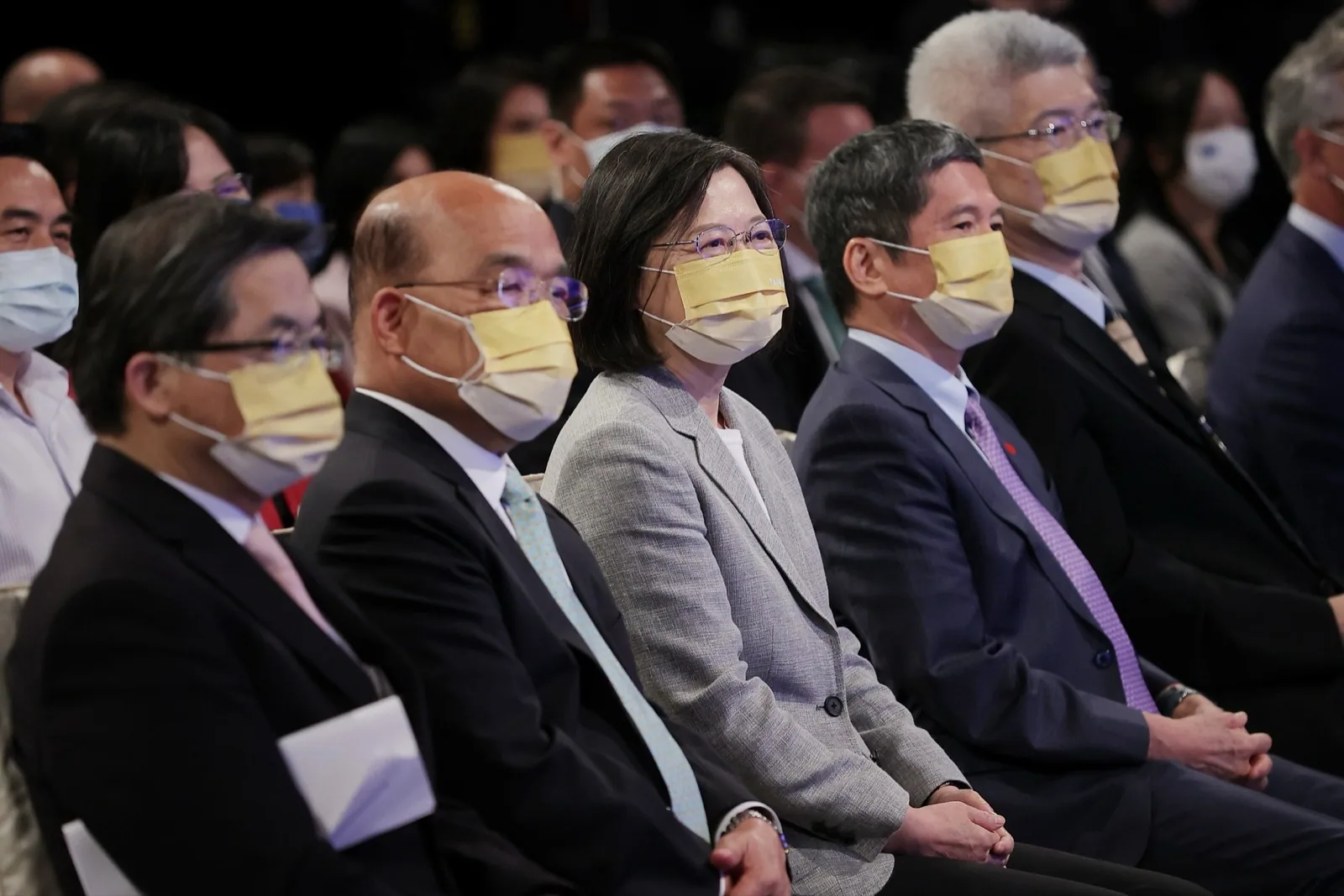
On October 3, 2022, President Tsai Ing-wen attended the launch press conference for PTS's TaiwanPlus 24/7 international English-language channel; the scene before her remarks. Photo: Chien Chih-hung / Office of the President, Republic of China. CC BY 2.0 via Wikimedia Commons.
In 2021, the Ministry of Culture launched the TaiwanPlus project with NT$580 million. On October 3, 2022, it was upgraded and officially launched as a 24/7 international English-language television channel.30 When PTS first took over the proposal, it encountered strong backlash and accusations of being a "government propaganda tool" and "government interference in PTS"; the Ministry of Culture withdrew the plan and instead assigned it to the Central News Agency. In August 2022, the National Communications Commission announced the platform's transfer back to PTS.31 Over three years (2021-2023), TaiwanPlus burned through nearly NT$3 billion, and the National Audit Office assessed that it had not met the goals of the plan to market Taiwan; one year after launch, in mid-2022, app downloads numbered only in the tens of thousands, far below the target of one million.32
But the controversy that truly ignited debate over editorial independence was the November 2024 Trump coverage incident.
On November 6, TaiwanPlus reporter Louise Watt said in a piece-to-camera report on the day Trump was elected: "America looks like it has chosen the felon. Donald Trump earlier here in West Palm Beach, Florida, claimed victory."33 At the time, the phrase "convicted felon" was also being used by the BBC, CBC, ABC, PBS, and AP.33 But on November 9, after PTS took down the piece, it reposted a revised version with that segment removed.34
Reporters Without Borders (RSF) immediately issued a statement on November 14: "to interfere with a broadcaster's editorial line in order to improve diplomatic relations is absolutely unacceptable."35 On December 16, Taiwan Insight, a platform of the University of Nottingham's Asia Research Institute, published an in-depth analysis arguing that TaiwanPlus's "lack of a robust firewall makes them susceptible to undue influence from the government or other domestic political actors," and citing VOA reporter William Yang's criticism that PTS had used a government personnel-style "demerit" to treat news editors.36
This controversy magnified a structural problem: when public media must carry the task of speaking externally, especially in diplomatically sensitive settings involving the United States, who guarantees the firewall of editorial independence? One reason the KMT proposed cutting the TaiwanPlus budget in January 2025 was precisely this incident. Conversely, however, the government's attitude that "public media should accommodate diplomatic considerations" itself violates the arm's-length principle. On the same issue, both the blue and green camps stood on the opposite side of protecting independence; they merely targeted different objects.
📝 Curator's note: In the TaiwanPlus controversy, the key issue was not whether Trump should be called a "convicted felon." It was the incident itself: news published by a public-media outlet was modified through intervention from a government perspective. If this had happened at the script stage of The World Between Us or Gold Leaf, it would have provoked a much larger backlash. But because it happened in an international English-language news slot, domestic discussion was instead lower. That gap itself is worth thinking about.
BBC Royal Charter, NHK Receiving Contracts, CPB Shutdown
Taiwan's PTS had a 2024 budget of NT$2.3 billion. By comparison:
The BBC's 2024/25 license-fee income was GBP 3.84 billion, about NT$154 billion, with total income of GBP 5.9 billion, about NT$236 billion.37 The BBC uses its 1926 Royal Charter to establish an "arm's length relationship to the state," adopting household collection, with each household paying about GBP 169 per year, and zero government interference. But from August 2025 onward, the license-fee issue again came under challenge, and discussion of "cutting off" BBC funding surfaced.38
Japan's NHK had 2024 receiving-fee income of JPY 590.1 billion, about NT$125 billion.39 NHK also began broadcasting in 1925 and launched television in 1953. It uses a household "receiving contract" collection model, but revenue has fallen for six consecutive years, with the household payment rate dropping to 77.3%; in October 2023, it voluntarily cut fees by 10%, reflecting the marginal pressure on subscription models.
The most instructive comparison is the United States' CPB.
The Corporation for Public Broadcasting (CPB) was created by the Public Broadcasting Act of 1967. Its 2024 federal appropriation was US$525 million, about NT$16.5 billion, distributed to more than 1,500 local public-media stations.40 But in July 2025, the U.S. Congress passed a rescission package withdrawing all CPB appropriations, about US$1.1 billion; on August 1, 2025, CPB announced that it would cease operations.41
The CPB shutdown occurred in the same year as Taiwan's January 2025 budget-cutting turmoil. They are two answers of the same type from two democracies to the question of "public media vs. government": releasing a budget does not mean independence has been built, and a budget once given can also be taken back.
Place Taiwan's NT$2.3 billion PTS in this global map: the BBC is 67 times larger, NHK 54 times larger, KBS about 20 times larger, and CPB before shutdown 7 times larger. Taiwan's public-media resources have never truly reached the level of a "medium-sized public broadcaster," yet its content output, from The Teenage Psychic, The World Between Us, and Gold Leaf to records in international co-production and reverse licensing, has surpassed the limits of scale in multiple respects. This gap is itself Taiwan's over-performance, and also the source of the fragility of Taiwan's public media: it depends too much on the individual choices of a few screenwriters, directors, and producers, and lacks the institutionalized content-production pipeline of the BBC or NHK.
A 28-Year Test Strip
Return to those 30 minutes on May 7, 2026.
When Hu Yuan-hui stood up and left the chamber, he was the second head in the history of Taiwan's public media to be pushed out of position by political pressure. The first was Feng Hsien-hsien in 2010, though her role was president rather than chairperson. Sixteen years separated them.
From the launch on July 1, 1998, to the chamber expulsion on May 7, 2026, PTS has traveled 28 years. In between were 23 years of the NT$900 million golden headband, three years of legal thaw, and a new political targeting 19 months later. Removing the golden headband is not the same as removing the golden band from Sun Wukong's head. At any time, a new incantation can be chanted again.
But over those 28 years, this institution has also accumulated things that neither the lifting nor the freezing of the NT$900 million budget can change:
500 documentaries premiered by PTS,21 five flagship dramas that shook society, 1.22 million PTS+ streaming members,42 editorial guidelines developed with the Taiwan FactCheck Center to fight deepfake disinformation,43 and a multilingual channel map built in collaboration with the Hakka Affairs Council, the Indigenous Peoples Cultural Foundation, and the Ministry of Culture. These things were accumulated one case at a time by several generations of television workers over 28 years. Budget amounts alone cannot buy them.
The Reuters Institute's 2024 Digital News Report found Taiwan's overall media trust at 33%, higher in the Asia-Pacific only than South Korea's 31%. But in this low-trust environment, PTS was listed as "one of the most trusted brands."43 A channel nobody watches made dramas that produced collective healing across society; an institution with a budget only one-sixty-seventh of the BBC's was named by readers as one of the most trusted brands.
The real question PTS has asked over 28 years is not "do we have enough money?" It is "are we mature enough?" Mature enough to sustain a public space that serves neither advertising nor the government? There is no answer yet. The January 2025 budget cuts and the May 2026 chamber expulsion are both asking the same question.
Perhaps the next 28 years will give an answer. Perhaps they will not. But one thing PTS has already proved over these 28 years is this: the fact that it asks this question every year is itself a test strip for the maturity of Taiwan's democracy.
Further Reading:
- Taiwan Media and Press Freedom — PTS as one part of the media ecosystem, and its interaction with the broader environment of press freedom
- CommonWealth Magazine — How a commercial financial media outlet tackles the same question of "who media should be accountable to," surviving on paid subscribers and a corporate ecosystem — a contrast with PTS's public-funding path
- Taiwan Variety Shows — A comparison with commercial television variety programs, for understanding why PTS chose to make dramas and documentaries
- Taiwan Film and Television Scores — The place of PTS flagship-drama scores within Taiwan's music industry
- Taiwan Animation Outsourcing — A comparison with the commercial IP industry, showing the different logic behind PTS's choices in animation subject matter
- Traditional Festivals and Celebrations — The long-term contribution of PTS's Documentary Viewpoint to preserving Taiwan's cultural memory
- Taiwan Design Research Institute — Another government-funded foundation walking the tightrope between "being seen" and publicness, turning design into a way for the government to serve the people
Image Sources
This article uses three Wikimedia Commons CC-licensed images, all cached in public/article-images/society/ to avoid hotlinking:
- PTS Neihu headquarters Building B (hero) — Photo by Yu tptw (Wikimedia Commons), March 16, 2024. License: CC BY-SA 4.0.
- President Tsai Ing-wen attending the launch press conference for PTS's TaiwanPlus channel — Photo by Chien Chih-hung / Office of the President, Republic of China (Wikimedia Commons, original Flickr file), October 3, 2022. License: CC BY 2.0.
- Anchor desk shared by PTS, Hakka TV, and Taiwan Indigenous TV — Photo by Solomon203 (Wikimedia Commons), Taiwan's National Day, October 10, 2010. License: CC BY 3.0.
References
- Legislative Yuan controversy: PTS Chairperson Hu Yuan-hui asked to leave chamber; Ministry of Culture protests — TNL The News Lens report on the full May 7, 2026, expulsion of Hu Yuan-hui at the Legislative Yuan's Education and Culture Committee, including the verbatim content of Hu's Facebook post.↩2
- Partial amendments to the Public Television Act pass third reading; funding ceiling lifted — Central News Agency report on the key points of the May 26, 2023, amendments: deletion of "government-donated funding shall decrease year by year" and the NT$900 million ceiling, lowering the director and supervisor threshold from three-fourths to two-thirds, and adding one employee director seat.↩
- Ministry of Culture press release on passage of draft amendments to the Public Television Act — Then Minister of Culture Shih Che's original phrase "everyone is a wave-maker" plus an article-by-article summary of the core amendment provisions (primary source).↩
- Ministry of Culture removes PTS's NT$900 million donated-funding ceiling in one step — Ministry of Culture official explanation of the background to the 23 consecutive years of frozen funding from 2001 to 2023 (primary source).↩2
- Chen Yu-jen proposes cutting entire PTS budget; KMT caucus withdraws it as an "individual act" — Central News Agency report on the full January 16, 2025, budget-cutting turmoil, including the withdrawal timeline and final negotiation result.↩2
- PTS NT$2.3 billion budget cut by 1%, NT$570 million frozen; film and television workers sign petition against it — PTS News report on its own budget cut, including the final vote result and frozen amount.↩
- Film and television workers sign petition opposing cuts to PTS budget - Mirror Media — Full statement by film and television workers including screenwriter Chen Shih-chieh and directors Wang Shau-di and Lin Hsi-hsuan, including the argument that the industry "could collapse within two years."↩
- What are the key points of the Public Television Act amendments? - Voicettank — In-depth analysis by Voicettank of the historical background to the three-way compromise in the 1997 legislation: scholars' version, terrestrial stations, and government.↩2
- The life story of the Public Television Act - PTS Action Quarterly — PTS's own magazine retrospective on the 1984-1986 Public Television Production and Broadcasting Team and Broadcasting Development Foundation period (primary source).↩
- Party, government, and military withdrawal from media - Wikipedia — Complete timeline of media democratization movements such as the 1992 PTS Legislation Observation Group and Public Television Civil Preparatory Committee.↩
- PTS News - Wikipedia — List of programs on the first day of broadcasting, July 1, 1998, including Roundtable, Public Opinion Summit, The Great Century, and Global Tribe.↩
- TaiwanPlus - Wikipedia EN — Complete timeline from TaiwanPlus's 2021 launch as a marketing project to its October 3, 2022, upgrade into a 24/7 international English-language channel.↩
- Lo Shih-hung: PTS amendments finally succeed; anticipating the start of public-media transformation and upgrading — In-depth May 2023 commentary by National Chung Cheng University communication professor Lo Shih-hung on the amendments, including budget comparisons with the BBC, NHK, and KBS.↩2
- Control Yuan corrective case on Taiwan Broadcasting System ratings survey — Official Control Yuan corrective record on the long-term stagnation of the PTS main channel's ratings and share (primary source).↩
- The Teenage Psychic finale reaches 4.61 rating, setting new PTS record - The News Lens — May 2017 ratings data for all episodes of The Teenage Psychic and record of 1.287 million simultaneous viewers.↩
- The World Between Us - Wikipedia — Ratings for all 10 episodes of The World Between Us in 2019, from 0.78 to a 3.4 peak, and simultaneous PTT discussion numbers.↩
- Interview with Lu Shih-yuan: fieldwork by the screenwriter of The World Between Us — April 2019 Central News Agency interview including the original statement that "PTS stepped forward; PTS was willing to tell this story."↩
- Gold Leaf tops viewing chart - Central News Agency — Report on Gold Leaf's viewing ranking and 4K/UHD HDR production specifications.↩
- Wake Up and the state of Taiwan's anesthesiologists - PanSci — Background on screenwriter Huang Chien-ming's field research and the number of anesthesiologists in Taiwan, including the record of four Golden Bell Awards.↩
- A Touch of Green - Wikipedia — Complete record of A Touch of Green's NT$60 million Ministry of Culture subsidy, NT$180 million total production budget, and four 2016 Golden Bell Awards.↩
- Documentary Viewpoint official website — Official PTS record of more than 500 domestic documentaries premiered since the program's 1999 launch (primary source).↩2
- Taiwan Broadcasting System wins 32 Golden Bells at the 60th Golden Bell Awards for Radio and Television — Official PTS Membership Facebook summary of the 2023 Golden Bell Awards results.↩
- Feng Hsien-hsien - Wikipedia — Original text of Feng Hsien-hsien's 2010 Apple Daily op-ed ("viewers are our bosses") plus the final 2012 High Court ruling against PTS.↩
- PTS board served as holdovers for 567 days - taronews — Record of the sixth board serving as holdovers for 567 days and Minister of Culture Lee Yung-te's April 14, 2021, project report.↩
- PTS seventh board delayed 957 days - Central News Agency — Record of the seventh board's 957-day delay and the completion of its formation after 12 nominees including Stan Shih passed review on May 20, 2022.↩
- Legislative Yuan - Discussion of problems in PTS director and supervisor selection system — Legislative Yuan internal assessment of the Control Yuan correction over the two-and-a-half-year delay in selecting PTS's fifth board and supervisors during KMT rule in 2013 (primary source).↩
- CTS's path toward publicization - Foundation for Excellent Journalism Award — Complete analysis of CTS's intermediate state of being "neither public nor private" after its 2006 incorporation into the Taiwan Broadcasting System.↩
- No consensus on CTS publicization - Foundation for Excellent Journalism Award — Financial data on CTS's accumulated losses of NT$2.27 billion from 2006 to 2014 and accumulated losses of NT$3 billion against capital of NT$1.6 billion.↩
- Strengthening public media: what is the problem with CTS? - mediawatch — PTS Chairperson Hu Yuan-hui's argument on strategic change for CTS transformation.↩
- Taiwan launches first English TV channel - France 24 — International English-language report on TaiwanPlus's official launch as a 24/7 international English-language channel on October 3, 2022.↩
- TaiwanPlus controversy 2020-2022 - Wikipedia EN — Complete timeline from PTS's initial takeover proposal, to the Ministry of Culture withdrawing it and assigning it to the Central News Agency, to the NCC announcing the transfer back to PTS in August 2022.↩
- TaiwanPlus burns through nearly NT$3 billion in three years - CM Media — National Audit Office assessment of TaiwanPlus's 2021-2023 budget execution and analysis of app downloads far below target.↩
- The TaiwanPlus Controversy: Press Freedom, Political Influence — In-depth English-language analysis by the University of Nottingham's Asia Research Institute of Louise Watt's November 6, 2024, Trump report for TaiwanPlus (international perspective).↩2
- PTS handling of TaiwanPlus Trump report takedown — Same analysis, including PTS's November 9 takedown and revised reposting process and internal disciplinary treatment of news editors.↩
- Reporters Without Borders statement on the TaiwanPlus incident — RSF's November 14, 2024, statement containing the original phrase "to interfere with a broadcaster's editorial line" (international media-freedom perspective).↩
- Taiwan Insight's English-language analysis of the structural firewall problem — Same analysis, including the structural argument about the "lack of a robust firewall" and VOA reporter William Yang's criticism.↩
- BBC TV Licence Fee Income - Statista — Data on the BBC's 2024/25 license-fee income of GBP 3.84 billion and total income of GBP 5.9 billion.↩
- BBC public broadcasting funding debate - Jacobin — In-depth analysis of renewed challenges to the BBC license fee issue in 2025 and discussion of "cutting off" funding.↩
- NHK 2024 receiving-fee income - Nikkei — Data on NHK's 2024 receiving-fee income of JPY 590.1 billion, six consecutive years of decline, and 77.3% payment rate.↩
- Corporation for Public Broadcasting - Wikipedia EN — Complete information on CPB's 1967 legislation, 2024 federal appropriation of US$525 million, and distribution to 1,500+ local public-media stations.↩
- TIME - Corporation for Public Broadcasting Shutdown — Complete timeline of the U.S. Congress passing a rescission package in July 2025 and CPB ceasing operations on August 1, 2025 (a comparative case for public-media policy in a democracy).↩
- PTS+ - Wikipedia — Complete growth trajectory of the PTS+ streaming platform from its October 2017 launch, to 250,000 members in January 2019, to more than 1.22 million total members in 2024.↩
- Reuters Institute Digital News Report 2024 - Taiwan — Official report by the Reuters Institute on Taiwan's 33% media trust level and PTS's evaluation as "one of the most trusted brands," including details on editorial guidelines developed with the Taiwan FactCheck Center to combat deepfake AI (international perspective).↩2