
30-Second Overview: Lee-Feng Chien (born 1963) is a Taiwanese information science scholar and entrepreneur. After studying in the Department of Electronic Engineering and Computer Science at Tamkang University, he earned his Master's and PhD in Computer Science from National Taiwan University. In the niche field of Chinese full-text retrieval, he became one of Taiwan's earliest researchers, developing the "National Thesis and Dissertation Online Retrieval System" used by countless graduate students, and later served as Deputy Director of the Institute of Information Science at Academia Sinica. In 2006, he became Google Taiwan's employee number one, leading a one-person office to become an R&D base of over 2,000 people over fourteen years before retiring in late January 2020. Since retiring, he has joined the boards of companies such as Appier, iKala, and Chunghwa Telecom, while focusing much of his energy on a warning to Taiwan: AI has arrived, and Taiwan's true bottleneck is talent. He proposed the concept of "$\pi$-shaped talent," listing eight soft skills where humans can still outperform AI, and repeatedly warns that "Taiwan will find no talent within five/five years and no consumers within ten."1234
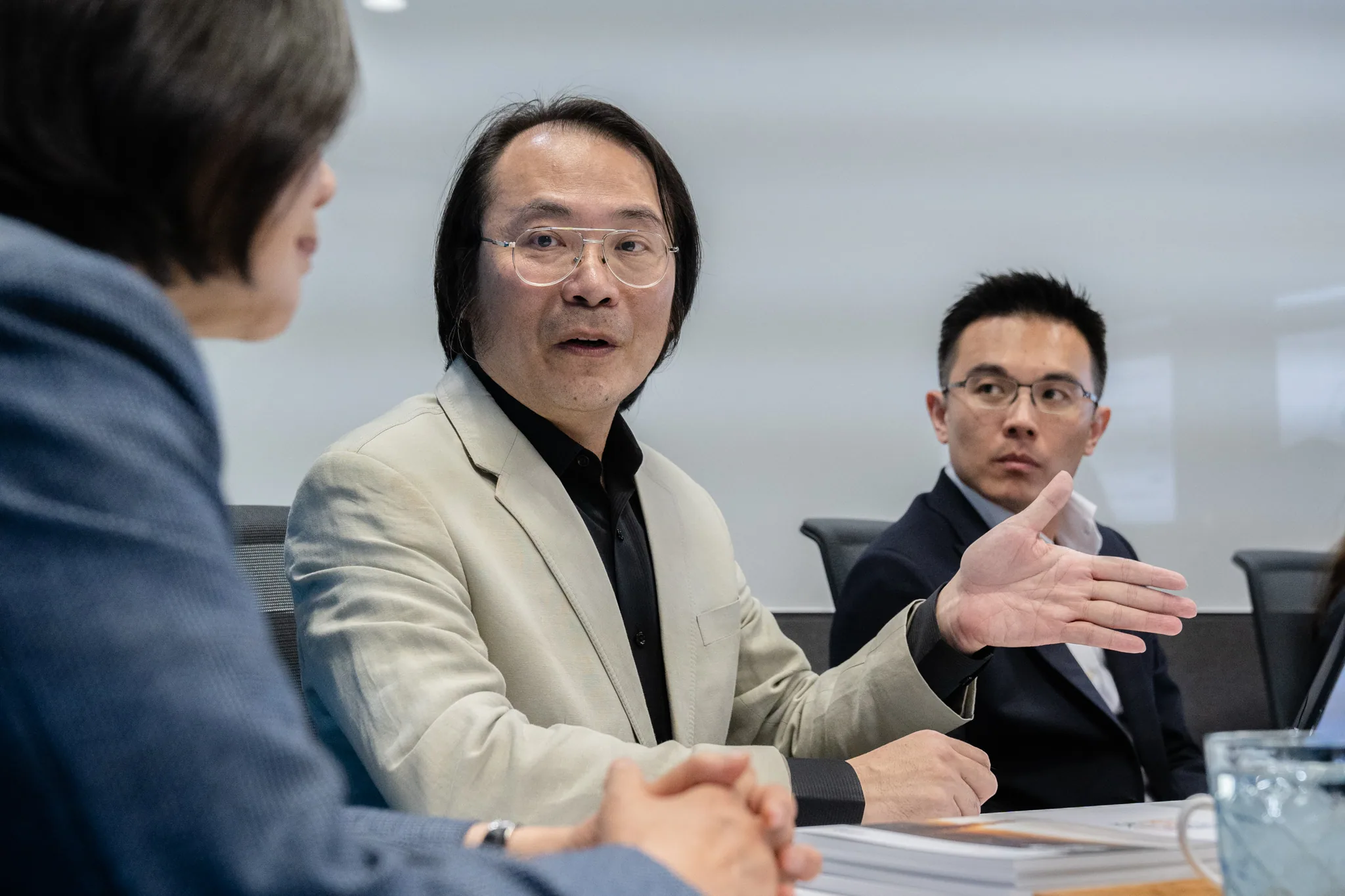
In 2019, Lee-Feng Chien explains to visiting President Tsai Ing-wen at the Google Taipei 101 office. Photo: Presidential Office, CC BY 2.0 via Wikimedia Commons.
Before Google Arrived, He Built the Search
To understand Lee-Feng Chien, one must go back to the era before Google entered Taiwan.
At that time, when Taiwanese graduate students wanted to search for theses or dissertations, they used a website called the "National Thesis and Dissertation Online Retrieval System"—this was all before Google arrived in Taiwan. One of the key researchers behind this system was Lee-Feng Chien. Born in 1963, he studied in the Department of Electronic Engineering and Computer Science at Tamkang University before pursuing his Master's and PhD at National Taiwan University's Institute of Information Science.15 During his graduate studies, he initially worked on AI and speech recognition before pivoting to the then-niche field of Chinese retrieval (full-text retrieval), becoming one of Taiwan's earliest researchers in the field of information retrieval.1
Looking back today, there is a sense of temporal displacement. The world eventually came to equate "search" almost entirely with Google, but before that, someone in Taiwan was already tackling a more fundamental problem: how can Chinese text be understood, segmented, and found by machines?
Chinese search was a genuine technical challenge in the 1990s. English sentences use spaces, allowing machines to easily identify word boundaries; Chinese is written as long, continuous strings of characters, so machines first had to learn how to segment strings like "graduate student online retrieval" into meaningful units like "graduate student / online / retrieval" before search could even be discussed. This step, called word segmentation, requires both linguistic knowledge and statistical methods. What Lee-Feng Chien accumulated during his years at Academia Sinica was precisely this fundamental skill of turning Chinese into machine-readable data. This also provided the unique foundation for his later success: he didn't just understand management; he truly understood the inherent difficulties of search within the Chinese language.
In an era when very few in Taiwan's academia treated "information retrieval" as a primary battlefield, Lee-Feng Chien's research provided Taiwan with a local technical accumulation for Chinese search. The retrieval and thesis inquiry systems he helped develop served actual users—graduate students writing theses and scholars searching for data—rather than remaining as mere theories in journals. This "build it for people to use" orientation was something he later brought into his work at Google. It was precisely because he had gone deep enough into search within academia that, when Google decided to establish a presence in Taiwan in 2006, they sought someone who understood both the technology and the Taiwanese engineering community to lead the way.
After completing his PhD, he joined Academia Sinica, eventually serving as Deputy Director of the Institute of Information Science, taught at National Taiwan University, and served as a technical advisor at Microsoft Research Asia.1 He followed a path rarely taken by high-level technical talent in 1990s Taiwan: rather than staying in US academia or heading directly to Silicon Valley, he returned to Taiwan, keeping research energy on the island. In an era when "going abroad meant not coming back," this was a significant choice in itself.
By the time Google decided to enter Taiwan and needed someone who understood both search and the Taiwanese academic and engineering circles, Lee-Feng Chien was already in position.
A correction to a common claim: Some sources (including earlier versions of this article) stated that Lee-Feng Chien held a "Bachelor's from NTU CS and a PhD from the University of Maryland." After cross-referencing Chinese Wikipedia and multiple academic records, his correct education is a Bachelor's from the Department of Electronic Engineering and Computer Science at Tamkang University and a Master's and PhD from the Institute of Information Science at National Taiwan University, with no record of study at the University of Maryland.15
Employee Number 001
In 2006, Lee-Feng Chien joined Google, becoming Google's first employee in Taiwan.26
"Employee number one" sounds like an honorary title, but in practice, it felt more like one person carrying an entire company. He had to start from scratch, building a team and finding engineers in Taiwan. The true difficulty of this job lay in the goal itself: making Taiwanese engineers produce products used by the entire world, which is much harder than simply bringing finished foreign products into the country.
Google chose to establish its first large-scale R&D center in Asia in Taiwan in 2006, rather than in Japan or South Korea, based on several considerations: Taiwan's pool of engineering talent, bilingual Chinese-English capability, geographical proximity to the hardware supply chain, and the information engineering research energy from top universities like NTU. Lee-Feng Chien's background at Academia Sinica made him the ideal bridge between Google's global R&D direction and Taiwan's academic ecosystem.2
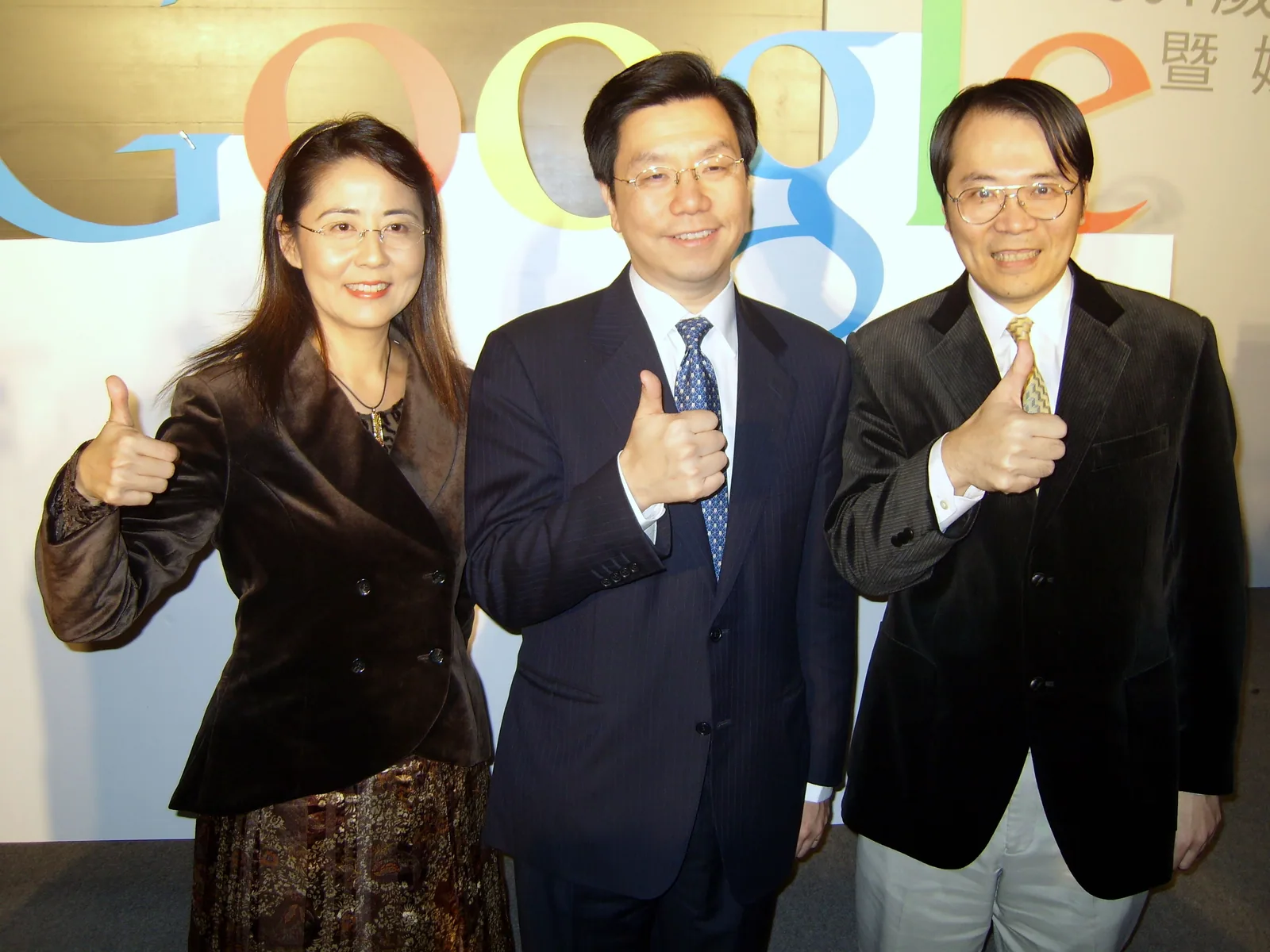
A 200.Google Taiwan press conference. At that time, the R&D center was in its startup phase and would later grow into Google's largest engineering base in Asia-Pacific. Photo: Rico Shen, CC BY-SA 4.0 via Wikimedia Commons.
Under his leadership, Google Taiwan's R&D projects expanded from search engines to advertising technology, mobile applications, and cloud services. He also promoted talent cultivation programs that funded Taiwanese graduate students, allowing young people to connect with the global research frontier without leaving Taiwan. This was crucial: Taiwan has long suffered from "brain drain" anxiety, where excellent graduate students leave the country immediately upon graduation; Google Taiwan provided another possibility, allowing engineers on the island to work on world-class problems right where they were.
What truly propelled Google Taiwan to the next level was a single transaction in 2017. In September of that year, Google announced it would acquire HTC's "Powered by HTC" Pixel R&D team and approximately 2,000 engineers for about $1.1 billion. The deal was completed in early 2018, instantly making Taiwan Google's largest engineering base in the Asia-Pacific region.78 For the Google Taiwan led by Lee-Feng Chien, this was the turning point from "growing slowly on one's own" to "growing in a massive burst," and it elevated Taiwan's position within Google's global footprint.
By the time he retired in 2020, Google Taiwan's workforce had grown from just himself to over 2,000 people (including the HTC team integrated in 2017), and subsequently expanded to approximately 3,000 people, becoming an indispensable R&D base for Google in Asia-Pacific.2 He served at Google Taiwan for fourteen years, officially stepping down on January 31, 2020, at the age of fifty-seven.29
These fourteen years spanned the era of pure search, the rise of smartphones, and the early stages of AI moving from laboratories to industry. In 2019, President Tsai Ing-wen visited the Google Taipei 101 office, with Lee-Feng Chien personally providing the tour; that photograph, in a sense, captured that era: a Taiwan R&D center for an American tech giant had become important enough to be a stop on a Head of State's itinerary.
He did more than just manage. He brought Google's culture—"speak with data, and if you have no ideas, don't occupy the meeting room"—to the Taiwan team, and he long moved between campuses and industry. One thing he often said was that even without having gone abroad, one can do international-scale work in Taiwan.10
Retiring but Not Resting
Many assume that Lee-Feng Chien's retirement meant an exit from the stage. Instead, he became busier.
Only days after leaving Google, in February 2020, he joined the boards of two Taiwanese AI startups: Appier and iKala.11 Both companies are highly representative. Appier operates a marketing AI platform and later listed on the Tokyo Stock Exchange; iKala provides marketing technology and cloud AI solutions. Later, he also served as a director for the Junyi Learning Foundation and was appointed by the Ministry of Transportation as a corporate director for Chunghwa Telecom12, while serving long-term as a mentor for the AAMA Taipei Cradle program, guiding wave after wave of Taiwanese startup teams.[^retint]11 At the time of his retirement, he mentioned wanting to spend more time with his elderly parents living in Yilan.2
Among these roles, being a director for the Junyi Learning Foundation might seem the least "tech-oriented," yet it most clearly reveals where his concerns lie. Junyi is a free online learning platform serving primary and secondary students in Taiwan, especially those in remote areas. For someone who spent fourteen years in a global tech company, dedicating retirement time to K-12 education stems from the same judgment: Taiwan's future competitiveness ultimately depends on how well we educate the next generation. He has mentioned in various venues that education and talent are essentially the same problem viewed at different points in time—the primary and secondary students sitting in remote classrooms today, who may or may not have fair access to good materials, are exactly the talent pool Taiwan will "find or fail to find" ten years from now. Investing resources early at the very front is the most practical long-term investment he can conceive. This thread is essentially two sides of the same coin as his later anxiety regarding talent.
Director, mentor, speaker—these roles may seem fragmented, but they are connected by a consistent direction. In the early stages of a startup, founders usually have ideas, but what is truly scarce is judgment and credibility. A person who has seen enough cases to know which paths work can save a team six months of wandering with a single word; this is exactly the role Lee-Feng Chien is able to play. He has invested the technical judgment and international connections accumulated during his fourteen years at Google into the earliest, most needy stage of the Taiwan AI ecosystem. After leaving Google, he took on a more transcendent position: no longer fighting for a single company, but speaking from the height of the entire Taiwanese industry.
The Sharpest Warning in the AI Era
Standing at that height, he began to speak about an increasingly urgent matter: Is Taiwan ready to face AI? His answer is almost always "not yet."
Lee-Feng Chien discusses "Future Talent in the AI Era" at a symposium at National Yang Ming Chiao Tung University.
His most frequently cited warning is that Taiwan "will find no talent within five years and no consumers within ten."413 This statement is blunt and uncomfortable, but he speaks with directness. Talent will be drawn away by international companies offering higher salaries, while the market will shrink due to declining birth rates and scale limitations—both happening simultaneously. His prescription is "Taiwan + N" and "New Outbound." The so-scale "Taiwan + N" suggests that Taiwan should not view its market as only the 23 million people on the island; through AI and the internet, a Taiwanese team's output can directly serve Southeast Asia, Japan, or even the entire world, turning the disadvantage of scale into a strategy of using Taiwan as a base to radiate outward. This "New Outbound" narrative is, to some extent, his way of magnifying what he saw at Google—that Taiwanese engineers can create products used by the whole world—into advice for the entire industry.4
Regarding the "Sovereign AI" being promoted globally, he also points directly to Taiwan's core gap: it is not computing power or technology, but talent.14 He often summarizes Taiwan's situation in one sentence: "Strong computing power, weak application." TSMC ensures Taiwan holds the world's best AI chips, but chips provide computing power; computing power does not automatically transform into AI capability. What truly determines a nation's position in the AI era is model development, application implementation, and data strategy—areas where Taiwan remains relatively thin. Taiwan has already built its moat in hardware, but it has yet to dig the moats for software and people, which is why his tone is always particularly urgent when discussing talent.
$\pi$-shaped Talent and Eight Soft Skills
So, what should young people do? Lee-Feng Chines proposed the concept of "$\pi$-shaped talent." While people previously discussed "I-shaped" talent (single expertise) or "T-shaped" talent (cross-disciplinary), he believes that in the AI era, one must stand on two legs like the Greek letter $\pi$: having both professional depth and sufficient breadth.315 He also warns that AI has significantly raised the baseline for work. In the past, a 60% was a passing grade; now, with AI handling much of the fundamental work, the passing line has been pushed to 80%.3
So, what can humans still do better than AI? He listed eight core soft skills: "Questioning, Expression, Empathy, Critical Thinking, Care, Collaboration, Negotiation, and Leadership."3 Among these, he emphasizes questioning most. He says: "Good answers come from smart questions." If you do not understand the fundamentals of a field, you cannot ask the right questions, and thus you cannot direct AI to do the job well.3
Regarding questioning, he left behind a quote that is frequently cited:
"One question and one answer is plagiarism; ten questions and ten answers is learning; a hundred questions and a hundred answers is creation."3
He also spoke more harshly. He observed that US companies have already begun "not hiring fresh graduates" because AI has supplemented the capacity of entry-level work, and this wave will next sweep through Taiwan. For him, the priority for the younger generation has changed: rather than rote memorization from textbooks, it is better to enter the workforce as quickly as possible to accumulate practical experience and learn how to "command" AI to complete tasks.16 He brings these words to university lecture halls, industry forums, and corporate training, addressing both engineers and business decision-makers, because in his view, the bottleneck of AI transformation is often not technical, but rather that no one within an organization can judge "which problem is suitable to hand over to AI, and which is not."
Part of his anxiety is for the youth. While he says companies will increasingly be unwilling to hire fresh graduates, he simultaneously dives into working with free primary and secondary education platforms; both point to the same problem: if AI removes the bottom rungs of the ladder, what happens to the next generation who has not yet climbed it? His answer is practical: rather than waiting to be eliminated by the era, prepare early—enter the field sooner, learn to collaborate with AI sooner, and practice those eight irreplaceable soft skills sooner, while the bottom rungs are still there.
The persuasiveness of these words comes from his position. The person saying Taiwan's talent will be poached is someone who personally built Google Taiwan from one person to thousands; the person saying AI will rewrite work is someone who has experienced search and witnessed wave after wave of technological shifts. This makes his warnings difficult to dismiss as mere alarmism—he is not commenting on the Taiwan tech industry from the outside; he is a part of it.
The Position of a Pioneer
Looking at Lee-Feng Chien's life in its entirety, one sees a very "Taiwanese" trajectory.
First, he built search in Taiwan himself, becoming a pioneer in the field; then he joined Google, leading a one-person office to become an R&D base of over 2,000 people, proving that Taiwanese engineers can produce world-class products; after retiring, instead of retreating into private life, he returned to use the most direct, even anxiety-inducing tone, to remind Taiwan not to be left behind in this AI wave.
This path is rare because it connects three roles that are usually separate in one person: a top-tier technical researcher, a regional leader of a multinational corporation, and an industry elder willing to stand in the public eye to speak loudly. Taiwan does not lack any of these types of people; what it lacks is someone who can weave them into a continuous trajectory and who is willing to look back to guide those following behind. From Chinese retrieval at Academia Sinica to being Google Taiwan's employee number one, to today's calls for talent, education, and "New Outbound," every stage of his experience has been paving the way for the next stage, and for others. This continuity explains who he is more than any single title.
Because of this, the uncomfortable truths he speaks are worth listening to seriously. He does not stand in a safe position to disparage Taiwan; rather, he is betting the second half of his life on "helping Taiwan gain a little more time." Whether talent truly hits a bottom within five years or markets truly shrink within ten may not be 100% certain, but the questions he poses remain valid.
Such a role is destined to cause friction. Some feel he exaggerates the talent anxiety; others do not entirely agree with the "New Outbound" narrative. But few would deny that the problems he points out are real. His position happens to be the rarest among Taiwan's tech professionals: someone who has performed the most fundamental technical research, worked in the most top-tier international companies, and finally chose to stand up and ask a difficult question for the entire island—when the technological waves of others crash upon us, what will Taiwan rely on so that it does not end up merely being someone else's market?
Further Reading:
- Du Yi-chin — From PTT to Microsoft, and then to Taiwan AI Lab: another path in Taiwan's AI journey.
- Morris Chang — Another prototype of the Taiwan tech industry's "do it yourself, then make it world-class" ethos.
- Taiwan AI School — How Taiwan uses private sector strength to fill the AI talent gap.
- Shi Zhen-rong — From OEM to brand: another tech godfather willing to stand before the camera to talk about Taiwan.
Image Sources
- Hero Photo: Presidential Office, Wikimedia Commons, CC BY 2.0. Original file: Google Taiwan Branch Engineering Director Lee-Feng Chien speaking with President Tsai Ing-wen (2019-04-17).
- Body Text 2007 Press Conference Photo: Rico Shen, Wikimedia Commons, CC BY-SA 4.0. Original file: 2007 Google Taiwan Press Conference Executives.
- Video: Yang Ming Chiao Chun Symposium, Lee-Feng Chien speaking on "Future Talent in the AI Era," YouTube official upload, for inline embedding purposes only.
References
- Lee-Feng Chien — Wikipedia — Chinese Wikipedia entry for Lee-Feng Chien, serving as an index for his birth year, education (Tamkang CS Bachelor, NTU CS Master/PhD), Deputy Director of Academia Sinica Institute of Information Science, Consultant at Microsoft Research Asia, General Manager of Google Taiwan, and post-retirement board positions. Key narratives are cross-referenced with Digital Age, Business Weekly, etc.↩2345
- Google's Lee-Feng Chien Announces Retirement! From Employee Number One to General Manager, Officially Stepping Down on Jan 31 — Digital Age report from 2020, recording his joining in 2006, being employee number one in Taiwan, 14 years of service, team growth from 1 to over 2,000, retirement on Jan 31, and post-retirement roles as AAMA mentor and caring for parents in Yilan.↩23456
- Software Engineers Must Think Like PMs! Lee-Feng Chien Reveals 8 Soft Skills Where Humans Beat AI — Digital Age report, verbatim quote sources: "Good answers come from smart questions," "One question and one answer is plagiarism; ten questions and ten answers is learning; a hundred questions and a hundred answers is creation," as well as the list of 8 soft skills, $\pi$-shaped talent, and AI raising the passing grade from 60 to 80.↩23456
- Lee-Feng Chien: Taiwan will find no talent within 5 years, no consumers within 10! Two key layers of "New Outbound" in the AI era — Digital Age report, recording Lee-Feng Chien's warnings regarding Taiwan's talent and market, as well as the "Taiwan + N / New Outbound" narrative.↩23
- Lee-Feng Chien's Academic and Professional Experience (Career Lecture Introduction) — Summarizes Lee-Feng Chien's academic and professional history at Tamkang, NTU, Academia Sinica, and Google Taiwan, used to cross-verify education and research direction (pioneer of Chinese retrieval).↩2
- More growth ahead in Taiwan — Official Google Blog (English, primary source), regarding Google's growth and investment in Taiwan, serving as an official profile of Google Taiwan's R&D scale.↩
- Google and HTC Announce US$1.1 Billion Cooperation Agreement — HTC official press release (English, primary source), announcing on September 21, 2017, that Google would acquire the "Powered by HTC" Pixel R&D team and non-exclusive patent licenses for $1.1 billion.↩
- Google Completes $1.1 Billion Deal with HTC, Taiwan Becomes Largest Engineering Base in Asia-Pacific — iThome report, recording the integration of approximately 2,000 HTC engineers into Google, the deal completion in early 2018, and Taiwan becoming Google's largest engineering base in Asia-Pacific.↩
- Lee-Feng Chien Announces Retirement from Google (2020-01-31) — iThome report, cross-verifying the retirement date as January 31, 2020.↩
- Former Google Taiwan GM Lee-Feng Chien: Even without going abroad, one can do international-scale work in Taiwan! — Cheers interview, recording Lee-Feng Chien's views on "doing international-scale work in Taiwan."↩
- Google Taiwan's Employee No. 1 Lee-Feng Chien Retires but Keeps Working! Joins Boards of AI Startups Appier and iKala — Digital Age report from 202 $\text{0}$, recording Lee-Feng Chien joining the boards of Appier and iKala after leaving Google.↩2
- Ministry of Transportation Invites Lee-Feng Chien and Wu Sheng-yuan to Serve as Chunghwa Telecom Directors — Economic Daily report from 2024, regarding the Ministry of Transportation appointing Lee-Feng Chien as a corporate director (non-independent) for Chunghwa Telecom, leveraging his AI and cloud industry experience.↩
- Lee-Feng Chien: Taiwan will have no talent in 5 years, no market in 10! Two keys to "New Outbound" in the AI era — Business Weekly report, cross-verifying with Digital Age regarding the "no talent in 5 years, no market in 10" warning and the New Outbound proposition.↩
- Technological Revolution... Taiwan Struggles for Sovereign AI; Lee-Feng Chien: The Gap is Talent — United Daily News report, recording Lee-Feng Chien pointing out that the core gap for sovereign AI is talent.↩
- The Highly Sought-after $\pi$ Person in the AI Era: One Person Doing the Work of Three! How Should Companies Cultivate Them? — Business Weekly report, summarizing Lee-Feng Chien's $\pi$-shaped talent concept and talent needs in the AI era, used to cross-verify the $\pi$-shaped talent narrative.↩
- Under the Impact of AI, the First to Lose Jobs are University Graduates! Lee-Feng Chien: The "No Fresh Graduate Hiring" wave in US companies will sweep Taiwan — Cheers/Business Weekly report, recording Lee-Feng Chien's observations on the "no fresh graduate hiring" trend and how the younger generation should respond.↩