
30-second Overview: Chen Tzu-hao (Howhow) did one of the most counterintuitive things in Taiwan YouTube history. While everyone else tried every way possible to hide sponsored content, he put up a giant subtitle reading “straight into the sponsored-content topic!” and turned the thing creators found most awkward into his signature. By writing scripts, directing, acting, and editing alone, he sustained the HowFun channel, with 1.54 million subscribers and 760 million views. But there are three layers of contradiction here that you may not have expected: the “honest sponsored content” for which he is praised is precisely the deceptive mechanism academics describe as “advertising that does not look like advertising”; his “one-person team” is a label imposed by others, while he himself dislikes loneliness and has always wanted a team; and the high-cost long-form videos he insists on making sit exactly in the lane most fiercely pressured by short-form video. This article is about how a creator preserves his own rhythm, and how that insistence is becoming expensive.
The Visual Rebellion of a Jinshan Boy
On April 20, 1989, Chen Tzu-hao was born in Jinshan Township, Taipei County, now Jinshan District, New Taipei City.1 Many profiles describe him as “from Wanli,” but that is in fact a small misunderstanding: Wanli is where his parents operated Dapeng Kindergarten and where his later studio was registered. Jinshan is where he was born.
Before he picked up a camera, he was a child moving steadily along the education track. He first attended The Affiliated Senior High School of National Taiwan Normal University, then entered National Chengchi University’s Department of Economics.1 On the surface, this was a path leading toward finance and office work. In a later interview with the ATCC business competition, he described his feelings at the time very plainly: “Why must one pursue the goals defined by society’s values? Why not do something one truly wants to do?” He said that he had “all along, in fact, been pushed forward by the invisible force of society, and had never honestly faced what his heart was drawn toward.”2 An economics student using words like “honestly faced what his heart was drawn toward” to describe a career shift: that fixation on “honesty” would later grow back into his work in a way no one expected.
What truly showed him the magic of images was a short film uploaded on June 24, 2013, titled “What Are We Performing at Graduation?”3 It was a promotional video he made for the graduation ceremony at his parents’ Dapeng Kindergarten. In it, a group of young children recited lines that were far beyond their age and difficult to understand. The strong contrast made it explode on PTT’s joke board, and it later appeared on television news. But the HowFun channel had actually been created on YouTube in 2007. At the time, he was still in college and had formed it with classmate Yeh Ta-fang; the name was a combination of the two of them. He once explained on PTT: “The name How Fun is because of the two people How and Fun. I am How (昊), and my friend is Fun (方).”4 So the channel opened in 2007 and only went viral in 2013, with six years in between.
After the graduation video became popular, he made a decision that ran against the instincts of an economics major: after completing military service, he went to the United States to study for a master’s degree in animation and visual effects at Savannah College of Art and Design (SCAD).1 He described his family as having “sent me abroad to drink that foreign ink.”5 At SCAD, his major was animation and visual effects; that often omitted “animation” neatly explains why his later videos could pack in so many visual tricks by himself. His years studying abroad also turned “facing the camera alone” from a real-life circumstance into the most familiar posture in his work.
Putting "Sponsored Content" in the Sunlight

Howhow discusses his creative approach and sponsored-content methods. The "King of Sponsored Content" laid bare in the sunlight is, in private, a self-described loner and a boy from National Chengchi University. Photo: WebTVAsiaTaiwan. CC BY 3.0 via Wikimedia Commons.
In September 2015, fate struck in a way even he can't quite explain. Samsung was holding the Galaxy Note 5 Unpacked event at New York's Lincoln Center, and through the ad agency Leo Burnett, they reached out to Howhow, who at the time had fewer than 100,000 subscribers6. He recalls thinking, "I figured they wanted to hire me as a photographer," because "my subscriber count and likes were still pretty low," and he couldn't understand why they'd chosen him7. He even saved the contact info for Samsung's representative in his phone as "Benefactor"7.
📝 Curator's Note
Most write-ups frame this as "Samsung saw his visual style," but that's a romanticized reversal of causality. Howhow's own account is the opposite: he had no idea why he was picked and thought he was being hired as a photographer. Samsung was betting on someone not yet famous but whose work inspired trust. In this industry, trust comes before traffic — a rarer path than "chase followers first, take jobs later." The contact name "Benefactor" captures that moment when a small-channel creator was unexpectedly chosen by the world.
What really made Howhow the "King of Sponsored Content" was his approach to handling sponsored content. Most YouTubers try to hide ads within their storylines so viewers are unknowingly marketed to. Howhow did the opposite — he used a tonal shift in the narrative, paired with a big on-screen title that literally read "Entering the sponsored-content topic!"8. Viewers who hate being stealth-advertised couldn't help but laugh when he put the ad right out in the open.
Behind this "straightforward" approach is a philosophy he's thought through carefully. He says, "If viewers only realize at the end that it was sponsored content, that's actually a success," because "how you tell the story matters... more than the dislike of sponsored content — it means you did it right."9 Breaking that down, what he cares about is really "is the story good enough to make you forget it's an ad?" For the age-old question of "does getting paid to serve brands mean betraying your audience?" his answer is pragmatic: "As long as they think it's funny, serving them is enough."7
⚠️ Controversial Take
This "honest sponsored content" approach sounds bulletproof, but academia sees another side. Native advertising research shows that even when "this is an ad" is clearly labeled, roughly a quarter of viewers still don't realize they're watching an advertisement and are thus influenced10. In other words, "making ads entertaining" is itself a mechanism of "ads that don't feel like ads": the happier you laugh, the lower your guard. Howhow's "Entering the sponsored-content topic!" pushes labeling to its extreme, but his cleverness is exactly where academia is most wary: the better the ad, the more it makes you forget it's an ad. Taiwan society's fatigue and distrust of "ye-pei" (a pun on sponsored content) is the same anxiety as "ads seeping into content." Some viewers have even quipped, "Your channel is nothing but sponsored content now."11 Once you make sponsored content your signature, you can't escape the backlash of "will it be all sponsored content?"
Taiwan's regulations are catching up too. In 2023, the Fair Trade Commission revised its guidelines to require influencers to be jointly liable with sellers for recommended products, seen as one of the strictest influencer advertising standards in Asia12. In this increasingly transparent environment, Howhow's "I'll just tell you outright this is sponsored content" approach looks like it got ahead of the curve. But academia reminds us: transparency in form doesn't mean there's no subtle influence.
Alone, But He Never Wanted To Be Alone
The label most widely attached to Howhow is “one-person team.” It has a solid basis: for a long period, he really did handle every stage by himself. He once described the picture: “thinking up the script myself, making the props myself, setting up the tripod myself, filming myself, editing myself, adding subtitles myself, doing the effects myself.”13 In his videos, he often plays multiple roles himself, pasting on paper mustaches, parting his bangs to the other side, putting on wigs, and acting opposite “another self.” His 2017 Universiade video “Taipei! My Home Field feat. Mayor Ko” is a representative example of this multi-role style.8
The 2017 Universiade promotional video “Taipei! My Home Field feat. Mayor Ko.” Howhow played multiple roles himself and also recorded Ko Wen-je and Tsai A-ga on the side; it was one of the most widely known public displays of “How-style rhythm.”
But the four words “one-person team” hide a misunderstanding romanticized by viewers and media. People read it as a kind of lonely aesthetic, as if he had actively chosen the ascetic practice of acting alone before an empty camera. The truth is exactly the opposite. When someone on PTT questioned whether it was “really hard to imagine that the script, cinematography, and acting were all done by one person,” and even wondered whether he was “exploiting marginal people,”14 Howhow himself came out and replied with a very real sentence: “I don’t want to be alone either, damn it.”13
💡 Did You Know
Howhow has never truly been “purely one-person.” When filming, he would temporarily ask his parents, girlfriend, or even collaborating brands to stand in position so he could focus the shot.13 On March 31, 2018, Lan Yi-ming officially joined his team.1 In an interview, he made his inner thoughts even plainer: “Actually I have always wanted to have a team,” because the biggest downside of working alone is that “it is too boring,” and he also previewed that “there will soon be one more editor around me.”15 So the celebrated “lonely aesthetic” was a label attached by viewers and media, not a choice he himself romanticized. What he wanted was simple: people to work with.
This is the layer of Howhow that is most often misread. The traffic-driven world likes to turn “carrying everything alone” into proof of will and talent, so “one-person team” became a selling point in his persona. But while the person concerned was praised with this label, he was also shouting “I don’t want to be alone either,” and quietly starting to look for people. Put those two things together and you find that his “one-person” state was forced out by reality, not by belief. What he was truly preserving was making the video look the way he wanted it to, even if that meant acting through the whole thing alone into empty air. It had nothing to do with loneliness.
Academic research sharpens this contradiction. Liu Chih-yu’s 2021 study at National Taiwan Normal University analyzed five common traits among Taiwanese YouTubers with one million subscribers: branding, title formats, teamwork, a relaxed everyday-life style, and being a standout in one’s field. Four of those were built on the foundation of a “team.”16 Howhow happened to go against the most crucial item, “teamwork,” achieving alone what others usually achieved through teams. Another study by Chung Ming-chun at Tamkang University points out that this kind of patterned, highly self-demanding creation is, at its core, a form of “self-exploitation” and a large amount of unpaid labor.17 Heard from this angle, his lines “too boring” and “I don’t want to be alone either” are in fact the most honest exhaustion of someone who has carried the load alone for too long.
The “Betrayal” of the Tool-Man Alliance
Howhow resonated so deeply with Taiwan’s PTT users because he moved the shared language of the mid-2010s PTT generation into his videos. Tool man, marginal person, “wake up, you don’t have a younger sister”: these memes were things he both used and created. The unloved single loser character he played, who had to do everything himself, was a self-projection for countless forum users. In that context, he was almost the spiritual leader of the “tool-man alliance.”

Singer-songwriter Teng Fu-ju (A-Fu), who registered her marriage with Howhow on Valentine’s Day 2019. Photo: Onlymyself65536. CC BY-SA 3.0 via Wikimedia Commons.
So when news came out that on February 14, 2019, Valentine’s Day, he and singer Teng Fu-ju, known as A-Fu, had registered their marriage,1 there was a subtle sense of “betrayal” for forum users who had followed his “marginal person” persona. The alliance leader was no longer single, and on Valentine’s Day no less. In 2021 he welcomed a son, and in 2023 a daughter, forming the character “好,” composed of “woman” and “child.”18 The person who had acted as a single loser alone before the camera had, in real life, steadily built a family.
📝 Curator’s Note
Hidden here is an invisible contrast running through Howhow’s entire creative work: the “marginal person” on screen and the “father of two” in real life are the same person. The forum-user persona was a role he extracted from shared experience and used to make everyone laugh; it was not his real life. When a creator’s real life, marriage, children, and desire for a team, begins to diverge from the persona that made him famous, loneliness, marginality, being alone, the question he has to answer becomes: “Do I still continue playing a role that is no longer me?” How does a man in his thirties, with two children and a desire for a team, keep being the “leader of the tool-man alliance”? He is still answering that tension through his work.
When discussing parenting, his attitude also differs from that comedic image. He has said that “hitting has no meaning at all,” and believes that “using threats to make children handle and suppress their emotions is actually very unhealthy,”19 advocating parenting without hitting or scolding. Asked whether he would have a third child, he laughed and said, “At this stage it is not very likely we will have a third child. In this era, people who can have three or four children really are warriors.”20
His identity is also not limited to YouTuber and father. He is the bassist and bandleader of SevenFat, whose album Yelusiku was released in 2020.21 How Bro Universe, often mistaken for a book by him, is actually a SevenFat single and music video, not a book. The book he actually published was How Fun! How to Happily Become a YouTuber, released by Aquarius Publishing in January 2018. He donated all royalties from the first, second, and third printings to the Taiwan Fund for Children and Families, later adding a donation in response to the Hualien earthquake.22 In January 2026, he also made a cameo in Accusefive’s “Happy Things Cannot Be Remembered” music video, playing a severely infected person wrapped head to toe in bandages and sitting in a wheelchair, practically a mummy. His description of the role was very Howhow: “Half the time I was inside the bandage mask with my eyes closed, sleeping. Super comfortable.”23
Long-Form Video Is an Increasingly Expensive Bet
If the story stopped at “king of sponsored content, father of two, bandleader,” it would be a tidy success-study version. But Howhow’s real contemporary significance lies in the fact that the lane on which he became famous is collapsing.
On December 23, 2018, HowFun reached one million subscribers.1 Put this date into the timeline of Taiwan’s professionalized YouTuber industry: in 2014, Tsai A-ga became the first Taiwanese YouTuber to reach one million subscribers; in 2016, This Group of People reached the mark; in 2017, Saint set the fastest one-million record at 225 days, while A-SEN also crossed the threshold; and at the end of 2018, Howhow joined the million-subscriber club.24 Each of these creators found a survival strategy. Howhow’s strategy was high-cost, carefully crafted long-form video, which happened to be the most laborious kind.
The problem is that this path keeps getting more expensive. Advertising unit prices, CPM, for Taiwanese YouTubers have long been low. For a channel with 300,000 views in a month, pure advertising revenue is often less than NT$10,000.24 This is why, for Taiwanese creators, “sponsored content is a survival necessity,” not greed. When ad-share revenue cannot support people, whoever can make sponsored content enjoyable and not annoying can survive. Beneath Howhow’s title as “king of sponsored content” is a brutal survival equation.
The bigger impact is short-form video. Academic research has found that after the rise of vertical short-form videos such as YouTube Shorts, views and engagement for long-form videos dropped significantly, and the first and hardest hit categories were long-form videos in Entertainment and Lifestyle; Information and Education were comparatively less affected.25 Short-form video now occupies the vast majority of internet traffic. In other words, the “entertainment long-form video” lane where Howhow stands is exactly the position most thoroughly crushed by short-form video.
He himself speaks of the exhaustion plainly. In a November 2023 interview, he said: “In the next five years, vertical short videos may be the trend. We have to compromise with this,” and compared short-form video to fast food: “Vertical short videos are like eating instant noodles.”26 He also directly identified the disappearance of platform bonuses: “About three or four years ago, long videos on YouTube had bonuses... but in the past one or two years everything has changed,” because “you cannot keep burning through your old capital; it will burn out very quickly.”26 The sentence most painful to hear is this one: “When your interest keeps getting ground down, ground down... it will definitely grind you down until you really start to hate filming.”26
💡 Did You Know
In July 2024, HowFun’s “avalanche-like decline” in views briefly became news. PTT split into two camps arguing over whether the times had changed or whether the problem was Howhow himself.27 Howhow did not publicly respond to that 2024 debate; the earlier remarks about “creative exhaustion” were in fact from a 2023 interview. The more interesting contrast is that while he continues to insist on long-form video, in March 2026 he led the jury for Lexus’s “MY FILM” short-form video festival.28 Meanwhile, the HowFun channel continued in 2026 to update the long-form videos at which he excels. A person who resists short-form video, has to learn to understand it, and even becomes its judge has turned the predicament of creators in this era into his own daily life.
This is the deepest contradiction in Howhow. The kind of honesty he insists on, laying sponsored content out in the sun and slowly grinding out a complete long-form video alone, is becoming an increasingly expensive luxury in an era that pushes you to be faster, shorter, and more team-based. It is not that he does not know. He knows it all too clearly, which is why he says, “We have to compromise.”
Can Honesty Also Be an Algorithm?
Howhow likes to cite a line from Silenced. He has said it himself: “We fought all the way not to change the world, but to keep the world from changing us.”29
Putting that sentence back into his situation makes people quiet. What he is preserving is actually very concrete: a boldly written line, “straight into the sponsored-content topic!”, and a long-form video that he writes, directs, acts in, and edits himself, even if he has to perform the whole thing facing an empty camera. In 2015, these were the capital that got Samsung to choose him and allowed him to secure a position in Taiwan YouTube history. By 2026, they had become a stubbornness no longer rewarded by the algorithm, after the bonuses had long since burned out. Honesty has not changed; what the world wants has.
We can read this story as the victory of a creator: he redefined sponsored content and turned the thing viewers hated most into something they anticipated. But research reminds us that the better an ad is to watch, the less it seems like an ad; the team dream he talks about has still not been fully realized; and the long-form videos he defends are being squeezed out inch by inch by short-form video, which even he has had to learn to judge. Stack these three layers together, and Howhow is less a perfect model of success than a real-world sample of “how much it costs to insist on your own rhythm.”
Return to that afternoon in New York in 2015. A young man with fewer than 100,000 followers, who thought he was there to work as a photographer, was taken seriously by the world for the first time. He saved the other party as “great benefactor.” Ten years later, he is still the person who writes alone and acts alone. Only this time, while shouting “I don’t want to be alone either,” he also has to watch what the world wants grow shorter and shorter.
Further Reading:
- Tsai A-ga: From the Original Influencer to Social-Work Vocation, the Man Who Used 18 Years of Traffic to Reverse His Fate — Taiwan’s first million-subscriber YouTuber, reaching the mark in 2014, four years before Howhow, and the starting point of this professionalization timeline.
- A-SEN — A gaming creator who crossed the million-subscriber threshold in the same period as Saint, 2017, and followed a survival strategy entirely different from Howhow’s.
- Brian Tseng: Calculating the Laughs, Miscalculating Society — Also made famous through “comedy with calculated rhythm,” but pushed jokes into social issues more sensitive than sponsored content.
- Zun: From His Eighth-Grade Bedroom to Two Million-Subscriber Channels, a YouTuber's Record of Growing Up — Also coming up from Taiwan's early YouTube era, he publicly documented his path through teenage filming, the weight of a million subscribers, and the routines of adult life.
- Taiwan’s YouTuber Industry and Culture: From Tsai A-ga to Chi Hsuan, the Digital-Culture Evolution of an Island — The full industry landscape in which Howhow stands, showing how this generation of creators sustained a generation of internet memory.
- Taiwan’s Self-Media Creator Economy: A Fragmented Battlefield of 23 Million People — Understand the advertising-revenue arithmetic behind “sponsored content is a survival necessity” through industrial structure.
Image Sources
This article uses three CC-licensed images, all cached in public/article-images/people/ to avoid hotlinking source servers:
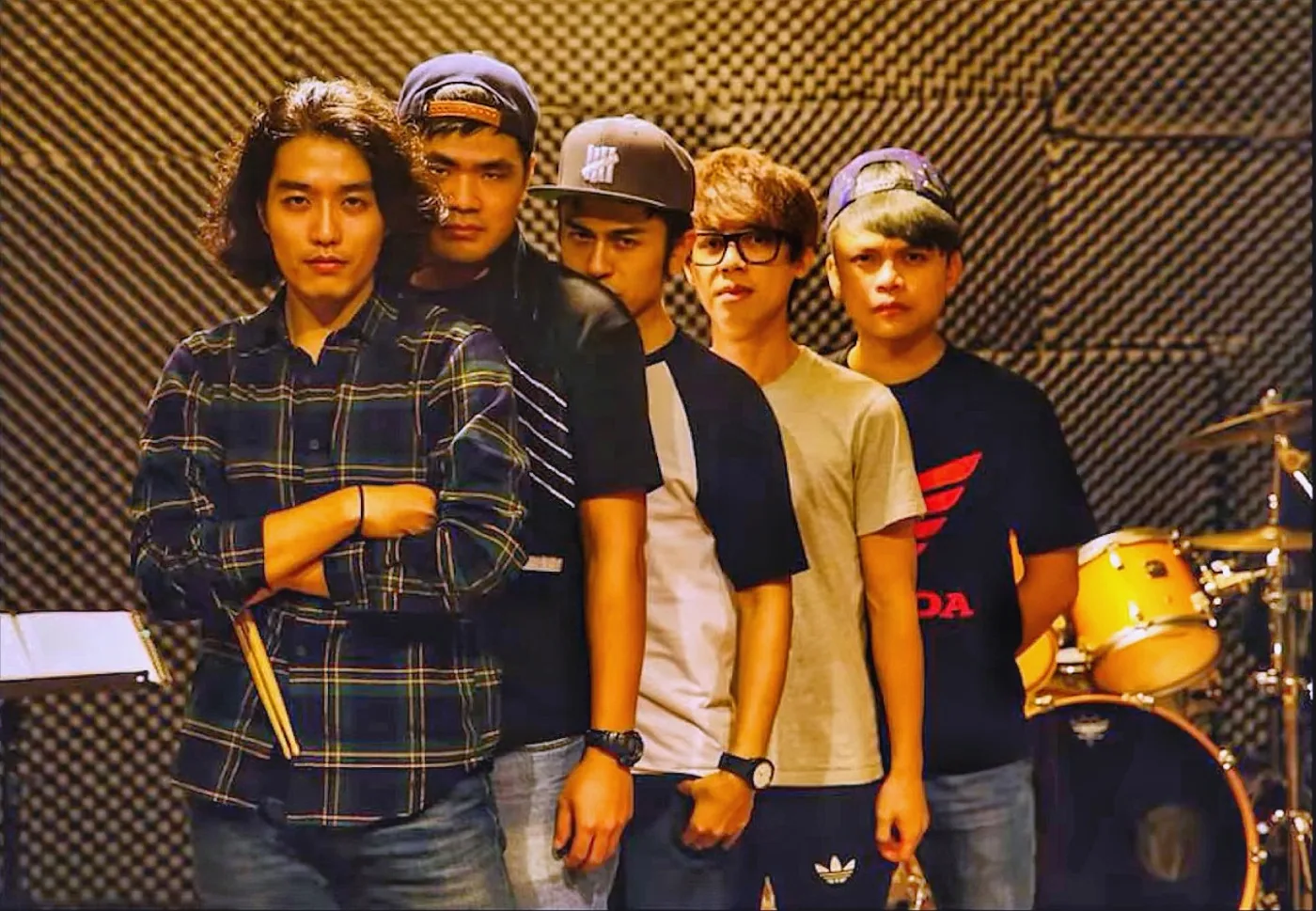
- SevenFat (hero) — Howhow is SevenFat’s bassist and bandleader, one of the band members pictured. Photo: RJ廉傑克曼, 2017-12-07, CC BY 3.0.
- WebTVAsia Interview with HOWFUN — Interview image of Howhow. Photo: WebTVAsiaTaiwan, CC BY 3.0.
- Teng Fu-ju — Howhow’s wife, singer-songwriter Teng Fu-ju, known as A-Fu. Photo: Onlymyself65536, 2011-06-11, CC BY-SA 3.0.
References
- How How — Wikipedia — The article infobox records basic facts including his birth on 1989-04-20 in Jinshan Township, Taipei County; master’s degree in animation and visual effects from SCAD; Lan Yi-ming joining on 2018-03-31; reaching one million subscribers on 2018-12-23; and marriage to Teng Fu-ju on 2019-02-14.↩23456
- Passionate Youth Chen Tzu-hao, ATCC Business Competition Interview — ETtoday — Chen Tzu-hao discusses his realization in shifting from economics to video creation, with verbatim quotations including “why must one pursue the goals defined by society’s values” and “had never honestly faced what his heart was drawn toward.”↩
- NCCU Memory: Chen Tzu-hao — National Chengchi University alumni database, recording his birth in Jinshan, bachelor’s degree in economics, master’s degree in animation and visual effects, co-founding the channel with Yeh Ta-fang, Dapeng Kindergarten, the 2013-06-24 upload of the graduation video, and his roles as SevenFat bassist and bandleader.↩
- HowHow’s Own Account of the Origin of the Name HowFun — PTT Repost — HowHow personally explained the channel’s naming on PTT, verbatim: “I am How (昊), and my friend is Fun (方).” It is also the original discussion thread questioning the one-person team.↩
- HowHow Discusses Studying Abroad — CTWANT — The report quotes HowHow describing studying in the United States as being “sent abroad to drink that foreign ink.”↩
- Howhow’s Sponsored-Content Path — Business Today — The report confirms the timing and model of the September 2015 Samsung Galaxy Note 5 sponsored content, arranged through Leo Burnett, specifically contact Ho Kuan-chun.↩
- Sponsored Content: HowHow YouTuber Case — TransBiz — A first-person account of the Samsung New York sponsored-content project, including “thought they wanted me to be a photographer,” “my subscriber count and like count were not high at the time,” the contact named “great benefactor,” and the verbatim line “Serve them and make them think it is funny; that is enough.”↩23
- Straight Into the Sponsored-Content Topic! HowHow’s Sponsored-Content Method — Business Next — Includes the verbatim description “directly used an abrupt tonal shift in the plot plus a giant subtitle to say ‘straight into the sponsored-content topic!’” and records his self-directing, self-acting, self-editing process and the 2017 Universiade side recording of Ko Wen-je.↩2
- How YouTubers Do Sponsored Content — INSIDE — Howhow’s sponsored-content philosophy, including verbatim lines “If viewers watch until the end and only then realize, ‘it was sponsored content after all,’ that is actually a kind of success” and “the storytelling method is very important.”↩
- Native advertising — Wikipedia — Summarizes native-advertising research, noting that even when labeled as advertising, around one-quarter of audiences still do not recognize that they are being exposed to advertising content and are influenced by it.↩
- One-Person Team Questions and Sponsored-Content Discussion — PTT Repost — Forum users’ discussion questioning HowHow’s one-person team and the proportion of sponsored content on the channel, including criticisms such as “how has the channel ended up with nothing but sponsored content?”↩
- Do Social Media Influencers Need to Disclose Partnerships? — Winkler Partners — Explains Taiwan’s 2023 amendments related to the Fair Trade Act, requiring influencers and sellers to bear joint liability, regarded as among Asia’s strictest influencer-advertising regulations.↩
- HowHow Responds to One-Person Team Questions — SET News — His own PTT reply includes verbatim lines “I don’t want to be alone either, damn it,” “thinking up the script myself, making the props myself, setting up the tripod myself, filming myself, editing myself,” “ask the brand to stand in position so I can focus,” and “I should start looking for people to help soon.”↩23
- Original Thread Questioning the One-Person Team — PTT Repost — The original poster questioned, verbatim, that it was “really hard to imagine that the script, cinematography, and acting were all done by one person,” and wondered whether he was “exploiting marginal people.”↩
- HowHow Discusses Team and Loneliness — LINE TODAY — Verbatim lines include “Actually I have always wanted to have a team!”, “the biggest downside is that it is too boring,” and “there will soon be one more editor around me.”↩
- Liu Chih-yu 2021 Study on Success Traits of Million-Subscriber YouTubers — NTNU / Airiti — Analyzes five common traits among Taiwanese million-subscriber YouTubers, branding, title formats, teamwork, relaxed everyday-life style, and being a standout in one’s field, with four of them built on the basis of teams.↩
- Chung Ming-chun 2021 Study on Patterned YouTuber Creation and Labor — Tamkang / Airiti — Discusses self-exploitation and unpaid labor in YouTubers’ patterned creative production.↩
- Report on HowHow’s Second Child, a Daughter — Taisounds — Reports that HowHow and Teng Fu-ju welcomed a daughter in 2023, joining their son born in 2021 to form the character “好.”↩
- HowHow’s Parenting View of No Hitting or Scolding — Yahoo News — Quotes HowHow verbatim: “hitting has no meaning at all” and “using threats to make children handle and suppress their emotions is actually very unhealthy.”↩
- HowHow Discusses a Third Child — SET News — At the 24th Mother and Baby Awards, he said verbatim: “At this stage it is not very likely we will have a third child. In this era, people who can have three or four children really are warriors.”↩
- SevenFat (Band) — Wikipedia — The band article records “How How: bassist and bandleader,” its November 2017 debut, and the 2020-12-05 release of the album Yelusiku.↩
- HowHow Donates All Book Royalties — INSIDE — Reports that all royalties from the first, second, and third printings of How Fun! How to Happily Become a YouTuber (Aquarius Publishing, 2018-01-10) were donated, to the Taiwan Fund for Children and Families and later with an additional Hualien earthquake donation.↩
- HowHow Cameo in Accusefive MV — Next Apple News — Reports that HowHow made a cameo in Accusefive’s “Happy Things Cannot Be Remembered” music video as a severely infected person wrapped in bandages and sitting in a wheelchair, with the verbatim line: “Half the time I was inside the bandage mask with my eyes closed, sleeping. Super comfortable.”↩
- Ranking of Taiwanese YouTube Channels by Subscribers — Wikipedia — Summarizes the timeline of Taiwanese million-subscriber YouTubers, 2014 Tsai A-ga, 2016 This Group of People, 2017 Saint / A-SEN, 2018 Howhow, and the industry context of low advertising unit prices for Taiwanese YouTubers.↩2
- Shorts on the Rise: Research on the Impact of Short-Form Video on Long-Form Video — arXiv 2402.18208 — Academic research finding that after the rise of short-form video, views and engagement for long-form video declined significantly, with Entertainment and Lifestyle long-form videos hit hardest and Information and Education less affected.↩
- HowHow Discusses Short-Form Video and Creative Exhaustion — udn Tech — November 2023 interview including verbatim lines: “In the next five years, vertical short videos may be the trend,” “vertical short videos are like eating instant noodles,” “long videos on YouTube had bonuses... but in the past one or two years everything has changed,” “you cannot keep burning through your old capital,” and “it will definitely grind you down until you really start to hate filming.”↩23
- HowFun’s Avalanche-Like View Decline and PTT Debate — TVBS News — July 2024 report on HowFun’s “avalanche-like decline” in views sparking a two-sided debate on PTT; HowHow did not publicly respond.↩
- HowHow Leads Jury for Lexus MY FILM Short-Form Video Festival — udn Autos — March 2026 report on HowHow serving as a judge for Lexus’s “MY FILM” short-form video festival, a contrasting role.↩
- HowHow Cites a Line from Silenced While Discussing Reading — English OK — HowHow personally quotes the line from Silenced, verbatim: “We fought all the way not to change the world, but to keep the world from changing us.”↩