
30-second overview: Cicada is an all-instrumental independent band founded in Taipei in 2009 and led by pianist Jesy Chiang (M.A. in Art History, Taipei National University of the Arts). The four-piece lineup includes piano, violin, cello, and acoustic guitar. Since their 2011 debut Pieces on White Wabbit Records, everything they have released over sixteen years has been without vocals. Their themes have moved from west-coast erosion (Coastland, 2013), the east coast and the Pacific (Light Shining Through the Sea, 2015), marine ecology (White Forest, 2017), and mountain forests (Hiking in the Mist, 2019) to stream sources (Seeking the Sources of Streams, 2022, a 15-day, 120-kilometer expedition through the Central Mountain Range). Their 2024 fifteenth-anniversary self-selected compilation Coastland Revisited reinterpreted coastal themes; in 2025, Gazing the Shades of White went beyond Taiwan for the first time, following glaciers across the Northern and Southern Hemispheres before returning to Xueshan to seek traces of ancient glaciers. They scored the Japanese film A Man and received the Japan Academy Film Prize for Outstanding Achievement in Music; in 2024 they completed a full Japan tour and have shared the stage with Icelandic composer Ólafur Arnalds. Their core method: letting nature speak for itself.
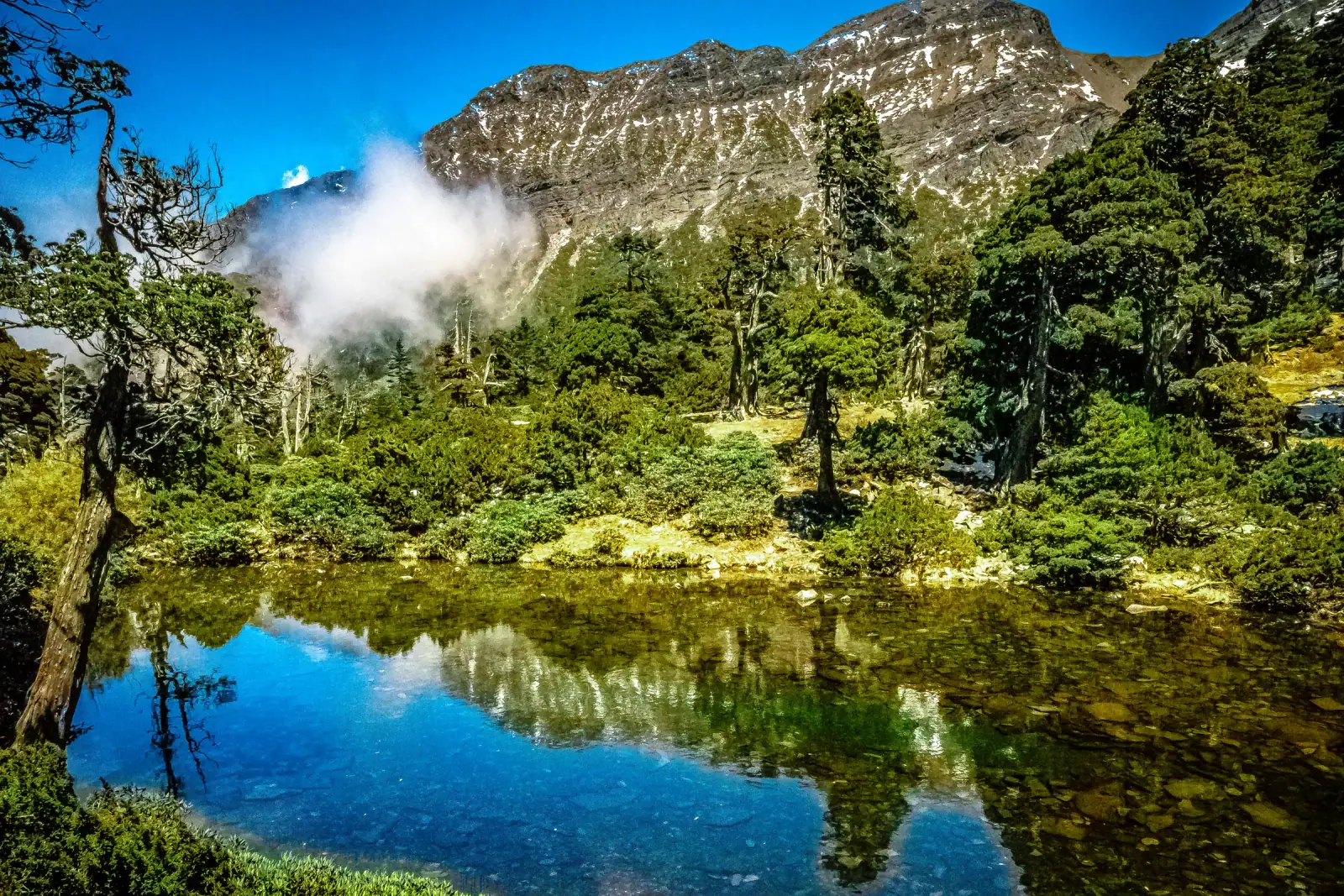
Cui Pond below Xueshan’s main peak, Taiwan’s highest alpine lake, surrounded by Taiwan junipers. Cicada’s 2025 _Gazing the Shades of White followed glaciers around more than half the planet, and finally returned here, one of Taiwan’s few glacial relic sites. Photo: Blackjack633 / Wikimedia Commons, CC BY-SA 4.0 (source link in image sources at the end)._
During dive training on Lanyu, Jesy Chiang learned one sentence:
✦ “The only thing you can control is your breathing.”1
That sentence does not appear on any Cicada album; their songs have no lyrics. But it is the best key to understanding fifteen years of the band’s work. When you sink underwater wearing a diving mask, every surface-level form of control fails: you cannot be fast, cannot be slow, cannot explain yourself. You can only be honest with yourself and keep breathing.
That realization later became the philosophical foundation of all Cicada’s musical work. They turn instruments into translators of nature, without adding narration on nature’s behalf.
📝 Curator’s note
In Mandopop, “nature” is usually handled in two ways: lyricism (turning ocean waves into longing) or advocacy (calling for environmental protection). Cicada takes a third route: sound documentary. Nature becomes the interview subject, not a background onto which feelings are projected.
The Typhoon Morakot News Report in 2009
The story’s first seed was planted in August 2009.
From August 7 to 9 that year, the moderate Typhoon Morakot struck Taiwan, causing the country’s deadliest typhoon disaster since World War II. Xiaolin Village was wiped out; mudslides struck many parts of mountainous Kaohsiung; multiple rivers changed course. News footage showed entire villages being swept away.
Jesy Chiang watched those reports and began composing.2
The timing matters. Cicada was founded in 2009, almost in step with Morakot. A band that carried the gene of “documenting disaster” from its first notes would, over the next fifteen years, make work that was not “lyrical nature” but “witnessed nature.”
The Pianist with a Master’s in Art History from TNUA
Jesy Chiang’s background differs from that of most musicians.
She holds a master’s degree in art history from Taipei National University of the Arts, specializing in art criticism, rather than coming from a traditional conservatory piano background.3 That education shaped a compositional method entirely different from that of classical musicians: she treats composition as narrative construction, not abstract form. She first completes a solo piano draft, then uses abstract images, such as “a bird flying past,” for the other members to translate into concrete instrumental techniques.3
In interviews, she has described her creative process as intuitive:
“I’m very intuitive: when I sit at the piano and the rhythm aligns with the image inside me, the motif naturally appears.”1
Describing the water-flow rhythm in the title track of 2022’s Seeking the Sources of Streams, she said:
“When you encounter a rock, it feels like, ‘Whoa?’ And then you flow past it from the side.”1
This way of speaking is very art-history-department: treating sound as visual imagery and rhythm as a narrative verb. Her other profession is publishing editor. She has done both jobs for fifteen years, editing books by day and composing by night. That dual-working life foreshadows Cicada’s long-standing production rhythm: slow, steady, and with a theme for every album.
The current Cicada has four members: Jesy Chiang (piano, composition, bandleader), Hsu Kang-kai (violin), Yang Ting-chen (nickname Peach, cello; a professional performer who attended music classes in elementary school and graduated from a music university), and Hsün Yu-Yang (nickname Hsiao Tsai, acoustic guitar).4
Across the entire fifteen years, not one song has included vocals.
Utility Poles Growing Out of the Water on the West Coast
In 2011, White Wabbit Records released Cicada’s first full-length album, Pieces, recorded on a vintage piano at Lirifeng Studio using multitrack live recording.5 The album’s style had not yet fully formed. The original version had an “indie rock flavor” and was sometimes classified by critics as post-rock; only the 2020 reissue became a purely neo-classical version.5 This detail matters: Cicada spent nearly a decade refining their own sound.
_ Coastland_ (2013) was the turning point.
Moving from personal relationships to territorial issues, Jesy Chiang chose a subject rarely visible in Taiwan’s media: the degradation of the west coast. Land subsidence, salinization from aquaculture, and sea-level rise had been accumulating for decades, with media attention appearing only briefly before disappearing again. That year, the band personally visited four specific places: Fangyuan in Changhua, Chenglong Wetlands in Kouhu, Yunlin, Mailiao, and Budai in Chiayi, moving south along the coastal land-sea boundary.6 Looking back on that field research, Chiang left one precise impression:
“The west coast has a gray tone. Utility poles grow out of the water. It’s hard to feel pure happiness.”6
“Utility poles growing out of the water” is a concrete, visual object: after land subsidence and sea-level rise, poles that were once on land now appear to be thrusting up from the sea. The disappearance of land on Taiwan’s west coast, aquaculture-induced subsidence, and farmland salinization are processes concrete enough to photograph, not abstract environmental issues.
Cicada documented this scene through instrumental music. There are no lyrics saying “our land is disappearing,” no slogan shouting “protect the coast,” only piano, violin, cello, and acoustic guitar simulating the soundscape of sea wind, tides, salt, and ruins.
Cicada’s official channel, “into the Ocean,” from 2013’s _Coastland, the band’s most-viewed work. The strings write the process by which degraded west-coast land eventually flows back into the sea._
From the West Coast to the East Coast
Coastland followed the west coast. Two years later, in 2015, Cicada turned the camera across the Central Mountain Range to the other side of the country: Light Shining Through the Sea writes Taiwan’s east coast and the Pacific that surrounds eastern Taiwan.7
If the west coast’s keyword is “degradation” (land subsidence, utility poles growing out of the water), the east coast’s keyword is “openness.” Jesy Chiang uses music to simulate the sea in its many states: elusive currents, long waves held high, broken waves beside reefs, and foam repeatedly brushing the shore. It is still the sea, but the west is gray-toned disappearance, while the east is brightness shining down through the surface.
The album also planted a line easily overlooked: it was the starting point of Cicada’s relationship with the Japanese label flau, with one track selected for flau’s compilation Ocean. A Taiwanese instrumental band had already begun finding its place in Japan’s environmental-music circles in 2015. Ten years later, Gazing the Shades of White would bring that line back to the surface.7
Cicada’s official channel, “Over Coastal Range,” from 2015’s _Light Shining Through the Sea, one of the band’s most-viewed singles. The camera crosses the Coastal Mountain Range from the west coast and lands on the Pacific in eastern Taiwan._
The Dive Training on Lanyu
From Coastland to 2017’s White Forest, the band’s camera moved from land to the seabed.8 The trigger was a training program: Jesy Chiang joined the Society of Wilderness’s volunteer training, learned to dive for the first time, entered the sea off Lanyu for the first time, and personally entered a coral-reef ecosystem for the first time. Each of the focal animals in _White Forest_, including the Taiwanese white dolphin, dolphins, corals, sea turtles, urban cats, and alpine birds, corresponds to a scene she witnessed during a dive.
“The only thing you can control is your breathing” was the realization she gained during this training.1 That awareness became the structural basis of all Cicada’s music afterward: you cannot control nature; you can only respond to it with your instruments.
Pieces such as “Fly” use instruments to simulate the rhythm of dolphins swimming, the extended long tones of humpback whales, and the light and shadow of coral reefs.9 At the time, conflicts between offshore wind development and the habitat of the Taiwanese white dolphin were a major environmental issue in Taiwan. Cicada did not intervene in advocacy campaigns; they simply preserved the sound of that history.
The Sudden Rain at Jiaming Lake
In June 2018, the band hiked to Jiaming Lake.10 During that trek, they encountered a rainstorm. That rain later became “Shower,” an important piece on 2019’s Hiking in the Mist.
This process reveals Cicada’s fieldwork method: the anchor of a work is a concrete present-tense moment, not the conceptual idea of “mountain” or “forest.” After that Jiaming Lake trip in 2018, the members continued hiking to Qilai South Peak and Hehuan North Peak, with each trek becoming material for a specific song.10
Jesy Chiang herself described this shift most accurately. She has said directly that her creation is like making a documentary: once she finds the subject she wants to document, she immerses herself in it, waits for events to happen, and gathers every flash of inspiration along the way; the members’ work is to discover, beyond the core of the composition, things that have not yet been found but need to exist.11
This stands in clear contrast with Cicada’s earlier aesthetics. Early Pieces (2011) was “mountaineering impressionist,” with the members looking back at mountains through their own emotional filters; with Hiking in the Mist, they began taking a step back and letting the mountains speak for themselves. On the surface, it was a change in expression. What truly changed was the relationship between creators and subject matter: from lyrical subject to witness.
_Hiking in the Mist_ was nominated for Best Instrumental Album Producer at the 31st Golden Melody Awards.11 This marked the first formal recognition within the Golden Melody Awards system for an all-instrumental, vocal-free band outside the idol industry.
Cicada’s official channel, “Sunlit Grassland,” from 2019’s Golden Melody-nominated _Hiking in the Mist. Acoustic guitar and strings descend onto the alpine grass slopes around Jiaming Lake._
“I Want It to Feel Like a Bird Flying Toward Us”
Cicada’s scores often lack conventional performance markings. Jesy Chiang’s interpretation of a musical passage might be a single abstract sentence: “I want it to feel like a bird flying toward us.” When the members receive the score, they have to translate that feeling into something actually audible on bowed strings, adding dynamics, changing technique, and turning “a bird” into sound.11 Acoustic guitarist Hsün Yu-Yang (Hsiao Tsai) once explained how he translated one image: “Chieh wanted me to become a little insect, flying around independently in my own small world. So I started imagining that if I were a little ladybug, there would be the sound of wings, and I would walk and stop, trying to see the world from a more microscopic angle and weave cute sounds with the guitar.”12
Not everyone accepts this approach without friction. Violinist Hsu Kang-kai is the rationalist in the band, and he cannot stand having to tell a story before everything else: “I really hate always talking about fu [feeling]. Put everyone together first, then talk to me about fu. Every time, she [Jesy Chiang] insists on telling the story first. If you start from the story, it’s too slow, too abstract.”13 One person composes through imagery; another wants to assemble the notes first before talking about feeling. This tension has not been smoothed away. Instead, it is why Cicada’s sound can be both delicate and structurally firm.
After more than a decade of practice, the four instruments have each developed their own ability to simulate nature: Cicada’s guitar makes the sound of wind, the violin makes the flapping of flocks of birds, and the cello makes the sound of streamwater moving through land.11 Here, instruments become nature’s vocal cords.
For these sounds to truly feel as if they come from the same site, even the recording method has to change. Cicada could easily use the most efficient industrial standard and record each part separately, but they insist on live recording together to “ensure that every player can hear one another in the moment, which is to ensure that everything from the low-frequency deep sea to the high-frequency sea spray comes from the same instant.”13 And for a band with no drums and no rhythm section, how should tempo be held? The answer is to return the metronome’s work to human beings: the members guide one another through eye contact and nods, on the condition that they have practiced precisely with a metronome beforehand, so that the machine can be put away during performance.14
The clearest illustration of this method is a mountain. On the 2018 Jiaming Lake trip, three members brought back three entirely different kinds of material: Kang-kai remembered the afternoon rainstorm on the way back to the mountain hut; Ting-chen’s strongest impression was of lively mice in the hut at night; another member liked the mist filling the mid-elevation forest road.15 One mountain, several different pairs of ears, and finally an album assembled from them. This is how Cicada can tell stories without writing a single lyric: each thing caught on site is handed to the appropriate instrument for translation.
Tanxiwan, Cuicui Valley, the Source of the Danda River, Fairyland
Seeking the Sources of Streams (2022) is the fullest expression of Cicada’s fieldwork method.
Jesy Chiang led the members on a 15-day, 120-kilometer trekking expedition through four valleys in the Central Mountain Range: Tanxiwan → Cuicui Valley → the source of the Danda River → Fairyland.12 The expedition’s goal was unusual: they were going to the source of a river, not to a mountain summit.
This subject choice itself was a major leap in Cicada’s aesthetics. From coasts (2013), oceans (2017), and mountain forests (2019) to stream sources (2022), the places the band documents have become deeper and more hidden. Chiang returned from the expedition with one realization:
“A stream source is not a single place. It is the entire valley’s pools plus its underground water flow.”12
That understanding is precisely reflected in the musical structure. The title track of _Seeking the Sources of Streams_ runs eleven minutes and contains changing durations for water flowing around rocks, textures of forest birds, and the timbres of wind among trees. It writes the sound of an entire watershed, not a single point. The album has nine tracks ranging from one to eleven minutes, presenting different scenes from the expedition.12
The band completed the album through crowdfunding on FlyingV and released it on December 27, 2022. A music film shot on site in the mountains was released at the same time.16
📝 Curator’s note
“15 days, 120 kilometers, four valleys” is itself an MRI image of Cicada’s method: a full geographical documentary, not a casual walk.
Cicada’s official channel, “Remains of Ancient Trees,” from 2022’s _Seeking the Sources of Streams, one of the band’s most widely heard recent pieces. The acoustic guitar’s pulse is the trace of giant trees that once stood in the cypress forest._
Kei Ishikawa’s A Man
In 2022, Cicada took on the score for Japanese director Kei Ishikawa’s film A Man (Aru Otoko). It was the band’s first international commission. The opportunity came about simply: the members had seen and liked Ishikawa’s previous film Listen to the Universe, while Ishikawa wanted an Asian sound. His instruction to Cicada was only one sentence: what he wanted most was the most Cicada-like sound.17
The film tells the story of a man living inside someone else’s life. Jesy Chiang’s solution is hidden in the intervals: she deliberately separated two notes by a seventh to express the condition of being clearly someone else while still retaining something of oneself.17 The following year, this refusal to alter themselves for the film was recognized: at the 46th Japan Academy Film Prize, A Man won eight major awards including Picture of the Year, and Cicada received the Outstanding Achievement in Music award for the score.18
Film scoring was not entirely new to Cicada. As early as 2017, they had written the soundtrack for director Chen Hung-i’s feature The Last Painting. Jesy Chiang wrote sixteen pieces in one stretch, joined the project before the screenplay was finalized, and some members even appeared in the film.19 What made A Man different was that it was Cicada’s first entry into a mainstream film industry across national borders. Ishikawa’s use of them was also unusual: he barely asked Cicada to change anything for the film. The band’s entire aesthetic was placed directly into the movie. For him, Cicada’s way of turning nature into sound was itself what he wanted.
In June 2024, Cicada completed a Japan tour: Hayakawa Soko in Kumamoto (June 1-2), Musashino Civic Cultural Hall in Tokyo (June 7), Sanda in Hyogo (June 8), and finally the planetarium at Subaru Hall in Tondabayashi, Osaka (June 9).20 This tour followed A Man’s Japan Academy Film Prize wins and was the band’s third visit to Japan, confirming their established position in Japan’s post-classical scene.
What Is “Between”?
On July 19, 2024, Cicada released Coastland Revisited, the band’s fifteenth-anniversary self-selected compilation.21
It is not an entirely new album. It is a reinterpretation of pieces from earlier albums including Coastland (2013, west coast), Light Shining Through the Sea, and White Forest (2017, ocean). Why choose this act for the fifteenth anniversary? Jesy Chiang’s explanation gives the answer:
“After focusing on stream sources, I began to pay attention to ‘between’: between mountain and mountain, between mountain and water, between forest and land.”21
This “between” is the final stage of Cicada’s fifteen-year method. They have already documented concrete places: coasts, oceans, mountains, and stream sources. Now they want to document the gaps between places: sites without names, the process that connects one place to another.
Reinterpreting coastal pieces written eleven years earlier is the concrete practice of this “between” concept. What lies between the band that had just begun fieldwork in 2013 and the band carrying fifteen years of method in 2024? This album is the answer.
Gazing the Shades of White: Leaving Taiwan for the First Time
For fifteen years, the places Cicada documented were all in Taiwan. In October 2025, that changed for the first time.
Gazing the Shades of White is the band’s first album to take its fieldwork beyond national borders, released by the Japanese label flau, the same label connected to Light Shining Through the Sea ten years earlier.22 In autumn 2024, Jesy Chiang personally flew to Iceland and Greenland to visit sites of glacial melt.23 She put it directly: “Over the past 10 years, we have continued composing for Taiwan’s mountains and seas. This time, we wanted to expand our view outward and connect to other island countries that seem distant.”23
The journey followed ice: Greenland’s Ilulissat Icefjord, where massive ice bodies float on the sea; Iceland’s highlands, where glaciers meet traces of volcanic lava, and broken ice quietly melts into time. But Chiang did not only want to record grandeur. She said the real “motivation that brought me here was that all of these places are undergoing dramatic change,” and that she wanted to use music to “strengthen the desire to protect.”23
How does climate change enter a song without lyrics? In the title track, “Gazing the Shades of White,” Chiang uses a single note, “B,” to refer to floating ice, then uses violin arpeggios to chase the speed of climate change, moving from slow to urgent and pressing toward the irreversible tipping point.23 You hear no sentence saying “the glaciers are melting,” but that acceleration and irreversibility are written entirely into the strings.
Then the camera turns back to Taiwan.
At the album’s end, Chiang brings this cross-hemispheric glacier journey back to Xueshan. The scree slopes of Xueshan’s cirque and the Taiwan junipers beside Cui Pond are among the few recognized glacial relics in Taiwan’s high mountains, dating from the Last Glacial Period more than 20,000 years ago.24 The album’s “Junipers by the Glacier Lake” is written about this place. A subject that sounds least “Taiwanese,” glaciers in the polar regions and New Zealand, ultimately lands on Taiwan’s own mountains.
They traveled so far, yet the point of arrival remains Taiwan. What Cicada has written for sixteen years has never been “Taiwan” as an abstract theme, but places personally walked as the ground of composition. When that ground expands to the disappearing ice of the entire planet, returning home makes it possible to see the glacial relic on Xueshan that most Taiwanese people have never heard of.
Cicada’s official channel, official MV for the title track “Gazing the Shades of White,” 2025. The images show glaciers and snowlines in Greenland, Iceland, New Zealand, and Taiwan’s Xueshan.
The Witnessing Philosophy of Cicada
To understand why Cicada is distinctive, one has to begin with the philosophical basis of their entire method.
Most musical works that handle “nature” or “environment” use one of two approaches: lyricism (turning ocean waves into longing) or advocacy (using lyrics to call for environmental protection). Cicada takes a third path: sound documentation. The members describe their role within natural contexts as resembling elements: wind, whales, trees, flowing water.1 The instruments’ job is to serve as nature’s vocal cords.
This philosophy has concrete musical correspondences: changes in duration correspond to the rhythm of water flowing around rocks and the arcs of bird flight; textural density corresponds to different ecosystems, with the deep sea sparse, the forest dense, and rivers rhythmic. The recording arrangement for every album matches this rule.
Those Places Are Still There
Across sixteen years and roughly ten albums, Cicada has left behind a rare practice in Sinophone independent music: an all-instrumental, vocal-free band that refuses the idol route and uses places they have personally walked as the foundation of musical creation. From utility poles growing out of the water on the west coast, to breathing beneath Lanyu’s coral reefs, to that sudden rain at Jiaming Lake, to the cypress forest at the source of the Danda River, and finally to ancient glacial relics atop Xueshan, they have used instrumental music to write concrete geography into a sound archive that can be heard again and again.
This archive will outlive advocacy-style environmental songs. It does not depend on topical issues or collective emotion, only on a simple fact: those places are still there, waiting to be walked again, documented again.
Only by Gazing the Shades of White has that fact begun to crack. Taiwan’s coasts are still eroding, corals are still bleaching, mountain forests are still under pressure; and the glaciers of Greenland and Iceland are disappearing from the map at even greater speed. Some places may not wait for the next visit. When Cicada records them, what is being recorded is already a present tense in the act of disappearing.
The name Cicada was the declaration of this work all along: do not look for us with your eyes; use your ears.
Works Chronology: Sixteen Years of Sound Archives
From 2011 to 2025, Cicada’s official albums and film scores. Representative tracks on the official channel are in parentheses; click through to listen directly.
- 2011 Pieces (White Wabbit Records; 2020 neo-classical reissue) — Pieces, Farewell, Lake's End
- 2013 Coastland (west-coast degradation) — into the Ocean, Blooms in Dark, Flapping Wings
- 2015 Light Shining Through the Sea (east coast and Pacific) — Over Coastal Range, Ocean Foam, Rolling Waves
- 2017 The Last Painting (Taiwanese film score) — The Last Painting Main Theme, The Black Eyes
- 2017 White Forest (marine ecology) — Fly, Whale Family, Dolphins Leap
After 2019, the places moved from mountain forests and stream sources all the way to glaciers in the Northern and Southern Hemispheres:
- 2019 Hiking in the Mist (nominated at the 31st Golden Melody Awards) — Hiking in the Mist, Sunlit Grassland
- 2022 Seeking the Sources of Streams (15-day, 120-kilometer Central Mountain Range expedition) — Seeking the Sources of Streams title track, Remains of Ancient Trees
- 2022 A Man / Aru Otoko (directed by Kei Ishikawa; Japanese film score)
- 2024 Coastland Revisited (fifteenth-anniversary self-selected compilation) — Coastland Revisited fifteenth-anniversary compilation preview, Fifteenth-anniversary concert, Cloud Gate Theater Live
- 2025 Gazing the Shades of White (glaciers in the Northern and Southern Hemispheres; released by flau) — Gazing the Shades of White, Embraced by Aoraki, Journey of Drifting Ice
Full albums, MVs, and performance records are available on Cicada’s official YouTube channel.25
Further reading:
- Waa Wei — Part of the same 2010s independent music ecosystem, but following a vocal rather than instrumental path
- No Party for Cao Dong — A comparison case from the same era, but following the path of an outward-facing, angry band
- Constant & Change — Also on the post-rock spectrum, but following a vocal narrative path
- Crowd Lu — Another path through independent music
- Popular Music and the Golden Melody Awards — The institutional context of Cicada’s Golden Melody nomination for Best Instrumental Album
- Taiwan Independent Music — The independent-music spectrum after the 2010s
- Taiwan’s Forest Ecosystems — The landscapes behind Cicada’s Hiking in the Mist and Seeking the Sources of Streams
- Taiwan’s Marine Ecology — The ecological background of the band’s 2017 ocean-themed album
- Taiwan’s Mountains and Mountaineering Culture — The context of Jesy Chiang’s mountaineering philosophy
Image Sources
This article uses one CC BY-SA 4.0 licensed image, cached under public/article-images/people/ to avoid hotlinking the source server:
- 翠池 汪大智 05 — Photo: Blackjack633, CC BY-SA 4.0 (hero, Cui Pond on Xueshan)
All videos embedded in the article are official MVs uploaded by Cicada’s official YouTube channel @Cicadatw, embedded via iframe; copyright belongs to the band and record labels, and use follows YouTube’s standard embed terms.
References
- Jesy Chiang’s creative method and diving realization - IN IN TO MUSIC — Jesy Chiang describes her creative method: “I’m very intuitive: when I sit at the piano and the rhythm aligns with the image inside me”; describes the water-flow rhythm in Seeking: “When you encounter a rock, it feels like, ‘Whoa?’ And then you flow past it from the side”; Lanyu diving realization: “The only thing you can control is your breathing” and “You have to be honest with yourself.”↩2345
- Cicada’s founding and the 2009 Typhoon Morakot trigger - Filmaholic interview — In 2009, Jesy Chiang began composing after watching news about Typhoon Morakot; Cicada was founded in 2009 almost in step with Morakot; the gene of “documenting disaster” shaped the style of the next fifteen years of work.↩
- Jesy Chiang’s TNUA art-history master’s background - Amouter ghost — Jesy Chiang holds an M.A. in Art History from Taipei National University of the Arts, specializing in art criticism, rather than coming from a traditional piano conservatory background; she treats composition as narrative construction rather than abstract form; dual profession: publishing editor + Cicada pianist.↩2
- Cicada’s current four-member lineup - White Wabbit Records official page — Current four members: Jesy Chiang (piano, composition, leadership), Hsu Kang-kai (violin), Yang Ting-chen (cello; elementary-school music class + music-university graduate), Hsün Yu-Yang (Hsiao Tsai, acoustic guitar); stable lineup since 2022.↩
- Pieces 2011 debut and 2020 reissue - VERSE, White Wabbit tenth anniversary — 2011 first full-length Pieces released by White Wabbit; recorded on a vintage piano at Lirifeng Studio; original version had an “indie rock flavor” and was sometimes categorized as post-rock; 2020 reissue changed to a purely neo-classical version.↩2
- Coastland 2013 west-coast fieldwork - HK01 — 2013 Coastland focused on west-coast erosion; visited Fangyuan in Changhua, Chenglong Wetlands in Kouhu, Yunlin, Mailiao, and Budai in Chiayi; Jesy Chiang quote: “The west coast has a gray tone. Utility poles grow out of the water. It’s hard to feel pure happiness.”↩2
- Light Shining Through the Sea - Cicada / Bandcamp — Released in 2015, themed around Taiwan’s east coast and the Pacific surrounding eastern Taiwan; official description: “using music to simulate the sea in its many states, including elusive currents, long waves held high, broken waves beside reefs, and foam repeatedly brushing the shore”; one track was selected for Japanese label flau’s compilation Ocean, the starting point of Cicada’s collaboration with flau. Representative track “Over Coastal Range” has more than 230,000 views on the official channel.↩2
- White Forest 2017 ocean theme - VeryMulan — White Forest released on 2017-11-23; focal animals include Taiwanese white dolphin, coral, sea turtle, urban cat, and alpine bird; Jesy Chiang’s participation in Society of Wilderness training and dive trip to Lanyu formed the field basis for this ocean-themed album.↩
- White Forest “Fly” official track - Cicada YouTube — 2017 representative track “Fly” uses instruments to simulate dolphins swimming, humpback whale long tones, and coral-reef light and shadow; at the time, conflicts between offshore wind development and Taiwanese white dolphin habitat were a focus of Taiwan’s environmental issues, and Cicada did not engage in advocacy but preserved a sound record.↩
- The Jiaming Lake rainstorm writing site for “Shower” - Amouter interview — In June 2018, the band encountered a rainstorm while hiking to Jiaming Lake, which became the writing site for “Shower” on 2019’s Hiking in the Mist; later hikes to Qilai South Peak and Hehuan North Peak each became material for particular songs; the works are anchored in concrete present moments rather than concepts.↩2
- Cicada and Jesy Chiang’s creative view, “like making a documentary,” plus Hiking in the Mist nomination at the 31st Golden Melody Awards - Filmaholic — Jesy Chiang describes creation as “like making a documentary. Once I find the subject I want to discuss and document, I immerse myself in it and wait for events to happen”; the members’ work is “beyond the core of the creation, to discover things that have not yet been found but necessarily exist”; her interpretation of music may be “I want it to feel like a bird flying toward us,” then concretized by the members; the article summarizes Cicada’s “guitar making the sound of wind, violin making the flapping of flocks of birds, cello making the sound of streamwater moving through land.” 2019’s Hiking in the Mist was nominated for Best Instrumental Album Producer at the 31st Golden Melody Awards. Verbatim rechecked 2026-06-21.↩234
- Seeking the Sources of Streams 15-day, 120-kilometer expedition through four valleys in the Central Mountain Range - VERSE — In 2022, Jesy Chiang led the members on a 15-day, 120-kilometer trekking expedition through four valleys in the Central Mountain Range: Tanxiwan → Cuicui Valley → the source of the Danda River → Fairyland; Chiang’s realization: “A stream source is not a single place. It is the entire valley’s pools plus its underground water flow”; nine tracks ranging from one to eleven minutes present different scenes from the journey.↩234
- Cicada Light Shining Through the Sea interview: live recording and members - BIOS monthly — Records Cicada’s insistence on live recording together to “ensure that every player can hear one another in the moment, which is to ensure that everything from the low-frequency deep sea to the high-frequency sea spray comes from the same instant”; violinist Hsu Kang-kai said, “I really hate always talking about fu. Put everyone together first, then talk to me about fu. Every time, she insists on telling the story first. If you start from the story, it’s too slow, too abstract”; cellist Ting-chen (Peach): “Many things can be overcome by breathing slowly.” Verbatim rechecked 2026-06-21.↩2
- How Cicada keeps tempo without a rhythm section - roomie / every little d — Cicada has no drums and no rhythm section, “taking control of tempo back from the metronome”; during performance, members use eye contact and nods to guide one another and achieve real interaction and human texture among the four instruments, but only after practicing precisely with a metronome beforehand. Checked 2026-06-21.↩
- Cicada Hiking in the Mist interview - Blow Music — The rainstorm encountered during the 2018 Jiaming Lake hike became the writing site for “Shower”; on the same mountain trip, three members brought back different materials: Kang-kai remembered the afternoon rainstorm on the way back to the mountain hut, Ting-chen remembered the lively mice in the hut at night, and then-guitarist Hsieh Wei remembered mist filling the mid-elevation forest road; Jesy Chiang discussed how transformation requires capturing “a bodily feeling.” Verbatim rechecked 2026-06-21.↩
- Seeking the Sources of Streams FlyingV crowdfunding + music film - Cicada Bandcamp — Released 2022-12-27, completed through FlyingV crowdfunding; an eponymous music film shot on site in the mountains was released at the same time; the full realization of Cicada’s documentary-style aesthetics.↩
- Official Cicada interview for the film A Man - Shochiku — Kei Ishikawa chose Cicada to score A Man (Aru Otoko), the band’s first international commission; the opportunity came because the members had seen Ishikawa’s previous Listen to the Universe; the director’s instruction: “一番欲しいのは、Cicadaらしい音” (what I want most is Cicada-like sound); because of the film’s theme of “living someone else’s life,” Jesy Chiang deliberately separated two notes by a seventh (original: “7度ずらして”) to express “他人なんだけどまだ自分が残っている” (clearly someone else, yet still retaining oneself). Verbatim rechecked 2026-06-21.↩2
- 46th Japan Academy Film Prize results - Japan Academy Film Prize official — 46th edition (2023): A Man (Aru Otoko) won multiple top awards including Picture of the Year; Cicada’s A Man score was listed alongside Yoshihiro Ike, Masaru Takami, and FUKUSHIGE MARI for “Outstanding Achievement in Music” (the nomination-level award, four recipients listed); the “Best Music” prize that year went to RADWIMPS / Kazuma Jinnouchi for Suzume. That is: the film won Picture of the Year, and Cicada’s score received Outstanding Achievement in Music, not Best Music.↩
- Cicada The Last Painting film-score interview - Blow Music — The soundtrack for director Chen Hung-i’s 2017 feature film The Last Painting (a murder-suspense social-realist film released 2017-09-22) was composed by Cicada; Jesy Chiang wrote sixteen pieces, all performed by the members, joined before the screenplay was finalized, and some members appeared in the film; the OST was released by A Good Day Records. This was Cicada’s film-score work before taking on Kei Ishikawa’s A Man internationally; official track “The Last Painting Main Theme” and others are on the official channel.↩
- FLAU Cicada Japan Tour 2024 - flau official — June 2024 Japan tour, following A Man’s Japan Academy Film Prize recognition (flau notes this was the band’s third visit to Japan): June 1-2 Hayakawa Soko, Kumamoto; June 7 Musashino Civic Cultural Hall, Tokyo; June 8 Sanda Satonone Hall, Hyogo; June 9 Subaru Hall planetarium, Tondabayashi, Osaka. Songkick also lists this June itinerary plus a July 27 Taipei show. The original 2026-04 text incorrectly stated October-November; corrected on 2026-06-21 according to flau’s official page.↩
- Coastland Revisited 2024 fifteenth-anniversary self-selected compilation and the concept of “between” - Cicada official — 2024-07-19 Coastland Revisited, fifteenth-anniversary self-selected compilation (not a wholly new album), reinterpreting tracks from Coastland, Light Shining Through the Sea, and White Forest; Jesy Chiang’s concept: “After focusing on stream sources, I began to pay attention to ‘between’: between mountain and mountain, between mountain and water, between forest and land.”↩2
- Gazing the Shades of White - Cicada / flau — Released 2025-10-30 by Japanese label flau (FLAU111), eight tracks total. Official description: “following ice, crossing the Northern and Southern Hemispheres,” with the journey passing Greenland’s Ilulissat Icefjord, the Icelandic highlands, and New Zealand’s Aoraki, finally returning to Taiwan’s Xueshan to seek traces left by ancient glaciers; tracks include “Embraced by Aoraki” and “Junipers by the Glacier Lake.” Official album preview and title-track MV were both verified as official-channel uploads on 2026-06-21.↩
- Cicada creative statement for Gazing the Shades of White - CNA information platform — In autumn 2024, Jesy Chiang personally visited Iceland and Greenland to witness glacial melt; statement: “Over the past 10 years, we have continued composing for Taiwan’s mountains and seas. This time, we wanted to expand our view outward and connect to other island countries that seem distant”; “the motivation that brought me here was that all of these places are undergoing dramatic change”; “strengthen the desire to protect”; the title track uses the note “B” to refer to floating ice, and violin arpeggios to symbolize the speed of climate change moving from slow to urgent, approaching an irreversible tipping point. Verbatim rechecked 2026-06-21.↩234
- Xueshan cirques and Taiwan’s glacial landforms - National Museum of Natural Science — Xueshan Cirque No. 1 is “the representative of Taiwan’s largest and most complete glacial landform” (citing Lin Chao-chi, 1957); during the Last Glacial Period (about 27,000 to 18,000 years ago), Taiwan’s high mountains developed mountain glaciers and glacial landforms; Cui Pond is a cirque lake, and the surrounding area is Taiwan’s largest pure stand of Taiwan juniper. Taiwan’s high-mountain glacial relics were long debated in scholarship, and were confirmed after Wang Hsin and others conducted detailed investigations of glacial erosion evidence in 1998.↩
- Cicada official YouTube channel @Cicadatw — Cicada’s official YouTube channel (channelId UCLDw8SU0rik3vQyW2K-m8_w), with complete albums, MVs, performance records, and behind-the-scenes footage. All embedded iframe videos and works-chronology links in this article are from this official channel and were individually verified as official uploads on 2026-06-21.↩