

30-Second Overview: In May 2001, four students took the stage at the National Chengchi University Golden Melody Awards and won the Best Popularity Award for the Band Category with the song "Peek." The band was called "Sodagreen." Twenty-two years later at the Taipei Arena, lead singer Wu Qing-feng took a deep breath and shouted, "We are 'Sodagreen'!"—a declaration that the four-year legal battle was finally over.1 In between, there was the Vivaldi Project's fourth installment, taking them through London, Beijing, Berlin, and Taitung; five Golden Melody Awards swept in one go at the 27th Golden Melody Awards for Winter Unfinished.2 There was the final encore of 20,000 people singing together at Liberty Square in 2017.3 And there was the series of "Fish Ding Si" alter egos, trademark lawsuits, criminal indictments, and Lin Weizhe's five consecutive losses.4 This is the story of this band's twenty-year journey from student club to courtroom, and from the courtroom back to the Taipei Arena.
In May 2001, at the National Chengchi University Gymnasium. On the stage of the 18th National Chengchi University Golden Melody Awards finals, four students stood together. Lead singer Wu Qing-feng, a freshman in the Department of Chinese Literature. Bassist Hsieh Hsin-yi, from the Department of Business Administration. Drummer Shi Chun-wei, from the Department of Sociology; the guitarist "Xin Ge" was Wu Qing-feng's high school friend.5 Their name was "Sodagreen." That day, they won the Best Popularity Award for the Band Category with the song "Peek."5
No one could have predicted that twenty-two years later, when the lead singer shouted "We are 'Sodagreen'!" on the Taipei Arena stage, he would be declaring the end of a four-year legal battle.1
This is the twenty-year arc of a band moving from a student club to a courtroom, and from the courtroom back to the Taipei Arena.
"Peek": The First Place Band at the NCCU Golden Melody Awards
The 18th National Chengchi University Golden Melody Awards took place in 2001. The venue was the NCCU Gymnasium, organized by the NCCU Curriculum and Examination Committee and student club unions.6 The Golden Melody Awards holds a specific place in the history of Taiwan's campus singing competitions: it is listed alongside the National Taiwan Normal University Cup and the Fu Jen Star as one of Taiwan's three major campus music awards. Running from 1984 to 2026, it has now reached its fortieth edition. In its early years, it carried the lingering warmth of the folk song movement; around the year 2000, it transformed into an incubator for indie bands: Chen Qi-zhen, Nuomi Tuan, Natural Vanilla, and Sodagreen were all discovered by the music industry from this competition stage.6
These four students, forming a band for the first time, needed one original song to enter the competition. Wu Qing-feng presented "Peek," a song he had written when he was in his senior year of high school. The song's origin predates the competition itself: in 1999, at the "Tianyun Awards" composition category held within the high school of National Taiwan Normal University Affiliated High School, Wu Qing-feng won first place with "Peek."7 He was seventeen years old at the time.
On the day of the Golden Melody Awards finals, they performed "Peek." They took home the Best Popularity Award for the Band Category.57
The word "Soda" in Sodagreen was proposed by drummer Shi Chun-wei: representing the fresh feeling of refreshing bubbles.8 The word "Green" was Wu Qing-feng's favorite color. The band name was thus assembled, without any profound allusion. In later interviews, they frankly admitted that it was simply catchy and easy to remember.8
💡 Did You Know? Compared to many band names deliberately designed with concepts, the three characters of "Sodagreen" were a superposition of two members' preferences—one proposed the taste, the other the color. The band name had no deep meaning, which ironically made it a container onto which various interpretations could later be attached. Twenty years later, when this name entered the trademark court, no one argued about what the three characters "originally meant"—the argument was about "who registered it first."
From May 2001 to March 2003, for nearly two years, Sodagreen was unstable. In between, the band went through three guitarists: Yan Ting, Xiao Wei, and Hong Ru.5 A student band with changing members was nothing unusual in the campus music scene: members studying, interning, completing military service, and the rhythm of life across schools pulled at whether a band could continue.
Wu Qing-feng's own educational trajectory: after graduating from National Taiwan Normal University Affiliated High School, he entered the Department of Chinese Literature at National Chengchi University via recommendation in 2000.9 The NCCU Memory Network: a university history wiki constructed by the National Chengchi University Library, has preserved this record of his recommendation admission. During his time at the university, he did not stay only in the Chinese Literature Department; he touched the radio station, choir, and record design. Sodagreen's early image was different from the context of "NCCU campus folk songs"; it was closer to the surge of indie bands in Taiwanese university campuses from the late 1990s to the early 2000s: labels might not have existed, studios might not have existed, but every campus had a band category, and every band category was groping its way on campus competition stages.
Hsieh Hsin-yi was among the first friends Wu Qing-feng met at NCCU. She studied Business Administration and was a junior/senior to Shi Chun-wei on the NCCU swim team: this was an era of layered campus community connections, where the path to forming a band usually involved the same group of people connecting from one club activity to another before coming together, a path completely different from the professional route of "the music industry having a need and then finding people."5
In March 2003, a significant marker in Sodagreen's history. That month, three new members joined in succession: He Jing-yang (NCCU Institute of Public Administration, acoustic guitar, later became the band leader, nickname A-Fu), Liu Jia-kai (NCCU Department of Psychology, electric guitar), and Gong Yu-qi (Master's program in Musicology at National Taiwan University of Arts, piano and viola, nickname A-Gong)510. The original four plus these three established Sodagreen's six-member lineup.
But there is a minor historical discrepancy here. The Chinese Wikipedia records He Jing-yang's joining date as March 2003, but He Jing-yang himself said in a later Yahoo interview that he joined on "the day of his birthday in 2004 when Qing-feng sent him a message."10 The two versions differ by a year, and no authoritative statement has yet unified this discrepancy. Such a large difference in memory regarding a member's joining date may reflect one thing: at that time, "Sodagreen" was a fluid name rather than a fixed lineup; the boundary between who was a formal member and who was just there to help with a performance was blurred.
📝 Curator's Note: The six members were scattered across the Chinese Literature Department, Business Administration, Sociology, Public Administration Institute, Psychology Department, and the Master's program in Musicology at NTUA—five departments, two universities. This diverse combination of disciplines would be magnified in the later Vivaldi Project: a band daring to cross from folk to rock, to Chinese traditional music, to grand classical, may well be related to the fact that the six people composing it included someone studying sociology, someone musicology, someone public administration, and someone psychology. The word "band" is often imagined as "a group of music department students," but Sodagreen was an exception from the start.
Chinese Literature, Business Administration, Sociology, NTUA Musicology
Laying out the disciplinary backgrounds of the six members reveals an interesting picture:
Wu Qing-feng (Lead Singer, Lyricist/Composer), born August 30, 1982, from Kaohsiung, graduated from National Taiwan Normal University Affiliated High School, NCCU Department of Chinese Literature, studied at the University of Birmingham in the UK for one year starting in 2004. From the Tianyun Awards high school championship with "Peek," the density of his lyric and composition writing far exceeds that of typical rock band lead singers.9
Hsieh Hsin-yi (Bass), born April 16, 1982, NCCU Department of Business Administration, one of the four founding members of Sodagreen, later positioned in many interviews as "the band's housekeeper"—managing administration, time, and communication.
Shi Chun-wei (Drums), born August 26, 1979, NCCU Department of Sociology. Yamaha lists him in their Taiwanese artist page; he is one of the few Taiwanese band drummers with an endorsement relationship with an international equipment brand.11 The word "Soda" was proposed by him.
He Jing-yang (Acoustic Guitar, Band Leader), born April 4, 1982, NCCU Institute of Public Administration. He later assumed the role of band leader.
Liu Jia-kai (Electric Guitar), born February 5, 1982, NCCU Department of Psychology.
Gong Yu-qi (Piano, Viola), born December 16, 1980, Master's program in Musicology at National Taiwan University of Arts: the only member in Sodagreen with formal music education credentials. It was he who, during the Vivaldi Project's Winter Unfinished, closed himself off for three months and completed a symphony score for 70 people alone.12
Lining up the six disciplines: Chinese Literature, Business Administration, Sociology, Public Administration, Psychology, Musicology. Three departments in management and policy, two in humanities and social sciences, one in music. This combination is not "typical" when viewed in any indie band.
The story of the band's formation is underestimated at this level. The common writing framework for Taiwanese indie bands is "a group of students who love music came together"—but the starting point for Sodagreen was being in the same time frame at the NCCU campus, knowing each other, and someone proposing to register for a campus competition. Campus competition was the first motivation; the works were a matter that came later.
This difference in order seems small, but it affects the entire story that follows. A band starting from a campus competition and a band starting from a recording demo have different dependencies on the music industry. The former is accustomed to the loop of "going on stage, being heard"; the latter is accustomed to the loop of "entering the recording studio, collaborating with producers." When Sodagreen was later taken by Lin Weizhe into the mainstream, they had already practiced the action of "going on stage, being heard" for two or three years: it was an instinct not found in demos.
"It's This Group": The Heatwave Rock Stage at the Keelung Sea Festival
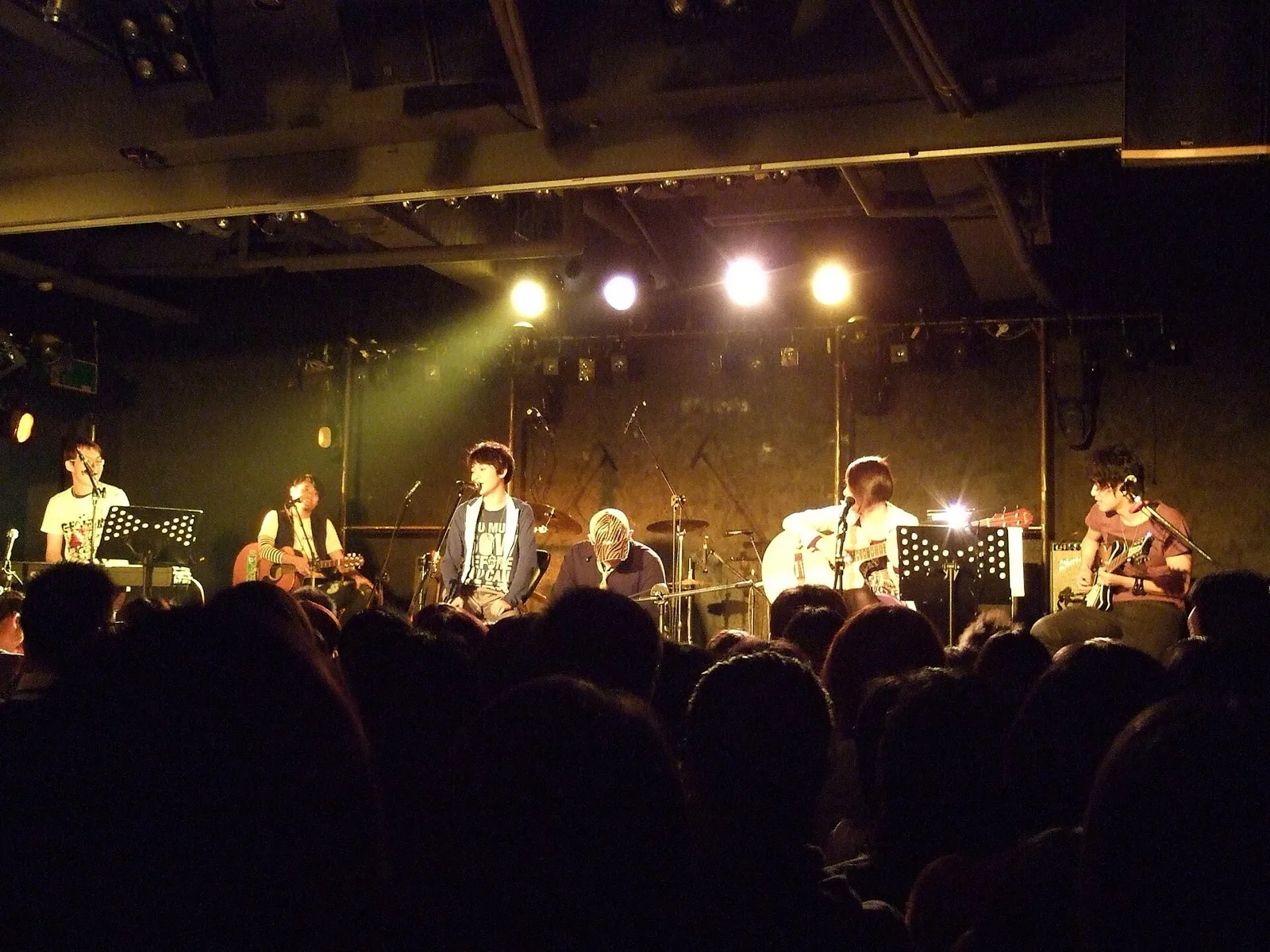
On March 12, 2008, Sodagreen performed live at The Wall in Gongguan, Taipei. Photo: Wikipedia user Solomon203, CC BY-SA 3.0. Wikimedia Commons.
In July 2003, at Fulong Beach in Keelung District, New Taipei City. The 4th Ocean Music Festival.
Sodagreen was then still a student band without an album. They registered for the "Heatwave Rock" stage at the Sea Festival: this stage was not at the same level as the main stage of the Sea Festival; Heatwave Rock was a small stage intended for campus and indie bands.5 At that Sea Festival, they were one of the stops on the farewell tour of the disbanded band "Yin Xia Tian." Before that, they had played Ximending, Tainan Utopia, Kaohsiung ATT Secret Base, Taichung Old Nuo, and the Taipei University Expo.5 A standard tour of a student band playing small venues across Taiwan, with nothing particularly special about it.
But there was one person in the audience that day: Lin Weizhe.
Lin Weizhe was already a senior producer in the Taiwan music scene. In his early years, he was the lead singer of the band Baboo; in the 1990s, he moved behind the scenes, producing for Chen Shan-ni, Yang Nai-wen, Chen Qi-zhen, and Sodagreen.13 Standing beneath the small Heatwave Rock stage at the Keelung Sea Festival, he heard Wu Qing-feng's voice.
Later, in an interview with Business Today, he described his judgment at the moment with a single sentence:
"It's this group."13
This moment has been repeatedly cited, but the details surrounding it are often simplified. A more accurate context is this: at the time, people in the music scene who had heard Wu Qing-feng's demos had polarized reactions to that voice. Some thought it was "neither male nor female," while others found it unique. Lin Weizhe later rewrote this controversy into a warmer term: "fluctuating between male and female"—written into the Sodagreen album copy.14 The character "fluctuating" is several degrees gentler than "neither."
Lin Weizhe did not accept that voice completely the first time. In later interviews, he recalled that when he first heard Wu Qing-feng's voice, he actually felt a bit of repulsion in his heart, but his body was more honest than his mind: his body finished listening to the song, and only then did he realize he had been sucked in. This quote has undergone several turns in online searches; the complete version can only be found in secondary retellings. Therefore, this article treats it as background context rather than a direct quote.
Lin Weizhe decided to sign Sodagreen, bringing them under his independent label "Lin Weizhe Music Society." The significance of this decision was not conspicuous at the time, but it would determine the relationship between Sodagreen and the mainstream market for the next decade or so: and twenty years later, this decision would return to叩问 (question/knock on) everyone in another form.
On May 30, 2004, Sodagreen officially released their music for the first time at the "School Rock" concert held at NCCU.15 Sharing the stage were Chen Shan-ni and Chen Qi-zhen: these two were the representatives of Taiwan's indie female voices at the time. Sharing the stage with them was equivalent to being formally introduced into this circle. They released a single with two tracks, published by Lin Weizhe Music Society, the first official commercial CD since Sodagreen's formation. Lin Weizhe Music Society later named May 30 "Sodagreen Day"—this date continued until the 2022 post on FB where Lin Weizhe abandoned the trademark, and he also chose May 30.16
On September 3, 2005, Sodagreen released their self-titled debut album Sodagreen. Produced by Lin Weizhe Music Society, with Lin Weizhe as producer, 11 songs, 53 minutes and 40 seconds.17 The pre-order gift was a Sodagreen Zine sodazine 1: an early unique tradition of Sodagreen, where every album came with a small zine compiled by the members, containing lyrics, writing backgrounds, photos, and casual notes. This zine series later became part of fans' collections.
The debut album was nominated for Best Band at the 17th Golden Melody Awards. They did not win, but they were noticed by the Golden Melody system.
📝 Curator's Note: The existence of the independent label "Lin Weizhe Music Society" was significant in Taiwan's indie music industry at the time. At that period, indie bands had a few paths to survive within the mainstream system: being signed by one of the Big Five record companies, cooperating with a mainstream agency, or figuring it out themselves. "Lin Weizhe Music Society" took a variant of the third path: a senior producer with mainstream production experience opened a small label and brought in the bands he saw potential in. This path was relatively avant-garde at the time, but it also buried a problem: when the producer is simultaneously the label owner, the contracting party, and the trademark holder, the power relationship between the artist and the producer is more intimate and more blurred than the typical "artist vs. company."
"Little Love Song" was the lead single from the 2006 album Mini Universe. Wu Qing-feng handled both lyrics and composition alone. Published by Lin Weizhe Music Society, it later became the Best Composer at the 18th Golden Melody Awards in 2007.
The Vivaldi Project Took Them to London, Beijing, Berlin
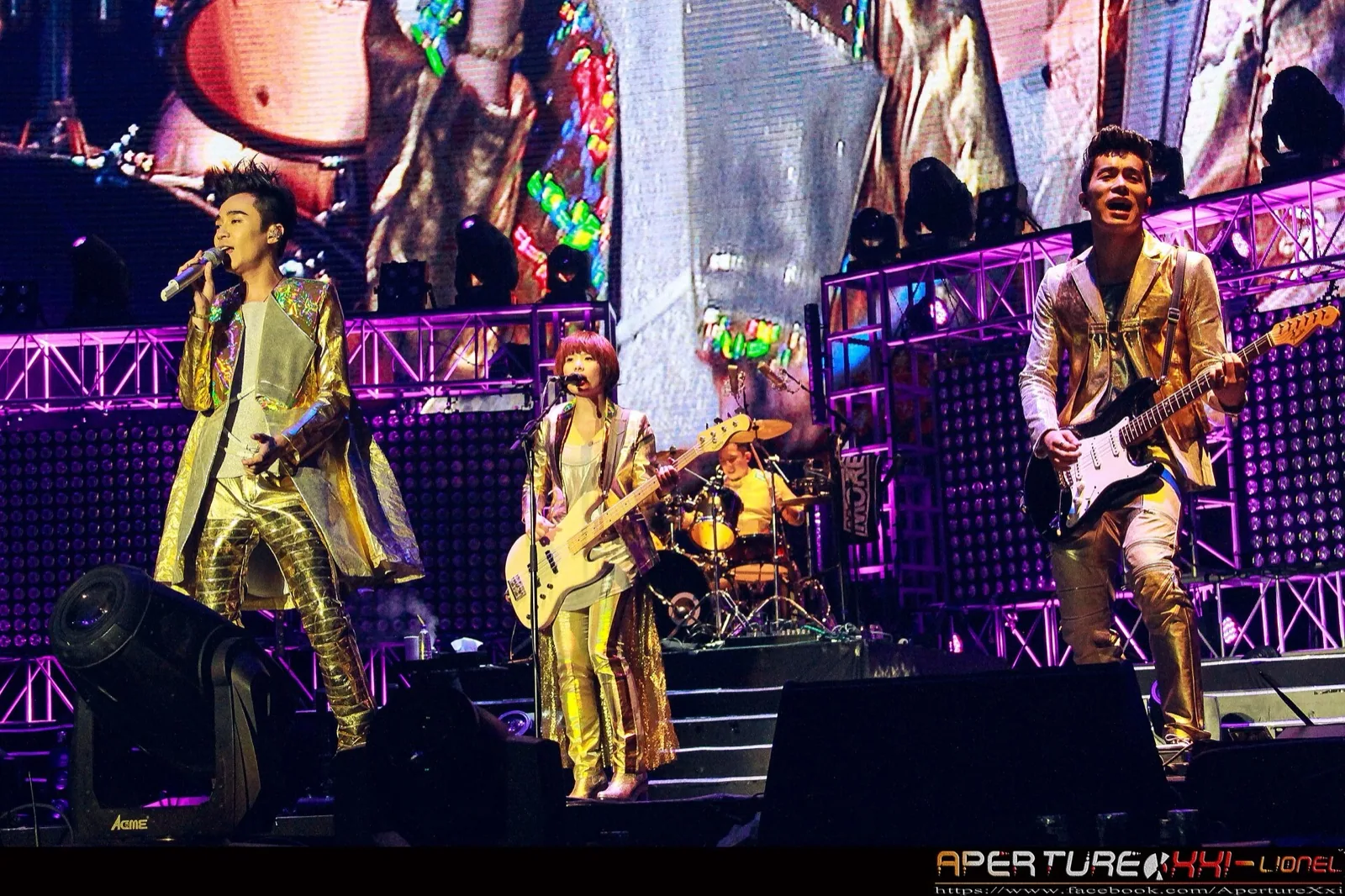
In July 2014, the live performance of the "Visual and Auditory in the Air" 10th Anniversary World Tour at the Taipei Arena for three consecutive nights. Photo: Wikipedia user Solomon203, CC BY-SA 3.0. Wikimedia Commons.
On October 20, 2006, Sodagreen released their second studio album, Mini Universe.18 The title track and "Little Love Song" were two memory points in the album. Wu Qing-feng handled both the lyrics and composition of "Little Love Song" alone. The melody's cleanliness and the lyrics' colloquialism pushed this song onto the must-play KTV list for Taiwanese college students of that era.
At the 18th Golden Melody Awards in 2007, Sodagreen won the Best Band Award with Mini Universe, and "Little Love Song" won the Best Composer Award (Wu Qing-feng)2. From being discovered by Lin Weizhe at the 2003 Keelung Sea Festival to winning the first Best Band Golden Melody Award, less than four years had passed.
The third studio album released that same year, Unmatchable Beauty, contained a song called "Four Seasons Rhapsody." This song was later recognized as the germination of the Vivaldi Project: the lyrics and melody already carried the embryonic concept of the turning of the four seasons, but it had not yet been magnified into an album series spanning several years.19
At the 19th Golden Melody Awards in 2008, Sodagreen won the Best Band Award again with Unmatchable Beauty.2 Sweeping Best Band for two consecutive years meant they had moved from "newcomers noticed by the Golden Melody circle" to "bands confirmed by the Golden Melody circle."
The next thing was the Vivaldi Project.
The Vivaldi Project: named after the Baroque composer Antonio Vivaldi's violin concerto The Four Seasons: it was an ambition of relatively unique scale in the history of Chinese pop music. It comprised four seasons, four cities, four emotions, and four albums.20 The entire series started with the first album in 2009 and ended with the last in 2015, sandwiching two albums not belonging to the Vivaldi series, spanning a total of six and a half years.
The timeline was arranged as follows:
Spring · Sunlight: Released May 8, 2009, Sodagreen's fifth studio album, with Taitung as the theme city and "Folk Spring Light" as the musical style.21 The recording team swapped the large recording studio for the natural environment of Taitung, combining it with local musical breath. This was the first album of the Vivaldi Project, the one that anchored the entire series concept.
Summer / Fever: Released September 11, 2009, the sixth studio album, recorded at London's Miloco Studios "The Pool": a legendary recording venue acquired in the 1970s by Pink Floyd's Roger Waters, later taken over by Miloco. Sodagreen's expenditure for recording this album there was reported to be close to 10 million NTD.22 The musical style was Rock and Britpop.
Autumn: Story: Released September 18, 2013, the ninth studio album, with Beijing as the theme city and "Poetic National Style" as the musical style, using Chinese traditional instruments like the guzheng, erhu, and suona extensively in the arrangement.23 A full four years passed between Summer and Autumn: in between, Sodagreen released an album not belonging to the Vivaldi series, What Are You Worrying About? (November 11, 2011, the eighth album), while A-Fu (He Jing-yang) served in the military, and A-Gong (Gong Yu-qi) also faced military service arrangements, forcing the Autumn and Winter plans to be pushed back.5
Winter Unfinished: Released November 4, 2015, the tenth studio album, with Berlin as the theme city and "Solemn Classical" as the musical style, recording in collaboration with the German Pops Orchestra (a 60-piece symphony orchestra)24.
Four albums, four cities, four seasons, four musical styles. An indie band planning a conceptual series spanning six and a half years like this had no second control group in Taiwan's indie history.
flipermag summarized the Vivaldi Project in a 2016 review with a single sentence:
"'Spring' in Taitung belongs to warm folk; 'Summer' in London belongs to passionate rock; 'Autumn' in Beijing belongs to sorrowful poetry; 'Winter' in Berlin belongs to solemn classical."20
The production details of Winter Unfinished deserve a special pause. A-Gong: Gong Yu-qi, the only member in Sodagreen with formal music education, closed himself off for three months and completed a symphony score for 70 people alone.12 During the Berlin recording, they collaborated with the 60-piece symphony orchestra of the German Pops Orchestra. For a Taiwanese indie band to record an entire album in collaboration with an overseas professional symphony orchestra, this was a very rare scale at the time.
💡 Did You Know? The second album of the Vivaldi Project, Summer / Fever, was recorded at London's Miloco Studios, with reported expenditures close to 10 million NTD.22 An indie band daring to spend 10 million NTD to record an album in London was almost counter-intuitive in the context of Taiwan's indie music industry at the time—most indie bands had recording budgets for a single album less than one-tenth of this number. It is not an exaggeration to call the Vivaldi Project a "luxury," but this luxury had output: six and a half years later, the 27th Golden Melody Awards handed five awards to Winter Unfinished in one go.
The results of the 27th Golden Melody Awards in 2016 were the official coronation of the entire Vivaldi Project series:
- Best Mandarin Album: Winter Unfinished
- Best Band: Sodagreen
- Best Album Producer: Lin Weizhe
- Best Lyricist: Wu Qing-feng ("He Raised His Right Hand to Take Roll")
- Best Arranger: Sodagreen + Lin Weizhe ("The Painful Elegance")25
Five Golden Melody Awards for a single album is a rare case in the history of the Taiwan Golden Melody Awards. From the 18th in 2007 to the 27th in 2016, Sodagreen swept three "Best Band" awards: a band winning Best Band at the Golden Melody Awards three times meant their status in the mainstream judging system of the Chinese music world had stabilized.
Music critic Hou An wrote a review upon the release of Winter Unfinished, containing a sentence cited by many fans:
"No answer is usually the only answer in life."26
Music critic Ji Ming Shui wrote a review of the Vivaldi Project on the independent media "The Stand News." He placed the entire series in the context of the discussion of Taiwanese indie bands "moving from independence to the market," arguing that the relationship between independence and the market is not a black-and-white dichotomy, and that exquisite packaging and musical skill are not mutually exclusive.27
This sentence later became the framework for understanding the Vivaldi Project: Sodagreen did not "switch" from independence to the mainstream; they did the work of directly dismantling the opposition between the two concepts habitually set against each other: "independence" and "mainstream market success."
After the Vivaldi Project concluded, Sodagreen announced the "After Summer" farewell tour in the second half of 2016: five cities, nine performances: Beijing (Same Name + Mini Universe), Guangzhou (Unmatchable Beauty + Spring Sunlight), Hong Kong (Accompany Me Singing + Ten Years in a Moment), Shanghai (Summer Fever + What Are You Worrying About?), Wuhan (Autumn Story + Winter Unfinished)28. Each performance used two album tracks as the theme.
Sodagreen used this tour to correspond to their entire twelve-year body of work: from the 2005 self-titled album to the 2015 Winter Unfinished: leading toward the moment in 2017 that no one expected to happen.
"Unmatchable Beauty" 2007 Original MV — Included in the self-titled album, Sodagreen's third studio album. The song "Four Seasons Rhapsody" in this album was the germination point of the Vivaldi Project, and it also won Sodagreen the Best Band Award at the 19th Golden Melody Awards in 2008.
The recording period documentary of Sodagreen recording _Summer / Fever at Miloco Studios "The Pool" in London in 2009, later released by the official channel. A legendary recording venue acquired early on by Pink Floyd's Roger Waters, later taken over by Miloco. For a Taiwanese indie band to dare to fly here to record, it was almost a solitary example at the time._
The Final Encore at Liberty Square
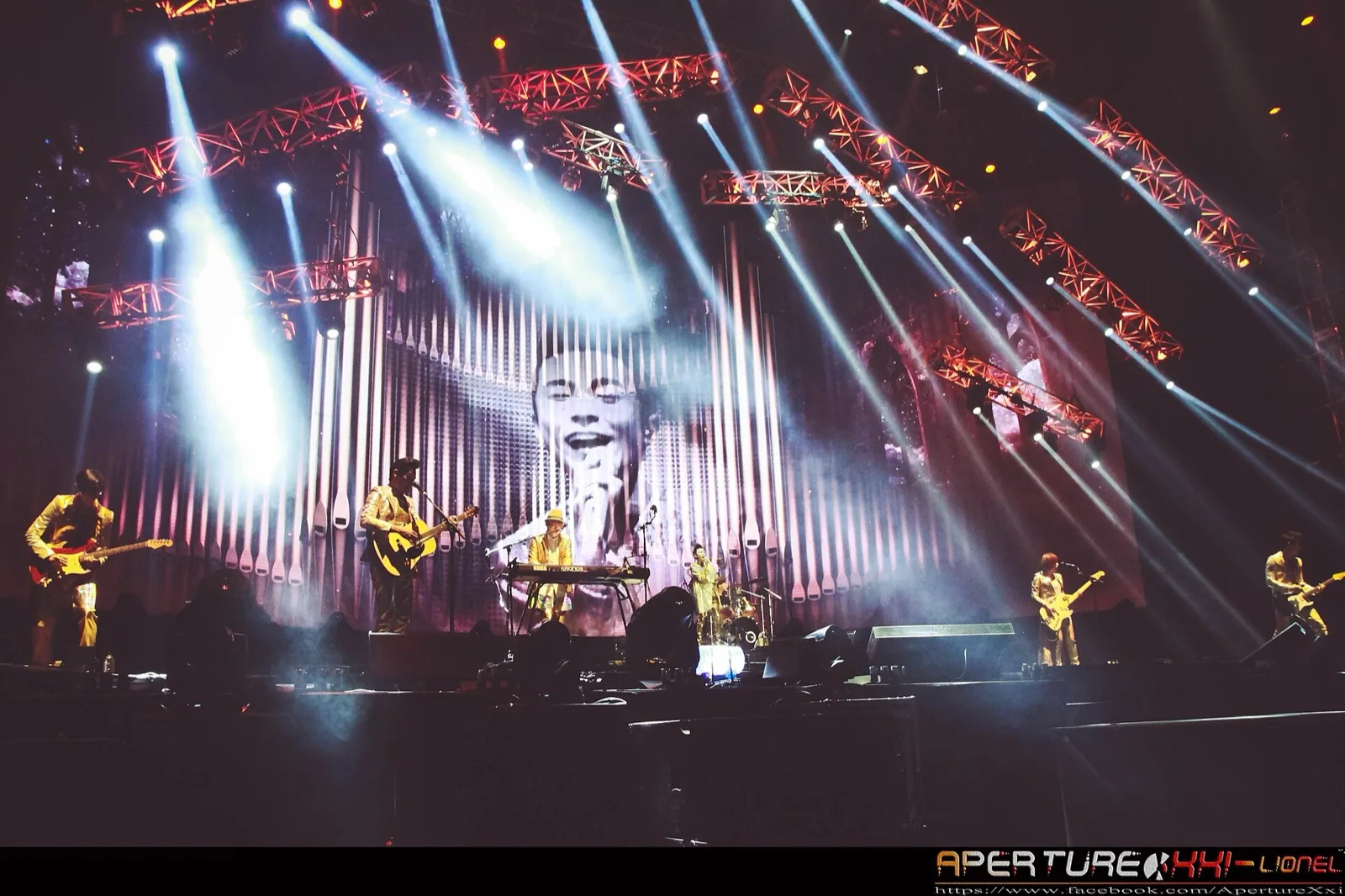
In 2014, the live performance of the "Visual and Auditory in the Air" 10th Anniversary World Tour — from the 2014 10th anniversary to the 2017 final encore at Liberty Square, Sodagreen completed their mainstream peak. Photo: Wikipedia user Solomon203, CC BY-SA 3.0. Wikimedia Commons.
On January 1, 2017, at the National Concert Hall.
That day, Sodagreen collaborated with the NSO National Symphony Orchestra for a concert called "Music Project"29. This made Sodagreen the first Taiwanese band to hold a concert on the stage of the National Concert Hall: before that, the stage of the National Concert Hall was tacitly assumed to be a venue for classical music, opera, and crossover arts; pop bands were not on this list.
After the "Music Project" ended, the story was not over. That night, Sodagreen paid out of their own pockets to build a stage at the Two Concert Halls Art Plaza (now known as Liberty Square), open to fans for song requests: they called this the "Final Encore"3. The estimated crowd outside was about 20,000 people.
Wu Qing-feng shouted to everyone on that stage:
"Hello, friends of the entire universe, we are Sodagreen."3
This sentence would return in another version at the 2023 Chi Tang Ying Ye at the Taipei Arena. But on January 1, 2017, at that moment, this sentence was a farewell.
The next day, January 2, 2017, Sodagreen officially announced a hiatus.5
Regarding the reason for the hiatus, the official version at the time was "a three-year hiatus"—this statement was announced by Lin Weizhe to the public on October 1, 2016.30 A three-year hiatus, according to plan, should have resumed in 2019.
But subsequent events disrupted all plans.
In the second half of 2019, when Sodagreen members attempted to re-release music under the name "Fish Ding Si," the legal relationship with Lin Weizhe and his companies entered judicial proceedings. In the litigation process starting from 2020, Wu Qing-feng successively stated outside court and in complaints: the hiatus was "forced by Lin Weizhe," "he wanted me to be unable to participate in Sodagreen for five years," "he wanted me to go solo after leaving the band, which I firmly refused"31. These statements are unilateral accounts of events in litigation, accusations and defenses in the legal process; this article records them as "statements during litigation" rather than historical facts.
Correspondingly, in Lin Weizhe's statement abandoning the trademark in 2022, he described the state at that time as follows:
"During the most severe period of the pandemic, I managed myself independently, staying at home, thinking quietly, recalling bits and pieces of the past."32
The versions of the two parties are different; this is the norm for events in litigation. What we can determine is: on January 2, 2017, Sodagreen announced a hiatus; on September 6, 2019, Wu Qing-feng released his first solo studio album, Space Person: this album was positioned as a collection of personal works during the hiatus, not involving leaving the band.33
The official statement on the hiatus, the unilateral statements during litigation, Lin Weizhe's retrospective: three versions point to different explanations, but they share a common time anchor: the final encore at Liberty Square on January 1, 2017, was the last step Sodagreen took with the name "Sodagreen." The next time they stood on the Taipei Arena stage with this name, it would not be until 2023.
On January 1, 2017, the live performance of Sodagreen's final encore at Liberty Square. Approximately 20,000 people. The next day, they announced a hiatus.
"The Person I Once Considered a Father"
In the two or three years after the hiatus, Sodagreen members attempted to re-release music under the name "Fish Ding Si." But the legal relationship between "Fish Ding Si" and "Sodagreen" would enter a series of judicial procedures between 2019 and 2021.
Laid out, the sequence of litigation is as follows:34
| Stage | Date | Content | Result |
|---|---|---|---|
| Civil Preliminary Injunction | From 2019 | Lin Weizhe applied twice successively | Both were rejected |
| Civil First Instance | 2020-04-16 | Intellectual Property Court 108 Min Zhu Su 134 | Rejected the plaintiff's claim |
| Criminal Indictment | 2020-02-24 | Taipei District Prosecutor's Office indicted Wu Qing-feng for violating Copyright Law (scope: Hunan TV 2019/4-9, 7-11 Kaohsiung Beer Music Festival, Macau, NTNU Affiliated High School, Keelung Sea Festival, Chengdu Chao Yin Festival) | Case No. Bei Yuan 109 Zhi Su 5 |
| Civil Second Instance | 2021-04-01 | Intellectual Property Court Second Instance | Rejected the appeal (Compensation of 5 million NTD lost entirely; First Instance 8 million NTD → Second Instance 5 million NTD) |
| Criminal First Instance | 2021-06-15 | Bei Yuan Criminal First Instance Judgment | Wu Qing-feng and Hali Kun's Huan Le Co., Ltd. were both not guilty |
| Criminal Appeal | 2021-09-01 | Lin Weizhe's side | Abandoned the appeal |
Total: Lin Weizhe suffered four consecutive losses in civil cases and one in criminal cases against Wu Qing-feng, a total of five consecutive losses.35 The figure of "Qing Feng accumulated 275 compositions" mentioned in Liberty Times reports is not the scope of infringement referenced in the complaint: 275 is Qing Feng's total number of personal compositions up to that point, separate from the scope of the litigation.36
On March 30, 2021, shortly before the宣判 (judgment) of the civil second instance, Wu Qing-feng was surrounded by media outside the court. He said the following:
"The teacher I always blindly trusted, the person I once considered a father, why did he become like this?"36
The key word in this sentence is "once considered" — the past tense combined with the verb "consider," rather than the present tense "I always considered him a father" with a subjective perspective. Many secondary media outlets retelling this sentence wrote it as "I always considered him a father," but comparing the Liberty Times reporter's live record of that day, the original words were "the person I once considered a father." This difference is not rhetorical pedantry: "once considered" carries more weight than "always considered him"; the former is a death certificate of a relationship, the latter is merely an emotional declaration.
Two months later, on May 11, 2021, Wu Qing-feng posted a 4,000-word public statement on FB. This statement was fully transcribed by multiple media outlets at the time. The statement began as follows:
"In terms of reason and emotion, I owe nothing; I am reasonable, legal, and have done everything humanly possible."37
The phrase "In terms of reason and emotion, I owe nothing" uses a double-mirror sentence from old classical Chinese, handling legal argumentation and emotional argumentation on the same level. Later, some secondary media condensed this into "I have not a shred of guilt" for headlines, but "not a shred of guilt" is not the verbatim version of the original FB post. This article adopts "In terms of reason and emotion, I owe nothing" from the FB original as the quote.
The end of this 4,000-word statement was this sentence:
"Once music loses its soul, only technique remains; and once law ignores the human heart, creating loopholes, it is merely text."37
A musician, when fighting a trademark lawsuit, lists music and law as two systems that may potentially lose their human heart. The weight of this sentence lies in that it is not an accusation against the other party, but an accusation against an entire structure that forces people to the courtroom.
⚠️ Controversial Viewpoint: In June 2025, the Intellectual Property Court first instance judged that Lin Weizhe should compensate 23.55 million NTD, and Sodagreen won the lawsuit. But the scope of Sodagreen's original claim was embezzlement of concert and copyright income of nearly 470 million NTD.38 This battle started with the application for civil preliminary injunction in 2019 and reached the IP compensation judgment in 2025, spanning more than six years—and it is not yet over. The gap between the compensation amount and the original claim amount is what remains to be completed in the litigation in the coming years.
Dismantling a Band's Name
On August 23, 2019, "Fish Ding Si Co., Ltd." registered the company with the Ministry of Economic Affairs.39 On July 3, 2020, they officially announced to the public that they would release music under the new name "Fish Ding Si" as a band; on July 31, they held the first concert under the name "Fish Ding Si"39.
The name "Fish Ding Si" is a character disassembly of Sodagreen:
- Su (蘇) = Grass radical (艹) + Fish (魚) + Grain (禾)
- Da (打) = Hand radical (扌) + Ding (丁)
- Lü (綠) = Silk radical (糸) + Lü (彔)
Taking the radicals "Fish," "Ding," and "Silk," they formed "Fish Ding Si." Written in English as Oaeen: these five letters were also picked from the old band name "Sodagreen," hiding the taken name within the letters of the new name.
This character disassembly concept actually did not appear for the first time in 2019. As early as before the release of Sodagreen's first self-titled album in 2005, they had used this name on test pressings. In 2016, when Sodagreen was on the After Summer farewell tour, they had also appeared on the small stage of the Ocean Music Festival under the alter ego name "Fish Ding Si": that was a ritualistic performance returning to the place where everything began under an "alter ego name."
The alter ego names for the six members of "Fish Ding Si" are as follows:40
| Real Name | Fish Ding Si Alter Ego |
|---|---|
| Qing Feng | Ri Chu (Sunrise) |
| Xin Yi | Xiang Wo (Fragrant Me) |
| Xiao Wei | Ba Nu (Eight Women) |
| A-Fu | Ke Tian (Can Field) |
| Jia Kai | Shi Dou (Pig Bean) |
| A-Gong | Jin Ba (Gold Eight) |
Each stage name is a重组 (recombination) or deformation of a radical from the real name: "Qing Feng → Ri Chu" uses the "Sun" character in Qing and the imagery of Feng; "Xin Yi → Xiang Wo" uses the "Fragrance" character in Xin and the symmetry of Yi; "Xiao Wei → Ba Nu" is a direct character disassembly. Fans' code name is "Duckweed," the fan club is called "Chi Tang" — the name of the 2023 Taipei Arena concert, "Chi Tang Ying Ye" (Pond Hall Shadow Night), was extended from the fan club "Chi Tang."
The existence of "Fish Ding Si" goes far beyond the level of a substitute. It is a character disassembly, an alter ego, a protest: when the three characters "Sodagreen" could not be used due to trademark ownership issues, they disassembled these three characters, picked out the radicals, and recombined them into another name, continuing to make music.
📝 Curator's Note: Placing "Fish Ding Si" in the context of Taiwan's indie and protest symbols reveals that its spirit connects with the tradition of "homophone name changes" and "character disassembly name changes" commonly used in Taiwan's social movements after the 1990s — the name itself is the carrier of protest. The difference is: social movement character disassembly often disassembles the opponent's name to make it ugly (e.g., changing an official name to a derogatory one), whereas Fish Ding Si disassembles their own original name to preserve it, a practice of "I hide my own name temporarily but you can still see it." This action is not provocative, but it is firm — a band deprived of its original name continues to say "we are still here" through character disassembly.
After the establishment of Fish Ding Si, they launched a larger project: to "remake" and re-record all works from the Sodagreen era.
The first of the remake projects was the Fish Ding Si version of Sodagreen's first self-titled album, named Different Name Album.41 Digital release on January 14, 2022; physical release on February 18, 2022. The second was the simultaneous release of Mini Universe (Fish Version).
The setting of the remake project was: each remake album recorded "double tracks" with "double budget." The original 11 songs would be expanded to 22, some old songs newly arranged, some simultaneous unreleased B-sides. The entire project was expected to re-record over 200 songs[^41]: this number was the goal Fish Ding Si publicly announced, separate from the "275 songs" of the litigation scope.
The remake of the fourth season of the Vivaldi Project was also in the plan, continuing according to schedule to 2025.
The significance of the remake project lies here: when the name "Sodagreen" had not yet returned to their hands between 2019 and 2022, they used the name "Fish Ding Si" to sing all the songs from the Sodagreen era again, arrange them again, and record them again. "Fish Ding Si" became a legal shell that allowed Sodagreen's songs to continue to be sung live, continue to be purchased, and continue to generate income: and, every time Fish Ding Si sang Sodagreen's songs, it was equivalent to cutting these songs away from their original legal ownership a little bit more.
"It's Time to Let Go" and "We Are Sodagreen"
On May 30, 2022: Sodagreen's founding day, which is the same date as the 2004 NCCU School Rock release of Visual and Auditory in the Air: Lin Weizhe posted a statement on FB, announcing the abandonment of the trademark ownership of "Sodagreen Sodagreen."
The key paragraph of the statement was as follows:3242
"This matter has come to today, and an inner voice told me 'It's time to let go.'"
"During the most severe period of the pandemic, I managed myself independently, staying at home, thinking quietly, recalling bits and pieces of the past. I knew I had to make a decision, let go of the past, whether good or bad, it was all the same. So I decided to abandon the ownership of the trademark. And bless this name with a better future."
"Law helps clarify facts, but it also destroys the feelings and trust between people."
"Life is short, I hope everyone is healthy and safe, I bless you."
The three characters "It's time to let go" were widely cited. But the complete context was "This matter has come to today, and an inner voice told me 'It's time to let go'" — a party who lost five consecutive lawsuits described the decision to abandon the trademark as the guidance of an "inner voice." This statement was fully published by CNA, Blow, Marie Claire, and other media.
The legal handling of the trademark was not as dramatic as the statement. The six "Sodagreen Sodagreen" related trademarks that Lin Weizhe abandoned: five were applied for by Lin Weizhe Music Society between 2007 and 2008, and transferred to company ownership in 2013; the other was directly applied for by the company in March 2013.43 Lin Weizhe abandoning the trademark did not mean Sodagreen members automatically obtained it: after he abandoned it, someone needed to reapply. The final result was: the Taiwan Intellectual Property Office (TIPO) announced on October 1, 2022, that the band name "Sodagreen" was obtained by "Sodagreen Co., Ltd." for a period of 10 years.44
On February 18, 2023. Taipei Arena.
The concert held by Sodagreen under the name "Fish Ding Si" was named Chi Tang Ying Ye (Pond Hall Shadow Night): "Chi Tang" is the code name for the fan club, "Ying Ye" is the imagery of the night. Two performances, 20,000 audience members.1 When the lead singer stood on the stage, took a deep breath, he shouted:
"Hello, friends of the entire universe, we are 'Sodagreen'!"1
This sentence had appeared once before during the final encore at Liberty Square in 2017. That time was a farewell. This time at the 2023 Chi Tang Ying Ye at the Taipei Arena, it was a return.
Three months later, on May 30, 2023: again May 30: Sodagreen held a free concert named Sodagreen Round 2 at the Chiang Kai-shek Memorial Hall. Wu Qing-feng said on stage:45
"I have waited for a long time, 6 years, finally I can say it, we are Sodagreen."
The number "6 years" was calculated from the day they announced the hiatus on January 2, 2017, to 2023.
After returning, Sodagreen's international tour restarted. March 22-24, 2024, three shows at Hong Kong's Red Hall: this was the first stop of the Twenty Years in a Moment tour comeback.46 April 20, 2025, London's OVO Arena Wembley: this was Sodagreen's first arena-level concert in London. May 29, 2025, Tokyo.47
💡 Did You Know? Sodagreen's first overseas performance was on August 11, 2007, at the "This Summer Is Especially Green" concert held at the Cultural Center of Republic Polytechnic in Singapore.48 From Singapore to London's Wembley Arena, this overseas tour arc spanned nearly eighteen years.
Tuition of 470 Million NTD: The Trademark Lesson for Taiwan's Indie Bands
In June 2025, the Intellectual Property Court first instance judged: Lin Weizhe should compensate Sodagreen 23.55 million NTD.38 The scope of Sodagreen's original claim: embezzlement of concert and copyright income: estimated at nearly 470 million NTD. The gap between the 23.55 million NTD compensation and the 470 million NTD original claim is what remains to be completed in the litigation procedure in the coming years. Whether Lin Weizhe's side will appeal, and the result of the second instance, was not yet concluded at the time this article was finalized.
The entire litigation process of Sodagreen was widely discussed in the Taiwan legal circle. Multiple law firms: Copyright Note, tandemlaw, Giant Group Law Office, khcattorney (Lawyer Du Yunhao), weleadlaw: all wrote case analyses of this case.4950 From these analyses, three legal consensus points can be summarized:
First, Taiwan's Trademark Law adopts the registration principle. Whoever registers first at TIPO (Taiwan Intellectual Property Office) holds the trademark rights, regardless of "who used this name first" or "who is the representative of this name." Sodagreen used this name for performances as early as 2003, but because Lin Weizhe Music Society did not apply for the trademark until 2007, the first registered was Lin Weizhe Music Society.
Second, If the agency contract does not explicitly stipulate "trademark ownership" in black and white, the trademark belongs to the registrant. That is, the agency company or label, not the artist. The contract Sodagreen signed with Lin Weizhe Music Society back then did not explicitly handle the clause of trademark ownership.
Third, Bands should apply for trademarks upon debut: this is the consistent advice from the legal community to all indie bands. Trademark application fees are not expensive, the process is not complex, but it can avoid a protracted legal battle ten, fifteen, or twenty years later.
Lawyer Du Yunhao specifically pointed out a point in his case analysis: the key to the second instance judgment was not the recognition of popularity based on "whether netizens can call out the members' full names," but based on the "registration principle" of Trademark Law.51 This reminder is worth noting, because many news reports simplified this case into a debate of "whether netizens support it" or "whether the market recognizes it," but the logic of the court does not operate this way.
What did the entire Taiwan indie music industry learn from this twenty-year litigation of Sodagreen?
The most direct impact is: between 2022 and 2025, the number of Taiwan's many indie bands actively applying for trademarks at TIPO increased significantly. The demand for law firms' consultation services for the music industry also increased. The act of "applying for trademarks before debuting" changed from an action previously considered "too commercial, not indie enough" to a basic self-protection measure.
From this perspective, Sodagreen's four-year litigation paid not only their own time, money, and emotions: it was also a collective legal education for Taiwan's indie bands. The 470 million NTD litigation amount, the 23.55 million NTD compensation, the six and a half years of court procedures, were a lesson they learned for the entire industry.
✦ The first thing for a Taiwanese indie band to debut is to register their band name first.
"We Are 'Sodagreen'!"
On February 18, 2023, on the stage of the Taipei Arena, Wu Qing-feng took a deep breath and shouted: "Hello, friends of the entire universe, we are 'Sodagreen'!"
The 20,000-seat audience cried together.
Twenty-two years had passed since that NCCU Golden Melody Awards stage in 2001, since the day they formed the band.
The boy who won the Tianyun Awards in high school and formed a band with seniors in his freshman year to register for a campus singing competition, is still singing today. Only this time, he no longer needs anyone's permission to sing his own "Little Love Song."
Further Reading:
- Ani Chuang and An Pu — Contemporary indie female voices, the political statement of collective indie bands
- Taiwan Independent Music — The ecology of Taiwan's indie bands
- Taiwan Music Festival Culture — Keelung Sea Festival and the discovery platform for indie bands
- Mayday — Another Taiwanese benchmark band formed in 1997, contrasting different agency models
- Golden Melody Awards — The context of Sodagreen sweeping the Golden Melody Awards
Image Sources
This article uses Wikimedia Commons CC BY-SA 4.0 licensed images, all cached in public/article-images/music/ to avoid hotlinking:
- 2014 Sodagreen 10th Anniversary World Tour - Visual and Auditory in the Air (Six members cropped) — Photo: Solomon203, 2014, CC BY-SA 4.0
References
- China Times 2023-02-18 Sodagreen Chi Tang Ying Ye Live — China Times Real-time News report, recording the complete moment of 2023-02-18 Chi Tang Ying Ye at the Taipei Arena where Wu Qing-feng declared "We are 'Sodagreen'!", with the reaction of 20,000 audience members singing together.↩234
- Sodagreen zh.wikipedia Entry (Golden Melody Awards Record) — Chinese Wikipedia Sodagreen main entry, fully listing the three Golden Melody Best Band awards (18th / 19th / 27th) and the record of five major awards for the album Winter Unfinished.↩23
- Liberty Square Final Encore Live Report — Juksy Street Star Magazine 2017 early live report, recording the details of the "Final Encore" live performance where the members paid out of their own pockets to build a stage at Liberty Square after the "Music Project" at the National Concert Hall on 2017-01-01.↩23
- Mirror Media 470 Million Litigation Report — Mirror Media 2025-08-19 in-depth report, organizing the scope of the claim and litigation progress of Sodagreen's lawsuit against Lin Weizhe for embezzlement of concert and copyright income of nearly 470 million NTD.↩
- Sodagreen zh.wikipedia Main Entry — Chinese Wikipedia Sodagreen complete entry, including the 2001-04 formation, the establishment of the six-member lineup in 2003-03, the 2003-07 Keelung Sea Festival, and the complete timeline before the hiatus.↩2345678910
- NCCU Golden Melody Awards Official History Page — National Chengchi University official university history data, recording the complete history of the NCCU Golden Melody Awards from its first edition in 1984 to the present and past winners.↩2
- Wu Qing-feng zh.wikipedia Entry — Chinese Wikipedia Wu Qing-feng personal entry, recording the 1999 NTNU Affiliated High School Tianyun Awards Composition Category Champion, the 2001 NCCU Golden Melody Awards Band Category Best Popularity Award, and the educational record of entering NCCU Chinese Literature Department via recommendation.↩2
- Marie Claire 50944 Fish Ding Si Naming and Sodagreen Allusion — Marie Claire Beautiful Lady 2020 in-depth report, recording the naming allusion of Sodagreen's band name formed by drummer Shi Chun-wei proposing "Soda" and Wu Qing-feng's favorite "Green".↩2
- NCCU Memory Network Wu Qing-feng Entry — The NCCU university history wiki constructed by the National Chengchi University Library, a primary record of Wu Qing-feng entering the NCCU Chinese Literature Department via recommendation in 2000.↩2
- He Jing-yang zh.wikipedia Entry — Chinese Wikipedia He Jing-yang personal entry, recording NCCU Institute of Public Administration, joining Sodagreen as an acoustic guitarist in March 2003, and the discrepancy with his own statement in a Yahoo interview about joining on his birthday in 2004.↩2
- Yamaha Shi Chun-wei Artist Page — Yamaha Instruments Taiwan official artist page, a primary record of Shi Chun-wei's drummer identity and equipment endorsements, including educational data such as NCCU Department of Sociology.↩
- Sodagreen Winter Unfinished zh.wikipedia Entry — Chinese Wikipedia Winter Unfinished album entry, recording A-Gong (Gong Yu-qi) closing himself off for three months to complete a symphony score for 70 people alone, and the production process of collaborating with the 60-piece symphony orchestra of the German Pops Orchestra.↩2
- Business Today Lin Weizhe Interview — Business Today 2015 in-depth interview, Lin Weizhe reviewing the instant judgment "It's this group" of discovering Sodagreen at the 2003 Keelung Sea Festival in full context.↩2
- Sodagreen zh.wikipedia "Fluctuating Male and Female" Copy Paragraph — Chinese Wikipedia Sodagreen main entry recording the detail of Lin Weizhe rewriting other musicians' comments on Wu Qing-feng's voice as "neither male nor female" into "fluctuating male and female" written into the album copy.↩
- Visual and Auditory in the Air zh.wikipedia Entry — Chinese Wikipedia Sodagreen debut single entry, recording the details of the 2004-05-30 NCCU School Rock concert and sharing the stage with Chen Shan-ni and Chen Qi-zhen for the debut.↩
- Blow (StreetVoice) Lin Weizhe 2022-05-30 Statement Full Text — Blow Chui Music StreetVoice's music magazine, fully publishing Lin Weizhe's FB statement abandoning the trademark and the historical context of "Sodagreen Day" on 2022-05-30.↩
- Sodagreen (Self-Titled Album) zh.wikipedia Entry — Chinese Wikipedia Sodagreen's first self-titled album entry, released on 2005-09-03, produced by Lin Weizhe Music Society, 11 songs, 53 minutes 40 seconds, pre-order gift Sodagreen Zine sodazine 1 details.↩
- Mini Universe zh.wikipedia Entry — Chinese Wikipedia Sodagreen's second studio album entry, released on 2006-10-20, including the background of the lyric and composition creation of "Little Love Song".↩
- Unmatchable Beauty zh.wikipedia Entry — Chinese Wikipedia Sodagreen's third studio album entry, recording the context of "Four Seasons Rhapsody" as the germination of the Vivaldi Project concept.↩
- flipermag Vivaldi Project Four Cities Review — flipermag Flip Design Magazine 2016-08-21 in-depth review, summarizing the Vivaldi Project as "Spring Taitung Folk, Summer London Rock, Autumn Beijing Poetry, Winter Berlin Classical" four city seasonal styles.↩2
- Spring · Sunlight zh.wikipedia Entry — Chinese Wikipedia Vivaldi Project first album entry, released on 2009-05-08, theme city Taitung, folk spring light musical style.↩
- Summer / Fever zh.wikipedia Entry and London Recording Details — Chinese Wikipedia Vivaldi Project second album entry, released on 2009-09-11, recording the expenditure of nearly 10 million NTD for recording at London's Miloco Studios "The Pool".↩2
- Autumn: Story zh.wikipedia Entry — Chinese Wikipedia Vivaldi Project third album entry, released on 2013-09-18, theme city Beijing, arrangement using Chinese traditional instruments like guzheng, erhu, suona.↩
- Winter Unfinished and German Pops Orchestra Collaboration Entry — Chinese Wikipedia Vivaldi Project fourth album entry, released on 2015-11-04, recording Berlin recording and collaboration with the 60-piece symphony orchestra of the German Pops Orchestra.↩
- 27th Golden Melody Awards — National Cultural Memory Bank Record — National Cultural Memory Bank's official archival data on the 27th Golden Melody Awards winning records, including the complete list of five major awards for Winter Unfinished.↩
- Hou An Music Review Winter Unfinished musictalk.blog — Music critic Hou An's long music review of Winter Unfinished on musictalk.blog on 2015-11-07, the original source of the sentence "No answer is usually the only answer in life".↩
- Ji Ming Shui Music Review: From Independence to Market (The Stand News) — Music critic Ji Ming Shui's review of the Vivaldi Project published on The Stand News, positioning the entire series within the dialectical context of indie bands moving from independence to the market.↩
- Sodagreen Concert List zh.wikipedia — Chinese Wikipedia Sodagreen concert complete timeline entry, including the schedule and track arrangements of the 2016 "After Summer" farewell tour's five cities and nine shows.↩
- National Symphony Orchestra NSO Music Project Official Page — National Symphony Orchestra official program page, a primary record of Sodagreen's collaboration with NSO for the "Music Project" concert on 2017-01-01.↩
- Sodagreen Concert List zh.wikipedia — 2016 Announced Hiatus — Chinese Wikipedia Sodagreen Concert List entry recording the official version of Lin Weizhe announcing "three-year hiatus" to the public on 2016-10-01.↩
- Time.udn.com Fish Ding Si Regains Sodagreen — United News Network Time.udn.com in-depth retrospective report, organizing the context before and after the hiatus of Sodagreen members' public statements during the litigation process, including Wu Qing-feng's unilateral statements outside court and in complaints.↩
- CNA 2022-05-30 Lin Weizhe Abandoning Trademark FB Statement — Central News Agency 2022-05-30 real-time news, fully publishing the full text of Lin Weizhe's FB statement announcing the abandonment of the trademark ownership of "Sodagreen Sodagreen".↩2
- Space Person zh.wikipedia Entry — Chinese Wikipedia Wu Qing-feng's first solo studio album entry, released on 2019-09-06, personal works during the hiatus rather than "leaving the band".↩
- Judicial Yuan Bei Yuan Press Release 109 Zhi Su 5 — Judicial Yuan Taiwan Taipei District Court press release, recording the case number and scope of the case of the Taipei District Prosecutor's Office indicting Wu Qing-feng for violating Copyright Law on 2020-02-24, a primary source of litigation.↩
- Stars.udn.com Lin Weizhe Five Consecutive Losses — United News Network Stars.udn.com 2021 organized Lin Weizhe's four consecutive civil losses and one criminal loss against Wu Qing-feng, a total of five consecutive losses, a complete litigation sequence report.↩
- Liberty Times 2021-03-30 Wu Qing-feng Outside Court Statement — Liberty Times 2021-03-30 real-time news, recording the verbatim version of the reporter's live record of Wu Qing-feng's statement to the media outside the court "the person I once considered a father" on 2021-03-30.↩2
- CTWANT Wu Qing-feng 4000-Word Statement Summary — CTWANT Weekly King 2021-05-11 real-time news, fully transcribing Wu Qing-feng's 4000-word FB statement, including the important verbatim of the opening "In terms of reason and emotion, I owe nothing" and the closing "Once music loses its soul".↩2
- Mirror Media IP Compensation 23.55 Million and 470 Million Litigation — Mirror Media 2025-08-19 in-depth report, recording the Intellectual Property Court's June 2025 first instance judgment that Lin Weizhe should compensate 23.55 million, and the complete litigation overview of Sodagreen's original claim of embezzlement of concert and copyright income of nearly 470 million.↩2
- Mirror Media Rename Fish Ding Si — Mirror Media 2020-07-03 report, recording Fish Ding Si Co., Ltd.'s company registration on 2019-08-23, and the complete timeline of announcing the release of music under the Fish Ding Si band name on 2020-07-03.↩2
- BIOS monthly Lost and Found Name and Belief — BIOS monthly Culture Magazine in-depth interview, fully recording the character disassembly allusions of Fish Ding Si's six members' alter ego stage names (Qing Feng / Sunrise, Xin Yi / Fragrant Me, Xiao Wei / Eight Women, A-Fu / Can Field, Jia Kai / Pig Bean, A-Gong / Gold Eight).↩
- Marie Claire 63071 Remake Project — Marie Claire Beautiful Lady in-depth report, recording Fish Ding Si's remake project setting of recording double tracks with double budget for each album, expected to re-record over 200 songs.↩
- Blow (StreetVoice) Lin Weizhe Complete Statement Full Text — Blow Chui Music StreetVoice's music magazine, fully publishing Lin Weizhe's FB statement abandoning the trademark on 2022-05-30, including important paragraphs such as "It's time to let go" and "Law helps clarify facts but destroys feelings and trust".↩
- Copyright Note Trademark Dispute Analysis — Copyright Note legal professional website's legal analysis of Sodagreen's trademark dispute, including the complete legal process of 6 trademarks applied by Lin Weizhe Music Society between 2007-2013, later transferred to the company.↩
- Ministry of Economic Affairs Intellectual Property Office TIPO Trademark Announcement — Ministry of Economic Affairs Intellectual Property Office official trademark announcement, 2022-10-01 Sodagreen band name obtained trademark rights by Sodagreen Co., Ltd. for a period of 10 years, primary announcement data.↩
- Mirror Media Sodagreen Round 2 Chiang Kai-shek Memorial Hall — Mirror Media 2023-05-30 real-time news, recording Sodagreen's Chiang Kai-shek Memorial Hall Round 2 free concert Wu Qing-feng's "6 years, finally I can say it, we are Sodagreen" live verbatim.↩
- Sodagreen Concert List — Twenty Years in a Moment Tour — Chinese Wikipedia Sodagreen Concert List, recording the 2024-03 Hong Kong Red Hall three shows of the Twenty Years in a Moment tour and subsequent 2025 London, Tokyo overseas schedule arrangements.↩
- LiveNation UK 2025 Wembley Arena — LiveNation UK official ticketing page, Sodagreen's 2025-04-20 London OVO Arena Wembley show English primary ticketing data.↩
- Marie Claire Chi Tang Ying Ye Review Sodagreen Overseas Tour — Marie Claire Beautiful Lady 2023 Chi Tang Ying Ye retrospective report, including Sodagreen's 2007-08-11 Singapore Republic Polytechnic Cultural Center "This Summer Is Especially Green" first overseas performance historical record.↩
- tandemlaw Trademark Registration Principle Analysis — tandemlaw Law Firm 2022-10-12 IP column analysis of Sodagreen's trademark case, interpreting the legal logic of the entire dispute from the perspective of Trademark Law's registration principle.↩
- Giant Group Law Office Trademark Case Analysis — Giant Group Law Office's legal column analysis of Sodagreen's trademark dispute, discussing the legal principle that if the agency contract does not explicitly stipulate trademark ownership, it belongs to the registrant.↩
- Lawyer Du Yunhao: Is Netizens' Inability to Call Out Members' Full Names the Key to Losing? — Lawyer Du Yunhao's personal legal column article, deeply analyzing that the core of the Intellectual Property Court's judgment is not the recognition of popularity based on "whether netizens can call out the members' full names," but the fundamental logic based on Trademark Law's registration principle.↩