
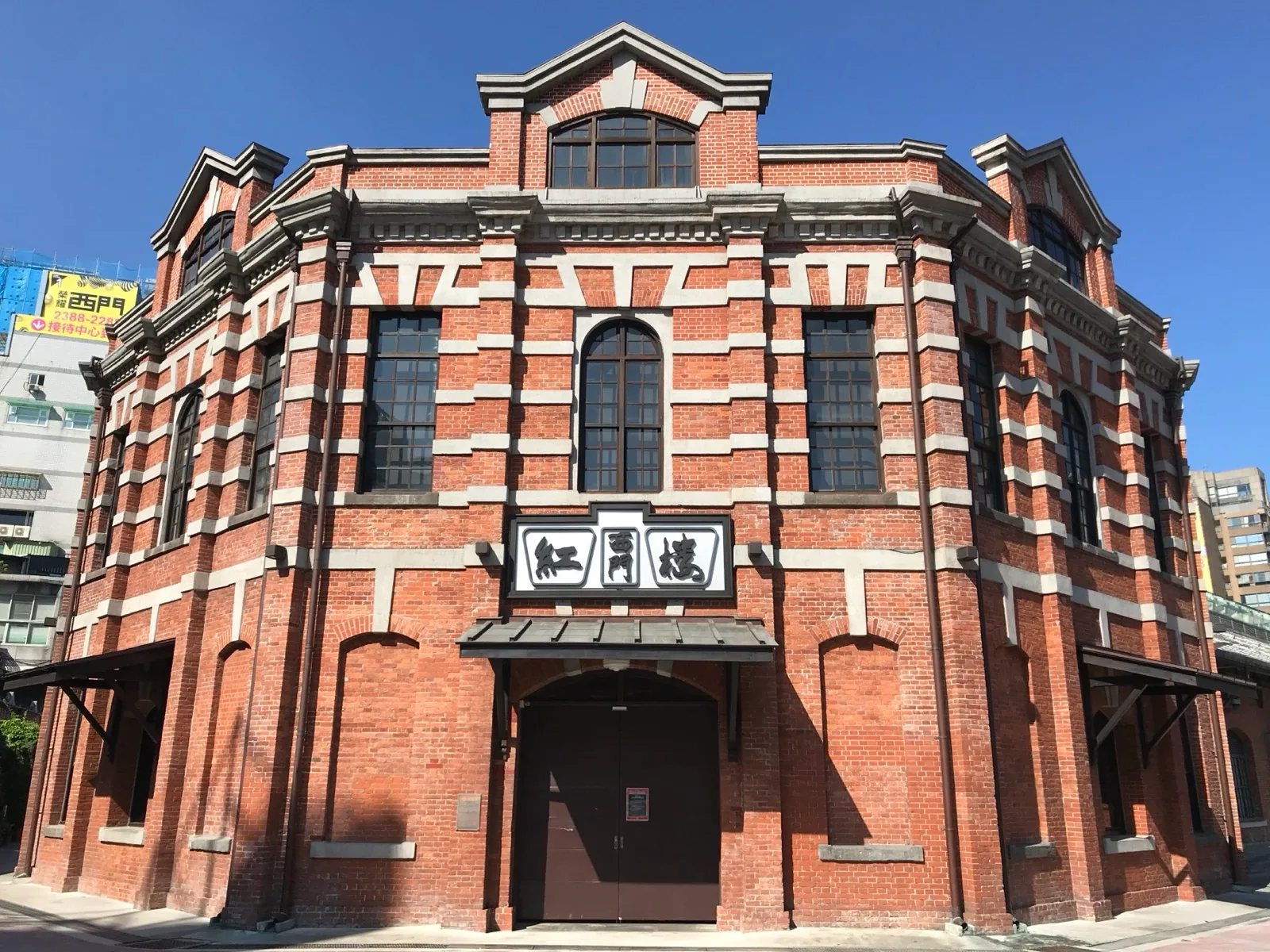
30-second overview: In December 1908, Japanese architect Juro Kondo designed a two-story red-brick octagonal market outside the west gate of Taipei’s city wall — its entrance took the form of the bagua, and its main body was a cross. Today, this building is called the Ximen Red House1. The Japanese originally wanted to imitate Tokyo’s Asakusa and build a district on this marshland east of Bangka dedicated to recreation for newly arrived Japanese migrants2. Thirty years later the Japanese left. In 1961, the eight buildings of Chunghwa Market grew along the longitudinal railway, and in 1992 they were demolished together with the railway, leaving behind a 1,171-meter blank in memory3. In 1999, the pedestrian zone was designated and the Bannan Line opened; Ximending was reborn a second time, becoming Taipei youths’ open-air living room4. From outside the Qing-era city walls, to a Japanese-era entertainment district, a postwar movie street, martial-law-era MTV lounges, post-martial-law hip-hop and skateboarding, the gay-bar district that began in 2003, and on to a tourist commercial district that drew 2.21 million visits in a single month in 20245, five generations of young people have already passed beneath the same octagonal hall. This article’s point is this: that “entertainment land for the other” left by the Japanese unexpectedly gave Taiwan’s postwar and contemporary subcultures a habitat that could not be flattened by Xinyi District capital.
Six o’clock on Saturday evening, Red House South Plaza
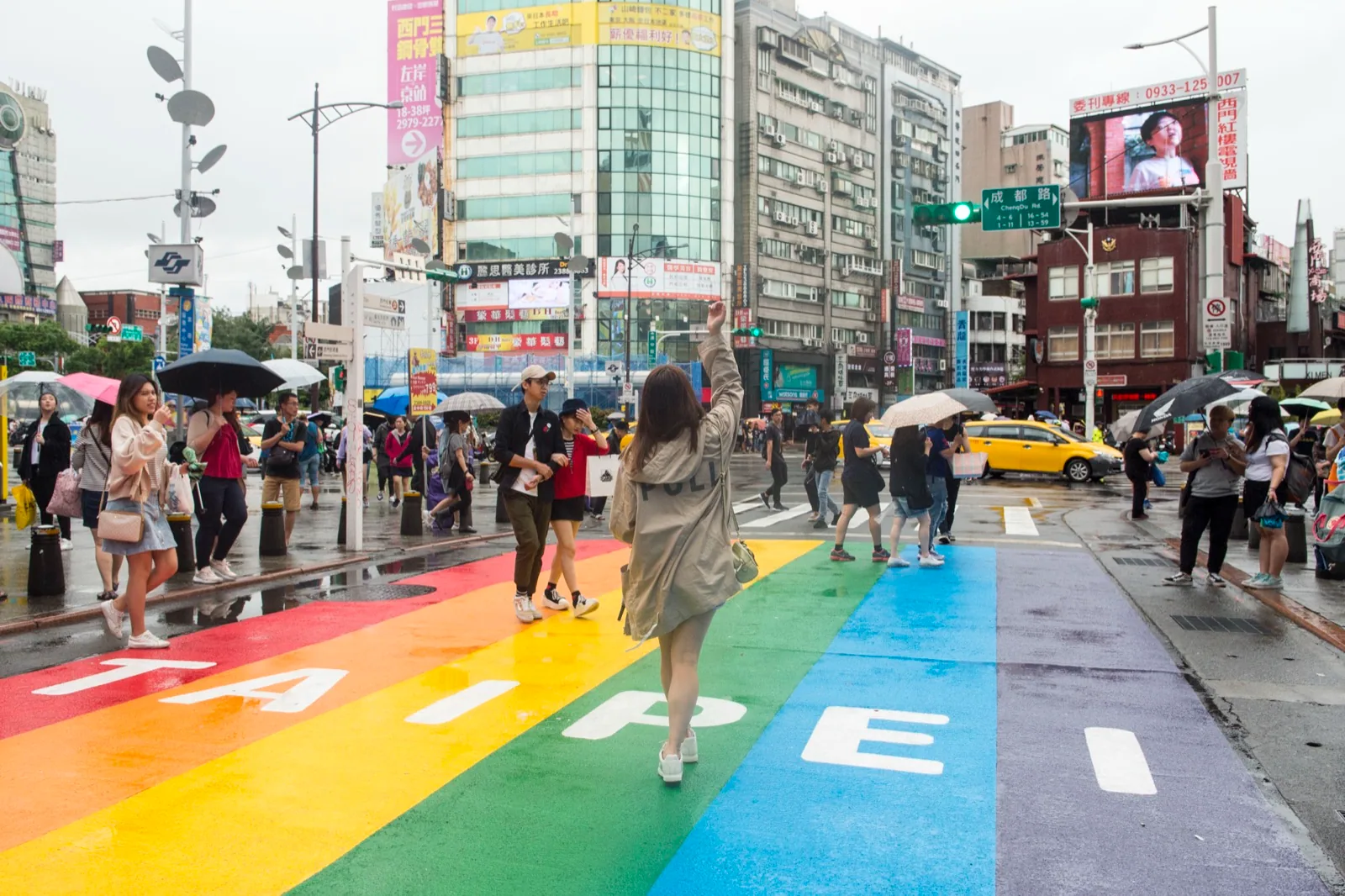
Crowds on the rainbow crosswalk in the Ximen pedestrian zone, September 2019. Photo: Volksabstimmung, 2019-09-28. License via Wikimedia Commons (CC BY-SA 2.0).
If you ask an 18-year-old Taipei teenager, “Where are you going this weekend?” they will not say Xinyi District. They will say “Ximen.”
At six o’clock on a Saturday evening, you climb up from Exit 6 of MRT Ximen Station. In front of the McDonald’s at the Hanzhong Street intersection, people are already lining up for tattoo-studio appointments. Walk another fifty meters to No. 10 Chengdu Road, and beneath the octagonal red-brick walls of the Ximen Red House, a girl in a Lolita dress is having her friend take photos of her — her puffy skirt and the red-brick arched windows completed in 1908 enter the same frame. Circle south to the open-air plaza behind the Red House, and the owners of several outdoor bars have already hung up rainbow flags and pushed tables and chairs outward; most of the guests who arrive at 5:30 are gay, while after seven, office workers getting off work and tourists begin to mix in.
Across the street on Zhonghua Road, a double-decker sightseeing bus carrying foreign visitors has just passed by. In the alley to the left is the line for Ay-Chung Flour-Rice Noodle; people holding paper bowls and eating while standing stretch from Chengdu Road all the way to Emei Street. A little farther north, someone is skateboarding beneath the blue wall at Cinema Park, with hip-hop beats drifting out from the streetwear shop next door.
This scene — an 18-year-old cosplayer, rainbow-flag bars, a standing-only rice-noodle stall, skateboarding teenagers — all stands within 250 meters of the red-brick building the Japanese built in 1908.
📝 Curator’s note: General introductions describe Ximending as “Taipei’s Harajuku” or “a youth gathering place,” but that narrative misses one thing: why Ximending, and not Xinyi or the East District? The answer is hidden in a Japanese decision from 130 years ago. In 1896, the Governor-General’s Office wanted to imitate Tokyo’s Asakusa and give this marshland east of Bangka, outside Taipei’s city walls, the function of “entertainment”2. From that moment on, this piece of land’s DNA was “outsiders come to consume, young people come to play, low-density capital, dense lanes, resistant to gentrification.” Five generations of young people later, the land’s function has not changed. Xinyi Planning District is an adult district planned by capital in the 2000s. Ximending is a youth district planned by empire in 1896. The two are three kilometers apart, living in different times.
A place called “outside the west gate”
To understand Ximending, you first need to know where its name comes from.
In the 10th year of the Guangxu Emperor’s reign in the Qing dynasty, 1884, Taipei Prefecture’s walled city was completed, enclosing an inner-city area of about 1.4 square kilometers. Its five gates were arranged symmetrically: the North Gate, Cheng’en Gate; the East Gate, Jingfu Gate; the South Gate, Lizheng Gate; the Little South Gate, Chongxi Gate; and the West Gate, Baocheng Gate6. Baocheng Gate was what later became commonly known as “Ximen,” the west gate. Its name meant “the achievement of treasures,” expressing the hope that Bangka outside the west gate would continue its commercial prosperity7.
During the Qing period, the area outside the west gate was Bangka’s eastern edge. It was low-lying, with scattered marshes, burial grounds, and small-scale trade spilling out from Bangka’s commercial district. The Japanese arrived in 1895. The Taipei they saw was a structure of three parallel urban quarters: Bangka was the dense settlement of local Hoklo people; Dadaocheng was a rising center of tea trade; and the walled city was where the Qing government offices had been located. The Japanese took over the walled city as their administrative center, but Bangka was crowded and Dadaocheng had already been occupied by tea merchants. They needed a new district dedicated to housing and entertainment for newly arrived Japanese migrants.
This land outside the west gate was just right. It lay east of Bangka, close to the walled city the Japanese had taken over, low-lying enough to fill and re-plot, and without powerful local commercial forces entrenched there. In September 1896, the Japanese built the wooden “Ximen Market” here, also called “Shinki Street Market,” mainly to supply everyday goods for local Japanese migrants8.
But Japanese ambitions went beyond a vegetable market. The theater Tokyo-tei opened in 1895, the Taipei-za on Shinki Cross Street opened in 1897, and the Eiza on Ximenwai Street opened in 19029. Theaters, restaurants, and photography studios lined up one after another. In 1922, the Governor-General’s Office implemented a reform of town names and officially named the area “Ximending.” The area of Ximen Village was bounded by Emei Street, Kangding Road, Neijiang Street, and Zhonghua Road9.
📝 Curator’s note: The decision-making logic behind the name Ximending matters. The Japanese did not randomly draw a circle around a piece of land. They were imitating Tokyo’s Asakusa. In the Edo period, Asakusa was already a commoners’ entertainment district; after the Meiji Restoration, it retained a texture in which theaters, geisha, markets, religion, and lower-class life mixed together. The Japanese transplanted the same formula to Taipei: they filled the marshland east of Bangka, re-plotted the lanes, and built markets and theaters. In effect, they moved the material recipe of Edo plebeian culture into the colony. The moment the three characters “Ximending” were fixed in 1922, this land’s “young entertainment district DNA” was written in. It has not been changed in 130 years.
But in 1904, something happened: the Japanese decided to demolish Taipei’s Qing-era city walls. Baocheng Gate was the only one of the five gates to be completely demolished. The decision was made in 1904 and provoked fierce opposition from Bangka merchants and gentry. To calm public anger, civil administrator Goto Shinpei preserved the remaining four gates and built a small oval park on the site of the demolished west gate7. Today, near Exit 6 of MRT Ximen Station, at the intersection of Baoqing Road and Hengyang Road, a “Baocheng Gate Historic Site” stele still reminds you that this city gate once stood here.
The octagonal brick building of 1908
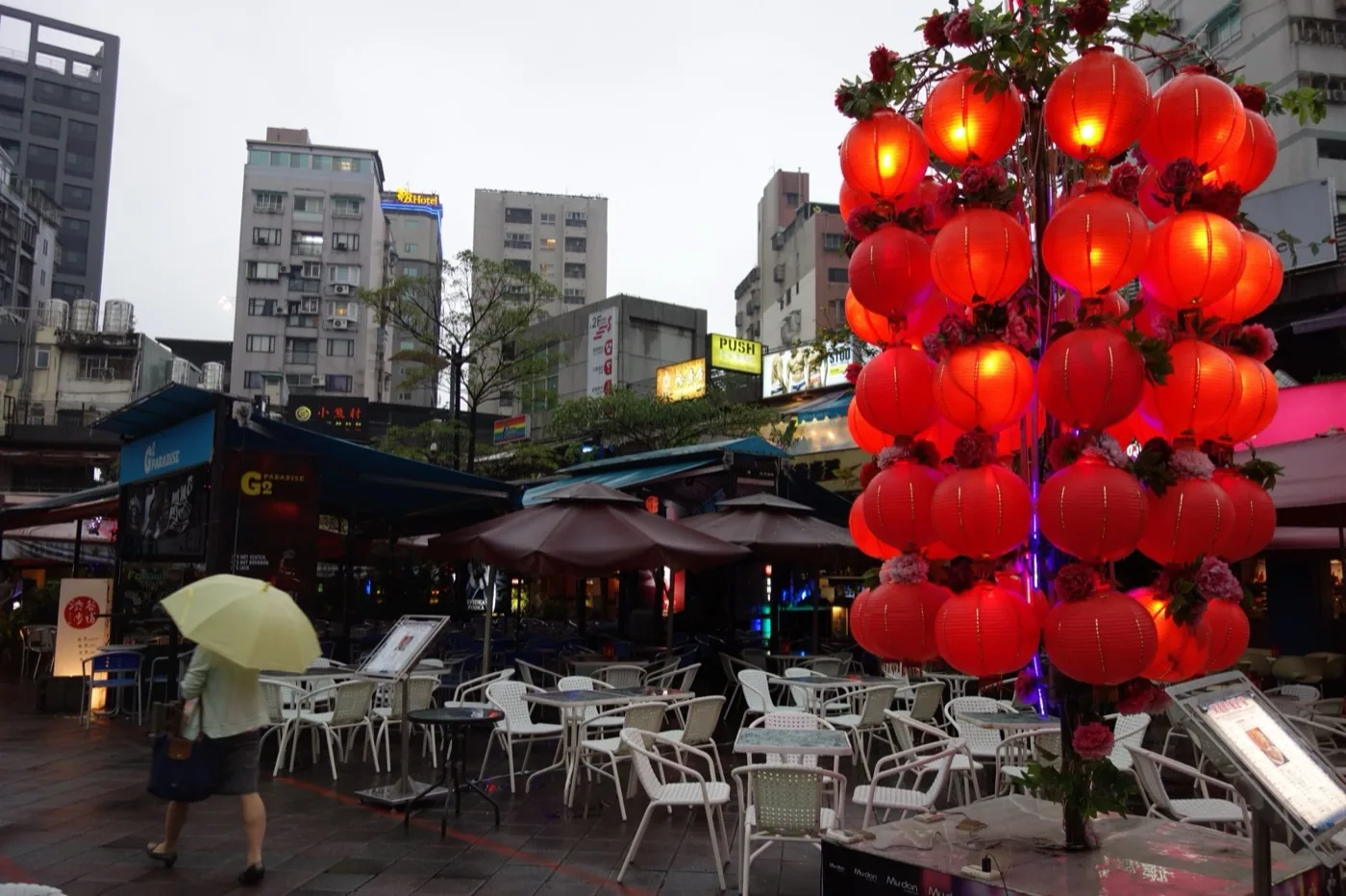
Panoramic view of the Ximen Red House South Plaza. Photo: Asacyan, 2013-04-25. License via Wikimedia Commons (CC BY-SA 3.0).
If there is only one object in Ximending that you must see, it is the Ximen Red House.
In April 1908, the wooden buildings of Ximen Market were torn down and rebuilt. On October 18 of the same year, the new brick market “officially began operations,” and in December it was formally completed1. The designer was Japanese architect Juro Kondo. Born in Japan in 1877, he graduated from the Department of Architecture at Tokyo Imperial University in 1904 and immediately decided to come to Taiwan. He served in the Building and Repairs Section of the Taiwan Governor-General’s Office and stayed for twenty full years10. His representative works in Taiwan, besides the Ximen Red House, include the old National Taiwan University Hospital building (1916), the Red House at Jianguo High School (1907), and the Keelung Post Office. They cover almost all of the important public architecture of Japanese-era Taipei10.
Juro Kondo’s design for Ximen Market had no precedent in Eastern or Western architectural history. He used a combination of two buildings: the “Octagonal Hall” to the north as the market entrance, and the “Cruciform Building” to the south as the market’s main body11. The Octagonal Hall is a two-story red-brick Western-style building, each principal elevation measuring eight meters, with a plan that is precisely a regular octagon. Why an octagon? In his design explanation, he wrote of the market-entrance image of “people gathering from all eight directions”11. The Cruciform Building, by contrast, is a pure cross plan, with good lighting and regularly arranged stalls.
A different explanation later circulated among the public. During the Qing period, the area around Ximen Market had been sparse marshland and burial grounds. Some people believed Kondo deliberately combined the bagua, the Chinese eight-directional talisman for suppressing evil, with the cross, a Christian symbol of purification, in order to ward off malign forces and ghosts12. Architectural historian Li Chien-lang has emphasized that “there is no formal documentary record that Juro Kondo had this consideration”12. Even so, the complete two-building red-brick composition of 1908 — the Octagonal Hall’s eight-direction symmetry and the Cruciform Building’s east-west and north-south axes — is hard to imagine as accidental on land that had once been a burial ground.
📝 Curator’s note: The Red House’s design is worth thinking about for another second. A Japanese architect trained at Tokyo Imperial University built a market on land that had once been a Taiwanese burial ground, combining a bagua form with a cross form. The building’s “hybrid” quality runs very deep. The Octagonal Hall uses the Chinese feng shui concept of the “eight directions” as an entrance; the Cruciform Building uses the geometry of Christian sacred space as its main body. Symbols from two entirely different civilizations are grafted onto the same architecture. Mainstream architecture in Japanese-era Taiwan was a Meiji hybrid of “Japanese + Western” styles, but Juro Kondo added another layer: “local Han folk practice.” In 1922 the town name was fixed as “Ximending”; in 1936 Zhongshan Hall was completed; after the war the building was renamed; in 1997 it was listed as a municipal historic monument. The same red-brick building stood in place without moving, while the ideologies of three regimes slid across it13.
After the war, the Red House’s fate for a time seemed forgotten. On March 14, 1949, the “Huyuan Theater” opened inside the Red House, focusing on Peking opera, but its box office was poor1. In 1953 it switched to Yue opera and instead sold out repeatedly, with rampant black-market tickets1. In 1958, the Red House was simply converted into a movie theater, the “Red House Theater”1. In April 1959, Wang Shufen of the Peacock Pingju Troupe performed there for ten consecutive days.
On February 20, 1997, the Ministry of the Interior listed the building as a Grade 3 historic monument, now a municipal historic monument, and formally named it the “Ximen Red House”13. But protection came too late. In the early hours of July 22, 2000, “a major fire at Ximen Market reduced the Cruciform Building, three thousand ping, and more than two hundred stalls to ashes in an hour and a half”1. Reconstruction after the fire dragged on for years. In March 2002, the Taipei City Government used an “officially owned, privately operated” model and entrusted operations to the Paper Windmill Cultural and Educational Foundation. On July 26, 2002, it reopened as the “Red House Theater”1. In 2007, Paper Windmill’s five-year contract expired and it withdrew; the Red House returned to direct management by the Department of Cultural Affairs. In 2008, its centennial special exhibition was held.
Today’s Red House has the Octagonal Hall as an exhibition hall and teahouse, while the Cruciform Building houses “16 Creative Boutique,” a lifestyle and cultural-creative department store with more than twenty Taiwanese cultural-creative brands14. The North Plaza hosts the “Ximen Red House Creative Market” every Saturday and Sunday, continuously since July 2007, while the South Plaza is one of Taiwan’s rare outdoor open-air bar districts, serving mainly the LGBTQ community15.
📝 Curator’s note: The formation of the gay-bar district was an accidental product of the Red House’s renovation after 2003. In the early period, when the Red House was still a second-run movie theater, it was near New Park, completed in 1899 and now 228 Peace Park. Because second-run theaters had low ticket prices and did not clear the audience between screenings, older gay Mainlander men would linger here15. After the Red House renovation was completed in 2003, several gay bars moved into the North Plaza, and Red House businesses consciously opened the bars outdoors. One bar owner told the media: “The mission of the businesses here at the Red House is to bring gay people from indoors out into the open air, to lift the lid off gay bars so they are no longer secret places that only insiders can get into”16. The Taiwan LGBT Pride parade walks from Ketagalan Boulevard to the Red House every year; in 2024, the parade crowd was estimated at up to 200,000 people16. A red-brick building drawn by a Japanese architect in 1908 became one of the most important urban spaces in Taiwan’s LGBTQ movement in the twenty-first century. This story line would be hard to write even as fiction.
Chunghwa Market’s 31-year “absent landscape”
If you ask someone who grew up in Ximending in the 1970s what the Ximending in their memory looked like, they will name one thing: Chunghwa Market.
After the Nationalist government retreated to Taiwan in 1949, Ximending expanded eastward. Along both sides of the longitudinal railway that had existed since the Qing period, running from Taipei Main Station in the north to Wanhua in the south, large numbers of illegal structures were built to house military dependents and migrants. The illegal-building areas had poor sanitation, dense populations, and frequent fires. In the 1960s, the Taipei City Government decided to clean them up: demolish the illegal structures east of the railway and build a connected market complex to resettle the vendors.
Construction of Chunghwa Market broke ground on July 1, 19603. “Along the east side of the railway running through Zhonghua Road, using the space on the side lane of the original three-lane road closest to the railway”3, it began at the intersection with Zhongxiao West Road in the north and extended south to the intersection with Aiguo West Road, for a total length of 1,171 meters. The eight long, three-story connected buildings were named from north to south after the “Eight Virtues”: Zhong, Xiao, Ren, Ai, Xin, Yi, He, Ping3. On April 22, 1961, “eight three-story buildings, each a long strip as a single building mass and arranged in a long chain through a connected-building form, were officially completed”3, and a total of 1,644 stalls opened for business3.
Chunghwa Market was the material gathering place of postwar Mainlander small businesses. The northern ends of the Zhong and Xiao buildings, near the old Taipei Main Station, sold electronic parts and computer components; Taipei’s earliest computer street in the 1980s formed here. The central Ren, Ai, Xin, and Yi buildings held everyday goods, bookstores, and record shops. The Xin building had Columbia Records, founded in 1961, where “display cases on the ceiling had photos of celebrities, and selling vinyl records was the store’s distinctive feature”3. Universal Records and Chia Chia Record also stood nearby, making the area a sacred ground for Taiwanese pop-music fans from the 1960s to the 1980s. “Dim Sum World,” founded at No. 1 of the Yi building in 1962, sold pork potstickers and steamed dumplings; the square wooden tables and chairs placed at 45-degree angles later became urban legend. On the second floor, “True Peiping Restaurant,” founded by General Chang Ti-an in 1962, was famous for its Peking sliced-skin roast duck3.
📝 Curator’s note: The naming logic of the eight buildings deserves a closer look. “Zhong, Xiao, Ren, Ai, Xin, Yi, He, Ping” — loyalty, filial piety, benevolence, love, trustworthiness, righteousness, harmony, peace — was the Kuomintang’s “Eight Virtues” moral slogan from the 1934 New Life Movement, moved directly into market-building names in the postwar 1960s. A market built along the east side of the longitudinal railway left by the Japanese had building names drawn from the postwar Republic of China’s Confucian moral sequence. In the same location, 1908 had the Japanese Empire’s red-brick market; 1961 had the Republic of China’s moral market. The ideological landscapes of two empires were layered on top of this land in Ximending.
In the 1980s, as the personal-computer industry rose, the electronic-parts merchants in the Zhong and Xiao buildings transformed into sellers of computer hardware and software, making the area one of Taiwan PC industry’s earliest retail nodes. But the railway era was about to end. After the 1980s, Taipei’s railway undergrounding project began; the railway on Zhonghua Road had to move underground, and the original track space had to be returned to the city’s road system. The problem was that the eight buildings of Chunghwa Market sat exactly on the three-lane road space east of the railway.
On October 20, 1992, Mayor Huang Ta-chou ordered the demolition of Chunghwa Market. Work began that day on the first building, the Zhong building. On October 23, the Xiao and Ren buildings were demolished; on October 27, the Ai and Xin buildings; and on October 30, the last three buildings, Yi, He, and Ping, were razed on the same day. A 31-year-old market was demolished in ten days3. Some of the vendors from the original 1,644 stalls moved to the “Taipei City Mall,” completed in 2000, and continued doing business there. But the material landscape that ran 1,171 meters along the railway, arranged by the Eight Virtues and connected on three floors, has lived only in photographs ever since.
📝 Curator’s note: Chunghwa Market is the strongest example of an “absent landscape.” When it was demolished in 1992, today’s 18-year-old cosplayers had not yet been born. When they walk on Zhonghua Road, what they see is the boulevard completed in 199917, not the eight market buildings of 1961-1992. But for Taipei people over fifty, Chunghwa Market is still the very center of the Ximending map in their minds. Wu Ming-yi’s 2011 novel The Magician on the Skywalk is set in the Chunghwa Market of the 1980s, and the 2021 PTS television adaptation rebuilt a 95-percent-scale Chunghwa Market set. Only thirty years after a landscape was demolished could it be seen again through literature and drama18. In Taiwan, mourning for “lost urban space” happens more often than actual urban planning.
Three places locals will take you to see
Tourists all know the Ximen Red House. But Ximending’s true texture is in three old shops that opened not long after the war.
Mei Guan Yuan Japanese Cuisine (No. 36 Emei Street). Founded by Chang Liang-tieh in 1946, it is Ximending’s oldest Taiwanese-style Japanese restaurant. The founder was from Yuanlin during the Japanese period. In 1934, he went north to Bangka to study Japanese cuisine at “Yanagiya.” After the war, in 1946, he opened “Mei Guan Restaurant,” later moved to Emei Street, and renamed it “Mei Guan Yuan”19. From a young man in his thirties leaving Yuanlin to apprentice, to a postwar start-up, to 2026, when the third generation still operates three branches on Emei Street, it has not moved in 80 years. The menu still uses a Taiwanese handwritten style; the set meals remain, basically, the same large portions at affordable prices as seventy years ago. Mei Guan Yuan’s existence explains one thing: postwar Ximending was not monopolized by Mainlander military-dependents’ village culture. Local Hoklo people also opened shops on this street and kept them alive for 80 years.
Fong Da Coffee (No. 42 Chengdu Road). Founded in 1956, it is one of the oldest coffee shops in Wanhua District20. The first-generation owner originally ran a honey wholesale business and sold coffee and tea with honey added. Later, the business shifted entirely to coffee, but the character “feng,” meaning bee, was kept in the name. The most popular thing in Fong Da is not the coffee; it is the Chinese handmade cookies in the transparent display case at the entrance, especially the walnut cookies and “abalone crisps.” It was a dating and matchmaking spot in grandparents’ generation20. In 2010, the travel section of USA Today selected the world’s ten best cities for tasting coffee. Taipei ranked tenth and was the only Asian city included. The two shops the report singled out were Fong Da and Baden20. A coffee shop that has operated from 1956 to 2026 without changing its decor, without moving its storefront, and without changing the unit price of its walnut cookies still stands on Chengdu Road.
Ay-Chung Flour-Rice Noodle (at the Emei Street intersection). Founded in 1975, it is the representative work of Ximending’s standing-to-eat culture21. The first-generation owner had originally been a director in the film and entertainment industry. When the film and television business slumped in the 1970s, he switched to selling squid thick soup, but business was poor. His wife’s godfather passed him a secret recipe for large-intestine flour-rice noodles. From then on, Ay-Chung Flour-Rice Noodle became popular in Ximending and has remained so for 50 years21. The shop has no seats; every customer holds a paper bowl and eats while standing at the entrance. The crowds stretching from Chengdu Road to the Emei Street intersection have become a standard tourist image of Ximending. But the real story of Ay-Chung Flour-Rice Noodle is not tourism. It is the story of a director who switched careers to sell rice noodles and used a Taiwanese “standing-eat” format to survive in Ximending for 51 years.
After walking through these three shops, you understand Ximending’s true texture. Tourists rush to photograph the Red House and Ay-Chung Flour-Rice Noodle, but what they see is only the surface. For locals, Ximending is Mei Guan Yuan, which has not moved in 80 years; Fong Da, which has not changed its decor in 70 years; and Ay-Chung, where people have eaten standing up for 50 years. These three Taiwanese small businesses spanning the postwar era to the present have stayed in their original locations the whole time.
📝 Curator’s note: The pressure of touristification in Ximending is enormous. In August 2024 alone, 2.21 million visits passed through this commercial district5, and rents rose to NT$17,700 per ping per month on Chengdu Road, setting a new Taipei high5. Under this kind of capital pressure, it is unusual that Mei Guan Yuan, Fong Da, and Ay-Chung have stood in place for 50 to 80 years. Why? Because they are not shops that “cater to tourism.” They were here before the tourist wave arrived, and their existence is tied to Ximending’s fate. When capital wants to turn this street into another Xinyi District, they are the physical “real estate” that does not move. Tourists come and go; they stand in the same places for 80 years. That kind of “not moving” is itself what Taiwan.md wants to preserve.
After 1999, the street slowed down and people increased
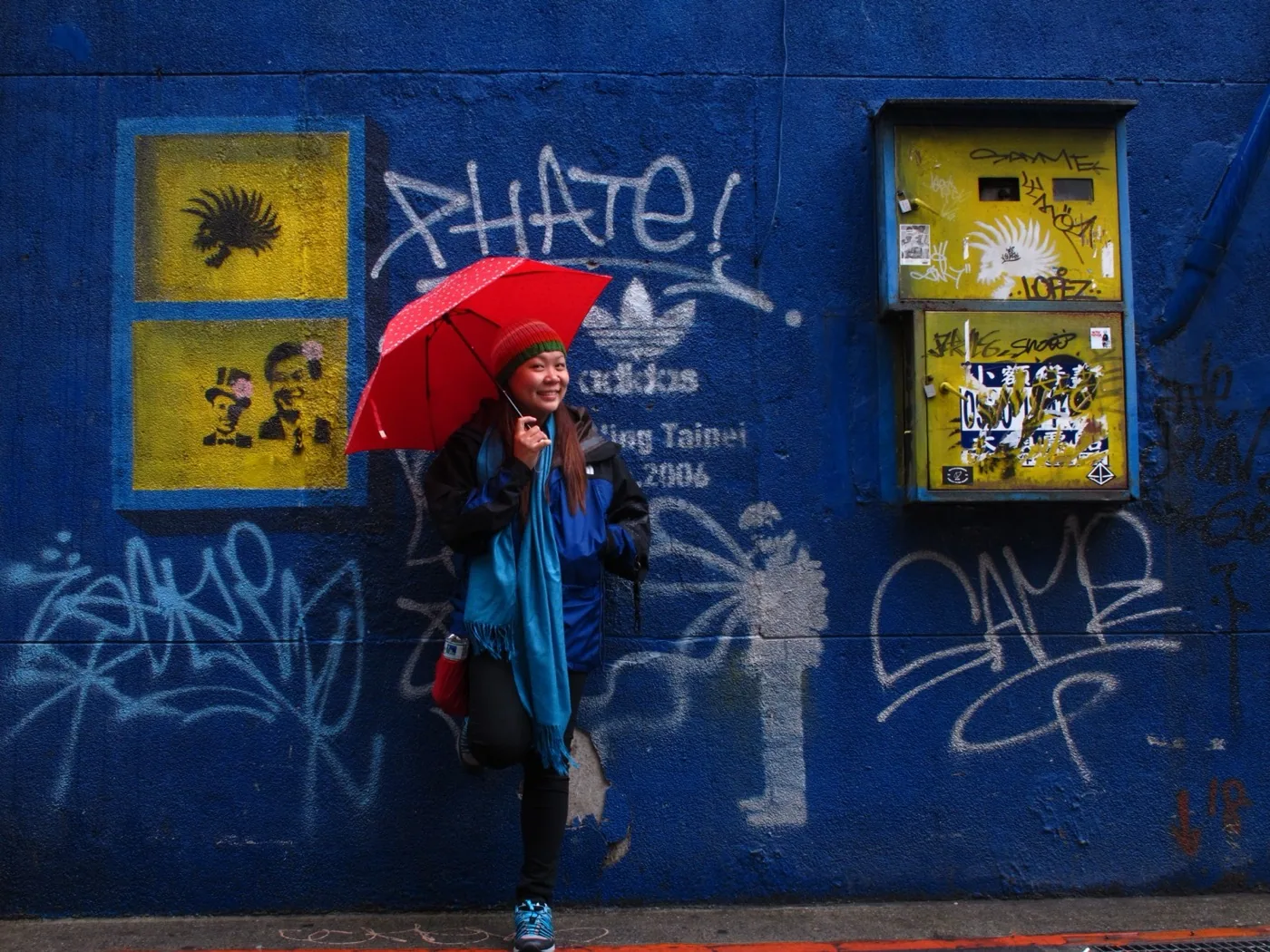
Graffiti on the blue wall at Ximending Cinema Park. Photo: eazytraveler, 2010-02-13. License via Wikimedia Commons (CC BY 2.0).
Ximending’s second major reincarnation happened in the late 1990s.
The 1980s were the golden peak of Ximending’s movie street. At its height, 37 cinemas opened successively in the district22, and ten cinemas gathered on Section 2 of Wuchang Street, earning it the name “Movie Street.” On August 2, 1964, the Lux Cinema opened with 1,680 seats, a U.S.-made 70mm projector, and six-channel stereo sound. It was the largest theater in Taiwan at the time23. The Ambassador Theater opened in 1965. Today Theater began operating in 1968 in the Wanqi Entertainment Building on Emei Street24. Together with the Wannian Commercial Building, which opened on October 6, 1973, with two underground floors and ten aboveground floors for a total of twelve floors and 200 shops opening at the same time25, and Lai Lai Department Store, opened by the Cathay Group in 1978 as Taiwan’s first modern department store26, the whole of Ximending in the 1970s and 1980s was Taiwan’s densest consumer district.
The years 1985-1992 were the golden age of MTV lounges. U2 Cinema was founded in 198627, and in 1987 U2 opened a branch on Chengdu Road in the Ximen commercial district. For the first time, Taiwanese teenagers had a private space “outside the home with a door that could close.” High school students under martial law used NT$100 MTV package tickets to enter small private rooms, watch pirated films by Nagisa Oshima, Buñuel, and Wong Kar-wai, and escape the gaze of parents and the inspections of military instructors. During the same period, red-envelope club culture also reached its peak in Ximending. At its 1980s height, Ximending had 16 to 17 red-envelope clubs operating at the same time28. Retired Mainlander soldiers listened to old songs here, recalled the Shanghai and Beijing where they had grown up, and handed red envelopes to singers who came down from the stage — thirty years earlier than today’s livestream tipping28.
But the golden age began to decline in the 1990s. Capital flowed toward the East District and Xinyi Planning District. Ximending entered what the media called its “ten dark years”: cinemas closed one after another; Lai Lai Department Store changed hands in the 1990s; First Department Store declined; Lai Lai Department Store finally closed in 201326. After Chunghwa Market was demolished in 1992, the street’s “center of gravity” disappeared.
In 1998, the Taipei City Government proposed the “Ximen Pedestrian Zone Overall Environmental Renewal and Improvement Plan,” preparing to turn Ximending from a vehicle-cluttered commercial street into Taipei’s first large pedestrian zone4. In 1999, the new pedestrian zone was officially completed. Its controlled area included Hanzhong Street, from MRT Ximen Station Exit 6 to Hankou Street; Section 2 of Wuchang Street, from Zhonghua Road to Kangding Road; and Emei Street, from Zhonghua Road to Xining South Road, for a total length of about 1.1 kilometers4. On July 21 of the same year, the northern portal of the Wanban railway undergrounding project was completed. The tracks on the former Chunghwa Market site were buried underground, and the surface became the Zhonghua Road boulevard17. On December 24, 1999, the Taipei Metro Bannan Line section from City Hall to Longshan Temple opened, and Ximen Station officially began service29.
From then on, Ximending’s physical structure was completely reorganized: the railway disappeared, Zhonghua Road became a tree-lined boulevard, the pedestrian zone was designated, and the underground MRT station let people pour in from every direction. Capital did not immediately return, but young people did. The reason was that a pedestrian zone has the qualities “no cars, no hierarchy, no judgment,” precisely the material conditions Taiwan’s youth subcultures needed.
In the late 1990s, American street culture began to take root in Ximending. Secondhand clothing stores, hip-hop streetwear brands, and skate shops opened one after another in Lane 96, Kunming Street30. In 2001, the streetwear shop Doobiest held the first “Street Culture Festival,” setting a stage for the four elements of hip-hop — MC, DJ, breaking, and graffiti — in Ximending’s lanes30. During the same period, cosplayers began taking weekend photos regularly in front of the Red House, skateboarders gathered at Cinema Park, and tattoo studios opened one after another in the lanes. Ximending changed from movie street into a subculture distribution center.
📝 Curator’s note: The material basis for subcultures pouring into Ximending in the late 1990s is worth analyzing. Why did subcultures choose here, not the East District or Xinyi? Three physical conditions: (1) the pedestrian zone meant no cars, dense crowds, and large activity space; (2) the low-average commercial real estate left after Chunghwa Market’s demolition kept rents cheap, relative to Xinyi and the East District; (3) the dense lane structure gave tattoo studios, cosplay photography, skateboarding, and graffiti — activities that need small spaces and less surveillance — a place to live. The dense lanes planned by the Japanese in 1896, the railway corridor left after the war, and the low-average commercial real estate left in the 1990s: the material bases of three historical layers were superimposed, allowing post-2000 subcultures to take root here. A century of geographical inertia sedimented into the Ximending we see today.
After the 2010s, the Taipei City Government actively reinforced the subculture positioning. Since 2013, it has held “Ximen Pleasure Festival: Cosplay Showdown in Ximending” every September31. The Ximen Red House has held a creative market every weekend since 2007, and in 2016 the Cruciform Building’s 16 Creative Boutique was converted into a lifestyle and cultural-creative department store14. After the 2020s, Ximending’s tourist crowds have mainly come from South Korea, Japan, Hong Kong, and overseas Chinese communities. In 2024, it drew 2.21 million visits in a single month and had accumulated 20.21 million visits for the year by August, more than twice Taipei 1015. On the nationality ranking board at Carrefour Guilin Store, Korean travelers overwhelmingly dominate. They eat, buy drugstore cosmetics, take photos, and buy streetwear in Ximending, coexisting with local teenagers in the pedestrian zone32.
Young people on the same street for 130 years
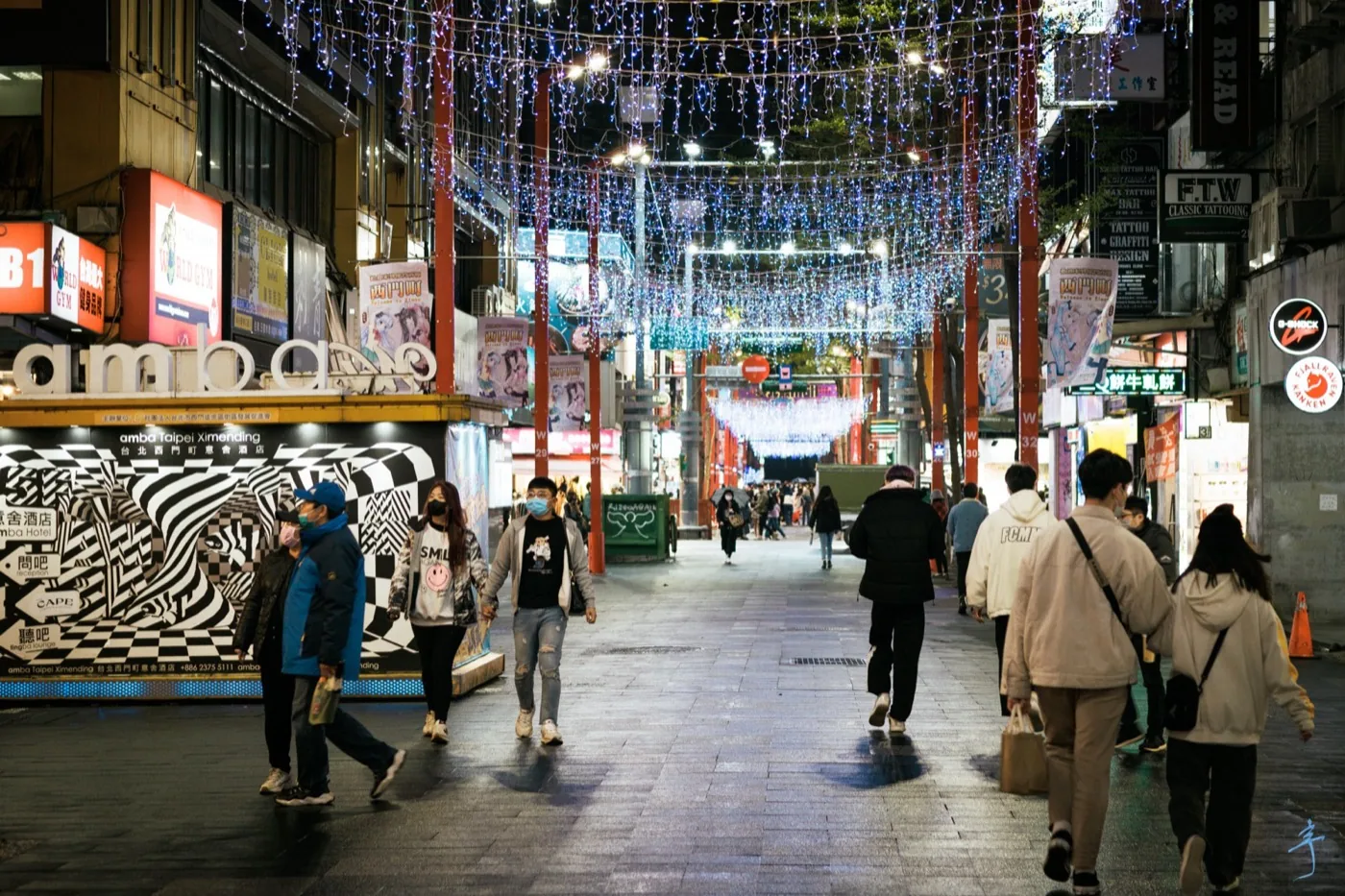
The Ximending pedestrian zone on a Christmas night in December 2022. Photo: 迷惘的人生 (KUO TUNG YU), 2022-12-14. License via Wikimedia Commons (CC BY-SA 2.0).
On October 18, 1908, the first day Ximen Market opened for business, an 18-year-old local Hoklo boy walked with his parents through the entrance of the Octagonal Hall designed by Juro Kondo and saw Japanese vendors selling seasonings he had never seen before. He did not know this red-brick building would stand here for 100 years.
One summer day in 1972, the 17-year-old Brigitte Lin went to Ximending with classmates to pick up custom-made bell-bottom pants. She was stopped by a talent scout named Yang Qi. That afternoon, she did not get the bell-bottoms, but she did get an audition for Outside the Window. The film was released on August 24, 1973, and she became synonymous with Chiung Yao films33.
One day after school in 1985, a group of high school students used NT$100 package tickets to sneak into a small U2 private room and watch a French New Wave film their parents would never have taken them to see. The world inside the film was completely different from martial-law Taiwan, but that door that could close made them believe the world had other possibilities27.
On December 24, 1999, the day the MRT Bannan Line opened, teenagers pouring out of Ximen Station stepped onto a pedestrian zone that had been designated less than three months earlier and discovered that the railway on Zhonghua Road had vanished, replaced by a boulevard. They did not remember what Chunghwa Market looked like, but they saw a street without cars, where they could stand wherever they wanted in the middle of the road429.
On a Saturday afternoon in 2024, an 18-year-old girl adjusts her Lolita puffy skirt beneath the red-brick wall of the Ximen Red House South Plaza. She does not know that this red-brick building beside her was a market the Japanese built 130 years ago to imitate Tokyo’s Asakusa. She does not know that the 1.1 kilometers of Zhonghua Road diagonally across from her were, thirty years ago, the eight buildings of Chunghwa Market. Nor does she know that the land beneath her feet was, fifty years ago, a movie street, and twenty years ago, a venue for electronic-music parties.
She only knows: this is Ximen. On weekends, she comes here with friends to take photos.
✦ “The name Ximending comes from the administrative district newly designated when Taipei City was established during the Japanese period in 1922: Ximending”9. A town name fixed by the Japanese Empire in 1922 is still, in 2026, the place name most familiar to every 18-year-old in Taipei. The Japanese have been gone for 80 years, but the three characters Ximending have not left.
Ximending’s core contradiction is this: a piece of entertainment land planned by the Japanese Empire in 1896 for its own people became, a century later, the most irreplaceable subcultural space for local Taiwanese youth. The material recipe that was originally a “consumption field for the other” — dense lanes, low barriers, no class judgment, pedestrian accessibility, proximity to transit hubs — unexpectedly allowed Taiwan’s post-1990s subcultures, including cosplay, hip-hop, skateboarding, tattooing, LGBTQ culture, and streetwear, to find a place to live here.
Xinyi Planning District is an adult district planned by capital in the 2000s. The East District is a middle-class district generated by boutique flows in the 1990s. Dadaocheng is a historic district sustained by tea trade from the 1860s. Only Ximending is the “young entertainment land” left by the Japanese in 1896, and that DNA has not changed in 130 years. Five generations of young people cannot change it.
The next time you walk past the Octagonal Hall of the Ximen Red House, stop for 30 seconds and look at that red-brick building. The land beneath your feet was a market the Japanese built for themselves 130 years ago. Today, an 18-year-old Taiwanese girl takes cosplay photos here. The same sky has not changed in 130 years.
Further reading:
Taipei Smoking Room: In a Smoke-Free City, the Glass Booth That Breathes — Taiwan's first outdoor negative-pressure smoking room, standing right at the street corner by Ximen MRT's exit
Taipei City: Three Times Inside One City, where the 1738 Longshan Temple Watches the 2004 Taipei 101 — Ximending’s position among the twelve districts, placed alongside the three timelines of Bangka, Dadaocheng, and Xinyi
Taiwan Anime and Manga Culture — Why cosplay gathers regularly on weekends in front of the Ximen Red House, and its relationship to the origin of the Fancy Frontier convention in 1999
Taiwanese Street Art and Graffiti Culture — The context of the blue-wall graffiti at Ximending Cinema Park and the origins of Taiwanese street culture after the lifting of martial law
Taiwan’s Old Street Culture and Commercial Districts — The structural differences between Ximending as a Japanese-planned entertainment district and Qing-era old streets such as Lukang, Bangka, and Dadaocheng
Bangka — A batch 1 historic-district sibling: when the Japanese planned Ximending in 1896, neighboring Bangka was northern Taiwan’s busiest Qing-era port
Dadaocheng — A batch 1 historic-district sibling: the emerging tea commercial street after the 1853 Dingxiajiao conflict, and Ximending’s Japanese-era entertainment district, are two different “street-formation moments”
Zhongshan North Road Tiaotong — The 1898 Japanese colonial "Chokushi Kaido" tree-lined boulevard leading to the Maruyama Taiwan Shrine; like Ximending it was Japanese-era planned, but a completely different urban experiment
Image sources
This article uses five CC-licensed images, all cached under public/article-images/geography/ to avoid hotlinking source servers:
- 西門紅樓八角樓.jpg — Photo: Outlookxp, 2021-08-16, CC BY-SA 4.0
- South_Plaza,\_Red_House_Theater_20130425.jpg — Photo: Asacyan, 2013-04-25, CC BY-SA 3.0
- Ximending_rainbow_crossing_201910.jpg — Photo: Volksabstimmung, 2019-09-28, CC BY-SA 2.0
- 2010-02-13_Blue_wall_with_graffiti_in_Ximending.jpg — Photo: eazytraveler, 2010-02-13, CC BY 2.0
- Christmas_lights_at_Ximending_20221214.jpg — Photo: 迷惘的人生 (KUO TUNG YU), 2022-12-14, CC BY-SA 2.0
References
- Ximen Red House — Wikipedia — The Ximen Red House entry records core historical facts including “construction date: Japanese Taiwan, Meiji 41 (1908),” “the building was designed by Juro Kondo,” “composed of an octagonal building and a cruciform building,” “on October 18, 1908, it officially began operations,” “in the early hours of July 22, 2000, the Ximen Market fire reduced the Cruciform Building, three thousand ping, and more than two hundred stalls to ashes in an hour and a half,” “on March 14, 1949, Huyuan Theater opened,” and “in 1958 the Red House was converted into a theater.”↩234567
- Ximending — Wikipedia — The Ximending entry records the urban-improvement background in which “the Japanese decided to imitate Tokyo’s Asakusa district and establish a leisure commercial district here,” as well as the timeline of the earliest entertainment facilities: “the 1895 theater Tokyo-tei, the 1897 Taipei-za on Shinki Cross Street, the 1902 Eiza on Ximenwai Street, and the 1908 Octagonal Hall.”↩2
- Chunghwa Market — Wikipedia — The Chunghwa Market entry records that “from July 1, 1960, demolition of illegal structures and construction of the market began,” “on April 22, 1961, eight three-story buildings, each a long strip as a single building mass and arranged in a long chain through a connected-building form, were officially completed,” “along the east side of the railway running through Zhonghua Road, using the space on the side lane of the original three-lane road closest to the railway,” “the eight three-story market buildings, from north (Zhongxiao West Road intersection) to south (Aiguo West Road intersection), were named after the ‘Eight Virtues’: Zhong, Xiao, Ren, Ai, Xin, Yi, He, and Ping,” “Chunghwa Market had a total of 1,644 units,” details of the phased demolitions from October 20 to 30, 1992, and records of businesses such as “Columbia Records (founded in 1961, with display cases on the ceiling showing celebrity photos),” “Dim Sum World (founded at No. 1 in 1962, selling northern wheat foods such as pork potstickers and steamed dumplings),” and “True Peiping Restaurant (founded by General Chang Ti-an in 1962).”↩23456789
- Official website of the Ximen Pedestrian Zone District Development Association — The Ximen pedestrian zone is described as “the area between ‘Zhonghua Road,’ ‘Kangding Road,’ ‘Chengdu Road,’ and ‘Hankou Street.’” The pedestrian zone was completed in 1999 and included three streets, Hanzhong Street, Wuchang Street, and Emei Street, for a total length of about 1.1 kilometers.↩234
- Taipei’s top 5 popular attractions announced: Ximending surpasses 20 million visits, far ahead of 101 — PTS News reported that according to August 2024 statistics from Taipei City’s Department of Information and Tourism, the Ximending commercial district had attracted 20,217,071 visits by August, with more than 2.21 million in August alone, ranking first among Taipei attractions. The report also notes Sinyi Realty’s statistics that among thirteen Taipei storefronts with 2023 rents exceeding NT$10,000 per ping, eight were in Ximending, including a 16.8-ping storefront on Chengdu Road rented for NT$300,000 per month.↩234
- History of Taipei Prefecture City — Taipei City Government — The Taipei City Government website records the official history that “in 1884, construction of Taipei City was completed, with five gates established: the East Gate, West Gate, South Gate, Little South Gate, and North Gate.”↩
- West Gate of Taipei Prefecture City — Wikipedia — The Baocheng Gate entry records that the name meant “the achievement of treasures,” that construction began in 1882 and was completed in 1884, that it was demolished by the Japanese colonial government in 1904 and was the only one of the five gates to be completely removed, and that opposition from Bangka merchants and gentry led Goto Shinpei to preserve the remaining four gates.↩2
- Ximen Market (Taipei) — Wikipedia — The Ximen Market entry records that in September 1896, “Ximen Market (Shinki Street Market) was built,” marking the beginning of Taiwan’s new markets and mainly supplying daily necessities to newly arrived Japanese migrants. Brick buildings began construction in April 1908 and were completed in November-December of the same year.↩
- Origin of the name Ximending — Wikipedia Ximending entry — The Wikipedia Ximending entry states verbatim that “the name Ximending comes from the administrative district newly designated when Taipei City was established during the Japanese period in 1922: Ximending. Its area was roughly today’s Ximen Village around Chengdu Road, bounded by Emei Street, Kangding Road, Neijiang Street, and Zhonghua Road,” and that “the area now commonly called Ximending is broader, also including the former areas of Shinki-cho, Wakatake-cho, Suehiro-cho, Kotobuki-cho, Tsukiji-cho, Hama-cho, Motono-cho, and other towns.”↩23
- Juro Kondo — Wikipedia — The entry on Japanese architect Juro Kondo records his life dates, April 5, 1877 to March 13, 1946; that after graduating from Tokyo Imperial University’s architecture department in 1904 he went to Taiwan and served for twenty years in the Building and Repairs Section of the Governor-General’s Office; and that his works include Ximen Market (Ximen Red House), the old National Taiwan University Hospital building, Jianguo High School, and the Keelung Post Office. It also records that he studied under Josiah Conder, as did Tatsuno Kingo, and worked in the British late Renaissance architectural style.↩2
- Official Ximen Red House Octagonal Hall page — The official Ximen Red House site records that the octagonal building used a bagua form, drawing on the meaning of “people gathering from all eight directions,” as the market entrance; that the cruciform form was the defining feature of the market’s main building; that each elevation of the regular octagon measures eight meters; and that its 1908 construction made it Taiwan’s first publicly built public market.↩2
- Ingenious design to ward off evil? Ximen Red House on a former Japanese-era burial ground, bagua and cross as “Chinese-Western synthesis” — SET News — The report records folk legends that the Ximen Red House Octagonal Hall’s main entrance faced the northeastern “ghost gate” to ward off evil, while architectural historian Li Chien-lang emphasized that “there is no formal documentary record that Juro Kondo had this consideration.” It also notes that the area around Ximen Market during the Qing period was indeed sparsely inhabited marshland and burial grounds.↩2
- Ministry of Culture National Cultural Heritage Database: Ximen Red House entry — The Ministry of Culture’s National Cultural Heritage Database officially records that on February 20, 1997, the Ximen Red House was listed by the Ministry of the Interior as a Grade 3 historic monument, now a municipal historic monument, and is Taiwan’s most completely preserved Grade 3 historic market building.↩2
- Official introduction to Ximen Red House 16 Creative Boutique — On January 6, 2016, the Department of Cultural Affairs of Taipei City Government and the Taipei Culture Foundation jointly positioned the Ximen Red House Cruciform Building’s 16 Creative Boutique as a “lifestyle cultural-creative department store.” It uses a select-shop concept to invite or select high-quality Taiwanese cultural-creative brands to move in. After reopening, more than twenty cultural-creative brand shops operated there.↩2
- Why did the “Red House” become a gay gathering place? — Pixnet — This blog provides an in-depth analysis of the LGBTQ gathering history of the Ximen Red House. In the early period, the Red House second-run theater attracted older Mainlander gay men because it was near New Park, now 228 Peace Park, and because its tickets were cheap and it did not clear audiences between screenings. After the Red House renovation was completed in 2003, gay bars moved in and became a feature of the Red House North Plaza.↩2
- With Pride attendance estimated at 200,000, Ximen Red House businesses become “good gay neighbors” — GagaTai — GagaTai reports a quote from a Ximen Red House bar owner: “The mission of the businesses here at the Red House is to bring gay people from indoors out into the open air, to lift the lid off gay bars so they are no longer secret places that only insiders can get into,” as well as the context of Taiwan LGBT Pride drawing up to 200,000 people and using the Ximen Red House as a gathering point.↩2
- Taipei railway undergrounding project — Wikipedia — Records of the Wanban railway undergrounding project state that it was approved on September 14, 1992; that the northern portal was completed and opened on July 21, 1999; and that the southern portal was completed on October 31, 2002. The tracks on the former Chunghwa Market site were buried underground, and Zhonghua Road was rebuilt as a three-lane boulevard.↩2
- Chunghwa Market was truly strange! Wu Ming-yi’s The Magician on the Skywalk — OKAPI — This Books.com.tw OKAPI interview with Wu Ming-yi records the basis of his childhood memories: moving from Bangka’s Zhuzai houses into Chunghwa Market to run a shoe store, in a space of less than three ping. It also discusses how the 2011 novel The Magician on the Skywalk and the 2021 PTS flagship television adaptation reconstructed the prosperity of 1980s Chunghwa Market.↩
- Mei Guan Yuan Japanese Cuisine 1946 — official website — Mei Guan Yuan’s official website records that it was founded in 1946 by Chang Liang-tieh; that during the Japanese period, as a Yuanlin native, he went north to Bangka in 1934 to study Japanese cuisine at “Yanagiya”; and that after the war he founded “Mei Guan Restaurant” in 1946, later moved to Ximending and renamed it Mei Guan Yuan. Today it operates three stores: the main old shop at No. 36 Emei Street, second and third shops at No. 47, and a fifth shop in Banqiao.↩
- Fong Da Coffee, a 60-year old shop — Margaret’s Photo-Life — This records the history of Fong Da Coffee, founded at No. 42 Chengdu Road in 1956; its shift from the honey business into coffee while retaining the character “feng” in its name; its signature walnut cookies and abalone crisps; and its status as one of only two Taipei coffee shops specifically recommended in a 2010 USA Today report on the world’s top ten coffee cities.↩23
- Ay-Chung Flour-Rice Noodle, an old Ximending brand since 1975 — Lord Cat blog — This records that Ay-Chung Flour-Rice Noodle was founded in 1975 by a former film and entertainment director. After his squid thick-soup business performed poorly, his wife’s godfather passed him a secret recipe for large-intestine flour-rice noodles. The entry also records its standing-eat culture and its development into an internationally known tourist shop with lines on Chengdu Road and at the Emei Street intersection.↩2
- Ximending Movie Street — Taiwan Cinema — The Taiwan film archive’s Ximending Movie Street entry records that at its height, the district had 37 cinemas, and that Section 2 of Wuchang Street gathered six to ten cinemas, so it was called “Movie Street.”↩
- Lux Cinema — Wikipedia — Lux Cinema opened in Ximending on August 2, 1964, with 1,680 seats, a U.S.-made 70mm projector, and a 120-watt six-channel stereophonic sound system, making it Taiwan’s largest theater at the time.↩
- The rise and fall of Today Department Store (1968-1997) — Jasonblog — In 1968, the Wanqi Entertainment Building on Emei Street in Ximending was completed, and the basement level plus the first through fourth floors above ground were leased to Today Co., Ltd. to open Today Department Store.↩
- Wannian Commercial Building — Wikipedia — The Wannian Commercial Building officially opened on October 6, 1973, with two underground floors and ten aboveground floors for a total of twelve floors, and with 200 shops opening for business at the same time. It remains a well-known Ximending landmark.↩
- Lai Lai Department Store — Wikipedia — Lai Lai Department Store opened in Ximending in 1978. It was Taiwan’s first modern department store and, in the 1970s and 1980s, a trend indicator for Ximending, operated by the Cathay Group.↩2
- U2 Cinema homepage — U2 Cinema was founded in 1986. In 1987, it opened the Chengdu branch on Chengdu Road in the Ximen commercial district, making it one of the most representative MTV private-room chains for Taiwanese teenagers during the martial-law era.↩2
- Red-envelope club culture — Ximen Pedestrian Zone District Development Association — The official Ximen pedestrian zone site records that red-envelope club culture arose in the 1960s. At its height in the 1980s, Ximending had 16 to 17 such clubs operating at the same time, with about 30,000 traveling customers across Taiwan each day. Its audience consisted mainly of Mainlander soldiers and civilians who had crossed the sea to Taiwan, and who treated it as a social entertainment space for reminiscing about the past.↩2
- Ximen Station (Taipei Metro) — Wikipedia — The Bannan Line side of Ximen Station opened with the Nangang Line’s “City Hall-Ximen” section and the Banqiao Line’s “Ximen-Longshan Temple” section on December 24, 1999. Its station code is BL11.↩2
- Cross-cultural walk: Ximen’s non-commercial street graffiti — King Car Cultural and Educational Foundation — This records the historical context of American and Japanese secondhand clothing stores in Lane 96, Kunming Street from the 1990s onward, and the streetwear shop Doobiest’s first “Street Culture Festival” in 2001, which gathered the four elements of hip-hop.↩2
- Cosplay Showdown in Ximending — Taipei Travel — Since 2013, the Taipei City Department of Cultural Affairs has held the annual “Ximen Pleasure Festival: Cosplay Showdown in Ximending” every year, inviting anime and manga participants to gather in the Ximen Red House South and North Plazas and the pedestrian zone for performances and competitions.↩
- A must-pilgrimage to Ximending Carrefour! Korean tourists “so numerous they produce a national flag” — ETtoday — This report records the massive density of Korean travelers at Carrefour Guilin Store in Ximending. On the store’s nationality ranking board, Korean customers overwhelmingly dominate, and Korean tourists treat Carrefour as a must-visit Ximending destination.↩
- Song Cunshou — Wikipedia — In 1972, Song Cunshou directed the Chiung Yao adaptation Outside the Window. The 17-year-old Brigitte Lin, having just failed her college entrance exam, was discovered in Ximending by the talent scout Yang Qi. After auditioning, she won the lead role of Jiang Yanrong. The film was released on August 24, 1973, becoming Brigitte Lin’s first film work.↩