
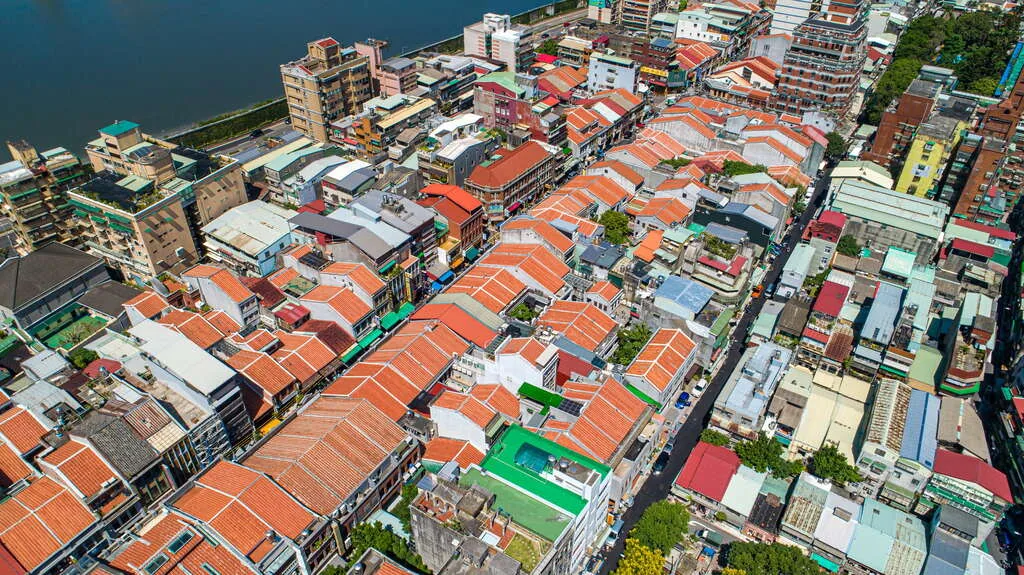
30-second overview: Dadaocheng stretches from Nanjing West Road to Minquan West Road. Dihua Street runs roughly 800 meters north to south, while the district is less than 500 meters wide east to west. Shops first appeared here in 1851, the first year of the Xianfeng reign. After the 1853 Dingxia Jiaopin conflict in Bangka, Tong'an refugees moved in and the street expanded. The opening of Tamsui Port in 1860 turned it into northern Taiwan's busiest foreign-trade port. In 1869, the first 120,000 catties of Taiwanese oolong tea were exported from Tamsui to New York under the name "Formosa Tea," and Li Chunsheng came to be known as the "father of Taiwanese tea." In 1885, Liu Mingchuan established a Western-style school in Dadaocheng, Taiwan's first modern school. Dadaocheng Railway Station opened in 1891. In 1920, the three urban settlements of Japanese-rule Taipei were merged into Taipei City. In 1921, Chiang Wei-shui opened Da'an Hospital at No. 199 Taipingcho, making it the political starting point of the Taiwan Cultural Association. At dusk on February 27, 1947, the packet of contraband cigarettes outside Tianma Tea House ignited the February 28 Incident. This article's argument is that a tea-trading street, a place that once hosted a Western-style school, and the site of postwar Taiwan's deepest wound compress three centuries of Taiwan into 800 meters.
Dihua Street at 5:30 in the Morning
If you ask a Taipei resident when Dadaocheng is at its most captivating, they will not tell you it is the week when the Lunar New Year market is packed so tightly that no one can move. That is for tourists. They might say it is Dihua Street at 5:30 in the morning, before the sky is fully bright, before the dry-goods shops have opened, when the incense of morning rites is rising in front of Xia-Hai City God Temple, and the Western-style building of Jinji Tea Company, opened by Chen Tian-lai in 1891, still stands at its original site at No. 73 Guide Street1.
That building was constructed between 1920 and 1923. It has a Baroque-inspired facade, with the two characters "Jinji" at the center. Chen Tian-lai's grandson Chen Shou-shan later served as Commander-in-Chief of the Taiwan Garrison Command, but that has little to do with the building itself. The building has stood there longer than the grandson's office ever did2. Walk 50 meters north from the building and you reach the intersection of Guide Street and Minsheng West Road, where the Li Chunsheng residence once stood before its redevelopment. Continue east from Guide Street across Gangu Street to No. 21, Section 1, Dihua Street, and you arrive at the starting point of "Middle Street," where the earliest shops opened in 1851. Since Xia-Hai City God Temple was relocated here in 1859, it has never moved again3.
When there are no tourists on the street in the early morning, three axes emerge on their own:
Walk five minutes south to No. 189 Nanjing West Road. Today the site is a commercial building, with a small stone plaque at the entrance engraved with three names: Lin Jiang-mai, Fu Xue-tong, and Chen Wen-xi. At dusk on February 27, 1947, that packet of contraband cigarettes was confiscated here4.
Walk ten minutes north to Section 2, Yanping North Road. The gate of Dadaocheng Public School, founded in 1898 and now Taiping Elementary School, remains in its original location. Chiang Wei-shui studied nearby in 1916. In 1921, he opened Da'an Hospital in Taipingcho 3-chome, today's Section 2, Yanping North Road, and the Taiwan Cultural Association was founded inside that clinic5.
Cross Huanhe North Road to the east and you reach the Tamsui River. In the 1860s, 160 years ago, this riverbank was the wharf from which Formosa Tea was exported to New York. The oolong tea loaded from this pier sustained northern Taiwan's foreign trade for half a century.
Eight hundred meters hold three centuries. That is the density of Dadaocheng.
Tappari, the Great Rice-Drying Ground, and Dingxia Jiaopin
The name "Dadaocheng" is plainspoken. It means "the great rice-drying ground." When Han settlers arrived, this was indeed an open area where rice could be dried. But "Dadaocheng" is a Han name. The original owners of this land were the Ketagalan Tappari community, rendered in Chinese as Dalangbengshe. Only after the Chen-Lai-Zhang reclamation association obtained the "Dajiala" reclamation permit in 1709 did Han settlers begin entering this area to cultivate it6.
The three Chinese characters for "Dalangbeng" nearly disappeared after Han settlers arrived, surviving mostly in academic papers and Indigenous cultural-promotion settings. Walk around Dihua Street today and you will not see a single sign saying, "This is the former site of the Tappari community." The covering of one place-name by another is Taipei's earliest and deepest historical layer.
Han settlers formally opened shops on this land in 1851, the first year of the Xianfeng reign. Lin Lantian moved from Keelung to Dadaocheng and opened a store called "Lin Yishun" near today's Section 1, Dihua Street, trading in general goods7. This was 24 years before Shen Baozhen petitioned to establish Taipei Prefecture in 1875, and 34 years before Liu Mingchuan arrived as governor in 1885. Dadaocheng is older than official "Taipei."
But what truly made Dadaocheng lively was an armed conflict that broke out in Bangka two years later.
In August 1853, the third year of the Xianfeng reign, Bangka saw the "Dingxia Jiaopin" conflict. The "upper guild" was a merchant association formed by people from the three Quanzhou counties of Jinjiang, Nan'an, and Hui'an, the same group that had jointly funded Bangka Longshan Temple in 1738. The "lower guild" was a merchant association formed by people from Tong'an, also in Quanzhou. The two sides fought over control of wharf trade, and the armed conflict continued into September. The Tong'an people were defeated. Their City God image, the center of their religious life, was carried by the devotee Chen Jinrong as they fled from Bajiazhuang in Bangka all the way to Dadaocheng8.
The name "Xia-Hai" comes from the Tong'an people's ancestral place, the seashore of Xiacheng in Zhangzhou, Fujian. In 1859, the ninth year of the Xianfeng reign, the Tong'an people who had fled to Dadaocheng built Xia-Hai City God Temple next to Middle Street, at today's No. 61, Section 1, Dihua Street3. From that day to 2026, the temple has stood in the same place for 167 years without moving.
📝 Curator's note: Conventional tourism narratives describe Xia-Hai City God Temple as "the temple where the Matchmaker God is most efficacious" and stop there. But the reason this temple physically stands here is that an armed conflict forced a group of people onto this land. In the summer of 1853, the Tong'an people who fled Bangka carried the City God image roughly 3 kilometers to settle in Dadaocheng. People who go to the temple today to pray to the Matchmaker God are standing on a refugee route from 173 years ago. Nearly every "old street" in Taipei has an armed conflict beneath it: behind Bangka Longshan Temple is the 1738 joint funding by the three Quanzhou counties; behind Dadaocheng Xia-Hai City God Temple is the defeat and flight of the Tong'an people in 1853. The incense of one place is often the wound of another.
What the Tong'an people brought to Dadaocheng was not only the City God image. They moved their firms from Bangka and built storefronts around Xia-Hai City God Temple. This was the earliest formation of "Middle Street." In the seven years after 1853, Dadaocheng transformed from a rice-drying ground into a commercial street with more than 100 shops9.
But the event that truly changed Dadaocheng would not arrive until 1860.
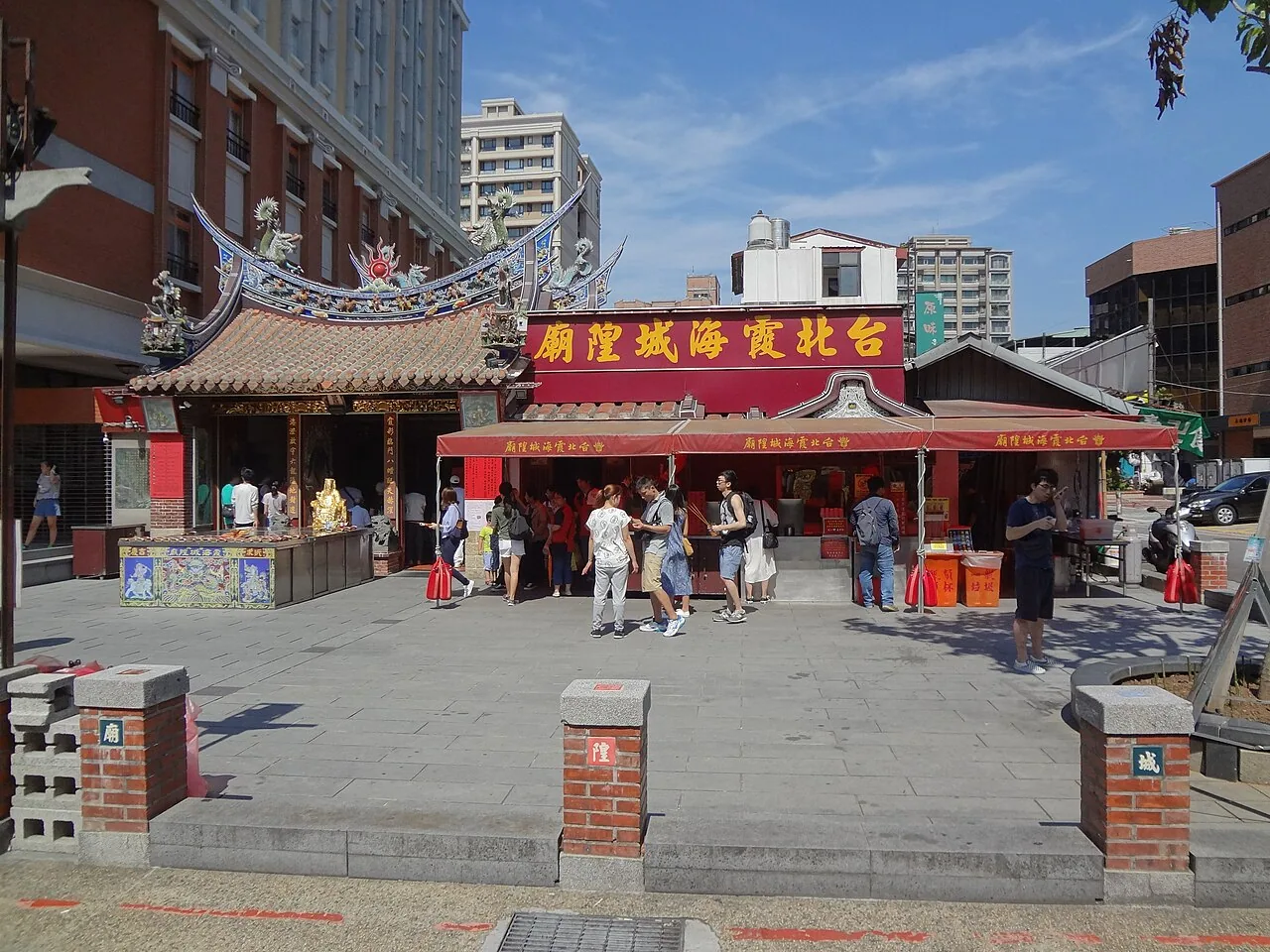
Dadaocheng Xia-Hai City God Temple, No. 61, Section 1, Dihua Street. Photo: Solomon203, CC BY-SA 4.0 via Wikimedia Commons.
The 1860 Opening of the Port, John Dodd, Li Chunsheng, and Those 120,000 Catties of Tea
In 1858, after the Qing empire was defeated in the Second Opium War, it signed the Treaty of Tianjin with Britain, and Tamsui was listed as a treaty port. In 1860, the tenth year of the Xianfeng reign, Tamsui formally opened as a port; in 1863, the agreed port area was extended to Dadaocheng10. From that year on, this inland street converted from a rice-drying ground was directly connected to ports across the Pacific.
The key figures who turned Dadaocheng into a "tea node" were two foreigners and one man from Xiamen.
The Scottish merchant John Dodd arrived in Taiwan in 1865 to investigate local conditions. He found that northern Taiwan's hills and climate were suitable for growing tea. In 1866, he introduced tea seedlings from Anxi, Fujian, to the hills south of Tamsui, around today's Muzha and Pinglin, for trial cultivation11. But Dodd himself did not speak Hokkien. He needed someone who could communicate with tea farmers and keep the accounts, so he hired Li Chunsheng, who was then living in Xiamen, knew business, spoke English, and spoke Hokkien, to serve as comprador.
Li Chunsheng was born in Xiamen, Fujian, in 1838. As a young man, he worked for the British firm Elles & Co. In 1869, he formally came to Dadaocheng with John Dodd12. He brought commercial experience and also a Protestant faith. He was one of Taiwan's earliest Presbyterian believers and later funded George Leslie Mackay's mission work in Dadaocheng. Dadaocheng Church was founded on Guide Street in 1885.
In 1869, something happened that changed Dadaocheng's fate.
In 1869, the first 120,000 catties of Taiwanese oolong tea were exported directly from Tamsui to New York under the name "Formosa Tea"11. "Formosa" means "beautiful" in Portuguese and was the name by which Westerners referred to Taiwan at the time. This tea did not pass through Xiamen for re-export and was not sold under the name of Chinese tea. It was exported directly to New York under the brand "Formosa Oolong," selling for roughly 30 percent more than Chinese tea.
From that year on, the warehouses along Dadaocheng's harbor began filling with tea chests awaiting shipment. Tea merchants built Western-style houses on this street for business. Li Chunsheng built a mansion on Guide Street. Chen Tian-lai opened Jinji Tea Company in 1891, the seventeenth year of the Guangxu reign, exporting pouchong tea to Southeast Asia and China1. Pouchong tea differs from oolong tea: it is less fermented and has a lighter, more fragrant taste, and was mainly exported to overseas Chinese in Southeast Asia and tea merchants in China.
By the 1880s, 39 British and American firms had offices in Dadaocheng, and more than 15 million pounds of oolong tea were exported each year. Dadaocheng became the Qing empire's second-largest foreign-trade port, behind only Shanghai11.
💡 Did you know: After that 1869 shipment of Formosa Tea to New York, the spelling "oolong" began entering English vocabulary from this year onward. The English spelling "oolong tea" that appears today in American Starbucks and Whole Foods stores traces back to those 120,000 catties of tea loaded from the Dadaocheng waterfront in 1869. Behind an English term lies the consequence of a street and a group of people choosing "Formosa" as a brand 160 years ago.
Li Chunsheng died in 1924 at the age of 87. After his death, he was called the "father of Taiwanese tea"12. He lived in Dadaocheng for 55 years, watching this street grow from the Middle Street of Tong'an refugees into the Qing empire's second-largest foreign-trade port, and then into the political starting point for Taiwanese people under Japanese rule.
Chen Tian-lai was born in Dadaocheng in 1872, though some accounts say Xiamen, and died in 1939. His Jinji Tea Company building was completed between 1920 and 1923, and the two characters "Jinji" remain at its center today2. In 1985, the Chen Tian-lai Residence was designated a Taipei City municipal historic site, and it was restored and reopened in 201813.
The 1885 Western-Style School, the 1891 Railway Station, and Taiwan's First Railway
In October 1885, the eleventh year of the Guangxu reign, the Qing court issued an edict establishing Taiwan as a province and appointed Liu Mingchuan as Taiwan's first governor. After taking office, Liu's first act was to place the provincial capital near Dadaocheng, not inside the Taipei Prefecture walls completed only in 1884, and not in Bangka's old temple district. This decision fixed the pattern in which "Dadaocheng did business, the walled city handled administration, and Bangka tended the old gods," with three urban settlements standing side by side, a pattern the Japanese later continued for 25 years14.
The things Liu Mingchuan did during his six years in Taiwan, from 1885 to 1891, were so dense that he hardly seems like a nineteenth-century Qing official:
In 1885, he established a Western-style school in Dadaocheng: Taiwan's first modern school. Its campus stood between today's Liuguan Street and Jianchang Street in Taipei's Datong District, around today's Nanjing West Road and Xining North Road. The curriculum included English, French, geography, mathematics, and arithmetic, taught by hired foreign teachers. It enrolled 64 students in its first year15. This was 13 years earlier than Dadaocheng Public School, established under Japanese rule in 1898. Taiwan's earliest modern education began next door to Dadaocheng's tea merchants.
In 1888, Taiwan's first post office opened: its site was also in Dadaocheng.
In 1889, the railway from Dadaocheng to Keelung began service: Taiwan's first railway, built mainly to carry coal from Keelung Harbor to Dadaocheng Wharf for export by ship.
In 1891, Dadaocheng Railway Station opened: Taipei's first railway station, located between today's Yanping North Road and Section 1, Chengde Road in Datong District, Taipei15. Dadaocheng Railway Station operated until 1908, when it was replaced by a new Taipei Station built by the Japanese beside New Park, today's 228 Peace Park, and formally closed.
Liu Mingchuan left office in 1891. His successor, Shao Youlian, was fiscally conservative, and many modernization projects stalled. Four years after Liu's departure, Taiwan was ceded to Japan in 1895 after the Qing defeat in the First Sino-Japanese War. But the foundations he laid in Dadaocheng did not disappear. After the Japanese took over, they continued to treat Dadaocheng as Taipei's core for foreign trade and education.
✦ "In prosperous Dadaocheng, many new experiments and activities first appeared here, then spread across the island." (StoryStudio, "Where Is Taipei? The Origins of Tianlongguo"14)
No. 199 Taipingcho: Chiang Wei-shui, the Cultural Association, and Taiwan's Ginza
After the Japanese took over Taiwan in 1895, they began replanning Taipei as a modern city from 1900 onward. From the 1910s, Dadaocheng was divided into four cho: Taipingcho, Eirakucho, Nisshincho, and Kenseicho. Of these, the two main axes of Taipingcho, today's Yanping North Road, and Eirakucho, today's Dihua Street, became "the Ginza of Taiwanese people" from the 1920s onward: Japanese people lived inside the walled city, while Taiwanese people lived in Taipingcho16.
In 1916, the 25-year-old physician Chiang Wei-shui graduated from the Taiwan Governor-General's Medical School and interned at Yilan Hospital. In May 1916, he opened Da'an Hospital at No. 199, Taipingcho 3-chome in Dadaocheng, today's No. 31, Section 2, Yanping North Road5. Chiang Wei-shui was 25 and had only recently obtained his medical license, but what he opened was not merely a clinic: Da'an Hospital later became the secret meeting place of the Taiwan Cultural Association.
On October 17, 1921, the Taiwan Cultural Association was founded at Jingxiu Girls' School in Dadaocheng, today's Sacred Heart High School for Girls at No. 1 Horai-cho. Lin Hsien-tang served as president, and Chiang Wei-shui as executive director. The association's charter stated that its purpose was "to foster Taiwanese culture." In a colonial context, the two characters for "culture" were politics that could pass censorship5.
Early on the morning of December 16, 1923, Taipei Prefecture police conducted large-scale searches of the residences of Cultural Association leaders. Chiang Wei-shui was taken into Taipei Prison. This was the Public Security Police Incident, the first collective political persecution of Taiwanese people under Japanese rule. Chiang was imprisoned for four months, then was released and put on a white suit before returning to the streets5.
Da'an Hospital stood at No. 199 Taipingcho and operated from 1916 until Chiang Wei-shui's death in 1931. After the 1940s following the war, that site became the flagship store of I-Mei Foods. I-Mei had opened "I-Mei Store" there in 1934, selling bread and groceries; after Chiang's death, his student Kao Fan-wang and father-in-law Kao Tsai-te continued operating the business17. Visit No. 31, Section 2, Yanping North Road today and you will see the sign for "I-Mei Yanping Store" at the entrance. Older residents will tell you, "This used to be Chiang Wei-shui's hospital."
Taipingcho was not only about politics. It also had music.
In 1932, "Longing for the Spring Breeze" was produced by the Taiwan branch of Columbia Records, composed by Teng Yu-hsien, written by Li Lin-chiu, and sung by Sun-sun, whose real name was Liu Qingxiang. The recording took place in Columbia Records' Dadaocheng office, in the southern section of today's Dihua Street. After its release, "Longing for the Spring Breeze" became widely popular in 1930s Taiwan and was Taiwan's first pop song in the true sense18. Teng Yu-hsien's later works, including "Rainy Night Flower" in 1934 and "Sorrow on a Moonlit Night" in 1933, also came out of this Dadaocheng office and are still covered today. In the 1930s, Dadaocheng was not only a commercial center but also the birthplace of Taiwanese-language popular music.
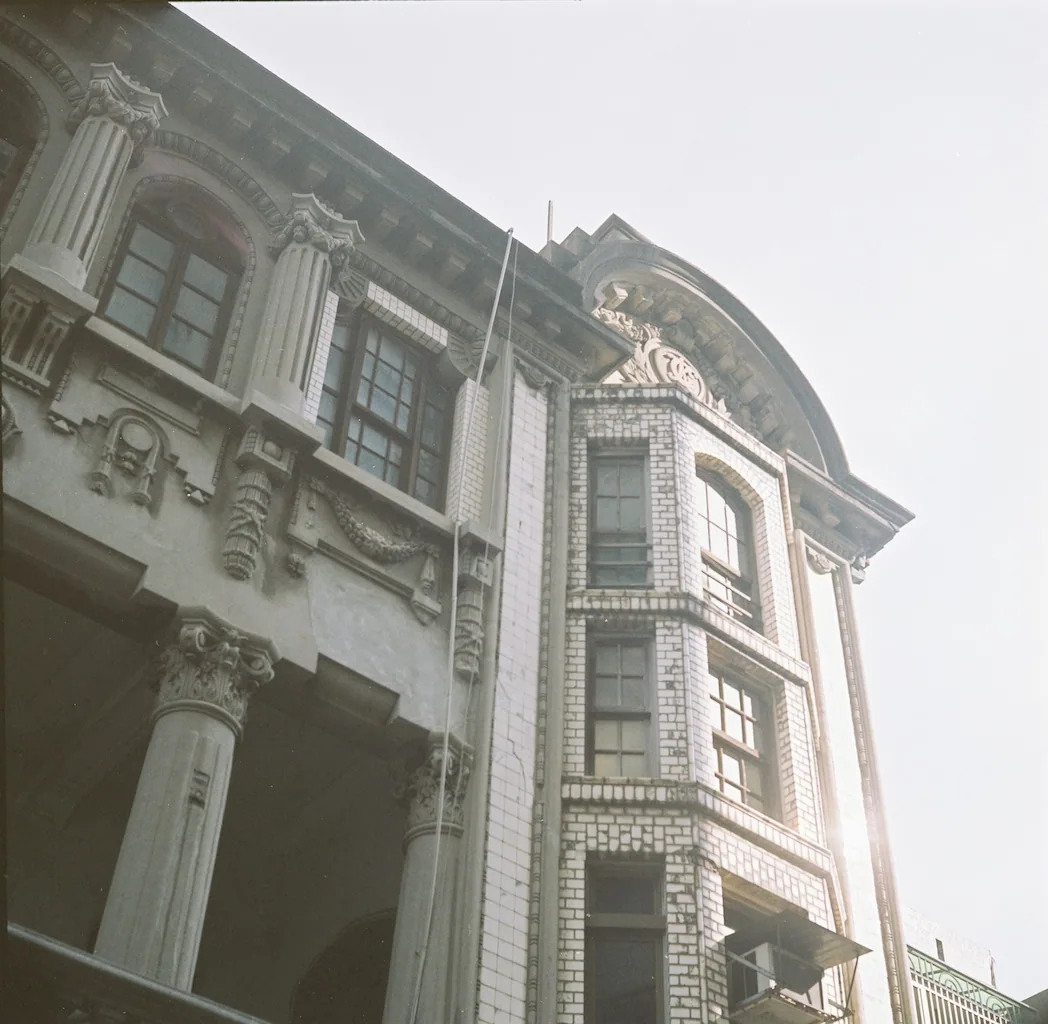
_Chen Tian-lai Residence, No. 73 Guide Street, reopened after restoration in 2018. Photo: Nisa yeh from Taipei, Taiwan, CC BY-SA 2.0 via Wikimedia Commons._
That Packet of Cigarettes: the Small Stone Plaque at No. 189 Nanjing West Road
On October 25, 1945, the Nationalist government accepted Japan's surrender at Taipei Public Hall, today's Zhongshan Hall. One year and four months later, at dusk on February 27, 1947, a packet of contraband cigarettes in Dadaocheng ignited postwar Taiwan's deepest wound.
The site was Tianma Tea House, at today's No. 189 Nanjing West Road, Taipei4, a cafe in Dadaocheng run by the cultural figure Zhan Tianma. Tianma Tea House opened in 1934, featuring phonograph music and coffee, and was a popular gathering place for Dadaocheng intellectuals in the 1930s.
At 7:30 p.m. on February 27, 1947, six investigators from the Taipei branch of the Taiwan Provincial Monopoly Bureau went to the area around Tianma Tea House to investigate contraband cigarettes19. They stopped Lin Jiang-mai, a 40-year-old widow who sold contraband and legal cigarettes side by side at the entrance to support her son and daughter. The investigators confiscated the contraband cigarettes and also took her legal cigarettes and money. Lin knelt and pleaded. Investigator Fu Xue-tong struck her on the head with a gunstock, leaving her bleeding and unconscious on the spot19.
The surrounding crowd pressed in. Fu Xue-tong fired his gun to intimidate them, and the bullet hit the bystander Chen Wen-xi, who died of his injuries the next day19. On the following day, February 28, 1947, Dadaocheng residents marched in formation from Tianma Tea House to the square in front of the Taiwan Provincial Chief Executive's Office, today's Executive Yuan. They were "swept by machine-gun fire from guards, causing multiple deaths and injuries"4. Protesters occupied nearby New Park, today's 228 Peace Park, and seized the Taiwan Broadcasting Station inside the park, now the site of the 228 Memorial Museum, broadcasting news of the incident across the island. Broadcasting was the key to the incident's loss of control. What happened in Taipei spread by radio across Taiwan, and protests erupted from Keelung to Pingtung. Island-wide suppression began in early March. According to various studies, the estimated death toll was between 18,000 and 28,00020.
The original site of Tianma Tea House is now a commercial building. At the entrance is a small stone plaque engraved with the names Lin Jiang-mai, Fu Xue-tong, and Chen Wen-xi. Most passersby do not stop to look. This plaque is not a national monument, it is not on maps, and there is no guided interpretation. It is only a low metal plaque embedded in the side of a building. But for those who know, this address is one of Taipei's heaviest coordinates4.
📝 Curator's note: Conventional commemorative narratives of the February 28 Incident focus on "how many people died," "who gave the order," and "the central government's responsibility." But the physical location of that packet of contraband cigarettes at dusk on February 27, 1947, No. 189 Nanjing West Road in Dadaocheng, is embedded into Taipei's streets more deeply than any monument. Lin Jiang-mai did not choose Dadaocheng at random. She sold cigarettes on this street because Dadaocheng was Taipei's busiest Taiwanese commercial district. Fu Xue-tong and the six investigators did not choose Dadaocheng at random. They came here because Dadaocheng had the most cigarettes. Dadaocheng became the stage for the incident that evening in 1947 because, since the 1860s, it had always been "Taiwanese people's Taipei": a commercial center, a political starting point, and the birthplace of Taiwanese-language popular music. The event's physical geography is as structural as the event itself. After 1949 came 38 years of martial law, and Taipei residents could not say the three characters "February 28" in public. Dadaocheng went from Taipei's liveliest street to an "address no one dared mention." Three generations of Taipei residents reconstructed their understanding of February 28 step by step, from silence to whispers to the memorial museum.
The 1996 Road-Widening Plan, the Leshan Foundation, URS, and Dihua Street 207
From the postwar period to the mid-1980s, Dadaocheng experienced nearly 40 years of slow silence. During martial law after 1947, the street retreated from being Taipei's most important commercial center to the safer role of a "dry-goods wholesale center." In 1965, the planned Sun Yat-sen Freeway route passed through Taipei; after the second elevated bridge opened in 1973, Dadaocheng's northern side was cut open and the old street's external circulation was obstructed21. At the same time, Taipei's emerging commercial districts, such as Zhongxiao East Road in the East District and the Xinyi Planning District, appeared one after another. Dadaocheng's tea shops, fabric shops, and Chinese medicine shops closed or moved away, one by one. By the late 1980s, many Taipei residents had already classified Dihua Street as an "old district."
In 1996, the Taipei City Government proposed the Dihua Street widening plan, expanding the street from its original 7.8 meters to 20 meters and demolishing many old shophouses on both sides, on the grounds of "improving traffic and commercial development." Had this plan been carried out as originally proposed, today's Dihua Street would look like any other commercial boulevard in Taipei, with all the old Western-style buildings demolished22.
But the plan met resistance.
The Leshan Cultural and Educational Foundation had been promoting surveys and preservation of Dihua Street's old buildings since the 1980s. After the 1996 widening plan was proposed, the Leshan Foundation, scholars, local residents, and cultural-heritage preservation groups jointly launched an anti-widening movement. After nearly four years of negotiation, in 2000 the Taipei City Government formally withdrew the widening plan and instead adopted a transfer of development rights mechanism: the development rights of old shophouses could be "transferred" to other districts, while the old houses themselves were preserved22. This was the first large-scale use in Taiwan of development-rights transfer to preserve a historic district, and it later became a model for preservation movements across the island.
From 2010, Taipei City's Department of Cultural Affairs launched the URS, or Urban Regeneration Station, program, establishing URS 27, URS 44, URS 127, and other sites on Dihua Street, converting old shophouses into galleries, cultural-creative spaces, and performance venues. In 2017, Museum 207 on Dihua Street was founded by Lin Wen-lan, transforming a 1962 old shophouse that had once been a Chinese medicine shop at No. 207, Section 1, Dihua Street into a museum displaying the everyday history of Dadaocheng23.
💡 Did you know: In the 1996 anti-widening movement, many of the signatures on petitions came from owners of old dry-goods shops still doing business on Dihua Street today. Their reason for stepping forward against the city government's widening plan was practical: "After widening, our shops would have to move five meters back. Trucks could not get in, customers could not get in, and the dry-goods trade would be cut off." In many Taiwanese historic-preservation movements, the key drivers were not hip young creatives or scholars, but older local residents.
Walk Dihua Street today and within 800 meters from south to north, you can see three eras coexisting: beside the 1851 Middle Street site stands the 1859 Xia-Hai City God Temple; across from the temple is the 1917 Watson's Pharmacy, with its Baroque-style shophouse facade; 200 meters farther north is the 1923 Chen Tian-lai Residence; still farther north are Museum 207, opened in 2017, and cultural-creative brands that arrived after the 2010s, including inBlooom, He Xing 88 Ting, and ASW Tea House. These 800 meters contain every result of Taiwan's 30 years of preservation movements.
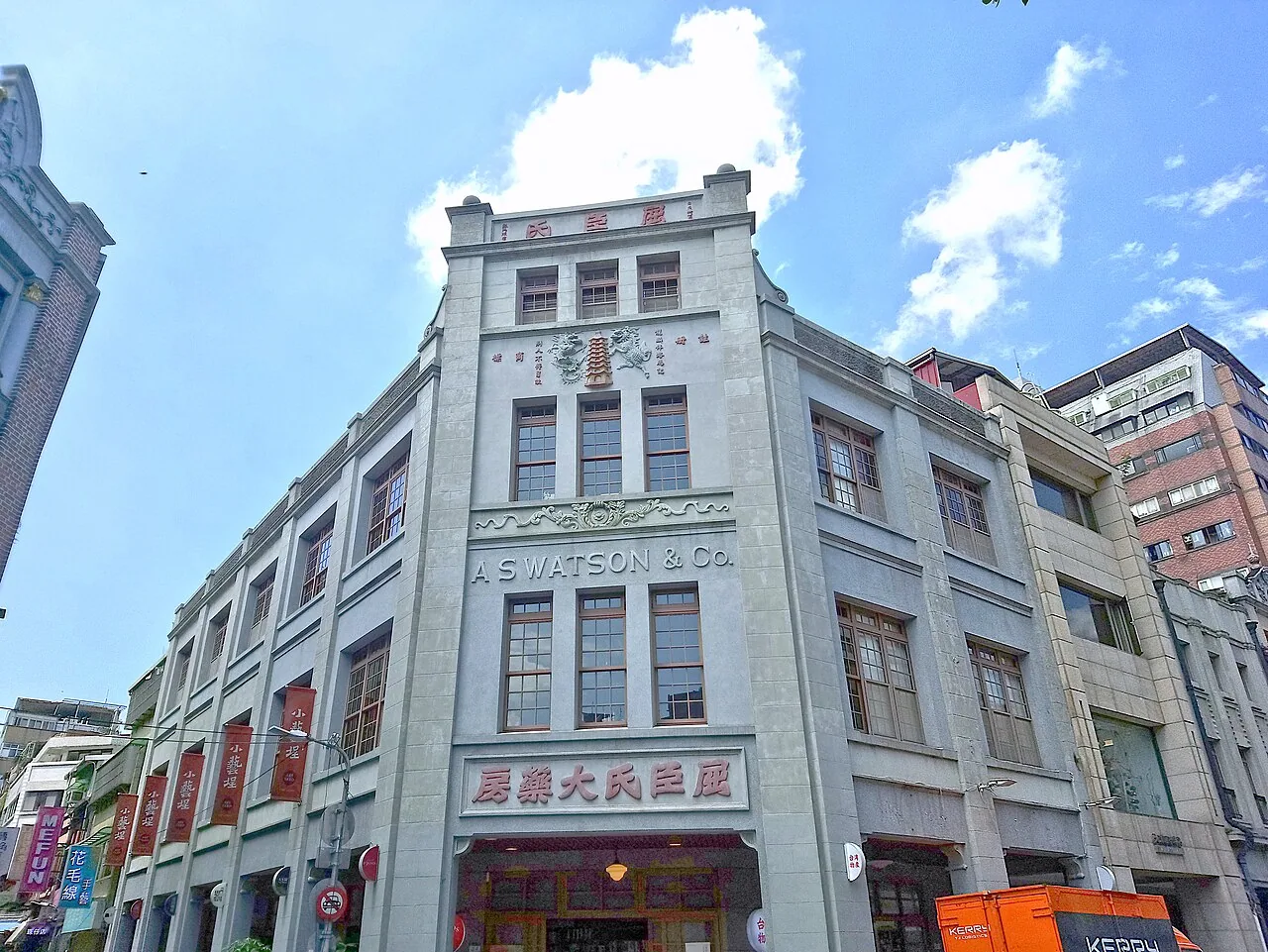
Dihua Street Watson's Pharmacy, founded in 1917. Photo: 寺人孟子, CC BY-SA 4.0 via Wikimedia Commons.
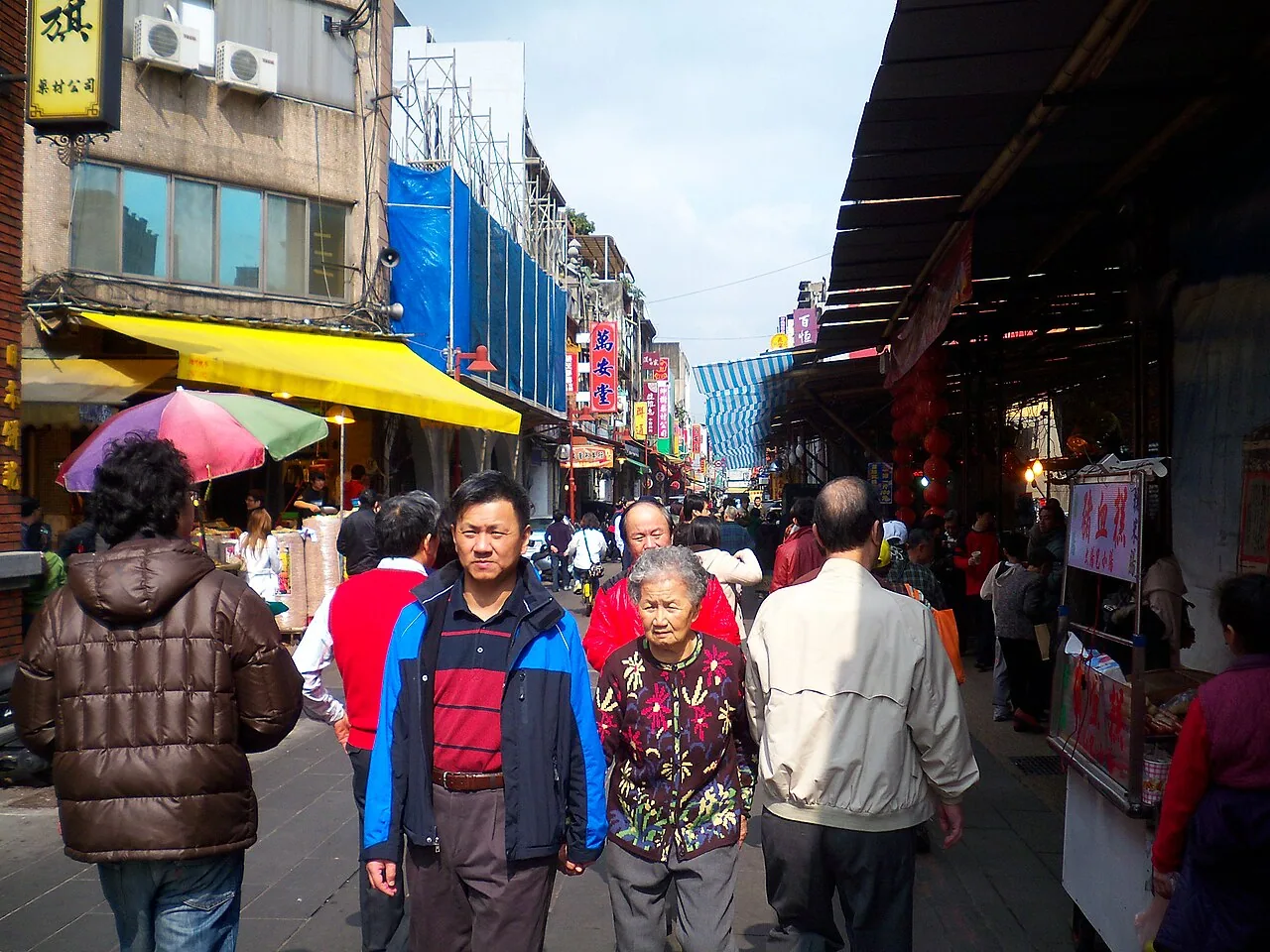
Dihua Street during the Lunar New Year market. Photo: 玄史生, CC BY-SA 3.0 via Wikimedia Commons.
Three Places Locals Will Take You
This does not list the photo spots for tourists: the line to pray to the Matchmaker God in front of Xia-Hai City God Temple, the Lunar New Year market week when the crowds make walking impossible, the dry-goods stalls on the first floor of Yongle Market, or the fried rice at Rice & Shine. You can find those by Googling "must-visit Dihua Street."
Instead, here are three places locals will take you, places that rarely trend on Instagram but have warmth:
1. The food-stall cluster in the square before Cisheng Temple (Bao'an Street Lane 49)
Walk north from Dihua Street past Minsheng West Road, turn left onto Bao'an Street, and continue to Lane 49, where you will see Cisheng Temple, the Mazu temple at Dadaocheng's northern end, built in 1864. The temple square has more than ten food stalls that open at 5:30 in the morning and close at 2 in the afternoon. "Xu's Pork Knuckle," "Ye Family Meat Congee," and "Mai Mian Yan Zai Jinquan Snack Shop" all draw lines, but locals come between 10 a.m. and noon, in the gap between the tourist breakfast peak and the Lunar New Year market lunch rush. The distinctive feature here is eating at tables and chairs set up in the temple forecourt. The temple provides tables and chairs for vendors to use free of charge, and when you look up while eating, you see the eaves of a temple built by Tong'an people 162 years ago24.
2. The riverside outside Water Gate No. 5 at Dadaocheng Wharf (end of Lane 32, Huanhe North Road)
Cross Huanhe North Road westward from Guide Street, walk out through Water Gate No. 5, and you reach the Tamsui River. This location was the waterfront from which Taiwanese oolong tea was loaded for export from the 1860s to the 1900s. Today the site is a riverside park and bicycle path. Locals come here between 5:30 and 7 p.m. to watch the sunset. From this angle, across the Tamsui River you see the outline of Guanyin Mountain in Sanchong, and around 5:30 the sun sinks behind Guanyin Mountain. One hundred sixty years ago, John Dodd and Li Chunsheng stood here looking at the same Guanyin Mountain and the same river. Stand here today and under your feet may be the remains of the wharf where Formosa Tea was loaded for New York in 1869.
3. The small stone plaque across from Fazhugong Temple (No. 189 Nanjing West Road)
From the southern end of Dihua Street, cross Nanjing West Road and you will arrive. Most people walking along this street do not look up at that small stone plaque: it is embedded in the side of a commercial building, roughly knee-high. It is engraved with "Lin Jiang-mai, Fu Xue-tong, Chen Wen-xi, 1947.2.27, origin site of the February 28 Incident." This is not a national monument. There are no flowers, no guided interpretation, and no national holiday. But for those who know what happened on that evening in 1947, the plaque's position is more direct than any central-level monument. Looking out from here, directly opposite is Fazhugong Temple, established during the Qing Xianfeng reign, around the 1850s, nearly a century before 1947. On that evening in 1947, the investigators, Lin Jiang-mai, Fu Xue-tong, and Chen Wen-xi all passed under this temple's gaze.
Eight Hundred Meters, Three Centuries
From the first shop opened by Lin Lantian in 1851 to the tourists walking into Museum 207 on Dihua Street in 2026, this street holds 175 years of time. Dihua Street is quiet at 5:30 in the morning: the Western-style building of Jinji Tea Company, opened by Chen Tian-lai in 1891, still stands at its original site at No. 73 Guide Street; the incense burner in front of Xia-Hai City God Temple has burned for 167 years; and the Baroque facade of the 1917 Watson's Pharmacy still stands on Section 1, Dihua Street.
Five minutes south at No. 189 Nanjing West Road, that small stone plaque is embedded in the side of a commercial building. The names Lin Jiang-mai, Fu Xue-tong, and Chen Wen-xi have been engraved there for more than 30 years, and most passersby do not stop to look.
From the 1709 Dajiala reclamation association to the Tong'an refugees who arrived in 1853; from the 1869 export of Formosa Tea to New York to Liu Mingchuan's Western-style school in 1885; from Chiang Wei-shui's Da'an Hospital in 1921 to Sun-sun's "Longing for the Spring Breeze" in 1932; from that packet of cigarettes in 1947 to the 1996 anti-widening movement; from URS in 2010 to Museum 207 on Dihua Street in 2017, an 800-meter street holds three centuries of Taiwan.
The next time you walk along Dihua Street, look up at the carved flowers and birds on those Western-style buildings from the 1910s, and remember that under your feet there is more than brick and tile.
Further Reading:
- Taipei City: Three Times in One City, Longshan Temple of 1738 Watching Taipei 101 of 2004 — a panorama of Taipei's 12 districts, and Dadaocheng's position among the three urban settlements
- Taiwan's Old-Street Culture and Commercial Districts — the master catalog for old streets, comparing Dihua Street with Lukang, Bangka, and Sanxia
- Taiwanese Tea Culture — the full context of Formosa Tea and northern Taiwan's tea industry
- The February 28 Incident — the incident ignited by that packet of cigarettes in 1947, the subsequent suppression, and transitional justice
- Social Movements in Taiwan under Japanese Rule — Chiang Wei-shui and the Cultural Association at No. 199 Taipingcho
- Taiwanese Folk Songs and Ballads — "Longing for the Spring Breeze" in 1932 and Columbia Records in Taipingcho
- Bangka — the Tong'an people defeated in the 1853 Dingxia Jiaopin conflict fled from Bajiazhuang in Bangka to Dadaocheng; the two streets were divergent results of the same armed conflict
- Ximending — a sibling historic district in the same batch 1, comparing an entertainment district formed under Japanese rule in 1896 with a Qing-era commercial street in Dadaocheng, two different "moments of street formation"
- Dalongdong — after the 1853 Dingxia Jiaopin defeat, Tong'an people first retreated to Dalongdong, using Bao'an Temple as a defensive center, before moving to Dadaocheng, an intermediary stop omitted from conventional Dadaocheng narratives
- Shilin — the 1859 Zhangzhou-Quanzhou armed conflict and Bangka's 1853 Dingxia Jiaopin were two different conflicts; Shilin was another divergent outcome, rebuilt after Zhangzhou people had their street burned by Quanzhou people
Image Sources
This article uses five CC / Attribution-licensed images (hero + 4 inline), all cached in public/article-images/geography/ to avoid hotlinking from source servers:
- Aerial photographs of Dihua Street — Photo: Yu tptw, Attribution
- Taipei Xia-Hai City God Temple 20180729 — Photo: Solomon203, CC BY-SA 4.0
- Chen Tian-lai Residence 12303134604 — Photo: Nisa yeh, CC BY-SA 2.0
- Watson's Pharmacy — Photo: 寺人孟子, CC BY-SA 4.0
- Dihua Street Lunar New Year 20110203a — Photo: 玄史生, CC BY-SA 3.0
References
- Wikipedia: Chen Tian-lai — A tea merchant born in Dadaocheng, Taipei, in 1872. In 1891, he opened Jinji Tea Company at No. 73 Guide Street, exporting pouchong tea to Southeast Asia and China. The Chen Tian-lai Residence, a Chinese-Western hybrid Baroque-inspired Western-style building constructed between 1920 and 1923, was restored and reopened to the public in 2018.↩2
- Taipei City Department of Cultural Affairs: Chen Tian-lai Residence — The Chen Tian-lai Residence was designated a Taipei City municipal historic site in 1985. The central characters "Jinji" remain preserved today. After restoration was completed in 2018, it opened for reservation-based guided tours and stands as Dadaocheng's best-preserved representative tea-merchant Western-style building.↩2
- Wikipedia: Taipei Xia-Hai City God Temple — After the Tong'an people were defeated in the 1853 Dingxia Jiaopin conflict in Bangka, devotee Chen Jinrong carried the City God image and fled to Dadaocheng. In 1859, the ninth year of the Xianfeng reign, they built the temple beside Middle Street at No. 61, Section 1, Dihua Street. The name comes from "Xia-Hai," the seashore of Xiacheng in Zhangzhou, Fujian, the Tong'an people's ancestral place. As of 2026, the temple has remained in its original location for 167 years without moving.↩2
- Wikipedia: Tianma Tea House — The cultural figure Zhan Tianma opened a cafe in 1934 at No. 189 Nanjing West Road, Dadaocheng, Taipei, opposite Fazhugong Temple. At dusk on February 27, 1947, Taiwan Provincial Monopoly Bureau investigators checking for contraband cigarettes outside the cafe struck the widow Lin Jiang-mai with a gunstock and wounded her, then fired and mistakenly killed the bystander Chen Wen-xi, triggering the February 28 Incident. The original site is now a commercial building but retains a small commemorative stone plaque.↩234
- Wikipedia: Chiang Wei-shui — In May 1916, Chiang opened Da'an Hospital at No. 199, Taipingcho 3-chome, Dadaocheng, Taipei, today's No. 31, Section 2, Yanping North Road. On October 17, 1921, he helped found the Taiwan Cultural Association at Jingxiu Girls' School in Dadaocheng and served as executive director. In the Public Security Police Incident of December 16, 1923, he was taken into Taipei Prison for four months. He died of typhoid fever in 1931 at age 41.↩234
- Taiwan Cultural Memory Bank: Chen-Lai-Zhang Reclamation Association and Dajiala — In 1709, the forty-eighth year of the Kangxi reign, five Quanzhou merchants, Chen Tianzhang, Lai Yonghe, Chen Xianbo, Chen Fengchun, and Dai Tianshu, jointly formed the Chen-Lai-Zhang reclamation association and obtained the "Dajiala" reclamation permit, broadly referring to today's Wanhua, Datong, Songshan, and Dadaocheng areas of Taipei. At the time, Dadaocheng remained within the activity area of the Ketagalan Tappari community.↩
- Wikipedia: Dihua Street — The earliest shops on Dihua Street appeared in 1851, the first year of the Xianfeng reign, when Lin Lantian moved from Keelung to Dadaocheng and opened the general-goods store "Lin Yishun." This is the earliest record of commercial activity in Dadaocheng, 24 years before Shen Baozhen petitioned to establish Taipei Prefecture in 1875.↩
- Wikipedia: Dingxia Jiaopin — In August 1853, the third year of the Xianfeng reign, the Dingxia Jiaopin armed conflict broke out in Bangka. The "upper guild" of Quanzhou people from the three counties of Jinjiang, Nan'an, and Hui'an fought the "lower guild" of Tong'an people from Quanzhou over control of wharf trade. In September, the Tong'an people were defeated, and devotee Chen Jinrong carried the Xia-Hai City God image from Bajiazhuang in Bangka to Dadaocheng. This was the key year in the expansion of Dadaocheng's streets.↩
- Datong District Office: Dadaocheng History Section — After the 1853 Dingxia Jiaopin conflict, Tong'an people moved into Dadaocheng and built shops around Xia-Hai City God Temple, forming "Middle Street." Between 1853 and 1860, the area expanded from a rice-drying ground into a commercial street with more than 100 shops, laying the foundation for Dadaocheng as northern Taiwan's foreign-trade center.↩
- Wikipedia: The Opening of Tamsui Port — After the Second Opium War in 1858, the Qing empire signed the Treaty of Tianjin with Britain, and Tamsui was listed as a treaty port. In 1860, the tenth year of the Xianfeng reign, it formally opened as a port. In 1863, the agreed port area extended to Dadaocheng, after which Dadaocheng was directly connected to ports across the Pacific and became northern Taiwan's foreign-trade node.↩
- StoryStudio: Where Is Taipei? The Origins of Tianlongguo — A full account of the tea era: Tamsui Port opened in 1860; the Tamsui port area extended to Dadaocheng in 1863; the Scottish merchant John Dodd arrived in Taiwan in 1865; tea seedlings were introduced from Anxi, Fujian, in 1866; in 1869, the first 120,000 catties of Taiwanese oolong tea were exported directly from Tamsui to New York under the name "Formosa Tea"; and by the 1880s, 39 British and American firms had offices in Dadaocheng.↩23
- Wikipedia: Li Chunsheng — Born in Xiamen, Fujian, in 1838, Li worked for the British firm Elles & Co. as a young man. In 1869, he came to Dadaocheng with John Dodd as comprador. One of Taiwan's earliest Protestant believers, he funded George Leslie Mackay's mission work in Dadaocheng in 1885 and helped establish Dadaocheng Church. After his death in 1924 at age 87, he was called the "father of Taiwanese tea."↩2
- Bureau of Cultural Heritage, Ministry of Culture: Chen Tian-lai Residence — The Chen Tian-lai Residence was designated a Taipei City municipal historic site in 1985. Located at No. 73 Guide Street in Datong District, Taipei, it is a three-story Chinese-Western hybrid Baroque-inspired Western-style building completed between 1920 and 1923. It was restored and reopened for reservation-based guided tours in 2018.↩
- StoryStudio: Liu Mingchuan's Choice of Taipei Site — In October 1885, the Qing court issued an edict establishing Taiwan as a province and appointed Liu Mingchuan as its first governor. Liu placed the provincial capital near Dadaocheng rather than inside the Taipei Prefecture walls completed in 1884, establishing the side-by-side pattern of "Dadaocheng doing business, the walled city handling administration, and Bangka tending the old gods," later continued by the Japanese for 25 years.↩2
- Taiwan Cultural Memory Bank: Liu Mingchuan's Modernization Projects in Taiwan — In 1885, Liu Mingchuan established a Western-style school in Dadaocheng as Taiwan's first modern school. Its campus was around today's Nanjing West Road and Xining North Road. The curriculum included English, French, geography, mathematics, and arithmetic, taught by hired foreign teachers, and the first year enrolled 64 students. Taiwan's first post office opened in 1888, the Dadaocheng-Keelung railway began service in 1889, and Dadaocheng Railway Station opened in 1891 before being replaced by the newly built Taipei Station in 1908.↩2
- Wikipedia: Taipingcho (Taiwan) — From the 1910s under Japanese rule, Dadaocheng was divided into four cho: Taipingcho, Eirakucho, Nisshincho, and Kenseicho. Taipingcho, today's Yanping North Road, and Eirakucho, today's Dihua Street, became "Taiwanese people's Ginza" from the 1920s onward. Japanese people lived inside the walled city while Taiwanese people lived in Taipingcho, making it a representative district of ethnic spatial differentiation in Japanese-rule Taipei.↩
- Wikipedia: I-Mei Foods — In 1934, Kao Fan-wang, a student of Chiang Wei-shui, and his father-in-law Kao Tsai-te opened "I-Mei Store" at No. 199, Taipingcho 3-chome, Dadaocheng, today's No. 31, Section 2, Yanping North Road, selling bread and groceries. The address had previously been Chiang Wei-shui's Da'an Hospital from 1916 to 1931. After the war, I-Mei Yanping Store continued operating to the present and is one of Taipei's most historically significant storefronts.↩
- StoryStudio: "Longing for the Spring Breeze" and Columbia Records — Produced in 1932 by the Taiwan branch of Columbia Records, composed by Teng Yu-hsien, written by Li Lin-chiu, and sung by Sun-sun, Liu Qingxiang, "Longing for the Spring Breeze" was Taiwan's first pop song in the true sense. The recording took place in Columbia Records' office in Dadaocheng, today's southern Dihua Street. Over the following decade, Teng Yu-hsien wrote Taiwanese-language popular songs including "Rainy Night Flower," "Sorrow on a Moonlit Night," and "A Face Full of Spring Breeze," establishing Dadaocheng as the birthplace of Taiwanese-language music.↩
- Wikipedia: February 28 Incident — At 7:30 p.m. on February 27, 1947, six investigators from the Taipei branch of the Taiwan Provincial Monopoly Bureau went to the area around Tianma Tea House in Dadaocheng to investigate contraband cigarettes. They stopped the 40-year-old widow Lin Jiang-mai, confiscated contraband cigarettes, and also took her legal cigarettes and money. Investigator Fu Xue-tong struck Lin on the head with a gunstock, causing her to faint. When bystanders surrounded them, Fu fired and mistakenly killed the passerby Chen Wen-xi, who died of his wounds the next day. This triggered the February 28 Incident, including the February 28 march by Dadaocheng residents to the Chief Executive's Office, where they were swept by machine-gun fire.↩23
- Academia Historica: February 28 Incident Research Report — Estimates of the island-wide death toll in the February 28 Incident. The Executive Yuan's 1992 "February 28 Incident Research Report" estimated 18,000 to 28,000 deaths, including those from the island-wide clearance and suppression campaign that began in early March 1947 after the Nationalist government moved troops from Fujian to Taiwan. It was postwar Taiwan's most severe political tragedy.↩
- Wikipedia: Dadaocheng — After the Sun Yat-sen Freeway's Taipei section was planned in 1965 and the second elevated bridge opened in 1973, Dadaocheng's northern side was cut open and the old street's external circulation was obstructed. After the 1980s, emerging Taipei commercial districts such as the Zhongxiao East Road East District and the Xinyi Planning District rose, and Dadaocheng gradually retreated from Taipei's liveliest commercial center into a dry-goods wholesale center. Tea shops, fabric shops, and Chinese medicine shops closed or moved away one after another.↩
- Leshan Cultural and Educational Foundation: Record of the Dihua Street Preservation Movement — In 1996, the Taipei City Government proposed widening Dihua Street from 7.8 meters to 20 meters, requiring the demolition of multiple old shophouses along the street. The Leshan Cultural and Educational Foundation, scholars, local residents, and cultural-heritage preservation groups jointly launched an anti-widening movement. In 2000, the city government formally withdrew the widening plan and adopted a transfer of development rights mechanism to preserve the old houses. This was Taiwan's first large-scale use of development-rights transfer to preserve a historic district.↩2
- Museum 207 Official Website — Founded in 2017 by Lin Wen-lan, this private museum transformed a 1962 old Chinese medicine shophouse at No. 207, Section 1, Dihua Street into a museum displaying the everyday history of Dadaocheng. It is the most representative private preservation case outside the Taipei City Department of Cultural Affairs' URS, or Urban Regeneration Station, program, and together with URS 27, URS 44, URS 127, and other sites forms Dihua Street's cluster of cultural-creative revival.↩
- Wikipedia: Taipei Cisheng Temple — Built in 1864, the third year of the Tongzhi reign, by Tong'an people in Dadaocheng to worship Mazu, the temple is located between today's Lane 49, Bao'an Street and Section 2, Yanping North Road in Datong District. The temple square has more than ten food stalls operating from 5:30 a.m. to 2 p.m., with tables and chairs provided free of charge by the temple for vendors. It is a local food cluster used by residents at Dadaocheng's northern end, forming the north-south poles of Dadaocheng's temple life with Xia-Hai City God Temple at the southern end.↩