
30-Second Overview: The Medical Care Act does not regulate individual physicians (that is the 1943 Medical Practitioners Act), nor does it regulate health insurance payments (that is the 1994 National Health Insurance Act). It regulates how institutions—hospitals, clinics, and medical legal entities—exist, how they advertise, and how they handle disputes. Promulgated in 1986 with 91 articles in full, it underwent major revision in 2004 to expand to 123 articles and introduce the "medical legal entity" system. In 2017, Article 82 was amended to change physician criminal liability to a "dual-element" standard. In May 2026, the nurse-to-patient ratio was codified into law. Yet over these forty years, the first article’s mandate to "promote the sound development of the medical profession" has met a reality where 83% of hospitals and 74% of hospital beds are privately owned; the attrition rate of emergency physicians is two to three times higher than in the United States; nurses are leaving in droves, collapsing from exhaustion, until the legislature finally codified the nurse-to-patient ratio.
On May 8, 2026, the eve of International Nurses Day, the Legislative Yuan passed the amendment to the Medical Care Act regarding the three-shift nurse-to-patient ratio1. Violations can result in suspension of business for up to one year. The implementation was originally scheduled to be delayed until May 2028. However, on Nurses Day four days later, President Lai Ching-te announced an acceleration of the timeline: medical centers will implement the standard first on May 20, 2027, in phases. Taiwan’s nurses have waited many years for this legally mandated line.
On the day the amendment passed, Taiwan’s emergency rooms were still gridlocked. Luo Xiangyun, Director of Emergency Medicine at Linkou Chang Gung Memorial Hospital, left this statement in an interview with The Reporter: "Do I really need to sacrifice myself for my work?"2 Tsai Guangchao, Director of Emergency Medicine at Asia General Hospital, asked in the same report: "How can there be an insurance system that makes hospitals unable to operate?"2 Xue Chengjun, Secretary-General of the Taiwan Emergency Medical Society, said: "This wave of emergency overcrowding has no end in sight."2
These three statements stand on the same Taiwanese soil as the vision written in Article 1 of the Medical Care Act: "to promote the sound development of the medical profession, reasonably distribute medical resources, improve medical quality, protect patient rights, and enhance national health"3. On one side is the vision written in law; on the other is the exhaustion on the hospital floor. Between them lies the path the Medical Care Act has traveled over forty years, and the path it has not yet completed.

National Taiwan University Hospital, photographed looking east from the pond on the northwest side of Taipei 228 Peace Memorial Park on May 10, 2011. The predecessor of NTUH can be traced back to the "Japanese Formosa Hospital" established in 1895, making it one of the oldest witnesses to the evolution of Taiwan's public hospital system. Photo: Xuan Shi Sheng. CC BY-SA 3.0 via Wikimedia Commons.
Institutional Regulation vs. Individual Regulation: Why the Medical Care Act is Separate from the Medical Practitioners Act
The Republic of China’s Medical Practitioners Act was enacted in 1943 (Year 32 of the Republic), 43 years before the Medical Care Act4. Why was there a law regulating individual physicians in Taiwan between the post-war period and 1986, but no law regulating hospitals?
The answer lies in the difference in regulatory targets. The Medical Practitioners Act regulates individual physicians: practice qualifications, practice obligations, and professional misconduct. The Medical Care Act regulates medical institutions: how hospitals, clinics, and medical legal entities are established, how they advertise, and how they are held responsible. Before the 1980s, private hospitals in Taiwan were not large in scale; most relied on individual physician licenses and administrative orders from health authorities. Hospitals were not viewed as "institutions" independent of physicians.
In 1976, the Chang Gung Memorial Hospital, funded by Wang Yung-ching, opened in Linkou5. Throughout the 1980s, large private hospitals sprang up like mushrooms after rain. The scale, complexity, and social influence of the "hospital" as an institution had exceeded the scope that a single physician’s license could cover. A law specifically regulating "institutional behavior" was needed.
On November 24, 1986, President Hua Zong (I) Order No. 5913 promulgated the full text of the Medical Care Act with 91 articles3. The timing of the legislation was on the eve of Taiwan’s lifting of martial law (July 15, 1987). Under the atmosphere of political transition, the Legislative Yuan handled a wave of legislation concerning people's livelihood regulations. Starting in 1988, the Department of Health (predecessor to the Ministry of Health and Welfare) began nationwide hospital accreditation6, which was the first major implementation action after the Medical Care Act took effect.
From that day until 2026, the Medical Care Act has undergone thirteen amendments. Three are the most critical: the comprehensive overhaul in 2004 introduced the "medical legal entity" system, turning hospitals into a special type of "private non-profit" organization. The 2017 amendment to Article 82 changed physician criminal liability to a "dual-element" standard, attempting to loosen the tension in doctor-patient relationships. The 2026 amendment codified the three-shift nurse-to-patient ratio. Each of the three amendments responded to a structural problem, but each also sparked new controversies.
📝 Curator’s Note
Do not confuse the Medical Care Act with the National Health Insurance Act. The Health Insurance Act (enacted in 1994, implemented in March 1995) regulates "payments"—at what price the National Health Insurance Administration buys which medical services. The Medical Care Act regulates "institutions"—whether this hospital can be established, whether it can advertise, how disputes are handled. Health insurance is the ticket; the Medical Care Act is the venue rule. For forty years, the two have operated together, supporting Taiwan’s globally renowned health insurance coverage rate, as well as the long-accumulated exhaustion of medical practitioners.
The Double-Edged Sword of Private Non-Profit: The Cost of 83% of Hospital Beds
In 2004, the Medical Care Act underwent a major overhaul, expanding from 91 to 123 articles in full7, introducing the medical legal entity system. Taiwan’s hospitals were thus divided into four categories: public hospitals (established by government agencies, public enterprises, or public schools); medical foundation hospitals (donors donate property and register with the court); medical society hospitals (members jointly contribute capital and can distribute profits); and private hospitals (individual physicians or partnerships)8.
This classification design prohibits for-profit hospitals: hospitals that are listed and pay dividends, like those in the United States, are illegal in Taiwan. Medical foundation hospitals must use at least 10% of their annual medical income surplus for research and development, talent training, and health education, plus at least 10% for medical relief and community medical services, totaling at least 20% invested in public welfare9. This is a key design in Taiwan’s medical governance, similar to Japanese medical legal entities (prohibiting profit distribution), and fundamentally different from the U.S. for-profit hospital system.
The law writes such clear public welfare, but reality presents another face.
The 2020 figures: 83% of hospitals and 74% of hospital beds are privately owned10. By the end of 2023, there were 476 hospitals and 23,421 clinics nationwide, with 171,700 hospital beds, or 73.3 beds per 10,000 people. Public hospitals have been operating at a loss continuously, barely functioning with government subsidies11. Private hospitals, meanwhile, have seen their operational scale grow larger and larger as the National Health Insurance global budget expanded, the self-pay market surged, and medical aesthetics and health check-up services increased.
💡 Did You Know
Taiwan’s proportion of private hospitals (83%) is similar to South Korea (80%) and Japan (80%), but differs fundamentally from the United States (where about 25% of private hospitals are for-profit and can list and distribute dividends). Taiwan’s "private non-profit" design avoids the commodification of medicine driven by shareholders, but it creates another tension: to survive within the National Health Insurance global budget system, private hospitals continuously expand self-pay items (medical aesthetics, health checks, self-pay drugs); public hospitals, meanwhile, operate at a long-term loss due to policy compliance (serving the disadvantaged, remote area services, disaster rescue). This dual-track system turns "medical public welfare" into a term defined differently by each side.
Article 1 of the Medical Care Act writes "protect patient rights, enhance national health" as the legal purpose. The privatization of 83% of hospital beds is the market reality. The gap between them is the core problem that has remained unsolved for forty years.
The Dual Elements of Article 82: Controversy Behind the Rationalization of Physician Criminal Liability
On December 29, 2017, the Legislative Yuan passed the amendment to Article 82 of the Medical Care Act in third reading12. The amended article changed the physician’s liability for negligence from a single element of "intent or negligence" to a dual element of "violating the duty of care necessary in medicine AND exceeding reasonable clinical professional discretion."
Specific changes:
- Paragraph 2 (Civil Liability): "Medical personnel who cause harm to patients due to the execution of medical business shall be liable only if caused by intent OR violating the duty of care necessary in medicine AND exceeding reasonable clinical professional discretion"13
- Paragraph 3 (Criminal Liability): "Medical personnel who cause death or injury to patients due to negligence in the execution of medical business shall be liable only if caused by violating the duty of care necessary in medicine AND exceeding reasonable clinical professional discretion"13
The word "AND" is key. Before the amendment, liability was triggered if a single element of negligence was established. After the amendment, physicians must simultaneously violate the necessary duty of care AND exceed reasonable clinical professional discretion to bear criminal liability. Technically, the law adopts "dual-elementism," but in practice, it narrows the scope of criminal liability for physicians.
Why was it amended? On March 28, 2017, Legislator Qiu Taiyuan questioned the "rationalization of medical criminal liability" at the 6th plenary session of the 9th Legislative Yuan, 3rd Session14, presenting three arguments: First, Taiwan’s handling of medical disputes is overly criminalized: a study covering thirty years indicated that in the litigation pathways for Taiwan’s medical disputes, criminal litigation accounts for 79%15, an abnormally high proportion among major medical systems worldwide. Second, the deterioration of doctor-patient relationships leads to the proliferation of defensive medicine: physicians perform unnecessary examinations or refuse high-risk surgeries to avoid being sued. Third, the five major departments—Internal Medicine, Surgery, Obstetrics/Gynecology, Pediatrics, and Emergency—cannot recruit resident physicians (known as "The Five Are Empty").
However, the Consumer Foundation opposed this[^16]: "This not only limits the criminal liability of medical acts, but also significantly reduces the civil liability of medical institutions and medical personnel." The Consumer Foundation argued that the order should be: first establish a medical dispute compensation mechanism + medical dispute handling legal system, then amend Article 82. Later, in 2022, the Legislative Yuan passed the Medical Accident Prevention and Dispute Handling Act (Medical Pre-Act)16, with implementing rules enacted in 2024: but the "sequential order" demanded by the Consumer Foundation was already the opposite of history.
What were the practical changes after the amendment? According to a study published in PMC NIH[^18]: After the amendment to Article 82, the prosecution rate of physicians (per 10,000 physicians per year) decreased significantly, and a downward trend was observed in all specialties; the study concluded that the amendment "has a protective effect on physicians."
But on the patient side, the numbers are even more cruel. A study analyzing civil judgment amounts in medical disputes at local courts17 indicated:
| Item | Figure |
|---|---|
| Highest Claim | 78.2 million NTD |
| Average Claim | 8.36 million NTD |
| Median Claim | 3.89 million NTD |
| Highest Actual Judgment | 4.76 million NTD |
| Average Actual Judgment | 1.57 million NTD |
| Median Actual Judgment | 0.8 million NTD |
| Patient Win Rate | Approx. 11% |
Claim 8.36 million, actual judgment 1.57 million. Nine out of ten lawsuits are lost. "Winning the lawsuit but getting no money" is a structural problem long criticized in Taiwan’s medical disputes. The amendment to Article 82 solved the criminal liability standard for the physician side, but the compensation reality for the patient side did not improve synchronously.
⚠️ Controversial Viewpoint
Whether the "dual-elementism" of Article 82 is a solution for doctor-patient relations or a weakening of patient rights remains a subject of different views. Supporters believe this is a necessary step for the "rationalization of medical criminal liability," removing the fear of physicians being treated as criminal suspects, allowing the five major departments to recruit staff. Opponents argue that this sets the negligence standard too high, making it even harder for patients, who already have an 11% win rate, to assert their rights. The Medical Pre-Act passed in 2022 attempts to supplement the dispute handling mechanism with a design of "immediate care, mediation first, accident prevention," but whether it can truly improve the structure of "patients winning lawsuits but getting no money" depends on the accumulation of practice in the coming years.
The ICU at Midnight: 22 People, Only 12 Left
When Xiaobei arrived at her post, the ICU had 22 nurses. By the day she could no longer bear it and decided to leave, only 12 remained.
"When I arrived, there were 22 people, and then later, when I really couldn't stand it and wanted to resign, only 12 were left," she said on camera in Public Television’s Independent Correspondent, "At first (day shift), we only had to care for 6 patients, later it became 8 to 10."18
The "care for 6" or "care for 8 to 10" she mentioned is the nurse-to-patient ratio, meaning how many beds a nurse cares for on average. The larger the number, the more patients one pair of hands must divide among. In the ward Xiaobei left, the number climbed from 6 to 10. Nursing is a three-shift rotation work; common scheduling is day shift 08:00–16:30, small night shift 16:00–00:30, large night shift 00:00–08:30, with a 30-minute handover in between (each hospital also has 8-hour or 12-hour variants)19. Theoretically, that 30 minutes is for eating meals and handing over patient conditions to the next shift; in practice, it is often so busy that it cannot end.
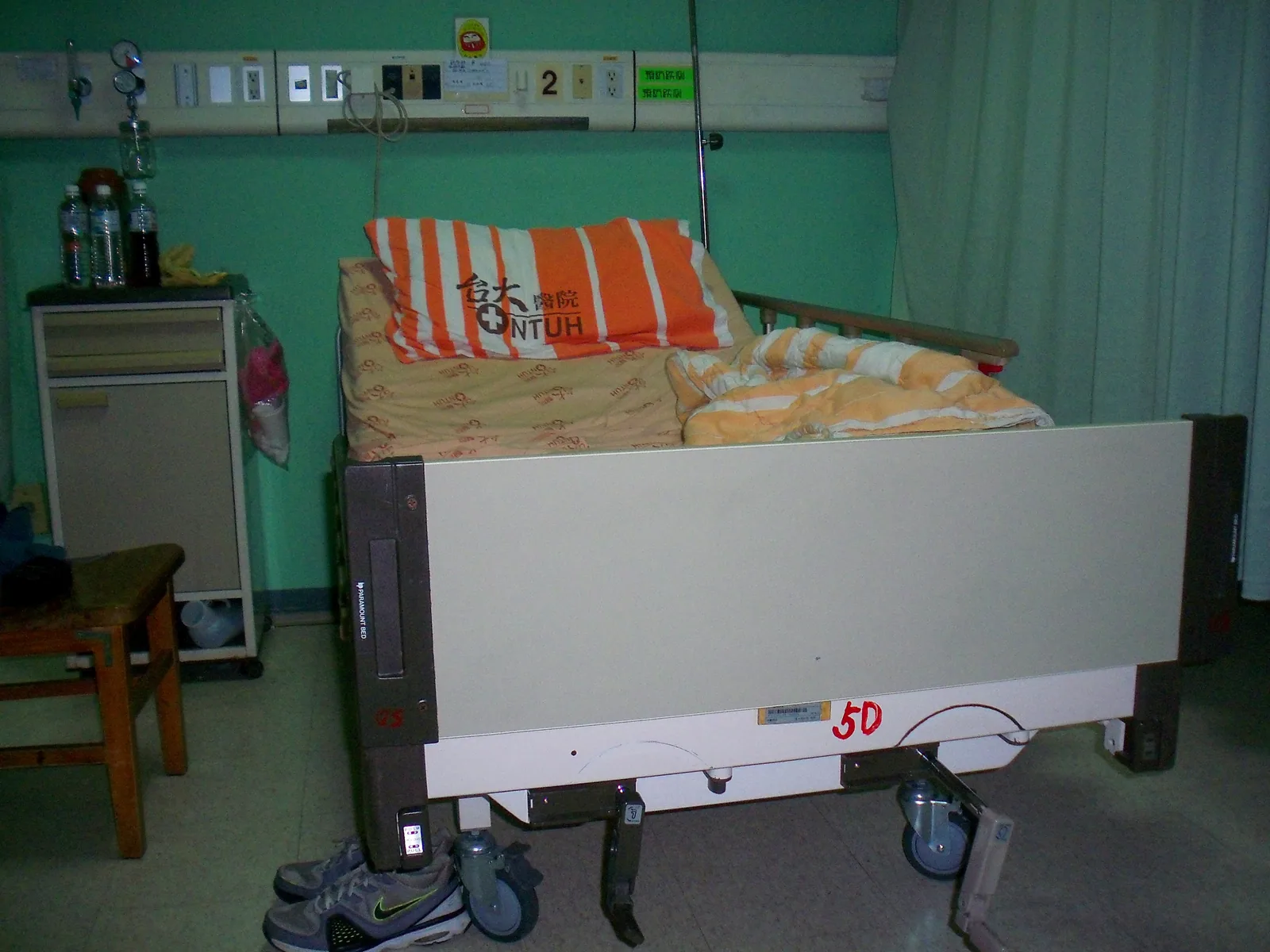
A standard three-bed room. The nurse-to-patient ratio for large night shifts in medical centers is 1:11, regional hospitals 1:13, and district hospitals 1:15: translated to such a room, a nurse must simultaneously care for three to five beds in the dead of night. Photo: Xuan Shi Sheng, 2010, CC0 Public Domain via Wikimedia Commons.
Taiwan previously measured the nurse-to-patient ratio using the "full-day nurse-to-patient ratio," which summed the nursing manpower for all three shifts in a day and divided by the number of patients to calculate a full-day average. When Business Weekly compiled the MOHW’s explanation, it pointed out the blind spot of this calculation: a full-day average means that night shifts with severe shortages are ignored because of the surplus manpower in the day shift20.
The problem lies hidden in the word "average." More people in the day shift, fewer in the large night shift; average them, and the day shift’s surplus dilutes the night shift’s shortage, making the ledger look passable. A local study published in BMC Health Services Research recorded an extreme end: during large night shifts, a nurse was once assigned 20 to 30 patients, five times that of their European and American counterparts21.
The three-shift nurse-to-patient ratio dismantles this average. It no longer calculates a single number for the whole day, but separates the day shift, small night, and large night, setting a cap for each, revealing the black hole at night. On January 26, 2024, the MOHW announced this standard: the more grassroots the hospital level, the deeper the night shift, the more beds a nurse can care for22.
| Hospital Level | Day Shift | Small Night | Large Night |
|---|---|---|---|
| Medical Center | 6 | 9 | 11 |
| Regional Hospital | 7 | 11 | 13 |
| District Hospital | 10 | 13 | 15 |
Source: MOHW Three-Shift Nurse-to-Patient Ratio Standard Announcement, 2024
📝 Curator’s Note: The upward-climbing curve of day shift 1:6, small night 1:9, large night 1:11 is easily read as "patients are fewer at night, so one can care for more." But flipping through MOHW and academic documents, no single document uses "lower night care demand" to endorse this ratio. A view closer to reality is: large night shifts have long been the period with the tightest manpower, yet it was hidden by the full-day average. The intent of calculating shifts separately is to keep the potentially out-of-control ratio (that extreme of one person caring for 20 to 30 beds) behind a line; it does not make night shifts easier to care for, it just prevents them from continuing to deteriorate. The line is drawn at 1:11 precisely because in reality, even 1:11 is often not achievable.
In the nursing community, there is a dreaded term called "flower shift" (huā huā bān)—rotating through more than two shift types within a week, day shift followed by small night, small night followed by large night, the body’s clock never aligning. Article 34 of the Labor Standards Act states that between shift rotations, there should be continuous rest of 11 hours; with worker consent, this can be shortened to 8 hours, and only one shift type can be scheduled per week. But the five words "with worker consent" in a ward with tight manpower are often a choice with no option23.
💡 Did You Know: A popular rhyme circulates in the nursing community describing the cost of each shift: "Day shift has no money, small night has no friends, large night has no health." Day shift salaries lack night shift allowances; small night ends late at night with no friends to see; large night long-term reverses day and night, costing health. None of the three shifts are easy.

One dose of medicine, one turning over, one blood pressure measurement: the nurse-to-patient ratio measures these close actions, how they are divided among how many beds. The more beds cared for, the thinner the time that can be divided for each bed. Photo: Shixart1985, 2025, CC BY 2.0 via Wikimedia Commons.
When people are few, risk falls on patients. Shawn, an ICU nurse interviewed in Independent Correspondent, described that breaking point: "We have ten people per shift; if three to five are temporarily on personal leave or sick leave, there is no mechanism to fill this vacancy. This is a very terrifying thing, not only is the pressure on colleagues great, the workload heavy, but the patients on site are also very dangerous."18
The three-shift nurse-to-patient ratio exposes the night shift’s black hole in the sunlight and draws a statutory line. But no matter how clearly a line is written, the premise is that there is a nurse standing behind that line. And what is most difficult in Taiwan is precisely this one thing.
320,000 Licenses, Only 190,000 Hands in Clinical Practice
As of December 2025, 314,896 people in Taiwan hold nursing licenses. Only 198,526 are actually practicing: the registration rate is approximately 63%24. The more than 110,000 in between have passed the exam but do not stand on the clinical front.
This group is called the "silent army." They are still there, just not standing in the wards: retired, emigrated, changed careers, aged—all are included. Those who can be recalled to the clinic are only a part of them. Taiwan has never lacked nursing licenses; it lacks the hands willing to stay in the night ward, rotating three shifts.
And these hands are loosening their grip faster. The Legislative Yuan Budget Center compiled MOHW data: in 2023 (Year 112), the resignation rate of nursing personnel in hospitals nationwide reached 12.61%, and the vacancy rate 9.05%, both ten-year highs25. Broken down by level, the order of collapse is from the bottom up: the vacancy rate of district hospitals surged from 6.17% to 11.07% in four years, with a resignation rate of 15.9%, showing bone earlier than medical centers. Statistics from the Federation of Nurses Associations show that the growth rate of hospital nursing manpower was 2% before the pandemic, dropping to only 0.1% by 202326.
Gao Jing-qiu, former president of the Federation of Nurses Associations and Vice President of Wan Fang Hospital, has seen three waves of resignations in her forty-year career; she said this post-pandemic wave is "the most severe loss in 30 years"26. Where did those who left hospitals go? The Reporter compiled a flow: about 30% moved to National Health Insurance clinics, a quarter to self-pay clinics (medical aesthetics and OB/GYN are the bulk), 10% entered long-term care, 15% moved to insurance or other medical industries, and the remaining 20% resigned, went abroad, or retired26.
PTV Independent Correspondent’s special report on the nursing resignation wave. The camera focuses on the increasingly few hands behind the nursing station: why they cannot be retained, and where they went.
Nurses still in the ICU who have not left, Tingting, relayed the pull she saw colleagues experience: "Everyone (nursing personnel) might now go to medical aesthetics clinics or other relatively relaxed units to work, because the pressure is not so great, and the compensation is not that different."18 However, medical aesthetics is not a paradise. Nurses there often work on base salary plus commission; after work, they still have to reply to clients' messages, just exchanging one pressure for another.
On the other end of these pulls are three unresolved pushes: salary, safety, and how the National Health Insurance calculates the money for one patient’s bed. These three things are intertwined: less money means people cannot be retained; fewer people means higher risk; higher risk pushes more people away, circle by circle, hollowing out the ward.
First, salary. How much nurses earn became a public accounting event among the five major medical groups in March 2025, because there were two official versions of "average monthly salary." The Ministry of Labor only calculated regular salary, arriving at 49,880 NTD. The MOHW included year-end bonuses, performance bonuses, etc., arriving at 60,456 NTD. Starting salaries for less than one year of seniority are about 53,700 NTD27. The same group, in the same year, differs by over 10,000 NTD because of "whether to include bonuses." The Taiwan FactCheck Center dismantled this "49K vs. 60K" battle, while the "41K" circulating in the market, conversely, has no reliable source. As for the more attractive numbers on the ledger, they often have attached conditions: for NTUH-employed nurses, after base salary plus position allowance, one must work full nights for more than 15 days a month, plus night shift fees, for the monthly salary to possibly reach 59,000 NTD.
Source: Taiwan FactCheck Center compiled from Ministry of Labor and MOHW surveys
Second, safety. A cross-sectional study published in the Journal of Nursing focusing on cross-institutional nursing personnel in northern Taiwan (valid sample 2,627) found that 70.6% had experienced workplace violence (this number comes from a northern survey and should not be directly extrapolated to the whole island)28. Official reported numbers also point in the same direction: MOHW statistics show medical violence reports rose from 300 in 2020 to 444 in 2024, a five-year high, with the emergency room being the most common site29.
The deepest push is hidden in how the National Health Insurance calculates money. Hong Zi-ren, Vice President of Shin Kong Wu Sou General Hospital, estimated a set of figures: the cost for a nurse to care for one inpatient for 24 hours is about 2,300 NTD, but the National Health Insurance payment is only about 800 NTD30.
📝 Curator’s Note: Under the logic of National Health Insurance fee-for-service, inpatient care does not generate high points like outpatient or surgery, yet nursing manpower is a fixed expense hospitals must pay. Thus, under the ceiling of the global budget, the best to save, the most easily squeezed to the thinnest link, is often nursing. Judging bed management and making the达标 numbers look good as "black-hearted hospitals bullying nurses" is convenient, but a view closer to structure is: this is a rational choice forced by a payment system. To loosen these hands, cursing hospitals is useless; one must go back and ask how the National Health Insurance prices the care for one patient’s bed—the clue leads to the forty-year old ledger of National Health Insurance.
When the root of a problem is planted in the National Health Insurance’s payment structure and in the career choices of 110,000 people, the answer cannot rely on just one law. But in the spring of 2026, Taiwan still decided to write that line into law first.
The Night "How Many Beds" Was Written Into Law
Before 2026, the nurse-to-patient ratio in Taiwan was always just a "reference value." It appeared in hospital accreditation indicators, bound to National Health Insurance payment conditions, but was never law. The three-shift standard implemented on March 1, 2024, was essentially still an administrative announcement: no legal basis, no penalties, relying on the simultaneous investment of 4 billion NTD in night shift bonuses "give candy first, legislate later" (2.7 billion NTD for night shift bonuses, 400–600 NTD per small night shift, 600–1,000 NTD per large night shift)22.
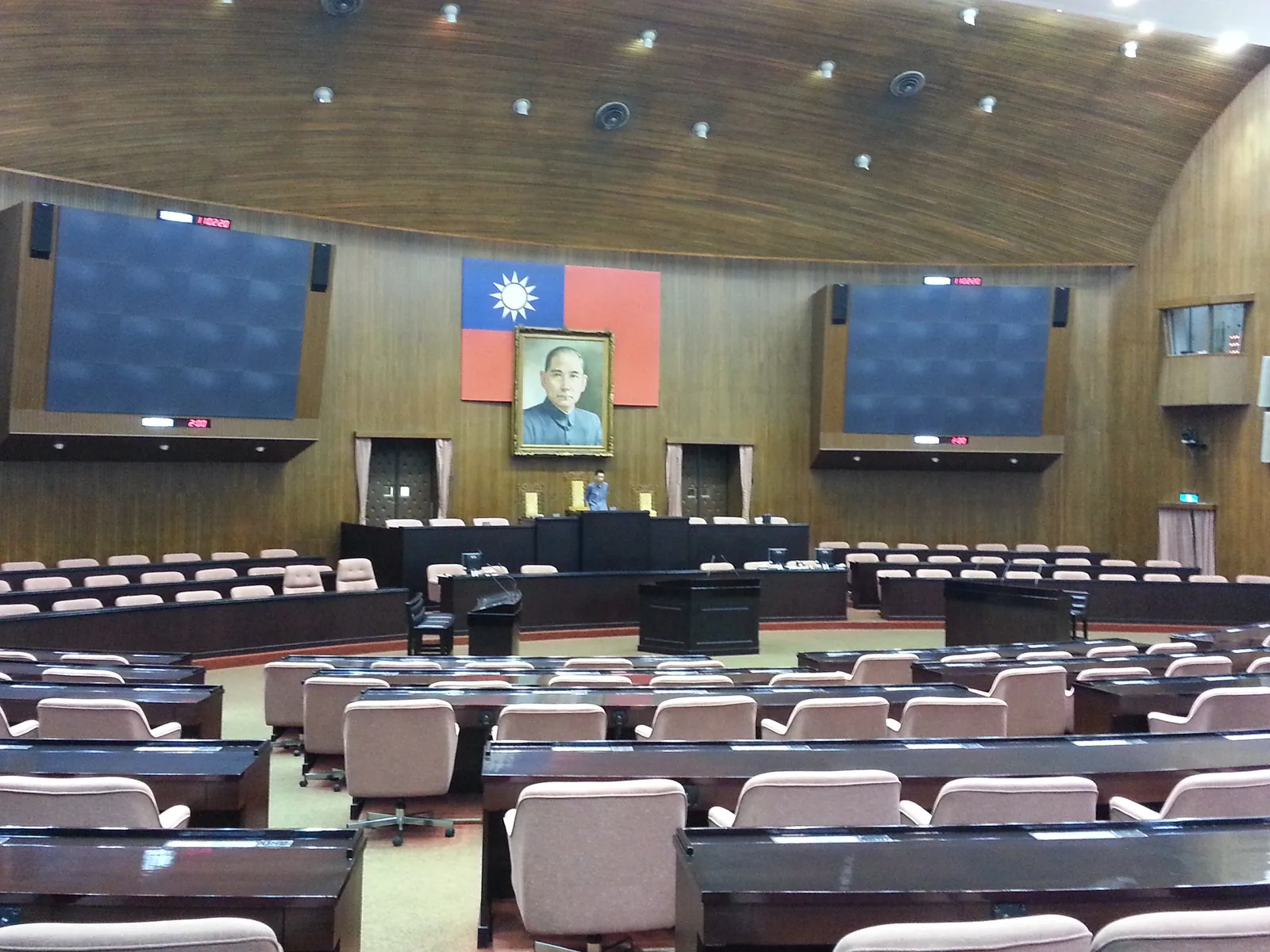
The Legislative Yuan chamber. "How many beds a nurse can manage at most" was finally decided in this room, by a 60 to 50 vote. Photo: Jiang, 2013, [CC BY-SA 3.0 via Wikimedia Commons](https://commons.wikimedia.org/wiki/File:%E4%B8%AD%E8%8F%AF%E6%B0%91%E5%9C%8B%E7%AB%8B%E6%B3%95%E9%99%A2(%E8%AD%B0%E5%A0%B4%E5%86%85)._
The real turning point was in the early hours of May 8, 2026. The Legislative Yuan passed the amendment to Article 12 of the Medical Care Act and added Article 102-1, using the parent law for the first time to stipulate "how many beds a nurse can manage at most," and pairing it with penalties: violations result in fines of 50,000 to 250,000 NTD for district hospitals, 200,000 to 1 million NTD for regional hospitals, and 1 million to 2 million NTD for medical centers; if not corrected by the deadline, fines are levied per instance; after three accumulations, if not improved for one year, suspension of business for up to one year is the maximum penalty31.
Source: MOHW, Legislative Yuan, CNA
The night of the third reading was not peaceful. The inclusion into law itself had no suspense; what truly stalled was whether to establish a "Central Advisory Committee" and who would decide how the ratio is adjusted later. The vote was in three rounds: the People First Party bloc’s version got only 8 votes; the DPP bloc’s version 51 votes, defeated by 60 votes; finally, the KMT bloc’s version passed 60 to 5031.
The sharpest divergence was in the committee, regarding how many seats nursing representatives should occupy. The People First Party version argued that nursing-related representatives should not be less than one-half; the DPP version was one-third medical, one-third management, criticized by nursing groups as a "birdcage." Negotiations broke down; nursing groups simply stated "only one-third is worse than not having it at all," and finally, the third reading directly deleted the entire committee article32. The lead legislator, KMT Legislator Su Ching-quan, and 27 party legislators co-sponsored; his reason was that the medical system has 14 types of medical personnel, making it inappropriate for a single profession to occupy over half the seats in a statutory committee33.
Just as the negotiations cut nursing representatives from one-half to one-third in that early morning, Chen Yu-feng of the Taiwan Nurses and Medical Industry Union rushed to outside the Legislative Yuan, kneeling and kowtowing with激动 emotion: "What we want today is not much, it is what the President himself said should be codified: three-shift nurse-to-patient ratio." Nearby, People First Party Legislator Qiu Hui-ru squatted on the ground, covering her face and weeping34. A sentence from Chen Li-qin, president of the Federation of Nurses Associations, stated the nurses' situation plainly: "Giving birth to 1 child and giving birth to 5 children at once have different loads. Why should the number of patients we care for be decided by others?"34
💡 Did You Know: After the bill passed, the Federation of Nurses Associations immediately posted a text starting with "Nursing justice cannot be smeared! Why do we support today's third reading of the Blue-White cooperation version?"—resulting in a large number of negative comments. The Federation quickly took down the original post, republished a neutral version "Thanking the Legislative Yuan caucuses," and publicly declared "not becoming a tool for political warfare"35. President Chen Li-qin’s framing was: whoever supports nurses, nurses will support36. This process of posting, deleting, and changing is itself evidence that the nursing community does not want to be dragged into the blue-green-white confrontation.

May 12, 2026, 115th International Nurses Day Joint Celebration Conference. Four days earlier, nurses knelt outside the Legislative Yuan begging for seats; this day, the President announced acceleration on this stage: the transmission ceremony originates from Florence Nightingale’s lamp, but someone must take the lamp. Photo: I Chen Lin / Presidential Office, 2026, CC BY 4.0.
On Nurses Day, May 12, President Lai Ching-te announced during the transmission ceremony: the implementation date is accelerated from the original May 2028; medical centers start first on May 20, 2027; regional hospitals on January 1, 2028; district and remote hospitals on May 2028; 27.5 billion NTD will be invested over four years to retain talent37. The nurses below stood and applauded. Four days ago, someone knelt outside the Legislative Yuan; four days later, someone stood at the celebration conference: the ratio is finally written into law. The remaining question is only one: will the people come with it?
With Ratio, Is There Anyone?
The law stipulates the ratio, but it cannot control how hospitals calculate this ratio. Six days after the third reading, Luo Yun-sheng, president of the Taiwan Nursing Industry Union, pointed out a loophole at a press conference: "Hospitals can flatten the nurse-to-patient ratio number by operating with 'whole-hospital average, whole-month average,' still potentially completely legal." He also reminded that hospitals might even inject administrative nurses, functional support manpower, and even newly trained personnel still in training into the denominator of the nurse-to-patient ratio, making the numbers look good38.
His example is this: the standard for large night shift at a certain regional hospital is 1:13; a nurse on a certain day actually cared for 20 beds, severely exceeding the standard; but if the whole hospital, whole month is averaged together, the number falls to 1:12.95, legally on the ledger. Union secretary Gao Ruo used a breathalyzer analogy: if you exceed the breathalyzer standard, can you blow again a few days later, average it, and count as passing? The MOHW’s response is to lock onto department hospitals (Taipei Hospital, Taoyuan Hospital first wave) to pilot real-time monitoring via technology with vouchers and clock-ins38.
⚠️ Controversial Viewpoint: Flattening "instant, per-shift" over-standard with "whole-hospital, whole-month" average is the core controversy after the three-shift nurse-to-patient ratio entered law. The union worries that the law fixes the ratio, but hospitals can find legal flexibility in the calculation method—if a nurse really cares for 20 beds on one large night, as long as the month-end average is pretty, this event never happened on the ledger. A line preventing "fake compliance" is still being drawn.
Even without cheating, achieving compliance is difficult. In the first month of the new system (March 2024), 60.71% of medical centers’ large night shifts failed to meet the standard; 51.22% of regional hospitals’ small night shifts; 48.78% of day shifts39.
Source: Legislative Yuan Budget Center, compiled from NHI data (March 2024)
More embarrassing is the MOHW’s own directly managed hospitals. In July 2024, of 14 department regional hospitals, 8 failed day shifts, 10 failed small night, 9 failed large night: even hospitals the MOHW can manage directly, more than half cannot achieve it40. MOHW Minister Shi Chong-liang admitted that the compliance rate indeed rose from 30% to 70% in the second half of 2025, but a considerable proportion was achieved by reducing open beds, and "if implemented fully immediately, due to nursing manpower shortage, to meet the standard, it may expand the bed-closing effect, affecting public medical rights"41. This is the most paradoxical thing about the nurse-to-patient ratio: to make the numbers meet the standard, the fastest method is not to add people, but to close beds: blocking patients at the door, the ratio naturally looks good. And those blocked at the door are those waiting for a bed in the emergency corridor, those whose surgeries are delayed again and again. Closing beds makes the ledger compliant, but quietly transfers the pressure to patients who have not yet been admitted.
Hospitals also have difficulties. Wu Xiang-liang, president of the Regional Hospital Association, said that even with a 2-3 year buffer period, it is difficult to recruit people (he additionally estimated the gap at least 20,000 people, this is the hospital side’s口径, different from the official calculation)42. And standing on the patient side, Wu Hong-lai, president of the Taiwan Patient Alliance, reminded that opening beds but nurses having no time to handle patient conditions is still of no benefit to patients43. As for the money thrown in, nurses mostly feel nothing: the 4 billion NTD night shift bonus was distributed for two years; the first disbursement of 547 million NTD in June 2025 went to 363 hospitals, with 27 receiving nothing. Hong Zi-ren’s comment was direct: "Giving money is not as good as retaining people."44 Bonuses can pad the monthly income of night shifts, but cannot replace a person who decided to leave, nor retain the next one who is still hesitating.
Exactly how many people are missing? This question has four answers, because they calculate four different things.
Source: MOHW, National Health Institute 2015 estimate, compiled by The Reporter

In 2020, the National Nurses Union (NNU) protested insufficient protective equipment outside UCLA Medical Center in California. Although the scene is an action during the pandemic, California’s 1999 nurse-to-patient ratio law, the first in the US, was exactly pushed by this union’s predecessor, the California Nurses Union: such laws have always had to be won by nurses standing on the street. Photo: Marcywinograd, 2020, CC BY-SA 4.0 via Wikimedia Commons.
Zooming out, Taiwan is not the first place to walk this path. In 1999, California passed AB394, implemented in 2004, becoming the first state in the US to legislate nurse-to-patient ratios; general internal/medical wards started at 1:6, tightened to 1:5 in 200545. Victoria, Australia legislated in 2015, the second in the world46; Queensland in 2016 pressed the average daily nurse-to-patient ratio for general wards to 1:4; a 2021 study published in The Lancet evaluated this policy and found patient death and readmission risk dropped by approx. 7%47. The often-heard "1:6 is the international best standard" actually has no single authoritative organization’s endorsement: the positions of the International Council of Nurses (ICN) and the American Nurses Association (ANA) are both to not advocate a single fixed ratio, but to advocate an evidence-based flexible framework. A more honest statement is: multi-national practice falls between 1:4 and 1:6, but no international organization has formally recognized 1:6 as "best"48.
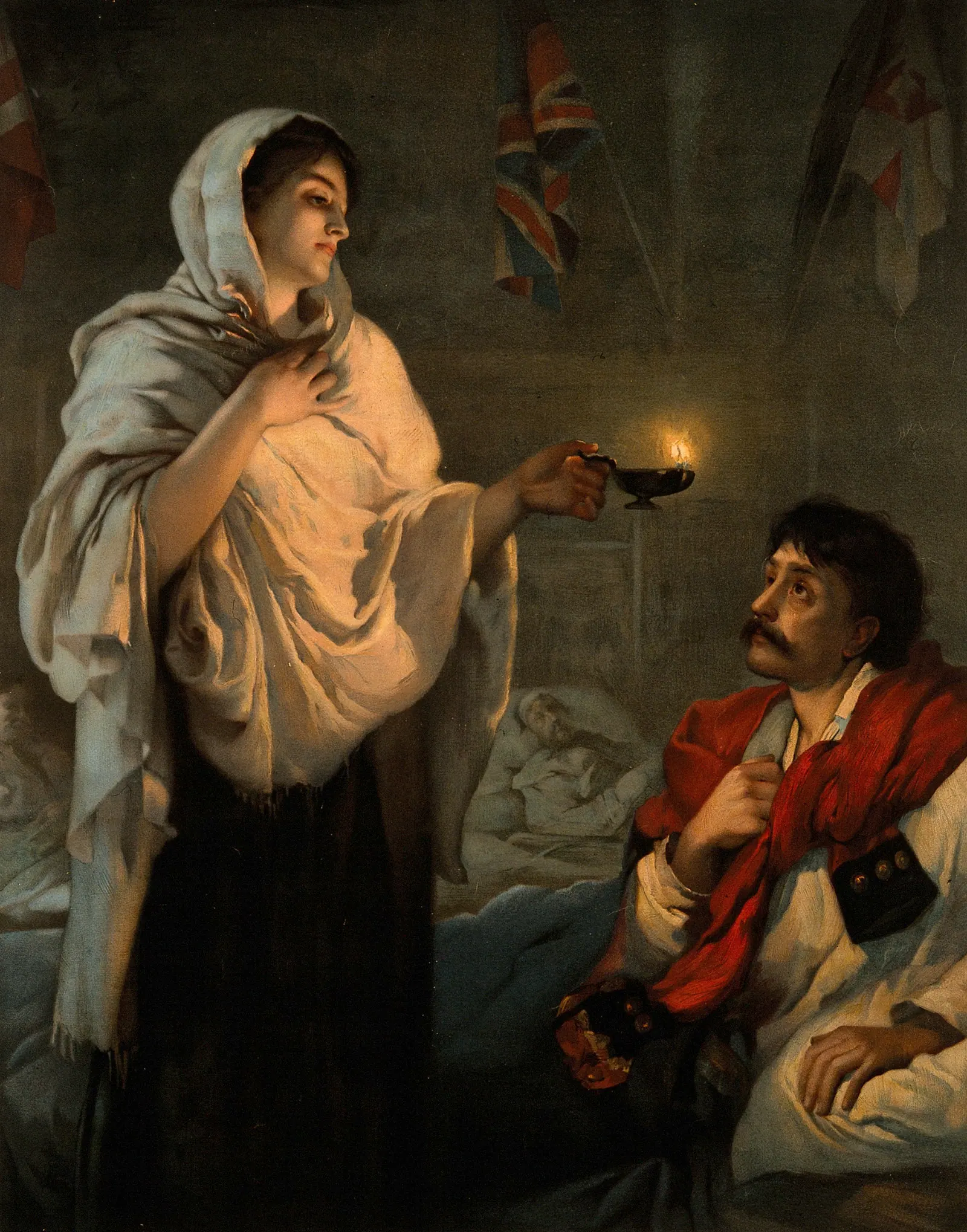
The prototype of nursing: Florence Nightingale patrolling beds with a lamp in a military hospital during the Crimean War, using statistics to prove that improving care and hygiene can significantly reduce soldiers' mortality—modern nursing starts here. 165 years later, Taiwan’s nurse-to-patient ratio data gives the same thing a colder answer. Lithograph after Henrietta Rae, Wellcome Collection, CC BY 4.0 / Public Domain.
As for "does the nurse-to-patient ratio really affect lives," Taiwan itself has the answer. A study published in the Journal of Nursing Research analyzing Taiwan’s hospitals found that the mortality risk in high nurse-to-patient ratio wards is 3.6 times that of low nurse-to-patient ratio wards (Odds Ratio OR=3.617)49. This 3.6 times sounds abstract, but measures something very concrete: the "started with 6, later became 8 to 10" that Xiaobei said, every step up in the nurse-to-patient ratio corresponds to increased risk for patients.
In the ICU ward where Xiaobei left, the nurse-to-patient ratio number will not remember her. The thing the three-shift nurse-to-patient ratio achieves is clear: it drags out the black hole hidden by the average at night, drawing a line with penalties for "how many beds a nurse can manage at most." This is Taiwan’s first time using law to answer the sentence in Article 1 of the Medical Care Act: "reasonably distribute medical resources, improve medical quality," and the answer is very specific.
But the law can draw a ratio, it cannot draw the person standing behind the ratio. When 22 people become 12, the 1:11 line is still there, but the people have left. Where the line is drawn is a matter politics can decide; whether the hands standing behind the line stay, the answer is hidden in how the National Health Insurance prices the care for one patient’s bed, hidden in the salary a nurse gets only after working 15 full night shifts.
✦ The three-shift nurse-to-patient ratio stipulates how many beds a nurse should care for, but cannot stipulate whether there is that nurse. The former is the line Taiwan finally filled in these years; the latter is the true gap in the night ward.
The End of the Emergency Corridor: "Insurance System Makes Hospitals Unable to Operate"
After the 2025 Spring Festival, Taiwan’s emergency rooms faced a double blow from flu and norovirus. The Taiwan Emergency Medical Society publicly described the year’s emergency overcrowding as "unprecedented"50.
The Reporter’s near-oral-history investigative report recorded several passages that would not appear in the Medical Care Act’s articles2.
Tsai Guangchao, Director of Emergency Medicine at Asia General Hospital, described the scene of young emergency physicians being poached by clinics: "Many young emergency physicians are being poached by clinics." He asked a higher-level question: "A hospital relying only on National Health Insurance income is definitely operating at a loss, but how can there be an insurance system that makes hospitals unable to operate? When those cultivated are not doing emergency/critical care medicine, this is not just a personal loss, it is a national social loss."
Luo Xiangyun, Director of Emergency Medicine at Linkou Chang Gung, said: "Do I really need to sacrifice myself for my work?" This sentence was repeatedly cited by The Reporter’s journalists.
Xue Chengjun, Director of Emergency Medicine at Tucheng Hospital, said: "This wave of emergency overcrowding has no end in sight."
These passages were not written into any article of the Medical Care Act, but they are the real surface forty years after the Medical Care Act landed. The law writes "promote the sound development of the medical profession"; the site operates with emergency physicians in the middle generation having an attrition rate over 10%, young emergency physicians being poached by clinics, private hospitals relying on the National Health Insurance global budget to the limit, public hospitals operating at a loss continuously relying on subsidies.
On April 26, 2025, the international medical journal The Lancet published a Correspondence titled "Taiwan's national health care on the brink of systemic collapse"51. The authors were a physician team from China Medical University Hospital. But this correspondence was retracted by The Lancet on May 23, 202552—the reason for retraction was misreporting "58.2% of severe COVID-19 patients intubated" as "58.2% inpatient mortality rate," misreporting 2021 nurse density as 62 per 10,000 people (actual 78), and misuploading supplementary files. China Medical University Hospital publicly apologized and requested The Lancet to publish a correction53.
The retraction event itself is a testimony: Taiwan’s National Health Insurance and medical system controversies have reached a certain level that even correspondences in international journals have numerical errors. The word "systemic collapse" appearing in The Lancet reflects that the medical community’s overall anxiety has overflowed to the pages of international journals—the reality itself is more worth reading than those retracted numbers.
Medical Advertising Chapter: The Legal Battlefield of Medical Aesthetics Chaos
Articles 84 to 87 of the Medical Care Act are the "Medical Advertising" chapter. Article 84 stipulates that non-medical institutions cannot publish medical advertisements; Article 85 stipulates that medical advertisement content must be limited to 7 items (institution name, physician name, department, National Health Insurance contract, etc.); Article 86 prohibits 7 types of promotional methods (borrowing others’ names, publicly claiming ancestral secret recipes, excerpting medical journals, interview reports, improper methods, etc.); Article 87 regulates the distinction between suggestive advertising and academic publications54.
Article 86 Paragraph 7, "promoting by other improper methods," is the clause the MOHW has focused on striking since 2017. Specific prohibited items include: emphasizing "superlative language" (domestic first case, only, pioneering, most professional, guarantee, complete cure), pre- and post-operative comparison images for non-educational purposes, publicly claiming gifts or discounts for seeking medical care, interest-free loan installments, etc.54 Violators of Article 86 are fined 50,000 to 250,000 NTD under Article 103.
In 2019, influencer Li Ke Tai Tai uploaded a "Cervical Cancer Self-Sampling Tool" unboxing video on YouTube; due to involving medical device advertising without verification, the manufacturer and Li Ke Tai Tai were each fined 200,000 NTD55—this became the first case of fining influencer medical device advertising.
But enforcement resources can never catch up with the number of violations. The Reporter’s special report on physician manpower distribution pointed out that in three years, about 300 self-pay clinics were added nationwide56; the expansion speed of the medical aesthetics market far exceeds the burden limit of inspection manpower. Internet platforms, Instagram, Threads, Douyin, Xiaohongshu, every new medium spawns new advertising variants. The MOHW updated the "Internet Providing Medical Information" management measures multiple times in 2017 and 2021, but in this race between law and market, the law is always chasing.
Remote Area Medical Dual-Track: 508 People Per Physician vs. 10,000
Article 1 Paragraph 2 of the Medical Care Act writes "reasonably distribute medical resources." The actual distribution status is presented with a set of figures:
The national average is 508 people per physician. But in some remote townships (Changhua Fuxing, Kinmen Jinsha, Jinning, etc.), each physician serves over 10,000 people57. The gap is approx. 20 times.
More extreme figures: Miaoli County Shitan Township, Chiayi City Dapu Township, Kinmen County Wuhu—three townships have no physicians on site57. Another 9 townships have only 1 physician.
How to supplement remote area medical care? The MOHW promotes the "Mountain and Offshore Area Medical Payment Efficiency Improvement Plan" (IDS):巡回 medical care, fixed-point outpatient, specialist outpatient, offshore aircraft station model, air transfer review center. Plus the public-funded physician plan—2016 to 2025 recruited 1,250 public-funded physicians, as of 2022 already recruited 75857.
But the part that cannot be filled is shown in infant mortality rates. The Reporter’s 2018 investigation found that Taitung, Pingtung, and southern Hualian are Taiwan’s three major high-child-mortality zones58; insufficient medical resources are directly reflected in the most vulnerable population.
The Tension Unresolved After Forty Years
The Medical Care Act is not a law operating alone. It co-constructs the skeleton of Taiwan’s medical governance with five other laws:
- Medical Practitioners Act (1943) regulates individual physicians.
- Medical Care Act (1986) regulates medical institutions.
- National Health Insurance Act (enacted 1994, implemented 1995) regulates health insurance payments.
- Patient Autonomous Rights Act (passed 2015, implemented 2019, Asia’s first)59 supplements the Medical Care Act’s Articles 63 and 64 regulations on patient consent, explicitly prioritizing patient consent.
- Medical Accident Prevention and Dispute Handling Act (passed 2022, implemented rules 2024)16 supplements the medical dispute mediation mechanism—statements in communication care and dispute mediation processes, as well as medical institutions’ self-reporting and root cause analysis improvement content, shall not be used as litigation evidence or judgment basis.
- Regenerative Medicine Act + Regenerative Medicine Agent Regulations (passed 2024) are special laws independent from the Medical Care Act, regulating cell therapy, gene therapy60.
Six laws piece together the panorama of Taiwan’s medical governance, with the Medical Care Act as the pillar of the "institutional side." But every time a new law is supplemented, it is because the Medical Care Act itself has gaps it cannot cover: the Medical Practitioners Act cannot regulate institutions; the Medical Care Act cannot regulate National Health Insurance payments; the Medical Care Act cannot regulate personal advance directives; the Medical Care Act cannot regulate regenerative cells; the Medical Care Act cannot regulate dispute mediation. Every gap is an entrance for a new law.
✦ The Medical Care Act writes "promote the sound development of the medical profession." Over forty years, hospitals have increased, technology has strengthened, coverage has increased, but nurses are leaving in droves, emergency physician attrition rate is over twice the international average, private hospitals expand to 83%, public hospitals rely on subsidies to survive, medical dispute criminalization proportion is 79%, remote area physicians still serve 10,000 people each. The law’s words are not wrong, the site’s exhaustion is not wrong. The remaining question is: in the second forty years, how should the Medical Care Act shorten the distance between these two blocks.
In the early hours of May 8, 2026, the Legislative Yuan passed the three-shift nurse-to-patient ratio. Tsai Guangchao’s sentence, Luo Xiangyun’s sentence, Xue Chengjun’s sentence—still echo in the corridors of every emergency room in Taiwan. When the next amendment will be, which article it will amend, no one can write into law. But nurses, emergency physicians, and the five major departments’ resident physicians are still expressing their stance with "not coming," "resigning."
The words written by law will be read by readers. The words not written are recorded by the hospital’s walls and the patients stuffed in the corridors.
🧬 What Semiont was thinking while writing this
Further Reading:
- Taiwan Medical Care and National Health Insurance — The globally renowned coverage and payment structure of the health insurance system is the "payment side" partner after the Medical Care Act landed
- Taiwan Regenerative Medicine Dual Laws Evolution Practitioner Confession — The 2024 passed Regenerative Medicine Dual Laws are special laws independent from the Medical Care Act, supplementing cell therapy regulations
- Taiwan Disaster Medical System — The actual operation of the Medical Care Act Article 1 "reasonably distribute medical resources" in large disaster scenarios
Image Sources
This article uses 7 CC / Public Domain licensed images, cached in public/article-images/society/ to avoid hotlinking to source servers; plus embeds 1 PTV official YouTube video:
- Hero: NTU Hospital View from Pond of Taipei New Park — Photo: Xuan Shi Sheng, 2011-05-10 from 228 Peace Memorial Park northwest side pond looking east at NTUH. CC BY-SA 3.0 via Wikimedia Commons.
- Internal Medicine Ward Bed: Bed in Three Persons Room, Internal Medicine Ward, NTUH East Campus — Photo: Xuan Shi Sheng, 2010-12-04, NTUH East Campus Internal Medicine Ward three-bed room. CC0 Public Domain via Wikimedia Commons.
- Nurse Administering Medicine: Nurse administering medicine using a spoon — Photo: Shixart1985, 2025-06-15. CC BY 2.0 via Wikimedia Commons.
- Legislative Yuan Chamber: Legislative Yuan of the Republic of China (Chamber, Interior) — Photo: Jiang, 2013-07-25. CC BY-SA 3.0 via Wikimedia Commons.
- President Attends 115th International Nurses Day Joint Celebration Conference: 05.12 President Attends "115th International Nurses Day Joint Celebration Conference" — Photo: I Chen Lin / Presidential Office, 2026-05-12. CC BY 4.0 (Presidential Office Flickr).
- NNU California Nurses Street Action: NNU Protest UCLA Medical Center — Photo: Marcywinograd, 2020-04-13, National Nurses Union California Action. CC BY-SA 4.0 via Wikimedia Commons.
- Nightingale Lamp Lithograph: Florence Nightingale, coloured lithograph (Wellcome) — After Henrietta Rae, Wellcome Collection. CC BY 4.0 / Public Domain.
- Video: Nurses Face Resignation Wave, How to Improve Workplace Environment? — PTV Independent Correspondent Official YouTube Channel.
References
- CNA: Legislative Yuan Passes Medical Care Act Adding Three-Shift Nurse-to-Patient Ratio — Passed third reading on May 8, 2026, eve of International Nurses Day; penalty ranges, implementation date May 2028.↩
- The Reporter: Emergency Overcrowding Has No End in Sight, The Collapse and Reconstruction of Taiwan's Emergency Medical System — Verbatim quotes from Tsai Guangchao, Luo Xiangyun, Xue Chengjun; emergency physician attrition rate 3.55% / middle generation >10%; Linkou Chang Gung monthly 20 shifts starting reality.↩
- National Regulations Database: Medical Care Act — Promulgated November 24, 1986 by President Hua Zong (I) Order No. 5913, full text 91 articles, Article 1 five legislative purposes.↩
- National Regulations Database: Medical Practitioners Act — Enacted 1943, 43 years before Medical Care Act; regulates individual physician practice qualifications, obligations, professional misconduct.↩
- Chang Gung Memorial Hospital Brief History — 1976 Wang Yung-ching and Wang Yung-tsai brothers donated to commemorate their father Wang Chang-keng.↩
- Medical Care Foundation: Hospital Accreditation — Department of Health launched nationwide hospital accreditation system starting 1988, one of the earliest implementation actions after Medical Care Act took effect.↩
- April 28, 2004 President Hua Zong (I) Order No. 09300083211 amended and promulgated full text 123 articles, introducing medical legal entity system (medical foundation / medical society), see National Regulations Database Medical Care Act version history.↩
- Medical Care Act Article 5 — Hospital Four Categories — Public hospitals, medical foundation hospitals, medical society hospitals, private hospitals.↩
- Medical Care Act Article 46 — Medical Foundation Public Welfare Use — Annual medical income surplus at least 10% for R&D / talent training / health education, at least 10% for medical relief / community medical services, total at least 20% public welfare use.↩
- Commonwealth Fund — Taiwan Health Care System Profile — 2020 data: 83% hospitals, 74% beds privately owned.↩
- Legislative Yuan Issue Analysis: Public Hospital Operation Problems — Public hospital loss and government subsidy structure analysis.↩
- MOHW Press Release: Medical Care Act Article 82 Amendment Passed Third Reading — Passed third reading December 29, 2017, announced implementation January 24, 2018; MOHW’s official explanation on "dual-elementism."↩
- Medical Care Act Article 82 (Current Articles) — Dual-elementism articles for paragraphs 2, 3, 4 and objective situation criteria such as "medical routine, medical standards, medical facilities, working conditions, emergency urgency."↩
- Physicians Association Federation: Medical Criminal Liability Rationalization Zone — Qiu Taiyuan March 28, 2017 at Legislative Yuan 9th Session 3rd Session 6th Plenary Session questioning content, criminal litigation 79% proportion, "Five Are Empty" context.↩
- Taylor & Francis Online — Medical Disputes in Taiwan: A 30-Year Analysis — Thirty-year period Taiwan medical dispute handling pathway analysis, criminal litigation accounts for 79%; Taiwan medical dispute criminalization proportion is abnormally high level internationally.↩
- National Regulations Database: Medical Accident Prevention and Dispute Handling Act — Passed third reading May 30, 2022, rules implemented January 1, 2024; evidence protection mechanism (Articles 28, 29) stipulates communication care and mediation process shall not be used as litigation evidence.↩
- Doctor119 — Medical Dispute Civil Judgment Amount Analysis — Local court medical dispute civil judgment: claim average 8.36 million, actual judgment average 1.57 million, patient win rate approx. 11%.↩
- Nurses Face Resignation Wave, How to Improve Workplace Environment? (PTV Independent Correspondent) — PTV Independent Correspondent nursing resignation wave special (approx. 2024-2025 interview), providing first-hand verbatim oral accounts from four pseudonymized nurses Xiaobei, Tingting, Shawn, Zhang Jing-wen, main source of this section’s on-site character voices.↩
- Labor Standards Act Nursing Scheduling Simple Report to You (Tainan City Nurses Association) — Nursing union’s explanation of three-shift types and handover times, day shift 08:00–16:30, small night 16:00–00:30, large night 00:00–08:30, each hospital has 8-hour, 12-hour system variants.↩
- Three-Shift Nurse-to-Patient Ratio Cheat Sheet: Understand Calculation at Once (Business Weekly) — Financial media compiles MOHW’s full-day nurse-to-patient ratio and three-shift nurse-to-patient ratio calculation formulas, pointing out full-day average blind spot where shortage night shifts are diluted by day shift surplus.↩
- Nurse staffing and patient mortality in Taiwan (BMC Health Services Research 12:44, 2012) — Local Taiwan study, analyzing 32 hospitals 108 wards, background indicates large night shift one nurse once assigned 20–30 patients, five times European and American counterparts.↩
- Hospital Three-Shift Nurse-to-Patient Ratio Standard Announcement, Simultaneously Launching 4 Billion Investment in Night Shift Nursing Personnel (MOHW) — MOHW January 26, 2024 announcement of three-shift nurse-to-patient ratio standard (Medical Center 1:6/1:9/1:11, Regional 1:7/1:11/1:13, District 1:10/1:13/1:15), and explanation of 4 billion night shift bonus details, announcement date and March 1 implementation date are two different dates.↩
- Labor Standards Act Nursing Scheduling Q&A and Reasonable Nursing Scheduling Guidelines (Ministry of Labor) — Ministry of Labor nursing personnel scheduling guidelines, explaining Labor Standards Act Article 34 shift interval should be continuous 11 hours, with consent can be shortened to 8 hours, weekly limit one shift type, source of "flower shift" illegality and labor-capital tension.↩
- Nursing Exam Too Difficult? Chen Jing-hui Refutes Zhuo Rong-tai (China Times) — Report states December 2025 nursing personnel holding certificates 314,896, practicing 198,526, overall registration rate approx. 63%, cross-verified with Liberty Times同期 data (practicing 198,526, 85 per 10,000 people).↩
- 114 Fiscal Year Central Government General Budget Overall Evaluation Report (Legislative Yuan Budget Center) — Legislative Yuan Budget Center compiled MOHW data, stating 2023 (112 fiscal year) national hospital nursing resignation rate 12.61%, vacancy rate 9.05%, revealing district hospital vacancy rate four years from 6.17% rising to 11.07% by level.↩
- Thirty Years’ Largest Hospital Nursing Resignation Wave (The Reporter) — In-depth report, including nursing manpower growth rate dropping from 2% to 0.1%, resigned nurse flow five-part method, Gao Jing-qiu "30 years most severe loss" verbatim, and 2030 gap 55,000 to 74,000 people interval definition.↩
- Nurse Monthly Salary 49K or 60K? Dismantling Official Two Surveys (Taiwan FactCheck Center) — Fact-checking institution dismantling verbatim Ministry of Labor (regular salary only) 49,880 NTD and MOHW (including year-end bonus) 60,456 NTD two口径, and starting salary approx. 53,700 NTD for less than one year seniority difference.↩
- Exploring Workplace Violence Among Northern Taiwan Nursing Personnel — Cross-Sectional Survey (Journal of Nursing 2018) — Focusing on northern cross-institutional nursing personnel, valid sample 2,627, finding 70.6% experienced workplace violence, northern region study, should not be extrapolated to whole island.↩
- Medical Violence Reports Hit New High (United News Network citing MOHW stats) — MOHW stats medical violence reports rising from 300 in 2020 to 444 in 2024, five-year high, emergency room most common site.↩
- Nurse-to-Patient Ratio Into Law But Payment Not Synchronous, Medical Community Worries (Min Zhong Network) — Shin Kong Wu Sou General Hospital Vice President Hong Zi-ren estimated one nurse 24 hours caring for one inpatient cost approx. 2,300 NTD, National Health Insurance payment approx. 800 NTD, single source estimate.↩
- Medical Care Act Third Reading Three-Shift Nurse-to-Patient Ratio Into Law, Worst Suspension 1 Year If Not Improved (CNA) — CNA verbatim report May 8, 2026 third reading passing Medical Care Act Article 12 amendment, adding Article 102-1, penalty tiers (5–250k / 20–1m / 1–2m) and three-party version voting order.↩
- Nurse-to-Patient Ratio Into Law, Advisory Committee Last Minute Not Included (United News Network) — Reporting negotiation broke down due to nursing representative proportion (1/2 or 1/3), nursing groups stated "only one-third is worse than not having it," final third reading deleted central advisory committee article complete process.↩
- Su Ching-quan: Hope to Resolve External Misunderstandings of Three-Shift Nurse-to-Patient Ratio (ETtoday) — KMT Legislator Su Ching-quan lead proposal (27 party legislators co-sponsor), explaining medical system contains 14 types of medical personnel, single profession occupying over half committee seats inappropriate reason.↩
- Nurses Tearfully Kneel Outside Legislative Yuan Opposing Blue Committee Version of Medical Care Act (Commercial Times) — On-site report May 8, 2026 early morning Chen Yu-feng kneeling and kowtowing outside Legislative Yuan, Qiu Hui-ru squatting crying, including Chen Yu-feng, Chen Li-qin verbatim quotes.↩
- After "Thanking Blue-White" Nursing Union Deletes Post Then Republishes: Not Becoming Political Warfare Tool (Sanli News Network) — Reporting nursing union originally posted "supporting Blue-White cooperation version" post causing negative comments then deleted, republished neutral version and declared "not becoming political warfare tool" post-delete-republish process.↩
- Nurse-to-Patient Ratio Enters Law According to KMT Version, Nursing Groups Emphasize No Party Color (United News Network) — Federation president Chen Li-qin stated "whoever supports us, we support them," and thanked cross-caucus supporting nurse-to-patient ratio into law legislators.↩
- Lai Ching-te: Three-Shift Nurse-to-Patient Ratio Starts May 20 Next Year, Nursing Advisory Committee Not Less Than One-Third (PTV) — May 12, 2026 Nurses Day President Lai Ching-te announced implementation date acceleration phased (Medical Center 2027.05.20 / Regional 2028.01.01 / District and Remote 2028.05.01), 27.5 billion NTD invested over four years to retain talent.↩
- Nursing Industry Union Criticizes "Fake Compliance" Number Game (CNA) — Taiwan Nursing Industry Union president Luo Yun-sheng May 14, 2026 press conference verbatim, criticizing whole-hospital whole-month average can flatten nurse-to-patient ratio, inflating denominator, and union secretary Gao Ruo’s breathalyzer analogy and MOHW tech monitoring response.↩
- Initial Exploration of Medical System Challenges After COVID-19 Pandemic Eases (Legislative Yuan) — Legislative Yuan compiled NHI data, stating March 2024 new system first month national by-level by-shift non-compliance rate: Medical Center large night 60.71%, Regional small night 51.22%, Regional day shift 48.78% non-compliant.↩
- Medical and Pharmaceutical Fund 114 Fiscal Year Budget Evaluation Report (Legislative Yuan) — Legislative Yuan revealed July 2024 14 department regional hospitals day shift 8, small night 10, large night 9 non-compliant, public hospital subset compliance rate significantly lower than national average.↩
- Shi Chong-liang: Three-Shift Nurse-to-Patient Ratio If Implemented Immediately May Expand Bed-Closing Effect (CNA) — MOHW Minister Shi Chong-liang verbatim stating compliance rate rose from 30% to 70% in second half of 2025, considerable proportion achieved by reducing open beds, and warning immediate full implementation may expand bed-closing effect.↩
- Hospital Association: Buffer 2, 3 Years Also Hard to Recruit People (United News Network) — Regional Hospital Association president Wu Xiang-liang discusses nurse-to-patient ratio buffer period hard to recruit manpower, and self-estimates gap at least 20,000 people (hospital side口径, different from official estimate).↩
- Patient Group: Opening Beds Without Quality Also Not Good Thing (United News Network) — Taiwan Patient Alliance president Wu Hong-lai reminds from patient perspective, opening beds but nurses having no time to handle patient conditions is still of no benefit to patients.↩
- Nurse-to-Patient Ratio Compliance Bonus 547 Million, 27 Hospitals Empty (Yi Ping News Network) — Reporting June 2025 first disbursement 547 million night bonus given to 363 hospitals, 27 received nothing, including Hong Zi-ren "giving money not as good as retaining people" verbatim comment.↩
- California's Minimum Nurse Staffing Legislation: Results from a Natural Experiment — Academic paper, recording California 1999 passed AB394, 2004 implemented (first state in US), general internal/medical wards 2004 start 1:6, March 2005 increased to 1:5.↩
- Saving lives: nurse and midwife to patient ratios (Australian Nursing & Midwifery Journal) — Australian nursing midwifery journal, recording Victoria 2015 Safe Patient Care Act legislation nurse-to-patient ratio, second jurisdiction globally to legislate.↩
- Nurse-to-patient ratios save lives (EurekAlert citing The Lancet 2021) — McHugh lead 2021 The Lancet study, evaluating Queensland 2016 general ward average daily 1:4 policy, patient death and readmission risk dropped approx. 7%, inpatient days shortened 3%.↩
- ICN position statement highlights safe staffing (International Council of Nurses) — International Council of Nurses position statement, advocating evidence-based flexible manpower framework rather than single fixed ratio, corroborating "1:6 is international best standard" has no single authoritative organization endorsement.↩
- Effects of nurse staffing ratios on patient mortality in Taiwan acute care hospitals (Journal of Nursing Research, 2012) — Local Taiwan study, finding high nurse-to-patient ratio ward mortality risk is 3.6 times low nurse-to-patient ratio ward (OR=3.617, 95% CI 1.930–6.776), different paper from BMC 12:44, numbers cannot be confused.↩
- Focus Taiwan: Taiwan's emergency room overcrowding "unprecedented", says ER medical society — Early 2025 Taiwan Emergency Medical Society described year’s emergency overcrowding degree as "unprecedented."↩
- The Lancet (RETRACTED): Taiwan's national health care on the brink of systemic collapse — April 26, 2025 China Medical University Hospital physician team published correspondence, later retracted May 23, 2025.↩
- The Lancet — Retraction Notice for Taiwan health care correspondence — Reason for retraction explanation: 58.2% number misreported, nurse density misreported, supplementary file misuploaded.↩
- Focus Taiwan: China Medical University Hospital apologizes over Lancet retraction — China Medical University Hospital publicly apologized and requested The Lancet to publish correction.↩
- MOHW Medical Affairs Division: Medical Advertising Control — Medical Care Act Articles 84-87 medical advertising chapter and 2017 onwards "other improper methods for promotion" strike focus.↩
- Consumer Foundation: Li Ke Tai Tai Medical Device Advertising Fined — 2019 manufacturer and Li Ke Tai Tai each fined 200,000 NTD, influencer medical device advertising first fine case.↩
- The Reporter: Taiwan Physician Manpower Distribution Imbalance — Five Are Empty and Self-Pay Market Surge — Three years nationwide added approx. 300 self-pay clinics, five major departments difficulty recruiting resident physicians.↩
- Nanhui Foundation: Remote Area Medical Resource Distribution — National average 508 people per physician, remote area some townships over 10,000; 3 no-physician townships (Shitan, Dapu, Wuhu); public-funded physician plan 2016-2025 recruited 1,250.↩
- The Reporter: Taiwan’s Three Major High-Child-Mortality Zones — The Cost of Insufficient Medical Resources — 2018 investigation Taitung, Pingtung, Hualian southern infant mortality rate and medical resource correlation.↩
- National Regulations Database: Patient Autonomous Rights Act — Passed third reading December 18, 2015, implemented January 6, 2019, Asia’s first complete law protecting patient autonomous rights.↩
- MOHW Press Release: Regenerative Medicine Dual Laws Passed Third Reading — June 4, 2024 Regenerative Medicine Act and Regenerative Medicine Agent Regulations passed third reading, promulgated June 19, 2024.↩