
30-second overview: No Party for Cao Dong is a four-piece independent band founded in 2012 at the "intersection of Jianxian Street and Cao Dong Street" on Yangmingshan in Taipei. In 2016, they self-funded 2,000 handmade CDs and sold them out in three days; at the 28th Golden Melody Awards in 2017, they won Best Band, defeating Mayday, Best New Artist, and Song of the Year, “Simon Says”, by overwhelming first-round vote counts of 19, 19, and 18. On October 30, 2021, drummer Fanfan (Tsai Yi-fan, age 26) died in a Taipei quarantine hotel, and the band fell into nearly two years of silence. On May 20, 2023, they released their second album, The Clod. The term wahe appears in “Biographies of Confucian Scholars” in Records of the Grand Historian; its extended meaning, “broken tiles joined together, gathered but not made uniform,” comes from the Tang dynasty scholar Yan Shigu’s annotation to “Biographies of Li, Lu, Zhu, Liu, Shusun” in the Book of Han.1 In 2024, The Clod won the 35th Golden Melody Awards triple crown of Album of the Year, Best Mandarin Album, and Best Band; the band was absent on the night of the ceremony, and their manager accepted on their behalf, declaring: “No Party for Cao Dong has never been only the four people standing onstage.” This is a twelve-year story whose core is loss, silence, return; then loss again, silence again, return again.
On the evening of June 29, 2024, at the 35th Golden Melody Awards ceremony, No Party for Cao Dong won three major awards: Album of the Year, Best Mandarin Album, and Best Band. But no one went onstage.2
The band was performing that night at the Bubble Island Music Festival in Guiyang, China, and was not present at the ceremony. Their manager went onstage in their place and said:
“In our hearts, No Party for Cao Dong has never been only the four people standing onstage, but every person who has joined together in these six characters.”2
That line brought a quiet over the room. Everyone who knew their story understood that “not only four people” was not a routine artist’s thank-you. It was a band’s direct recognition of a member who had died three years earlier.
This is the best entry point for understanding No Party for Cao Dong’s twelve years: not the night in 2017 when they defeated Mayday, but the night in 2024 when they themselves were not there.
📝 Curator’s note: Cao Dong’s story is not a band history of “rise, success, maintenance.” It is a story of “explosion, disappearance, one return, then interruption by death, then another return.” Only by understanding this rhythm can one understand why they have been the most important voice in Mandarin-language independent music over the past decade.
Source: Compiled from Wikipedia, Golden Melody Awards winner lists, and band interviews
High School Classmates Wandering Yangmingshan on Scooters
The story began on June 9, 2012.3 At the intersection of Jianxian Street and Cao Dong Street on Yangmingshan in Taipei, near Lane 245, Alley 34 of Yonggong Road, several students with Taipei National University of the Arts backgrounds who liked to mess around with instruments gathered there. Wudu (real name Lin Keng-yu) and Chu Chu (Chan Wei-chu) were high school classmates who often wandered around Yangmingshan together on scooters and skateboarded.
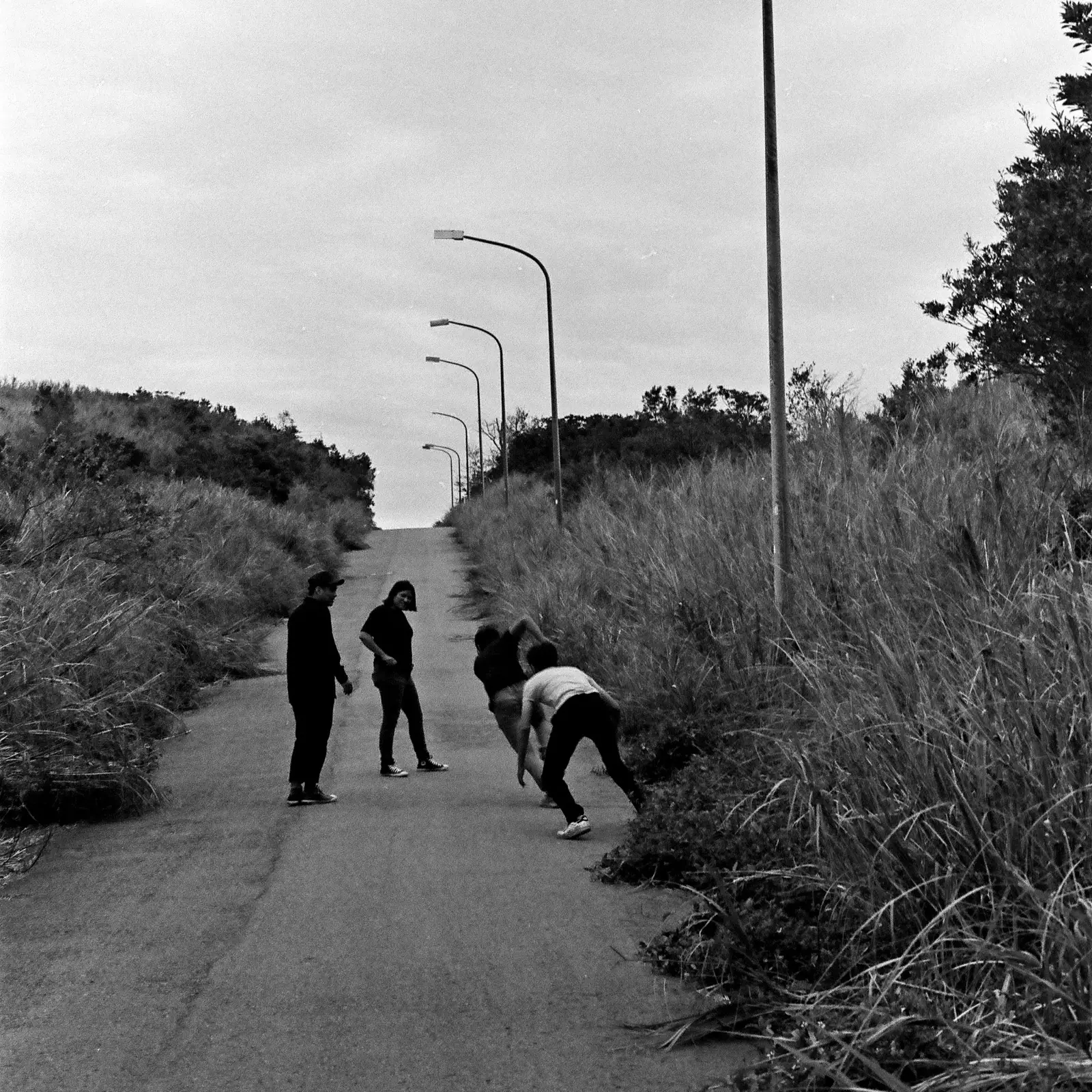
Official promotional group photo of No Party for Cao Dong: four figures scattered on an empty road stretching toward the hills, matching the estranged way their work often makes people appear very small. Photo: Official promotional image / Apple Music.
The band’s name went through three stages of evolution: at first it was “Turn Left on Cao Dong Street,” then “Cao Dong Street Party,” and in 2014 it finally settled into “No Party for Cao Dong.”3 The first version was dance-punk inspired by Two Door Cinema Club; after the 2014 name change, the music changed direction as well, shifting from dance-punk toward Nirvana-inspired grunge and post-rock.
The name change itself was a declaration: the party was over.
Liu Li, Sam, Fanfan: The Band Between Four Drummers
To understand Cao Dong’s current four-person lineup, one first has to understand how that lineup evolved.
The first drummer was Liu Li, who later shifted to working full-time on band video production and filmmaking. In fact, he never really left Cao Dong; his role simply changed from drummer to documentarian.3 The second-generation bassist was Sam; later, the band paused for nearly a year because he had to perform military service.
In 2016, the drummer’s seat was taken over by Fanfan (Tsai Yi-fan), who came from another independent band, Triple Deer. Fanfan’s official appearance with Cao Dong was at the “Not All Born by Mom 2.0” show on May 21, 2016.3
In 2023, original bassist Yang Shih-hsuan announced an indefinite pause from front-stage activities; former drummer Birdman (Huang Shih-wei) returned to take over again. The current lineup in 2026 is four people:
- Wudu (Lin Keng-yu): vocals, guitar, main songwriter
- Chu Chu (Chan Wei-chu): rhythm guitar, backing vocals
- Birdman (Huang Shih-wei): drums
- Dennis (Chang Hao-tang): bass
The most important position in the middle, drummer, changed hands four times in twelve years. The third of them, Fanfan, died in 2021.
The Handmade CD Pressing of 2,000
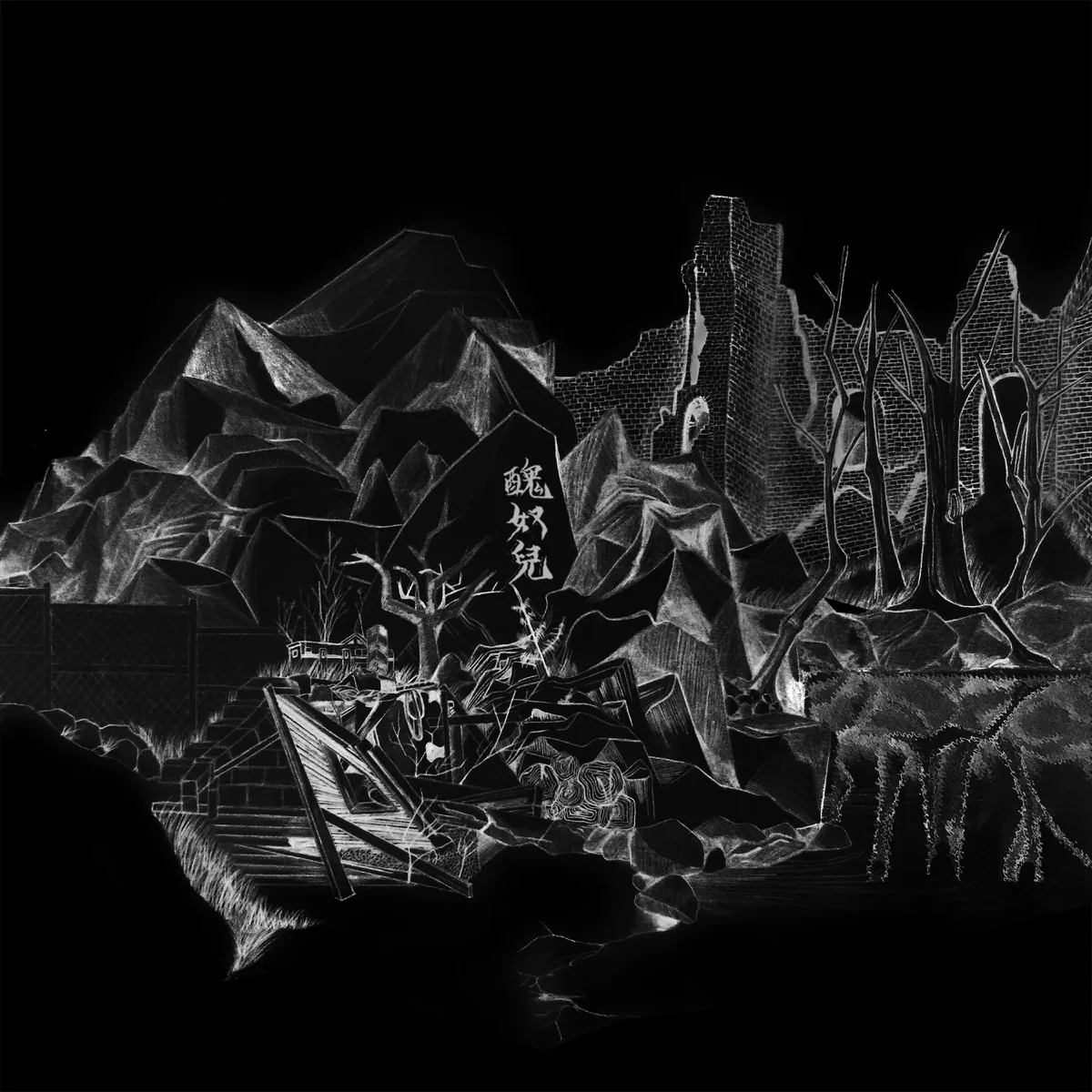
The digital version of The Servile was released on February 19, 2016; the physical CD was released on March 11. Only 2,000 copies were pressed, all handmade, and they were stocked only at 11 independent cafes and record shops across Taiwan.4
They sold out in three days.
The full album has 12 tracks and runs 38 minutes and 57 seconds. It was produced by Lee Hsiao-tsu, with American mixing engineer Andy Baker and Georgia mastering engineer Joel Hatstat brought in. The entire production period lasted four months.4 The album was funded by a Ministry of Culture grant, with no record company, no manager, and no mainstream distribution channel.
One unusual detail in the album’s musical design appears in “Simon Says”: it specially layers live audience voices with studio recording, letting two “spaces” exist simultaneously within the song, the space of being watched and the space of being alone.4 This technical choice foreshadowed the band’s later aesthetic as a whole: on the surface, shouting at the world; inside, talking to oneself.
“Simon Says” as Wound Inspection
On February 14, 2018, the official music video for “Simon Says”, directed by first drummer Liu Li, went online on YouTube. By April 2020, the video had accumulated more than 5.4 million views, and even the earlier demo posted on StreetVoice had 210,000 listens.5 But the song’s influence does not lie in the numbers. It lies in its becoming a shared language for a generation.
Official music video for “Simon Says,” directed by first drummer Liu Li (2018). Having left the drummer’s seat, he used the camera to preserve this song as a generation’s shared memory. Source: No Party for Cao Dong official YouTube channel.
The song was written against the traumatic backdrop of Taiwan’s 2015 movement against high school curriculum guideline adjustments: students took to the streets, and a student leader died by suicide.6 Wudu compressed those memories, along with his own experience of school bullying, into a set of lyrics.
On the surface, the lyrics refer to the children’s game Da Feng Chui, similar to musical chairs; underneath are three different layers of story: a generational metaphor for competition over resources, a sense of existence trapped by time (“Blame it on time / it gave a beginning / blame it on time / it gave an end”), and Wudu’s personal experience of being bullied.6
Later, music critic Ma Shih-fang positioned Cao Dong’s generation as the “loser generation”:
“The lyrics cut with every line; at their core is a nihilism with absolutely no way out, becoming lines that youths of the ‘collapsing generation’ delight in passing around.”7
Over the following decade, that positioning became fact: a National Taiwan University of Science and Technology poll on “the song that best represents my generation” placed “Simon Says” near the top for six consecutive years; MC HotDog sampled the song; and the “Sociology of Losers” course opened in fall 2017 by National Taiwan University Department of Sociology assistant professor Lee Ming-tsung packed the classroom with more than 600 students.8 A song can do these things not because it sounds good, but because it said for an entire generation what they had not said aloud themselves.
The Night of “These Guys Are Geniuses”
On June 24, 2017, at the 28th Golden Melody Awards ceremony, No Party for Cao Dong was nominated in six categories and won three, all by overwhelming first-round victories: Best New Artist with 19 votes, Best Band with 19 votes, and Song of the Year for “Simon Says” with 18 votes.7
Source: Golden Melody Awards winner lists
Jury chair Kay Huang described the band as “the explosion of a muted generation”: “They brought an enormous impact and broke people’s understanding of sound.”7
The most narratively charged detail at the time was the reaction of Mayday’s Ashin. After hearing Cao Dong’s songs, he told Masa backstage: “Should we go meet them? These guys are geniuses!”9
The media quickly simplified the story into “generational succession”: an independent band that had self-funded its CDs defeated the giant of Mandarin-language rock. But Ashin himself did not buy that narrative: “It has nothing to do with generational succession. Being forever positive and proactive is tiring too; occasionally having a different energy to release is also great.”9
When Wudu went onstage to accept the awards, he also rejected that narrative. When accepting Best Band, he said, “This award belongs to everyone.” For Best New Artist, with tears in his eyes, he said, “We are very lucky that there is always a group of people who, amid all this nothingness, keep trying to find a voice that belongs to themselves.” And regarding Mayday:
“This is not something to view through a competitive mindset. Mayday’s position is irreplaceable.”9
Two generations of bands yielded space to each other on the same night. That should have been the climax of the evening. But the media seized the “defeated Mayday” headline and missed the moment of mutual recognition.
📝 Curator’s note: Cao Dong and Mayday were never opponents. They are two generations’ two answers to the question of “what can rock do?” Mayday says it is a public embrace; Cao Dong says it is private pain. Both answers are correct.
Tudou, 14 Years, 15 Hours
October 30, 2021.
Drummer Tsai Yi-fan, known as Fanfan, was found dead in a Taipei quarantine hotel. She was 26.10 She had returned to Taiwan on October 25 after a China tour and checked into the hotel for a scheduled 14-day quarantine. Her beloved dog, Tudou, had come into her life when she was 14 and had accompanied her for 12 years. By late October, Tudou was already a 14-year-old elderly dog in critical condition.
On the night of October 29, while in quarantine, Fanfan wrote her final public post on Instagram:
“What hurts me most is that I’m in quarantine and can’t be by your side, and can’t even see you one last time. I’ve already cried to the point of breaking down and don’t know how to face all of this... The first thing your big sister will do when quarantine ends is carry all my luggage and run to your side, to accompany you through the end of your life. Big sister loves you.”10
Fifteen hours later, she was found dead in her hotel room.
Eighteen days later, on November 17, 2021, Wudu publicly wrote to Fanfan on Instagram:
“My thoughts have been chaotic for days, trapped in a cycle of self-doubt and regret... I am deeply sorry I could not give you better company.”11
The band entered nearly two years of complete silence. No new songs, no interviews, no performances. In 2023, original bassist Yang Shih-hsuan announced an indefinite hiatus from the band.3 During that period, Cao Dong looked as if it had ended completely.
📝 Curator’s note: A band entering a quarantine hotel after a tour and then losing a teammate is a story particular to the COVID era. It is not a heroic death, but a loss under administrative rules: quarantine policy separated Fanfan from her dying dog and left her alone when death occurred.
The Seven-Year Wait for “Lie”
On April 7, 2023, No Party for Cao Dong released the single “Lie” and its lyric video.12 It was the band’s first new song since Fanfan’s death.
Official lyric video for “Lie” (2023): a song already performed live for seven years became the band’s first voice after losing Fanfan. Source: No Party for Cao Dong official YouTube channel.
But the song had in fact already been performed live by them for seven years. They began playing it in 2016; it simply had never been recorded.12 The reason they chose this song as their return single in 2023 was not because it was well written, but because it had already walked with them for seven years and existed before this loss.
“Lie” is not an elegy. It does not directly mention Fanfan, has no tears, and makes no accusation. Its narrative is quiet: a person lying in bed, unable to wake up and unable to sleep, sung through in a tone with almost no emotional fluctuation.
The band handled loss through this low pressure of “there is no returning to that time,” not through dramatic grief. That choice itself is why Cao Dong is Cao Dong: they have never consumed tragedy.
Broken Tiles Joined Together: Two Layers of Allusion from Records of the Grand Historian to Yan Shigu’s Annotation to the Book of Han
On May 20, 2023, The Clod was released, seven years after The Servile.13
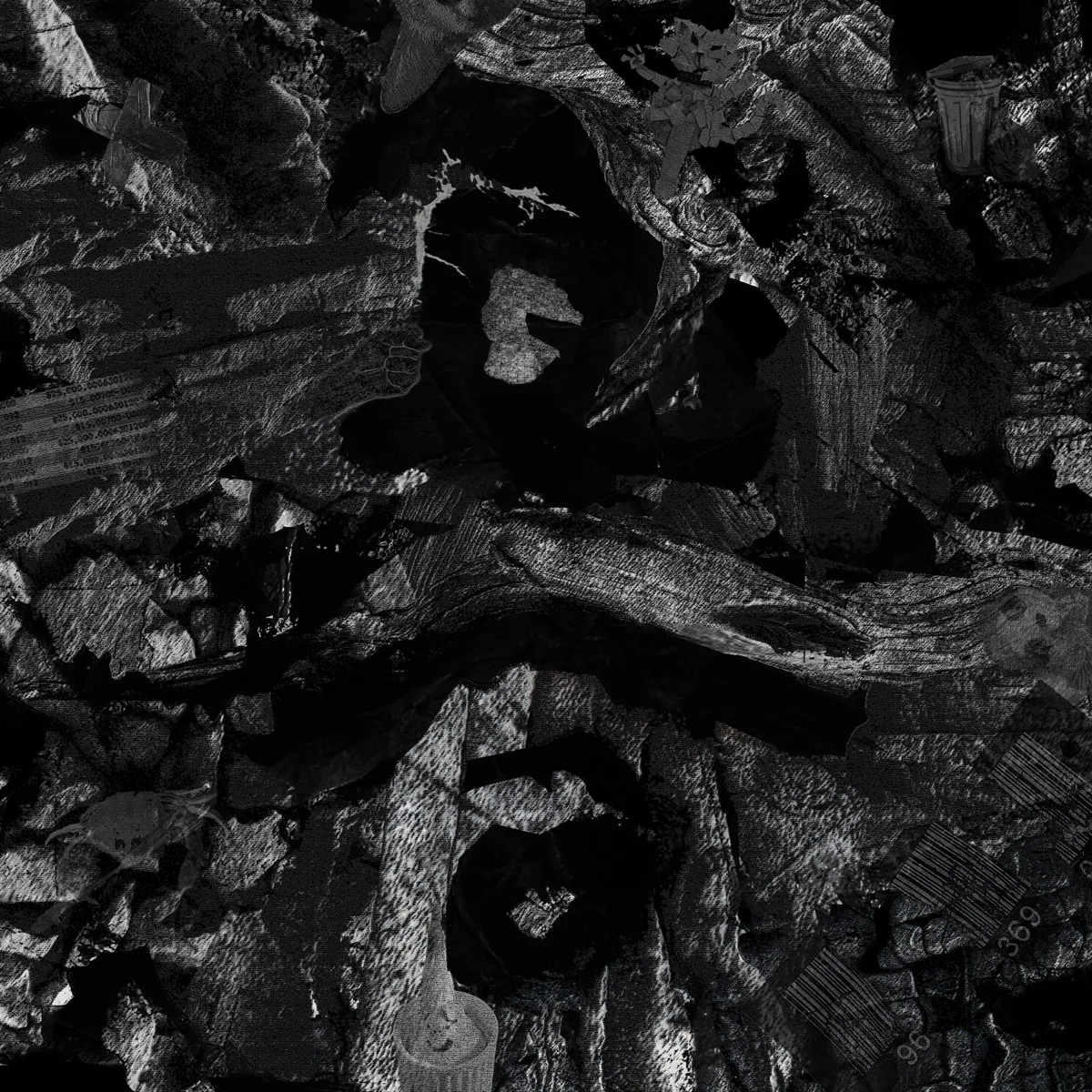
Cover of _The Clod (2023). The album title comes from Records of the Grand Historian; the front matter reads, “We dedicate this album to Fanfan,” making it the band’s first complete work after losing her._
The allusion behind the album title wahe has two layers. This detail is worth distinguishing precisely because it defines what the album title is really trying to say.
The first layer: the two characters 瓦合 appear in “Biographies of Confucian Scholars” in Records of the Grand Historian: “Chen She rose from commoner status, drove together a ragtag group of conscripted border guards, and within a month became king of Chu.”13
The second and more crucial layer: the extended gloss “like broken tiles joined together; though gathered, they are not uniform” is in fact not in the original text of Records of the Grand Historian. It comes from the Tang dynasty scholar Yan Shigu’s annotation to “Biographies of Li, Lu, Zhu, Liu, Shusun” in the Book of Han.1
In her 2023 review of The Clod, Tsai Yu fully traced these two layers of allusion.1 The distinction matters because, taken alone, the literal sense “a group of broken tiles gathered together” is merely the derogatory sense of “a mob.” Only with Yan Shigu’s extension, “though gathered, they are not uniform,” does it become broken individuals gathered together while retaining their own irregularities. This annotative layer is the actual semantic direction of Cao Dong’s choice of title: not “repairing what is broken,” not “united as one,” but continuing to coexist while carrying rupture.
Producer Chou Yi-tun said of the choice of this term in an interview:
“This is an album expressing regret and all kinds of disappointments in life.”14
The album’s front matter reads: “We dedicate this album to Fanfan.”13 The final new song is “Damn”, whose vocalist almost screams “I love you,” dedicating it to Fanfan.14
“Damn” (2023): the final new song on _The Clod, with the vocalist nearly screaming “I love you” to Fanfan. Source: No Party for Cao Dong official YouTube channel._
When Wudu spoke in interviews related to The Clod about how the band continued making music after Fanfan’s death, he gave one verbatim line:
“Life is inherently so fragile; the death of all things is never an end, but the continuation of companionship in another form.”1
That line explains why The Clod does not sound like “getting through grief.” It is continuing to make music while living inside grief.
“Tank” and “Air”: The Remaining Works of Critique
The density of social critique in The Servile is high: “Wimpish,” “The Brave,” “Simon Says,” “Us.” Music critic Tsai Yu counted that in The Clod, the works in which one can clearly feel “critique and collision with society” are only two songs: “Tank” and “Air.”1
Source: Music review by Songstoryworks (Tsai Yu), 2023
The chorus of “Tank” is the moment on this album closest to the sharp blade Cao Dong wielded in 2017:
“And so we smashed the dye vat / smashed the dye vat / only then saw the vast sea / while you and I still do not know where we are”1
The earlier section builds anticipation through delayed guitar effects and racing drums, then finally drags in a heavy guitar sound, forming a sonic contrast between “expectation and disappointment.”1 The chorus’s biggest hook, “smashed the dye vat,” is held until the end. This is a structural arrangement absent from The Servile.
Tsai Yu summarized the direction of the other songs on The Clod this way: “After ‘Cave Mountain,’ it shows a tendency toward inward closure, entirely different from the earlier scene of raising the banner of ‘world-weariness’ and shouting, colliding with a system in which ‘dreams’ cannot be redeemed.”1
This turn from “world-weariness projected outward” to “world-weariness turned inward” is a structural pivot in Cao Dong’s twelve years. Tsai Yu summarized it as “the end of the youth generation”: Cao Dong and their listeners are preparing to move toward the next stage.1 They no longer write social critiques in the mode of “Wimpish,” but turn toward songs such as “Daydream,” “Lie,” “Old Chang,” “Bud,” and “Damn,” which face the emotional gaps between the self and loved ones.
📝 Curator’s note: The Clod is not a weaker album. It is an album that moves from “speaking for a generation” to “dealing with one’s own interior.” The courage Cao Dong shows in making this turn is something the 2017 “Simon Says” version of Cao Dong could not have done.
Critics later also defined The Clod as “an album by suicide survivors.”15 The first three songs continually advance the theme of death, with images of drowning and self-destruction; the mid-album instrumental interlude creates an atmosphere that is “drifting and impossible to grasp”; the ending turn abandons anger and instead “mourns calmly”; in the final song, “Damn,” the vocalist nearly screams in an expression of longing and the resolve to keep living.
The Moment Their Manager Accepted the Award
On June 29, 2024, at the 35th Golden Melody Awards, the Best Band category in which No Party for Cao Dong was nominated was called by the media a “group of death”: the nominees also included Fire EX. and Accusefive, among six strong bands.16 Cao Dong won three awards: Album of the Year, Best Mandarin Album, and Best Band for the second time.2
But the band was performing that night at the Bubble Island Music Festival in Guiyang, China, and was not at the Golden Melody ceremony. Their manager accepted onstage for them and said, “No Party for Cao Dong has never been only the four people standing onstage, but every person who has joined together in these six characters.”2 At the time, this was interpreted as including the late member Fanfan.
This “winning in absence” was itself a Cao Dong statement: we do not treat awards as life’s climax. They continued performing in Guiyang, turning the Best Band acceptance into a “ritual of absence.”
In the history of Mandarin-language popular music, it is already rare for a band to win Golden Melody Best Band twice. Cao Dong’s two wins were separated by seven years, by the death of a member, and by two years of almost complete silence. From the high-profile moment in 2017 when they defeated Mayday to the low-key moment in 2024 when their manager accepted for them, this band is redefining the word “success” in its own way.
Why They Do Not Accept Interviews
Since their debut, No Party for Cao Dong has rarely given formal interviews.17 Wudu has given a very small number of interviews, mainly to Blow Music in 2016, but the band as a whole has taken an almost closed attitude toward the media.
This is not coolness. It is a form of professional ethics. They refuse to shape themselves into “consumable personalities”: they refuse to sell everyday life on Instagram, refuse variety-show crossover, and refuse to turn Fanfan’s death into narrative capital. One sentence from Wudu summarizes their creative attitude:
“Many of our works sound violent, but they are actually full of... love.”17
This is what distinguishes Cao Dong from most Taiwan bands of the late 2010s: they believe the content of the song should be larger than the singer’s personality. Fans may recognize the chords of “Simon Says” but not necessarily Wudu’s face. That is a distance the band has deliberately preserved.
This Is an Album by Suicide Survivors
Twelve years. Four drummers. Two albums. Two Golden Melody Best Band awards. One death. Two years of silence. One manager accepting an award.
What No Party for Cao Dong has left behind is not “a rise story,” but a story about how to piece oneself back together amid loss. The dance-punk youths of Cao Dong Street on Yangmingshan in 2012; the self-funded pressing of 2,000 CDs in 2016; the 2017 Golden Melody triple crown that defeated Mayday; the loss of drummer Fanfan in 2021; the 2023 return with “Lie”; the 2024 Golden Melody triple crown with The Clod, a term for the defeated from Records of the Grand Historian.
They also proved something more difficult: a band can lose a member and live on, but the way it lives on will not look the same as before. The title The Clod already says all of this. Incomplete, unrepaired, and still joined: continuing together while carrying rupture.
On the Golden Melody stage in 2024, their manager said:
“In our hearts, No Party for Cao Dong has never been only the four people standing onstage.”
At that moment, no one in the audience laughed, and no one stood to cheer. Everyone was quiet for five seconds.
Then the camera turned to the next award.
Further reading:
- Waa Wei — A comparison within the same 2010s independent music ecosystem, through a female vocal pathway
- Constant & Change — A comparison within the post-rock spectrum, but with a vocal narrative pathway
- Cicada — A fully instrumental, no-vocal pathway, the opposite of Cao Dong’s “lyrics as sociology”
- Crowd Lu — Another “work-centered singer” path in independent music
- Popular Music and the Golden Melody Awards — The stage coordinates for Cao Dong’s two Best Band wins
- Taiwan Independent Music — The evolution of independent music from Natural Q to Cao Dong to Accusefive
- Taiwan Pop Music — The industry environment of Mandarin-language popular music
Image Sources
The three images in this article are included under “fair use editorial commentary,” cached in public/article-images/people/, and do not hotlink to source servers:
- Official promotional group photo of No Party for Cao Dong — © No Party for Cao Dong (official promotional photo, distributed through Apple Music). Fair use editorial commentary.
- _The Servile_ (2016) album cover — © Stone Paper Co., Ltd. (No Party for Cao Dong’s self-operated label). Fair use editorial commentary.
- _The Clod_ (2023) album cover — © Black Skin Co., Ltd. (No Party for Cao Dong’s self-operated label). Fair use editorial commentary.
The embedded official videos for “Simon Says,” “Lie,” and “Damn” all come from the band’s official YouTube channel, @nopartyforcaodong, and are embedded through YouTube’s standard player.
References
- Album review | No Party for Cao Dong, The Clod | Now truly knowing the taste of sorrow, a great wind blows into Cave Mountain - Songstoryworks — Tsai Yu’s 2023-09-16 review fully traces the two-layer source of the wahe allusion: the two characters wahe from “Biographies of Confucian Scholars” in Records of the Grand Historian + the extended meaning “like broken tiles joined together; though gathered, they are not uniform” from Tang dynasty scholar Yan Shigu’s annotation to “Biographies of Li, Lu, Zhu, Liu, Shusun” in the Book of Han; fully quotes Wudu’s verbatim line, “Life is inherently so fragile; the death of all things is never an end, but the continuation of companionship in another form”; quotes and analyzes the lyrics and musical structure of “Tank”; compares the density of critical works in The Clod and The Servile (the latter has 4 critical songs → the former only “Tank” and “Air,” 2 songs); core arguments include “after ‘Cave Mountain,’ it shows a tendency toward inward closure” + “the end of the youth generation.” On 2026-04-18, Tsai Yu proactively pointed out in the Taiwan.md Cao Dong spore #33 Threads comments that the original draft of this article had wrongly written that “broken tiles joined together” came from Records of the Grand Historian, and provided the original review as textual evidence. This article’s second version (2026-04-19) was comprehensively revised according to that textual research.↩23456789
- No Party for Cao Dong absent from 35th Golden Melody Awards; manager accepts award - CNA — On 2024-06-29, at the 35th Golden Melody Awards, No Party for Cao Dong won the triple crown of Album of the Year, Best Mandarin Album, and Best Band for The Clod; the band was performing that night at the Bubble Island Music Festival in Guiyang, China and could not attend, so their manager accepted on their behalf and said: “No Party for Cao Dong has never been only the four people standing onstage, but every person who has joined together in these six characters.”↩234
- No Party for Cao Dong - Wikipedia — Founded on 2012-06-09 at the intersection of Jianxian Street and Cao Dong Street on Yangmingshan in Taipei; the band name evolved in three stages from Turn Left on Cao Dong Street → Cao Dong Street Party → No Party for Cao Dong (settled in 2014); lineup changes include Liu Li (first drummer, later shifted to video), Sam (military-service interruption), Fanfan (joined in 2016 from Triple Deer), and Yang Shih-hsuan’s indefinite hiatus in 2023.↩2345
- The Servile album production details - Science Monthly — Digital release on 2016-02-19 and physical release on 3-11; 2,000 handmade CDs sold out in three days; producer Lee Hsiao-tsu, American mixing engineer Andy Baker, Georgia mastering engineer Joel Hatstat; “Simon Says” uses a layering technique combining live audience voices and studio recording; production period of four months.↩23
- “Simon Says” (song) - Wikipedia — The official music video for “Simon Says” was released on YouTube on 2018-02-14, directed by former band drummer Liu Li; as of 2020-04-19, the video had accumulated 5,410,374 views, and the demo version on StreetVoice had reached 214,727 listens, making it one of the most widely circulated singles in 2010s Taiwan independent music.↩
- Lyrics of “Simon Says” and interpretation through the 2015 anti-curriculum-adjustment movement - VERSE — The lyrics of “Simon Says” were written against the backdrop of Taiwan’s 2015 movement against high school curriculum guideline adjustments, when students took to the streets and a student leader died by suicide. The lyrics carry three layers of meaning: a musical-chairs game (resource competition), generational predicament (trapped by time), and Wudu’s personal experience of school bullying.↩2
- Ma Shih-fang’s “loser generation” Cao Dong review - One Little Day — Ma Shih-fang positioned Cao Dong generationally as the “loser generation”: “The lyrics cut with every line; at their core is a nihilism with absolutely no way out, becoming lines that youths of the collapsing generation delight in passing around”; he compared their “fit between lyrics and music” with Deserts Chang. At the 28th Golden Melody Awards in 2017, jury chair Kay Huang called them “the explosion of a muted generation,” and Cao Dong won an overwhelming first-round triple crown (19/19/18 votes).↩23
- “Simon Says” as cultural phenomenon - PanSci + Global Views Monthly — “Simon Says” was defined as a representative work of the “loser generation” / “collapsing generation”; it ranked near the top for six consecutive years in National Taiwan University of Science and Technology’s “the song that best represents my generation” poll; MC HotDog sampled it; Lee Ming-tsung’s fall 2017 “Sociology of Losers” course in the Department of Sociology at National Taiwan University overflowed with more than 600 students.↩
- Full source for Mayday Ashin’s “geniuses” comment - Business Today — After Ashin heard Cao Dong’s songs, he said to Masa: “Should we go meet them? These guys are geniuses!”; regarding the generational-succession controversy: “It has nothing to do with generational succession. Being forever positive and proactive is tiring too; occasionally having a different energy to release is also great.” Wudu at the 28th Golden Melody Awards: “Mayday’s position is irreplaceable.”↩23
- Cao Dong drummer Fanfan dies during quarantine + original IG post - China Times News — On 2021-10-30, Tsai Yi-fan (Fanfan, 26) was found dead in a Taipei quarantine hotel; she had returned to Taiwan from a China tour on 10-25 and checked in; on the evening of 10-29, she posted a devastated IG message: “The first thing your big sister will do when quarantine ends is carry all my luggage and run to your side, to accompany you through the end of your life. Big sister loves you”; her beloved dog “Tudou,” who had been with her for 12 years since she was 14, was critically ill, and she could not return home to accompany him at the end.↩2
- Wudu’s IG message to Fanfan - Mirror Media — On 2021-11-17, 18 days after Fanfan’s death, vocalist Wudu publicly wrote on Instagram: “My thoughts have been chaotic for days, trapped in a cycle of self-doubt and regret... I am deeply sorry I could not give you better company.”↩
- “Lie” 2023 return single and seven-year live history - HackaZine — On 2023-04-07, the band released its first single after Fanfan’s death, “Lie,” along with a lyric video; the song had actually been performed live since 2016 and waited seven years before being recorded and released. The band publicly stated that the new album was dedicated to Fanfan.↩2
- The Clod album concept and Records of the Grand Historian allusion - Vocus — The Clod was released on 2023-05-20, seven years after The Servile; the album title wahe appears in “Biographies of Confucian Scholars” in Records of the Grand Historian: “Chen She rose from commoner status, drove together a ragtag group of conscripted border guards, and within a month became king of Chu”; the full extended allusion of “broken tiles joined together” is separately documented in [^19] (Tsai Yu traces it to Yan Shigu’s annotation to the Book of Han); the front matter reads “We dedicate this album to Fanfan”; “Damn” is the final new song and sings “I love you” for Fanfan.↩23
- Producer Chou Yi-tun interview: Cao Dong’s album “expresses regret” - Blow Music — Producer Chou Yi-tun interprets The Clod: “This is an album expressing regret and all kinds of disappointments in life.” He also describes his production philosophy: “What I worry about least is sound quality itself; what I care about is whether the result matches the musicians’ vision and whether they feel comfortable in the collaboration.” “The way Cao Dong faces music is completely honest.”↩2
- The Clod as an “album by suicide survivors” review - Vocus — The review defines The Clod as “an album by suicide survivors”; the first three songs continually advance the theme of death, with images of drowning and self-destruction; the mid-album instrumental interlude creates a “drifting and impossible to grasp” atmosphere; the ending turn abandons anger and instead “mourns calmly”; the final song has the vocalist “nearly screaming” to express longing and the resolve to keep living.↩
- 35th Golden Melody Awards “group of death” Best Band competition analysis - The News Lens — The Best Band nominees at the 35th Golden Melody Awards, including Cao Dong, Fire EX., Accusefive, and three other strong groups, were called by the media a “group of death”; analysis of the competitive context in which Cao Dong emerged with three awards for The Clod.↩
- Wudu’s creative philosophy — full 2016 Blow Music interview — One of Wudu’s few formal interviews, from 2016: creative process, “When this character is sometimes, mostly, a projection of ourselves, we draw material from the people and things around us”; musical intention, “We actually did not especially set out to do anything”; emotional core, “They are actually all full of... love”; explanation of the violent exterior: “They sound violent, but they are actually full of love and opposed to violence.”↩2