
Ma Ying-jeou: From Harvard Law PhD to Interpreter in Chiang Ching-kuo's Office, He Became a President Known for "Integrity," Leaving Behind Cross-Strait Relations, the Sunflower Movement, and 22K
30-Second Overview: Ma Ying-jeou (born in British Hong Kong in 1950) served as the twelfth and thirteenth president of the Republic of China (2008–2016). During his tenure, he facilitated ECFA, direct cross-strait flights, and the 80-second handshake at the Ma Xi Meeting on November 7, 2015. He also left behind the low starting wages associated with the 22K incident, the Sunflower Movement, and the 9.2% figure from historical public opinion polls. After leaving office, he visited China twice in 2023 and 2024. At the second Ma Xi Meeting in Beijing on April 10, 2024, he immediately corrected a slip where he referred to "Chinese nation" as "Republic of China." In May 2026, his family requested assisted declaration, and Ma Ying-jeou himself responded with a video, saying, "Lawyer, does this prove I am not senile?" A decade after leaving office, he remains in the news. The impressions—"integrity," international perspective, controversial decision-making, and post-presidency disputes—exist to varying degrees in the minds of different Taiwanese people today. Even under the news coverage of his video responding to dementia rumors on May 22nd, two factions commented: one emphasizing his integrity and cross-strait thawing, while the other questioned whether the Special Fee Case, the Ma Wang political struggle, the suppression of the Sunflower Movement, and his retreat without controversy should be overshadowed by the term "integrity."
At 3 p.m. on November 7, 2015, in the lobby of the Shangri-La Hotel in Singapore, before a yellow backdrop symbolizing descendants of the Yellow Emperor, Ma Ying-jeou shook hands with Xi Jinping. Both referred to each other as "Mr.," and the flashbulbs went off for 1 minute and 20 seconds1. This was the first meeting between top leaders since the political separation of cross-strait relations in 1949.
The same photo elicited two completely different reactions in Taiwan the next day. KMT supporters viewed it as a historical achievement in thawing cross-strait tensions. The DPP and many young people felt it represented a concession on core identity. Looking back ten years later, the Hong Kong protests against extradition in 2019 added another layer of meaning to the second interpretation; after Lai Ching-te took office in 2024, heightened tensions over Taiwan caused supporters of the first interpretation to find their voices again.
To understand why this person is remembered in both ways simultaneously, one must start from an earlier scene. In 1981, a 31-year-old graduate of National Taiwan University's Law Department returned to Taipei after receiving an SJD degree from Harvard with the topic "Legal Issues of Donghai Seabed and Foreign Investment," having been recommended by Chien Fu to serve as interpreter for Chiang Ching-kuo in the Presidential Office23.
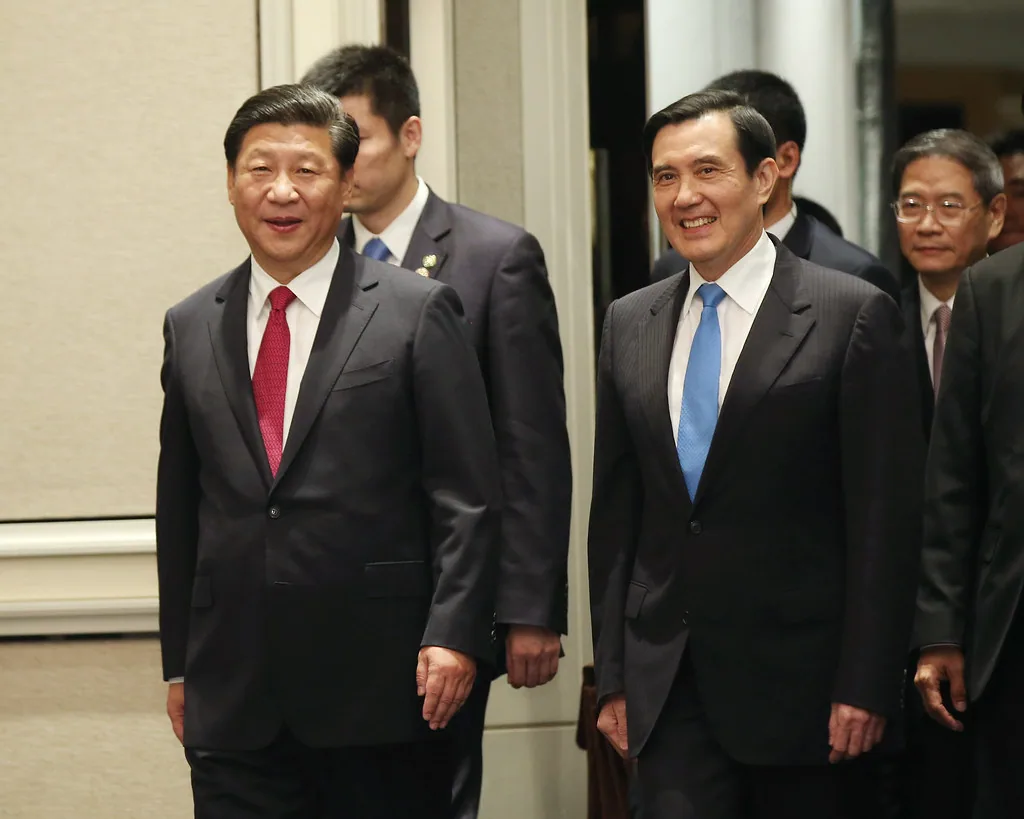
On the afternoon of November 7, 2015, at the Shangri-La Hotel in Singapore, Ma Ying-jeou and Xi Jinping held a closed-door meeting. The two publicly shook hands for 1 minute and 20 seconds and referred to each other as "Mr.," marking the first meeting between top leaders since the political separation of cross-strait relations in 1949. Photo: Presidential Office. License via Flickr (CC BY 2.0)
The English Translation of the Office of Chiang Ching-kuo: The Path Untouched by Dust from 1981 to 1996
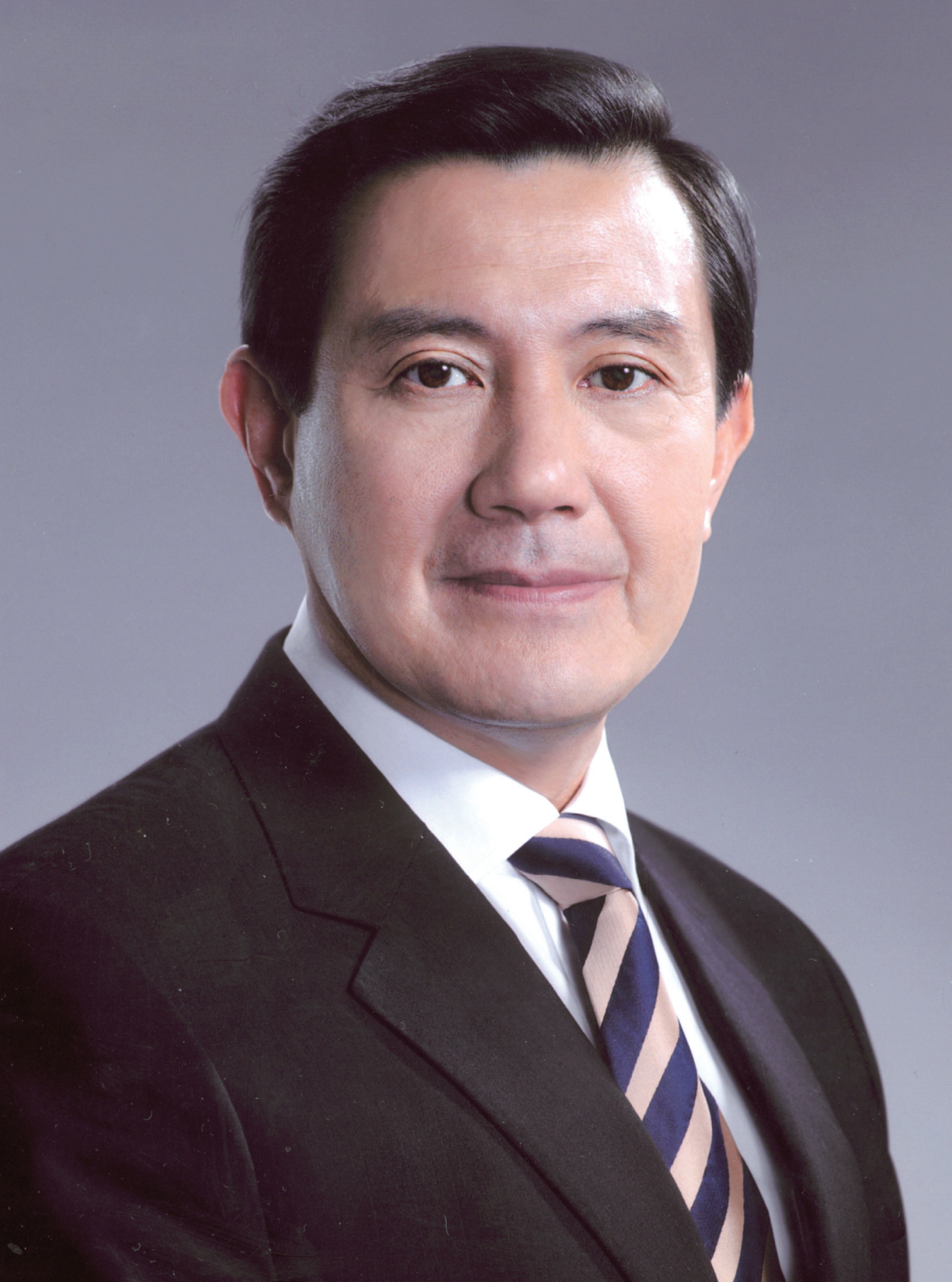
Official portrait of Ma Ying-jeou upon assuming the presidency in May 1988. Photo: Ministry of Foreign Affairs, Republic of China / Presidential Office. License via Wikimedia Commons (Government website open data declaration)
Ma Ying-jeou was born on July 13, 1950, at Guanghua Hospital in Yau Ma Tei, Kowloon, British Hong Kong. His father, Ma Her-ling, was a cadre in the Kuomintang (KMT), serving as the Director of the Secretariat Office and Deputy Director of the Central Examination Board of the KMT. The urn containing his ashes bore eight characters: "Transforming Unification Gradually, Fully Revitalizing China" 4. These eight characters were later often used by outsiders to interpret Ma Ying-jeou's cross-strait political choices, although he rarely responded directly.
His educational path was the standard model for second-generation overseas elites of that era: Jianzhong University, National Taiwan University College of Law, receiving the KMT Sun Yat-sen Scholarship to study in the United States in 1974, obtaining an M.A. in Law from New York University in 1977, and earning a Ph.D. in Law from Harvard University in 1981 3. His dissertation topic concerned foreign investment disputes surrounding the East China Sea boundary of Penghu and the Diaoyu Islands, which was both an extension of his participation in the "Preserving Fishing Grounds" movement while studying abroad and laid the foundation for his later firm stance on the Diaoyu Islands.
In 1981, he returned to Taiwan and was recommended by Chien Fu to work at the Presidential Office as the English translator for Chiang Ching-kuo 35. This position was a gateway for political elites in Taiwan during the 1980s. After Chiang Ching-kuo's passing in 1988, Lee Teng-hui succeeded him, and Ma Ying-jeou was appointed as the Director of the Executive Yuan Research and Development Assessment Committee. He was tasked with establishing the "Executive Yuan Mainland Affairs Bulletin" and serving as its executive secretary, subsequently promoting the drafting of the Regulations Governing Relations Between People in Taiwan Area and Mainland Area and establishing the Mainland Affairs Council (MAC) and the Cross-Strait Affairs Council (CSAC) 5. The foundational concepts for his later cross-strait approach began here.
On February 27, 1993, Ma Ying-jeou was appointed Minister of Justice 6. During his tenure, he vigorously promoted anti-crime campaigns, combating organized crime and political finance with the posture of "declaring war on gangsters." He was portrayed by the media as an honest and courageous reformer. The phrase "not getting involved" later followed him like a shadow 7. This term initially served as praise (referring to his lack of involvement in political patronage), but its context later changed, acquiring negative connotations (suggesting evasion of responsibility or unwillingness to make political judgments). Two meanings for the same word.
📝 Curator's Note
The common narrative is that "not getting involved" is a personality issue. However, looking closely at his path from 1993–2007 (translator for Chiang Ching-kuo, executive secretary of Mainland Affairs, Director of the Research and Development Assessment Committee, Minister of Justice, Mayor of Taipei), every position was one of high visibility, high prestige, but low actual responsibility. "Not getting involved" may have been a proactively chosen career strategy rather than a passive personality trait. When he had to become president in 2008 and make genuine political judgments, this path untouched by dust became a burden.
5.22 Percentage Points and the Special Fee Case: A Political Ascent from 1998 to 2007
On December 5, 1998, the Taipei mayoral election was held. Ma Ying-jeou defeated the incumbent Mayor Chen Shui-bian with 51.13% of the vote (766,377 votes) against 45.91%, winning by only 78,305 votes, a margin of 5.22 percentage points8. This narrow victory reshaped the power distribution between the mainstream (external province faction) and non-mainstream (local faction) Kuomintang in the late 1990s, also positioning Ma Ying-jeou as the next viable candidate for the KMT after its split from the Lee Teng-hui line.
In 2002, he was re-elected as Taipei mayor with 64.11% of the vote9, setting the record high for votes in a Taipei mayoral election to date. During his term, he vigorously implemented the "pay-as-you-throw" garbage fee system. These achievements were topics of consensus among the middle class in Taipei during the mid-2000s.
In July 2005, Ma Ying-jeou defeated Wang Jin-pyng to become the KMT chairman with 72.36% of the vote10. The Chen Shui-bian era officially concluded. However, the lingering tensions from this internal party competition between Ma Ying-jeou and Wang Jin-pyng would culminate in one of the most dramatic political showdowns in Taiwan's history eight years later in September.
February 13, 2007, was a scene that could only be described with the word "the same day": in the morning, the Taipei District Prosecutors Office indicted Ma Ying-jeou in the special fee case under anti-corruption statutes; in the afternoon, Ma Ying-jeou held a press conference to announce his resignation as KMT chairman and his candidacy for the 2008 presidential election11. Being indicted in the morning and announcing a run for the highest political office in the afternoon—this was a certain archetype of a legal professional entering politics. Ma Ying-jeou's defense strategy was the "large reservoir theory": mixing public and private accounts, arguing that as long as money had liquidity and the total inflow and outflow balanced, there was no crime. The first trial at the Taipei District Court found him innocent on August 14th. The second trial at the High Court upheld his innocence on December 28th.
💡 Did you know? Ma Ying-jeou has been indicted three times in his life: the 2007 special fee case, the 2014 Huang Shi-ming leak case, and the 2017 Sanzhong case. All three have resulted in acquittals to date. In the second trial of the High Court's review of the Sanzhong case on December 31, 2025, Ma Ying-jeou, Chang Che-chen, and Wang Hai-qing were found innocent, with the High Prosecutors Office considering an appeal; Tsai Cheng-yuan was convicted of embezzlement for 3 years and 6 months12. The success rate of a legal professional in the judicial arena is completely different from their success rate in the political arena.
In July of that year, Ma Ying-jeou launched the "Taiwan Moves Forward—Long Stay Plan" campaign strategy, starting in Central Taiwan for 18 days13. This strategy was later analyzed by commentators as one of the keys to him winning 2 million votes in the 2008 election: having a second-generation Taipesians who had never lived in the south or central regions travel and live with local families across the country. However, this strategy preceded the harshest criticism he would face eight years later before he could ascend to the presidency.
The Room After the Financial Crisis: How 22K Became a Symbol
On March 22, 2008, Ma Ying-jeou and Hsiao Wan-chang defeated Chiang Ching-kuo and Su Tseng-chang with 7,659,014 votes (58.45%) to 5,444,949 votes (41.55%)14. This was the highest voter turnout in Taiwan's democratization era, with a margin exceeding two million votes. The voters' expectations were clear: set aside political disputes, focus on the economy, and improve cross-strait relations.
In his inauguration speech on May 20, 2008, Ma Ying-jeou proposed the "No Unification, No Independence, No Military" framework for cross-strait issues and pledged to resume cross-strait negotiations based on the "1992 Consensus." A frequently cited sentence from the original text was: "Ying-jeou firmly believes that the key to resolving cross-strait issues lies not in sovereignty disputes, but in ways of life and core values."15
However, what followed was more than just a promise. In September 2008, Lehman Brothers collapsed, and the global financial crisis arrived. Ma Ying-jeou's "633 Policy" (6% average annual economic growth, unemployment below 3%, $30,000 per capita income by 2016), which he campaigned on in 2008, was admitted during an interview with a Mexican media outlet in September as being unable to be realized in the short term due to the financial crisis16. By the end of his term, the average economic growth rate was about 2.81% to 3.0%, unemployment was around 4%, and per capita income did not reach $30,000.
In April 2009, under the impact of the financial crisis, the Executive Yuan introduced the "Internship Program for University Graduates in Corporate Workplaces," commonly known as 22K. The government subsidized companies to pay new university graduates a base salary of NT$22,000 per month plus NT$4,190 for labor insurance and health insurance17. The original intention was to alleviate unemployment pressure. The actual result was that the monthly income of employed individuals aged 20-24 decreased from NT$23,351 in 2008 to NT$21,685 in 2009, a 7% drop. The program ran for two years and five months (from April 2009 to September 2011), and was officially abolished on June 3, 2013.
The degree of connection between 22K and Ma Ying-jeou's personal decision-making remains a controversial topic in Taiwan's economic circles.
⚠️ Controversial Views
Causation Camp (DPP, labor unions, some scholars): The government subsidy directly became the "pricing anchor." Companies paid salaries based on NT$22,000 without additional increases. In 2008-2009, the wages for those aged 20-24 declined by 7% corresponding to when the program was introduced. Real wages in Taiwan throughout the 2010s remained stagnant; this figure requires no interpretation.
Symptom Camp (KMT, some financial scholars, National Policy Research Foundation): 22K was a temporary relief measure following the 2008 financial crisis, and declining wage levels were already a general reality during that period18; the common argument from this camp is that structural declines in wages are the result of globalization, China's magnetic pull, and industrial relocation combined, and it is unfair to attribute them directly to a single policy.
Even when the Symptom Camp acknowledges structural factors, it is an undeniable fact that 22K became a generational symbol. University graduates at the time used 22K on PTT and blogs as a code name for their generation being sacrificed. This impression lasted longer than the actual lifespan of the 22K policy, later becoming one of the key elements in shaping the political consciousness of Taiwan's younger generation between 2014 and 2020.
In August of that year, Typhoon Morakot arrived. The H88 water disaster caused 681 deaths and 18 missing people19. In Xiaolin Village, 474 people were buried alive in the village's destruction. The Ma administration was criticized for slow disaster response, leading to the resignation of Prime Minister Liu Chao-hsuan in early September of that year. This was one of the first major crises during Ma Ying-jeou's term and a period when the term "not getting involved" began to carry negative connotations.
Two Ledgers of the ECFA Agreement: 2010–2013
On June 29, 2010, Jiang Bingkun, Chairman of the Association for Economic Cooperation between Taiwan and Mainland China (EAC), and Chen Yunlin, President of the Association for Japan-Taiwan Economic Exchange, signed the Economic Cooperation Framework Agreement (ECFA) in Chongqing20. This was a core achievement of Ma Ying-jeou's cross-strait policy. The early harvest list included preferential tariff reductions from Mainland China for 539 Taiwanese products and special tariffs on 18 agricultural products from Taiwan to the Mainland. All products were reduced to zero tariffs as of January 1, 2013.
Before signing ECFA, on the afternoon of April 25, 2010, Ma Ying-jeou held a televised debate with then-DPP Chairperson Tsai Ing-wen regarding ECFA21. This was the first time a President of the Republic of China had conducted a policy debate with the chairperson of an opposition party. Ma Ying-jeou argued that ECFA would prevent Taiwanese products from being marginalized when competing in the Mainland market alongside ASEAN members; Tsai Ing-wen argued that ECFA would lead to Taiwan's economy becoming overly dependent on China and sacrificing workers in specific industries (traditional manufacturing and agriculture). Looking back a decade later, both sides of this debate were partially correct.
The actual economic benefits of ECFA are viewed through two different ledgers. The first ledger is the official estimate from the National Institute of Economic Research's GTAP model: GDP was estimated to increase by 1.65% to 1.72%20. The second ledger concerns the distribution of benefits: the early harvest list primarily benefited large enterprises in traditional manufacturing, while small and medium-sized enterprises and service industries did not feel the dividends; concurrently, Taiwan's trade dependence on China continued to rise without any reversal before the Sunflower Student Movement erupted.
📝 Curator's Note
ECFA is a typical example of "macro vs. distribution." From the perspective of macroeconomic scientists, the agreement increased Taiwan's GDP by 1.65%; from the perspective of factory workers and farmers, this figure had nothing to do with their wages. The cross-strait economic policies during Ma Ying-jeou's era were statistically successful, but what statistics do not tell you exploded on the evening of March 18, 2014. That night, hundreds of students stormed the Legislative Yuan chamber.
The Presidential Residence During the Typhoon and the 9.2% Poll: The Wang Jin-pyng Case of 2013
On January 14, 2012, Ma Ying-jeou defeated Tsai Ing-wen and Su Chia-chuan with 6,891,139 votes (51.60%) to their 6,093,578 votes (45.6%), re-elected as the thirteenth president22.
His second term began in decline. In April 2012, oil prices rose by nearly ten percent, and electricity prices also increased significantly in May. The "May 19th Anti-Ma" mass march was estimated to have involved 55,000 people23. Within four months of his re-election, public opinion had turned against him.
On the night of Typhoon Morakot on August 31, 2013, Prosecutor General Huang Shih-ming reported to Ma Ying-jeou at the presidential residence regarding Wang Jin-pyng, Speaker of the Legislative Yuan, who was suspected of interfering in judicial cases for KMT member Ko Jian-ming. The Special Investigation Unit had intercepted conversations related to this matter. Between 11 p.m. and midnight that night, Ma Ying-jeou called Huang Shih-ming for an inquiry. On September 1, Huang reported a second time to the residence. On September 4, Ma Ying-jeou suggested that Huang report to Executive Yuan President Jiang Yi-hua. On September 6, the Special Investigation Unit held a press conference and released the transcript of the intercepted conversations.
On September 8, Ma Ying-jeou held a press conference with Vice President Wu Dun-yi and Executive Yuan President Jiang Yi-hua present. What he said in this segment was written into history by reporters24:
"If powerful people can interfere with the judiciary, how can ordinary citizens expect fair justice? This is the most serious attack on judicial independence and a day of shame for Taiwan's democratic rule of law."
On September 11, the KMT disciplinary committee revoked Wang Jin-pyng's party membership. On September 13, the Taipei District Court approved Wang Jin-pyng's provisional release with bail of NT$9.38 million to retain his party membership. Ma Ying-jeou won the moral high ground but lost in public approval ratings and internal party unity.
On September 15, 2013, a survey by Yanda News revealed that satisfaction with Ma Ying-jeou's administration was 9.2%, while dissatisfaction was 80.5%25. This was one of the lowest records for any president since Taiwan democratized. A TVBS poll at the same time showed 11%. (Many media outlets in the past decade mistakenly attributed this 9.2% to TVBS; the correct source is the Yanda News survey from September 15 that year.)
📝 Curator's Note
The common explanation is that "the September political struggle proved Ma Ying-jeou's lack of political judgment." However, a more accurate description might be: Ma Ying-jeou fought a political battle using the logic of a legal professional. From the perspective of a legal professional, Wang Jin-pyng's alleged interference, supported by intercepted recordings, and the revocation of party membership according to party rules, were procedurally correct. From the perspective of a politician, the cost of this fight was losing cooperation from the Legislative Yuan chairman, losing internal party unity, and losing public support. The limitation of governing as a legal professional is not that he was not smart enough, but that procedural justice and political reality are two different dimensions.
150 Injured Outside the Legislative Yuan and Executive Yuan During Sunflower Movement in 2014: An Explosion of Civil Society
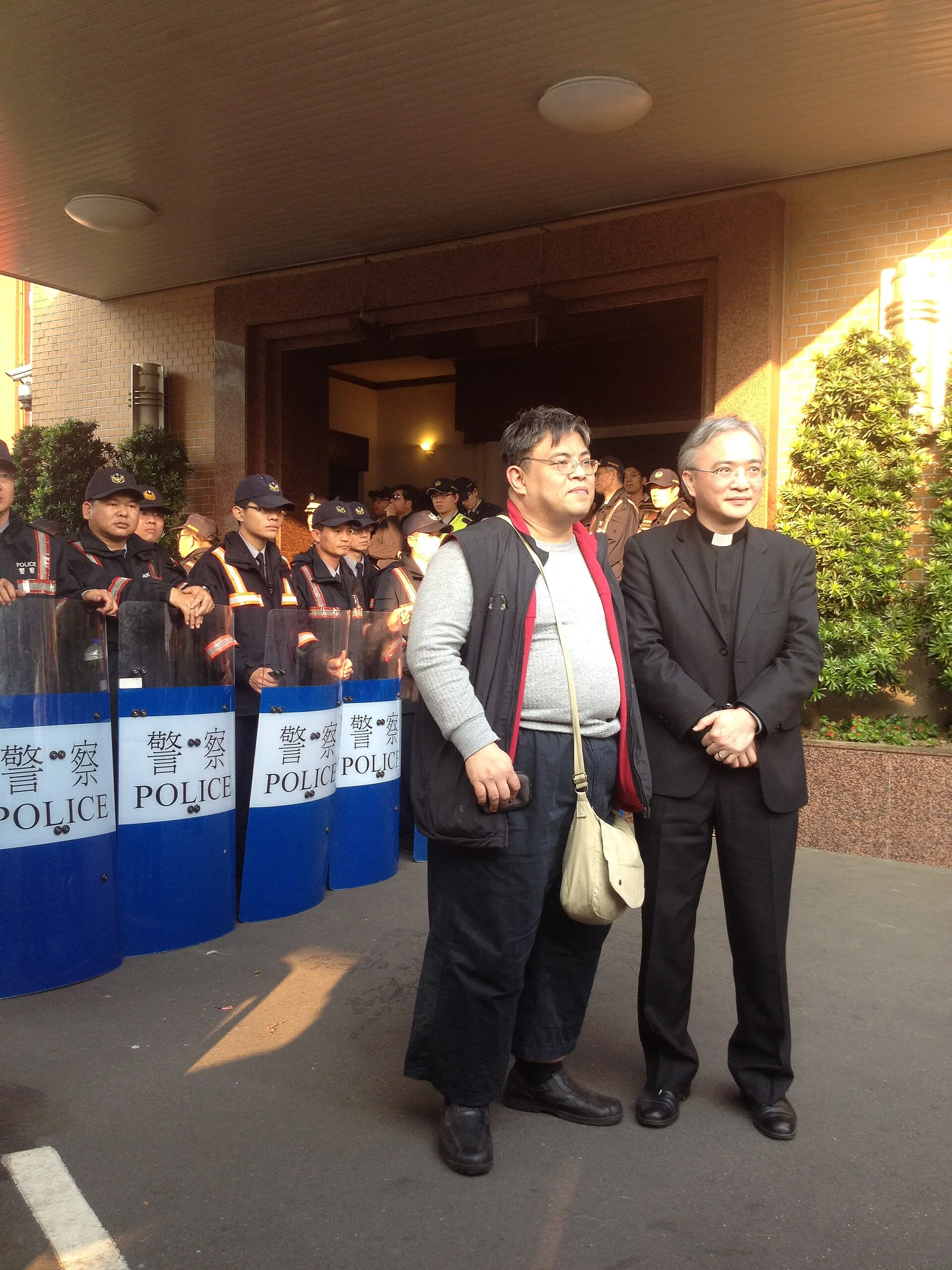
During the Sunflower Movement in March 2014, crowds gathered outside the Legislative Yuan. The March 18th Sunflower Movement began when students stormed the legislative chamber at 9:20 PM on March 18 and concluded their occupation on April 10, occupying the Legislative Yuan for a total of 24 days. Photo: Voice of America. License via Wikimedia Commons (Public domain, U.S. government work)
On the afternoon of March 17, members of the Legislative Yuan's National Affairs Committee, including KMT legislator Chang Ching-kuo, announced in a 30-second statement that the Cross-Strait Economic Cooperation Framework Agreement (ECFA) review was complete26. At 9:20 PM on March 18, approximately 300 students stormed the Legislative Yuan. The organizers of the anti-ECFA march in Ke tao estimated 500,000 participants on March 30, while police estimated 116,000. Students left on April 10. The ECFA has not yet been legislated.
On one particular night, March 23, several hundred students attempted to occupy the Executive Yuan at 7:35 PM that day. In the early morning of March 24, Police Commissioner Wang Chuan-chuan reported to Premier Jiang Yi-hua that persuasion efforts failed, and Jiang Yi-hua ordered enforcement according to law. Starting from midnight, police launched multiple forced dispersal operations, using water cannons and batons. The complete dispersal was finished by 5:30 AM, resulting in injuries and bloodshed among both protesters and police27. A nine-year investigation by the Control Yuan (with a report released in 2023) concluded that "police agencies used violent means exceeding proportionality to carry out the dispersal" and censured the Executive Yuan, Ministry of National Defense, National Police Agency, Taipei City Police, and Taipei District Prosecutors Office.
Jiang Yi-hua firmly maintained afterward28: "I not only do not regret it, but I feel that I have never made a more correct decision than this (the dispersal)." Regarding allegations of attempted murder, he described them as "malicious slander and baseless accusations that distort the facts." Ma Ying-jeou and Jiang Yi-hua were subsequently indicted for attempted murder, and in the second trial on September 15, 2020, they were acquitted.
Lin Fei-fan, one of the leaders of that movement, reflected ten years later in 202429: "(Sunflower told everyone) That we decide Taiwan's fate ourselves. Because by blocking the ECFA, preventing the Ma administration from signing a trade agreement or a military confidence mechanism, and not engaging in political negotiations with the mainland, these are our achievements, the results we created."
Ma Ying-jeou himself commented on the Sunflower Movement four years later in his preface to Memoirs of Eight Years in Power, published in December 201830: "Those sinners who have held Taiwan back!" He described the freezing of the ECFA as a profound betrayal and a grave harm, which was what saddened him the most.
The same movement had two completely opposing historical interpretations. Ten years later, neither side yielded.
📝 Curator's Note
If the story of the Sunflower Movement is only written up to "students occupying the legislature, the Ma administration using water cannons for dispersal, and political party transitions," it is too thin. What truly made this movement a watershed moment in Taiwan's civil society was what followed: the Sunflower generation supported Tsai Ing-wen with 6.89 million votes in 2016, 8.17 million votes in 2020, and Lai Ching-te with 5.58 million votes in 2024. When Ma Ying-jeou wrote "sinners who have held Taiwan back" in 2018, those students were already 25 years old, voting to elect the next president. All the contradictions of eight presidential terms ultimately became the electorate structure for the last three presidential elections.
On March 14, 2014, Ma Ying-jeou referred to deer antler as "hair in the deer's ear" when meeting with Lion Club executives31. This gaffe, along with the contemporaneous memes "Is A-Gei a name?" and "Death Grip," completely collapsed Ma Ying-jeou's image among the younger generation. Nine months later, on November 29, 2014, in the September 9th elections, the KMT suffered a major defeat, with the pan-green bloc winning 14 counties/cities against the pan-blue bloc's 8 counties/cities. Ko Wen-je in Taipei City won 853,983 votes (57.16%) to defeat Wen's 609,932 votes (40.82%)32. On December 3, Ma Ying-jeou resigned as Chairman of the KMT.
He still had a year and a half left before stepping down as president.
From 80 Seconds to 16 Seconds: Two Ma Xi Meetings and Two Post-Tenure Narratives
On November 7, 2015, Ma Ying-jeou was already a lame-duck president. The Kuomintang (KMT) had lost the "One Connect" referendum in the previous year, leaving only grassroots supporters, and his path diverged from those of Zhu Li-lun, who succeeded him as party chairman for the 2016 election. At this point, he flew to Singapore's Shangri-La and shook hands with Xi Jinping.
Both sides deliberately referred to each other as "Mr." to avoid formal titles. In his opening remarks, Ma Ying-jeou put forth five main points33: "Consolidating the '1992 Consensus,' maintaining the status quo of peace... The consensus reached by both sides in November 1992 regarding the principle of 'One China' is known as the '1992 Consensus.' The 1992 Consensus serves as a common political foundation for cross-strait peaceful development... The people of both sides belong to the Chinese nation and are all descendants of the Han race, and should assist each other in promoting Chinese culture."
Supporters viewed this as the first meeting between top leaders from across the Taiwan Strait since 1949, a historical breakthrough in reducing cross-strait hostility. Britannica noted under Ma Ying-jeou's entry34 (translated): "The U.S. government was satisfied with Ma Ying-jeou’s presidency because he reduced tensions in the Taiwan Strait by building friendly relations with Beijing rather than provoking its leaders."
Opponents saw it as a concession of subjectivity: referring to each other as "Mr." and avoiding the title "President of the Republic of China" was seen as tacitly diminishing status, while the phrase "the people of both sides belong to the Chinese nation and are all descendants of the Han race" echoed Xi Jinping's concept of "One China." After the 2019 anti-extradition protests in Hong Kong, this perspective—that "cross-strait economic integration might be a test case for Hong Kong"—led more people to re-read the photo from November 7, 2015.
On May 20, 2016, Ma Ying-jeou stepped down and handed over to Tsai Ing-wen. After his term ended, the Taipei District Prosecutors Office immediately resumed investigations into 24 criminal cases, including the disclosure case involving Huang Shi-ming, as he lost his immunity35.
On July 27, 2018, the "Ma Ying-jeou Foundation" was established at the Grand Hotel in Taipei. Former KMT chairmen such as Hsiao Wan-chang and Lien Chan attended. The foundation promoted youth camps called the "Great Nine Academy" and cross-strait youth exchanges.
From March 27 to April 7, 2023, Ma Ying-jeou visited China for the first time in 12 days, making him the first former president since 1949 to visit mainland China. On March 28, he inscribed "Peaceful Struggle and Promoting Chinese Culture" (和平奮鬥 振興中華) on Zhongshan Mausoleum in Nanjing36. The wreaths prepared by the Chinese side referred to him as a "former chairman of the KMT"; Ma Ying-jeou referred to himself as a "former president." Throughout his trip, he repeatedly mentioned that "the people of both sides belong to the Chinese nation."
From April 1 to 11, 2024, Ma Ying-jeou visited China for a second time. On April 4, he presented flowers alongside Song Tao, a representative from the other side, at the Yellow Emperor's Mausoleum in Huangling County, Shaanxi (his first visit to pay respects; he had paid homage six times remotely from Taipei). He became emotional twice while reading the dedication text37.
At 4 p.m. on April 10, in the East Hall of the Great Hall of the People in Beijing, there was a second Ma-Xi meeting. The talks lasted about an hour. In his speech, Ma Ying-jeou mistakenly said "Republic of China" instead of "Chinese nation," which he immediately corrected. He quoted Lu Xun's famous line: "Crossing all tribulations, brothers meet and laugh away grievances." Afterward, Wang Huning hosted a farewell banquet at the Fisherman's Wharf Guest House, where Xi Jinping told Ma Ying-jeou, "Welcome to come often in the future" 38.
The handshake in Singapore's Shangri-La lasted 1 minute and 20 seconds39. The meeting in the East Hall of the Great Hall of the People in Beijing lasted 16 seconds 38.
Disagreements within Taiwanese society regarding this visit to China and his entire post-tenure trajectory continue:
⚠️ Controversial Views
Communication Channel Faction: Official cross-strait communication stalled after Tsai Ing-wen took office in 2016. The "Great Nine Academy" of the Ma Ying-jeou Foundation is one of the few remaining civilian bridges. Supporters argue that the April 10, 2024, Ma-Xi meeting—held before (April 10) and after (May 20, when Lai took office) Lai Ching-te's inauguration—was intended to provide Beijing with a "window."
"Selling Taiwan" Faction: The Democratic Progressive Party (DPP) stated that Ma Ying-jeou's remarks were "consistent with CCP discourse" and "completely betray the people of democratic Taiwan" 40. During his first visit in 2023, Chen Jun-han of the National Youth Corps protested at Taoyuan Airport.
On May 21, 2026, Ma Ying-jeou's wife, Chu Mei-ching, and sister, Ma Yi-nan, issued statements expressing hope that Ma Ying-jeou would truly retire and that the foundation's affairs should be handled by the board of directors; Ma Yi-nan, through a lawyer, filed a petition with the court requesting an auxiliary declaration (not guardianship, as they have different legal effects)41.
The next day, May 22, Ma Ying-jeou himself responded via video, signing his manuscript. Holding up the document to the camera, he said: "Lawyer, this can prove that I am not senile, right?" He spoke about his sister: "I live further from my sister; we live in Wenshan District, and she lives in Neihu District; we meet maybe once a month at most, so we are not that close." Regarding the foundation: "These corrupt individuals should never try to use this reason to say I am senile and do things I shouldn't."
The context behind the incident involves an investigation by a three-person investigative team into the "Financial Discipline Case" of the Ma Ying-jeou Foundation (with Li De-wei as spokesperson), which is investigating Hsiao Xu-tsin (CEO) and Wang Guang-ci (former CEO). Li De-wei responded to the family's statement: "The investigation by the three-person team into this case will not stop; it will continue... Ma Ying-jeou's family will issue a statement, indicating that there are indeed doubts about Ma Ying-jeou's health."
This news story is far from over, and Taiwanese society has yet to reach a consensus.
Those 80 Seconds and 16 Seconds, The Young Man Who Returned to Taipei in 1981
On April 10, 2024, at the Great Hall of the People in Beijing, he mistakenly said "Zhonghua Minzu" (Chinese nation) instead of "Zhonghua Minguo" (Republic of China), immediately correcting himself. Sixteen years earlier, in his inaugural address as the twelfth president, he wrote: "The key to resolving cross-strait issues ultimately lies not in sovereignty disputes, but in lifestyles and core values."
On May 22, 2026, he raised a hand toward the camera in a video, asking, "Lawyer, can this prove I am not senile?" Forty-five years had passed since that young man—who returned to Taipei from Harvard with an SJD in international law and was recommended by Chen Fu to work as an English interpreter at the Presidential Office—in 1981.
The handshake in Singapore's Shangri-La lasted 80 seconds; the event at the Great Hall of the People in Beijing lasted 16 seconds. The same person, two historical moments, and Taiwanese society still remembers him in different ways.
🧬
Further Reading:
- Sunflower Student Movement — The occupation of the legislative body from March 18 to April 10, 2014, how it transformed from an anti-FTT movement into a rite of passage for Taiwanese civil society
- Tsai Ing-wen — A successor in governance; the opponent in the 2010 ECFA debate; the unifier of the opposition camp after Sunflower
- Chen Shui-bian (controversial president) — The opponent in the 1998 Taipei mayoral election; the leader of political turnover in 2000
- Ma Ying-jeou memes — Deer antler, lunchbox set, Provence permanent house, death grip: how 19 internet memes became another face of his public image
- Taiwan Strait Crises and Cross-Strait Relations Development — The positions of the Ma Xi meetings and ECFA in the long arc of Taiwan Strait relations
Image Sources
This article uses 3 publicly licensed images, all cached in public/article-images/people/ to avoid hotlinking from source servers:
- Ma Ying-jeou and Xi Jinping at the closed-door meeting in Singapore on November 7, 2015 (Flickr Presidential Office photo 22472046408) — Photo: Presidential Office, 2015-11-07, CC BY 2.0
- Official portrait of Ma Ying-jeou upon assuming the presidency in 2008 (Wikimedia Commons File:Ma_Ying-jeou_MOFA_Presidential_Portrait_2008.png) — Photo: Ministry of Foreign Affairs / Presidential Office, 2008-05-29, Government website open information declaration (Attribution Only), original source see MFA Yearbook
- Scene outside the Legislative Yuan during the 318 Sunflower Movement (Wikimedia Commons File:Sunflower_movement_legislative_yuan.jpg) — Photo: Voice of America, 2014-03, Public domain (U.S. federal government work)
References
- Yahoo: Historical Review - Ma Ying-jeou's Century Handshake, Lasting 80 Seconds — Details of the 1 minute and 20 second handshake, both referring to each other as 'Mr.', and the setting in Singapore's Shangri-La. The scene time is confirmed with ETtoday Ma Ying-jeou's Full Address.↩
- Central News Agency: Ma Ying-jeou Recalls Chiang Ching-kuo, Ending Authoritarianism by Being Born from It — On January 22, 2022, Ma Ying-jeou recalled his experience as the English secretary to Chiang Ching-kuo and translating the declaration of martial law lifting word for word.↩
- Wikipedia: Ma Ying-jeou — Complete biography and education (1977 NYU LL.M., 1981 Harvard SJD), 'In 1981, at the recommendation of Qian Fu, he returned to Taiwan to serve as the English translator for then-President Chiang Ching-kuo'.↩23
- Wikipedia: Ma Her-ling — Biography of Ma Ying-jeou's father; his highest positions were Director of the Youth Affairs Office of the Executive Yuan + Vice Chairman of the KMT Central Inspection Commission + Member of the Central Council, with the inscription on his urn reading 'Transformation from Unification to Gradual Integration, Comprehensive Revitalization of China'.↩
- Government Official Database: Ma Ying-jeou's Political Career Record — Official appointment records: December 21, 1981 (Year 70) as Deputy Director of the Presidential Office; July 20, 1988 (Year 77) as Chairman of the Special Executive Yuan Research and Development Assessment Committee; May 30, 1991 (Year 80) as Vice Chairman of the Mainland Affairs Council of the Executive Yuan.↩2
- Wikipedia: Ma Ying-jeou § Tenure as Minister of Justice — Served as the Minister of Justice from February 27, 1993, to June 9, 1996, during which he promoted anti-corruption efforts and the eradication of black money.↩
- UDN: The Evolution of the Nickname 'Not Getting Involved' — 'The three words 'not getting involved' have been constantly associated with Ma Ying-jeou. According to Ma Ying-jeou himself, he absolutely does not get involved in any bad pots that are malicious, illegal, or against the system.'↩
- Wikipedia: 1998 Municipal Mayoral and Council Elections of Taipei City — Ma Ying-jeou received 51.13% of the votes (766,377 votes), Chen Shui-bian 45.91%, Wang Jianxuan 2.97%; Ma won by 78,305 votes / 5.22 percentage points. The campaign context of 'Abandoning Wang to Support Ma' is seen in Yuanjian.↩
- Wikipedia: Ma Ying-jeou § Re-election as Taipei Mayor in 2002 — In the 2002 re-election as Taipei Mayor, he received 64.11% of the votes, setting the record for the highest voter turnout in a Taipei Mayoral election to date.↩
- Wikipedia: Ma Ying-jeou § Chairman of the KMT — In July 2005, he was elected as the chairman of the Kuomintang with 72.36% of the votes, officially succeeding the Lian Zhan era.↩
- Wikipedia: Taipei Mayor Ma Ying-jeou's Special Fee Case — On February 13, 2007, he was indicted and announced his candidacy for President in 2008; the defense of the 'Large Reservoir Theory' was accepted by the court; the first instance trial at the Chiayi District Court found him innocent on August 14, and the second instance appeal at the High Court upheld his innocence on December 28.↩
- Yuanjian: Verdict of the Second Trial in the Sanzhong Case — On December 31, 2025, the Taiwan High Court's second trial in the Sanzhong case ruled that Ma Ying-jeou, Chang Zhechen, and Wang Haiqing were innocent; Cai Zhengyuan was sentenced to 3 years and 6 months for embezzlement, and the High Prosecutors Office is reviewing an appeal. This is the third case where Ma Ying-jeou has been found innocent after being indicted.↩
- United Daily News: Taiwan Moves Forward - The Origin of the Long Stay Plan Campaign Strategy — On July 11, 2007, Ma Ying-jeou launched the 'Taiwan Moves Forward - Long Stay Plan,' starting in Central Taiwan for an 18-day long stay period.↩
- News Feed: The Overwhelming Victory of Ma Ying-jeou in the 2008 Presidential Election — In the March 22, 2008 election, Ma Ying-jeou / Hsiao Wan-chang received 7,659,014 votes (58.45%), defeating Hsieh Chang-ting / Su Tseng-chang with 5,444,949 votes (41.55%).↩
- Presidential Office: Inaugural Address of President Ma Ying-jeou, the 12th President of the Republic of China — The full transcript of the inauguration speech on May 20, 2008, including the original sentences 'No Unification, No Separation, No Militarism' and 'The key to resolving cross-strait issues is not sovereignty disputes, but lifestyles and core values'.↩
- Wikipedia: 633's Political Views — 2008 election platform (GDP 6% / unemployment 3% / per capita income $30,000); in September 2008, Ma Ying-jeou admitted that this could not be fulfilled due to the financial crisis when interviewed by a Mexican media outlet.↩
- Wikipedia: Internship Program for University Graduates in Corporations — Implemented in two stages from April 2009 to September 2011, with government subsidies of NT$22,000 per month + labor and health insurance (NT$4,190); the monthly income of employed individuals aged 20-24 decreased from NT$23,351 in 2008 to NT$21,685 in 2009 (a 7% decrease); the program was officially abolished on June 3, 2013.↩
- National Policy Research Foundation: Review and Controversy of the 22K Policy — Xue Chengtai's 'What is the 22K Plan?' from December 14, 2011: 'The government provides each graduate with a salary of NT$22,000 per month plus labor and health insurance (commonly known as 22k)' and 'Because the wage level had already declined during the financial crisis was a common fact.'↩
- Wikipedia: Typhoon Morakot — Typhoon Morakot from August 6-10, 2009, caused 681 deaths and 18 missing; 474 people were buried alive in Xiaolin Village; Premier Liu Chao-hsien resigned in early September of the same year. See Far Sight: Reflections on Morakot Disaster Relief.↩
- Wikipedia: Economic Cooperation Framework Agreement (ECFA) between Taiwan and the Mainland — Jiang Bingkun and Chen Yunlin signed ECFA in Chongqing on June 29, 2010; the early collection list included 539 goods from the Mainland to Taiwan + 18 agricultural products from Taiwan to the Mainland; all products were reduced to zero tariffs on January 1, 2013.↩2
- Wikipedia: TV Debate on Cross-Strait Economic Agreements — On April 25, 2010, Ma Ying-jeou held a TV debate with DPP Chairman Tsai Ing-wen regarding ECFA, marking the first time a President of the Republic of China held a policy debate with a chairman from an opposition party.↩
- Wikipedia: 2012 Presidential Election in the Republic of China — The election was held on January 14, 2012, where Ma Ying-jeou / Wu Dunyi received 6,891,139 votes (51.60%) defeating Tsai Ing-wen / Su Chia-chuan with 6,093,578 votes (45.6%) and Song Chu-yu / Lin Rui-hsiu with 369,588 votes (2.77%).↩
- Wikipedia: May 19th 'Challenging Ma, Kicking Communism' Grand March — A popular backlash after the rise in oil and electricity prices in 2012: oil prices rose by 10.7%, and electricity prices rose by 29.5%; police estimated 55,000 people at the May 19th grand march; a survey by Taiwan Think Tank on April 27 showed that 44.1% of the public believed 'Taiwan chose the wrong president.'↩
- ETtoday: Full Transcript of Ma Ying-jeou's Press Conference on September 8 — The verbatim transcript of the Wang Jin-pyng case press conference, including the original sentences: 'If powerful people can influence justice, how can ordinary citizens expect judicial fairness and justice?' and 'The most shameful day in Taiwan's democratic rule of law development.'↩
- Liberty Times: Ma Ying-jeou's Poll at a Record 9.2% — A survey by Niandai News on September 15, 2013, showed that the approval rating for Ma Ying-jeou's administration was 9.2%, while dissatisfaction was 80.5%; TVBS polls at the same time showed 11%. Some media mistakenly attributed the 9.2% to the TVBS poll. See ETtoday for the TVBS 11%.↩
- Wikipedia: Sunflower Student Movement — On March 17, 2014, KMT legislator Chang Ching-chong announced that the committee reviewing the trade agreement was complete; on the evening of March 18, students stormed the legislative assembly; on April 30, the Kaohsiung march (organized by 500,000 / police 116,000); students left on April 10. See CNA: Sunflower Decade Returns to the Scene.↩
- Wikipedia: The March 3rd Occupation of the Executive Yuan — On the evening of March 23, 2014, students occupied the Executive Yuan; on the morning of March 24, police forcibly removed them, injuring over 150 people; a 2023 investigation report by the Control Yuan determined that 'police agencies used violent means exceeding proportional principles to conduct removals' and corrected the Executive Yuan / Ministry of the Interior / National Police Agency / Taipei Police / Taipei Prosecutors Office. See Reporter: The Long Wounded Path of Sunflower Citizens.↩
- Human Today Online: Jiang Yi-hua on Not Regretting the Removal of the Sunflower Movement: Intellectuals Must Insist on Doing What is Right — Jiang Yi-hua's verbatim statement on September 3, 2020: 'I not only do not regret it, but I feel that I have never made a more correct decision than this (the removal).' See Newtalk: Describing the accusation of attempted murder as 'a distortion of facts, baseless malicious slander and abuse.'↩
- CNA: Lin Fei-fan Talks About the Sunflower Decade — Lin Fei-fan recalled the achievements of the Sunflower Movement in his original words: '(The Sunflower told everyone) that we decide Taiwan's fate ourselves. Because by blocking the trade agreement, preventing the Ma administration from signing a trade agreement and a military confidence mechanism, and not negotiating politics with the mainland, these are our achievements, the results we created.' See Asia Times.↩
- RFA: Ma Ying-jeou: The 'Sunflower Movement' Has Stagnated Taiwan — In the preface of his book Memoirs of Eight Years in Power, published by Ma Ying-jeou on December 20, 2018, it states: 'The sinners who have stagnated Taiwan!' In the preface, he said that the Sunflower Movement 'froze the trade agreement until now, harming the overall economic development of Taiwan, being a profound betrayal and causing great harm, which is what makes him most heartbroken.'↩
- ETtoday: Ma Ying-jeou's 'Deer Antler is Hair in Deer's Ear' Slip — On March 14, 2014, Ma Ying-jeou referred to deer antler as "hair inside a deer's ear" during a meeting with Lion Club executives, causing nationwide ridicule.↩
- Yahoo: 2014 September 1st Election Results — On November 29, 2014, the KMT suffered a major defeat in the September 1st election; Pan-Green won 14 counties/cities to Pan-Blue's 8; Taipei City's Ko Wen-je (853,983 votes, 57.16%) defeated Wen (609,932 votes, 40.82%); Ma Ying-jeou resigned as KMT chairman on December 3.↩
- ETtoday: Full Text of Ma Ying-jeou's Speech at the Ma Xi Meeting — Ma Ying-jeou's five points from November 7, 2015, were verbatim: consolidating the 1992 Consensus, reducing hostility, expanding cross-strait exchanges, establishing a cross-strait hotline, and mutual cooperation; the original text stated that "the people of both sides belong to the Chinese nation and are all descendants of the Han race." Supported by Great Circlet + Cross-Strait Affairs Council.↩
- Britannica: Taiwan—The Ma Ying-jeou presidency — An English encyclopedia's evaluation of the Ma Ying-jeou era: "The U.S. government was indeed very pleased with Ma as president, principally because he reduced tensions in the Taiwan Strait by pursuing cordial relations with Beijing rather than provoking its leaders. In the process, the Taiwan Strait was downgraded from its former status as the foremost flash point in the world"↩
- TVBS: Investigation into 24 Cases Reopened After Ma Ying-jeou's Term — On May 20, 2016, the Taipei District Prosecutors Office immediately reopened investigations into 24 criminal cases, including the disclosure case involving Huang Shi-ming, after his term.↩
- CNA: Ma Ying-jeou's Inscription at Zhongshan Cemetery in Nanjing — On March 28, 2023, Ma Ying-jeou inscribed "Peaceful Struggle to Revitalize China" (八字) at the Zhongshan Cemetery in Nanjing; the mainland Chinese side prepared wreaths stating "Former Chairman of the KMT," while Ma referred to himself as "former president." Supported by Apple News.↩
- Wikipedia: Ma Ying-jeou's Second Visit to Mainland China — April 1-11, 2024: second visit to China; on April 4, he paid respects at the Yellow Emperor's Mausoleum in Huangling County, Shaanxi (first time paying respects, having remotely honored six times in Taipei), and tearfully delivered a eulogy alongside Song Tao. Supported by CNA.↩
- CNA: Ma Xi Meeting Held in Beijing — At the East Hall of the Beijing People's Hall on April 10, 2024, at 4 PM, the Ma Xi meeting lasted about an hour; during his speech, Ma Ying-jeou mistakenly said "Chinese Nation" instead of "Republic of China" and immediately corrected himself; he quoted Lu Xun's "Crossing all tribulations, brothers meet with a smile to dispel enmity"; after the meeting, Wang Huning hosted a farewell banquet at the Fisherman's Wharf Guest House, where Xi Jinping told Ma, "Welcome, come often in the future." Supported by Yuanjian (4 PM) + Wikipedia: Ma Ying-jeou's Second Visit to Mainland China (meeting lasted about an hour, farewell at Fisherman's Wharf Guest House, "come often in the future").↩2
- Wikipedia: Cross-Strait Leaders' Meetings — A comparison of the history of cross-strait leaders' meetings, including the 1 minute and 20 seconds (80 seconds) handshake between Ma and Xi on November 7, 2015.↩
- CNA: DPP: Ma Ying-jeou Aligns with CCP Discourse and Betrays Taiwan's People — On October 15, 2024, the DPP issued a statement: "Ma Ying-jeou is 'aligned with CCP discourse' and is 'completely betraying the people of democratic Taiwan.'"↩
- CGTV News Network: Relatives Hope for Retirement, Request Assisted Declaration; Ma Ying-jeou Responds to Counter Claims Without Mental Impairment — On May 21, 2026, Chou Mei-ching and Ma Yi-nan issued statements saying "hope that Ma Ying-jeou can truly retire / the foundation's affairs should be handled by the board of directors"; Ma Yi-nan submitted a petition via a lawyer requesting assisted declaration (not guardianship); on May 22, 2026, Ma Ying-jeou responded in a video, saying three sentences: "Can this prove I am not mentally impaired?", "Living further from my elder sister... maybe meeting once a month", and "These corrupt criminals should not try to use this reason to say I am mentally impaired"; the background is that the investigation team of Ma Ying-jeou Foundation regarding the "Financial Discipline Case" (Li De-wei spokesperson) is investigating Hsiao Hsu-tsin (CEO) and Wang Guang-ci (former CEO).↩