
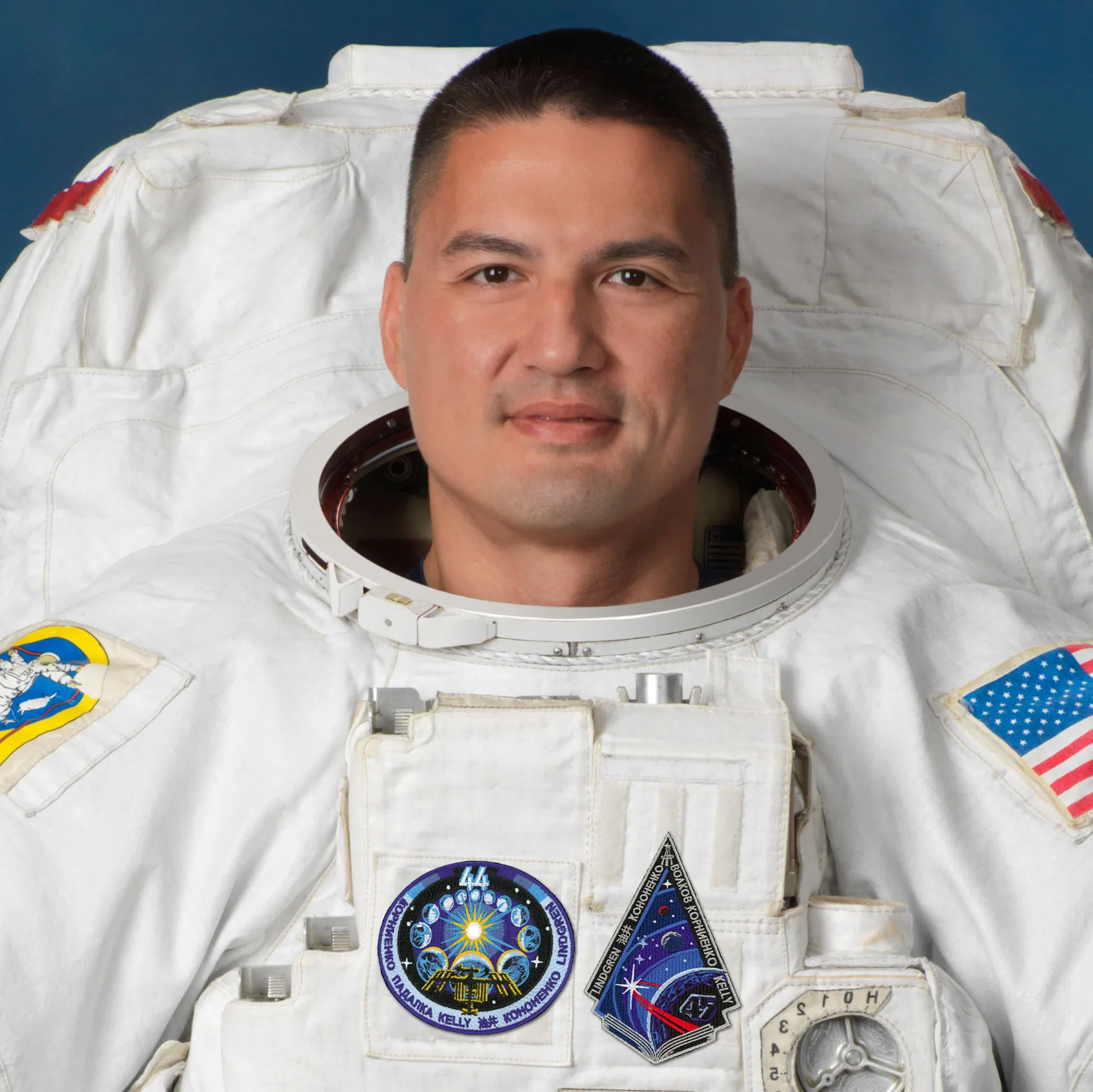
30-second overview: Kjell N. Lindgren was born in Taipei on January 23, 1973. His father was a U.S. Air Force officer stationed at Ching Chuan Kang Air Base in Taichung; his mother, Zhang Chuyun, was born in Wuhan and came to Taiwan as a child with the Nationalist government. He left Taiwan at age two and a half, spending his childhood in England and Virginia. After graduating from the Air Force Academy, a misdiagnosis of asthma during flight training ended his pilot ambitions. He pivoted to medicine, and eleven years later a NASA physical reversed the diagnosis. In 2009, he was selected as one of nine astronauts from 3,565 applicants in NASA's 20th class. He grew red romaine lettuce on the Space Station, played a plastic bagpipe inside the module in tribute to a fallen friend, and commanded SpaceX Crew-4 "Freedom," accumulating 312 days 5 hours 11 minutes in orbit. In April 2026, he returned to Taiwan under the "Freedom 250" program and said at the Presidential Office: "My NASA astronaut career began in Taiwan."
Mountains to climb
In April 2026, at a lecture hall at National Central University in Taoyuan, he said:
✦ "I know with almost 100% certainty that if I stayed in the Air Force and become a pilot like I was planning, I would not be here today. So, recognizing that even our hardest days are not necessarily as bad as we think they are. Recognizing that those hard days are actually challenges to overcome. Mountains to climb."1
The mountain he referred to was a medical report he received after graduating from the U.S. Air Force Academy (USAFA) in 1995 and entering flight training. The report identified him as having asthma — which meant he could not fly combat aircraft.2 The Air Force medically discharged him from the pilot track. Lindgren himself later described that period as "dream obliterated."3
He detoured through medical school. In 2002 he earned his MD from the University of Colorado, then pursued aerospace medicine. In 2007 he joined NASA as a flight surgeon, completing his aerospace medicine residency in 2008.4
📝 Curator's Note
That asthma diagnosis was later found to be a misdiagnosis. About eleven years later, when he underwent a NASA physical, a retest showed no asthma — the original report was overturned, and he became eligible to apply as an astronaut.5 A young man pushed out of his pilot dream took a detour through medical school, ended up exactly where NASA needed a flight surgeon, then applied from that position. The entire path began with one wrong piece of paper.
The television in a second-grade classroom
In April 2026, a PBS reporter asked him: "You've said you wanted to be an astronaut since you were young." He remembered that moment clearly:
✦ "I was deeply inspired by science fiction. I was a Star Wars fan, I loved reading sci-fi. But it wasn't until second grade, when my teacher wheeled a TV into the classroom, that I actually saw the first Space Shuttle launch in 1981. And in that moment I suddenly understood that living and working in space was not fantasy, not science fiction — it was real. From that moment, I was completely captivated."6
The launch he described was April 12, 1981 — Columbia, STS-1, lifting off for the first time.7 He was eight years old. A second-grade classroom in an American school, a teacher rolling in a television — and later that boy walked into the Air Force Academy, then medical school, then NASA, then onto the Space Station.
During his 2026 Taiwan visit, he brought several Star Wars-themed keepsakes that had flown in space. In the PBS interview, he described his connection to Arthur C. Clarke and Jules Verne:
✦ "Arthur C. Clarke's idea about communication satellites has now come true. So those things we see as children that inspire us become the goals we pursue in our studies and careers. I think this cycle from imagination to reality is very important. It sparks others' imaginations, turns those ideas into reality, and then further inspires the next generation of writers and engineers."6
The teacher who wheeled that television into the classroom — Lindgren has never publicly named her — may not have known what she set in motion that day.
Ching Chuan Kang, Wuhan, Skåne: three migration lines converge
Lindgren's story begins at a bank counter inside Ching Chuan Kang Air Base, Taichung.
Around 1972, Zhang Chuyun was working as a teller at a bank on the base. Her ancestral home was Wuhan; she had come to Taiwan as a child with the Republic of China government and grown up in Taichung. A Swedish-American Air Force officer walked in to conduct some business, and the two met.8
The surname Lindgren, in Swedish, breaks down into Lind (small-leaved linden tree) and Gren (branch). The first name Kjell traces to Old Norse from the Viking era, originally meaning "cauldron" or "helmet."9 Further back, his great-grandfather, Kjell William Dahl, emigrated from a small village called Hjässby in Skåne, southern Sweden, to the United States in 1902 — part of the wave of roughly 1.3 million Swedes who crossed the Atlantic between 1846 and 1930.10
On January 23, 1973, Kjell Norwood Lindgren was born in Taipei.11 The Chinese name "Lin Chi-er" (林琪兒) was chosen by his father's Chinese language teacher; the sound of "Chi-er" echoes the name of his mother, Zhang Chuyun — the namer hid a reflection of the mother inside the son's Chinese name.12
Three migration lines converged in this one child: one from Wuhan to Taichung, one from Sweden to America, one from an officer's posting to a civilian bank counter. All of these meeting points would eventually be packed into a spacesuit and sent 400 kilometers up.
9 from 3,565
In June 2009, NASA selected its 20th astronaut class from 3,565 applications. Nine were chosen. Lindgren was one of them.13
He was 36. Before selection, he had served as a flight surgeon in support of STS-130 and as a backup flight surgeon for Expedition 24.4 The man who had once stood at the edge of the runway checking other people's fitness was now on the list to fly himself.
From the medical discharge notice to the acceptance letter: approximately 14 years apart. The pilot dream pushed away, the medical school detour, the career slot that happened to be exactly what NASA needed — all of it closed in that single month in 2009.
The first bite of lettuce under red LEDs
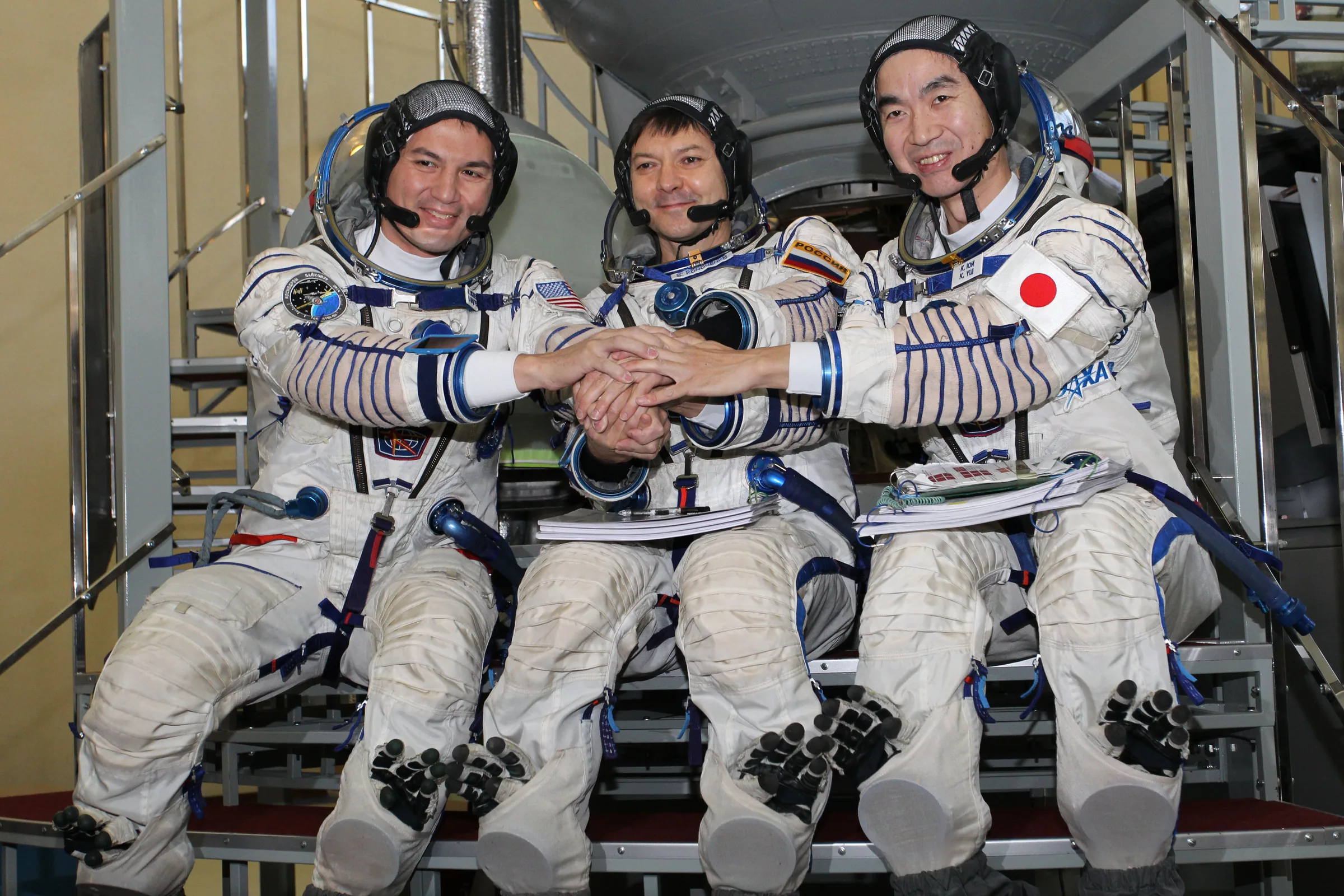
October 30, 2014: Lindgren (left) with Expedition 42/43 backup crew members Oleg Kononenko (center, Russia) and Kimiya Yui (right, Japan) at the Gagarin Cosmonaut Training Center in Star City — they would later be his crewmates on Soyuz TMA-17M. Photo: NASA/Stephanie Stoll. Public domain via Wikimedia Commons.
On July 22, 2015, Lindgren launched aboard Soyuz TMA-17M from Baikonur Cosmodrome in Kazakhstan, alongside Russian commander Oleg Kononenko and Japanese astronaut Kimiya Yui, for Expedition 44/45.14 This was his first spaceflight.
Shortly after arriving at the International Space Station (ISS), he took over experiment Veg-01. Scott Kelly had initiated the growth of red romaine lettuce (variety "Outredgeous") in plant "pillow" pouches in July 2015; the plants were illuminated by red LEDs — red LED light is absorbed directly by chlorophyll at high efficiency, without drawing heavily on the station's power budget. The variety had been selected from candidates including spinach, beets, Swiss chard, bok choy, and mizuna, chosen for low-light tolerance and short growth cycle.15
On August 10, Kelly, Lindgren, and Yui floated beneath the Veggie module's red LED glow, harvested lettuce leaves grown over 33 days, dressed them with olive oil and balsamic vinegar, and ate — the first time humans had grown food in space and eaten it directly.
✦ "That's awesome. It's fresh." (Lindgren, on his first bite of space-grown lettuce)
"Tastes good. It tastes like arugula." (Scott Kelly's verdict)
Kelly also said what became a widely quoted line: "If we're ever going to go to Mars someday, we're going to have to have a spacecraft that is more self-sustainable in regards to its food supply."15
That first bite of space lettuce tasted like something no textbook on rocketry covers: if humans are going to go further from Earth, they need to learn to grow their own food up there.
Bagpipes in the void
On October 22, 2015, NASA astronaut trainer Victor Hurst died suddenly at age 48. Hurst was a researcher at Wyle Science and one of the trainers who had worked with Lindgren's astronaut class.16 Lindgren was on the ISS at the time and had no way to return for the memorial service.
He found another way. More than two years earlier, he had contacted McCallum Bagpipes in Scotland and commissioned a lightweight plastic bagpipe that met NASA's onboard hygiene standards.17 The preparation had started long before: he already knew how to play bagpipes and had always intended to bring a set to space. When news of Hurst's death arrived, the custom-made plastic pipes — ordered two years prior — found their purpose.
In November 2015, he played "Amazing Grace" inside the Space Station.18 It was the first time bagpipes had ever been played in space. The footage was transmitted to Earth and played at Hurst's memorial service.
In NASA's official tribute, he wrote:
✦ "He always had a quick smile, a kind word. I don't know if anyone was more enthusiastic and professional about being involved in human space flight."19
Sound does not travel in a vacuum. He played for those on Earth who still remembered Hurst.
During those 141 days, he also completed two spacewalks (EVAs), both with Scott Kelly as his partner: the first on October 28, lasting 7 hours 16 minutes; the second on November 6, lasting 7 hours 48 minutes — 15 hours 4 minutes combined.20 On December 11, the Soyuz descent module landed on the Kazakh steppe, and he returned to Earth.
Naming his spacecraft Freedom
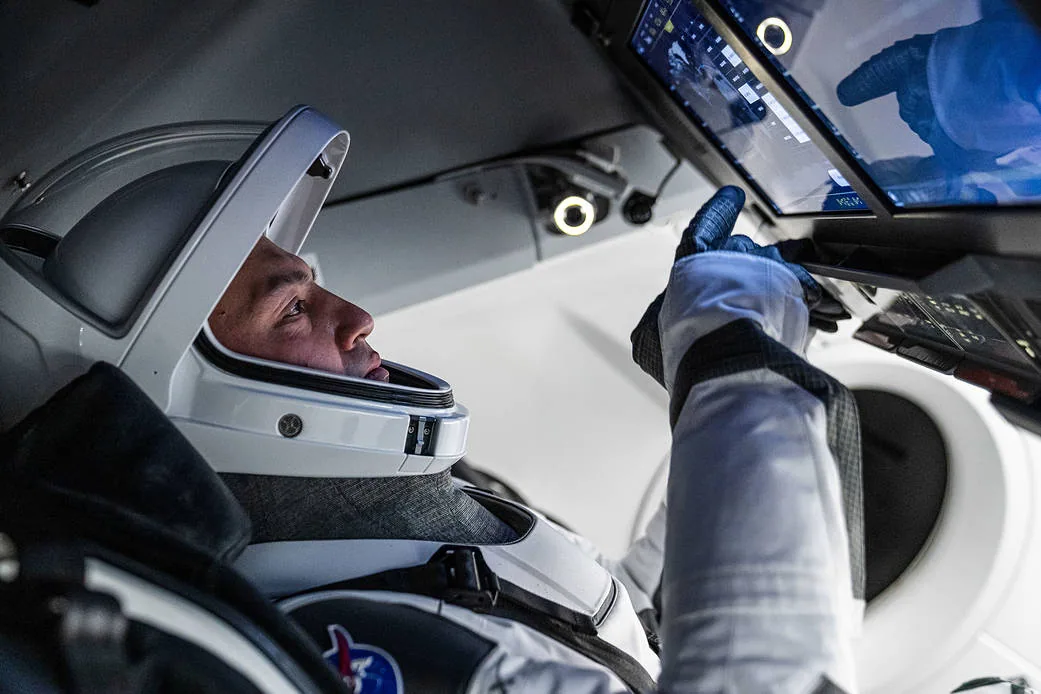
February 2022: Lindgren, as SpaceX Crew-4 Commander, during training in the Crew Dragon mockup at SpaceX headquarters in Hawthorne, California. Photo: NASA. Public domain via NASA (NASA Image ID jsc2022e011416).
Seven years later, on April 27, 2022, Lindgren launched a second time — this time aboard a SpaceX Crew Dragon, as commander of the Crew-4 mission.21
Four crew members: Lindgren as commander, Bob Hines as pilot, NASA's Jessica Watkins and ESA's Samantha Cristoforetti as mission specialists. They named their Crew Dragon "Freedom."
Over 170 days, they conducted more than 300 science experiments and technology demonstrations aboard the ISS. On October 14, 2022, Freedom splashed down off the coast of Florida.21
Combined with his first mission, Lindgren accumulated 312 days 5 hours 11 minutes in space.22 As the first NASA astronaut born in Taiwan, his total time in orbit approaches an entire year.
He later described the physical sensation of those days:
✦ "Even though you've been in space for months, floating, zero gravity never gets old. The ability to do things that you could never dream of doing back here on Earth. Doing front flips, doing back flips, just tumbling around the space station is absolutely amazing and fun."1
30% of the time versus Earth
Looking down at Earth from space, he encountered that old question — the one psychologists call the overview effect. But his answer was not the tourist-brochure version of "a beautiful blue marble."
When the PBS reporter asked him about it, he gave what may have been the most substantial passage of the entire interview:
✦ "I think your experience of the overview effect depends greatly on what you're thinking and believing when you're on a mission. Some people feel disconnected from Earth, very lonely; when I looked back at the Earth, I felt deeply connected. But what struck me most was seeing how breathtakingly beautiful the Earth is — and yet on the Space Station, that spacecraft that provides us with air to breathe, food, and shelter from the harsh environment outside, we have to spend 30 percent of our time maintaining it. Because if it breaks down, the crew inside will die. Our lives depend on the Space Station. Now look at Earth — there is nothing else like it around us. It is unique. All of humanity lives there. It is humanity's spacecraft. But I think very few of us spend 30 percent of our time maintaining that spacecraft — the Earth. Its resources are not inexhaustible; they are finite. I came back more convinced than ever that we need to do a better job of maintaining humanity's spacecraft."6
📝 Curator's Note
Astronauts talking about climate can easily slide into slogans: "protect the Earth, we only have one" or "the Earth is a fragile home." Lindgren's version is not a slogan. He gives an engineering number — 30%. The ISS maintenance time: maintenance cycles, life support, pipe repairs, air seal checks, microbial filtration — all of it together takes up 30% of an astronaut's working hours. The discipline he developed in orbit became, back on the ground, a point of comparison: that spacecraft, they maintained at 30%. This one — Earth — what percentage do we spend?
On the real constraints of interplanetary travel, he was equally direct:
✦ "I think for most of us, the biggest challenge of spending 5, 6, 12 months in space is actually leaving family. The team does a tremendous job of keeping us connected through phone systems, video chats, and care packages... The long-duration challenge of going to Mars will be even greater, because we'll be farther from Earth, communication delays will increase, and we won't be able to see Earth every day."6
He was not describing a technological hurdle. He was describing what it means for the people inside the capsule — that during a Mars mission, they won't be able to see Earth each day.
Not a tiger mom
Near the end of the PBS interview, the reporter asked about his mother. The reporter said: "Many people in Taiwan assume she must be a 'tiger mom,' because you're not only an astronaut but also a doctor, with multiple degrees and 24 years of accumulated education."
Lindgren's response:
✦ "I was certainly not the top student at the Air Force Academy, but my grades were good enough to enter pilot training. I'm very grateful to my parents for their support and guidance. I would not describe my mom as a 'tiger mom.' What my parents did was truly support my choices. They never told me what I should do — instead, they told me that if I wanted to do something, if I had a goal, I just needed to work hard to achieve it, and then they would support me in pursuing it. So I feel very fortunate and grateful for the support my parents gave me. They created an environment in which I could thrive, nurtured my love of learning, my curiosity for exploration, and enabled me to follow the path I chose."6
He spoke of his father briefly: an Air Force officer, stationed at Ching Chuan Kang, who later took him back to Taiwan to visit relatives in the 1980s.6 He spoke of his mother even more briefly: Zhang Chuyun, grew up in Taichung, met his father at the base bank counter.
What he described his parents giving him was specific: they gave him space. They did not give him a checklist.
The island behind the bank counter
From April 21 to 25, 2026, Lindgren returned to Taiwan as a member of the "Freedom 250" delegation (marking the 250th anniversary of American independence) arranged by the American Institute in Taiwan (AIT), in his first official visit to his birthplace since leaving at age two and a half.23
He arrived with his group on Sunday — and Sunday and Monday were his own time.
✦ "We actually arrived quite early on Sunday, so Sunday and Monday were for exploring. On the first day we did a three-hour walk starting from Longshan Temple all the way to Chiang Kai-shek Memorial Hall, and we had bubble tea."6
He also returned to the markets he had walked through with his father in the 1980s:
✦ "I remember very clearly — especially when I came to Taiwan in the 1980s as a child, wandering through markets, seeing those little breads shaped like animals (chicken egg cakes). So seeing those again this time really brought back many memories."6
The most significant thing, he saved for last:
✦ "Another very meaningful thing was that we found the hospital where I was born. So making that connection to that place meant a great deal to me."6
On April 21, he met Vice President Hsiao Bi-khim at the Presidential Office. She told him: "You are absolutely the first Taiwan-born astronaut I have ever met." He replied in English: "My NASA astronaut career began in Taiwan."24
On April 22, he lectured at National Central University, encouraging students to pursue their own interests and strengths rather than simply meeting outside expectations. He said: "Working hard creates more opportunities for yourself."25 In the following days, he visited the National Public Information Library in Taichung, NCKU's Han Hwa-ming Space Technology Center and CubeSat Development Center, and the Taipei Astronomical Museum.26
His current position is Deputy Director of NASA Johnson Space Center's Flight Operations Directorate, responsible for training and flight mission operations.27 In April 2026, the four Artemis II astronauts (Reid Wiseman, Victor Glover, Christina Koch, Jeremy Hansen) had just returned from circling the Moon — he was one of the people who trained them. When asked what it felt like watching them round the far side of the Moon and return, he said:
✦ "I am incredibly proud of this crew and the entire team... This crew represents hundreds and thousands of people who put millions of hours of preparation into this mission... They safely took those astronauts around the far side of the Moon and brought them home. That was absolutely stunning."6
The reporter then asked: do you want to go yourself? He said:
✦ "Oh, I would very much like to. But right now I'm in a leadership role, serving as the Deputy Director of the Flight Operations Directorate. So my primary responsibility is to serve the agency and the nation... If they wanted me to fly a lunar mission, I would be very happy to do that."6
⚠️ A detail often misreported
Chinese-language media and early reports frequently describe Lindgren as an "Artemis program crew member" or imply he is one of the Artemis II astronauts. In fact, in 2020 he was selected as one of 18 NASA astronauts on the "Artemis team of astronauts eligible to fly," meaning he is qualified to be assigned to future Artemis lunar missions. However, Artemis II launched on April 1, 2026, and returned on April 9, 2026, with crew members Reid Wiseman, Victor Glover, Christina Koch, and Jeremy Hansen.28 Lindgren has not flown to the Moon.
He has said: "Young Taiwanese should not be afraid to hold on to their dream of going to space."29
The child carried off the island at age two and a half, at 46, floated 400 kilometers above, looking down for a jewel of green in the mist. From space, "a green jewel in the mist"29 — and now returned, finding the bank counter behind which the island began for him, the hospital where he was born, the street from Longshan Temple to the Memorial Hall, the animal-shaped breads in the market: the same island, seen from two distances.
If that asthma report had been accurate, he might today be a retired Air Force fighter pilot, whose highest flight had been his aircraft's service ceiling. Because the paper was wrong, and because he kept walking after it was, he reached low Earth orbit at 400 kilometers, spent 312 days up there in total. And then came back to find the hospital.
Further Reading
- Wu Ta-you — foundational figure in Taiwanese physics, who built the country's basic science infrastructure in the postwar period
- Chiang Wei-shui — physician who diagnosed colonial-era Taiwan's "intellectual malnutrition" and pioneered its civil rights movement
- Taiwan Space Industry Development — Taiwan's own satellites, rockets, and space policy, the local industry context he returned to face
Image Credits
This article uses three public domain images, all taken by NASA staff or contractors and reusable with attribution under NASA media usage policy. Files cached at public/article-images/people/ to avoid hotlinking Wikimedia servers:
- Kjell Lindgren in EMU (cropped) — Photo: NASA/Bill Stafford, 2014-08-27, Public domain, via Wikimedia Commons
- Expedition 42 backup crew members in front of the Soyuz TMA spacecraft mock-up in Star City, Russia — Photo: NASA/Stephanie Stoll, 2014-10-30, Public domain, via Wikimedia Commons
- NASA astronaut and SpaceX Crew-4 Commander Kjell Lindgren training — Photo: NASA, 2022-02-15, NASA Image ID jsc2022e011416, Public domain, NASA
References
- NASA's Kjell Lindgren Returns to Taiwan To Share Space Journey | TaiwanPlus News, YouTube PnqZCdHqFyA — TaiwanPlus News journalists Justin Wu and Lily Lamattina, recorded at National Central University lecture, April 2026; contains verbatim "I would not be here today," "mountains to climb," "zero gravity never gets old," and "front flips, back flips" quotes. Transcript archived at
reports/research/2026-04/林琪兒-transcripts/transcript-tw-news-en.txt.↩2 - Marie Claire Taiwan, Taiwan-born NASA astronaut Lin Chi-er's feelings on returning to Taiwan — Chinese-language media profile compiling the career pivots: asthma misdiagnosis at USAFA, retest eleven years later, 2009 NASA selection.↩
- Astronaut Kjell Lindgren's career path — Science News Explores — 2024 interview clearly identifying the asthma misdiagnosis as occurring "after graduating from the U.S. Air Force Academy and enrolling in pilot training"; Lindgren verbatim: "Being medically discharged from the Air Force was a very challenging time. It obliterated this dream of not only becoming a pilot but really the dream of getting to serve as an astronaut at any point." Cross-referenced with Colorado Springs Gazette 2024 report.↩
- Wikipedia, Kjell N. Lindgren — Full academic and career timeline integrating NASA official biography: 1995 USAFA BS biology, 1996 CSU MS cardiovascular physiology, 2002 CU MD, 2006 UMN MS health informatics, 2007 UTMB MPH, 2008 aerospace medicine residency, 2007 joined NASA.↩2
- Colorado Women's Medical Legacy, Kjell Lindgren, MD — CU medical school profile documenting Lindgren's Colorado academic path and the USAFA asthma misdiagnosis.↩
- PBS News, NASA Taiwan-born Astronaut Lin Chi-er Interview — YouTube f9DQuQ8EwVE — PBS News April 2026 one-on-one interview with Chinese subtitles. Childhood memories, second-grade classroom television, overview effect and 30% Earth maintenance argument, family and "not a tiger mom" passage, Day 1 Longshan Temple to Memorial Hall walk, 1980s market egg cake memory, and finding the birth hospital all sourced from this interview. Transcript archived at
reports/research/2026-04/林琪兒-transcripts/transcript-zh.txt.↩234567891011 - NASA, STS-1 Mission — Official NASA record of the April 12, 1981 launch of Columbia on STS-1, the Space Shuttle program's first flight. Lindgren specifically said in the PBS interview that he watched "the first Space Shuttle's first launch in 1981" in his second-grade classroom after a teacher wheeled in a television.↩
- CNA, First Taiwan-born NASA Astronaut Lin Chi-er to Visit Taiwan in April — States that Zhang Chuyun was born in Wuhan, came to Taiwan as a child with the government, grew up in Taichung, and worked at a bank on the Ching Chuan Kang base, where the parents met.↩
- CNA, Lin Chi-er Returns to Taiwan: The Swedish Immigration History Behind the Name — Traces etymology of Kjell (Old Norse "cauldron"/"helmet") and Lindgren (Lind = linden tree + Gren = branch).↩
- United Daily News, Lin Chi-er's Swedish Family Immigration History — Details the 1846–1930 Swedish emigration wave of ~1.3 million people, and the specific year (1902) and village (Hjässby, Skåne) of great-grandfather Kjell William Dahl's emigration to the US.↩
- Wikipedia, Kjell N. Lindgren — Birth date 1973-01-23, birthplace Taipei, Taiwan, full name Kjell Norwood Lindgren.↩
- The News Lens, same as note 2 — Story that the Chinese name "Chi-er" was chosen by his father's Chinese language teacher and phonetically echoes his mother's name, Zhang Chuyun.↩
- CU Med Today, Kjell Lindgren: Space Station Doctor — University of Colorado Medical School profile giving the specific figures for NASA's 20th class: 3,565 applicants, 9 selected.↩
- Colorado Women's Medical Legacy, same as note 4 — Expedition 44/45 launch date (2015-07-22, Baikonur), Soyuz TMA-17M, crewmates Kononenko and Yui, mission duration 141 days.↩
- Scientific American, Astronauts Take First Bites of Lettuce Grown in Space — Veg-01 experiment details: August 10, 2015, three astronauts harvesting and eating Outredgeous red romaine lettuce after 33 days of growth; species selection from spinach/beets/Swiss chard/bok choy/mizuna; verbatim dialogue between Lindgren and Kelly.↩2
- NASA Watch, Remembering Victor Hurst — Obituary for astronaut trainer Victor Hurst, died October 2015, age 48.↩
- Neatorama, Bagpipes Played in Space for the First Time — Background on Lindgren contacting McCallum Bagpipes two years earlier to commission a plastic bagpipe meeting NASA onboard hygiene standards.↩
- BBC News, Astronaut plays bagpipes on International Space Station — BBC UK report on Lindgren playing "Amazing Grace" aboard the ISS in November 2015 in memory of Victor Hurst.↩
- NASA Watch, same as note 14 — Lindgren's tribute to Victor Hurst in English: "He always had a quick smile, a kind word..."↩
- Wikipedia, same as note 3 — EVA details: 2015-10-28, 7h16m; 2015-11-06, 7h48m; partner Scott Kelly both times; total 15h04m.↩
- Britannica, Kjell Lindgren — SpaceX Crew-4 "Freedom" mission details: launched 2022-04-27, splashed down 2022-10-14, 170 days, commander Lindgren + pilot Bob Hines + MS Jessica Watkins + ESA MS Samantha Cristoforetti, 300+ experiments.↩2
- Wikipedia, same as note 3 — Cumulative spaceflight time: 312 days 5 hours 11 minutes (two missions combined; some Chinese-language sources erroneously cite 311 days).↩
- TechNews, Kjell Lindgren to Visit Taiwan in April — Lin Chi-er's April 21–25, 2026 Taiwan itinerary and Freedom 250 context.↩
- Yahoo News, Complete Record of Hsiao Bi-khim's Meeting with Lin Chi-er — Full account of the April 21, 2026 Presidential Office meeting, with verbatim dialogue from both Hsiao Bi-khim and Lindgren.↩
- United Daily News, Lin Chi-er Lectures at National Central University — April 22, 2026 on-site report, including verbatim quotes: "pursue your own interests and strengths" and "hard work creates more opportunities for yourself."↩
- Liberty Times, Summary of Lin Chi-er's Five-Day Taiwan Itinerary — Details of visits to the National Public Information Library in Taichung, NCKU's Han Hwa-ming Space Technology Center and CubeSat Development Center, and the Taipei Astronomical Museum.↩
- Focus Taiwan, Taiwan-born NASA astronaut to visit hometown — CNA English-language report specifying Lindgren's current title: Deputy Director, Flight Operations Directorate, NASA Johnson Space Center.↩
- Britannica, same as note 19 — Clarifies that Lindgren was selected in 2020 for the 18-person "Artemis team of astronauts eligible to fly," not as an Artemis II crew member; Artemis II crew: Wiseman/Glover/Koch/Hansen, launched 2026-04-01, returned 2026-04-09.↩
- Taipei Times, Lindgren encourages young Taiwanese — April 23, 2026 report quoting Lindgren: "Young Taiwanese should not be afraid to hold on to their dream of going to space," and his description of seeing Taiwan from orbit as "a green jewel in the mist."↩2