
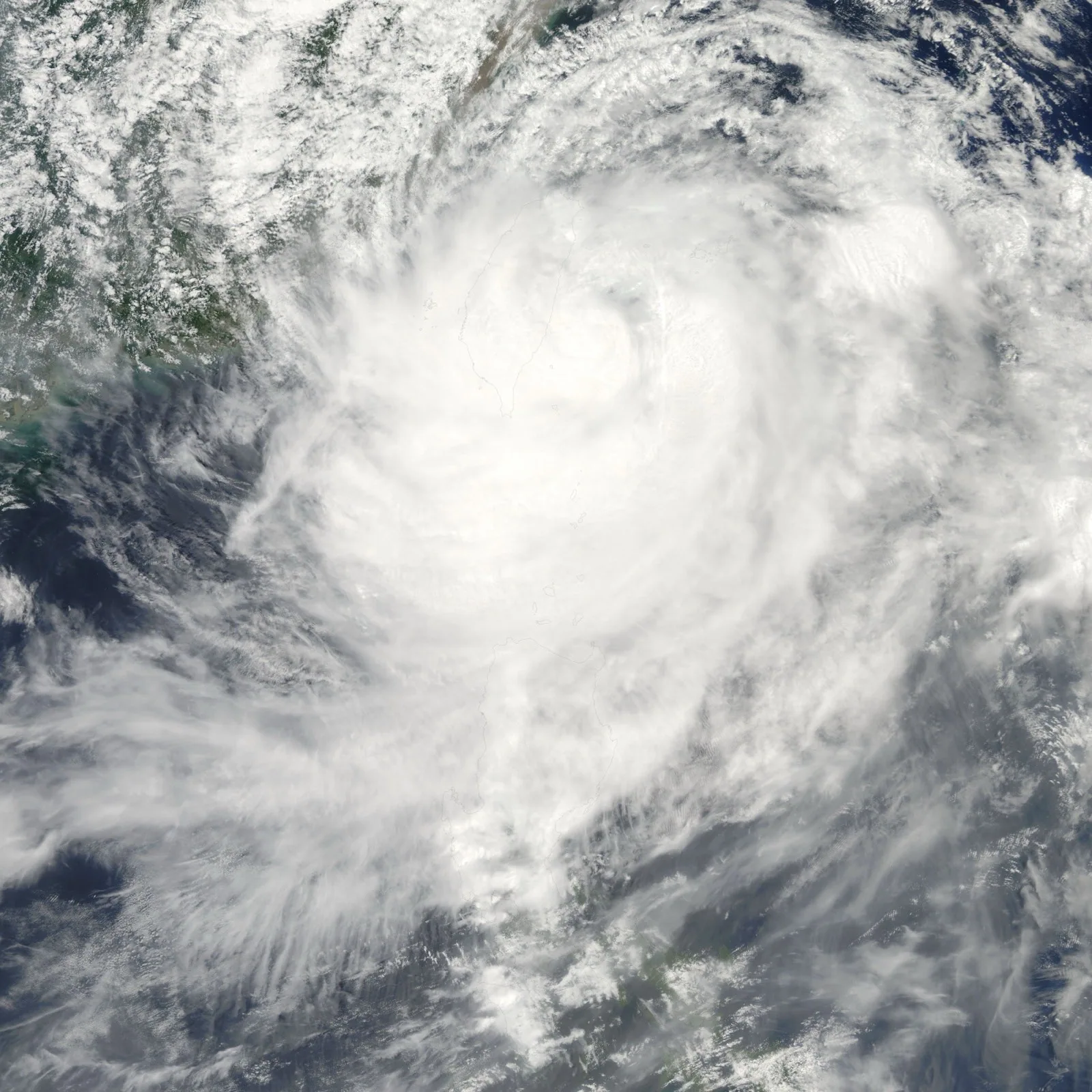
30-second overview: In the early morning of August 8, 2009, after three straight days of torrential rain, Mt. Xiandu collapsed and swallowed 462 lives in Xiaolin Village. Sixteen years later, Taiwan's 24-hour typhoon-track forecast error had shrunk from 172 kilometers in 2000 to 57 kilometers in 2025. Each day, one FORMOSAT-7 satellite delivers more than 4,000 atmospheric data profiles, and six AI models generate 30 days of warning maps within four minutes. But the second Lo Pan Chun-mei stood on the second floor and watched her loved ones disappear, even the most precise radar could not catch them. We can forecast wind and rain, but not fate.
"Xiaolin is gone!"
In the early morning of August 8, 2009, 71-year-old Lo Pan Chun-mei stood on a second-floor balcony.
Mt. Xiandu, which had looked intact the day before, collapsed under the erosion of three consecutive days of torrential rain. Earth and rock rushed down from the summit like a giant yellow dragon, swallowing streets, houses, and the community where she had spent her entire life. Her 462 loved ones disappeared into the mountains from that moment on.1
✦ "I cried until I could not cry anymore. Now I don't shed tears as easily. We have to come through it." — Lo Pan Chun-mei, looking back ten years after Typhoon Morakot
That cry was one of the most painful moments in Taiwan's four-hundred-year struggle with typhoons. On this land, typhoons are the lines of poetry Penghu officials wrote in 1705, the colored storm flags on the roof of a hospital in Takao Harbor in 1865, the morning Xiaolin Village disappeared in 2009, and the rain in which 81% of workers still go to work every summer.
| Indicator | Figure |
|---|---|
| Average annual number of typhoons affecting Taiwan | 3.5 |
| Share of Taiwan's annual rainfall contributed by typhoons | Nearly 50% |
| Agricultural losses from typhoons in 2024 | About NT$52 billion (98.88% of annual agricultural disaster losses) |
| 24-hour typhoon-track forecast error (2000->2025) | 172 km -> 57 km |
| Daily atmospheric profile data from FORMOSAT-7 | 4,000-5,000 profiles |
From Takao's Colored Storm Flags to Alishan's 1,094 Millimeters
Taiwan's history of facing typhoons is far older than the Republic of China.
During the Qing dynasty's Tongzhi era, around 1865, the British hung colored wind-and-rain flags on the roof of the Takao Hospital in Takao, today's Kaohsiung. This was Taiwan's earliest meteorological warning system. The colors of the flags represented different wind-force levels, letting ships know whether they should go to sea.2
One hundred and sixty years earlier, in Penghu in 1705, official Sun Yuan-heng personally witnessed a hurricane. He wrote the 85-line "Song of the Hurricane": "Autumn wind rose overnight in a mad gale; the hurricane mother came west, haughty in rage."3 Three centuries later, before each typhoon arrives, his lines still get reread somewhere in a Facebook post.
Jump forward to July 31, 1996. Typhoon Herb struck Taiwan, and Alishan received 1,094.5 millimeters of rain in a single day — equivalent to nearly half a year of Taipei City's rainfall pouring down in one day.4 It was the first such event since the weather station was established in 1933. Years later, one PTT user recalled: "Typhoon Herb directly flooded my first-floor home." Another said: "Most of the fish ponds and farmland my father had worked for all his life were carried away."4 Herb was called "the 921 earthquake of typhoons," with total losses of about NT$25 billion to NT$30 billion.
Five years later, in September 2001, Typhoon Nari stalled over Taiwan for 49 hours along an eerie track. Taipei weather station recorded 425 millimeters of rainfall in one day, the station's highest figure in 105 years.5 The entire Bannan Line of Taipei Metro stopped running, and 16 stations and depots were completely flooded. Hu Tsung-li, a former Bannan Line section chief, escaped with keys and several hundred thousand dollars in working cash; overnight, all 12 stations under his management were submerged. Residents of Bishan Village in Neihu had spent a year promoting resource recycling; when the storm disaster arrived, 150,000 tons of garbage completely paralyzed the entire recycling system.5
From the poem of 1705 to the metro system of 2001, the recorded details differ, but what they record is the same thing: when a typhoon arrives, this country does not know where it will break.
The "Sacred Mountain Protecting the Nation" Is a Pressure Amplifier, Not a Barrier
Whenever a typhoon approaches from east to west, people in Taiwan habitually look toward the Central Mountain Range, whose average elevation exceeds 3,000 meters. Popular speech calls it the "sacred mountain protecting the nation," thanking it for weakening typhoons and protecting the western half of Taiwan.
Wu Der-rong, former director of the Central Weather Bureau's Forecast Center, has publicly refuted this claim many times.6
"If Taiwan were flat, the rainfall Morakot brought would have been a world apart. It was precisely the towering terrain forcing warm, moist air upward that produced extreme rainfall on the windward side."
Scientific data support his judgment. Typhoon Herb's three-day total rainfall at Alishan reached 1,994 millimeters, nearly 2,000 millimeters. Morakot's total rainfall at Alishan exceeded 3,000 millimeters, setting a historical record.4 How could these figures mean the storm was "blocked by the sacred mountain"? They were squeezed out by it. The mountains turn wind into water and dump it on the windward side.
📝 Curator's Note
The title "sacred mountain protecting the nation" is, at its core, the perspective of residents on the western plains. For the mountain areas on the windward side, the Central Mountain Range acts as a pressure amplifier: wind is squeezed into water and poured onto the windward slope. In the same typhoon, the western half thanks the mountains for blocking the wind, while mountain communities bear the 2,000 millimeters of rain squeezed out by them alone. This geographic pattern of "who benefits, who bears the cost" foreshadows the same fault line that appears in every later typhoon story.
When a typhoon's circulation crosses the mountains and descends, it often triggers hot, dry foehn winds on the leeward side. In Taitung and Taichung, temperatures surge after typhoons, severely damaging crops.4
Fewer but Stronger: One to Two Typhoons a Year, Each an Extreme Event
Taiwan's statistics from 1951 to 2023 show that in six years, no typhoon formed before May. From 2020 to 2022, Taiwan also set a record of three consecutive years without a typhoon landfall.1
But behind this "fewer and fewer" trend is an even more worrying transformation.
The Research Center for Environmental Changes (RCEC) at Academia Sinica and National Taiwan Normal University used the high-resolution HiRAM cloud-resolving model to simulate future trends:1 by the end of this century, from 2080 to 2099, typhoons affecting Taiwan may number only one or two per year, but the share of Category 4 or stronger typhoons will increase by more than 150%, typhoon rainfall intensity will increase by 40%, and landfall wind speed will increase by 10%.
| Indicator | Present (baseline 1979-2015) | Mid-21st century (2040-2059) | Late 21st century (2080-2099) |
|---|---|---|---|
| Number of typhoons affecting Taiwan annually | 4-5 | 3-4 | 1-2 |
| Share of Category 4+ typhoons | Baseline | +105% | +150%+ |
| Typhoon rainfall intensity | Baseline | +20% | +40% |
| Typhoon landfall wind speed | Baseline | +8% | +10% |
The study also found that 6.5% of Typhoon Morakot's extreme rainfall was amplified by human-induced climate change.1 Without global warming, Mt. Xiandu might not have collapsed on that morning. This is a concrete number by which academia directly connected one typhoon to a warming planet.
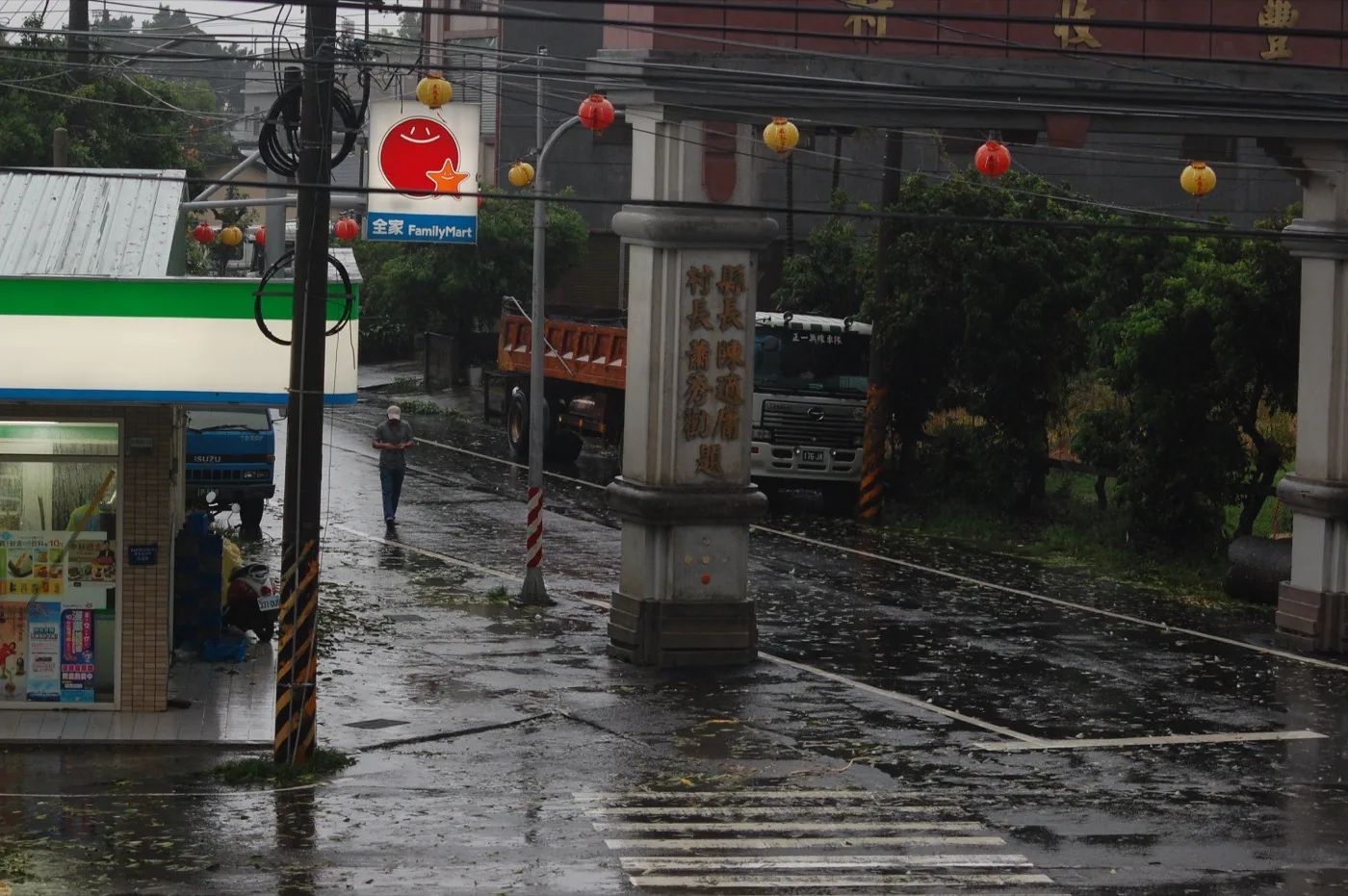
On August 9, 2009, in Minxiong, Chiayi, Morakot moved slowly, and days of torrential rain poured into this village. The rain amplified by that 6.5% from climate change ultimately became water like this. Photo: zilupe, CC BY 2.0 via Wikimedia Commons.
"Fewer but stronger" overturns the old logic of disaster prevention. In the past, resources were allocated on the assumption that "several will come every year." The new premise is: "The whole summer may be quiet, but when that one comes, we have to withstand an entire year's worth of destruction." One typhoon becomes an annual extreme event.
The People Who Chase Wind: Taiwan Dropping Sondes at 40,000 Feet Above the Typhoon
Human tools for facing typhoons have evolved from colored flags in 1865 to AI in 2025. Along this trajectory stands a National Taiwan University professor named Chun-Chieh Wu.
Beginning in 2002, he led "Dropwindsonde Observations for Typhoon Surveillance near the Taiwan Region" (DOTSTAR), commonly called the typhoon-chasing project, Asia's first large-scale typhoon research program. The team flies an Astra SPX twin-engine jet up to 43,000 feet and releases dropwindsondes from above the typhoon, circling its outer edge to collect critical atmospheric data around the eyewall (a different playbook from the U.S. Hurricane Hunters, who use propeller aircraft to fly straight through the eyewall). On September 1, 2003, with Typhoon Dujuan, the team formally chased a typhoon for the first time. By the end of 2012, they had completed observation missions for 49 typhoons across 64 flights, released 1,051 dropwindsondes, and logged 334 flight hours. These first-hand data reduced the average error in 24- to 72-hour typhoon-track forecasts by 20%.7
Chun-Chieh Wu described, in the first person, how it felt as a child in Taitung to greet a typhoon eye passing overhead from the ground (not from a plane):
"I grew up in Taitung, and I have chased them. You first feel the northerly wind, because a typhoon rotates counterclockwise, and then suddenly there is no wind. That means you are inside the typhoon eye. Several dozen minutes later, a southerly wind begins to blow. That means the eye has already passed over you."
But storm chasing is only one part of Taiwan's typhoon-observation map. In 1998, Taiwan became the first country in the world to use Aerosonde unmanned sounding aircraft to observe typhoons.8 After the United States banned Aerosonde exports in September 2001, Taiwan became the last country to possess and use the system.
FORMOSAT-7, launched on June 25, 2019, lifted the observation angle from within the stratosphere into space.9 Six small satellites, in cooperation with the U.S. National Oceanic and Atmospheric Administration (NOAA), provide 4,000 to 5,000 atmospheric profile datasets per day. About 80% of them can penetrate below an altitude of 1 kilometer, twice the figure of the older FS3/COSMIC system.
Taiwan Space Agency (TASA) promotional video: after FORMOSAT-7, Taiwan's domestically built Triton satellite was designed specifically to measure sea-surface wind fields, pushing this country's eyes on typhoons another step forward.
By 2025, the Central Weather Administration was using six AI models to integrate data from the United States, Taiwan, and Japan into 18 predicted tracks. The 24-hour track forecast error fell from 172 kilometers in 2000 to 57 kilometers, an improvement of about 67% over 25 years. AI models can generate 30 days of warning data within four minutes, 900 times faster than traditional methods.9
| Technology | Key Data | Significance for Disaster Prevention |
|---|---|---|
| Typhoon-chasing project (aircraft) | 64 flights, 1,051 dropwindsondes | 20% reduction in 24- to 72-hour track forecast error |
| FORMOSAT-7 (satellite) | 4,000-5,000 atmospheric profiles per day | 80% penetrate below 1 km, twice the old system |
| National Central University drones | IP65 waterproofing, 3,000-meter altitude | 1,000+ observation missions |
| AI weather models (including HuaFeng and five others) | 30-day forecasts generated in 4 minutes | 24-hour track error reduced from 172 km to 57 km |
From colored storm flags to predicting 30 days in four minutes, the accuracy accumulated over these 160 years is enough for the government to deploy rescue supplies 72 hours in advance, and enough for farmers to harvest bananas a week early. But precision ultimately belongs to the map. A map tells you where a typhoon will make landfall. It cannot tell you who on that street will have to go to work as usual.
DIGITIMES Tech Talk EP.4: how AI models pushed typhoon-track forecast errors all the way down to 57 kilometers.
The NT$31.5 Billion Price: Who Pays?
Typhoons have also produced a distinctive Taiwanese institution: typhoon leave.
The system began with a tragedy. On July 30, 2001, during the assault of the moderate Typhoon Toraji, teacher Hsu Pi-lan of Qingshan Elementary School in Changhua County died in the line of duty after accidentally falling into a drainage ditch while protecting students. Then-president Chen Shui-bian personally went to the mourning hall to pay tribute. Twelve years later, in 2013, the original operational guidelines were renamed the "Regulations Governing the Suspension of Work and Classes Due to Natural Disasters."10
✦ "Each day of suspended work and classes has an impact exceeding NT$31 billion."
This claim originated in a 2005 op-ed by former environment minister Peng Chi-ming. It was later recalculated by Lin Por-fong, chair of the Third Wednesday Club, using 2023 GDP data, producing an estimated net loss of about NT$31.5 billion per day.11
But this arithmetic misses a structural problem. A yes123 job bank survey of 1,330 workers found that 81% had gone to work as usual on typhoon days, and 65% of them did so at a supervisor's request. An FTNN News survey showed that 53.5% of workers still received full pay, while 37.7% received no pay at all.12 Civil servants and white-collar office workers wait at home for leave announcements, while workers in wholesale and retail, agriculture, fisheries, animal husbandry, and food service keep going out in the same typhoon.
📝 Curator's Note
The story of typhoon leave and the story of the "sacred mountain protecting the nation" are actually two versions of the same story. The mountains turn wind into water, but onto whose houses does that water pour? Work-suspension announcements give leave to whom, and leave whom out? In the same typhoon, the rainfall on the map is uniform, but the people who bear the cost never are.
The full class distribution of typhoon leave, the blind spots behind the NT$31.5 billion arithmetic, and the situation of migrant workers are a separate story, told in the article Typhoon Leave.
Tribal Weather Stations: Thousand-Year Wisdom as the Last Safety Net
Technology is not Taiwan's only way of forecasting typhoons.
In the Kabalelradhane community in Laiyi Township, Pingtung County, Paiwan elders judge weather changes by observing natural phenomena. If a rainbow appears in the direction of sunrise, a typhoon will weaken; if a rainbow appears in the direction of sunset, it will bring in a typhoon. Large numbers of crabs climbing onto land, mass movements of ant nests, and earthworms emerging in great numbers are all signals that a typhoon or earthquake is approaching.13
During Typhoon Morakot in 2009, members of the Kakanami community in Taitung County noticed that creek water had turned muddy, warning of landslide risk and evacuating the entire village in time.13 That year, no satellite saved the 462 lives in Xiaolin Village. But the people of Kakanami survived because of one muddy creek.
Amis people in the Makelahay community of Fengbin, Hualien, have their own ocean-watching knowledge. Before a typhoon arrives, northerly winds blow; after it passes, southerly winds are more common. If the dark rocks are covered by large waves, it means a typhoon will sweep through the area. On Orchid Island, Tao place names encode knowledge of disaster risk. "Ji-Rako a Poas" denotes an area of large-scale landslides, while "Ji-Igang" denotes a flood-danger zone.13 The Tao people's traditional semi-subterranean houses performed better than modern concrete buildings during Morakot and Typhoon Tembin.
Research by National Chengchi University professor Da-Wei Kuan indicates that although Indigenous traditional weather forecasting is not as precise as modern instruments, it reflects the wisdom of long-term observation of nature and coexistence with the environment.14 When AI models miss the mark, or when remote mountain areas have no internet coverage, this knowledge may be the last safety net.
Four hundred years ago, Sun Yuan-heng watched the sky and wind in Penghu. Three hundred years later, Tao elders read the color of creek water to judge landslides. Today, the Central Weather Administration uses AI to calculate 30 days of warnings. The three systems are layered on top of one another. When the precision on the map has been pushed to 57 kilometers, what actually protects people within those 57 kilometers may still be that muddy creek.
Xiaolin Fifteen Years Later: From Collapse to Ancient Songs
In 2024, Typhoon Morakot's devastation marked its fifteenth anniversary.
Pan Yuan-ming, chair of the Xiaolin Community Development Association, returned to the memorial shrine. He changed the flowers used for offerings from sunflowers to chrysanthemums, which symbolize longevity and suggest that the ancestors hope their descendants will live well.1
"Because it was a typhoon day, everyone carries fear and does not dare come back here."
The permanent housing at Wulipu consisted of 90 new homes built by the Red Cross for Xiaolin villagers, but the occupancy rate is only 30% to 40%. Making a living is difficult, and younger generations continue to leave.15 Yet some young people chose a different path.
Wang Min-liang, known as A-liang, secretary-general of the Sunshine Xiaolin Community Development Association, founded the Daman Dance Troupe in 2011, leading Xiaolin people through grief by way of ancient songs and dance. The troupe was recognized at the 2019 Golden Melody Awards for Traditional Arts and Music.1 Five-year-old Bang Szu-chi had always listened to her mother sing ancient songs. She said: "Listening and listening, listening to Mom sing, then I learned it!"
Public Television Service's Our Island, Episode 1016 (2019-08-12): ten years after Morakot, the Daman Dance Troupe uses ancient songs to "plant home back" into the remembered Xiaolin Village, line by line.
In interviews marking Morakot's tenth anniversary in 2019, survivor Weng Jui-chi formed a new family in the Wulipu permanent housing with his neighbor Yang Mei-lu, who had also lost relatives. He said: "Life still has to go on."16
📝 Curator's Note
Xiaolin Village's story reveals a paradox of the typhoon era: modernization allows more people to move away from high-risk areas, but cultural roots are also severed in the process. The Daman Dance Troupe's attempt to "plant home back" through ancient songs answers a more fundamental question: when the physical hometown can no longer be returned to, where should the cultural hometown be built? This is in fact the same core idea behind Taiwan's 335 autonomous disaster-prevention communities: saving one's own homeland oneself. This project, promoted by the Water Resources Agency under the Ministry of Economic Affairs since 2010, had established 335 communities by 2015, from Meizhou in Yilan and Dingxiang Village in Keelung to Liren in Huwei, Yunlin. Each village or neighborhood organizes its own warning and rescue network.17
Typhoons will keep coming. AI models will keep improving. But fifteen years after Xiaolin, what the village tells Taiwan is this: however accurate technology becomes, reconstruction still depends on relationships washed apart and pieced back together again: between people, between people and land, and between the living and the dead.
Can Forecast Wind and Rain, but Not Fate
The typhoon-track forecast error has shrunk from 172 kilometers to 57 kilometers.
But on that morning in 2009, when Lo Pan Chun-mei stood on the second floor and watched Mt. Xiandu collapse, watched 462 loved ones disappear from her sight, no forecast at any scale could have arrived in time.
We can forecast wind and rain, but not fate.
Further Reading
- Typhoon Leave — In the same typhoon, public-sector white-collar workers stay home while wholesale and retail workers go out. The class fracture missing from the NT$31.5 billion arithmetic
- Taiwan's Climate Crisis and Net-Zero Transition — Behind the 40% increase in typhoon rainfall intensity is the larger context of global warming and Taiwan's energy transition
- Taiwan's High-Mountain Ecosystems and Glacial Relicts — The Central Mountain Range not only changes typhoon tracks; it is also home to the world's highest-elevation ecosystems
- Plum Rains — Beyond typhoons, the plum rain season is another major source of rainfall in Taiwan and is likewise affected by climate change
- Offshore Islands and Ocean Culture — The Tao people's traditional architecture and place-name knowledge on Orchid Island have unique disaster-prevention value in the typhoon era
Image Sources
This article uses two public-domain / CC-licensed images, all cached in public/article-images/nature/ to avoid hotlinking source servers:
- Satellite cloud image of Typhoon Morakot (2009-08-07) — Photo: NASA MODIS Rapid Response (Aqua satellite), 2009-08-07, public domain (NASA). Original image 7200x9200, center-square-cropped to 1600x1600 as the hero image.
- Flooding in Minxiong, Chiayi, after Morakot's torrential rain (2009-08-09) — Photo: zilupe, 2009-08-09, CC BY 2.0 via Wikimedia Commons.
References
- Climate report warns typhoons striking Taiwan may fall to only 1 to 2 per year by century's end, but with stronger wind and rain — A 2024 Central News Agency report on Academia Sinica's Research Center for Environmental Changes using the HiRAM cloud-resolving model to simulate typhoon trends over the next century; includes background on Lo Pan Chun-mei and Wang Min-liang's Daman Dance Troupe.↩23456
- One Hundred Questions on Typhoons — Official popular-science column by the Ministry of Transportation and Communications' Central Weather Administration, with a full explanation of typhoon formation, classification, forecasting, and history; includes background on Takao's colored storm flags.↩
- Agricultural Knowledge Portal — Wind-and-rain legends of old Taiwan — Collects classical typhoon poems including Qing-era Sun Yuan-heng's "Song of the Hurricane" and Zheng Yong-xi's "Hurricane."↩
- When a typhoon comes, is the Central Mountain Range really a "sacred mountain protecting the nation"? Expert: the idea is absolutely wrong — A 2016 Storm Media report discussing in depth the myth of the sacred mountain protecting the nation and the terrain-driven causes of foehn winds; includes Alishan rainfall data from Typhoon Herb.↩234
- Taipei Metro 30th anniversary / The devastation of Typhoon Nari was shocking — TVBS report reviewing the flooding of Taipei Metro during Typhoon Nari for the system's 30th anniversary; the Bannan Line stopped running for three months, with on-site recollections by Hu Tsung-li.↩2
- Using Morakot as an example: meteorological expert Wu Der-rong says the Central Mountain Range is absolutely not a sacred mountain protecting the nation — Yahoo News report from 2016 in which Wu Der-rong uses Morakot to explain how orographic rain amplifies rainfall.↩
- 20 years of the "typhoon-chasing project": Chun-Chieh Wu discusses Asia's first large-scale typhoon research program — SciTechVista of the Ministry of Science and Technology, fully documenting the typhoon-chasing project's 20-year history from the first flight during Typhoon Dujuan in 2003 to 2023; includes Chun-Chieh Wu's first-person description of the typhoon eye.↩
- A Song of Sky and Water: Into the Typhoon Storm Circle! Taiwan's Unmanned Aircraft Sounding Team — SciTechVista of the Ministry of Science and Technology, documenting Taiwan's full trajectory from importing Aerosonde in 1998 to developing a new generation of unmanned aircraft in 2014.↩
- Introduction to FORMOSAT-7 — Official Taiwan Space Agency page explaining how FORMOSAT-7 improves the precision of weather forecasts; includes AI-model data on 24-hour forecast error.↩2
- Storm Media — How "typhoon leave" came about: a tragedy 24 years ago that changed Taiwan's disaster-prevention thinking — Traces the origin of the typhoon-leave system to the 2001 death in the line of duty of teacher Hsu Pi-lan.↩
- Data updated! Huang Yang-ming: one day of typhoon leave costs Taiwan more than "this figure" in New Taiwan dollars — NOWnews recalculation of the economic cost of typhoon leave using 2023 export figures.↩
- FTNN News — Survey: half of employers give full pay on typhoon leave — 1111 Job Bank survey on typhoon-leave wages, source for the figure that 37.7% receive no pay at all.↩
- Reading typhoon tracks through traditional wisdom — elders' experiences from Kabalelradhane and Makelahay communities — Taiwan Indigenous Television report recording the traditional meteorological wisdom of Paiwan, Amis, and Tao peoples; includes the 2009 Morakot evacuation case in Kakanami.↩23
- NCCU Humanities Island — Facing typhoons and extreme climate, NCCU's Da-Wei Kuan shares Indigenous views of nature — National Chengchi University professor Da-Wei Kuan discusses Indigenous views of nature and their complementary relationship with modern meteorology.↩
- Radio Taiwan International — Ten years after Morakot: Xiaolin Village, still in the process of disappearing, waits for those who will return — Occupancy rates and current conditions for villagers in Wulipu permanent housing ten years after Morakot.↩
- Ruthless floodwaters, human compassion: small fortunes amid misfortune for Xiaolin Village survivors — Central News Agency's 2019 report on Morakot's tenth anniversary, documenting the reconstruction stories of survivors including Weng Jui-chi in Wulipu permanent housing.↩
- National Taiwan University Research Center for Future Earth — Saving one's own homeland oneself — National Taiwan University Research Center for Future Earth introduction to the autonomous flood-disaster-prevention community model; source for the figure of 335 communities.↩