

30-second overview: Taiwan's National Health Insurance (NHI) launched on March 1, 1995. Yeh Ching-chuan later acknowledged that "the preparation time was actually only three days"1. Thirty years later, NHI covers 99.6% of the eligible population2, has kept administrative costs below 2% over the long term3, and has ranked first in the world on Numbeo's Health Care Index for six consecutive years4. Yet the system rests on three things at once: a 5.17% premium rate, a nursing turnover rate that has reached a 10-year high of 12.61%5, and the 30-year political taboo of "total household income." This article begins with the frantic six days before the 1995 launch and moves through the 2026 three-shift nurse-to-patient ratio reform, unpacking three common assumptions: "NHI is cheap," "the five major specialties are hollowed out because point values are low," and "Taiwan's IC card was the world's first." It shows how a successful institutional design locked the political pathway for institutional renewal.
"The Preparation Time Was Actually Only Three Days"
At midnight on March 1, 1995, National Health Insurance officially began. The public-facing version was a "world-record pace": 96% population coverage, with one card accepted across 18,000 contracted medical institutions throughout Taiwan6. The inside version came from Yeh Ching-chuan, the first director-general of the Bureau of National Health Insurance, recalling the launch in 2021: "the preparation time was actually only three days," "the NHI cards had not even been printed yet," "the information system had not been settled either," and it was "a fire at our backsides"1. More than 20 million NHI cards were only rushed to completion a month after the launch. On March 1, people entered clinics with their national ID cards instead.
Pull the timeline backward, and the system had in fact been under deliberation for 27 years. In 1968, the Ministry of the Interior first drafted a universal health insurance plan. In 1986, the Executive Yuan approved 2000 as the target launch year. In 1988, the Council for Economic Planning and Development established a dedicated planning task force7. On February 28, 1989, Premier Yu Kuo-hwa announced at the Legislative Yuan that the launch would be moved up to 1995. In July 1990, planning work was transferred from the Council for Economic Planning and Development to the Department of Health. After Hau Pei-tsun became premier, he instructed that the launch be moved up again to 1994. In February 1991, the Department of Health established the National Health Insurance Planning Task Force. In December 1993, the preparatory office of the Bureau of National Health Insurance was inaugurated, with Yeh Ching-chuan as director7.
The legislative phase was not calm. On July 16, 1994, Democratic Progressive Party legislator Shen Fu-hsiung went on hunger strike to protest the NHI Act8. On July 19, the National Health Insurance Act passed its third reading. On November 12, labor groups took to the streets in the annual Autumn Struggle, raising the slogan of "three non-guarantees"7. The Act for the Establishment of the Bureau of National Health Insurance was passed on December 23, 1994. The Bureau of National Health Insurance was established on January 1, 1995. On February 25, 1995, Premier Lien Chan ordered that "the March 1 launch proceed on schedule." Yeh's remark that "the preparation time was only three days" is counted from this point1.
The system's skeleton was chosen in 1989 by a task force led by Harvard public-health scholar William Hsiao. After comparing the models of the United States, the United Kingdom, Germany, France, Canada, and Japan, the task force selected a Canadian-style "single-payer" system9. Hsiao's reason for choosing the Canadian model was brief: "the quality of services was very high"10. Scholars later broke down single-payer into five major attributes: everyone placed into one risk pool, a consistent benefits package, sufficient healthcare resources, a single purchaser setting the rules of the game, and global budgeting to control medical inflation11. These five features are the structural reason Taiwan's NHI can still sustain the world's highest coverage rate 30 years later. They are also the fundamental binding constraint behind every reform over the past three decades: change one part, and you touch all of them.
The satisfaction data from the first year is often buried under mythmaking. In 1995, coverage surged to 96% in the first year, but public-opinion polling at the same time showed only 39% satisfaction and 47% dissatisfaction12. "Universal support" is a retrospective narrative. At the time, Taiwanese society had real doubts about this new payment bill that had descended from above.
📝 Curator's note: "Single-payer" is usually rendered in Chinese as "single insurer," but those four Chinese characters have locked in 30 years of political possibility. Putting everyone into the same pool means that any decision to change premium rates, benefits, copayments, or the way total household income is calculated has no fallback route of "pilot first," "trial first," or "separate first." Either everyone changes together, or nothing changes. This was written into the DNA of the system when William Hsiao chose the Canadian model in 1989. Thirty years later, it is simultaneously NHI's greatest advantage and its greatest political brake.
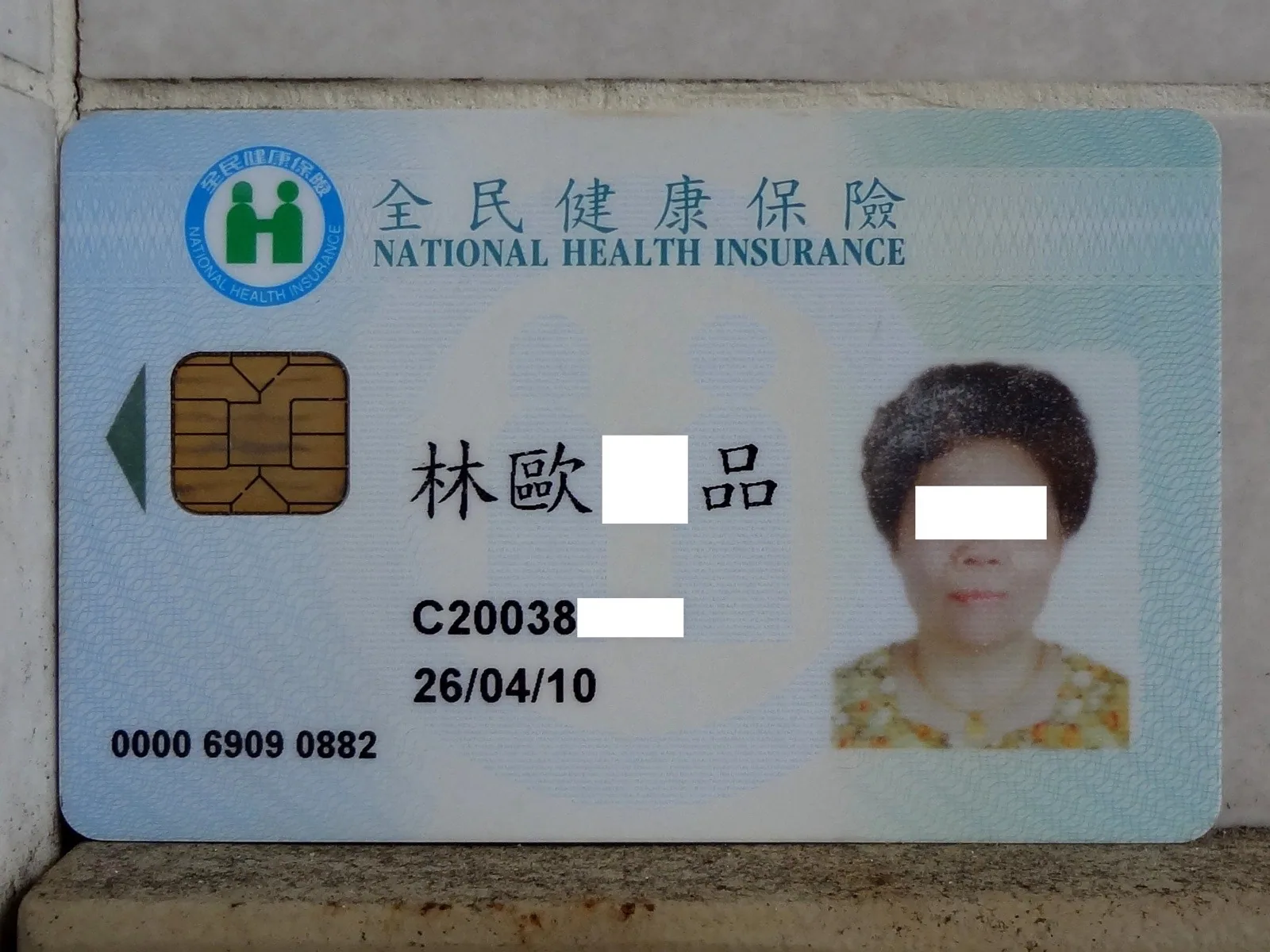
The 2017 version of the NHI IC card. Taiwan fully replaced its cards with IC cards in 2004, and the move is often described as "world first." But Slovenia had completed nationwide deployment as early as September 2000. Taiwan was the second case, and the largest and most deeply integrated.
Lee Yu-chun's Four Characters
The phrase "five major specialties hollowed out" has, by the 2020s, almost become a synonym for Taiwan's healthcare crisis: internal medicine, surgery, obstetrics and gynecology, pediatrics, and emergency medicine cannot recruit enough resident physicians. But the person who coined the original phrase was not Yeh Ching-chuan, not the medical associations, and not the Ministry of Health and Welfare. It was Lee Yu-chun, a public-health professor at National Yang Ming University, who coined the phrase "four major specialties hollowed out" in the summer of 2009, referring to internal medicine, surgery, obstetrics and gynecology, and pediatrics13. The media later added emergency medicine, turning four into five.
The timeline runs like this. Professor Chiang Tung-liang recalled in 2018: "In the summer of 2009, Control Yuan member Huang Huang-hsiung began conducting a comprehensive examination of NHI. By 2011, as the comprehensive examination report was released, the issue of the four major specialties being hollowed out suddenly became urgent"13. Yeh Ching-chuan also wrote a counter-version in 2018: "What the medical community calls the five major specialties being hollowed out should first have emerged at a seminar, when a hospital superintendent reported on the shortage of physicians in internal medicine, surgery, obstetrics and gynecology, and pediatrics at his hospital and called it 'the four major specialties hollowed out.' Later, people repeated it, emergency medicine joined the battle, and with media embellishment and overgeneralization, it became 'the five major specialties hollowed out'"14.
The Control Yuan corrective case of July 17, 2012, was the first time the term appeared in official documents. Control Yuan members Huang Huang-hsiung, Shen Mei-chen, and Liu Hsing-shan wrote very bluntly: in the four major specialties, there was "little money, much work, and proximity to prison"; "medical disputes and the payment system have effectively become the two great 'tightening spells' strangling the development of the five major specialties"; and "most hospitals lack resident physicians in the four major specialties, with some working more than 300 hours a month; in some hospitals completely lacking residents, attending physicians in the four major specialties must also cover shifts, and with on-call duties, monthly working hours sometimes reach as high as 400 hours"15.
Yeh has always had reservations about the "five major specialties hollowed out" framing. In his 2018 article, he wrote another sentence: "It is not that all five major specialties are comprehensively short of people; the overall number of physicians is sufficient"14. This counterargument is almost absent from the mainstream narrative, but it is important for understanding the later inference that "low point values equal hollowed-out major specialties." If the total number of physicians is sufficient, then failure to recruit must be examined through distribution, working conditions, medical-dispute burden, and shift systems. A problem that can be explained by the single word "money" cannot be something that has remained unsolved for 30 years.
5.17% Appeared Twice
The political history of NHI premium rates can almost be told with one table. The rate was 4.25% at launch in 1995. It was adjusted to 4.55% in September 2002. In April 2010, during Yang Chih-liang's tenure, it was raised to 5.17%. This increase was so controversial that Yang resigned immediately after second-generation NHI passed its third reading on January 26, 201116. In January 2013, second-generation NHI came into force: the main premium rate fell back to 4.91%, while a 2% "supplementary premium" was added. From 2016 to 2020, the rate fell to 4.69%, with a 1.91% supplementary premium. In January 2021, during Chen Shih-chung's tenure, the main rate was raised again to 5.17%, and the supplementary premium rose at the same time to 2.11%17.
5.17% appeared twice. The first time was in 2010, after Yang Chih-liang pushed the increase through and resigned. The second was in 2021, under Chen Shih-chung. Eleven years passed in between, and the system went in a circle back to the same number. This stable state is the structure produced by the double bind of "single payer plus politically sensitive premium rate": every adjustment carries political costs; whenever political costs reach their limit, the rate is pushed back down; then, when the finances can no longer hold, it rises again.
The choice of the "supplementary premium" route in second-generation NHI was itself a cornered compromise. The original plan was "total household income": charging premiums based on a household's full annual income, theoretically the fairest model. But in the 2010 legislative process, that plan was overturned. After the third reading in 2011, Yang Chih-liang said bluntly: "The supplementary premium is a mistake"; "Second-generation NHI was meant from beginning to end to use total household income for premium collection. But first the Ministry of Finance said total household income could not be done, and later legislators on the Finance Committee overturned the resolution of the Social Welfare and Environmental Hygiene Committee, taking only three days to propose the idea of supplementary premiums"18.
The supplementary premium that began in 2013 therefore targeted six types of income, calculated by individual payment: high bonuses, part-time wages, professional-practice income, dividends, interest, and rent19. From the first day, the design had two loopholes: calculation by individual payment made it easy to split payments to avoid the charge; income outside the six categories, such as overseas income and crypto assets, was not captured. Fifteen years later, in November 2025, the National Health Insurance Administration planned to change from "single-payment" calculation to an "annual settlement system": any accumulated annual total over NT$20,000 would be charged, and the withholding cap would rise from NT$10 million to NT$50 million. The estimate was that 4.8 million people would be affected, bringing in NT$10 billion to NT$20 billion20. But the Executive Yuan abruptly halted this reform in November 2025, saying the plan would be "temporarily suspended"20, triggering complaints from stock-dividend investors and retirees.
The four characters for "total household income" have gone untouched for 30 years. William Hsiao's 1989 single-payer prototype already pointed toward an income-tax-like premium base. Yang Chih-liang stepped down immediately after pushing the 2010 reform. In 2025, even the milder "annual settlement" version was stopped by the Executive Yuan. Technically, it can be done. Politically, it cannot. Any reform that tries to put different income sources into the same base will find opponents in the Legislative Yuan.
⚠️ Contested view: The supplementary premium has long been criticized by the left as a "regressive tax." Salaried workers have premiums withheld each month, while capital-income groups are only touched when they receive dividends or rent, and even then face a withholding cap. Yet the 2010 legislative process was exactly the reverse: left-leaning labor groups opposed "total household income" because they feared working households would be aggregated and charged more, while the right-leaning Ministry of Finance opposed "total household income" because it feared insufficient administrative capacity. In the end, the Social Welfare and Environmental Hygiene Committee's proposal was overturned by the Finance Committee in three days18. Who exactly counts as the "fat sheep that escaped the net" has gone through three rounds of narrative change over 30 years, and there is still no consensus.
Official documentary by the National Health Insurance Administration, Ministry of Health and Welfare: 30 years from "the preparation time was only three days" to a 23-million-person shared single-payer system.
39.8% Using, 54.8% Paying
In 2020, National Statistics Bulletin No. 231 from the Directorate-General of Budget, Accounting and Statistics published a precise figure that is rarely cited: people aged 65 and above used 39.8% of NHI resources; those aged 15 to 64 used 54.8%; and those aged 0 to 14 used 5.4%21. Compared with 2015, the 65-plus share had risen by 4.2 percentage points. Per capita annual NHI spending for those aged 65 and above exceeded NT$70,000. For those under 65, it was about NT$10,000, a sevenfold gap21.
Multiply that sevenfold gap by Taiwan's accelerating aging curve, and you get NHI's largest financial clock over the past 30 years. Yeh Ching-chuan put it even more bluntly in 2020: "The current system can last at most another five years"22. Counting five years from 2020 brings us to 2025. In November 2025, the NHI Committee approved a 2026 global budget of NT$988.335 billion, growth of 5.5%, and a safety reserve level of two months, while maintaining the current 5.17% premium rate without adjustment23. On the surface, the system held. But once unpacked, the way it held looks precarious.
The first correction in the financial framing concerns the common phrase "NHI is about to go bankrupt." NHI is a pay-as-you-go system; it has no concept of "bankruptcy." The accurate question is whether the "safety reserve" has fallen below the statutory lower bound24. In June 2025, the National Health Insurance Administration estimated the safety reserve at "0.96 months." By November, it had become "two months." In between, the gap was filled by a NT$3 billion government subsidy plus NT$18.1 billion shifted from public budgets23. On November 19, 2025, NHI Committee Executive Secretary Chou Shu-wan gave the technical version: "For 2026, the NHI global budget safety reserve is two months and has not fallen below the level, so the premium rate remains at the current 5.17% without adjustment"23.
The more hidden way of holding the system together is the policy of "guaranteeing a point value of NT$0.95." Taiwan's NHI settles claims through a "global budget plus floating point value" system: the points claimed by medical institutions are divided by a fixed global budget and converted into New Taiwan dollars at a floating rate. In recent years, counties and cities where the point value fell to NT$0.70 or NT$0.80 have often been criticized as places where providers "lose thirty cents for every dollar of work"25. To appease the medical community, the government pledged from 2024 to guarantee the point value at NT$0.95. But The Reporter revealed that this policy was estimated to increase spending by NT$70 billion, with the Executive Yuan allocating NT$33.6 billion in subsidies: NT$18.1 billion shifted from public budgets and NT$15.5 billion from an enhanced revenue fund25. Cheng Shou-hsia, dean of the College of Public Health at National Taiwan University and the first director-general after the Bureau of National Health Insurance was reorganized, summarized it in one line: "Guaranteeing point value is equivalent to abolishing the global budget"; "it is arithmetic, and it does not solve the substantive problem"25.
Copayment reform began on July 1, 2023: the ceiling for outpatient drug copayments at medical centers and regional hospitals was raised to NT$300; emergency-department copayments were set at NT$750 for medical centers and NT$400 for regional hospitals26. After the new system took effect, 8.45 million people were affected, and annual revenue increased by NT$3.273 billion. But the Public Television Service assessment one year later was ironic: annual outpatient visits per person reached 14.3, a four-year high; average emergency-department visits per person increased by 0.1 from the previous year26. NHIA Director-General Shih Chung-liang emphasized the increase in primary-level chronic disease care and a NT$5.27 billion injection of funds. But Lin Ya-hui, executive director of the Taiwan Healthcare Reform Foundation, captured the core criticism: "NHI is not commercial insurance; it emphasizes the spirit of sharing hardship and paying according to ability"26. Treating copayments as a "demand suppression tool" runs into pushback at the level of the NHI Act's spirit.
Low Point Value Is a Symptomatic Explanation, Not the Root Solution
The mainstream narrative attributes the "five major specialties hollowed out" problem to one variable: "NHI payments are too low." The extended inference is: "point values are too low → physician salaries are low → no one can be recruited." In healthcare politics from 2024 to 2026, this inference has almost become common sense. But academia and the NHIA itself offer five counterarguments. Taken together, they dismantle this single-cause explanation.
The first is Cheng Shou-hsia's "abolishing the global budget" argument: "Guaranteeing point value is equivalent to abolishing the global budget"; "it is arithmetic, and it does not solve the substantive problem"25. The purpose of NHI's global budget system is to act as a brake on medical inflation. Guaranteeing the point value at 0.95 is equivalent to loosening that brake. Money is added, but medical utilization rises along with it; the point value falls again the next year, turning the policy into a perpetual subsidy.
The second is Kao Jo-hsiang's argument that "the trickle-down effect simply does not exist"25. Kao, secretary-general of the Taiwan Medical Workers Union, analyzed the financial statements of 13 private hospitals and found "a low correlation between personnel expense ratios and profit margins." Hospital surpluses are often spent on construction, equipment, and expansion; they do not automatically trickle down to frontline medical workers' wages. In other words, the transmission chain of "government supplements NHI point values → hospitals make money → doctors and nurses get raises" is not supported by the financial statements of those 13 hospitals.
The third is Lee Yu-chun's own counterargument. In 2024, the person who coined the term "four major specialties hollowed out" told The Reporter: "Point value is a symptomatic explanation, not the root solution"25. The link is deeply ironic: the scholar who coined the alarm-raising phrase 15 years earlier came out to say, "It is not a money problem."
The fourth is Shih Chung-liang's position: "We hope the target point value can reach 0.95, but not through a guarantee, otherwise medical services will be distorted"; "physician salaries come from hospital-level allocation, and hospital operators must bear considerable responsibility"25. The NHIA director-general personally threw the ball back to hospital managers: the point value the government provides is an overall budget; how it is distributed to physicians, nurses, and technicians is a hospital management issue, not simply an NHI issue.
The fifth is Yeh Ching-chuan's 2018 statement that "the overall number of physicians is sufficient"14. If the total number is sufficient, then "failure to recruit" is a distribution problem, not a supply problem. The question to solve is why emergency physicians would rather go to self-pay clinics, or why obstetrician-gynecologists would rather switch to medical aesthetics, not why physician salaries are too low overall.
Put the five counterarguments together, and the result is an uncomfortable conclusion: the framing that "low point values equal hollowed-out major specialties" is simple, politically correct, and easy to mobilize around, but it does not survive close inspection. The real solutions involve medical-dispute handling, resident-physician working-hour limits, internal hospital allocation, specialty recruitment systems, and recognition of overseas medical licenses. Each is ten times harder than "raise the premium rate" or "raise the point value."
💡 Did you know? In Taiwan, the average person makes 18 outpatient visits per year, more than twice the OECD average27. The same cold symptoms may lead someone to visit three clinics and receive three prescriptions. This is the "doctor shopping" long discussed by scholars. One cost of cheap NHI is the structural amplification of medical utilization; that amplified volume then pushes point values down. The chain of "cheap → more use → point values fall → medical workers' salaries cannot hold" loops back and accelerates itself. It is not just linear transmission.
A 12.61% Turnover Rate, a 60% Practice Rate
The nursing shortage has to be read through precise definitions: holding a nursing license is not the same as practicing. In 2023, about 310,000 nurses held licenses, but the practice rate was only 60%, leaving about 186,000 actually working in clinical settings28. One-third of newly hired nurses left within three months28. The annual turnover rate, based on hospital reports, was 11.12% in 2019, 10.13% in 2021, 11.73% in 2022, and 12.61% in 2023, a 10-year high. The vacancy rate that year was 9.05%, also a 10-year high29.
Population aging amplifies the problem. The average age of practicing nurses was 36.33 in 2019 and passed 39 in June 202428. The share under age 40 fell from more than 70% in 2017 to below 50% in 2023. According to an analysis of 13 private-hospital financial statements by Han Hsing-wen of the National Taipei University of Business, outflow destinations were as follows: 30% to NHI clinics, 25% to self-pay clinics, 10% to long-term care, 15% to other industries, and 20% to resignation, overseas work, or retirement28.
Global demand is expanding at the same time. By 2030, the world will be short 4.5 million nurses. Taiwan had 186,000 practicing nurses in 2023, while projected demand in 2030 is 241,000 to 260,000, leaving a shortage of 55,000 to 74,00028. Registered nurses in Australia earn NT$1.44 million to NT$2.2 million a year, two to three times the level in Taiwan. Lin Hsiu-chu, vice president of the National Union of Nurses' Associations, said an Australian scholar told her in person: "Sorry, we have already been vigorously recruiting Taiwanese nurses for several years"28.
Closed beds are the most visible indicator. Among Taiwan's 22 medical centers, NHI-reported beds account for 92% of total beds. After the pandemic, conservative estimates put the bed-closure rate above 30%28. Kao Ching-chiu, vice superintendent of Wanfang Hospital and former president of the National Union of Nurses' Associations, gave the bluntest version: "This is also the most serious loss in 30 years"; "which hospital would voluntarily report to the local health bureau? Hospitals do not say beds are closed. They only say they are 'reducing load'"28.
The political tug-of-war over closed beds exploded in June 2024. Tsai Shu-feng, director of the Ministry of Health and Welfare's Department of Nursing and Health Care, publicly asked on June 2024: "Which hospitals have closed beds?"28. The remark was understood as "the ministry does not acknowledge bed closures." On June 5, Minister of Health and Welfare Chiu Tai-yuan apologized at the Legislative Yuan over the remark30. That same month, Chao Lin-yu, director of the spine division at Ditmanson Medical Foundation Chia-Yi Christian Hospital, gave the frontline version in an interview with The Reporter: "If there are no surgeries to perform, does a surgeon still have a career?"; "we are short of anesthesia nurse specialists, so surgeons are restricted to only one surgery day per week"28. Luo Hsiang-yun, head of emergency medicine at Linkou Chang Gung Memorial Hospital, gave what became one of the most frequently cited lines in 30 years of nursing shortage discourse when speaking to patients' families: "You can lose your temper at me, and you can be rude to me, but not to the nurses!"28
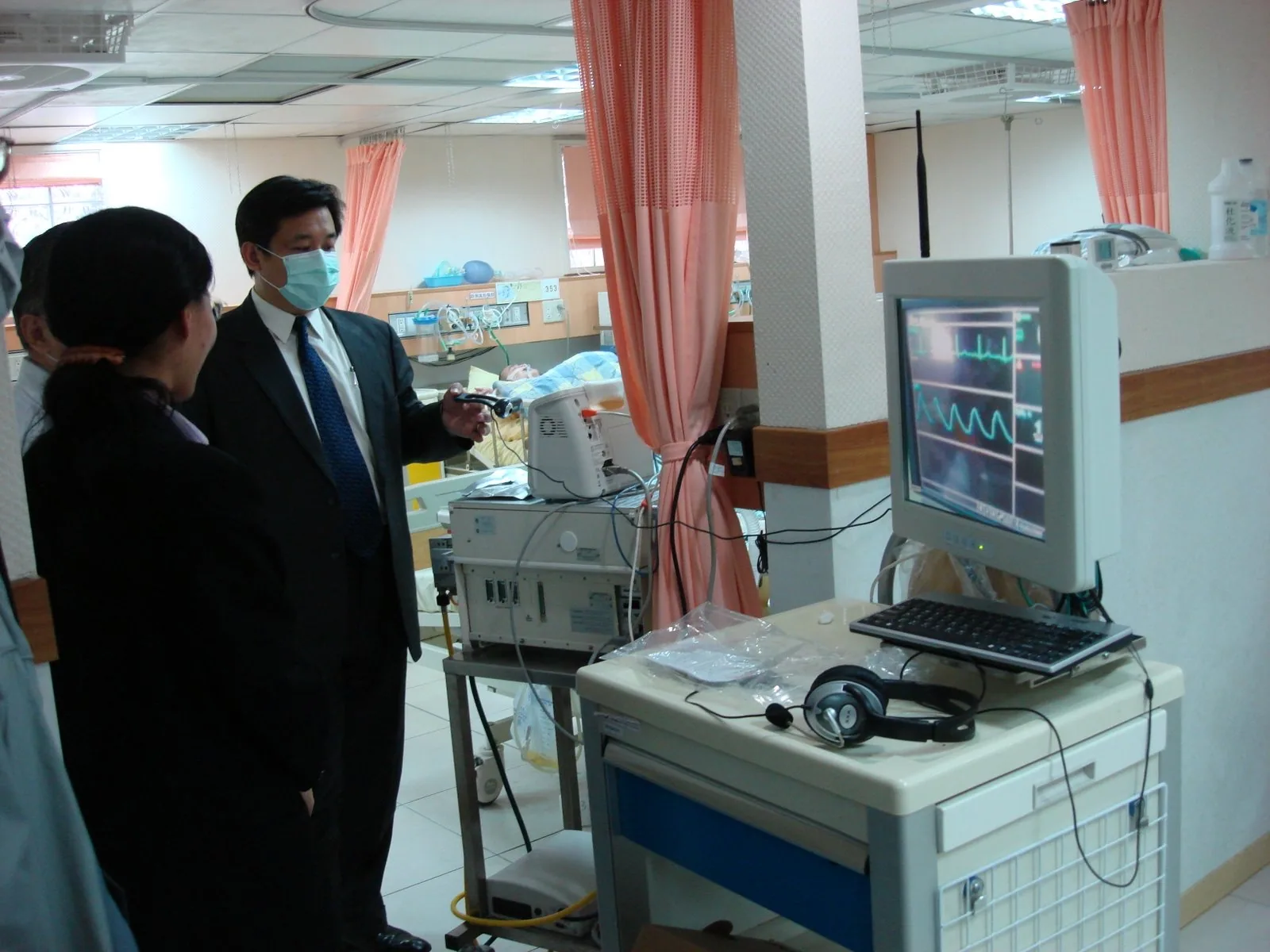
A mobile nursing station at Ditmanson Medical Foundation Chia-Yi Christian Hospital in 2007. The three-shift nurse-to-patient ratio reform, brought forward to 2026, is the largest structural adjustment to nursing working conditions in 30 years.
Three-shift nurse-to-patient ratio reform: on March 1, 2024, the Ministry of Health and Welfare issued an administrative order setting ratios of 1:6/1:7/1:10 for day shifts, 1:9/1:11/1:13 for evening shifts, and 1:11/1:13/1:15 for night shifts. On May 8, 2026, the Legislative Yuan passed amendments to the Medical Care Act on third reading. On May 12, 2026, Lai Ching-te announced that phased implementation would be brought forward to May 20, 202731. Penalties are NT$250,000 to NT$500,000 for district hospitals, NT$500,000 to NT$1 million for regional hospitals, and NT$1 million to NT$2 million for medical centers31. This is the largest structural adjustment to nursing working conditions in 30 years. But scholars generally assess that "improving working hours does not automatically bring people back." Australia and Canada are still offering what they offer. If Taiwan's healthcare wage structure does not change at the same time, the three-shift nurse-to-patient ratio can only slow the acceleration of loss; it may not reverse it.
The Blind Spots of 99.6%
The figure "99.6% coverage" is often abbreviated as "universal." More precisely, it means "99.6% of the eligible population"2. Outside the definition of eligibility are three groups: migrant workers who have lost contact with the system, babies born without household registration, and overseas Taiwanese who suspended coverage.
When migrant workers who have lost contact with authorities lose NHI eligibility, emergency medical care often leaves unpaid bills. This is a long-unresolved hole in Taiwan's migrant-worker healthcare policy32. A January 2025 policy report by the Global Taiwan Institute noted that the "stop-and-resume" mechanism for overseas nationals had long been treated as a form of exploitation: people living abroad did not pay premiums, then resumed coverage before returning to Taiwan for medical care33. Reform on December 23, 2024 finally abolished stop-and-resume coverage. But after abolition, how to calculate spillover costs and whether to apply retroactive rules remain political no-go zones.
The problem of the National Health Insurance Research Database runs deeper. From NHI's launch in 1995 to 2024, Taiwan's NHI database accumulated 70 billion medical records and 3.4 billion medical images, supporting more than 8,414 peer-reviewed publications34. The NHIA and National Taiwan University Hospital signed an MOU to jointly build "the world's first cardiovascular risk database based on imaging information"34. In academia, this is one of Taiwan's greatest forms of soft power.
But on August 12, 2022, Constitutional Court Judgment No. 111-Hsien-Pan-13 held that this world-scale NHI database was unconstitutional on three levels: lack of an opt-out right, insufficiently clear regulations, and absence of an independent oversight mechanism35. The Court set a three-year deadline. On December 2, 2025, the National Health Insurance Data Management Act passed its third reading, granting an opt-out right36. This was the largest remedial lesson in NHI data governance in 30 years.
Read together, these two facts show the same structure: 99.6% is an achievement in coverage; the database's unconstitutionality is the side effect of using that coverage "too thoroughly." One cost of universal enrollment is that everyone's medical records enter the same pool. Thirty years later, when big data was extracted for research in reverse, people discovered: "I never consented." The Constitutional Court's judgment, in essence, returned NHI "data rights" to individuals. For academic research, it is a major shock. For the protection of basic rights, it is a correction.
Accessibility contains another often-overlooked blind spot. The Integrated Delivery System plan for improving medical benefits in mountainous and offshore-island areas began in 1999. It covers 49 mountainous/offshore-island areas plus 49 non-mountainous offshore-island areas, providing fixed-site outpatient clinics, 24-hour emergency care, mobile medical services, home medical care, referrals, and medical evacuation37. NHI covers "enrollment" at 99.6%. It does not cover "accessibility." A resident of a remote area may have an NHI card, but if the nearest hospital is 50 kilometers away, the card's substantive meaning differs from that for an urban resident. IDS is a remedial mechanism, not a system-level solution.
Moving Through IC Cards and Databases, Too Fast and Too Far
Taiwan fully replaced NHI cards with IC cards in 2004, and the move is often claimed to be "world first." The accurate version is that Slovenia had completed nationwide deployment by September 2000, making it the first country in the world to universalize health smart cards. Both HIIS, Slovenia's health insurance institute, and a 2001 paper by Hriberšek indexed in PubMed record this fact38. Taiwan was the world's second case, and the largest and most deeply integrated. The gap was three and a half years.
This correction is not meant to deny Taiwan's achievement. It is meant to correct the narrative habit of "we are world first." Once internalized, that habit turns into an extended inference that "therefore our data governance is also world-class." Thirty years later, that is how the system stepped into the Constitutional Court's 2022 judgment.
✦ Closing warning: The NHI IC card and the NHIRD have stood at the front edge of the world. That is an achievement accumulated over 30 years. But systems that move too fast, too far, and too deep are often tripped by their own achievements. Constitutional Court Judgment No. 111-Hsien-Pan-13 marks the moment when a mature system must turn back and make up a missed lesson. It does not mark institutional failure.
The "world number one" framing also needs correction in international indices. Taiwan ranked first on the Numbeo Health Care Index in 2024 for the sixth consecutive year, scoring 86 out of 100, ahead of South Korea at 82.7, Japan at 79.3, the Netherlands at 78.9, and France at 78.1. The index covered 4,119 cities and 43,700 respondents4. But this is a user perception index, not an institutional metric. Respondents self-select, and the index includes subjective scores from healthcare users. Taiwan's actual position in Bloomberg's Health-Care Efficiency Index was 14th in 2018, not ninth; in 2020, because of Covid-era epidemic-control reshuffling, it moved into the top four; by 2024, the index had stopped updating39.
The academic citations are substantial. William Hsiao's 2003 Health Affairs 22(3):77 article, "Does Universal Health Insurance Make Health Care Unaffordable? Lessons From Taiwan," not a Lancet article, is the most-cited English-language academic paper on Taiwan's NHI9. In 2015, Tsung-Mei Cheng wrote in Health Affairs: "Taiwan's NHI stands out as a high-performing single-payer national health insurance system that provides universal health coverage to Taiwan's 23.4 million residents based on egalitarian ethical principles"40. Princeton professor Uwe Reinhardt, who died in 2017 and had been one of Taiwan's NHI advisers since 1989, nonetheless wrote in his own article: "I have not advocated the single-payer model here because our government is too corrupt"41. One of the system's designers openly opposed transplanting it to the United States.
As for the narrative that "Obama learned from Taiwan," publicly available sources do not show an official delegation directly visiting Taiwan to study the system. The accurate version should be: Taiwan is one of the cases most often cited by U.S. single-payer advocates, through a citation chain formed by scholars such as Reinhardt and Cheng and politicians such as Bernie Sanders, rather than a case of "the Obama administration directly learning from Taiwan"41.
The private insurance market is another piece of counterevidence. A 2004 survey found that 72.3% of Taiwanese households had purchased private health insurance; in 1993, before NHI began, the figure was 63.9%42. The assumption that "universal NHI locks out the private insurance market" is reversed: nine years after NHI began, private insurance household penetration had not fallen but risen by 8.4 percentage points. Taiwanese people are pragmatic. They know NHI is good, but they also know that room upgrades, self-pay therapies, overseas emergency care, long-term care, and targeted cancer drugs outside the NHI benefits package require private insurance supplementation. This is also the structural reason why, 30 years later, the question "Is NHI enough?" is becoming more common.
Three Sentences Combined
Thirty years later, that small card from midnight on March 1, 1995, still exists; it has simply moved into apps as a QR code. But the same system is currently propped up by three figures: a 99.6% coverage rate, a 5.17% premium rate, and a 12.61% nursing turnover rate. The first two are a source of pride for the people of Taiwan; the third is an account that no one has dared to touch for 30 years.
In 2020, Yeh Chin-chuan said: "The current system can only hold out for five more years at most"22. In 2011, before resigning following the third reading of the legislation, Yang Chih-liang said: "Supplementary premiums are a mistake"18. In 2024, Li Yu-chun—the person who coined the term "Sida Jiekong" (all four elements being empty)—said: "The point value is a symptomatic solution, not a fundamental one"25. Combined, these three sentences are not necessarily pessimistic; they sound more like words that someone finally dares to speak aloud after 30 years of implementation. The world's number-one health insurance requires world-class investment; but the word "investment" has never been just about adding money. It points toward total household income, internal hospital resource allocation, resident physician working hours, the bearing of medical disputes, and data governance. Every single one of these is ten times harder than adjusting premium rates.
In 1989, Hsiao Ching-lun chose the Canadian model because "the quality of services was very high"10. In Taiwan, 30 years later, the world's highest coverage rate rests upon the lowest payment point values and a nursing turnover rate of 12.61%. The success of a system is not the antonym of its flaws—success itself creates a political path dependency that generates these flaws. To move forward, we cannot rely on the next "three days of fire under one's buttocks"; we must rely on someone being willing, for the first time in 30 years, to tackle the forbidden zones of "total household income," "hospital allocation," and "the right to data withdrawal," one by one.
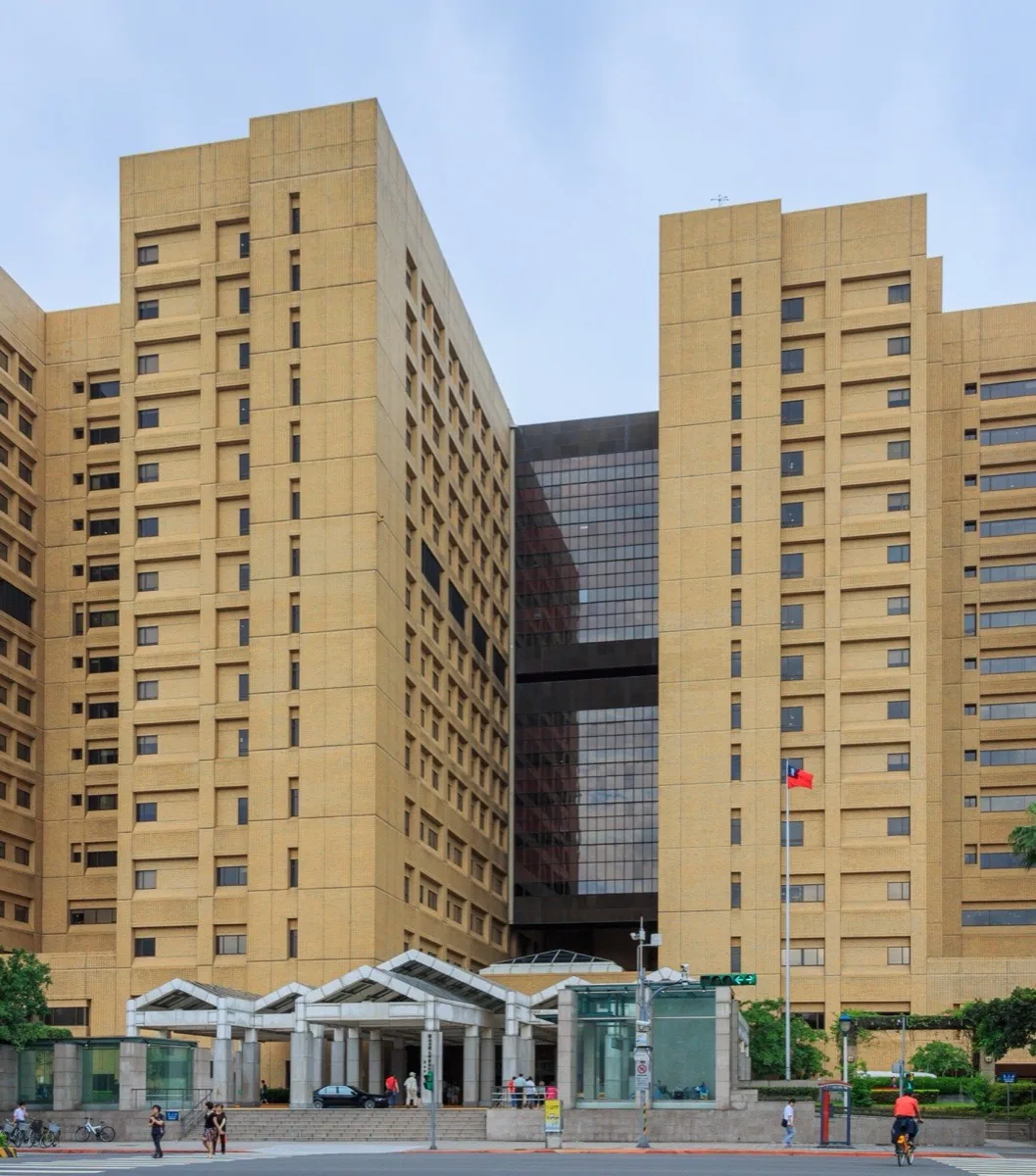
The main building of National Taiwan University Hospital (NTUH). Founded in 1895, it is the largest medical center in Taiwan's NHI system; on March 1, thirty years ago, during the launch of National Health Insurance, ID cards were used here to replace health insurance cards that had not yet been printed.
Further Reading:
- Medical Care Act — The NHI Act governs "benefits," while the Medical Care Act governs "institutions"; these two laws constitute the dual tracks of Taiwan's medical governance: the benefit side and the institutional side.
- Evolution of Taiwan's Regenerative Medicine Laws: A Professional's Confession — Beyond the boundaries of NHI benefits, the two regenerative medicine laws passed in 2024, representing another governance track outside of NHI SOPs.
- Controversy over Veterinary Drugs in Taiwan — NHI covers humans, not animals; the controversy over pet medication serves as a control group for the NHI system.
- Taiwan's Disaster Medicine System — NHI supports routine medical care, while the disaster medicine system supports extraordinary periods; these two systems together construct the normal and emergency aspects of Taiwan's public health governance.
- COVID-19 and Vaccines in Taiwan — That same health insurance card was used for the real-name mask distribution system in 2020, set up within two weeks; the same underlying data infrastructure also enabled epidemic investigation and vaccine appointments to function.
Open Data
The following government open datasets allow you to verify, or overturn, the arguments in this article yourself. Links point to persistent pages on data.gov.tw. Readers working with AI can also query the same datasets through Taiwan's open-data MCP gateway, Twinkle Hub.
- Statistics on National Health Insurance insured persons by category, sex, and age group (National Health Insurance Administration, Ministry of Health and Welfare; updated every three months) — The generational structure discussed in "39.8% using, 54.8% paying" can be checked by breaking down this table by age group and insurance category
- Meeting minutes of the National Health Insurance Committee, Ministry of Health and Welfare (National Health Insurance Committee, Ministry of Health and Welfare; updated monthly) — Primary meeting minutes showing at which table, and with what reasoning, the 5.17% premium rate was "maintained without adjustment"
- Statistics on government subsidies for disadvantaged insured persons under National Health Insurance (National Health Insurance Administration, Ministry of Health and Welfare; updated monthly) — The implementation side of Lin Ya-hui's "sharing hardship and paying according to ability": this table shows whose premiums the government pays
Image Sources
- Hero: NHI Building, ROC-MOHW-NHIA Taipei Division main entrance by Solomon203 / Wikimedia Commons / CC BY-SA 4.0
- Scene-mid 1 (2017 version of the NHI IC card): official image from the National Health Insurance Administration, Ministry of Health and Welfare / Public Domain (government open information)
- Scene-mid 2 (NHI 30th anniversary documentary iframe): official YouTube channel of the National Health Insurance Administration, Ministry of Health and Welfare
- Scene-mid 3 (Chia-Yi Christian Hospital mobile nursing station, 2007): Ditmanson Medical Foundation Chia-Yi Christian Hospital / used for nonprofit educational purposes
- Closure (National Taiwan University Hospital main building): National Taiwan University Hospital main building / Wikimedia Commons / CC BY-SA 4.0
References
- 醫奉 31/葉金川:火燒屁股的三天,撐起 30 年健保 — A 2021 "Medical Dedication 31" feature interview with Yeh Ching-chuan by Yuanqi Net. Yeh, the first director-general of the Bureau of National Health Insurance, recalls the emergency mobilization in the six days before the March 1, 1995 launch, including verbatim remarks such as "the preparation time was actually only three days," "a fire at our backsides," and the emergency fallback mechanism of using national ID cards in place of NHI cards.↩
- 全民健康保險統計 — Official statistics page of the National Health Insurance Administration, Ministry of Health and Welfare, publishing indicators including enrollment numbers, coverage rate, and global budget growth rate. The 99.6% figure is coverage of the "eligible population" and excludes migrant workers who have lost contact with authorities, babies without household registration, and overseas people who suspended coverage.↩
- 全民健保行政成本國際比較 — The NHIA publishes annual administrative expense ratios, which have long remained between 1.5% and 2% of premium revenue, far below the roughly 12% level for U.S. commercial insurance. This is a structural advantage of the single-payer system.↩
- Numbeo Health Care Index by Country 2024 — Numbeo is a global cost-of-living and quality-of-life index platform based on self-selected user participation. Taiwan's 2024 health care index score was 86/100, ranking first for the sixth consecutive year, but this is a perception index rather than an institutional metric.↩
- 立法院第 11 屆第 1 會期第 14 次會議主決議文 — A main resolution passed by the Legislative Yuan in May 2024 requiring the Ministry of Health and Welfare to conduct a comprehensive inventory of nursing manpower. The attachment shows that the 2023 nursing turnover rate reached a 10-year high of 12.61%, while the vacancy rate of 9.05% was also a 10-year high.↩
- 中央健康保險署 30 週年大事紀 — The NHIA's 30th-anniversary milestones published in 2025, including baseline data from the March 1, 1995 launch such as the number of contracted medical institutions, coverage rate, and first-year premium revenue.↩
- 全民健保法立法歷程 — The NHIA's official institutional history page, recording the full timeline from the first draft in 1968 to formal launch in 1995, including policy milestones such as Premier Yu Kuo-hwa's February 28, 1989 announcement at the Legislative Yuan and Hau Pei-tsun's instruction to move the launch forward again.↩
- 全民健康保險法三讀與沈富雄絕食 — The Legislative Yuan legal system's record of the July 19, 1994 third reading of the National Health Insurance Act. Legislator Shen Fu-hsiung's July 16 hunger strike over NHI financing is recorded in that issue of the Legislative Yuan Gazette.↩
- Does Universal Health Insurance Make Health Care Unaffordable? Lessons From Taiwan — PubMed abstract for William Hsiao's 2003 Health Affairs 22(3):77 paper. This is the most-cited English-language academic paper on Taiwan's NHI and records the 1989 task force's comparison of six national models before choosing Canadian-style single payer.↩
- Why Did Taiwan Adopt a Single-Payer System? Lessons From the Hsiao Task Force — A 2019 Commonwealth Fund case study quoting Hsiao's evaluation of the Canadian model, "the quality of services was very high," and recording the decision structure of the 1989 six-country comparison.↩
- Taiwan's Single-Payer Success Story — and Its Lessons for America — Cheng's 2015 Health Affairs article, which breaks single payer into five major attributes: unified risk pool, consistent benefits package, sufficient resources, single purchaser, and global budget control. These five points are the theoretical basis for Taiwan's 30-year structural stability.↩
- 全民健保開辦初期民意調查 — The NHIA official institutional history page includes first-year polling from 1995: coverage was 96%, but satisfaction was 39% and dissatisfaction 47%. "Universal support" is a retrospective narrative; Taiwanese society had doubts about the new system at the time.↩
- 江東亮:四大皆空的緣起與監察院 2009 總體檢 — Yuanqi Net's publication of a 2018 article by Professor Chiang Tung-liang, explicitly stating that the term "four major specialties hollowed out" was coined by National Yang Ming University public-health professor Lee Yu-chun in the summer of 2009 during Control Yuan member Huang Huang-hsiung's comprehensive NHI examination, and became urgent after the 2011 report was released.↩
- 葉金川:五大皆空的爭議與我的看法 — Yuanqi Net's publication of Yeh Ching-chuan's 2018 article, presenting counterarguments such as: "What the medical community calls the five major specialties being hollowed out should first have emerged at a seminar when a hospital superintendent reported on the issue," and "It is not that all five major specialties are comprehensively short of people; the overall number of physicians is sufficient." Yeh argues the problem is distribution, not supply.↩
- 監察院 101.7.17 健保總體檢糾正案 — The comprehensive NHI examination corrective case published by Control Yuan members Huang Huang-hsiung, Shen Mei-chen, and Liu Hsing-shan in July 2012, which first officialized allegations such as "little money, much work, and proximity to prison" in the four major specialties and resident working hours of 300 to 400 hours per month.↩
- 楊志良請辭:補充保費三天決議與二代健保爭議 — A 2021 Central News Agency retrospective on the political background of Yang Chih-liang's resignation after second-generation NHI passed its third reading on January 26, 2011, showing the controversy around his immediate departure after pushing the main premium rate to 5.17%.↩
- 全民健保費率歷次調整 — The NHIA's table of premium-rate adjustments: 4.25% from 1995 to August 2002; 4.55% from September 2002; 5.17% from April 2010; second-generation NHI in January 2013 at 4.91% plus a 2% supplementary premium; a decrease in 2016 to 4.69% plus 1.91%; and a January 2021 return to 5.17% plus 2.11%.↩
- 楊志良:補充保費是個錯誤 — Top1Health's publication of a 2011 interview with Yang Chih-liang, including the verbatim remarks: "The supplementary premium is a mistake"; "Second-generation NHI was meant from beginning to end to use total household income for premium collection. But first the Ministry of Finance said total household income could not be done, and later legislators on the Finance Committee overturned the resolution of the Social Welfare and Environmental Hygiene Committee, taking only three days to propose the idea of supplementary premiums."↩
- 二代健保補充保費六項所得規定 — The NHIA's official supplementary premium calculation rules page, listing six types of income: high bonuses above four times the monthly insured amount, part-time wages, professional-practice income, dividends, interest, and rent; withholding begins at NT$20,000 per payment, capped at NT$10 million.↩
- 補充保費改革 480 萬人影響 行政院喊暫緩規劃 — A November 2025 Global Views Monthly report on the original plan to change from "single-payment" calculation to "annual settlement," raise the withholding cap to NT$50 million, affect an estimated 4.8 million people, and inject NT$10 billion to NT$20 billion, before the Executive Yuan abruptly suspended the plan, triggering complaints from stock-dividend investors and retirees.↩
- 國情統計通報第 231 號:65 歲以上人口醫療資源使用分析 — The Directorate-General of Budget, Accounting and Statistics National Statistics Bulletin of December 6, 2021, publishing the 2020 NHI spending structure: 65-plus accounted for 39.8%, ages 15 to 64 for 54.8%, and ages 0 to 14 for 5.4%; annual per capita NHI spending exceeded NT$70,000 for 65-plus and was about NT$10,000 for those under 65, a sevenfold gap.↩
- 葉金川:健保現在的制度最多只能再撐 5 年 — A 2020 in-depth report by The Reporter quoting Yeh Ching-chuan's warning about NHI's financial clock and analyzing in depth the political structure of generational transfer and blocked total-household-income reform.↩
- 健保 2026 總額 9,883 億 費率維持 5.17% — A November 19, 2025 Storm Media report quoting NHI Committee Executive Secretary Chou Shu-wan verbatim: "For 2026, the NHI global budget safety reserve is two months and has not fallen below the level, so the premium rate remains at the current 5.17% without adjustment." The report reveals details of maintaining the reserve through a NT$3 billion government subsidy plus NT$18.1 billion shifted from public budgets.↩
- 全民健康保險法第 78 條安全準備條款 — The Laws and Regulations Database of the Republic of China's current text of the National Health Insurance Act. Article 78 states that the total safety reserve should in principle be equivalent to one to three months of insurance benefit expenditures based on the most recent actuarial projection. This is the legal basis for why NHI does not "go bankrupt" and reflects the structure of a pay-as-you-go system.↩
- 報導者:保障點值 0.95 元政策深度解析 — A November 2024 special report by The Reporter, collecting five counterarguments including Cheng Shou-hsia's "guaranteeing point value is equivalent to abolishing the global budget," Kao Jo-hsiang's "the trickle-down effect simply does not exist," Lee Yu-chun's "point value is a symptomatic explanation, not the root solution," and Shih Chung-liang's "we hope the target point value can reach 0.95, but not through a guarantee."↩
- 部分負擔新制 1 年後評估:門診次數創 4 年新高 — A July 2024 Public Television Service assessment of the July 1, 2023 copayment reform, showing that annual outpatient visits per person reached 14.3, a four-year high, and quoting Taiwan Healthcare Reform Foundation Executive Director Lin Ya-hui verbatim: "NHI is not commercial insurance; it emphasizes the spirit of sharing hardship and paying according to ability."↩
- Doctor Shopping in Taiwan: A Population-Based Study — A PubMed Central study of doctor shopping under Taiwan's NHI, analyzing the structure behind an average of 18 outpatient visits per person per year, more than twice the OECD average, and providing the theoretical basis for the feedback chain of "cheap → more use → point values fall."↩
- 報導者:護理出走潮深度報導 — A June 2024 special report by The Reporter, covering the 2023 turnover rate of 12.61%, a 60% practice rate, one-third of new hires leaving within three months, more than 30% bed closures at 22 medical centers, outflow distribution of 30%/25%/10%/15%/20%, and multiple verbatim remarks from Kao Ching-chiu, Lin Hsiu-chu, Chao Lin-yu, Luo Hsiang-yun, and Tsai Shu-feng.↩
- 立法院主決議要求衛福部全面盤查護理人力 — Attachment to a May 2024 Legislative Yuan main resolution requiring the Ministry of Health and Welfare to comprehensively inventory nursing manpower, revealing the five-year nursing turnover sequence from 2019 to 2023: 11.12% in 2019, 10.13% in 2021, 11.73% in 2022, and 12.61% in 2023, a 10-year high.↩
- 衛福部長邱泰源為「關床的醫院是哪幾家」道歉 — A June 5, 2024 United Daily News report on Minister of Health and Welfare Chiu Tai-yuan's apology at the Legislative Yuan over Department of Nursing and Health Care Director Tsai Shu-feng's rhetorical question, "Which hospitals have closed beds?" This was a turning point in the 2024 political confrontation over the nursing shortage.↩
- 三班護病比 2027 年提前實施 賴清德宣布 — A May 12, 2026 Central News Agency report on Lai Ching-te's announcement that the three-shift nurse-to-patient ratio would be moved up from the original 2030 schedule to phased implementation beginning May 20, 2027, with penalties of NT$250,000 to NT$500,000 for district hospitals, NT$500,000 to NT$1 million for regional hospitals, and NT$1 million to NT$2 million for medical centers.↩
- 失聯移工醫療權益困境 — A Taiwan Association for Human Rights special report documenting the problem of unpaid emergency medical bills after migrant workers who have lost contact with authorities lose NHI eligibility. This is the most visible blind spot behind the 99.6% "universal" coverage rate.↩
- Global Taiwan Institute: Taiwan's NHI Stop-and-Resume Loophole — A January 2025 Global Taiwan Institute policy report analyzing the exploitation structure of the stop-and-resume mechanism for overseas Taiwanese and recording the policy process behind the December 23, 2024 reform abolishing stop-and-resume coverage.↩
- NHIRD 學術產出與健保署 × 臺大 MOU — The NHIA's publication showing that the National Health Insurance Research Database has accumulated 70 billion medical records and 3.4 billion medical images, supported more than 8,414 peer-reviewed publications, and signed an MOU with National Taiwan University Hospital to build "the world's first cardiovascular risk database based on imaging information."↩
- 111 年憲判字第 13 號:健保資料庫違憲 — Full text of the Constitutional Court's August 12, 2022 judgment, which held that the NHI database was unconstitutional on three levels: lack of an opt-out right, insufficiently clear regulations, and absence of an independent oversight mechanism, with a three-year deadline for legislative amendment.↩
- 《全民健康保險資料管理條例》三讀通過 — A December 2, 2025 Lawbank report on the third-reading passage of the National Health Insurance Data Management Act, granting the public an opt-out right. This was the largest remedial lesson in NHI data governance within the three-year deadline set by Constitutional Court Judgment No. 13.↩
- 山地離島地區醫療給付效益提昇計畫 IDS — The Ministry of Health and Welfare's publication on the IDS program, launched in 1999, covering 49 mountainous/offshore-island areas plus 49 non-mountainous offshore-island areas and providing fixed-site outpatient clinics, 24-hour emergency care, mobile medical services, home medical care, referrals, and medical evacuation. It addresses the "accessibility" gap beyond NHI "enrollment."↩
- Slovenia: First Country with Nation-Wide Health Smart Cards — A 2001 paper by Hriberšek and others indexed in PubMed, recording Slovenia's completion of nationwide health smart card deployment in September 2000 as the world's first case; Taiwan in 2004 was the second, and the largest and most deeply integrated.↩
- Bloomberg Health-Care Efficiency Index Methodology — Bloomberg's official health-care efficiency index methodology page, recording the real sequence in which Taiwan ranked 14th in 2018, not the commonly cited ninth, moved into the top four in 2020 due to Covid-era reshuffling, and the index had stopped updating by 2024.↩
- Cheng 2015 Health Affairs: Taiwan's NHI Performance — PubMed abstract for Cheng's 2015 Health Affairs article, with the verbatim line: "Taiwan's NHI stands out as a high-performing single-payer national health insurance system that provides universal health coverage to Taiwan's 23.4 million residents based on egalitarian ethical principles."↩
- Uwe Reinhardt: Why I Don't Advocate Single-Payer in America — HuffPost publication of Princeton economist Uwe Reinhardt's core verbatim remark, "I have not advocated the single-payer model here because our government is too corrupt." Reinhardt, who died in 2017, had been one of Taiwan's NHI advisers since 1989 and publicly opposed copying the model in the United States.↩
- Taiwan's Private Health Insurance Market After NHI — A 2012 Geneva Papers on Risk and Insurance article analyzing the rise in Taiwan's household private health insurance penetration after NHI began, from 63.9% in 1993 to 72.3% in 2004, an 8.4 percentage-point increase that counters the assumption that universal NHI locked out the private insurance market.↩