
Walk through almost any Taiwanese city and you’ll find a distinctive architectural rhythm: a continuous covered walkway at ground level, columns marching along the sidewalk, and upper floors cantilevered above. This is the qílóu (騎樓)—often translated as “arcade,” though that English word doesn’t fully capture its role in Taiwan. The qílóu is not merely a design feature; it is a living interface between private property and public life, where shelter, commerce, and community overlap.
Under the arcades, you’ll see daily life in motion: breakfast stalls setting up at dawn, neighborhood clinics and salons opening their shutters, scooters parked in tidy or messy lines, and pedestrians weaving through a space that is at once public and privately owned. These scenes form a signature Taiwanese streetscape—one that is practical, dense, and animated, and that reflects the island’s layered history.
The qílóu’s evolution mirrors Taiwan’s social shifts: colonial modernization, postwar self-built housing, the rise of informal economies, the dominance of scooters, and contemporary debates on urban renewal. It is a story of adaptation and negotiation—between climate and architecture, commerce and mobility, regulation and improvisation.
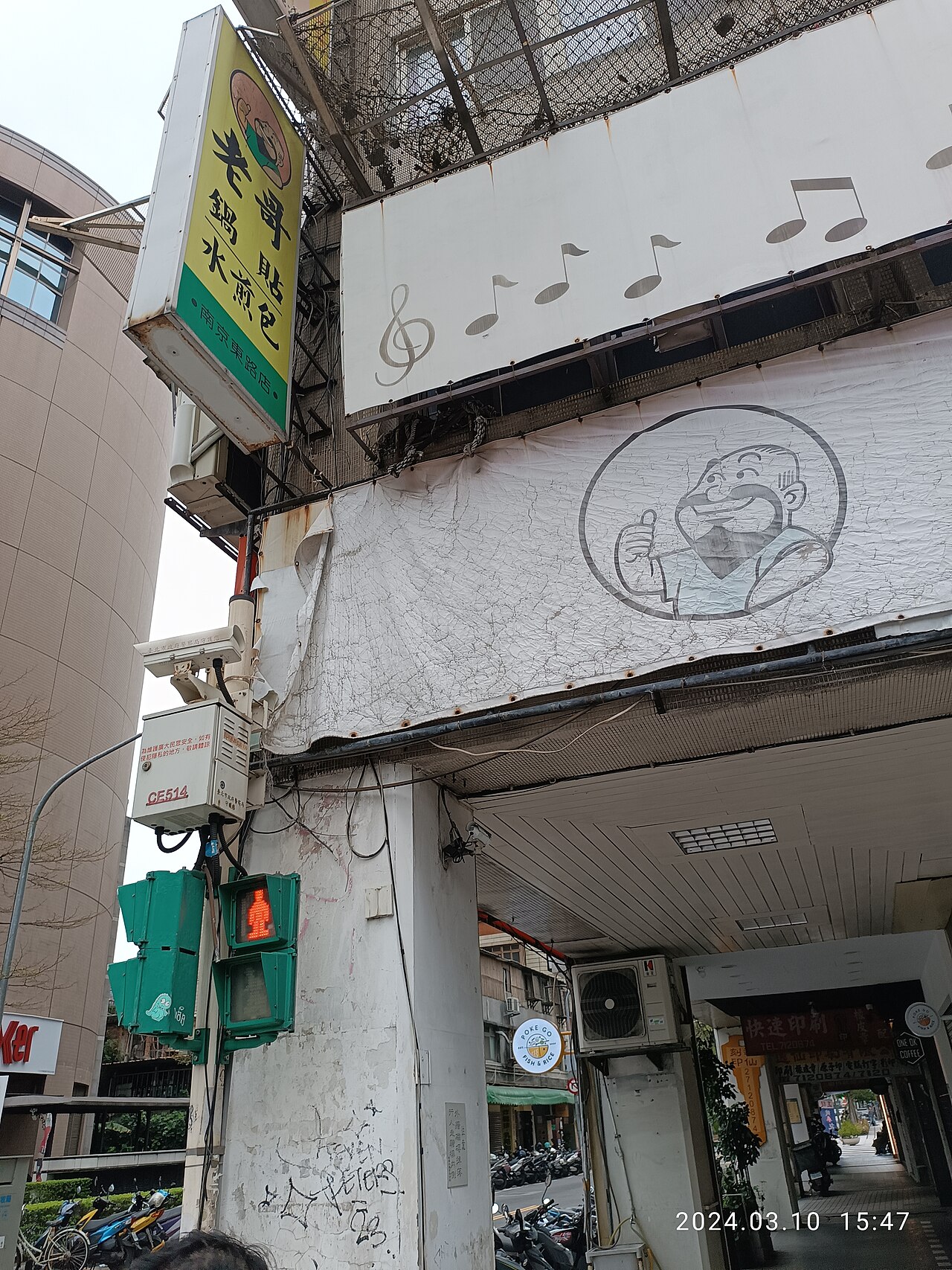
Photo: Arcaded shophouses in Dihua Street, Taipei, a classic commercial district where the qílóu defines the street’s rhythm.
Origins: From Southeast Asia to Taiwanese Streets
Colonial Transfer and Local Adaptation
The qílóu is not originally Taiwanese. Its architectural roots trace back to the shophouses of Southeast Asia—especially in colonial port cities such as Singapore, Penang, Batavia (Jakarta), and Saigon (Ho Chi Minh City). These buildings developed a common logic: a sheltered walkway below with residences above, designed for tropical heat, heavy rain, and bustling street commerce.
During Japanese rule (1895–1945), Taiwan’s colonial administration introduced this model as part of urban modernization. Planning reforms such as the 1900 Taipei City Improvement Plan and later initiatives in Taichung, Tainan, and Takao (Kaohsiung) institutionalized arcaded streets. Standardized widths and heights, reinforced concrete, and fire-safety considerations were promoted to create orderly, “modern” streets.
In this period, the arcade also served a symbolic function: it reflected a colonial vision of civility, hygiene, and economic efficiency—a built expression of “modernity.”
Postwar “Self-Built” Urbanism
After 1945, Taiwan entered a period of rapid reconstruction and urban growth. Arcades became part of self-built housing and family business culture, producing diverse local variations:
- Flexible heights and depths rather than standardized proportions
- Mixed-use interiors, where retail, storage, workshops, and living spaces coexisted
- Decorative façades, blending local motifs with global styles
- Family enterprises, reflecting the structure of Taiwanese small businesses
This postwar adaptation made the qílóu uniquely Taiwanese: not only a functional shelter but also a space of improvisation and identity.
A Space of Many Functions
1) The Commercial Corridor
The qílóu is Taiwan’s everyday marketplace. Under its canopy, one can find:
- Traditional shops such as herbal pharmacies (中藥房) and incense stores (金香店)
- Modern businesses like convenience stores, repair shops, and hand-shaken drink stalls (手搖飲)
- Micro-entrepreneurship built on trust, credit, and neighborhood relationships
These businesses thrive on foot traffic and proximity. The arcade’s shallow depth and continuous shelter encourage slow browsing and spontaneous encounters—key ingredients in Taiwanese street commerce.
2) The Informal Economy Stage
Arcades also enable a flexible, low-barrier economy:
- Morning breakfast carts and late-night snack vendors
- Seasonal markets and festival stalls
- Small-scale entrepreneurship for people who cannot afford full storefronts
This informal economy is both a safety net and a cultural engine. It preserves food traditions, creates opportunities, and keeps the street lively. At the same time, it brings challenges: sanitation, congestion, and debates over the rightful use of public space.
3) The Shelter of Scooter Society
Taiwan has one of the highest scooter densities in the world, and arcades play a crucial supporting role. They offer shade and protection for parked scooters, making them an everyday convenience—even when such use conflicts with pedestrian access.
This tension highlights a core feature of Taiwanese urban life: the constant negotiation of shared space. The qílóu’s ambiguous status—private property used as public passage—creates both friction and flexibility.
The Ambiguity of Semi-Public Space
Legally, the qílóu is part of private property. Socially, it is expected to function as public walkway. This ambiguity creates a unique spatial politics:
- Property vs. access: Owners often use arcades for business, while pedestrians claim it as a right of way.
- Flexibility vs. order: The space adapts to time-of-day and local needs but resists strict regulation.
- Community vs. authority: Municipal rules exist, yet everyday practice is shaped by local customs and negotiations.
This gray zone is precisely what makes the qílóu culturally rich—and administratively complex.
Climate Intelligence Built Into the City
Taiwan’s humid subtropical climate makes shade and shelter essential. The arcade is a traditional response:
- Sun protection lowers ground temperature and improves walking comfort
- Rain shelter keeps goods and pedestrians dry during sudden downpours
- Ventilation corridor allows air to circulate and reduces heat buildup
Long before “green building” became a buzzword, the qílóu embodied climate-adapted urban design.
The Signboard Jungle and Visual Culture
One of Taiwan’s most striking urban impressions is the dense layering of signboards along arcades and façades. The result is a visual ecosystem:
- Vertical stacking of signs
- Loud color palettes and mixed typography
- Chinese, English, and zhuyin (注音) coexisting on the same street
- Neon, LED, and acrylic materials in constant conversation
To some, this is chaos; to others, it is a vibrant “democratic” visual culture where every shop competes for attention. International visitors often describe Taiwanese streets as cyberpunk or “future-retro,” yet locals know these signs are simply the street’s voice.
Municipal efforts to standardize or reduce signage have faced pushback, as small businesses fear losing visibility. The debate reveals a tension between order and vitality, between global aesthetics and local identity.
Urban Renewal: Preservation vs. Modernization
As cities modernize, arcades face real challenges:
- High-rise developments replacing low-rise shophouses
- Glass curtain walls and standardized building codes
- Underground parking systems that reduce need for arcade parking
Preservation efforts exist—from cultural heritage listing to design controls—but they often struggle against development pressures. Some of Taiwan’s most iconic arcade districts have found ways to adapt:
- Dihua Street (迪化街) in Taipei: heritage restoration and creative retail
- Lukang Old Street (鹿港老街): traditional crafts and tourism
- Dadaocheng (大稻埕): historical architecture repurposed for cafés and cultural venues
These cases show that renewal doesn’t have to erase heritage; it can reposition it.
The Social Meaning of Arcades
The qílóu is more than architecture—it is a social infrastructure:
- A platform for cross-class interaction
- A buffer for economic shocks via informal commerce
- A public living room for elders, migrants, and youth
Its resilience lies in how it absorbs change without losing its fundamental role as a shared threshold. The qílóu is where city life becomes human-scaled.
Taiwan in a Regional and Global Context
Comparing Taiwan with other arcade cities reveals distinctive traits:
- Singapore has preserved shophouses with strict conservation and premium commercial reuse.
- Penang protects its arcades through UNESCO heritage recognition.
- Ho Chi Minh City struggles with rapid modernization and uneven preservation.
Taiwan’s difference lies in the everydayness of its arcades: they are not just heritage sites, but still the default stage for ordinary life—scooters, snacks, and all.
Looking Forward: The Future of the Qílóu
In a digital economy, the arcade must adapt again. E-commerce is shrinking some storefronts, while experience-driven retail and community spaces become more important. New possibilities include:
- Smart city infrastructure integrated into arcade corridors
- AR heritage trails and localized tourism
- Adaptive reuse for cultural programming
At the same time, sustainability initiatives could reframe arcades as climate-resilient urban assets: shading, ventilation, and density-friendly design already make them a low-energy urban form.
Conclusion
The qílóu is a living archive of Taiwan’s history: colonial urban planning, postwar improvisation, informal economies, and the everyday choreography of scooters and pedestrians. It embodies Taiwan’s ability to negotiate space—between public and private, tradition and modernity, regulation and resilience.
If Taiwan’s streets are a language, the qílóu is its grammar. And like any living language, its future will depend on how well it balances preservation with reinvention—so that this century-old urban form can continue to shelter the next generation of Taiwanese life.
Further Reading
- 台灣都市發展與城鄉差距 — Taiwan’s broader path of urbanization
- 夜市文化 — Another major street culture ecosystem
- 台灣交通系統 — The mobility context behind scooter culture