
30-Second Overview
Taiwan's expressway system has grown from the MacArthur Highway in 1964 through today's Xueshan Tunnel and National Highway No. 7—used by all of Taiwan every day, yet few know its true depth. Nearly every version of this road's history circulating lacks a verifiable source: the first expressway wasn't the Zhongshan Expressway, the 1978 opening ceremony wasn't cut by Chiang Ching-kuo, the Control Yuan determined the ETC arrangement was "distinct in nature from BOT," and the legendary fighter jets never landed at that location. But one thread holds up under every check: from a solitary elderly woman in the authoritarian era whose name was never recorded, to the last toll collector who fought an 11-year legal battle, to farmer Wang Chun-fa in Kaohsiung today praying to the sea god that "this road never gets built," behind every push for speed there is a concrete person paying the price.
Legends You Can Find, Accounts You Can't Finish Tallying
On the morning of December 15, 1997, at 8 a.m., deep in the westbound tunnel of the Xueshan Tunnel, water flooded in from all directions. A full-face tunnel boring machine, worth over a billion NT dollars, was stuck in a fractured fault zone. Leng Yao-tung, the deputy chief of electromechanics, noticed something: the machine's 22.8 kilovolt-ampere (KVA) high-voltage main power supply had not been shut off. With the power still on, the two or three hundred rescue workers at the scene were all exposed to the risk of electrocution. He and a colleague rushed back to the control room to cut the power, then turned and ran outside. Behind them came the sound of collapse1.
Nearly three hundred lives hung on one person remembering to flip a switch. This is one of the few moments in Taiwan's fifty years of national highways that has been repeatedly retold. Yet even this story—and the number hanging beside it, the Xueshan Tunnel's "25 fatalities in the line of duty"—is wrong.
This road that almost all of us use nearly every day: most of the versions circulating about it don't hold up to scrutiny. Most people think Taiwan's first expressway was the Zhongshan Expressway (in fact, the MacArthur Highway came fourteen years earlier—it just wasn't formally classified as an "expressway"). They think the 1978 opening ceremony ribbon was cut by Chiang Ching-kuo (he had stepped down as Premier half a year before). They think the ETC was a BOT project (the Control Yuan itself said it was "different in nature from a BOT"). They think an F-104 fighter jet test-landed on the national highway near Huatuan, Changhua in 1978 (both the aircraft type and location are wrong). Over fifty years, almost no "one-sentence version" of this road's history can stand up to scrutiny2.
But there is another thread that holds up no matter how many times you check it: behind every step forward, every bit faster, there are concrete people paying the price for that speed. There is an elderly man living alone beside the Zhongli interchange whose name was never recorded. There is a toll collector who fought a lawsuit for eleven years and ended up with a settlement whose amount cannot even be made public. There is an old farmer in Kaohsiung facing a statue of the sea god, praying that National Highway No. 7 "never gets built." This article does two things: it takes apart and fact-checks the legends that have circulated, one by one, while putting back into the ledger those people whose costs have never been counted.
So let's start with the earliest of those roads: the first expressway that even Taiwanese themselves have almost forgotten.
Taiwan's First Expressway—Nobody Remembers Its Name Today
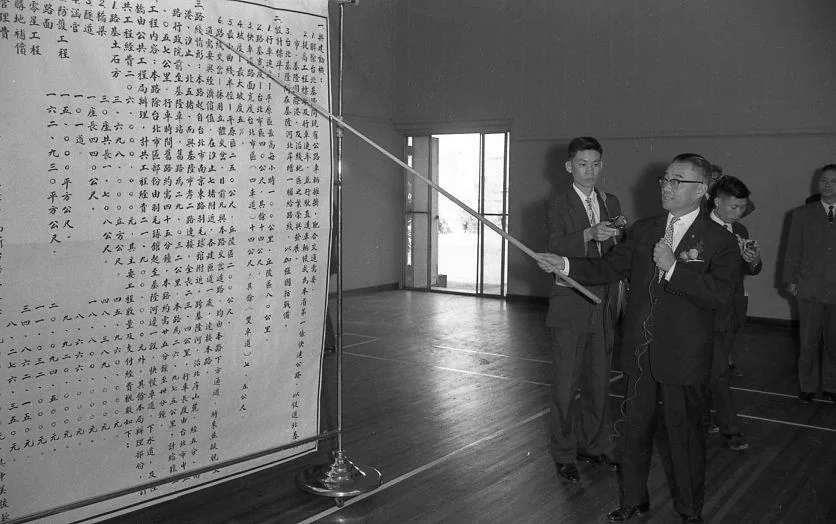
Taiwan's first expressway was not called the Zhongshan Expressway; it was called the MacArthur Highway, which opened on May 2, 1964—fourteen years before the Zhongshan3. It ran from Taipei to Keelung, with a main line of 22.65 kilometers plus a branch line of less than one kilometer. It was Taiwan's first expressway to use grade-separated interchange design, with all at-grade intersections either elevated or depressed, and toll booths at each end. Where did the money come from? Of the construction cost of over 227 million yuan, U.S. aid provided over 120 million—it was Cold War infrastructure through and through4.
It was not originally called this. It was called the "Taipei-Keelung New Road." On April 5, 1964—less than a month before opening—General MacArthur died. The government, grateful for American assistance and the general's friendship, hastily renamed the road the MacArthur Highway5. This is one of the rare cases where Chinese and English historical records align so closely that we can use it with confidence: "News of the general's death arrived at the time of the opening."
💡 Did you know?
The MacArthur Highway harbored a secret in its route selection: it deliberately chose to build a new line on the north bank of the Keelung River rather than simply widen the old road on the south bank. The reason had nothing to do with engineering—it was military preparedness: if one road were destroyed in war, the other could still be used6. This "first expressway" carried the logic of "what if war breaks out" from the very beginning, a logic that would resurface again and again later.
The fate of the MacArthur Highway says much about the character of Taiwan's national highways. On July 10, 1977, when the Keelung-to-Neihu section of the Zhongshan Expressway opened, most of the MacArthur Highway was directly absorbed into the Zhongshan: not replaced, but swallowed by the road that superseded it7. Only the small segment that was not absorbed was downgraded to today's Provincial Highway 5A. If you drive along Provincial Highway 5A today, most people will not realize that the road beneath their wheels was once Taiwan's first ticket to modernization.
If the origins of the first road alone have so many versions, how much of the story of the Zhongshan—the largest in scale and most traveled over fifty years—has been simplified away?
Twelve Years of Relay, and Two People Whose Names Were Never Recorded
The most widely circulated version of the Zhongshan Expressway goes like this: Chiang Ching-kuo gave an order, uttered the phrase "if we don't do it today, we'll regret it tomorrow," and single-handedly directed the construction and completion of the largest of the Ten Major Construction Projects.
This version falls apart under scrutiny at nearly every point. The concept of the expressway predated Chiang Ching-kuo's involvement in any capacity, and the initial decision was not made by him alone but by a joint conference of the provincial governor, minister of economic affairs, and minister of transportation8. The actual groundbreaking ceremony took place on August 14, 1971, presided over by Vice President Yan Jia-gan, not Chiang Ching-kuo, because Chiang was only Vice Premier of the Executive Yuan at the time—he did not formally assume the premiership until 1972. By the full-line opening ceremony on October 31, 1978, Chiang had already become President on May 20 of that year and stepped down as Premier, so he did not preside over that ceremony either9. As for the phrase "if we don't do it today, we'll regret it tomorrow," it comes from a biography published in 1991, eighteen years after the decision was made—it very likely represents a representative statement synthesized by later writers, not a verbatim recording.
There is another detail frequently misremembered: the full-line "completion and opening" (October 31, 1978) and the formal "naming as Zhongshan Expressway" (April 19, 1979) are two separate events nearly half a year apart, not the same day10.
📝 Curator's Note
The prevailing account compresses a process spanning twelve years, three transportation ministers, and Chiang Ching-kuo himself holding three different titles (Vice Premier, Premier, President) into a single moment of one person's decision. This is precisely how authoritarian-era memory operates—another invisible kind of speed in this road: the speed at which power consolidates narrative. Credit flows upward and concentrates in the name of the top leader, while Yan Jia-gan, Lin Jin-sheng, Huang Jie, and Sun Yun-xuan—along with the costs they bore—vanish from the narrative. But those who disappeared most completely were not these ministers.
The truly disappeared were the people run over by this road. Land acquisition for the Zhongshan Expressway was handled by the Freeway Engineering Bureau's "Right-of-Way Section," established in 1971 and expanded from thirty-some staff to forty-some. Why establish a dedicated unit? Wang Chaosheng, the administrator of the Right-of-Way Section, explained it clearly in his oral history: "The expressway was the first of the Ten Major Construction Projects, and Mr. Chiang Ching-kuo required it to be opened, completed, and opened to traffic on schedule. Local government efficiency was poor—a single provincial road would take local government a very long time to acquire land for, so it would be impossible to meet the deadline."11
Wang Chaosheng personally handled land acquisition for the Zhongli-Yangmei section, the Taipei section, and the Yangmei-Sanyi section. He had to go to the site himself for cadastral surveys and assessments of structures, "walking the site I don't know how many times." He remembers two households.
The first was on the land for the Zhongli interchange. Beside a rural road stood a dilapidated house with no roof or walls, just two beams still standing, inhabited by a solitary elderly man in his seventies with mobility difficulties. Within reasonable limits, Wang Chaosheng gave him somewhat more compensation, coordinated with the local government's social affairs department to help arrange his resettlement, and ultimately used the engineering bureau's official vehicles to help him move. "It took a lot of time back and forth before we successfully acquired the land."12 The second household was at the Yangmei interchange, a small tile-roofed house where a couple lived—both were blind. Their eldest son was in military service, their younger son was in junior high school, the family had no money, the land belonged to someone else, and they could not even receive land compensation, only compensation for structures. All the other households had been demolished, but they still lived there. Wang Chaosheng tried getting help from the conscription office, social affairs department, and citizen service centers to no avail. Finally, the local village chief found an empty plot by the river and had a shelter built there, allowing them to move.13
These two households—their names were never recorded in any document. This is not forgetting; they had no channel to be recorded from the start. That era had no hearings, administrative litigation, or environmental review procedures like today. When compensation standards got stuck, the fate of the vulnerable hung on the conscience and connections of a single civil servant. "When these standards couldn't solve individual problems, we had to figure out solutions ourselves," Wang Chaosheng said—his words are the most apt evidence of "the cost of the authoritarian era": the cost certainly existed, only it was personalized and non-institutional, held together by personal relationships.
That era was not a monolith of public opinion either. Wang Chaosheng's colleague Chen Mao-xiong remembered that "when the expressway was being planned and built, many people came forward to oppose it, arguing that the expressway was built for the wealthy." Contemporary reports also wrote that "some criticized the expressway as favoring the rich, since only wealthy people could afford to buy cars, while others believed... it would be better to widen the existing western trunk line instead."14 Voices of opposition were always there, but in the martial-law news environment, they had no chance to be organized, recorded, or passed down.
How this road was built was itself a form of unequal cost. Taiwan had no expressway design standards at the time and could only rely on the American consulting firm De Leuw Cather to translate California standards and learn as they went. Engineer Xu Junyi remembered the salary gap: Taiwanese engineers earned four thousand yuan a month, foreign consultants earned four hundred thousand, plus room and board, transportation, and drivers—"a hundred times what we made." But the money bought real expertise: "Before, if you didn't know something at school, you'd go find a book. Now, when your sketch is wrong, after he corrects it, you know where you went wrong." Most vividly, they had a homespun method for road acceptance: they'd accelerate a properly aligned four-wheel vehicle to design speed, "then let go of the steering wheel, and the car would drive straight ahead without drifting out of the lane—that meant the construction was qualified."15 Within seven years, this group built three hundred seventy-three kilometers.
That "three hundred seventy-three kilometers" deserves a note too: the inscription on the Zhongsha Bridge monument erected at the Xiluo Service Area in 1978 reads the round number "373 kilometers," but after the Kaohsiung Port access elevated section was incorporated in 2015, the current official standard is 374.3 kilometers7. The same road yielded several different measurements over fifty years.
The Zhongshan Expressway ran from Keelung all the way to Kaohsiung, dramatically shortening north-south travel along the western corridor. But what it faced next was an entire Central Mountain Range.
Xueshan Tunnel Deaths: Thirteen, Not Twenty-Five
Back to the person who cut the power at the opening. The nearly three hundred people Leng Yao-tung saved, and those who could not be saved, are two sides of the same mountain. And the number of the dead is precisely the figure most commonly misremembered about this road.
The version in current circulation says "25 workers died in the Xueshan Tunnel construction." The Ministry of Labor's official press release in 2006 drew the distinction clearly: 25 is the workplace fatality count for the "Taipei-Yilan Expressway overall project," of which 13 belonged to the Xueshan Tunnel proper, with 8 from the Nangang-Pinglin section and 4 from the Toucheng-Su'ao section—13 plus 8 plus 4 equals 2516. Attaching the "full Taipei-Yilan line" figure of 25 directly to the "Xueshan Tunnel" is a scope error.
💡 Did you know?
What's interesting about the number 25 is that two completely different ways of categorizing it both yield a "13": by project segment, the tunnel proper is 13; by nationality, of the 25 deceased, 12 were nationals and 13 were Thai. The two 13s do not refer to the same group of people17. When reading numbers, always ask first: "What is the basis of this count?" That is also the method of this entire article.
Those 13 Thai migrant workers have names that appear in contradictory versions across different reports—dates, causes of death, spellings all fail to align, making it impossible to trace back to a single primary source. Rather than pick one version and fix it in writing, it is more honest to acknowledge: a group of people gave their lives for this tunnel, and their names could not even be accurately preserved. That fact itself is a form of cost.
The engineering details of the Xueshan Tunnel (quartzite harder than steel, six major fault zones, high-pressure water inflow, five major construction methods) are covered in detail elsewhere on this site; here we add only one commonly misspoken term. During construction, the tunnel boring machines became stuck a total of 26 times18. One main shaft TBM affected by the 1997 water inflow was never extracted—it "ended its days in the Xueshan Range"19. A machine can be left in the mountain as a memorial; 13 lives cannot.
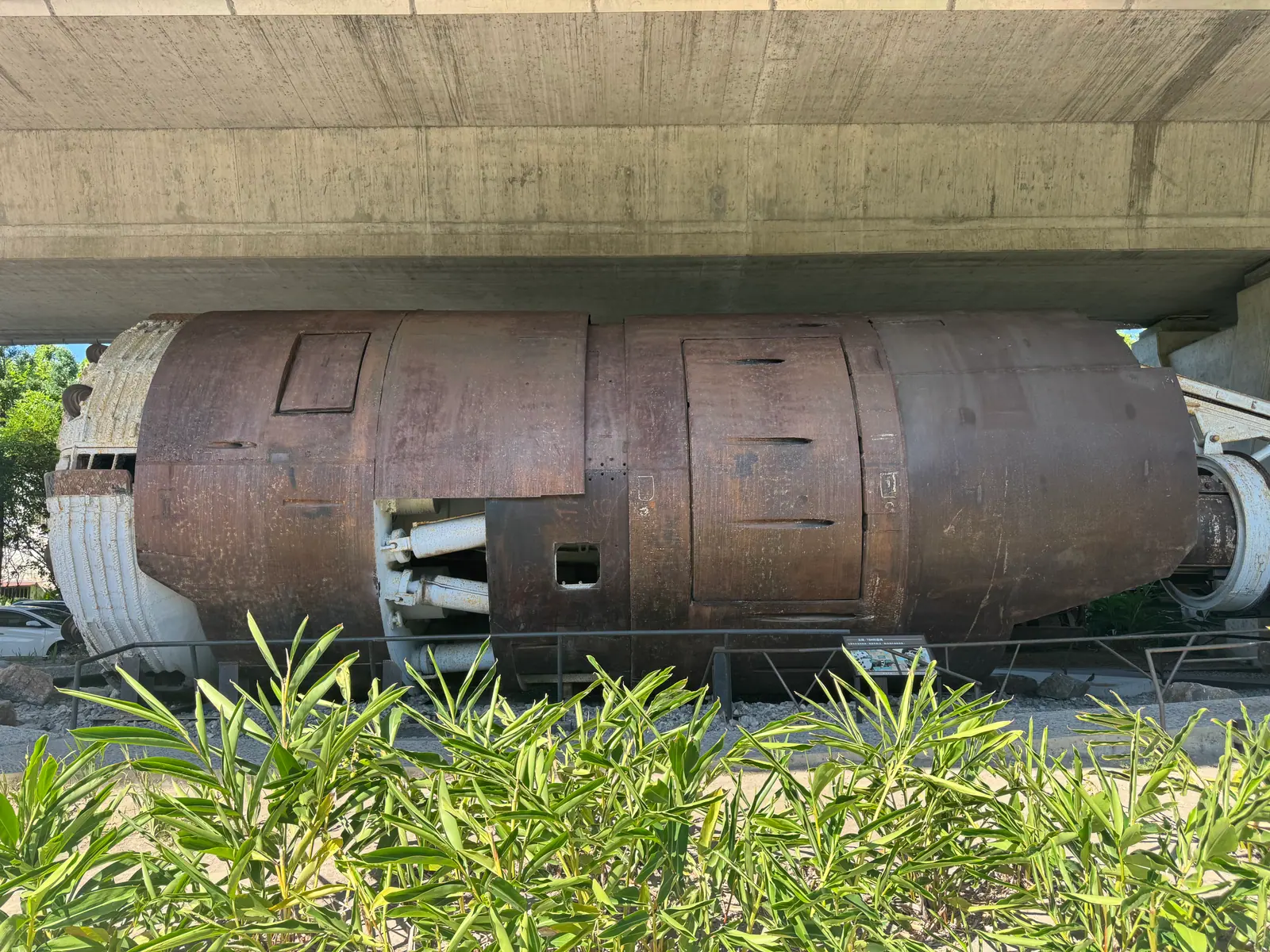
The retired Taipei-Yilan No. 1 tunnel boring machine main unit preserved at Wulao Gorge Scenic Area. During Xueshan Tunnel construction, boring machines became stuck a total of 26 times. Photo: Outlookxp, 2025, Wikimedia Commons, CC BY 4.0.
The mountain was pierced, east and west were connected, yet the toll method would have to change.
The Control Yuan Itself Says: This Is Not a BOT
Everyone assumed ETC was a BOT deal: the government outsourced national highway toll collection to a corporation, and Fareastone Telecom got a twenty-year concession. The Control Yuan's corrective measure dismantled that framework in a single sentence.
The official text states in black and white: "After Fareastone Telecom collects tolls on behalf of the Freeway Bureau and remits them to the national treasury, the Freeway Bureau then pays Fareastone Telecom a service fee for the commissioned work. The Freeway Bureau's statutory authority has never been transferred from start to finish, making this more akin to the procurement of services under the Government Procurement Act, and thus distinct from a BOT arrangement."20 The eTag toll lanes themselves remained under the Freeway Bureau's control. This is the official legal determination. Yet the industry—including Fareastone's own English press releases—continued using the term "BOT." An arrangement that operates much like a BOT but was officially determined to be "distinct" from one remains stuck in this ambiguous space.
Even the contract duration got rounded into a whole number. The actual term was 18 years and 4 months: signed August 22, 2007, expiring December 2025—not "twenty years."21 And there was a compressed detour in between: in the first selection process in 2004, Fareastone's status as the preferred applicant was revoked by the Supreme Administrative Court on August 3, 2006. After roughly a year, a new selection and new contract were finalized.22 Even earlier, the government had originally planned to handle electronic toll collection itself through Chunghwa Telecom before canceling that contract and opening it to bidding instead. The impression that "ETC rolled out smoothly as a BOT" erased both reversals.
In late 2013, all manual toll booths nationwide shut down simultaneously and switched to distance-based electronic toll collection. The transition produced numerous duplicate-charge incidents. Official figures put the number of affected vehicle owners at 121 (vehicle owners, not the "number of transactions" circulating in public discourse).23 What truly ignited public anger was a single response from Fareastone spokesperson Zhou Shi-hui: "Duplicate transactions are an inescapable fate and challenge that any eTag system must face."24 The Control Yuan's original wording was sharper than the phrasing news headlines typically used—"subject to the vendor." It employed language stating the response "gave the public the impression of favoritism toward the vendor, only compounding the vendor's excess profits… and seriously damaged the government's image."
📝 Curator's Note
We habitually frame ETC as a clean "government versus corporation" BOT story, but the Control Yuan itself says it is not a BOT. This ambiguous space is the real point: a "successful" technological upgrade whose legal classification remained murky and whose regulatory responsibilities remained unclear, leaving the question "Was this a government victory or a vendor victory?" without a clean answer even today. What deserves equal attention is that this technological transition eliminated over nine hundred jobs.
Eleven Years, One Settlement That Cannot Be Disclosed
On December 30, 2013, toll booths across Taiwan went dark overnight. Approximately 947 toll collectors—the official figure—lost their jobs. Another count put the number at 942, with 486 choosing to find work elsewhere and 456 reassigned by the ETC operator, figures that add up but coexist as competing narratives to this day25. The fact that even the victim count cannot be reconciled speaks volumes about this story itself.
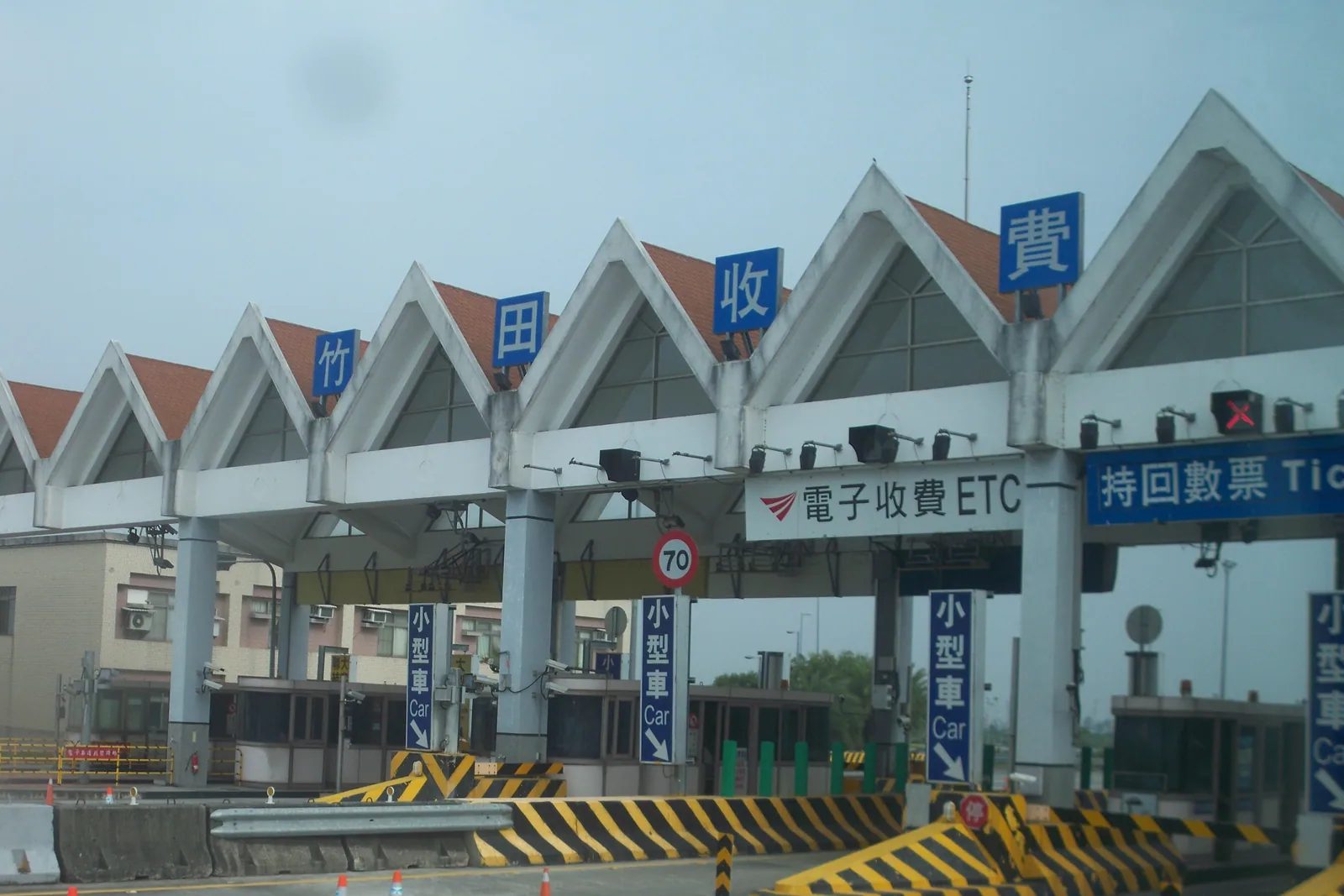
Zhutian toll booth, 2012. More than a year later, all manual toll collection booths across Taiwan shut down simultaneously. Photo: Chi-Hung Lin, 2012, Wikimedia Commons, CC BY-SA 3.0.
Holding this 11-year struggle together was Sun Xiu-luan, chair of the self-rescue association. She had worked as a toll collector since 1997 and was laid off in 2013 after 17 years of service (details about her age and family circumstances could not be verified across four searches and are omitted here). The protest began on a bewildered morning: "We thought our employer was the Ministry of Transportation, so we went there, but once we arrived we didn't know what to do. A police officer told us to go to the Presidential Office instead, so we went there."26
Source: Focal Point, Judicial Yuan, Ministry of Transportation Freeway Bureau
Protest tactics escalated to the body's limit. In October 2014, they performed six steps followed by a kowtow on a Zhongli highway shoulder. A month later, three hunger strikers climbed the ETC gantry in Taipei's Donghu district (the machine that replaced them became their final stage of protest), fasting for 200 hours before withdrawing due to hypothermia27. Sun Xiu-luan recalls the psychological tension at the negotiating table: "During the negotiations, they were watching us too—would we really abandon everything for these nine people?"26
In the early morning of August 16, 2016, after standing for more than 30 hours26, the self-rescue association and the government (represented by Executive Yuan official Lin Wan-yi) signed the "0816 Consultation Conclusion." Lin Wan-yi acknowledged on the spot that "both the government and the ETC operator admit there were lapses in the toll collector reassignment process."28
The agreement was signed, but the dispute continued: the self-rescue association alleged compensation was cut by 60–70 percent and some members were excluded, taking the case all the way to administrative court. On December 19, 2019, they lost at first instance. But the court's reasoning was not simply "the government reneged unilaterally"; the judgment argued from procedural defects that the agreement did not constitute a formal administrative contract29. Here lies a crucial distinction: politically, the "broken promise" (the self-rescue association's anger stands on solid ground) and legally, "whether it constitutes an administrative contract" (the court ruled it did not), are two separate matters—the latter should not be used to refute the former. That afternoon after losing, the self-rescue association went to Tsai Ing-wen's campaign headquarters to protest; the journalists covering the event were actually the ones removed first30. Sun Xiu-luan later wrote in a letter the heaviest words: "The judicial system told us that the government's written agreement with the people counts for nothing—it's worth less than a private contract, with no obligation to be fulfilled."31
The opposing position must also be presented. The Freeway Bureau's official stance is: toll collectors were "year-to-year" employees whose employment contracts explicitly stated termination upon implementation of distance-based electronic toll collection; under regulations, there was no mandatory reassignment obligation, though the government assisted with reassignment out of compassion32. National Highway Engineering Bureau Director Chen Yen-po also calculated the cost: if the government fully complied with the self-rescue association's demands, compensation alone would cost NT$2.6 billion33. In this conflict, one side brought bodily rage to the streets; the other side calculated administrative costs.
The ending is an unfindable period. On December 30, 2024, during appellate proceedings, both sides reached mediation (not a judgment) and signed a confidentiality agreement; the specific amount will never be disclosed. On February 15, 2025, the self-rescue association held a 20-table banquet in Kaohsiung; many joked it was the self-rescue association's happiest mobilization, and hoped it would be their last rally cry34. From hunger strikes, six steps and kowtows, climbing steel structures, to sitting at tables—11 years of protest ended in a settlement where the system need not even publicly account for how much it paid.
ETC replaced toll collectors, but the road network ETC serves—still growing—is replaying the same story elsewhere: taking away some people's land. Residents of Kaotuan Village in Kaohsiung have renamed National Highway No. 7, which will soon cut through their homes, as "National Highway Deception Number."
Third Expropriation: Wang Chun-fa's Kaotuan
Old farmer Wang Chun-fa had lived in Kaotuan for generations, making his living from farming. This was not the government's first time expropriating Kaotuan land to build roads: first came the opening of Routes 1 through 3, then Highway 88, and now National Highway No. 7—the same household facing expropriation three times over35. He went to Zhentuan Temple, the spiritual center of the village, and whispered prayers to the Jade Emperor.
✦ "I beseech the Jade Emperor to protect Kaotuan village, to protect us from National Highway No. 7 being built. Please don't let it succeed." "I was able to make a living from farming—growing pineapples and fruit—and survive. But National Highway No. 7 will expropriate my farmland, and I will have nothing left. How am I supposed to live out the rest of my life? What about my descendants?" — Wang Chun-fa, Public Television's Our Island, 2013
Kaotuan residents did not only seek divine help; they also took to the streets. "Stop Highway 7, we're furious!" they chanted as they came to protest outside the Environmental Protection Administration, because the environmental impact assessment meeting had already been held three times without residents knowing anything about it36. Geopolitics scholar Hsu Shih-jung put the absurdity most plainly: "To spend 66 billion to build a 23-kilometer road is like paving the highway with gold!"
Wang Chun-fa and the two households Wang Chao-sheng handled, separated by exactly fifty years, stood on the same hidden line. The difference was: Wang Chun-fa at least had a name, had his words recorded verbatim. The old man Wang Chao-sheng remembered, that blind couple—they didn't even have names. Whose sacrifice is remembered and whose is not—this line runs straight from authoritarianism through to today.
If we can verify things down to this level of detail, what about those stories we cannot verify, only circulating online? Like that airplane.
Emergency Airstrips: Not That Aircraft, Not That Location
A popular internet claim circulates a cool-sounding story: in 1978, an F-104 fighter jet conducted an emergency landing test on the national highway in Huatan, Changhua, proving that Taiwan's expressways were designed for war.
Every concrete detail in this version is wrong. The 1978 emergency landing test that Chiang Ching-kuo inspected took place at the Chungli Emergency Airstrip, the aircraft was a T-33 trainer piloted by an Air Force Academy instructor, followed later by F-5 fighters—it had nothing to do with the F-104 or Huatan37. Huatan (renamed Changhua Emergency Airstrip in 2019) has the earliest verifiable emergency airstrip exercise record from 2007's Wan Guang 23 drill; the specific aircraft types deployed in that exercise remain unconfirmed, but what is certain is: the Huatan emergency airstrip records have never included any F-104.
But emergency airstrips themselves are real, and more layered than the legend suggests. Taiwan has at least five emergency airstrips (Chungli, Huatan, Minxiong, plus Rende and Madou in the south), each roughly two to three kilometers long, capable of converting from highway to combat-ready airfield in 24 to 48 hours—a concept originating from the Ten Major Construction Projects planning of the 1970s. This was "civil-military integration" written into the design from the start38. From the MacArthur Highway's deliberate routing along the north bank of the Keelung River as a backup corridor, to today's emergency airstrips, this road has carried the logic of "if war breaks out" from day one.
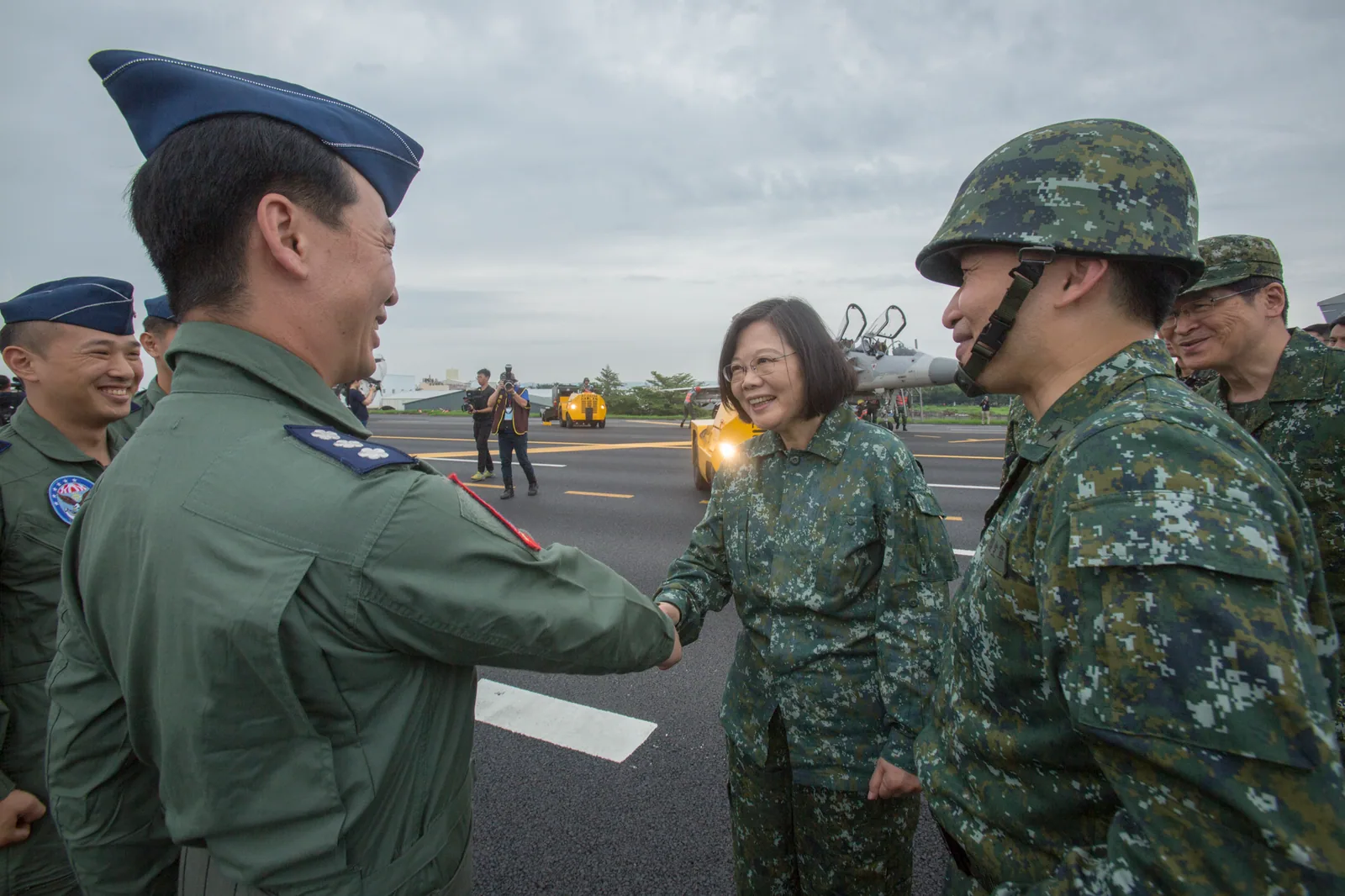
Wan Guang 35 exercise in 2019: fighter jets conducting takeoffs and landings at Changhua emergency airstrip, with the president personally overseeing operations. Photo: Office of the President (photographer Mori), 2019, Wikimedia Commons, CC BY 2.0.
The cost of civil-military integration fell on Minxiong. National Highway No. 1 passed through Minxiong, Chiayi in 1978, but because that section of roadway itself served as a military emergency airstrip and involved national defense, interchanges could not be constructed, leaving local residents waiting for over three decades. The final solution was to relocate the emergency airstrip segment two kilometers south, freeing up land for the interchange, which finally opened on December 23, 201139. A road forced to obey both "national defense secrecy" and "local development" logics pays the price in thirty years of waiting. By the 2019 Wan Guang 35 exercise, F-16V, Mirage 2000-5, and IDF fighters—the three main combat types—successfully conducted takeoffs and landings at the Changhua emergency airstrip, with the president personally present to oversee operations40.
Beyond verification, this road also lives in the bodily memory of every Taiwanese person.
Between the Kilometer Markers: Fifty Years of Everyday Life
Heading south for Lunar New Year, "the whole road is a parking lot"—the radio tuned to traffic reports, eyes fixed on the kilometer markers slipping past along the shoulder. This is probably the strongest shared bodily memory of all Taiwanese people. On the fourth day of Lunar New Year 2025, the western expressway system logged approximately 76 million vehicle-kilometers in a single day, about 1.6 times the weekday average41.
There's an interesting cognitive gap hidden here. Most people stuck in traffic want to know "how many kilometers backed up." But the Freeway Bureau measures traffic volume in "vehicle-kilometers"—adding up every kilometer driven by every vehicle, measuring total traffic flow rather than queue length. The public asks how long the line is; the authorities calculate total traffic volume.
Service areas are Taiwan's unique invention of turning rest stops into attractions. They are the midpoint of school trips, showcases for souvenirs, and rare opportunities for long-distance drivers to sit down for a proper meal. The most complete story arc in recent years belongs to Qingshui Service Area: after eight months of renovation in 2024, its revenue dropped to 587 million yuan, falling to second place. After a team from 7-Eleven took over in 2025, it grew nearly 70 percent within a year, surging to 1.015 billion yuan to reclaim the top spot. That same year, the combined revenue of all 15 national expressway service areas exceeded 6 billion yuan for the first time42.
Source: Ministry of Transportation Freeway Bureau, Central News Agency, 2025
So who sits at the exact center of this road? Tai'an Service Area's official website states it confidently: it is "located at the center point of National Highway No. 1," at the 158.6-kilometer mark43—precisely the psychological midpoint where long-distance drivers heading north or south most need to stop and rest. This road has been completed for fifty years, and the service areas are still learning how to be loved. These fifty years of service areas raking in profits are exactly the years Wang Chaosheng remembers that blind couple, the years Sun Xiu-luan spent fighting an eleven-year legal battle. The money this road has earned and the price it has made people pay have never been calculated together.
But this account is not yet settled.
National Freeway No. 7: The Bill Isn't Settled Yet
National Freeway No. 7 had an official construction budget of NT$60 billion according to a 2013 Public Television report35. By May 2026, the latest reporting showed total costs had reached NT$150.17 billion—2.5 times the 2013 figure. And in May 2026 itself, this massive billion-dollar project saw two civil construction contracts fail to attract any bidders and were withdrawn44.
Construction is never a linear process, and bidding can stall. This thousand-billion-dollar road remains a work in progress to this day. And Wang Chun-fa? After that 2013 report, he vanished from public view. Even when Public Television revisited the same Kaotuan village in late 2024—this time discussing the rapidly disappearing water caltrop fields and a century-old ancestral home—the entire report never mentioned him once45. No one knows whether his farmland was ultimately preserved. Kaotuan did not stop bearing the pressure of development after that 2013 report; only the protagonist of the story changed.
Fifty years ago, a land administration official remembered using a government vehicle to help an unnamed elderly man move. Fifty years later, an elderly farmer with a name and a voice—no one remembers what became of him. The legends that circulated along this road have been debunked one by one (the road's name, who cut the ribbon, the death toll, that airplane). Yet the fact that "someone has been paying the price for speed" has never been overturned, no matter how many times it is investigated. What has changed is only how it is seen—or forgotten.
Next time you're stuck in freeway traffic, glance at the kilometer marker on the roadside. The numbers on that sign are the accumulated bill for every "faster" decision Taiwan has made over fifty years—and all those people who were never counted in the ledger.
Further Reading
- Xueshan Tunnel — The engineering history this article only touches on lightly; the complete story of the Miocene sandstone, five major construction methods, and thirteen years of TBM struggle are all there.
- Ten Major Construction Projects — The Zhongshan Expressway was only the first of the Ten Major Projects; this piece covers the full scope and controversies of this entire authoritarian-era infrastructure program.
- Martial Law Period — Why the cost of land acquisition in the authoritarian era "left no record even of protest"—the answer lies in this history of press control.
Image Sources
This article uses 4 public-domain / CC-licensed images, all cached in public/article-images/lifestyle/ to avoid hotlinking source servers; all videos are standard YouTube embeds from official channels (Ministry of Transportation Freeway Bureau, Public Television News):
- MacArthur Highway Opening Ceremony (hero) — Photo: Taiwan New Life Post, 1964, National Cultural Memory Bank, CC BY 4.0
- Taipei-Yilan Expressway Tunnel No. 1 Tunnel Boring Machine (TBM) Main Unit — Photo: Outlookxp, 2025, Wikimedia Commons, CC BY 4.0
- Formosa Freeway Zhuotian Toll Station — Photo: Chi-Hung Lin, 2012, Wikimedia Commons, CC BY-SA 3.0
- Wan An Exercise 35 Changhua Emergency Airstrip Fighter Takeoff and Landing — Photo: Office of the President (photographer Mori), 2019, Wikimedia Commons, CC BY 2.0
References
- CTWANT (2021): Tears in the Snow Tunnel 3 / Life Hanging by a Thread in the Tunnel - A Chinese-American Engineer's Action Saved Over 300 People — Direct interview by reporter Li Chengzhi with Deputy Director of Electromechanical Systems Leng Yaodong, reconstructing firsthand details of shutting off high-voltage power at the water inflow site on December 15, 1997, the most substantive eyewitness account source for the "nearly cost 300 lives" narrative.↩
- Ministry of Transportation Freeway Bureau: National Highway No. 1 Zhongshan Expressway Current Information Page — Official reference page used to verify basic figures cited in this article, such as the Zhongshan Expressway's starting and ending mileage and number of interchanges.↩
- Wikipedia: MacArthur Highway — Entry documenting verbatim the basic facts that MacArthur Highway opened on May 2, 1964, with a main line of 22.65 kilometers plus a branch line of 0.75 kilometers, and was inaugurated by Provincial Governor Huang Jie and others.↩
- StoryStudio: Taiwan's Construction of Its First Expressway—Visionary Policy or Fortunate Accident? — Verbatim documentation of MacArthur Highway construction cost of NT$227.9 million, with US aid of NT$126.95 million in its funding structure, cross-verified with English historical sources.↩
- National Development Council Archives Administration: MacArthur Highway Archives — Historical materials on MacArthur Highway organized by the national archives institution, including opening ceremony and renaming context, corroborating the narrative that it was originally named North-Base New Road and renamed following MacArthur's death; the exact date of death April 5, 1964 is further documented in Wikipedia: Douglas MacArthur.↩
- Taipei Times, "Taiwan in Time" (2024/4/28) — Reporter Han Cheung's compilation of national archives, verbatim noting that MacArthur Highway deliberately opened a new route on the north bank of the Keelung River rather than widening the existing south bank route, a wartime redundancy design meaning "if one road is destroyed in war, the other can still be used."↩
- Wikipedia: Zhongshan Expressway — Entry documenting the current total length of 374.3 kilometers (earlier 373.2 kilometers, not including the 700-meter elevated section at the Keelung end), and explaining the endpoint mileage adjustment after the Kaohsiung Port access elevated section was incorporated in 2015, a source for clarifying the "373 vs 374.3" discrepancy; the full verbatim text of the Xiluo Service Area Zhongsha Bridge monument reading "373 kilometers" is further documented in the aforementioned oral history "The Way of the Great Road," Xu Junyi chapter, note 6, PDF page 22.↩2
- Ministry of Transportation Freeway Bureau: "The Way of the Great Road—Oral Records of Zhongshan Expressway Construction Personnel" Appendix "National Highway No. 1 Major Events Chronicle" — Official chronicle verbatim documenting "Year 55, October: Provincial Highway Bureau proposed 'Preliminary Discussion on Western Trunk Line New Route Direct Highway Plan,' marking the origin of Zhongshan Expressway" and "Year 57, January 12: Taiwan Provincial Government Chairman Huang Jie, Minister of Economic Affairs Li Guoding, and Minister of Transportation Sun Yun-suan held a joint meeting deciding to first build the Taipei-Zhongli direct expressway," a primary source for the starting point of the twelve-year decision chain.↩
- United Daily News "News Time": Zhongshan Expressway Full-Line Opening—Historical Today — Official media history column documenting that the 1971 groundbreaking ceremony was presided over by Vice President Yan Jiagang, attended by Saudi Arabia's Deputy Minister of Transportation, and other key dates; cross-referencing the official "Way of the Great Road" chronicle confirms that Chiang Ching-kuo had already stepped down as Premier six months before the opening ceremony (1978/5/20) to become President, corroborating that "he did not preside over this ceremony." The circulating claim that "Transportation Minister Lin Jinsheng presided over the ribbon-cutting" could not be verified verbatim in any traceable source during this fact-check, so the article does not identify the actual presiding official by name.↩
- Ministry of Transportation Freeway Bureau: "The Way of the Great Road—Oral Records of Zhongshan Expressway Construction Personnel" Appendix "National Highway No. 1 Major Events Chronicle" — Official oral history chronicle with day-by-day major events clearly documenting 1971/8/14 groundbreaking by Yan Jiagang, 1978/10/31 full-line opening, and 1979/4/19 official naming as "Zhongshan Expressway," a primary source establishing that completion and naming occurred on two separate dates.↩
- Aforementioned oral history "The Way of the Great Road," Wang Chaosheng (Land Rights Group Administrator) chapter, PDF pages 100-101 — Wang Chaosheng's oral account of the Land Rights Group's establishment background, documenting that "Chiang Ching-kuo's requirement for timely construction start, completion, and opening" was the direct cause for establishing this dedicated land acquisition unit.↩
- Aforementioned oral history "The Way of the Great Road," Wang Chaosheng chapter, PDF pages 102-104 — Wang Chaosheng's verbatim recollection of an elderly, solitary man in his seventies with mobility difficulties whose land was needed for the Zhongli interchange, and how administrative discretion and preferential compensation plus official vehicles enabled his relocation; this individual's name was never recorded in any documentation.↩
- Aforementioned oral history "The Way of the Great Road," Wang Chaosheng chapter, PDF page 104 — Wang Chaosheng's verbatim recollection of a blind couple without land rights at the Yangmei interchange who received only above-ground structure compensation and were relocated only after the village chief built them a shelter by the river; this couple's name was similarly never recorded in any documentation.↩
- Human Welfare Journal: The Zhongshan Expressway That Shortened North-South Distance (Part 2) — Verbatim documentation that during Zhongshan Expressway construction "considerable protests arose from local figures" and "some criticized this expressway as favoring the wealthy," cross-verified with the Chen Maoxiong chapter of "The Way of the Great Road" to confirm that social skepticism about Zhongshan Expressway indeed existed during the authoritarian period.↩
- Aforementioned oral history "The Way of the Great Road," Xu Junyi chapter, PDF pages 21-22 — Engineer Xu Junyi's verbatim oral account of foreign consultants earning 100 times the salary of local engineers, "letting go of the steering wheel and letting the car drive itself" as a folk method for road surface inspection, and "building 373.13 kilometers in seven years," firsthand engineering memories.↩
- Ministry of Labor (Labor Commission) Press Release (2006/6/7): Labor Commission Clarifies Workplace Fatalities in Xueshan Tunnel Project — Official press release clearly delineates: 25 workplace fatalities across the entire Taipei-Yilan Expressway project, of which 13 in Xueshan Tunnel proper, 8 in Nangang-Pinglin section, 4 in Toucheng-Suao section—the most authoritative primary source for "13 not 25."↩
- Wikipedia: Memorial Monument for Taipei-Yilan Expressway Project Casualties — Entry records 25 deceased workers divided by nationality as 12 Republic of China nationals and 13 Thai nationals, illustrating how both "segmentation by project section" and "segmentation by nationality" each yield a 13, but referring to different groups of people.↩
- Lanyang Museum E-Newsletter: Xueshan Tunnel Chronicles — Government cultural institution publication verbatim records "TBM was trapped and buried 26 times" and "pilot tunnel and main tunnel collapses totaled 64 times during construction," independently cross-verifying the "26 times" figure with Wikipedia data—primary source for this number.↩
- Classic Magazine (Special Report): Xueshan's Curse vs. Taiwan's Spirit — Verbatim record: "thirteen tunnel workers who died before realizing their ambitions (25 across the entire Taipei-Yilan Expressway)," and TBM "ended its life in the Xueshan mountain range," corroborating casualty figures and the phrasing that "on-site abandonment was a policy decision rather than technical limit."↩
- Control Yuan Corrective Measure (Original PDF from E-Gazette System) — Control Yuan official document verbatim determines the Yuantong ETC case "more closely resembles labor procurement under Government Procurement Act rather than BOT nature," using language such as "providing cover," "generating excessive contractor profits," and "severely damaging government image"—the most critical primary legal source for the entire article.↩
- PRNewswire: FETC extends partnership with Freeway Bureau — Yuantong ETC official English press release verbatim confirms original contract "scheduled to conclude in December 2025"—primary source for both the "18 years 4 months" figure and the "August 22, 2007 contract signing" date, cross-verified with the following Control Yuan document.↩
- Same as previous note: Control Yuan Corrective Measure, ETC Procurement Timeline Section — Document records item-by-item: 2006 Supreme Administrative Court revocation of top applicant's qualification, need for re-evaluation in second phase, August 22, 2007 contract re-signing with 18-year-4-month term—complete chronology of the complex process.↩
- Same as previous note: Control Yuan Corrective Measure, Duplicate Deduction Audit Section — Document records official figure of "121 vehicle owners" affected by duplicate deductions in January 2014, correcting the "few transactions" scale circulating in public discourse.↩
- ETtoday News Cloud (2014/1/11): eTag Glitches Out; Spokesperson: This is Destiny — Verbatim record of Yuantong ETC spokesperson Zhou Shihui's statement: "Duplicate transactions are a destiny that every eTag must face, and our challenge"—primary source for the key quote that ignited public discontent during the transition period.↩
- Wikipedia: National Freeway Toll Collectors Layoff Resistance Movement — Records additive figures: 486 of 942 toll collectors self-transitioned, 456 transferred by Yuantong; official figure of 947 persons separately documented at Freeway Bureau: Toll Personnel Placement Explanation ("Freeway Bureau toll personnel totaling 947 all streamlined")—both figures coexist.↩
- Focal Point: Battle of 1219 — Interview with self-help association chair Sun Xiuliang, verbatim recording her bewilderment from 17 years of employment (1997–2014) to first taking to the streets in 2014, and key quotes such as "would I really give up everything for these nine people."↩23
- October 25, 2014 Zhongli National Freeway shoulder six-step-one-kneel protest, see Taipei Times (2014/10/26): Toll Collectors Zhongli Freeway Protest Report. November 28 Donghu ETC toll gate 200-hour hunger strike, see Focal Point Protest Timeline.↩
- Focal Point: "Gentlemen's Agreement Defaults" — Verbatim record of August 16, 2016 "0816 Consultation Conclusion" signing, with Policy Committee member Lin Wanyi's statement: "Government and Yuantong both acknowledge shortcomings in toll collector placement," and self-help association advisor's allegations of subsequent default.↩
- Judicial Yuan: Taipei High Administrative Court Case No. 106-Su-1125 Judgment Press Release — Court press release verbatim explains December 19, 2019 judgment against self-help association, reasoning from procedural defects that "0816 Consultation Conclusion" does not constitute formal administrative contract, citing Sun Xiuliang's own statements as evidence.↩
- 苦勞網 (Zhang Zhiqi, 2019/12/19): Toll Collectors Lose Case, Storm into Tsai Ing-wen Campaign Headquarters to Protest — On-site report verbatim records that during police clearance, "the first targets cleared were the two media outlets inside the headquarters" (Focal Point reporter Wang Zihao,苦勞網 special correspondent Tang Zuoxin), who identified themselves as journalists but were forcibly removed—primary source for "journalists were cleared first."↩
- Bitter Labor Network: Full Text of Sun Xiu-luan's Submitted Letter — A signed submission by self-rescue association chairman Sun Xiu-luan, written word-for-word stating "the judicial system has shown us that the written agreements signed between the government and the people do not count," serving as a firsthand source of the plaintiff's voice after losing the case.↩
- Ministry of Transportation Freeway Bureau: Explanation of Toll Collector Redeployment — Official page confirming word-for-word that toll collectors are "employees hired on a one-year basis," with employment contracts already stipulating termination upon implementation of electronic toll collection; the statement "the government has no obligation to resettle, but assists with redeployment out of compassion" is a compiled summary of the official consistent position, not a direct verbatim quote (this sentence could not be precisely located on the page during re-verification), serving as a firsthand source from the opposing perspective.↩
- Taipei Times (2015/3/17): Report on Toll Collectors' Surprise Visit to Mao Chih-kuo's Residence — Direct quote from interviewed National Freeway Engineering Bureau Director Chen Yen-po: "the government would have to spend NT$2.6 billion compensating these former toll fee collectors alone, if it did what they wish," serving as the primary source for the cost estimate of "2.6 billion yuan."↩
- Focal Event: Report on Toll Collectors' Protest Banquet — Word-for-word documentation of mediation settlement on December 30, 2024, Kaohsiung banquet with 20 tables on February 15, 2025, and "the self-rescue association's happiest mobilization" and other details of the protest's conclusion; the section on both parties signing confidentiality agreements with undisclosed amounts is also referenced in United Daily News related report.↩
- Public Television 'Our Island' Episode 692: National Highway 'Deception' Number — Investigative report from January 28, 2013, documenting word-for-word elderly farmer Wang Chun-fa's prayer to the Zhentan Temple deity and his lament about having "nothing left," as well as the narrative framework of Kuotan residents facing three rounds of land expropriation for Routes 1-3, Route 88, and National Highway 7; the report also documents the National Highway 7 project budget of 6 billion yuan, serving as a primary source for this figure.↩2
- Same as preceding note: Public Television 'Our Island' Episode 692 — Same report documenting word-for-word Kuotan residents' protest "strongly opposed to National Highway 7" at the Environmental Protection Administration, and geopolitics scholar Xu Shi-rong's criticism: "using 66 billion to build a 23-kilometer highway is equivalent to paving gold on the road."↩
- Wikipedia: Emergency Airstrip — Entry documenting word-for-word that the location of Chiang Ching-kuo's inspection test landing in 1978 was the Zhongli emergency airstrip, with aircraft types T-33 trainer and F-5 fighter, used to disprove the internet-circulated version of "F-104 test landing in Huatan in 1978."↩
- The National Interest: Taiwanese F-16s can land on highways — Defense policy media report stating Taiwan has approximately five emergency airstrips with specifications of about 3,000 meters, convertible to airports in 24 to 48 hours, and noting their origin in infrastructure planning from the 1970s Ten Major Construction Projects era.↩
- Wikipedia: Minxiong Interchange — Entry documenting that Minxiong Interchange was built on the Minxiong emergency airstrip, with the airstrip relocated 2 kilometers south to acquire land, using rapidly removable road signs and street lights, and opening to traffic on December 23, 2011.↩
- Public Television News (2019/5/28): Hanwu 35 Exercise Changhua Emergency Airstrip Live Exercise — On-the-day report documenting word-for-word successful takeoff and landing of F-16V, IDF Jing Guo, and Mirage 2000, and recording "Commander-in-Chief, President Tsai Ing-wen also inspected the site," serving as a firsthand source for the exercise's successful execution and presidential on-site supervision (the original citation from Central News Agency's April 28 report was only a preview one month before the exercise; it has been replaced with the result report from the exercise day).↩
- Central News Agency (2025/1/24): Chinese New Year Holiday Peak Traffic Management Concentrated from 1/29 for 5 Consecutive Days — Report documenting word-for-word that during the 2025 Chinese New Year "February 1st (Fourth Day of Lunar New Year) saw the largest volume, with an estimated 76 million vehicle-kilometers on western national highways," "approximately 1.6 times the daily average," corroborating the Freeway Bureau's measurement of traffic peaks by "vehicle-kilometers" rather than "kilometers of congestion."↩
- Taro News (Central News Agency dispatch, 2026/3/6): National Highway Service Areas' Annual Revenue Exceeds 6 Billion for First Time, Qingshui Leads — Documentation word-for-word that the 15 national highway service areas' total revenue in 2025 reached 61.5 billion yuan, exceeding 6 billion for the first time, with Qingshui Service Area topping at 1.015 billion yuan. Qingshui ranked second in 2024 due to 8 months of renovation (revenue 587 million yuan) with a new management team from 7-Eleven, also referenced in Liberty Times: Guanxi Service Area 598 Million Yuan Tops National Highway Revenue / Qingshui Service Area Drops to Second at 587 Million Yuan Due to Last Year's 8-Month Renovation Period.↩
- Ministry of Transportation Freeway Bureau Central District Maintenance Engineering Branch: Tai'an Service Area Introduction — Official page clearly stating word-for-word that Tai'an Service Area is "located at the center point of National Highway 1" at the 158.6-kilometer mark, corroborating that "the center point of National Highway 1" is an official designation rather than marketing language.↩
- Liberty Times (2026/5/10): National Highway 7 to Begin Construction by Year-End, Key 2 Civil Construction Contracts Surprisingly Fail to Attract Bids — Reporter Hong Ding-hong's report documenting National Highway 7's total length of approximately 23 kilometers, total budget of 150.17 billion yuan, and the 5th and 6th sections failing to attract bids due to no submissions, serving as the most recent firsthand source for National Highway 7 progress and budget escalation in this article.↩
- Public Television 'Our Island' Episode 1288: Rapidly Disappearing Kuotan Water Caltrop Fields — Report revisiting the same Kuotan village on December 28, 2024, with the focus shifted to water caltrop field and century-old ancestral hall preservation, with no further mention of Wang Chun-fa throughout, corroborating that "he disappeared from public view after 2013" as the conclusion.↩
🧬 What Semiont was thinking while writing this