
Taiwan Railway History
30-Second Overview: In 1891, Taiwan built China’s first passenger railway—only for the Japanese to take over and find it so dilapidated it had to be scrapped and rebuilt. From Liu Ming-chuan’s "lung disease railway" to the 300 km/h High-Speed Rail in 2007, Taiwan used 136 years to stitch an island without plains into a one-day living circle. In 2024, the High-Speed Rail carried 78.25 million passengers in a single year, while TRA finally corporatized after an accident that claimed 49 lives. The tracks are carved into every turn of this island.
James W. Davidson’s Railway Adventure
In 1895, American journalist James W. Davidson stepped onto Taiwan and took a train from Keelung to Taipei. The scene he witnessed made its way into his later work, The Island of Formosa: passengers bought second-class tickets but squeezed into first-class carriages; others carried small chickens, pigs, and piles of vegetables and pork onto the train. After a few miles, the train began to sway: the faster it went, the more the people and livestock inside swayed left and right.
This was the true face of the Liu Ming-chuan railway.
In 1887, Liu Ming-chuan, the first Governor-General of Taiwan, established the "General Bureau of Taiwan Railway Commerce" in Dadaocheng. He hired German engineer Becker to survey the roadbed and began building Taiwan’s railway—China’s first passenger railway. In 1891, the Keelung to Taipei section opened for service; in 1893, it extended to Hsinchu, with a total length of about 107 kilometers. The route crossed the Shiqiu Ridge from Keelung, passed through Badu, Nangang, Xikou (Songshan), crossed the Daqiaotou bridgehead into Haishankou (Xinzhu), then crossed the Kuilun Ridge to Taoyuan and Zhongli, finally reaching Hsinchu.
It sounds like a great starting point for modernization. The problem is, this road was built terribly.
The "Lung Disease Railway"
After Japan took over Taiwan following the First Sino-Japanese War, Governor-General Kabayama Sukenori personally took a train from Keelung to Taipei in June 1895. Conditions along the way were constantly problematic: the train swayed, the speed was extremely slow, and the roadbed was soft. Accompanying soldiers gave it a nickname: the "lung disease railway," meaning the railway was like a tuberculosis patient, panting after every two steps.
The professional engineering team sent by Japan arrived in Keelung three months later. The results of the on-site survey were even more tragic. Railway technician Koyama Yasumasa found that many sleepers on the Taipei to Hsinchu section had been pulled out, and even the rails were short. The stations were built of earth-brick huts, all of which had to be demolished and rebuilt. The most fatal issue was the route design itself: the section from Taipei via Xinzhu crossing the Kuilun Ridge to Taoyuan was too steep; the train simply couldn’t climb it.
The Japanese made a decision: scrap it and rebuild.
North of Taipei, they abandoned the Shiqiu Ridge tunnel section, opting instead for the flatter Sankeng direction, connecting to a new tunnel at Badu. The changes south of Taipei were even greater: they abandoned the original route via Xinzhu and the Kuilun Ridge, switching to the route via Banqiao and Yingge to Taoyuan. This change directly rewrote the fate of the towns along the line: Xinzhu fell into silence for decades due to the loss of the railway, while Banqiao began to rise due to the new route.
Here lies a historical issue that is still debated today: Who is the "Father of Taiwan Railways"?
How Foreign Names Faded
Liu Ming-chuan’s road was not just about Liu Ming-chuan. In 1887, the General Bureau of Taiwan Railway Commerce in Dadaocheng first recruited a mixed German-British foreign team: German Becker was responsible for engineering design and roadbed surveying; British W. Watson served as the chief route surveyor; H.C. Matheson was listed as a business consultant, backed by the transnational procurement network of Jardine Matheson in Shanghai. The same firm had just built China’s first railway (the Wusong Railway) in Shanghai in 18761.
The eight steam locomotives were also a mix of German and British origins. No. 1 "Tengyun" and No. 2 "Yufeng" were ordered from Germany; the remaining six came from the UK, numbered 1 to 8, each with a Qing dynasty Mandarin name (Jiedian, Chaochen, Shejing, etc.)2. On the day the first section opened in 1891, the people in the cab included German technicians, British technicians, and Qing army soldier apprentices. Engineering design was in foreign hands, but construction was handed to Qing soldiers and local laborers who couldn’t read blueprints. This fracture was later personally verified by Davidson when he rode that swaying train.
The problem is, this foreign team left no names. After the Japanese took over and scrapped the line to rebuild, Becker’s roadbed was realigned, Watson’s survey was overturned, and Matheson’s contract was voided. To this day, it is difficult to find Becker’s full name in Chinese sources: all sources only list the surname, and even the Taiwan Railway Museum’s exhibition panels only mention it briefly1.
The Japanese who took over left names, but they also experienced a genealogical reset.
Hasegawa Kin-suke (長谷川謹介, 1855–1921) was the chief engineer of the Trunk Line. Born in Yamaguchi Prefecture, he learned English as a youth while staying with his older brother, who worked at the Osaka Mint. He later served as an interpreter for foreign technicians at the Japanese Railway Bureau, learning surveying while translating3. In 1899, Gotō Shinpei brought him from mainland Japan to Taiwan to serve as Chief Engineer of the Temporary Taiwan Railway Construction Department. He stayed for nine years: the 404-kilometer Trunk Line from Keelung to Fengshan, the full line opening on April 20, 1908, and the opening ceremony at Taichung Park on October 24. The entire engineering project was laid from scratch by him45.
Hasegawa’s presence was not just on the tracks. He designed the Keelung Station (1912) and Hsinchu Station (1913) buildings; he also collaborated with Kondo Jūrō on the West Gate Red Tower3. In 1921, he died of illness in Japan. A bronze statue was once erected in front of Taipei Station for him, but it was demolished after the war. The removal of that statue was the standard move for this foreign name genealogy: the records left by the previous generation were always renumbered by the next.
Under Hasegawa was an even crazier branch line. Kawai Shitarō (河合鈰太郎, 1865–1931) was from Nagoya, graduated from the Forestry Department of Tokyo Imperial University, and studied forestry and forest management in Germany and Austria in 1897. He was the initiator of the Alishan Forest Railway6. This road had to climb from the plains of Chiayi to an altitude of 2,274 meters, a drop of over 2,000 meters. Hasegawa used all four methods of mountain railways in the world (switchbacks, zigzag reversals, spiral lines, and alternating bridges and tunnels)6. Hasegawa’s right-hand engineer, Shindo Kumenosuke, was responsible for surveying the section from Zhuziqi to Zhangnaoliao. This was the most difficult section of the mountain railway: during the trial run after the full line opened, he derailed and died in the Alishan section. Among the foreign team (including these colonial-era technicians), he was the first to sacrifice his life on the Taiwanese tracks.
Shinmoto Shikanosuke (新元鹿之助, 1870–1949) was from Kagoshima, graduated from the Civil Engineering Department of Tokyo Imperial University in 1894, and first served as a technician in the Railway Bureau of the Ministry of Posts and Telecommunications. He later took over Hasegawa’s Taiwan railway system7. Chinese sources have far fewer records of his specific work in Taiwan than for Hasegawa. This is a common phenomenon in the colonial genealogy: the stories of the first-generation chief engineers are written repeatedly, while the names of successors slowly fade into footnotes.
📝 Curatorial Perspective: From Becker to Hasegawa to Shinmoto, every foreign name was responsible for building a section of the road, only to be partially overwritten when the next generation took over. The Liu Ming-chuan railway was scrapped and rebuilt by the Japanese; Hasegawa’s Trunk Line was renamed and renumbered by the post-war TRA; Kawai’s forestry railway became a tourist route after logging ended. TRA’s tracks are truly alive and running, but the cost of being alive is that the records of the previous generation retreat to footnotes—a single line that has lost its foreign names.
Liu Ming-chuan or Hasegawa Kin-suke?
In July 2020, the National Taiwan Museum Railway Department Park opened. The exhibition commentary referred to Hasegawa Kin-suke, the Director-General of the Taiwan Governor-General’s Railway Bureau during the colonial era, as the "Father of Taiwan Railways." Within a week, it caused an uproar. Former Legislator Tsai Cheng-yuan questioned: The person who first promoted railways in Taiwan was clearly Liu Ming-chuan; how can this title be given to a Japanese?
The gray area of fact is here: Liu Ming-chuan indeed built Taiwan’s first railway, but that road was so bad that the Japanese dismantled it entirely. Hasegawa Kin-suke stayed in Taiwan for nine years starting in 1899, presiding over the construction of the Trunk Line, which was 404 kilometers long from Keelung to Kaohsiung. The full line opened in 1908: this is the true foundation of today’s Taiwan railway network.
One is a dreamer; the other is an executor. Who is the "Father" depends on whether you think "starting" is more important or "finishing" is more important. (From the context of the commentary by Jiang Bing-lun in United Daily News Mingren Hall)
📝 Curatorial Perspective: The dispute over the "Father of Railways" is, on the surface, historical research; underneath, it is the identity politics that Taiwanese society is always dealing with—whose legacy is "more ours": the Qing dynasty or the Japanese colonial era? This question appears not only in railways but also in Japanese Colonial Architecture, water conservancy facilities, and even medical systems.
April 20, 1908: The Day at Taichung Park
On April 20, 1908, the Trunk Line was fully opened. On October 24 of the same year, the Taiwan Governor-General’s Office held the "Trunk Railway Full Opening Ceremony" in Taichung Park, building a dual-pavilion in a Japanese-Western hybrid style as a rest house for royal guests. This pavilion still stands in the heart of the lake in Taichung Park today, serving as a landmark of the city.
The Trunk Line changed Taiwan’s spatial logic. Before the railway, Taiwan was a string of independent settlements clustered along river ports. After the railway, towns next to train stations in Taichung, Chiayi, and Tainan quickly grew commercial districts, becoming regional centers. The train station determined which places prospered and which were forgotten; this pattern lasted for a century.
The Trunk Line was divided into the Mountain Line and the Coast Line. The Mountain Line crossed Miaoli from Zhunan, went through the Taichung mountainous area to Changhua, with high technical difficulty. Shengxing Station on the Old Mountain Line is at an altitude of 402 meters, the highest point of the Western Trunk Line. The Coast Line ran along the west coast through Tongxiao, Dajia, and Qingshui; it was relatively flat but had many dunes, requiring special sandproof engineering. The two lines merged at Zhunan and Changhua, like two strands of a necklace.
A Railway at 2,274 Meters Altitude
In 1912, another crazier railway was completed.
The Alishan Forest Railway started from Chiayi City and climbed all the way to Alishan at an altitude of 2,274 meters. The total length was 71 kilometers, with a drop of over 2,000 meters. To overcome this terrain, engineers used all four of the world’s mountain railway methods: switchbacks, zigzag reversals (Z-shaped switchbacks), spiral lines, and alternating bridges and tunnels. The entire line had over 50 tunnels and 77 wooden bridges.
It was originally built to transport Alishan’s millennium-old cypress trees down the mountain to sell. After logging ended, this railway unexpectedly became Taiwan’s most beautiful tourist route: taking a small train from the plains to the high mountains, the view outside the window changed from betel nut orchards to bamboo forests, then to misty coniferous forests, equivalent to crossing Taiwan’s vertical ecosystem in two hours.
The Ministry of Culture has listed the Alishan Forest Railway as one of Taiwan’s 18 World Heritage Potential Sites. In 2018, the Executive Yuan established the "Alishan Forest Railway and Cultural Assets Management Bureau" to be responsible for preserving this century-old industrial heritage. (Source: Ministry of Culture)
The "Black-Headed Ones" and the Naming Genealogy
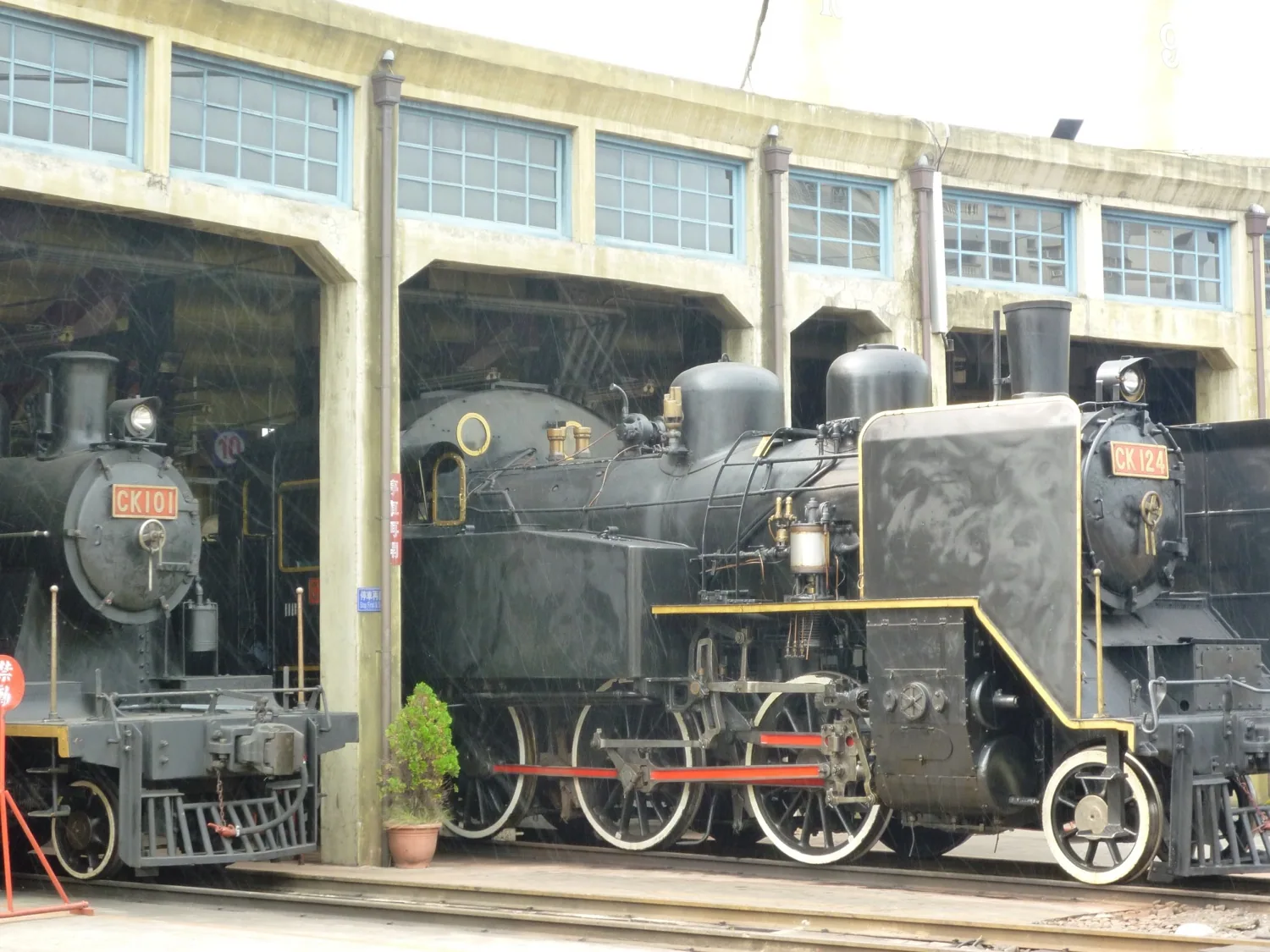
A group of TRA steam locomotives preserved at the Changhua Roundhouse in 2009. Photo: Neeson Hsu. CC BY 2.0 via Wikimedia Commons.
Running on the tracks left by foreign engineers was another group of things. From the late colonial period to the post-war era, Taiwan’s trains had their own Taiwanese names.
"Black-Headed Ones" (o͘-thâu-á) was the common name for all steam locomotives. The reason was that black paint was durable, easy to maintain, and convenient for aerial concealment during wartime. This protective color continued into the post-war period8. The locomotive was painted entirely black, a huge object; the folk simply named it by its color. The term "train" (huoche) itself was a direct translation: fire generates steam, steam drives wheels. "Little Train" (huoche-zi) was a nickname for small steam locomotives from the colonial to post-war era, sharing the same object as "Black-Headed Ones" but representing two layers of naming (one emphasizing color, the other emphasizing power).
After the war, TRA took over all the steam locomotives introduced during the colonial period and renumbered them into three major series: CK, CT, and DT. Representative models:
| Number | Same Model (JNR) | Manufacturing Year | Quantity in Taiwan | Manufacturer | Notes |
|---|---|---|---|---|---|
| CK101 | (Passenger/Freight Tank Locomotive) | 1917 | 1 (Preserved) | Nippon Sharyo | Returned to service on Railway Day, 1998-06-09; TRA’s first dynamically preserved steam locomotive9 |
| CT250 | C55 | 1935-37 | 9 | Kawasaki Heavy Industries | Streamlined passenger 4-6-210 |
| DT650 | D51 | 1936-44 | 32 | Kawasaki, Nippon Sharyo, Hitachi | 2-8-2 freight mainstay, also ran passenger trains during wartime10 |
CK101 was a passenger/freight tank locomotive manufactured by Nippon Sharyo in 1917, sealed away for a period after the war. On Railway Day in 1998, it was reignited at the Chiayi Depot, its whistle blowing long as it rolled out: this was TRA’s first dynamically preserved steam locomotive9. "Dynamically preserved" means it is truly running, not a specimen in a museum.
💡 Did You Know: The post-war TRA steam locomotive numbering rules retained the colonial logic—CK was for tank locomotives (water tanks on the locomotive body), CT was for 4-6-2 passenger专用的 (from JNR C series), and DT was for 2-8-2 freight专用的 (from D series). Just by looking at the first letter of the number, railway fans could guess its axle configuration and purpose.
After the steam era ended, TRA began giving new names to passenger trains. This layer of naming genealogy was more political than the technical genealogy:
| Train | Year Introduced | Naming Origin | Model |
|---|---|---|---|
| Juguang | 1970-02-03 | "Do Not Forget Ju" — Chiang Kai-shek took the allusion of Tian Dan recovering the state | R100 Diesel-Electric Locomotive Towing11 |
| Ziqiang | 1978-08-15 | 1976 Poll → Xie Dongmin ruled "Be Respectful and Self-Improving, Unfazed by Change" — the slogan after the ROC left the UN | EMU100 Electric Multiple Unit12 |
| Fuxing | 1980-07-06 | Meaning "Recovery" and "Revival," positioned as the third-class passenger car below Juguang | Air-conditioned car made by Tangrong Iron Works13 |
The naming process of the Ziqiang train is worth slowing down to look at. In 1976, TRA commissioned the Republic of China Public Opinion Testing Association to conduct random surveys. The three pre-determined candidate names were "Ziqiang, Shengli, and Ziyou." The survey results showed each got one-third of the votes: effectively no consensus. Finally, Xie Dongmin, Chairman of the Taiwan Provincial Government, personally ruled it as "Ziqiang," derived from the widely circulated slogan of the Chiang Ching-kuo era: "Be Respectful and Self-Improving, Unfazed by Change"12. On August 15, 1978, the EMU100 Electric Multiple Unit (commonly called "British Mother-in-Law" because the car body was manufactured by UK’s GEC) officially went on the road.
The naming of the three generations of passenger trains from the 1970s to 1980s all corresponded to KMT political slogans (Juguang / Be Respectful and Self-Improving / Fuxing). This naming genealogy was a witness to the overlap of engineering modernization and ideological modernization during the Martial Law period: the EMU technology was truly introduced, but the outer packaging was the rhetoric of "Unfazed by Change." After the 1990s, discussions on railway privatization rose; new train models used indigenous place names and mountain names: Puyuma (Puyuma language for "gathering"), Taroko (Taroko people). This was a turning point in the naming history on the same track, shifting from "We Must Not Forget" to "What This Island Was Originally Called."
✦ From Becker to Hasegawa to Puyuma: the tracks never changed, but the names kept changing.
The Bento Is More Famous Than the Train
In 1949, TRA began producing bentos in the railway restaurants of five stations: Kaohsiung, Tainan, Taichung, Taipei, and Songshan, for the convenience of long-distance travelers. Initially, they were just ordinary vegetable and rice bentos; later, they slowly became the classic that leaves a lasting flavor: Braised Pork Ribs Bento. (Source: Taiwan Panorama)
By the 2020s, TRA bentos sold over 10 million units a year. Just at Taipei Station, tens of thousands are sold daily, with Braised Pork Ribs Bentos accounting for nearly 90%. Some say TRA is a "bento shop delayed by a train." This joke contains a true bitterness: TRA’s service quality has been criticized for years, but the reputation of its bento has never wavered. (Source: United Daily News Time Machine)
TRA bentos sell more than just food. That aluminum bento box, that dark braised sauce-soaked pork rib, those pickled vegetables and dried tofu stuffed in the corner: for many Taiwanese, this is the olfactory memory of train travel, a sense of ritual of "being on the road."
The "Zero Government Funding" Gamble
In the 1990s, Taiwan’s north-south transportation was already saturated. the Freeway and North Second Freeway were jammed; domestic flight routes were fully booked. The government decided to build a high-speed railway, adopting the BOT (Build-Operate-Transfer) model for bidding.
In 1997, the Taiwan High-Speed Rail team led by Yin Qi defeated opponents with the promise of "zero government funding," winning this largest BOT case in history. The total construction cost was approximately NT$513.3 billion, adopting the Japanese Shinkansen 700T train technology. It opened in January 2007; the fastest time from Taipei to Kaohsiung was 1 hour and 35 minutes, at a speed of 300 km/h.
But the promise of "zero funding" quickly turned into a financial nightmare. The initial passenger volume of the HSR did not meet expectations; massive interest expenses caused the company to continue operating at a loss, with debt reaching up to 40 billion. In 2009, Yin Qi resigned as Chairman; the HSR was nearly on the verge of bankruptcy. Then-CEO Ou Jin-de blocked the bankruptcy proposal, believing that government buyback was "detrimental to society." (Source: Fortune Magazine)
In 2015, the government led financial reforms, extending the concession period and adjusting the equity structure. The HSR finally came back to life. In 2024, it carried 78.25 million passengers for the year; revenue broke through NT$50 billion for the first time, reaching NT$53.19 billion; daily average volume was 214,000 passengers. (Source: United News Network)
From near-bankruptcy to annual revenue of 50 billion, the HSR story is not a pure success narrative: it is a lesson on public infrastructure, private capital, and political maneuvering.
📝 Curatorial Perspective: The HSR BOT case taught Taiwan one thing: "Zero government funding" sounds beautiful, but the risks of infrastructure must ultimately be borne by someone. Most HSRs in the world are built with government money; Taiwan took twenty years to learn why.
| Key HSR Numbers | |
|---|---|
| Route Length | 350 km (Nangang – Zuoying) |
| Opening Year | 2007 |
| Construction Cost | ~NT$513.3 billion |
| 2024 Passenger Volume | 78.25 million |
| 2024 Revenue | NT$53.19 billion |
| Max Operating Speed | 300 km/h |
Reform Bought with 49 Lives
On April 2, 2021, the eve of the Qingming holiday, TRA Train No. 408 Taroko Express collided with an engineering vehicle that slid down the slope in front of the Qingshui Tunnel in Hualien, causing 49 deaths and over 200 injuries. This was the most serious accident in TRA’s history since 1948.
The accident investigation revealed not just a sliding engineering vehicle, but the systemic problems accumulated by TRA over years: loose construction management, weak safety culture, and organizational rigidity. Japanese JR West Safety Consultant Anbu Chengzhi bluntly stated that, by his standards, "JR West, after 18 years of reform following the Fuchuyama accident, only scored 50 points; the TRA about to corporatize has safety awareness still stuck at the pre-accident JR West level." (Source: The Reporter)
On January 1, 2024, the Ministry of Transportation and Communications’ Taiwan Railways Administration was officially restructured into "Taiwan Railways Corporation." The first Chairman and General Manager signed the "Safety Charter," posted at the entrance of the TRA Corporation building. Corporatization was seen as the starting point to break the bureaucratic system and introduce corporate management: but while the organization changed, how long it would take for the culture to change, no one dared to guarantee.
The Nervous System of an Island
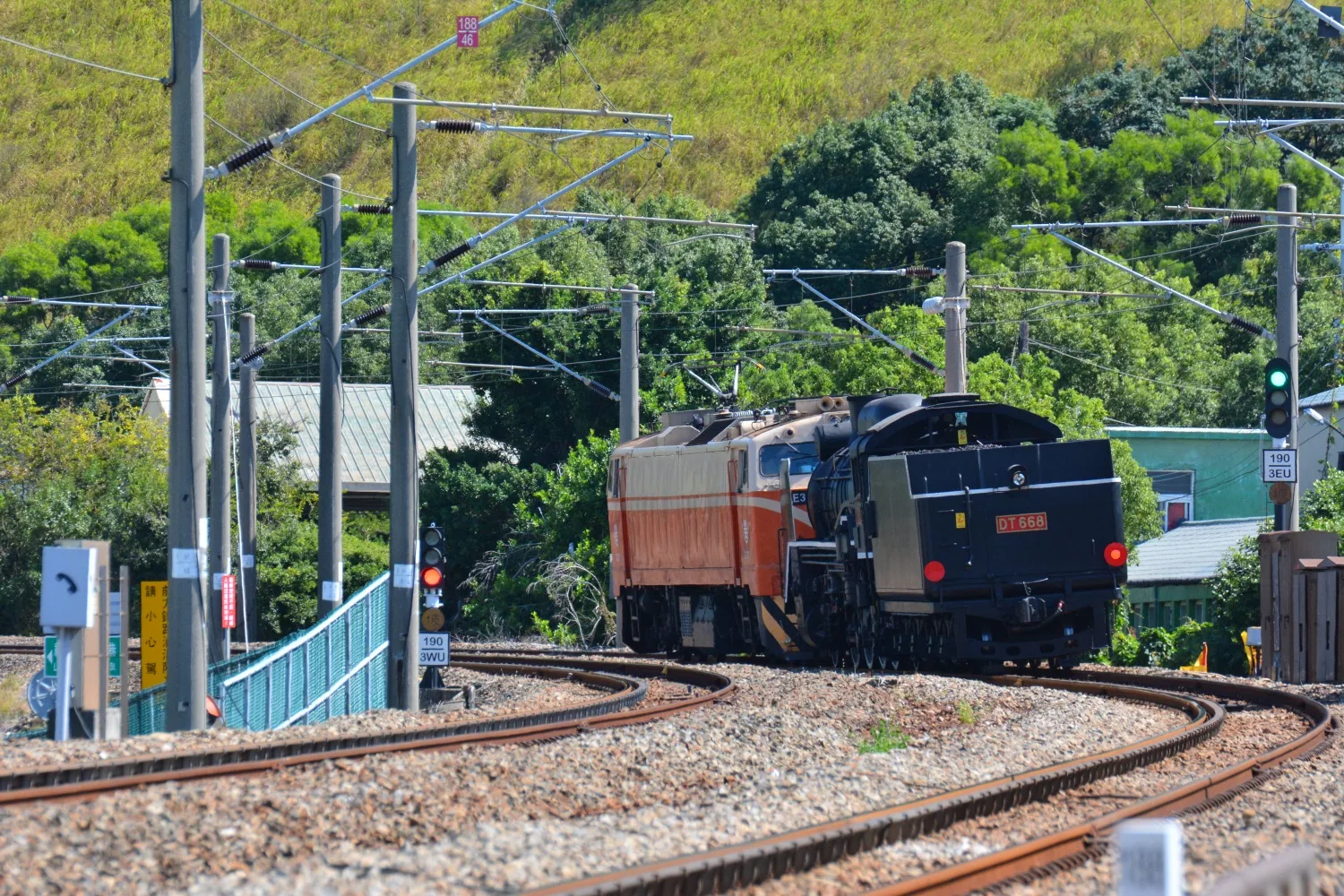
DT668 pushed by E327 on the TRA Coast Line in 2021 (a contemporary dynamic preservation example of the D51 class from the late colonial period). Photo: Cheng-en Cheng. CC BY-SA 2.0 via Wikimedia Commons.
Taiwan’s railway map is like a nervous system: the Western Trunk Line is the spinal cord, the HSR is the high-speed channel next to it, the Eastern Peitou Line and Nan’ao Line are the nerve endings extending to Hualien and Taitung, and the Alishan and Pingxi Lines are the capillaries.
This system grew out of Liu Ming-chuan’s swaying "lung disease railway" in 1891, passed through the Japanese scrapping and rebuilding, through wartime bombing and post-war repair, through electrification and high-speedization, through a gamble that nearly bankrupted the HSR, through painful reform bought with 49 lives.
When the National Taiwan Museum Railway Department Park opened in 2020, the plaque said Hasegawa Kin-suke was the "Father of Taiwan Railways." In the forests of Anle District, Keelung, Liu Ming-chuan’s Shiqiu Ridge tunnel still stands: Taiwan’s first railway tunnel, its brick walls covered in moss. As for the section of the MRT Zhonghe-Xinlu Line from Daqiaotou to Huilong today, it runs almost exactly on the route of Liu Ming-chuan’s 1893 railway, just drilled underground from the surface.
One hundred thirty years have passed. That road is still there. Just with a new skin.
Image Sources
This article uses 3 CC-licensed images, all cached in public/article-images/history/ to avoid hotlinking to source servers:
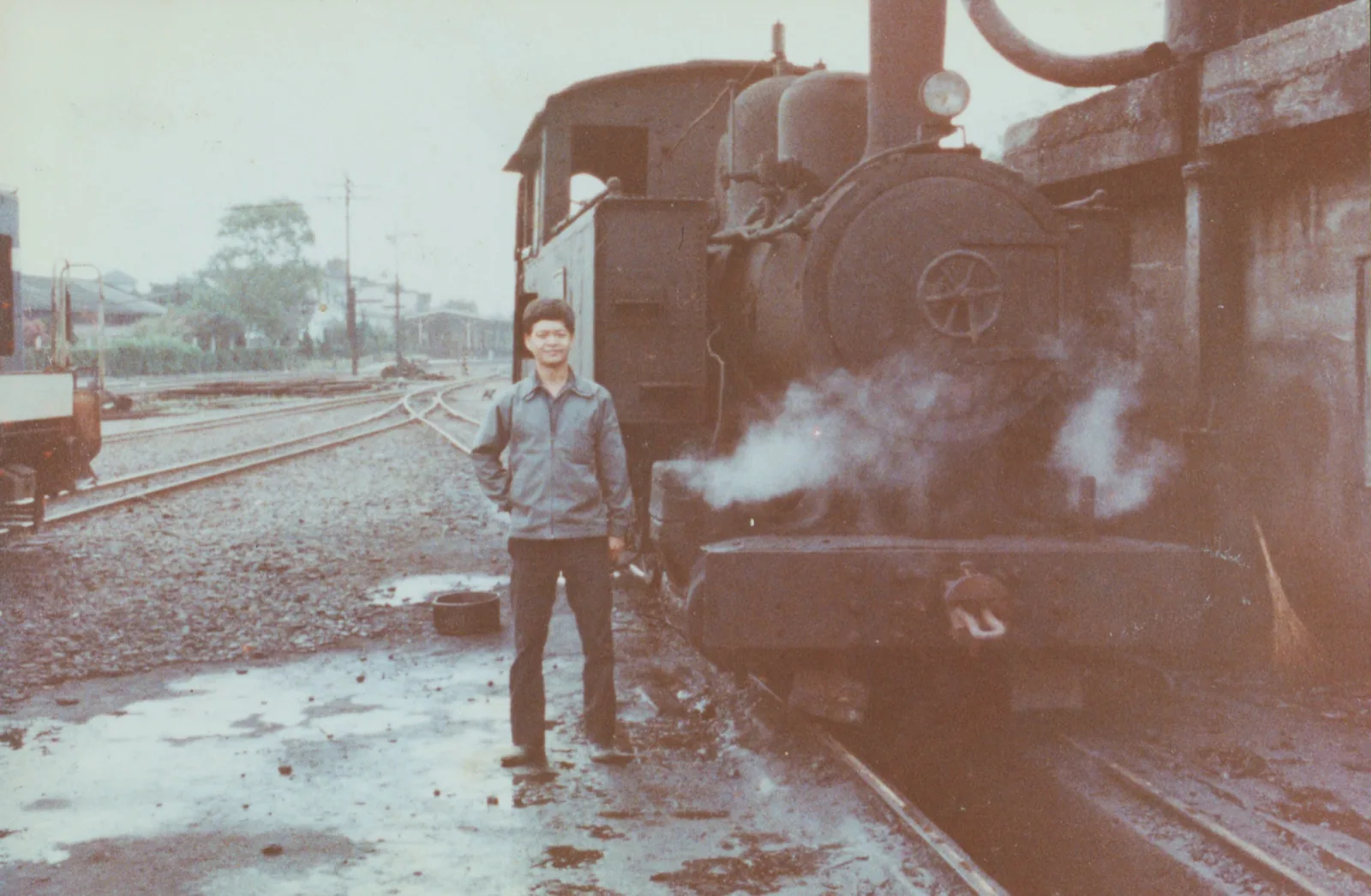
- Taitung Line Steam Locomotive Fireman 1970s — Photo Provider: Zhou Yongfu, 1970s, CC BY 4.0, Wikimedia Commons File:Locomotive_fireman_of_TRA_Taitung_Line_1970s.jpg
- Changhua Roundhouse Steam Locomotive Group 2009 — Photo: Neeson Hsu, 2009-08-30, CC BY 2.0, Wikimedia Commons File:2009-08-30_Steam_locomotives_at_TRA_Changhua_Roundhouse.jpg
- DT668 Pushed by E327 on Coast Line 2021 — Photo: Cheng-en Cheng, 2021-10-25, CC BY-SA 2.0, Wikimedia Commons File:2021-10-25_TRA_DT668_pulled_by_E327_on_the_Coast_Line.jpg
Further Reading
- Qing Dynasty Rule — Political background of Liu Ming-chuan starting to lay tracks
- Japanese Colonial Era(/history/日治時期) — Colonial government context of Hasegawa Kin-suke and Kawai Shitarao taking over Taiwan railway construction
- Sino-French War — Liu Ming-chuan was appointed as the first Governor-General of Taiwan due to this war, immediately initiating railway construction from Keelung to Hsinchu
- Taiwan Transportation System — The position of post-war railways in the diverse transportation network of highways, airports, and MRT
- Taiwan High-Speed Rail — The high-speed railway system opened in 2007, the contemporary extension of Taiwan railway history
References
- Taiwan Memory Expedition Team: October 24, 1908 Taiwan Trunk Railway Full Opening Ceremony
- JuZhen Taiwan: April 20, 1908, Trunk Railway Full Line Opened
- Geek’s View (Narrative Circle): Taiwan History Keywords | Liu Ming-chuan Railway
- United Daily News Mingren Hall: Why is Hasegawa Kin-suke the "Father of Railways" and Liu Ming-chuan the "Railway Paymaster"?
- Newtalk: Guan Renjian’s Viewpoint: Tsai Cheng-yuan Was Wrong! Liu Ming-chuan Is Not the "Father of Taiwan Railways"
- Story Studio: When Did Taiwan Railway Bentos Start Being Sold?
- Fortune Magazine: Is Bankruptcy Really the Only Destiny for Taiwan HSR?
- The Reporter: Driver Changed to ATP Manual Reversing? The 4th Anniversary of the Taroko Accident
- United News Network: HSR Revenue Broke 50 Billion Last Year
- Wikipedia: Alishan Forest Railway
- Ministry of Culture (English): Alishan Forest Railway
- Taiwan Panorama: The Taste of Nostalgia — Bento Culture Is Popular Again
Foreign Engineers and Locomotive Genealogy (Added Footnotes in 2026-05-11 EVOLVE)
- Wikipedia: Taiwan Railway (Qing Dynasty) — Configuration of foreign engineers on the Liu Ming-chuan Railway (Becker engineering design, Watson route survey, Matheson business consultant) and the context of the Jardine Matheson procurement network behind it.↩2
- Wikipedia: History of Taiwan Railways — Records of the manufacturing countries of the eight steam locomotives from 1887-1891 (Tengyun and Yufeng were German-made, the other 6 were British-made) and the list of Qing dynasty Mandarin names.↩
- Wikipedia: Hasegawa Kin-suke — Birth and death in Yamaguchi Prefecture, career timeline, records of designing Keelung Station, Hsinchu Station, and the West Gate Red Tower.↩2
- Cai Longbao: Hasegawa Kin-suke and the Development of Taiwan Railways in the Japanese Colonial Era (Academic Paper from Academia Historica) — Academic primary research on Gotō Shinpei bringing Hasegawa to Taiwan and the nine-year decision-making process of the Trunk Line.↩
- Nippon.com (Chinese): The Greatest Contributor to Completing Taiwan’s Trunk Railway — Hasegawa Kin-suke — Series "Japanese Who Changed Taiwan," including records of the full line opening on April 20, 1908, and the October 24 Taichung Park opening ceremony.↩
- Nippon.com (Chinese): Kawai Shitarao Who Opened the Alishan Railway — Kawai Shitarao’s origin in Nagoya, Tokyo Imperial University Forestry Department, 1897 study in Germany and Austria on forestry, and the context of the four mountain railway methods designed for the Alishan Forest Railway.↩2
- Wikipedia: Shinmoto Shikanosuke — Origin in Kagoshima, 1894 graduation from Tokyo Imperial University Civil Engineering Department, starting point as a technician in the Railway Bureau of the Ministry of Posts and Telecommunications.↩
- Wikipedia: TRA Steam Locomotives — Origin of the Taiwanese nickname "Black-Headed Ones" (uniformly black appearance: convenient maintenance + national defense concealment) and explanation of the CK/CT/DT numbering system.↩
- Wikipedia: TRA CK101 Steam Locomotive — Manufactured by Nippon Sharyo in 1917, returned to dynamic service on Railway Day, 1998-06-09; record of TRA’s first dynamically preserved steam locomotive.↩2
- TRA Class DT650 / CT250 — Wikidata — Technical specification data for DT650 as JNR D51 class (1936-44 Kawasaki, Nippon Sharyo, Hitachi total 32 units) and CT250 as JNR C55 class (9 units).↩2
- Wikipedia: Juguang Train — Record of entering service on 1970-02-03 towed by R100 Diesel-Electric Locomotives, naming origin "Do Not Forget Ju" (Tian Dan recovering the state).↩
- Wikipedia: Ziqiang Train — Complete context of the 1976 Public Opinion Testing Association survey, Xie Dongmin’s ruling on the name, EMU100 entering service on 1978-08-15, including the allusion "Be Respectful and Self-Improving, Unfazed by Change."↩2
- Wikipedia: Fuxing Train — Record of entering service on 1980-07-06, air-conditioned cars made by Tangrong Iron Works, positioned as third-class passenger cars.↩
🧬 What Semiont was thinking while writing this