
In 2023, a tiny restaurant with only twenty-odd seats in Sandimen Township, Pingtung County, landed on the Asia's 50 Best Restaurants list at No. 39. The restaurant is called AKAME, meaning "flame" in Paiwan. Chef Peng Tien-en is Paiwan; the menu has no foie gras, no truffles—only mountain tsiaah (wild onion), magau (mountain pepper), false gooseberry leaves, and the cinavu his grandmother learned from her grandmother. Media wrote "Taiwan Indigenous cuisine debuts on the international stage"—in truth, it was the international media's gaze that finally arrived. The foodways of Taiwan's Indigenous peoples have been sedimenting in these island mountains and coasts for three thousand years.
30-Second Overview
Taiwan's 16 officially recognized Indigenous peoples each possess a distinct culinary language: the Paiwan's cinavu, the Amis' wild vegetable knowledge, the Tao's flying fish culture, the Bunun's millet ceremonies. These foodways are not merely sustenance; they are covenants with the land, dialogues with ancestral spirits, and the deepest epistemology of a people.
Entering the 21st century, after dual suppression under Japanese colonial assimilation policies, a cohort of young chefs and tribal elders is using food as a medium to reknit the severed cultural umbilical cord. AKAME's Chef Peng Tien-en (Paiwan) and Sinasera 24's Chef Yang Po-wei (Amis) are leading figures in this revival movement, and the key drivers bringing Taiwan Indigenous cuisine onto the global gastronomic map.
Keywords: Millet Festival, cinavu, Lover's Tears, magau, AKAME, Sinasera 24
Naming the Fire: AKAME and the Lost Food Narrative
Before opening his restaurant in Sandimen, Peng Tien-en worked in a French restaurant in Taipei. He told media: "I learned a lot of technique in Taipei, but always felt something was missing. Only later did I realize what I'd lost was my own language—the language of food."
That "language" concretely resides in several plants. The scent of tsiaah (Paiwan for a wild Allium) is sharp as a blade, a sign by which the Paiwan identify food's boundaries; the layered folds of false gooseberry leaves wrapping cinavu let millet and pork meld slowly in the steam; magau (mountain pepper, Litsea cubeba) is the soul spice of the Bunun and Atayal, carrying ginger, lemongrass, and pepper in a single breath—anyone who smells it once never forgets.
AKAME's menu changes each season, because the mountain's language changes each season. Peng says his job is "translation": translating tribal elders' memories into today's plates, turning the grammar of the forest into a narrative anyone can understand.
Sinasera 24 in Changbin, Taitung, walks a similar path. Chef Yang Po-wei centers Amis wild vegetable ingredients, taking staff into the mountains daily to forage, turning whatever plants they find that day into that day's menu. "Sinasera" in Amis means "place where the sun rises." Yang says: "In Han Chinese eyes many wild vegetables are weeds, but Amis people know from childhood they are food, medicine, even gifts. This knowledge was never written into books; it lives in elders' footsteps, in the stooping motion as they push through grass."
📝 The Naming of AKAME
Paiwan akame means "fire," also implying "origin." Fire is among the Paiwan's most ancient linguistic memories: it cooks food, and connects humans with ancestral spirits. In a traditional Paiwan house, the hearth (adju) is the spiritual center and the place where food is shared. Peng Tien-en naming his restaurant "Flame" was not a romantic choice.
Millet: Not Just a Staple, a Cosmology
In the Taiwan Indigenous context, millet (foxtail millet, Setaria italica) holds a status almost no Han staple can parallel. Rice is eaten; millet is "alive."
The Paiwan call millet djulis, regarding it as a seed with spirit. Every stage of millet's annual life cycle—sowing, weeding, harvesting, storage—has corresponding rituals and taboos. Harvested millet cannot be touched casually; it may be opened and eaten only after specific rites. The Amis call millet hafay. The Bunun developed a complex ceremonial calendar around millet, among which the "Prayer for Millet Harvest Song" (pasibutbut) was documented by UNESCO as a representative case of world polyphonic music.
Linguists and archaeologists confirm Taiwan as the homeland of the entire Austronesian language family. Seafarers departing Taiwan dispersed over millennia to Madagascar, Hawai'i, New Zealand, the Philippines, across the Pacific and Indian Oceans. The food cultures of these peoples find their most ancient prototypes in Taiwan.
The competition between millet and rice began the moment 17th-century Han immigrants brought rice. Rice yielded more, stored easier, and under official policy promotion gradually replaced millet. Japanese-era (1895–1945) collective farming policies accelerated this process. Postwar land-leveling policies pushed it further. By the 1970s, many tribes had nearly abandoned millet cultivation; the Indigenous millet on the market today is largely the fruit of revival efforts over the past twenty years.
Amis Wild Vegetables: Two Hundred-Plus Species of Ecological Knowledge
Taiwan's largest Indigenous people, the Amis (total population approx. 236,939), identify, name, and consume over 200 species of wild vegetables, many with no corresponding name in Han food culture.
This is not "eating indiscriminately"; it is a precise ecological knowledge system. Each wild vegetable has its season, gathering location, processing method, and strictly orally transmitted taboos: which month it cannot be picked, which part must be blanched first to remove oxalic acid, which pairings turn the flavor astringent. This knowledge is not written in books; it lives in elders' memories.
Partial Amis Wild Vegetable Register
Lover's Tears (Nostoc flagelliforme): cold-dressed, appears only after rain, texture between fruit jelly and sea urchin
Bird's Nest Fern (lonot): stir-fried, has gathering grades, tender hearts and mature fronds each have uses
Showa Grass (airplane grass): bitter with sweet undertones, the most familiar daily wild vegetable for tribal women
Faro (a fern): smooth tender texture, called "mountain spinach"
Wild Ginger Flower Root: distinctive fragrance, commonly used for seasoning
"Lover's Tears" illustrates how Indigenous peoples view food scarcity. This black transparent cyanobacterium appears only after rain; the gathering window lasts mere hours; dried, its volume shrinks twentyfold. The Amis did not sacralize it, nor call it precious—they simply gave it a name that recalls rainy days, then ate it well.
Cinavu, Stone Slab Barbecue, Flying Fish: Three Archetypes
Taiwan Indigenous cooking techniques are few, but each is precise. Precision means: the correspondence among ingredient, tool, and season is the result of centuries of trial and error, not chance. These three examples come from different terrains and peoples, but share a commonality: the act of cooking is not just making a meal, but a complete performance of a knowledge system.
Cinavu is the festive food the Paiwan and Rukai make for weddings and ceremonies. Marinated pork and millet are wrapped in false gooseberry leaves, then bound again with shell ginger leaves, and steamed in bamboo steamers. The moment it opens, three layers of plant fragrance surge like waves. Making cinavu requires whole-family collaboration; the leaf-wrapping technique must be learned from elders, and folding methods differ subtly by family. Cultural researchers record that being able to wrap cinavu signifies having learned the family's food transmission, a cultural indicator of readiness to assume adult responsibility.
Stone slab barbecue is a direct product of Paiwan and Rukai mountain life. The Central Mountain Range's gneiss heats evenly and does not fracture—a natural griddle. Hunted wild boar and sambar deer are slow-roasted on the stone, seasoned with tsiaah and magau, needing no other condiments. The relationship among food, geology, and spice is the result of generations of dialogue between local people and this mountain range.
The Tao's flying fish constitutes another complete marine philosophy. Every year March to June is flying fish season on Lanyu (Orchid Island); only after the Fish-Calling Festival (Mavanuo) may boats put to sea, and overharvesting is forbidden. The Tao developed a full suite of drying and curing methods for flying fish, and have gender- and age-based consumption rules for different sizes of fish: men's portions, women's portions, elders' portions, children's portions—flying fish allocated according to social order. Ecologists analyze that these rules embody rigorous resource-management logic, maintaining ecological balance on a resource-limited island. The Tao do not describe their practice with the word "sustainability"; they simply do as their ancestors said.
Two Roads to Revival: Tribal Kitchens and Fine Dining
Since 2014, the Council of Indigenous Peoples has promoted the Tribal Industry Upgrade Program; by 2022 cumulative investment exceeded NT$4 billion, estimated to have generated nearly NT$20 billion in output value, involving nearly 5,000 employment person-times. These are administrative numbers; behind them lies a harder-to-quantify cultural event: a food memory interrupted for decades is attempting to rewire itself.
This reconstruction runs on two parallel tracks. The first leads from elders' kitchens. The Wild Vegetable School in Guangfu, Hualien, lets Amis women hold regular classes on tribal open ground—teaching not cultivation, but recognition. Which slope yields which fern, which season yields which tender shoot; knowledge transfers between elders' mouths and young people's notebooks. Taitung's Tribal Kitchen Program gives elders' recipes an institution to record them, a classroom to teach them. These spaces are sometimes formal projects, sometimes simply an elder deciding to teach traditional cooking every week.
The second track begins in fine dining. The fine-dining path represented by AKAME (Peng Tien-en) and Sinasera 24 (Yang Po-wei) has sparked divergent voices within tribes: some feel it detaches food from its original communal context; others feel it is the most effective way to make young Indigenous people take pride in their foodways again. This debate has no standard answer, but both tracks are doing the same thing: preserving food knowledge on the verge of disappearance.
📝 Wild Vegetables Are Not a Mark of Poverty
Taiwan society long linked wild vegetable diets with material deprivation, assuming Indigenous peoples ate wild vegetables because they had no better options. This perception inverts cause and effect. Amis wild vegetable knowledge is thousands of years of actively accumulated ecological wisdom: which season, which elevation, which soil conditions yield the best texture; which parts are edible, which are toxic; how to pair them to supplement protein and minerals. This is a knowledge system more complex than any wet market, simply stored in bodies and language rather than databases.
Conclusion: A Question of Speed
Peng Tien-en has said the hardest part of AKAME isn't technique, but persuading tribal elders to speak what's in their heads. Those elders don't feel they possess knowledge worth recording—it's just "how we eat."
This is the truest predicament of Taiwan Indigenous food: the most masterful recipes were never written down; they live in people's bodies, in seasonal perception, in decades of familiarity with these mountains and forests. One day that person passes, and the recipe goes with them.
AKAME's 2023 entry into Asia's 50 Best Restaurants at No. 39 is a signal that those recipes are worth retrieving. Media love to frame this with "international recognition," but the core question isn't international: with every tribal elder still here, how much food knowledge does each elder take away? That number is the real countdown. The remaining question is speed.
Image Source
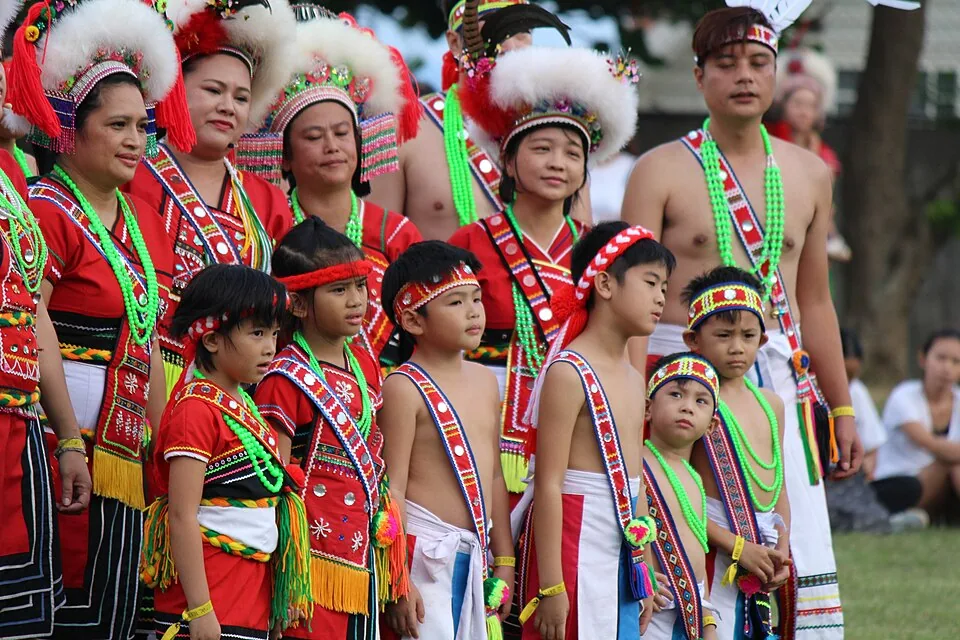
- Hero: Indigenous dancers at the 2016 Amis Music Festival, photo by HaeB, Wikimedia Commons, CC BY-SA 4.0.
References
- Asia's 50 Best Restaurants Official List
- AgriHarvest (2021) "Family Memories Passed Down: Paiwan _Vuvu_ Private Millet Recipes"
- Council of Indigenous Peoples, Executive Yuan: 16 Peoples Overview
- Indigenous Traditional Knowledge Protection Digital Archive Project (National Museum of Natural Science)
- Indigenous Languages Development Act (2017)
- Taiwan Review: Indigenous Cuisine Revival
- UNESCO Bunun _Pasibutbut_ Polyphonic Music Record
Further Reading: Taiwan Indigenous Peoples' History and Rectification Movement · Taiwan Indigenous Land Justice and Traditional Territories · Cultural Map of Taiwan's 16 Indigenous Peoples · Taiwan Indigenous Language Revitalization Movement · Taiwan Indigenous Ecological Wisdom and Environmental Conservation · Contemporary Indigenous Art of Taiwan