
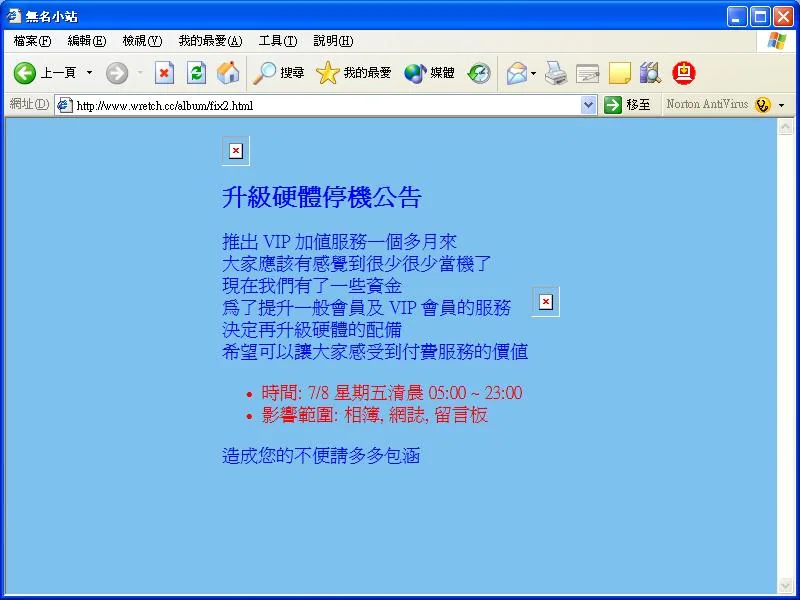
30‑second overview: Wretch was born in 1999 in a dormitory at National Chiao‑Tung University, where six computer‑science students cobbled together a BBS from the department’s discarded equipment and self‑deprecatingly named it “Wretch.” Within a decade it became Taiwan’s largest blog platform and the cradle of the island’s first creator economy; in March 2008 it even surpassed Yahoo to become the top site in Taiwan, with 2.5 million members, 1.2 million daily visits, and 500 million photos. Yet it had been bought by Yahoo back in 2007, and on the night of 26 December 2013 it was permanently deleted. Today, most people who try to retrieve their old albums via the Wayback Machine only get a grid of empty, unopenable frames. We remember it as “youth,” but we rarely recall that that youth was, from day one, stored on a server whose power could be turned off by someone else.
Wretch’s story is often told as a warm‑hearted nostalgic vignette: the youth of the “seventh‑ and eighth‑grade generation,” password‑protected photo albums and “who’s coming over?” messages, a pre‑algorithm era of innocence. That version is not wrong, but it filters out the most crucial element.
This article puts that element back. It is not merely the rise and fall of a piece of hardware; it is the first time a generation handed its most private memories over to a switch it could not turn off, and that switch was eventually pressed.
Picked‑up Discarded Computers and a Site Called “Wretch”
1999, Hsinchu, National Chiao‑Tung University dormitory. Six computer‑science students—Jian‑Chih Yu, Wei‑Kai Wu, Hong‑Chuan Lin, Chien‑Hsi Chiu, Wei‑Cheng Pan, and Hsuan‑Yun Chen, all teaching assistants in the department’s computing center—set up a BBS1. At the time, this was nothing extraordinary; almost every engineering department in Taiwan ran a BBS. What was special was where the hardware came from.
“At the time we had to cope with ever‑increasing system load, so we spent all day collecting the department’s discarded equipment and cobbled together a usable machine,” founder Jian‑Chih Yu later recalled2. A reporter for Taiwan Panorama described it even more bluntly: some said Wretch was founded on “picking up junk.” That may be an exaggeration, but the site was indeed built from old, decommissioned gear3. The machine’s simplest characteristic was that you could turn the power off at any time. If you didn’t want to play, just pull the plug—no one objected. That detail seems trivial now, but eight years later it became the story’s axis.
As for the name, they self‑deprecatingly called it “Wretch,” which later became the familiar Wretch site. “We were all nameless foot soldiers, with no grand ambitions at the start,” Yu said4. In the late‑1990s Taiwan, doing anything on the Internet sounded suspicious. “Starting a venture was already heretical; doing it online made you a lunatic,” he later described the atmosphere5. A group of self‑identified lunatics, on a salvaged computer, planted something that would later be remembered by more than twenty‑million people.

“Who’s Coming Over?”: Turning “Being Seen” into Intimacy
Wretch truly began to expand the moment it sprouted a blog function. On 28 October 2003 the blog feature officially launched6. It stitched together three trendy services under one account: a personal blog (not a “personal news channel,” which was a PChome brand), password‑protected photo albums, and a comment board where everyone could decorate their own corner.
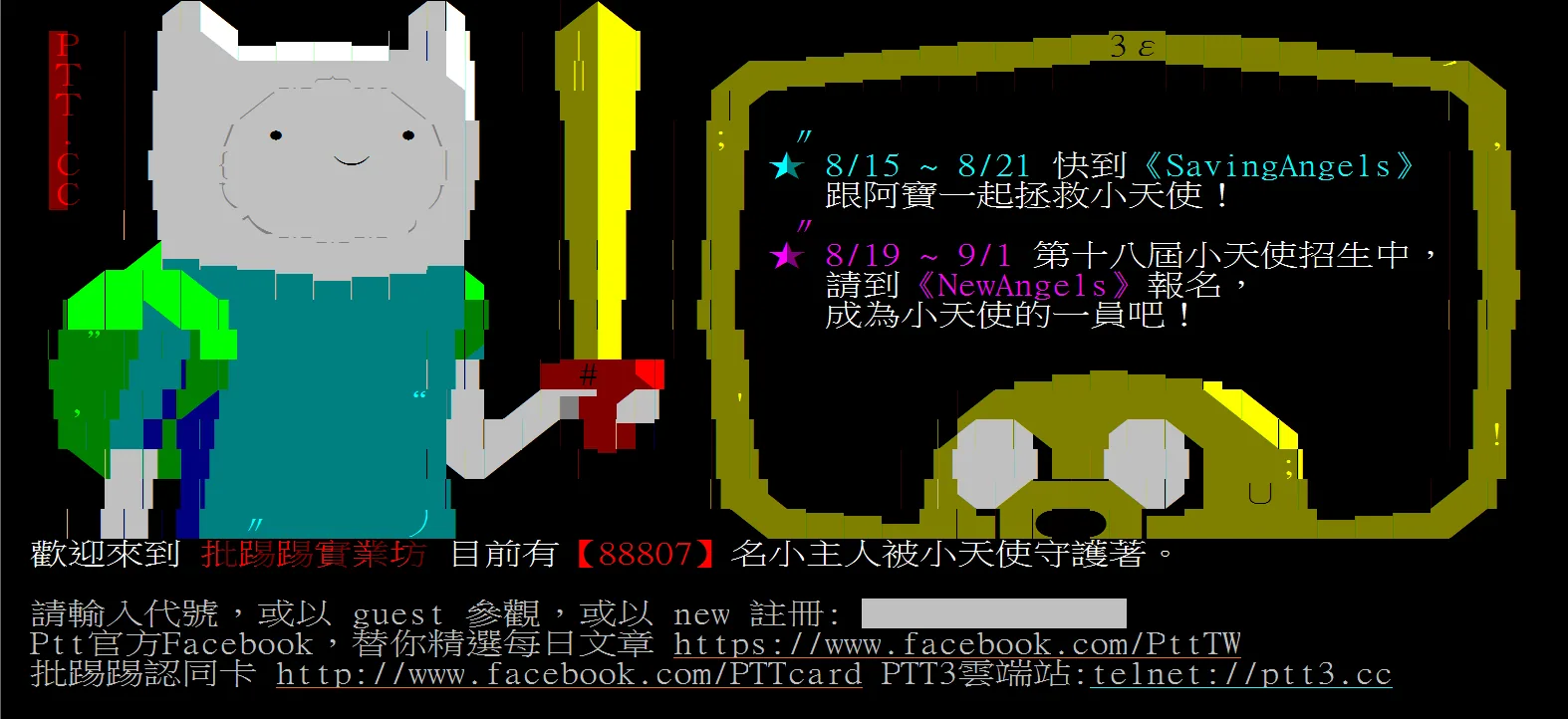
The most “Taiwan‑flavored” feature was “Who’s Coming Over?” It recorded every visitor to your page, leaving a trail of footprints. In the West, exposing “who has viewed my page” would likely scare privacy‑concerned users away—a surveillance anxiety that even Facebook and Instagram still avoid. In Taiwan, however, it became a form of digital intimacy: you know the crush who dropped by your album at 11 p.m., you know which old friend silently revisited your space. Being seen turned into evidence of being cared about.
The same logic extended to password‑protected albums. Locking photos and privately sharing the password was a small trust ceremony: giving someone the password meant inviting them into your inner circle. For that generation, “being seen,” originally risky, was translated by Wretch into warmth. This is the most nostalgic, most amplified part of the story. Yet that very unguarded intimacy makes the next point brutally cruel: the more you hand over, the more you stand to lose.
💡 Did you know?
“Photo‑album passwords” were the hard currency of Taiwanese online social life. Who got the password and who didn’t drew concentric circles of relationships. The hidden premise no one thought about then was that the lock was never in your own hands. The lock lived on the server, and the ultimate key was controlled by the platform. On 14 April 2007 Wretch’s password‑protected album was briefly “fully opened” due to a system glitch; all locked private photos were exposed, and the platform blamed “system maintenance”7. The so‑called “private album” was never truly private.
By 2006 Wretch had become Taiwan’s second‑largest website, behind Yahoo! Kimo. According to the InsightXplorer ARO non‑unique reach metric, its reach rate hit 63.81%, with over 6.5 million unique monthly visitors8. Over 2.5 million registered members, 500 million photos, more than 5 000 blogs, and 1.2 million daily visits3. A dorm‑room BBS had, within seven years, become the default homepage for an entire generation’s online life. The membership growth curve mirrors the collective migration of Taiwan’s youth onto the web.
The Ten‑Million Investment and the Unpublicized NT$700 Million Deal
When the platform reached that scale, the “picking up junk” romance could no longer sustain it. Yu later described the turning point clearly: “We have to take responsibility for this site; we can’t just turn the power off like before.”4 This was the first moment anyone sensed the weight of the power switch. From a machine you could unplug at will to a platform responsible for millions, Wretch was shifting from a student project to a business that needed money, shareholders, and accountability.
The money came from angel investor Chia‑wen Chia. In 2005 he invested NT$10 million as an angel round and later led the negotiations with Yahoo. In March of that year Wretch Co., Ltd. was incorporated with a capital of NT$20 million, and the founding team retained a 51 % technical stake9. Vision magazine reported that Chia held 49 % and personally earned over NT$300 million, but that share‑holding figure appears only in Vision; other media have not corroborated it10.
On 14 December 2006 Yahoo! Kimo announced the acquisition of Wretch11. The following year, on 29 March, the Fair Trade Commission ruled in its 803rd meeting that the merger would not be prohibited, granting Yahoo 100 % ownership12. The most quoted figure for the deal is “NT$700 million,” but that number carries a question mark. Yahoo! Kimo’s managing director Tsou Kailian never confirmed the amount; TVBS reported a rumor of “US$22 million, roughly NT$7.11 billion”13. English‑language outlet InfoWorld simply stated, “Terms of the deal were not disclosed.”14 In other words, the amount that made Wretch a landmark Taiwanese M&A has never been officially disclosed. The “NT$700 million” we remember is a media estimate, not a confirmed figure.
Why did Yahoo want to buy? The popular slogan “If you can’t beat them, buy them” is catchy but it is commentary, not Yahoo’s official rationale. Tsou Kailian gave a more nuanced answer: “By combining Yahoo’s technology, our massive traffic, and the content Wretch had already generated, the two sides can multiply each other and take the service to the next stage.”15 Of course, “multiply” is the polished PR line for a merger; if we translate it literally to “if you can’t beat them, buy them,” we are attributing a line to Yahoo that it never said. The truth likely lies between: Fair Trade data showed Yahoo held about 60 % of the portal market, while its own blog platform had only 1.6 % market share12. Yahoo could not overtake Wretch, but it framed the move as synergy rather than surrender.
📝 Curator’s note
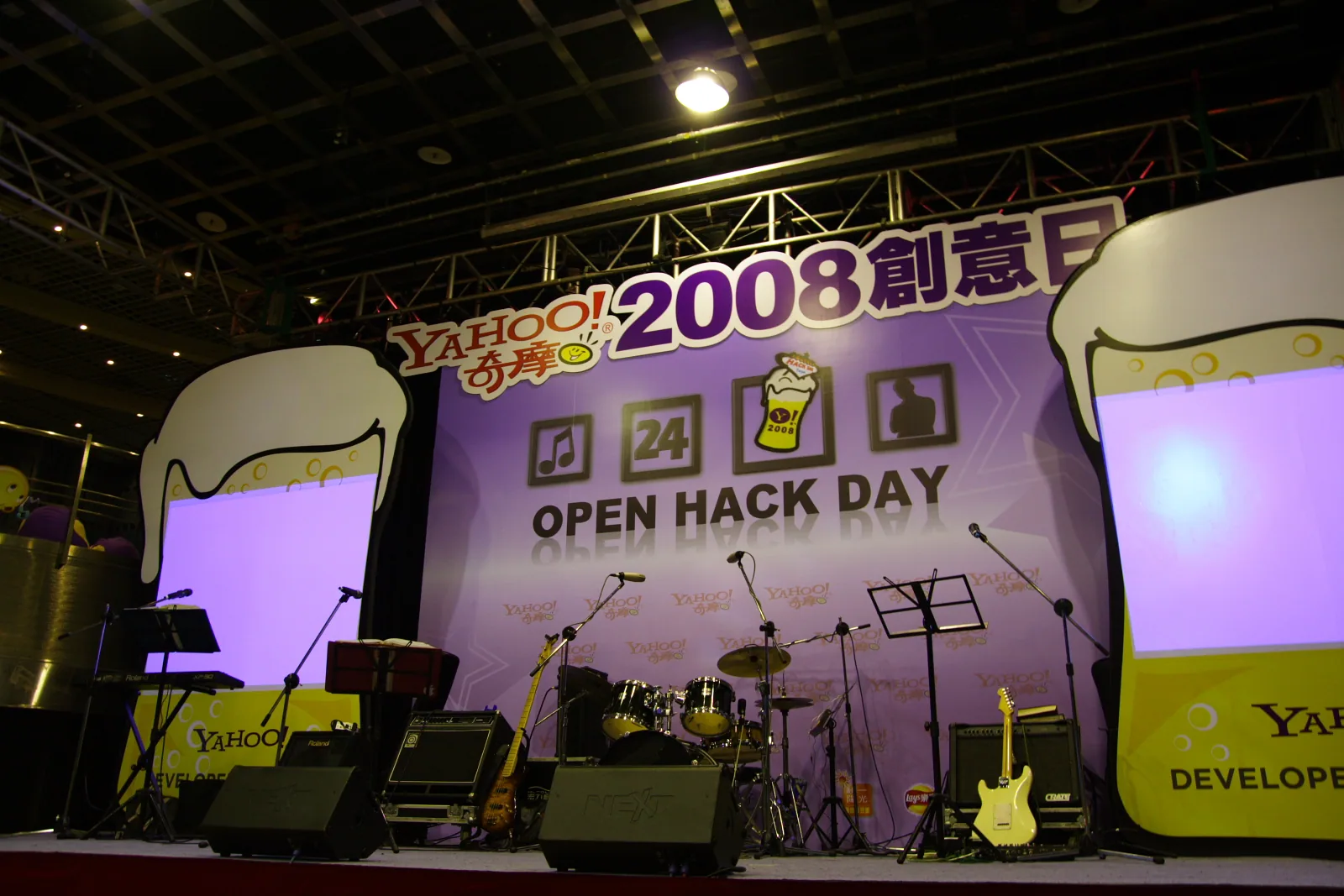
An often‑overlooked coordinate: when Yahoo bought Wretch, it had bought GeoCities in the United States only seven years earlier, and would shut it down in 2009. In other words, when Wretch was handed to Yahoo in 2007, Yahoo already owned a platform of the same type with a “death‑record” on its hands. The same hand bought GeoCities, closed it, then bought Wretch and six years later closed it again. We only recognized this pattern in hindsight, but it was written at the moment of the contract.
2008: Wretch Climbs to the Top of Yahoo!
Logic would suggest that a platform absorbed by a giant would gradually lose its edge. Wretch did the opposite.
Less than a year after the acquisition, in March 2008, Wretch topped the “Top 100 Taiwan Sites” list compiled by Digital Age (ARO plus Alexa weighting), overtaking Yahoo! Kimo to become the island’s number‑one site16. The English‑language tech outlet NetworkWorld found it amusing enough to headline “Yahoo loses top spot in Taiwan to Wretch”17. A student‑run site that started in a dormitory of salvaged junk rode the very next year onto the head of the multinational that bought it.
What sustained that ranking was a massive creator cradle. Today we talk about “self‑media” and “KOLs,” but Taiwan’s first generation of internet‑visible amateur creators were almost all incubated on Wretch. The most representative example is Wan‑wan: she originally joined just to follow Jiu‑Ba‑Dao’s serial on the Wretch BBS, tried the blog function, and soon attracted 150 k daily views. Her 2005 book Can’t I Just Not Work? sold over 100 k copies18. She, Jiu‑Ba‑Dao, and The Queen were dubbed the “Three Writer Treasures,” followed by a long list: Yuan A‑fei (the “Raptor”), Da‑Yuan (over 9 million fans), Lin Yi‑hsin (Sarah), and Cai Huang‑ru (Tofu‑girl)19. Wretch’s “pretty‑girl” album culture was also part of the machine, though it later attracted criticism for objectifying women—a topic we will revisit later.

A key clarification: the legend that “Wretch incubated e‑commerce sellers” is false. Brands such as Tokyo‑Wear and Lativ originated from Yahoo! Auctions, not Wretch. What Wretch incubated were writers, illustrators, and photographers. This distinction matters because it shows that Wretch’s most valuable asset was the content itself: over two‑million users spent years building up blogs and photos, and that seven‑year‑accumulated asset vanished entirely when the platform disappeared.
That was Wretch’s highest moment: perched atop Yahoo, nurturing a whole generation of creators, with 500 million photos stored on its servers. No one at that peak imagined that eight years later everything would be erased in a single night.
When You’re Done, Turn the Power Off
Wretch’s decline was not a single, sharp cut. It was pulled in several directions, slowly draining it.
The first force was “stickiness.” In September 2009 Facebook overtook Wretch in InsightXplorer’s ARO survey, becoming Taiwan’s second‑largest site20. Notably, Facebook didn’t win on reach: Wretch still led in “how many people have ever visited.” Facebook won on “how long people stay.” The survey showed Facebook users spent an average of 6.3 minutes per day, versus Wretch’s 3.9 minutes20. The news feed kept users glued in a way photo albums and blogs could not.
The second force was smartphones. From 2010 onward, mobile devices became the primary internet entry point, while Wretch’s layout was designed for desktop browsers. The third force came from its new owner. After Yahoo took over, account integration caused friction, and the product itself stalled.
In 2013 Business Weekly described Wretch as “a traffic‑declining star whose service interface had barely progressed since 2006, a relic of a bygone era”21.
All three forces converged on Yahoo’s “difficult decision.” On 30 August 2013 Yahoo announced the shutdown of Wretch, citing a shift to “mobile‑first” and a refocus on core products. The official statement read: “To refocus on optimizing core products and accelerating innovative services, sometimes difficult decisions must be made.”22 This was followed by a four‑month countdown, each step tightening the closure23.
Jian‑Chih Yu’s original mantra—“If you’re done, just turn off the server’s power”—was meant as a declaration of responsibility. Yet the hidden premise was that the switch was no longer in his hands. When the contract was signed in 2007, ownership of the power button transferred to Yahoo. On the night of 26 December 2013 the power was indeed turned off—but the hand that pressed it was not the group of students who could simply unplug; it was the acquiring corporation.
A Disappearance Without a Funeral
If the story stopped at “the platform shut down, people were sad,” it would be just another obsolete website. What truly unsettles us is what happened after the shutdown.
A look at the Wayback Machine for wretch.cc shows a cruel fact: text, comments, and even traffic numbers remain, but photos are almost entirely gone. Most users who open their old albums see a grid of empty boxes—because the image files were hosted on an external CDN whose URLs became dead after the shutdown, leaving only empty frames24. A platform that once boasted 500 million photos now leaves virtually nothing for posterity.
International volunteers from the Archive Team crawled Wretch in two batches before and after the shutdown, rescuing roughly 45.7 GB and over 5 million pages, but they labeled the archive “Partially Rescued”25. Forty‑five gigabytes is a drop in the bucket; it cannot even hold a fraction of the five‑hundred‑million photos at peak. Moreover, the rescuers were an international group with no direct ties to Taiwan; they have archived countless dying websites worldwide, and Wretch was just one entry on their list.
In Taiwan, no organization performed a systematic rescue: not the National Library, not the Ministry of Culture, no one. Repeated verification shows a glaring blank: Taiwan has zero state‑level preservation of its largest digital youth archive26. Taiwan has robust systems for preserving ancient books, old photographs, and intangible cultural heritage, yet no mechanism to catch a website that housed the memories of over two‑million people when it shut down. In our cultural imagination, “things worth preserving by the state” still seem confined to paper and physical artifacts; digital youth is assumed disposable.
When placed side‑by‑side with international efforts, the gap widens.
| Platform | Nature | Buyer / Parent | Acquisition year | Shutdown year | Rescue scale |
|---|---|---|---|---|---|
| Wretch (Taiwan) | BBS → Blog + Album | Yahoo | 2007 | 2013 | Archive Team ≈ 45.7 GB (marked “Partially Rescued”); State‑level preservation: 0 |
| GeoCities (USA) | Personal webpages | Yahoo | 1999 | 2009 | Archive Team ≈ 1 TB |
| Skyblog (France) | Teen blogs | — | — | 2023 | Bibliothèque nationale de France rescued 12.6 million blogs, 37 TB |
| MySpace (USA) | Social music | News Corp | 2005 | Decline | Large early‑audio loss |
The numbers speak loudly. France’s BnF rescued 37 TB for Skyblog, nearly a thousand times the 45.7 GB Archive Team saved for Wretch. That disparity reflects an unspoken attitude difference: France treated teenagers’ blogs as “our collective memory, to be preserved,” while Taiwan treated the site as a relic no one felt responsible for. The French organized a national funeral for a generation’s blogs; Taiwan let its greatest digital youth fade away in a night without a funeral.
⚠️ Controversial view
Before mourning Wretch, we must reckon with its origins. Wretch’s founder used the academic TANet (the university network) to host the BBS, then turned it into a profit‑driven business. In late 2006, translator Zhu Xue‑heng criticized, “Innovation and entrepreneurship cannot be pursued by any means; they must be ‘Do No Evil’ to be worthy of encouragement. Wretch’s controversies this year make it a perfect negative example.”27 In January 2007 legislator Tang Huo‑sheng questioned the commercialization of academic network resources in the Legislative Yuan28. Add the fully‑opened password album and the objectifying “beauty‑page” culture, and the wounds are real. Portraying Wretch solely as an innocent era erases those controversies. An honest remembrance must include them.
A Account with 12 Followers Waits Ten Years
The story could have ended in that empty album, but in spring 2025 it resurfaced unexpectedly.
In March, a Threads account named @wretch_1999 began posting. Its bio copied the old branding verbatim: “★●○● Welcome to Wretch ●○●★ / Background music: 5566 – I’m Sad / Cumulative visits: 0000520.” On 24 March it shared a screenshot of its own Instagram (only 12 followers) with a self‑deprecating caption: “When will anyone notice me? Revived.”29 The post struck a nerve, went viral, and its follower count surged past 17 00030. The account’s nature was never officially confirmed; it appears to be a fan‑made tribute rather than an official Wretch revival.
Yet the responses were more honest than any corporate announcement. Commenters asked for “account passwords,” lamented missed opportunities a decade earlier, and even wrote to the dead platform: “I’m from the future—secretly tell you not to sell to Yahoo.”31 The account itself asked in the post: “Do the younger Threads crowd even know who I am?”32 A name forgotten for twelve years finally got noticed—but only as a fan‑built shell. The body itself had long been erased, leaving no trace.
And the unsettling part is not 2013; it is now.
The salvaged computer’s simplest feature—being able to unplug it—later became a responsibility Yu learned to bear. He later realized the power switch was no longer in his hands; Yahoo pressed the button. Now it’s our turn: the Instagram Stories you post, the Facebook albums you share, the cloud‑stored birthday photos of your child—these are the same kind of thing as the five‑hundred‑million photos on Wretch. They all sit on servers whose power can be turned off by someone else, and whose contents can be lost forever. Wretch was Taiwan’s first digital lesson, teaching not nostalgia but a sentence we may still not fully understand twelve years later: you think you’re preserving memory, but you’re merely depositing it on a server whose owner can pull the plug at any moment.
Further Reading
台灣網路社群遷徙史、PTT批踢踢、巴哈姆特、Dcard、噗浪Plurk、Facebook、台灣YouTuber產業與文化、台灣新偶像世代、黃山料、台灣的年級生世代.
Image Credits
All five images are licensed under Creative Commons or GPL and cached in public/article-images/culture/ to avoid hot‑linking:
- Alan Sung / Wikimedia Commons – CC BY 2.0 (2005 Wretch hardware upgrade notice screenshot, hero)
- T Gordon Cheng / Wikimedia Commons – CC BY‑SA 4.0 (South gate of NCTU Kuang‑Fu Campus, 1999 founding site)
- T2o6n8y9 / Wikimedia Commons – GPL (Taiwan campus BBS login screen, PTT as era illustration, not Wretch)
- Alan Sung / Wikimedia Commons – CC BY 2.0 (2008 Yahoo! Kimo Open Hack Day stage)
- Yahoo! Blog / Wikimedia Commons – CC BY 2.0 (2010 Yahoo! Kimo Wretch Fun Party)
References
- Wikipedia: Wretch – documents the 1999 founding at NCTU and lists the six computer‑science co‑founders (Jian‑Chih Yu, Wei‑Kai Wu, Hong‑Chuan Lin, Chien‑Hsi Chiu, Wei‑Cheng Pan, Hsuan‑Yun Chen), as well as Lin Hong‑chuan’s succession as BBS admin on 12 May 2004.↩
- Taiwan Panorama “The ‘Wretch’ Miracle” – interview with Jian‑Chih Yu describing the collection of discarded equipment and cobbling them into usable hardware.↩
- Taiwan Panorama “The ‘Wretch’ Miracle” – journalist’s description of “starting from junk,” plus 2006 scale figures: 2.5 M registered members, 500 M photos, 5 000+ blogs, 1.2 M daily visits, second‑largest site in Taiwan.↩2
- Taiwan Panorama “The ‘Wretch’ Miracle” – quote on naming origin and the later responsibility statement about not being able to simply turn off the server power.↩2
- Digital Age interview with Jian‑Chih Yu (2016) – quote on the “heretical” vibe of early internet entrepreneurship in Taiwan.↩
- Merit Times “Wretch Milestones” – records the official opening of the blog function on 28 Oct 2003 and the BBS origin.↩
- Wikipedia: Wretch – documents the 14 Apr 2007 “full‑open” of password‑protected albums due to a system glitch, with the platform blaming a “system maintenance” plan.↩
- InsightXplorer ARO traffic report (2006) – Wretch reach rate 63.81 %, monthly unique visitors 6 572 790, 2.8 M members.↩
- Wikipedia: Wretch – notes the March 2005 incorporation of Wretch Co., Ltd., NT$20 M capital, and the founding team’s 51 % technical equity.↩
- Vision magazine “The Story of Wretch” – reports angel investor Chia Wen‑chung’s NT$10 M investment, 49 % stake, and personal earnings over NT$300 M; the share‑holding figure appears only in Vision.↩
- TVBS news “Yahoo! Kimo acquires Wretch” (14 Dec 2006) – first‑hand report of the acquisition announcement and interview with managing director Tsou Kailian.↩
- InfoWorld “Yahoo to buy Taiwan’s Wretch” (15 Dec 2006) – confirms the deal and that terms were undisclosed; also cites Fair Trade Commission 803rd meeting ruling.↩2
- TVBS news “Yahoo! Kimo acquires Wretch” (14 Dec 2006) – reports the rumor of a US$22 M (≈ NT$7.11 B) price, noting Tsou never confirmed the figure.↩
- InfoWorld “Yahoo to buy Taiwan’s Wretch” (15 Dec 2006) – original English line “Terms of the deal were not disclosed by the companies.”↩
- TVBS news “Yahoo! Kimo acquires Wretch” (14 Dec 2006) – quote from Tsou Kailian on “multiplying” Yahoo’s technology, traffic, and Wretch’s content.↩
- Digital Age “Taiwan’s Top 100 Sites” (Mar 2008) – ARO + Alexa weighted list placing Wretch #1 and Yahoo #2.↩
- NetworkWorld “Yahoo loses top spot in Taiwan to Wretch” (5 Mar 2008) – English article confirming the ranking.↩
- Taiwan Panorama “Blogging Star: Wan‑wan” (Sept 2006) – documents Wan‑wan’s 150 k daily views and 2005 book sales over 100 k copies.↩
- PopDaily “Wretch’s 11 Popular Kings” – lists Wan‑wan, Jiu‑Ba‑Dao, The Queen, plus Yuan A‑fei, Da‑Yuan, Lin Yi‑hsin, Cai Huang‑ru, Zhou Xiaohan, Jian‑Ting‑rui.↩
- E‑Commerce Times “Facebook overtakes Wretch” (Nov 2009) – InsightXplorer ARO data: Facebook daily stay 6.3 min vs Wretch 3.9 min; reach still lower for Facebook.↩2
- Business Weekly blog “Wretch’s Dusk” (2013) – describes Wretch as a traffic‑declining star with an interface stuck in 2006 thinking.↩
- Archive Team – Wretch (Chinese) – official Yahoo statement (30 Aug 2013) on refocusing on core products and “difficult decisions.”↩
- ETtoday “Yahoo Wretch shutdown three phases” (30 Aug 2013) – timeline of shutdown steps.↩
- Dappei “Can Wretch’s photo albums be retrieved?” – reports that Wayback retains text and comments but image URLs fail, leaving empty frames.↩
- Archive Team – Wretch backup entry – two batches totaling ~45.7 GB and 5 00 00 0 pages, labeled “Partially Rescued.”↩
- Archive Team – GeoCities Project – comparison showing no state‑level rescue for Wretch in Taiwan.↩
- Zhu Xue‑heng criticism of Wretch (Pixnet repost) – 2006 article stating “innovation must be Do No Evil; Wretch is a negative example.”↩
- Liberty Times “Legislator Tang questions Wretch” – 7 Jan 2007 Legislative Yuan questioning of Wretch’s use of TANet resources for profit.↩
- ETtoday “Wretch Threads account goes viral” (26 Mar 2025) – reports @wretch_1999 posting IG screenshot (12 followers) and self‑deprecating caption.↩
- Mirror Media “Wretch revival goes viral” (27 Mar 2025) – reports follower count jumping past 17 k.↩
- Mirror Media “Wretch revival comments” (27 Mar 2025) – includes user comments like “I’m from the future, don’t sell to Yahoo” and “Give me my account password.”↩
- UDN Tech “Wretch Threads account” (2025) – reports the account’s question about whether the younger “Crisp” generation even knows who it is.↩