
30-second overview: The story of Taiwan tea is the story of a single leaf changing containers over a century. Qing dynasty immigrants brought small pots of gongfu tea across the sea; a Scottish merchant renamed it "Formosa Oolong" and shipped it to New York in 1869; during the Japanese colonial period, black tea reached London auction houses; after the war, exports collapsed and tea turned inward, giving rise to competition tea, the Taiwan-invented term "tea art," and high-mountain tea grown at over 2,000 meters above sea level. By the 1980s, a shaken iced tea cup sparked bubble tea, which evolved into today's plastic-cup republic of over 16,000 bubble tea shops across Taiwan. The way of drinking has always changed—but what remains constant is this island's ability to steep foreign opportunities into a flavor uniquely its own.
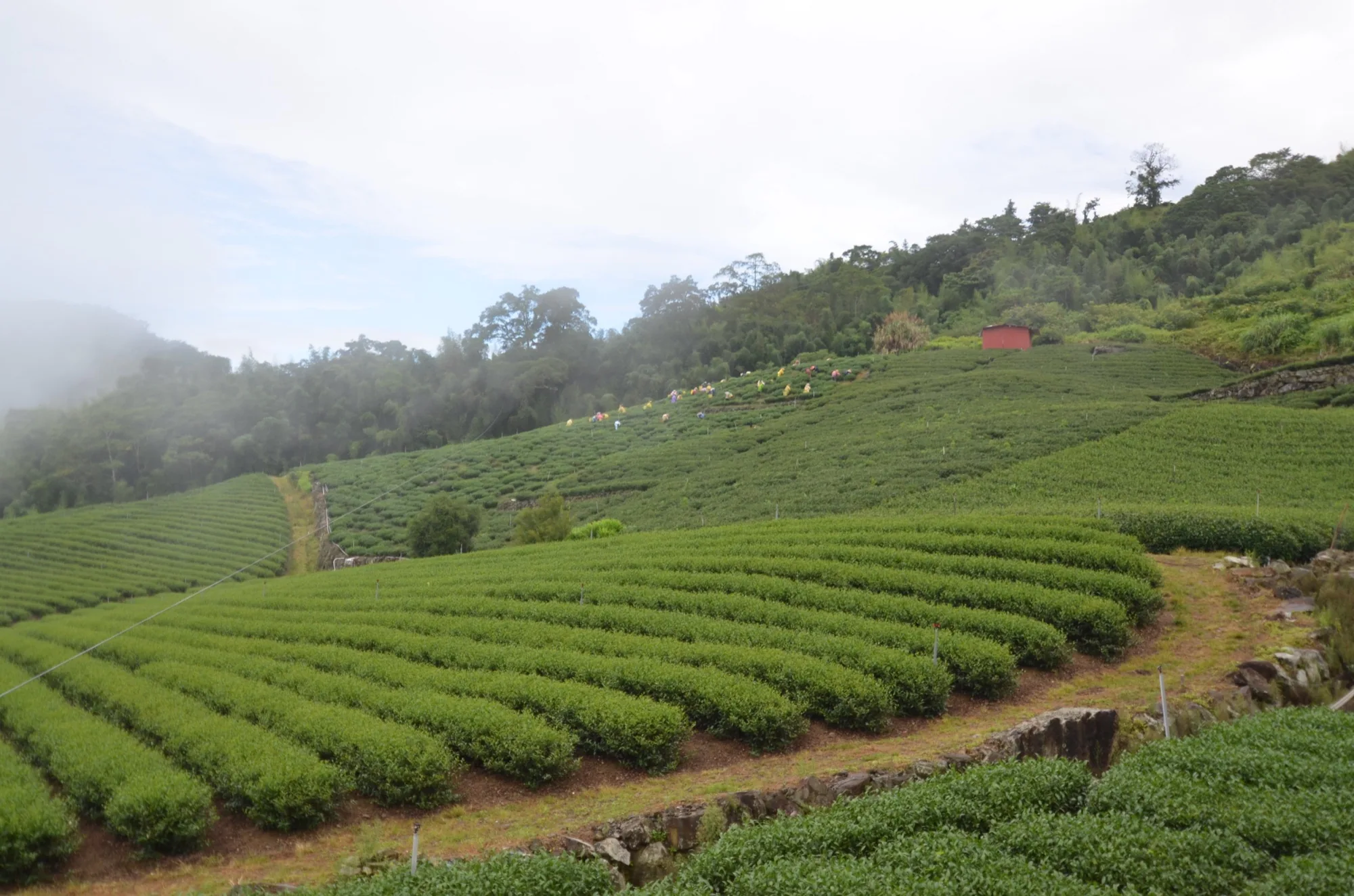
The high-mountain tea garden of the Alishan Tsou tribal village. Altitude, mist, and diurnal temperature variation—Taiwan tea's latest chapter in over a century of identity shifts.
A Little Pot of Origins
A palm-sized purple clay teapot, paired with three paper-thin cups so translucent they let light through. Pour boiling water over it, discard the first infusion to warm the cups, and only the second infusion is served to guests. This was the custom of wealthy families in Qing-dynasty Taiwan for receiving guests.
Lián Huáng wrote all about this in his Yátáng Wénjí· Míngtán: "The way Taiwanese people brew tea differs from the mainland, yet is the same as in Zhangzhou, Quanzhou, and Chaozhou; the tea must be Wuyi, the pot must be Meng Chen, and the cups must be Ru Kiln. All three are indispensable." Lián Huáng even added: "Without these, one cannot feel proud, nor can one properly receive guests."1
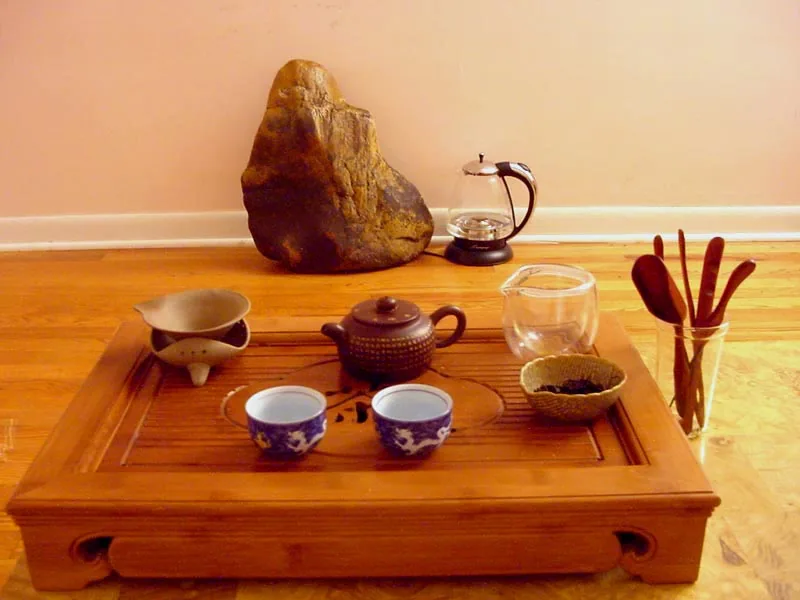
The one-pot-three-cup gongfu tea method. The small pot, small cups, and meticulous brewing process are the traditional drinking style brought over by Minnan immigrants from the mainland.
This brewing method has a name: gongfu tea, also known as "old people's tea." It did not originate in Taiwan. Lián Huáng's statement "same as in Zhangzhou, Quanzhou, and Chaozhou" makes it clear: the way Taiwanese people drink tea is the traditional flavor brought over by immigrants from Zhangzhou, Quanzhou, and Chaozhou. The earliest complete textual record of gongfu tea dates to the late Qianlong era, when Yu Jiao wrote about the Chaozhou drinking method in his Mèng Chǎng Zázhu· Cháo Jiā Fēngyuè Jì: "The stove is shaped like a truncated tube, about one chi and two to three cun tall, made of fine white mud. The teapot should ideally be from Yixing Kiln."2 The entire process of burning charcoal, rinsing the pot, and performing the high-pour low-pour technique came ashore with the Minnan immigrants' luggage.
As for the folk name "old people's tea," the common Taiwanese saying goes: this method of brewing tea is too labor-intensive, so usually only elderly people with plenty of leisure time can take the time to prepare it slowly. Later, young people turned to Western-style beverages, and oolong tea was even labeled as "what old people drink." Neither explanation has rigorous documentary evidence, but both point to the same fact: before bubble tea and high-mountain tea appeared, when Taiwanese people drank tea, they were practicing a set of rituals brought over from the mainland—slow, meticulous, and deliberate.
Interestingly, the island of Taiwan already had tea of its own. In 1717, the Zhuluo County Gazetteer recorded the earliest written mention of tea in Taiwan, describing wild tea in the mountainous areas of Shihsha (present-day Nantou): "There are many wild teas in the Shihsha mountains, with a flavor and green color like pine fern... but the paths are treacherous, and the indigenous people are feared, so Han people dare not enter to harvest, nor do they know how to process tea."3 Those wild tea trees were right there, but Han people feared the dangerous paths, feared the indigenous people, and didn't know how to make tea, so they could only watch. Taiwan had its own tea, yet it had to wait for outsiders—and their techniques—to turn it into a business. This act of transforming "foreign opportunities into one's own" would repeat itself over and over again in the following century.
A Scot Who Rebranded Fujian Tea as Formosa
In 1860, a Scottish merchant named John Dodd first set foot in Taiwan, originally there to inspect camphor and tea. He took a liking to the hilly terrain of northern Taiwan, finding the red-soil slopes of Wenshan and Daxi ideal for tea cultivation. Around 1865, he hired the Xiamen-based comprador Li Chun-sheng to introduce oolong tea seedlings from Anxi County in Fujian Province, lending money to tea farmers to encourage planting. By 1867, he had established his own enterprise, Dodd & Co., began mechanizing tea production, and even test-marketed oolong tea in Macau. 4
Dodd's real innovation lay in a single step. Before him, Taiwan's roughly processed crude tea had to be shipped to Fuzhou for refinement and then exported under the label "Fujian Tea," with Taiwan serving merely as a source of raw materials. In 1868, Dodd invited masters from Xiamen and Fuzhou to Taiwan to refine the tea on-site, branding it "Formosa Oolong" and allowing Taiwan's tea to make its international debut under the name "Formosa" rather than "Fujian."
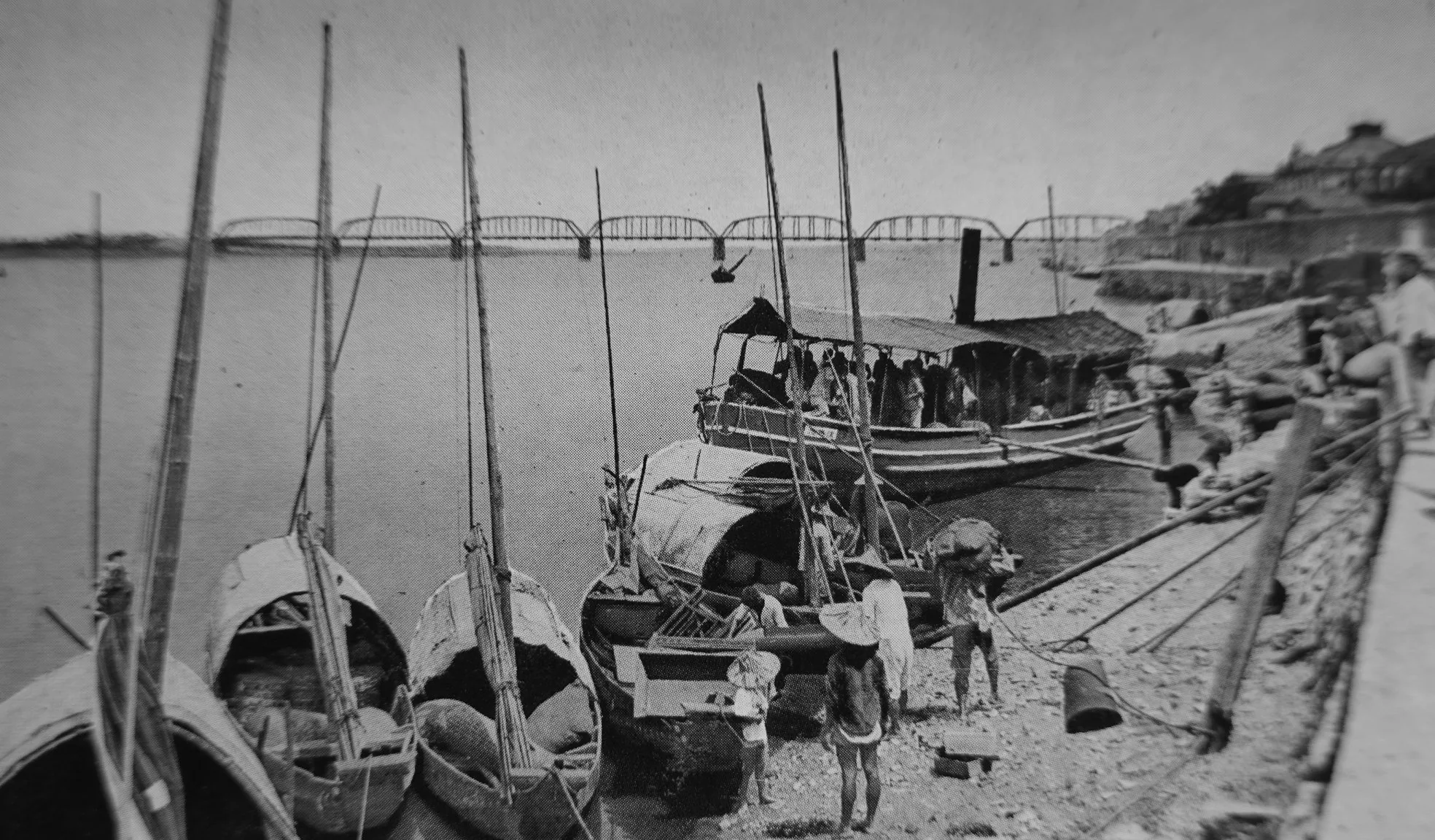
1920s Dadaocheng and the Tamsui River. Dodd's Dodd & Co. originally set up shop in Bangka, but after facing local anti-foreign sentiment, relocated to Dadaocheng in the north, inadvertently transforming this area into northern Taiwan's tea trading center.
In 1869, Dodd and Li Chun-sheng rented two fast clippers to transport 2,131 catties (approximately 213,000 pounds, or 128 tons) of Formosa oolong directly from Dadaocheng, clearing customs at the Tamsui Customshouse, and shipping all the way to New York. That same year, the Suez Canal had just opened for navigation. This batch of tea was well-received in New York, and "Formosa Oolong" became an instant hit, marking the beginning of Taiwan's tea export era. 4
There's a commonly misremembered detail here: the prosperity of Dadaocheng's tea trade was actually an accidental byproduct of anti-foreign sentiment. Dodd's Dodd & Co. originally set up shop in Bangka, but local merchants were unwelcoming of this foreigner encroaching on their territory, forcing him to relocate and start anew in Dadaocheng to the north. This move inadvertently turned Dadaocheng into northern Taiwan's center for the tea trade. By 1870, the area had gathered five major trading companies, with a row of foreign-style buildings lining the riverbank. Taiwan was discovered by outsiders, forced to turn around, and ultimately flourished in the place it had turned to—a story as winding as the tea itself.
Source: Chinese and English Wikipedia, Academia Sinica Digital Archives
The Quota Agreement Left Out an Island
On February 9, 1933, the three major black tea-producing regions of the world — British India, Ceylon, and the Dutch East Indies — signed the International Agreement for the Restriction of Tea Exports, agreeing to reduce production and control tea prices, with the term running from 1933 to 1940.5 This agreement had a loophole: Japan was not a signatory, and at the time, Taiwan was a Japanese colony, so it was naturally not bound by the restrictions. While others were handcuffed, Taiwan's black tea seized the opportunity to break through.
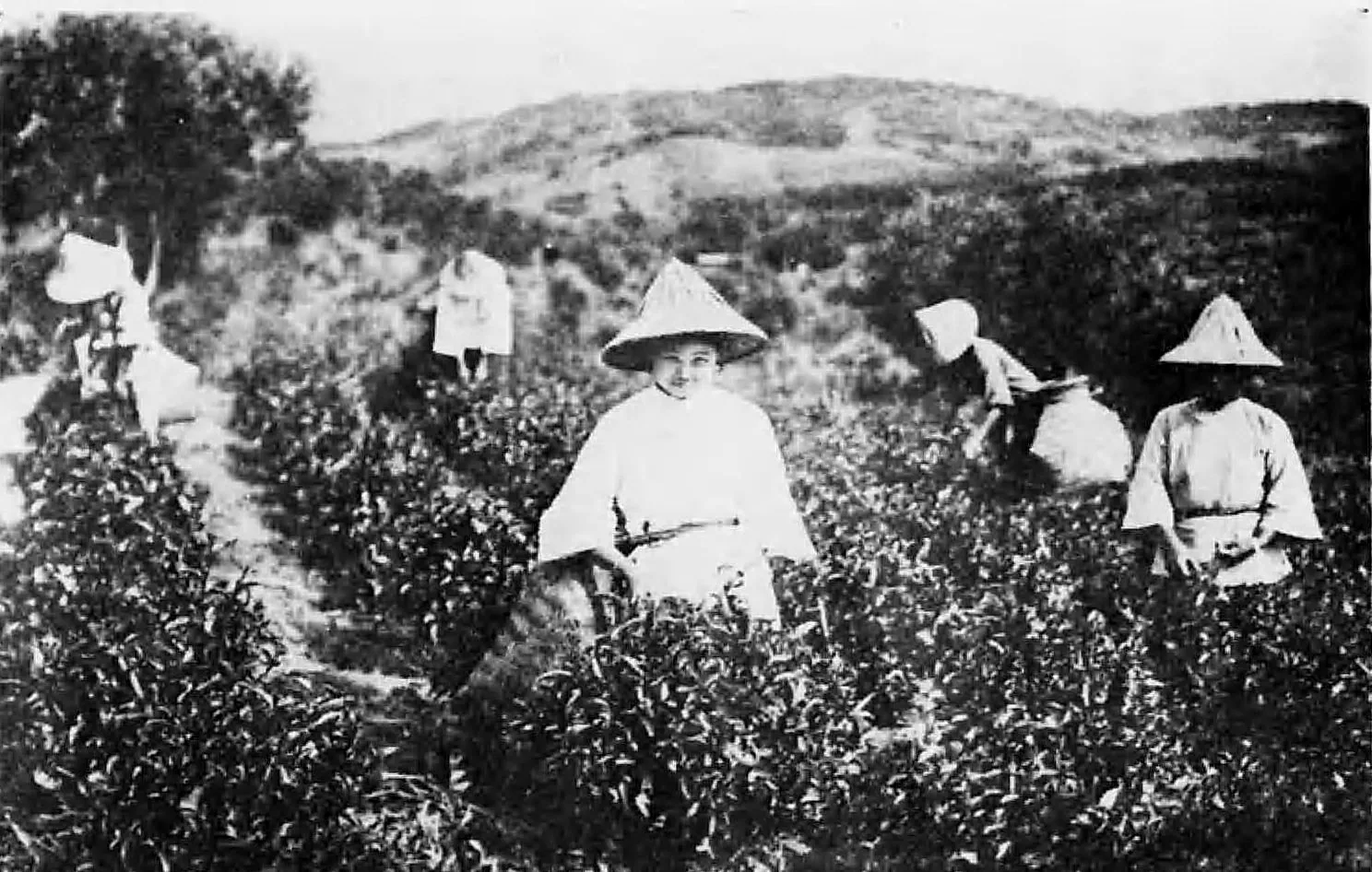
_ A tea plantation in Taiwan around 1933. Just as the world's three major black tea-producing regions were handcuffed and reducing output, this island — not bound by the agreement — was about to surge into its golden age. _
The numbers jumped dramatically. In 1933, before the agreement took effect, Taiwan's black tea exports were only 820,000 kg. In the first year of the agreement's enforcement, 1934, exports surged to 3,296,532 kg in a single year — nearly a fourfold increase.6 By 1937, industry estimates placed Taiwan's black tea exports at 580,000 kg, accounting for more than half of Taiwan's total tea exports that year.7 Oolong, green tea, and black tea — three types of tea — stood side by side in the export market at the end of the Japanese colonial period.
Source: National Cultural Memory Database; 1937 figure is an industry estimate (Tea Academy)
💡 Did you know: In 1937, black tea produced around Sun Moon Lake was sold at auction in London, England, under the name "Formosa Black Tea." According to the National Cultural Memory Database, it was "unanimously praised by all quarters"8. A leaf plucked in the mountains of central Taiwan traveled across the sea to the heart of the British Empire to be auctioned — this was the most glorious moment for Taiwan's black tea, and also the second time the "Formosa" brand shone on the international market.
Behind this golden age of black tea stood a Japanese man's name: Arai Kōjirō. He arrived in Taiwan in May 1926, established a black tea experimental station in Fish Lake, Nantou, in 1936, and became the station chief in 1941. The Japanese Wikipedia even specially noted his identity: "the last Japanese chief."9
The most moving part of Arai's story is the period at the end of the war. As the military situation grew dire, headquarters ordered him to convert the tea gardens to food crops. He refused, stubbornly preserving the batch of black tea experimental tea trees. When Japan surrendered in 1945, he handed over his position as station chief to the successor, Chen Wei-chen, sent his wife and children back to Japan, and chose to remain, continuing to guide Taiwan's black tea research as a technical advisor. On June 19, 1946, he contracted malaria and died at the age of 42. It is said that after his death, a staff member saw a firefly flying toward the tea fields, believing it was Arai's soul transformed into a firefly, still guarding those tea trees.9 The batch of tea trees he preserved later became the foundation for breeding at the Fish Lake branch station after the war. Today, Taiwan's famous black tea cultivar, Taiwan Tea No. 23 "Chi Yun," was selected and bred from the base of these very tea trees.
The Year the Export Market Collapsed: Champion Tea at NT$5,000 per Catty
How did Taiwan tea's export business finally collapse? The popular story blames the 1970s energy crisis combined with international low-cost competition, which supposedly knocked Taiwan tea flat on its face. But this narrative gets the causality backwards.
📝 Curator's Note: Flipping through a peer-reviewed paper attached to a curve of export volumes from the Journal of National College of Commerce, from 1970 to 1978, Taiwan tea exports actually remained stable at roughly 20 million kilograms per year10. The energy crisis didn't hurt Taiwan tea at all — it was actually a boon: oil prices rose, coffee prices followed, and some people switched to tea; the Chinese Cultural Revolution halted mainland tea exports; India and Sri Lanka experienced population booms and strengthened domestic demand, reducing their export volumes. While others made space, Taiwan stepped in. The real collapse came after 1979, and the main cause wasn't "others becoming cheaper and grabbing market share," but rather "Taiwan itself became too expensive": the NT dollar appreciated, wages rose, production costs couldn't be brought down, and export competitiveness was lost one step at a time. The 1980s marked the true watershed moment when Taiwan tea shifted from export to domestic sales.
With the export route no longer viable, the tea had to turn around and sell to its own people. This pivot sparked the most creative period of self-reinvention in Taiwan tea's history.
In 1975, then-Premier Chiang Ching-kuo inspected Mingjian Township in Nantou County, tasted the locally grown "Puzhong Tea" — which could be harvested four times a year and whose tea trees stayed evergreen — and renamed it on the spot with a memorable and pleasant name: "Songbo Changqing Tea"11. A political figure's naming gave a once-obscure local tea a free nationwide marketing campaign. This approach of "telling stories about tea and turning tea into a branded product" became the core strategy of the domestic market era.
What truly institutionalized this approach was competition tea. The prototype of competition tea existed during the Japanese colonial period's sales promotion associations, but back then only certificates were awarded, with honor outweighing material gain. The turning point came in 1976: the Ministry of Agriculture and Forestry organized the first Taiwan Superior Tea Contest to promote domestic sales12. On May 2, 1976, the Lugu Township Farmers' Association held a contest for premium Dong Ding oolong tea at Lugu Elementary School. At the time, regular tea sold for NT$60-70 per catty, and a basic government employee's monthly salary was about NT$1,200, yet the champion tea of that contest commanded NT$5,000 per catty, drawing media coverage and causing a sensation across the island. (It is said that the first special prize was awarded to a tea merchant's brand from Lugu, though this person's name has only a single source, so we'll just treat it as a legend.)
Competition tea did far more than just select good tea — it reordered Taiwan tea's value hierarchy. From then on, tea had grading, rankings, and the possibility for tea farmers and merchants to achieve both fame and fortune.12
Competition tea didn't emerge out of nowhere. In 1975, a competition and sale event for Pouchong tea was held in Xinzhuang. According to sociological research by Chen Yu-xiang, that contest "immediately pushed tea prices up by more than threefold"13. Combined with the government's 1981 abolition of the "Tea Factory Establishment Regulations" and encouragement of tea farmers to produce and sell independently, these pieces finally came together. Taiwan tea completed a graceful transformation: from a product that watched international trends for its fate, it became a domestic premium product with stories, grades, and identity.
"Tea Art" — Two Characters That Don't Appear in Ancient Texts
In the domestic market era, to sell tea to one's own people, grading and hierarchy alone were not enough — it was also necessary to give the act of drinking tea a higher cultural identity. So Taiwan's tea circle did something quite bold: they invented a new term.
The two characters "tea art" sound ancient and elegant, as if they had been passed down from the Classic of Tea. In fact, they were not. According to research by the Academia Sinica, "tea art" is a new term created by Taiwan's tea circle from the mid-1970s to early 1980s. This term "does not appear in ancient texts, nor in Ci Hai"14. Why create a new term? Because "tea ceremony" had already been claimed by Japan. The Taiwanese wanted a way to distinguish themselves from Japanese tea ceremony while still connecting to Chinese tea culture — and so "tea art" was born. There are claims online that someone first coined this term in 1977, but upon verification, no solid evidence can be found. The more credible explanation is that this was a term gradually shaped by an entire generation of Taiwanese tea practitioners, with no single inventor.
With a term came space. In 1980, Cai Rongzhang founded the Lu Yu Tea Art Center, organizing the traditionally oral and informal elder tea-brewing methods into a systematic curriculum. Lu Yu's Tea Art Monthly ran from December 1980 to issue 320, and also held "tea brewing technician certification exams." By 2010, nearly 30,000 people had graduated and received certification.15 A simple tea that grandfathers used to casually brew under a veranda was transformed into a formal skill with textbooks, certificates, and a magazine.
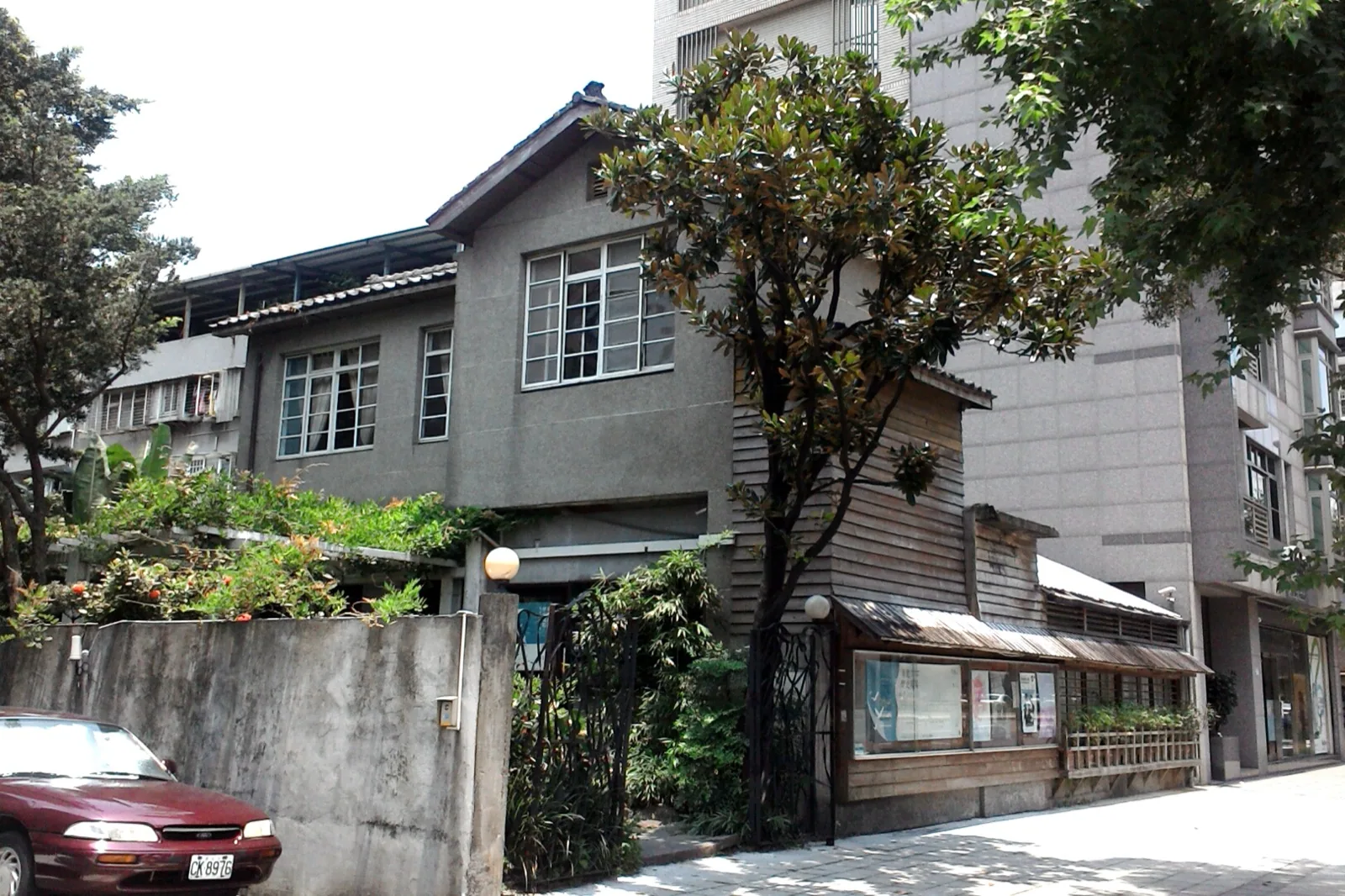
The Wisteria Tea House at the Gongguan Historic Site in Taipei. In 1981, Zhou Yu opened the first humanistic tea house in all of Taiwan in this Japanese colonial-era old mansion.
In 1981, Zhou Yu opened the Wisteria Tea House in a Japanese colonial-era old mansion in Taipei — Taiwan's first humanistic tea house. Zhou Yu was clear about his intention: he sought "tea for tea's sake, to beautify life, rather than as the Japanese use tea to discuss philosophy"16. These tea art houses both responded to the government's promotion of Chinese cultural revival in opposition to China's Cultural Revolution, and provided urban middle-class people with a quiet, refined social space. As for the first shop to hang a "tea art house" sign, some say it was opened by French fashion designer Kuan Shouling. According to government business registration records, it was hers in 1981 on Shuangcheng Street in Taipei. The complete lifestyle aesthetics behind the tea gathering, old mansion, and oriental beauty tea deserve a separate article (see Taiwan Tea Ceremony and Aesthetic Living).
A climax of this tea art revival was the "Selfless Tea Gathering" founded by Cai Rongzhang in 1990.
💡 Did you know: "In May 1990, Mr. Cai Rongzhang proposed the idea of founding the 'Selfless Tea Gathering'"17; in June of the same year, on June 23rd, at the 13th Tea Brewing Technician Graduation Ceremony at the Lu Yu Tea Art Center, about 70 tea brewing technicians each brought their own tea utensils and sat on the ground, holding tea for the first time in the form of a Selfless Tea Gathering; on December 18th of the same year, the first International Selfless Tea Gathering was held at the Ten Directions Zen Forest in Taiwan. Its rules were quite special, emphasizing seven major spirits: no distinction of status (seats determined by lottery), no intention of reward (the tea you brew is offered to your tea partner on the left without expecting anything in return), no preference or dislike, no distinction of region or school, the aspiration for refinement, adherence to announced commitments, and cultivation of collective harmony17. A group of people sitting in a circle, all equal, all serving others — turning the act of drinking tea into a near-spiritual collective ritual.
The Allure of Two Thousand Six Hundred Meters
Dong Ding oolong became the representative of Taiwan tea. But the Taiwanese ambition for tea quickly climbed higher.
The origin of Dong Ding oolong itself is shrouded in romantic mist. The most popular account says that in 1855, a man from Luguh named Lin Feng-chi went to take the imperial examinations in Fujian. After passing the higher-level exams, he brought back 36 sprouts of Qingxin oolong from Wuyishan. Of these, 12 were planted near Chi-Lin Pond in Luguh, marking the beginning of Dong Ding oolong. Other versions, such as the Su family's migration in 1684 and Shuishalian's indigenous origins, also exist. Who is right and who is wrong, even Wikipedia doesn't take sides. The Taiwan tea circle simply doesn't dwell on the origin—after all, in modern times, Dong Ding has already become Nantou Luguh's trademark: "Nan Dong Ding, Bei Pouchung."
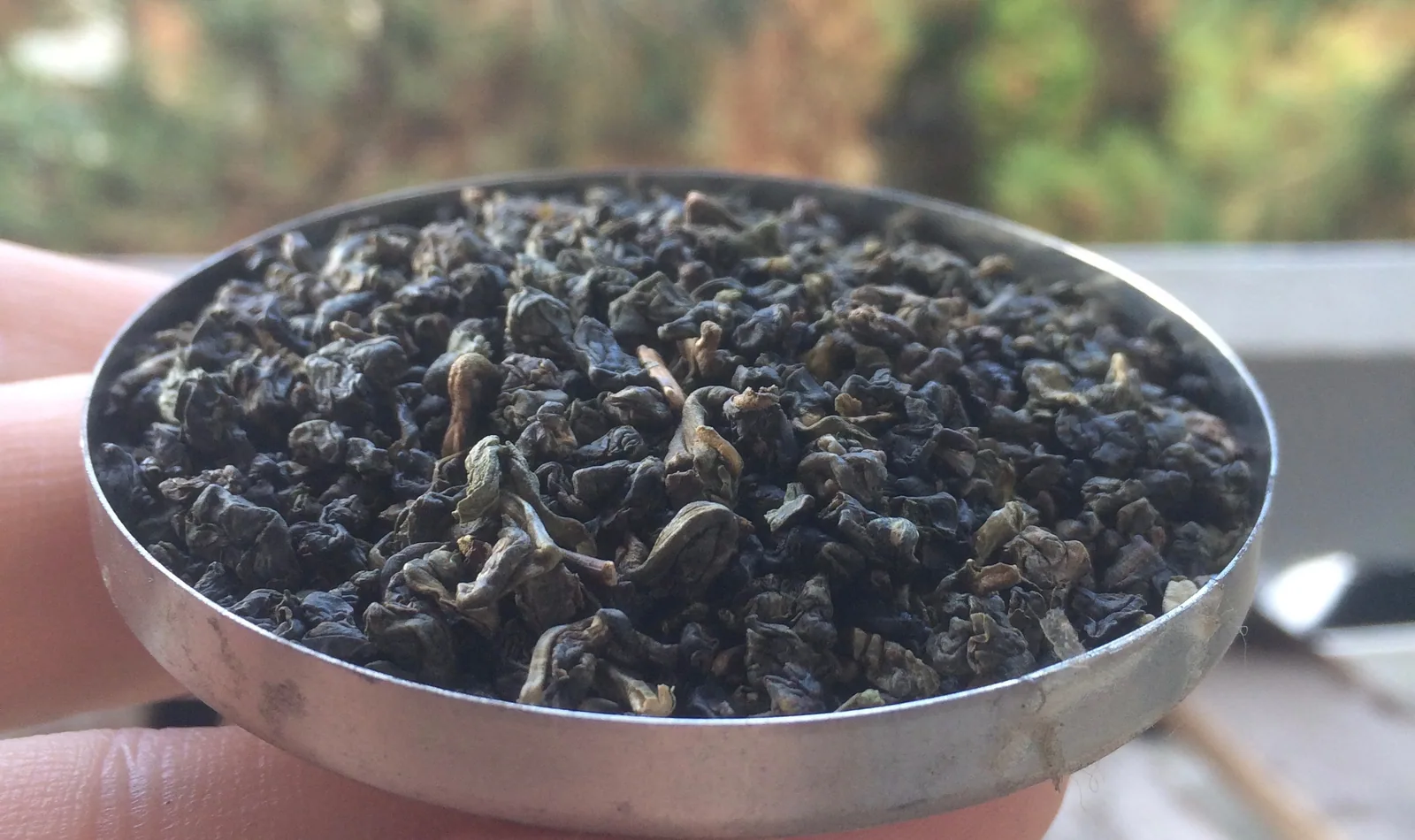
The dry leaves and tea liquor of Dong Ding oolong. The low-temperature slow-roasted Dong Ding was once the representative of Taiwan tea, until high-mountain tea drew consumers' attention to higher elevations.
What truly pushed Taiwan tea to the extreme was elevation. The Dong Ding tea region is roughly between 600 to 1,200 meters, but tea farmers kept climbing upward. Alishan and Shanlinxi climbed to 1,000 to 1,600 meters, while Lishan and Tatungling broke through 1,600 meters. The Tatungling tea region once reached an elevation of 2,650 meters, making it the highest tea region in Taiwan. Until 2015, when the government large-scale removed the highest tea gardens due to their location in the Deji Reservoir watershed area affecting water and soil conservation, the remaining highest tea region dropped to about 2,400 meters.18
Source: Liberty Times (Tatungling); elevation ranges for each tea area are industry-standard intervals
Why does elevation make tea taste better? Chiu Chuei-feng, deputy director of the Tea Experiment Station, explained a key mechanism.
✦ "High-mountain day-night temperature differences are large. Tea trees conduct photosynthesis during the day, producing carbohydrates and sugars. At night, the low temperatures mean less respiration and lower energy consumption, thus accumulating a lot of sweetness, making high-mountain tea smooth and enduring."19
The stronger ultraviolet rays at high elevations stimulate the synthesis of amino acids that determine freshness in tea leaves. The constant clouds and mist on the mountains reduce the accumulation of tannins that cause bitterness. Temperature differences, ultraviolet rays, and clouds—three independent mechanisms stacked together, pushing the sweetness, fragrance, and freshness of high-mountain tea upward.
However, the allure of elevation also brought reflection. Senior tea evaluator Chen Huan-tang wrote a chapter titled "The Confusion of High Mountains" in Taiwan Tea's First Lesson, criticizing the market's "elevation-only" fallacy—that consumers are actually buying "the elevation of the origin" and "brand stories," making low-elevation old tea regions increasingly difficult to survive.20 The relentless climb to higher elevations was Taiwan tea's attempt to push "refinement" to the extreme, at the cost of mountain forests' water and soil, and the livelihoods of low-elevation tea farmers. This is one of the more bitter aspects of Taiwan tea's many faces.
A Plastic Cup Republic Born from a Shaker
In 1979, Liu Han-chieh from Taichung was traveling in Japan. When he asked for ice in a tea shop, he was politely refused — the Japanese didn't have a habit of drinking iced tea at the time. Undeterred, he returned to Taiwan and shook his iced tea in a shaker he had brought back from Japan, accidentally discovering a refreshing and delicious foamy iced tea. In May 1983, he opened "Yangxuan Tea House" (the predecessor of Chunshui Tang) at No. 24-1, Siwei Street, Taichung, and put this foamy tea on the menu.21
Who actually invented foamy tea is just as disputed as the origins of bubble tea later on. Shuangquan Hongcha in Tainan (founded in 1949) claims to have had a similar drink during the Japanese colonial period, and Xiaoxie Tea House in Taichung has its own origin story. What is certain is that Chunshui Tang transformed foamy tea from a single drink into an entire industry. Within just one year, six foamy tea shops had sprung up across Taichung City alone. These shops featured Western-style counters and traditional rattan chairs, where young people would sit for hours playing cards, smoking, and chatting. This was Taiwan's first "tea you could linger over." In 1987, Chunshui Tang's manager Lin Xiuxue poured tapioca pearls into milk tea, giving birth to bubble tea — but that's a much bigger story for another time (see Bubble Tea).
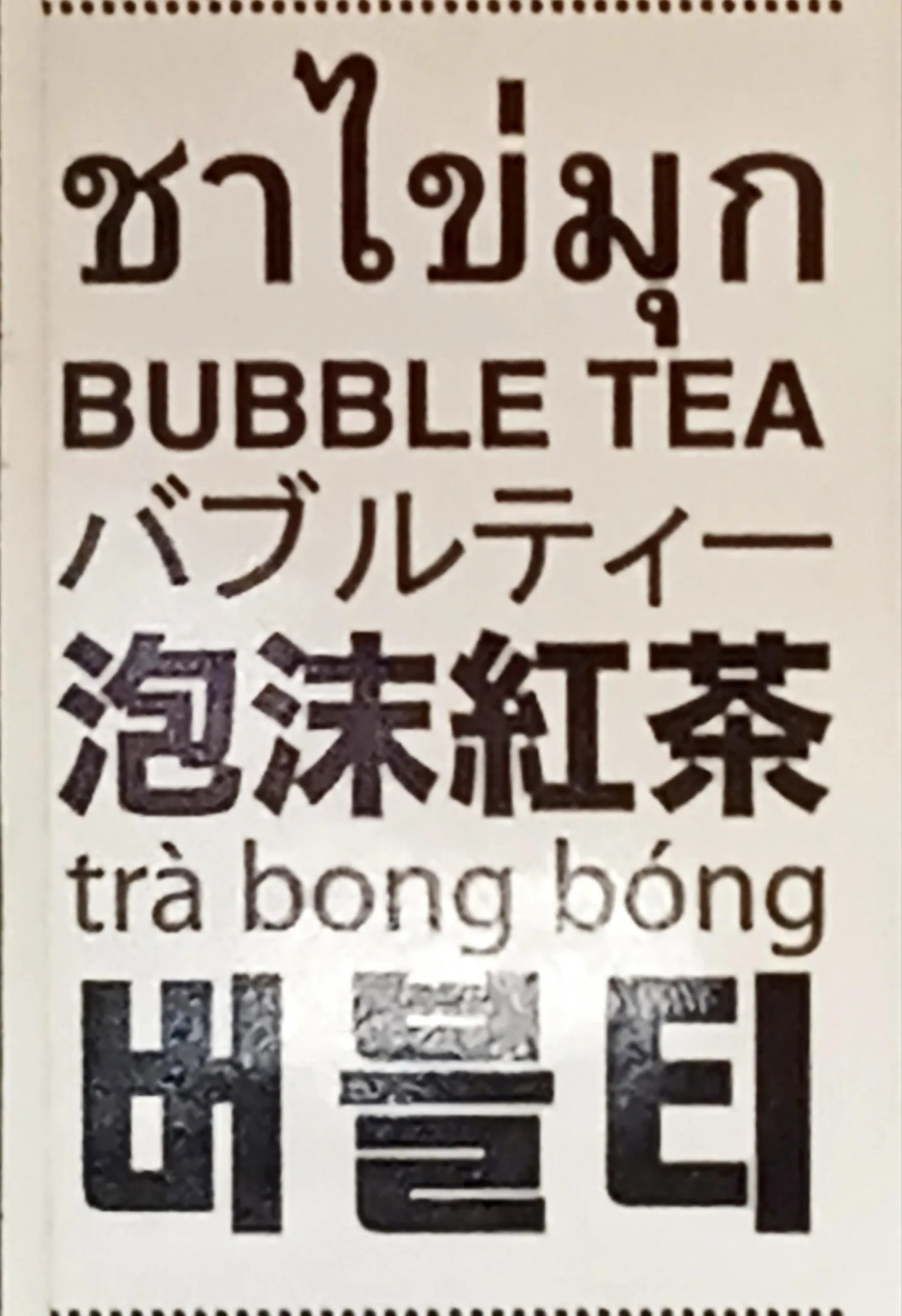
The six languages of “Bubble Tea.” From a staff meeting at a tea house in Taichung to a menu item on tables around the world.
Almost simultaneously with foamy tea, another trend was emerging: putting tea into cans. In 1985, C'est Bon Oolong Tea hit the market, becoming "Taiwan's first commercially successful canned oolong tea beverage"22. However, it struggled for several years after launch and didn't sell well. What truly turned things around was a series of advertisements starting in 1990.
💡 Did you know: C'est Bon's comeback was driven by a plainclothes star — a mother. "Granny C'est Bon" was born Zhou Liangxue. According to reports, "six years ago she was washing cars when a client's advertising company executive happened to spot her and invited her to audition"23 — a car-washing mother in her 60s was chosen by an ad agency, went on to film over a dozen commercials, and even walked the red carpet at the Golden Melody Awards. Behind her was advertising genius Ye Liangchuan, who used the concept of "New Humans" to create a strong generational contrast with the traditionally dressed Granny C'est Bon. This series of ads even made it to the Cannes Film Festival advertising selection in 199323. C'est Bon's aluminum cans went from struggling to becoming a collective memory, and even though the brand was sold for NT$650 million due to debt disputes in 200524, Granny C'est Bon's image remains etched in the minds of an entire generation.
The next wave in canned tea was "sugar-free." In 2001, Shaun Wang of Vitasta returned from an internship in Japan and launched unsweetened green tea "Royal Spring"; in 2002, Uni-President introduced "Tea King"25. Sugar-free canned tea captured the hearts of office workers who wanted to drink tea without the sweetness, becoming a regular fixture in convenience store refrigerators.
But what truly turned Taiwan into a "plastic cup republic" was the rise of hand-shaken beverages. The scale of this business is staggering: according to Ministry of Finance statistics, as of the end of May 2024, there were 16,070 hand-shaken beverage shops across Taiwan, accounting for 57% of all beverage shops26. Just how significant is this number? Roughly one hand-shaken shop for every 1,400 people in Taiwan. The hand-shaken industry also gave rise to an entire supply chain — about 80% of the base tea comes from Nantou's Mingjian Township, sealing technology comes from the sealing machines that appeared around 1985 (see Beverage Sealing Machine), and how this cup of tea became a form of soft power on the global stage is a story for another article (see Taiwan Hand-Shaken Drink Culture).
However, by September 2025, while hand-shaken beverage shops were still increasing in number (16,113 shops), their share had dipped slightly from 57% to 56% — the first decline in recent years27. As coffee shops and other beverage shops multiply faster than hand-shaken ones, this cup of tea in a plastic cup has, for the first time, encountered the limits of growth.
Dark Current: Vietnamese Tea at NT$30 per Catty
The higher Taiwan's tea climbs and the pricier it sells, the more it invites a dark current: fake tea.
The root of the problem is the supply-demand gap. Taiwan produces only about 14,027 tons of tea per year (2022 figures from the Council of Agriculture)28, but domestic consumption far exceeds this amount, and the shortfall can only be made up through imports. A large portion of imported tea comes from Vietnam. Vietnam's cost advantage is remarkable—as one tea merchant put it, "Vietnamese tea, backed by a cost advantage of NT$30–70 per catty, is absolutely dominant in the low-price tea market"29. At NT$30–70 per catty, Vietnamese tea contrasts sharply with Taiwan's high-mountain tea, which starts at NT$1,000 or more per catty—the price difference is precisely the motivation for counterfeiting.
Thus, stories occasionally surface of businesses passing off Vietnamese tea as Taiwan's high-mountain tea for sale. An expert from the Tea Industry Research and Extension Laboratory speaks plainly: mixing tea leaves from different origins is not inherently illegal; the real issue lies in unclear labeling and deliberate deception. To combat fake tea, Taiwan has developed a system of origin-certification marks—Alishan high-mountain tea, Lugu Dongding oolong, Wenshan Baozhong tea each have their own certification mark, allowing genuine origins to present evidence. This dark current will not disappear; it is an unavoidable shadow of Taiwan's path toward tea "premiumization": the more "Taiwan" and "high mountain" become valuable brands, the more people seek to counterfeit those brands.
The Time in Tea
Today, only 0.14% of the tea consumed worldwide is exported from Taiwan; Taiwan’s tea production accounts for less than 2% of the global total. Yet the export price of Taiwan tea reaches $11.06 per kilogram, 3.3 times the global average30. Quality over quantity — this is the position Taiwan tea has carved out for itself over the past century. From Sanxia Bi Luo Chun green tea (see Sanxia Tea) to Nantou’s Dong Ding oolong, to Yuchi’s Sun Moon Lake black tea, Taiwan produces all six major tea categories; a single variety, Qingxin oolong, accounts for 60–70% of all tea trees on the island31. This island was already home to wild tea trees — in 2009, the botanical community confirmed through DNA testing that Taiwan camellia (Camellia formosensis) is a distinct species, echoing the line from the 1717 Zhuolo County Gazetteer: “There are many wild teas deep in the mountains of Shuishalian”32.
Source: Taiwan Economic Monthly, Tea and Beverage Crop Improvement Office
Three centuries ago, those wild tea trees grew deep in the mountains of Shuishalian, where Han settlers “dared not enter to harvest, nor did they know the method of tea-making.” Three centuries later, this island not only learned how to make tea but also invented gongfu tea, covered bowls, Yixing clay teapots, competition-grade tea, canned tea, and hand-shaken tea — all the way to plastic cups.
A century after Lian Huan wrote “The teapot must be Mengchen, the cup must be Rushi,” people walking into bubble tea shops in Taiwan say without hesitation, “less sugar, less ice.” Between the covered bowl and the Yixing clay teapot, between Tao De’s flying scissor ship, Xinjing’s fireflies, the auction at Lugu Elementary School that reached NT$5,000, and Auntie Kai’s aluminum cans — the containers in hand have cycled endlessly. The tea drinkers have shifted from Qing Dynasty merchants to office workers in skyscrapers, from leisurely elders to middle school students on their way home from school. Yet one thing has remained unchanged from beginning to end: this island has always been able to take things from the outside world — Wuyi tea varieties, Japanese snow cups, British black tea auctions — and brew them into a flavor that is uniquely its own.
In Taiwan, tea is not a formal ritual to be performed with dignity; it is part of daily life. It is the little pot at the grandfather’s stall under the arcade, the plastic cup of less sugar and less ice on the way home from school — the flavor this island can drink at any time and is constantly rewriting.
Further Reading
- Taiwan Tea Ceremony and Aesthetic Living — the complete lifestyle aesthetics behind tea gatherings, Zhitonglu, and Dongfang Meiren
- Bubble Tea — the complete story and origin disputes of how it went from a Taichung staff meeting to a global beverage
- Taiwan Hand-Shaken Drink Culture — how Taiwan's hand-shaken brands went from street-side shops to the world
- Mingjian Puchung Tea — the Nantou town that supports 80% of the base tea for hand-shaken drinks
- Beverage Sealing Machine — the machine that caught the bubble tea golden era and was unexpectedly inspired by radish soup
Image Sources
- Alishan Tsou ethnic village tea garden: Yuyupas/Wikimedia Commons
- Gongfu tea utensils: Wikimedia Commons (Public Domain)
- Dazhi area, Tamsui River in the 1920s: Wikimedia Commons (Public Domain)
- Tea plantation in Taiwan around 1933: Wikimedia Commons (Public Domain)
- Zhitonglu Humanistic Teahouse: Wikimedia Commons
- Dongding wulung oolong tea and tea liquor: Wikimedia Commons — CC BY-SA 4.0
- Bubble tea six-character signboard: Wikimedia Commons
References
- Lián Huáng, "Yátáng Wénjí· Míngtán" (quoted from Taiwan Tea News blog) — The original source of the Qing Dynasty Taiwanese elite's three essentials for tea brewing—'tea must be Wuyi, teapot must be Mengchen, cup must be Ruoshan'—verified by cross-referencing with an academic paper from the Bei Shang Xue Bao.↩
- Yu Jiao, "Cháo Jiā Fēngyuè" (Wikisource) — The complete gongfu tea brewing method recorded in Yu Jiao's 'Mèng Chǎng Zázhuó· Cháo Jiā Fēngyuè Jì' from the late Qing Dynasty's Qianlong era, representing the earliest textual record of 'gongfu tea'.↩
- Zhūluó Xiànzhì, Volume 12 (National Digital Library of China) — Compiled by Zhōu Zhōngxuán in 1717 (Kangxi 56th year), documenting water and sand mixed with wild tea, this is the earliest textual record of tea in Taiwan (the entire 1697 'Bì Hǎi Jìyóu' is often mistakenly cited but contains no mention of 'tea').↩
- John Tod (Chinese Wikipedia) — A complete timeline of John Tod's first arrival in Taiwan in 1860, establishment of the Pao Shun Trading Company in 1867, and shipment of 2,131 catties of oolong tea to New York by two clipper ships in 1869; the English Wikipedia's '128 metric tons' matches the conversion of 2,131 catties and can be cross-verified.↩2
- International Tea Committee History — On February 9, 1933, British India, Ceylon, and the Dutch East Indies signed the International Tea Export Restriction Agreement, effective from 1933 to 1940; Japan did not sign, so Taiwan was not restricted.↩
- Changes in Taiwan Black Tea Exports During the Japanese Colonial Period (National Digital Library of China) — Official digital archive showing Taiwan black tea exports of 823,078 kg in 1933, surging to 3,296,532 kg in 1934 when the agreement took effect, with figures precise to the unit.↩
- Historical Context of Taiwan Tea (College of Tea Studies) — Industry estimate of 5.8 million kg of Taiwan black tea exports in 1937, accounting for 52% of that year's exports (not traced to original Japanese colonial official statistics, widely cited in the industry).↩
- The Rise of Dongfang Hong Tea (National Digital Library of China) — Official archive showing that in 1937 (Showa 12th year), Riyueyan black tea was auctioned at the London auction under the name 'Formosa Black Tea' and received unanimous praise from all quarters.↩
- Arai Kōjirō (Japanese Wikipedia) — The father of Taiwan black tea: arrived in Taiwan in 1926, established the Yuchih Black Tea Experimental Station in 1936, served as the last Japanese station chief in 1941, and died of malaria on June 19, 1946; the firefly legend and wartime refusal to cut tea trees are corroborated by Nippon.com.↩2
- Changes in the Structure and Business Models of Taiwan's Tea Industry (Bei Shang Xue Bao, Issue 37) — By Hé Zhìfēng, Lín Hàoyǔ, and Hé Qīngrù, a peer-reviewed paper using export volume curves to prove stable exports of approximately 20 million kg from 1970 to 1978, followed by a significant decline after 1979 due to Taiwan dollar appreciation and rising wages.↩
- Mùbó Zhǎngqīng Tea (National Digital Library of China) — Originally named 'Pǔzhōng Tea' and 'Mùbó Kēng Tea', grown in Nántōu Míngbó Lǐng, named by Chiang Ching-kuo, then Premier of the Executive Yuan, in 1975 due to its four harvests per year and evergreen tea trees.↩
- Competition·Tea: The Rationality and Emotionality of Taiwan Tea (Classic Magazine) — The first Taiwan High-Quality Tea Competition organized by the Ministry of Agriculture in 1976; in 2011, a catty of top-grade frozen-top oolong from Lugu Township Farmers' Association won a record price of 300,000 yuan at auction.↩2
- Constructing Taiwan Tea (Lane House Sociology) — Chen Yuxi from the Department of Sociology, Sun Yat-sen University: 'The first Tieguanyin tea competition and sales fair was held in Xindian in 1975, immediately raising tea prices by more than threefold.'↩
- New Creations of Tradition: Tea Art Originating from Taiwan (Academia Sinica's 'Have You Seen It') — 'Tea art' is a new term coined by the Taiwan tea circle from the mid-1970s to early 1980s; this term does not appear in ancient texts or in the dictionary.↩
- About Us - Arai Tea Art Center Website — Founded by Cai Rongzhang in 1980; 'Tea Art Monthly' was published from December 1980 to its 320th issue; by 2010, nearly 30,000 people had obtained tea brewing certification certificates across all subjects.↩
- Who's for My Tea? Who's Against? (Story Studio) — In 1981, Chou Yu founded Taiwan's first humanistic teahouse, Purple Vineyard, advocating 'tea for tea's sake, beautifying life, rather than using tea to discuss Tao as the Japanese do,' aligning with the Chinese cultural renaissance movement.↩
- Origin and Seven Spirits of the Selfless Tea Gathering (Sina Blog) — Tsai Rongzhang proposed the idea in May 1990, first implemented at the 13th Tea Master Certification Ceremony by Lu Yu on June 23, and the first International Selfless Tea Gathering was held at Shifang Monastery on December 18. See the same site's article 'Seven Spirits of the Selfless Tea Gathering' for the seven spirit articles.↩2
- Dasyueshan Tea Region and the 2015 Clearance (Liberty Times) — Dasyueshan's highest tea region reached an altitude of 2,650 meters, but in 2015, due to being within the Deji Reservoir watershed area and violating afforestation regulations, it was requisitioned by the government; the remaining highest altitude dropped to about 2,400 meters.↩
- The Changing High-Mountain Tea (Upstream and Downstream News) — Tea Industry Improvement Station deputy director Chiu Chuingfeng explains the causes of large temperature differences between day and night in high mountains, low energy consumption during breathing at night, and accumulation of sweet components, with named experts quoted verbatim in interviews.↩
- Author Introduction: Chen Huan-tang (Commonwealth) — Chen Huan-tang, born in 1952 into a tea farming family in Nanyuan, Nantou, became a Level A tea appraiser certified by the Republic of China Tea Art Association in 1983 (one of only two nationwide); his work 'Taiwan Tea: First Lesson' Chapter 2 'The Confusion of High Mountains' criticizes the market's sole focus on altitude.↩
- Spring Water Hall Humanistic Teahouse (Chinese Wikipedia) — In May 1983, Liu Han-jie established 'Yangxian Teahouse' (the predecessor of Spring Water Hall) at No. 24-1, Siwei Street, Taichung, pioneering the culture of foamy black tea cold drinks; there are also multiple origin stories for foamy black tea such as Double Perfection Black Tea.↩
- Kaixi Oolong Tea (Chinese Encyclopedia Newton) — Launched the first canned oolong tea beverage in 1985, it was Taiwan's first successfully commercialized canned tea drink; Xinxing Industry was founded in 1981, and Kaixi Oolong Tea was launched in 1985.↩
- Grandma Kaixi Creates Billions in Business at Age 60 (Report Time) — Grandma Kaixi, born Zhou Liangxue, was originally a plain housewife who washed cars for others until she was discovered by an advertising company; advertising creative Yeh Liangchuan used the 'new human being' appeal to create a series of advertisements, and in 1993, it was selected for the Cannes Advertising Festival (see Brain DeedDoer cross-verification).↩2
- Xinxing in Crisis: Deji Trading Affected (Liberty Business) — In January 2005, due to Xinxing Industry's debt arrears to Deji Trading, Deji purchased the usage rights of the Kaixi Oolong Tea Taiwan trademark for 65 million yuan and sent staff to take over the factory.↩
- Tea King (Chinese Wikipedia) — Uni-President launched Tea King in 2002; Vita Lemon Tea by Shaun Yue was developed and launched in 2001 (see Mirror Media https://www.mirrormedia.mg/story/20180615fin007/), both marking the beginning of Taiwan's sugar-free ready-to-drink tea era.↩
- Rapid Expansion of Bubble Tea Shops (Economic Daily News) — As of the end of May 2024, there were 28,193 beverage shops across Taiwan, of which 16,070 were hand-shaken drink shops, accounting for 57%; an average of 40.2 new hand-shaken drink shops opened each month.↩
- MOEA: Beverage Shop Revenue Grew 7.2% Year-on-Year in First 10 Months (Central News Agency citing Ministry of Finance statistics) — As of the end of September 2025, there were 28,788 beverage shops across Taiwan, of which 16,113 were hand-shaken drink shops, accounting for 56%, a slight decrease from 57%.↩
- What is the Annual Total Value of Taiwanese Tea? (Ministry of Agriculture Knowledge Base) — According to the Council of Agriculture, in 2022, the tea planting area in Taiwan was 12,192 hectares, with a production of 14,027 tons; domestic consumption far exceeded production, with about 85% relying on imports to make up the shortfall.↩
- Where Do 20,000 Tons of Vietnamese Tea Leaves Go Each Year? (Liao Changxing Tea Industry) — 'Vietnamese tea, with a cost advantage of 30-70 yuan per catty, is invincible in the low-price tea market'; here, 'catty' refers to the Taiwanese catty (600 grams), creating a huge price difference compared to Taiwanese high-mountain tea priced at thousands of yuan per catty.↩
- Achieving Taiwanese Tea Glory Through Diversified Strategies (Taiwan Economic Monthly) — The export unit price of Taiwanese tea leaves was 11.06 US dollars per kilogram, 3.3 times the global average; in 2011, the export volume accounted for only 0.14% of the global total tea exports, focusing on quality rather than quantity.↩
- Qingxin Oolong Proportion (Tea and Beverage Crop Improvement Office) — Qingxin Oolong is the tea variety with the longest cultivation history and widest distribution in Taiwan, accounting for approximately 60-70% of all tea trees in Taiwan.↩
- Treasure or Legacy? A Century of Exploration into Taiwan's Native Camellia (Classic Magazine) — Taiwan Camellia (Camellia formosensis) was first proposed by Ying Jing and Shozo Suzuki in 1937, and confirmed as an independent species through DNA analysis in 2009, providing evidence that there were indeed native wild tea plants in the Shuishalian area during the Qing dynasty.↩
🧬 What Semiont was thinking while writing this