
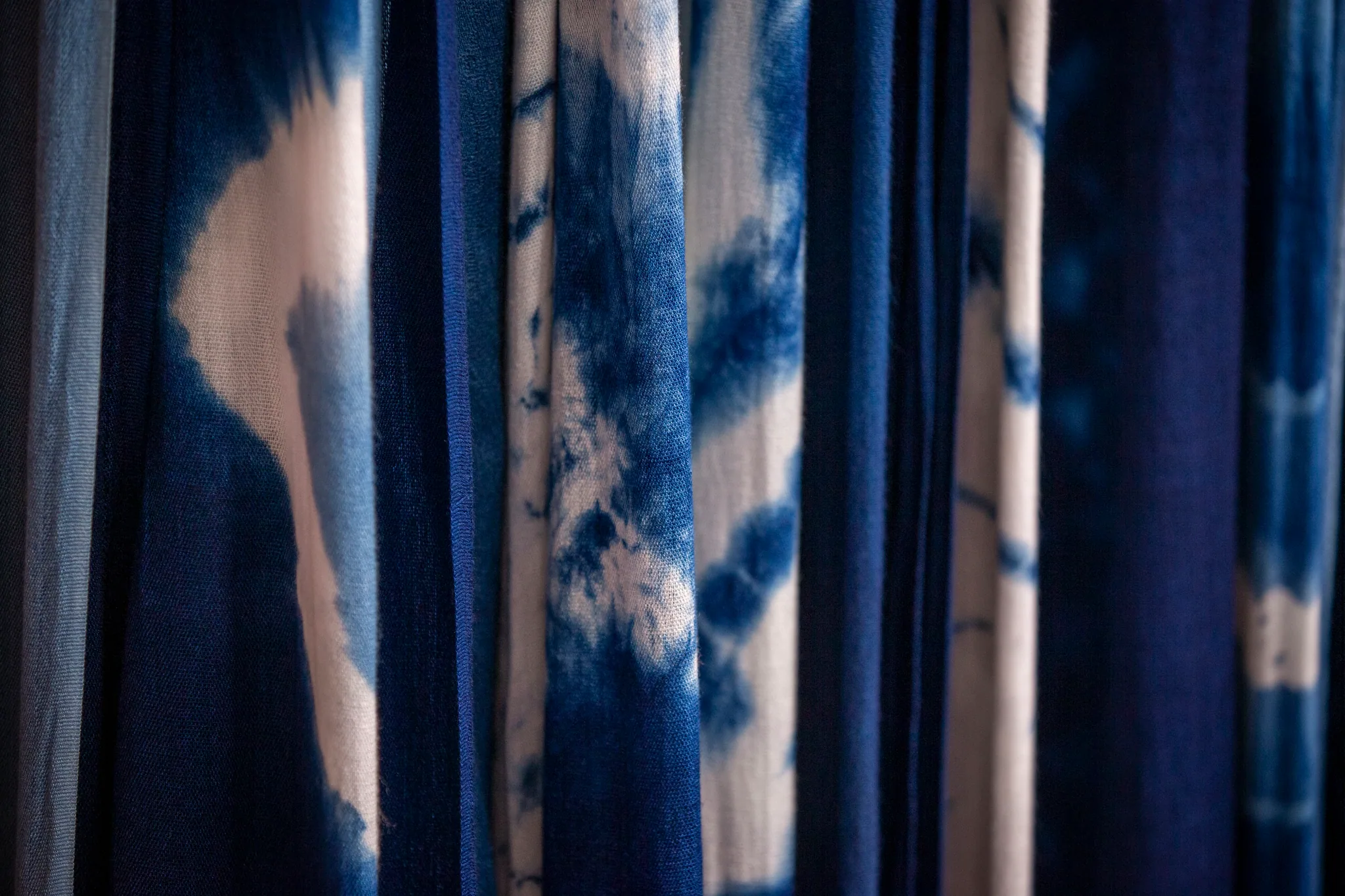
Sanxia indigo dyeing visitor center's display of tie-dye fabric. Photo: Presidential Office (Kenny Mori), CC BY 2.0.
30-Second Overview: In August 1999, members of the Sanxia Dye Workshop pulled a cloth from the dye vat, producing the first blue scarf in over seventy years after the craft had lain dormant in Taiwan. Once a major Qing-era export alongside tea and camphor, the industry shrank to just ten households island-wide by 1940. Today, four distinct groups—Sanxia, Miaoli's Joye Hut, Taichung's Taiping Blue, and Tainan's Chingliao—have independently relearned how to wait for a vat of living bacteria. The color can be saved, but whether to use sodium hydrosulfite to make it show color in three minutes remains an unresolved debate within the craft community.
In August 1999, inside a modest workshop in Sanxia, Chen Ching-lin watched the dye vat, waiting. Invited by the Sanxia Cultural Association to guide the process, he had arrived a year earlier after association members, recruited by veteran indigo researcher Ma Fen-mei, first climbed the Maokong hills near Taipei to harvest indigo grass and learn the vat-building process. The moment the cloth was pulled from the vat, its color was yellow-green; only after exposure to air did it slowly deepen, finally settling into blue. This was the first blue scarf dyed in Sanxia in over seventy years since the craft's decline1.
No one knew at that moment that over the next thirty years, this vat of color would live out four completely different lives across Taiwan.
Sanxia's revival was a community-driven movement initiated by local historians. Miaoli's Joye Hut is a family enterprise run by a farming couple. Taichung's Taiping Blue emerged from post-921 earthquake community reconstruction. Tainan's Chingliao guards a place name far older than the other three ("Ching" in Chingliao refers precisely to the plant used to produce indigo). These four groups operate independently, with no national organization linking them2. What they share is a single contradiction: to recreate this blue, you must first let a vat of living bacteria work at its own pace, but living bacteria do not care about tourist schedules or order deadlines.
A Living Vat of Color
The most counterintuitive aspect of indigo dyeing is that the raw material is a completely non-blue plant.
Taiwan's indigo dyeing primarily relies on two plant species: the Sanxia area uses Strobilanthes cusia (Da-chin, a herb in the Acanthaceae family), while southern Hakka settlements traditionally use Indigofera tinctoria (small indigo, a shrub in the Fabaceae family). The two belong to entirely different botanical families, with different cultivation environments and extraction details3. Regardless of the species, the leaves themselves are not blue; the indigo pigment only appears through fermentation.
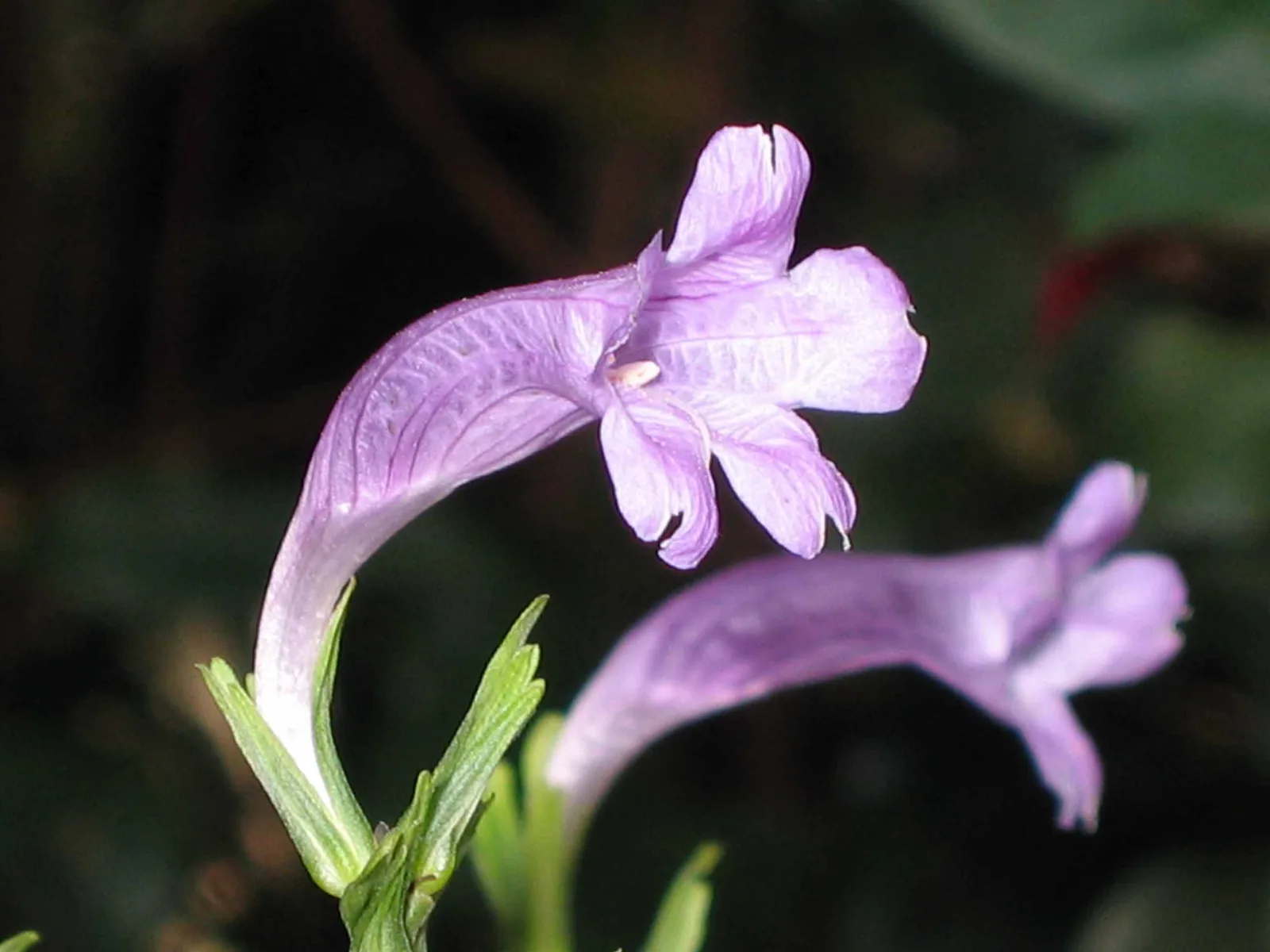
Strobilanthes cusia (Da-chin), the primary raw plant for Sanxia's indigo craft. The leaves are green and only turn blue through fermentation. Photo: HQ Aqiao, CC BY-SA 2.0.
The process divides into three stages. First is the "ch'ing-k'uo" soaking: the entire indigo plant is submerged in a stone-lined pool, relying on natural microbial fermentation for three to seven days to hydrolyze the leaf's indican into indoxyl. Next comes "ta-lan" oxidation: lime water is added and stirred vigorously; the indoxyl oxidizes upon contact with air into water-insoluble blue indigo particles, which settle and are scooped up to form the commonly known indigo paste. Finally comes the actual dyeing: fabric is soaked in a "chien-lan" dye vat, which must use natural reducing agents to convert the indigo paste back into soluble indoxyl, maintaining a temperature between 26 and 35℃ for three to seven days of fermentation. The fabric is soaked, pulled out, and the moment it contacts air, it shifts from yellow-green to deep blue. A single piece of fabric often requires repeated soaking to achieve the desired depth4.
📝 Curator's Note
This entire process requires heating not a single drop of water. It relies entirely on microbes working at the right temperature and pH. In other words, indigo dyeing is a craft of "waiting": the vat's condition changes daily, and experienced artisans can only read its shifts, not control them.
Cheng Mei-shu of Miaoli's Joye Hut has firsthand experience with this. Holding a master's degree in agronomy from Chung Hsing University, she served as director of the National Yuanlin Agricultural and Forestry High School's farm management and leisure agriculture department before retiring. She began learning indigo dyeing from Ma Fen-mei in 2001 and officially entered the indigo business with her husband, Cho Ming-bang, in 20045. After more than twenty years, her description of the dye vat is far from romantic: "The dye vat has a temper," and "indigo dyeing has far too much unpredictability"6. This is the most honest complaint from someone who interacts with these microbes daily.
Today, Joye Hut has restored nearly two hectares of indigo grass, producing over a thousand kilograms of indigo paste annually, accounting for seventy to eighty percent of Taiwan's total output7. From an agronomy master to a thousand-kilogram annual yield, the gap is filled by twenty years of daily learning to read a living vat's temper, not a single romantic pivot.
The First Blue Scarf in Over Seventy Years
Sanxia's path was longer and more "self-driven."
In 1990, local residents in Sanxia launched a campaign called "Finding the Lost Sanxia Blue," initially just hoping to recover the memory of the old street once lined with dye workshops. In 1994, the Sanxia Historical and Cultural Studio was established, officially registering as the Sanxia Cultural Association in 1996. In May 1998, association members, recruited by Ma Fen-mei, went to Maokong to learn vat-building, after which Ma introduced Chen Ching-lin to guide them. A year later came the moment at the article's opening: pulling yellow-green cloth from the vat and watching it turn blue8. In April 2001, the Sanxia Dye Workshop was officially established, beginning to train seed instructors.
The detail most easily misunderstood in this timeline is the government's role. Sanxia co-hosted the first Indigo Festival with the Taipei County Government's Cultural Bureau in 2002, not the New Taipei City Government, as New Taipei City was only elevated from Taipei County in December 20109. More importantly, the sequence itself: the revival's initiation, expert recruitment, skill acquisition, and workshop establishment all occurred before government intervention. The government only joined to co-host festivals after the community had already recovered the technology and trained the seed instructors.
The Sanxia Cultural Association's executive director, referred to as "Liu Mei-ling" by most editorial-standard media10, has spoken bluntly about how difficult this path was: "Actually, no one was optimistic about indigo dyeing." After twenty years of restoration, "people have slowly seen a bit of a future over the past decade"11. Waiting twenty years for the words "a bit of a future" is the most honest metric from someone who actually did the work for twenty years, measuring the word "revival."
Sanxia's dye workshop later collaborated with Fu Jen Catholic University's Textile and Apparel Research Institute and internationally renowned fashion designer Li-fen Hung12. Hung has cultivated fashion design across Taiwan and Paris for over forty years. In the 1990s, she simultaneously studied under bamboo-weaving master Chang Hsien-ping and ceramic artist Chiu Huan-tang. Indigo dyeing was one stop in her apprenticeship with multiple Taiwanese craft masters; she personally traveled to Sanyi to hand-make indigo scarves, dyeing them with distinct depth gradients13. Behind a fashion-circle-recognized work stands an entire technical chain starting from harvesting indigo grass in Maokong.
Two Hectares of Indigo Grass Fields from an Agronomy Master, Paris Display Cabinets
Joye Hut walks a completely different path, while Taichung's Taiping Blue walks yet another.
If Sanxia is a community collective action, Joye Hut is a couple's corporate investment: Cheng Mei-shu and Cho Ming-bang turned indigo dyeing into a business starting in 2004. Today, Joye Hut calls itself Taiwan's largest plant-dye base and Asia's largest indigo dye base14. This path pursues scale: two hectares of indigo grass, a thousand-kilogram annual indigo yield, supplying seventy to eighty percent of the island's output. This is a self-sufficient industrial chain, even supplying peers, not a museum displaying craft.
Taiping Blue follows a "crisis births new industry" path. The September 21, 1999, earthquake's epicenter passed through the Chelungpu Fault in Taiping, Taichung, devastating the area. Yeh Chin-yu, then a professor at Taichung University of Science and Technology and chairman of the Water Source Cultural Foundation, called on youth volunteers to settle in Tou-fien-keng to assist community reconstruction15. The foundation initially tried promoting Hakka cuisine and floral fabric, both hitting同质 competition, until discovering local Hakka already had an indigo tradition: "Early Hakka lacked money for beautiful clothing, using local materials to extract dye from plant leaves to add color to garments"16, shifting focus to indigo. In 2008, the Hakka indigo route was officially set; in 2012, after project manager Chan Ya-wen joined, the craft was formally branded as "Taiping Blue"17.
📊 Taiping Blue Specifications
Item Figure Brand Established 2012 (Workshop origins: 1999 921 reconstruction) Dye Extraction Ratio 10 kg leaves yield ~1 kg dye Soaking Process 16 soaks, achieving 12 gradient stages International Exhibitions Exhibited at Paris Maison & Objet starting 2017 Design Awards Won Ministry of Economic Affairs Golden Point Design Award in 2018
Ten kilograms of leaves for one kilogram of dye, this ratio itself says one thing: this craft has no shortcuts, whether you're dyeing a scarf or displaying it in a Paris home furnishings exhibition cabinet. Taiping Blue indeed later sent works to Paris, Singapore, and Bangkok's international furniture and home furnishings exhibitions18, but the foundation supporting this path remains the volunteers who stayed in Tou-fien-keng after 921, and the same patient soaking process requiring waiting.
Tainan's Houpi Chingliao provides a coordinate older than Sanxia or Miaoli. The place name "Chingliao" itself originates from the indigo raw plant "ch'ing-tzŭ" (small indigo, i.e., Indigofera tinctoria). The 1717 (Kangxi 56) Chuluo County Gazetteer already recorded "ch'ing-tien: trees four to five feet tall, planted in gardens, also called lan-tien," placed after "sugar," indicating the Chingliao area was already an important indigo raw material production site in early Qing, with quality high enough to be shipped to Anping for overseas export early on19. Chingliao's revival route differs again: the community began root-seeking in 2008, completed vocational training and elder interviews in 2010, and in 2014 partially converted the "Molin Cultural Museum" (originally the residence of Chingliao's only Japanese colonial-era physician, Liang Yao-ming) into the "Indigo Bear Workshop" for public operation. This workshop remains active today, open weekends, "with almost daily groups or individual visitors coming to experience traditional indigo DIY"20.
Four places, four completely different starting points: a historical studio, a family enterprise, a post-disaster reconstruction foundation, a community root-seeking project. Occasionally, the market mentions the "Taiwan Indigo Dyeing Society," implying an organization coordinating all this. Verification shows this society's recent activities lean toward ecological observation and bee lectures, with no verified connection to any of the Sanxia, Miaoli, Taiping, or Chingliao communities21. Revival was always four unrecognized groups, each facing the same vat of living bacteria and offering their own answers.
Public Television Taiwanese Channel's "Taiwan Event Log" Episode 323 official video: Walking through prosperity and decline, the revival path of Taiwan's indigo craft,实地 filming the dyeing process at revival workshops across regions.
"Major Export" in Qing Documents Is Not a Precise Ranking
To understand why these four answers today start from scratch, we must return to why the craft disappeared.
During the Dutch East India Company's rule over Taiwan (1624–1662), indigo was already an important trade good. This industrial history's starting point is earlier than most assume, not beginning in the Qing dynasty22. Early Qing documents record in Huang Shu-cheng's Records of the Taiwan Envoy's Journey that ch'ing-indigo was one of Taiwan's main crops in the second and third lunar months. Indigo traded actively both domestically and for export, with merchant ships paying export taxes "contributing considerable indigo tax silver." Taiwan Prefect Chiang Yu-ying's Gazetteer of Taiwan Prefecture leaves a frequently cited line: "Ch'ing-tzŭ, planted to make ch'ing-indigo, abundant in Changzhou and Quanzhou, but Taiwan's production is especially fine23."
After Balibao Port opened in 1792 (Qianlong 57), northern commerce began flourishing. Contemporary documents used the phrase "tea, camphor, coal, and indigo as major exports"; by the early Tongzhi reign, another document wrote "indigo, camphor, and sugarcane are especially abundant"24. These documents repeatedly list indigo as one of the export "major" goods, but none provide precise ranking numbers. Indigo was not placed into the later 1868–1895 post-port-opening standard three-strong framework of "tea ~54%, sugar ~36%, camphor ~4%" because that was a different period's trade structure25. After the late 1870s, export patterns shifted: from exporting indigo raw materials to local workshops dyeing cloth and exporting finished products26.
What truly stopped this craft was two events happening simultaneously. In 1897, German chemist Adolf von Baeyer invented a mass-production method for synthetic indigo; this technology reached Taiwan in 191327. Cheap, stable, and requiring no fermentation waiting, Taiwan's indigo industry shrank from roughly 3,000 households during the Japanese colonial Taisho era (1912–1926) to just ten households by 1940, disappearing almost entirely after 194528. Sanxia Street's golden years of twenty dye workshops (1886–1920)29 simply stopped for over seventy years, until that blue scarf dyed in 1999.
Between Sodium Hydrosulfite and Maltose
The craft revival returned, but a core question remained unsolved: what exactly is being revived? The complete technique requiring natural fermentation, or just the result of "dyeing blue"?
Traditional chien-lan methods rely on wood ash water, indigo paste, maltose, and rice wine to blend, maintaining temperature for days to let natural microbes slowly reduce30. But within the same craft circle, the chemical reducing agent route truly exists and is openly used. The key institution guiding Sanxia and over twenty other communities toward revival, Ten Dye Workshop, sells sodium hydrosulfite (sodium dithionite, product code B2030) on its own website, priced at 137 NTD per 500 grams31. This means even the core guiding institution steering Sanxia toward natural fermentation does not reject chemical reducing agents in its own teaching and supply system.
Chen Li-yu of the Wild at Heart Conservation Association wrote an article on this, describing the industry's "rapid vat-building method": using strong alkali sodium hydroxide plus sodium hydrosulfite, reduction can be completed in a short time, replacing wood ash water, molasses, and maltose. She directly expressed unease about this phenomenon:
✦ "This passage leaves one feeling helpless, prompting reflection on the true purpose of rebuilding indigo dyeing: Do we hope to popularize rapid indigo methods?32"
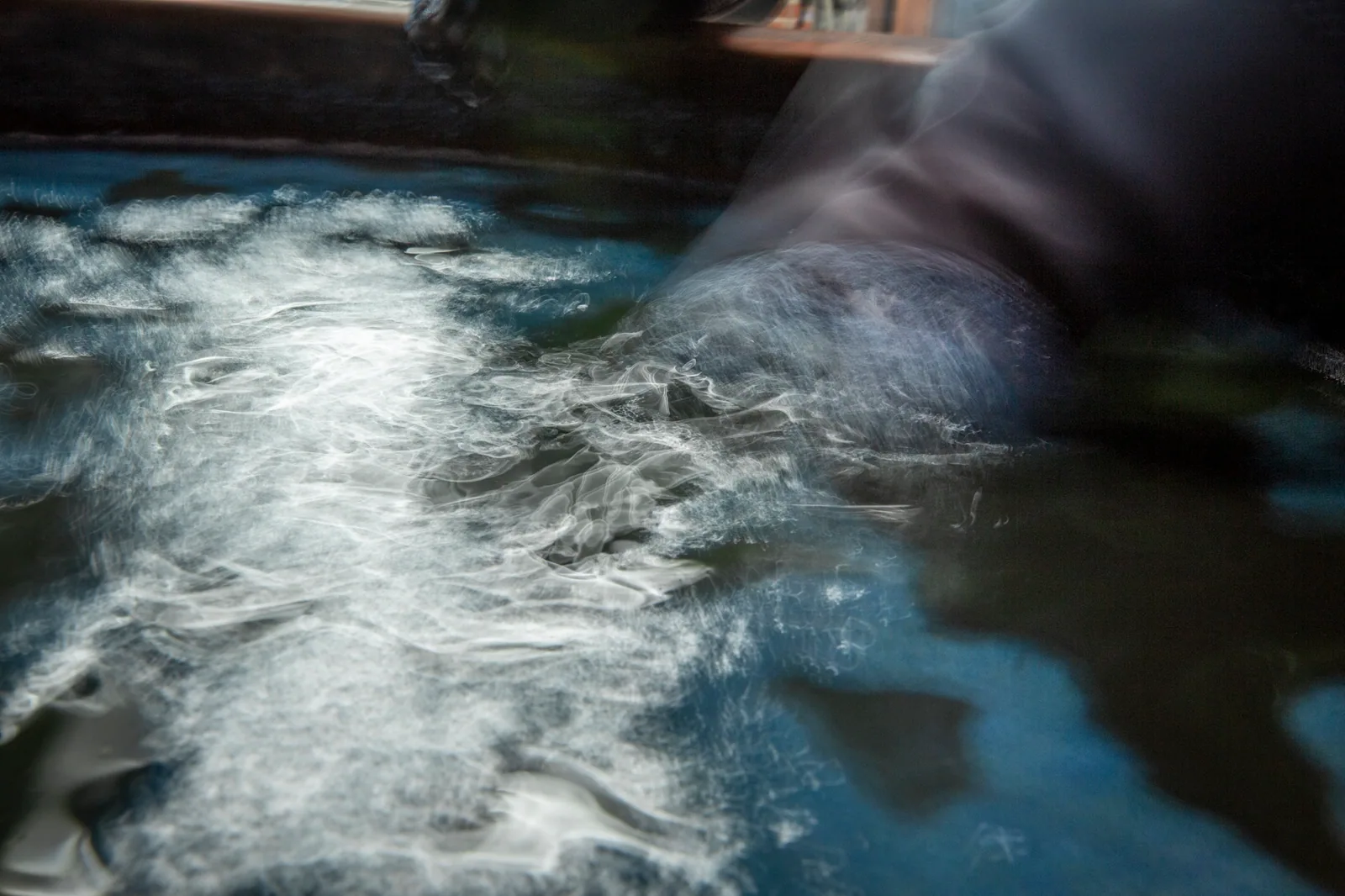
The moment of ta-lan oxidation: stirring the dye vat exposes indoxyl to air, the splashing water already beginning to turn blue. Photo: Presidential Office (Kenny Mori), CC BY 2.0.
This self-question is a real practitioner's inquiry within the craft circle, not an external researcher's fabricated nitpicking. Chemical rapid methods are particularly common in tourist experience scenarios, because natural fermentation can only dye a limited number of times per day, while rapid methods "require short time, simple steps easy to learn, and guarantee 100% sense of achievement," better fitting tourist workshop turnover needs33, explaining why the same craft might present completely different faces at production versus experience ends.
📝 Curator's Note
This controversy has no standard answer, and probably shouldn't. The blue dyed in three minutes with sodium hydrosulfite, and the blue cultivated over three days by microbes, may be equally deep in color, but they carry two completely different knowledge systems: one requires understanding species, temperature, and pH; the other only requires buying a 137-NTD packet. Is revival saving that color, or the patience that allows the color to appear? This question, Sanxia, Joye Hut, Taiping Blue, and Chingliao each answer in their own way, none concluding for the others.
Japan's Tokushima BUAISOU brand has given a clear stance on this question: they insist on using the ancient "Jigoku" (hell) method to build vats for dye, firmly refusing to replace it with convenient chemicals like sodium hydrosulfite and sodium hydroxide solution, sticking to wood ash water, shell ash, and bran as vat-building materials34. Tokushima's Awa-ai peak agricultural land reached 15,000 hectares with over two thousand farming households; today only six commercial producers remain, roughly 70 acres, area evaporated by over 99%35. Taiwan's climate allows indigo grass multiple harvests yearly, contrasting with Japan's single annual harvest limited by climate, giving Taiwan a concrete, verifiable advantageous position in the global indigo map36, but this advantage cannot solve the more fundamental question of "which reducing method to use."
Whose Blue?
Indigo dyeing is often labeled "Hakka craft," but this label itself deserves unpacking.
Northern Taiwan's indigo craft was introduced to the Taipei Basin's surrounding mountains by Quanzhou Anxi people planting Strobilanthes cusia during the Qing dynasty, not a single ethnic group's technology37; both Minnan and Hakka historically used this craft extensively. Hakka blue shirts (big-front shirts) in the southern Liukwei area form another independent system, traditionally using Indigofera tinctoria, a different botanical family from Sanxia's Strobilanthes cusia, with slightly different dyeing methods, often "requiring eight dyes to achieve that depth"38. The blue shirt's stand collar is hand-sewn from seven layers of fabric, a structure physically durable and wear-resistant, endowed with a dual meaning of "hard neck": both the collar's physical stiffness and symbolizing Hakka people's honest, unyielding character39. This term originally carried derogatory connotations, later shifting from derogatory to commendatory, becoming a positive symbol of Hakka self-identity.
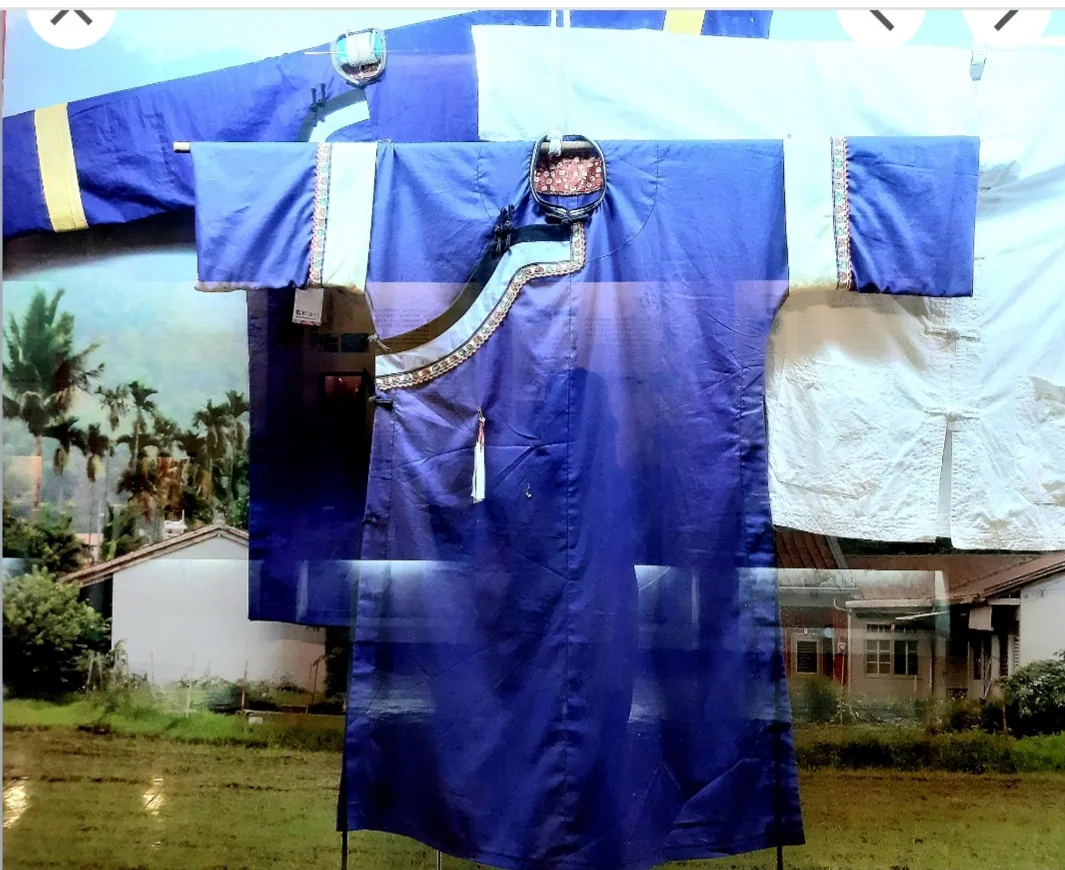
Hakka blue shirt (big-front shirt), traditionally dyed with Indigofera tinctoria in the southern Liukwei area. Collar and cuff trim decorations are key identification features. Photo: WEI, WAN-CHEN, CC BY-SA 4.0.
Meinong's "Chin Hsing Hsing" Hsieh Ching-lai, apprenticed in Fuzhou at sixteen, opened business on Meinong's Yong'an Old Street in 1932, and could still personally cut fabric until passing at 102, called a "national treasure-level blue shirt master." Chin Hsing Hsing remains the only shop in Meinong still making traditional blue shirts40. Researcher Wang Hui-ling, fearing the blue shirt sewing craft would be lost, personally interviewed old masters, cross-referenced documents, and found the most traditional sewing methods, publishing monographs like Blue Shirts and Women's Embroidery41.
As for whether indigenous peoples also have indigo traditions, this requires honest stratified viewing, not a single sentence dismissal. Atayal evidence is relatively solid: the Ministry of Culture's National Cultural Memory Bank explicitly records that Atayal traditional dyeing and weaving plants include blue series such as Indigofera tinctoria, mountain indigo, and Rothmannia42. This is official cultural asset archiving, medium-to-strong evidence strength, but currently no specific dyeing process or academic paper verification found. Bunu evidence is much weaker: traditional clothing color schemes indeed contain blue-black, but no clear data points to specific dye plants. Pingpu (plains indigenous) situation is even thinner: most records mentioning "blue" refer to embroidery thread colors on clothing, not independent dyeing craft. These groups' evidence strengths differ and cannot be written as equally strong parallel narratives.
📝 Curator's Note
A preface in a Hakka Council research report quotes mainland scholar Hsieh Chung-kuang (1999): Hakka women's "planting ch'ing and dyeing cloth" may have been a skill learned from the She people in their Huazhou homeland, not a Han native skill brought to Taiwan43. This claim belongs to an internal academic考证 viewpoint, not a settled conclusion, but placed alongside the earlier fact of Quanzhou Anxi people introducing Strobilanthes cusia and Minnan-Hakka sharing the craft, it points to the same thing: the answer to "whose craft is this?" has never been limited to one ethnic group.
Can Dye Sludge Return to the Fields? Is "Natural" Always Eco-friendly?
The most easily skipped part of the revival narrative is the relationship between this craft and sustainability, which is actually more complex than imagined.
Natural fermentation, no chemical synthesis, recyclable sludge, this narrative perfectly aligns with contemporary anti-fast-fashion sentiment. But 2024 scientific literature points out that both natural and synthetic indigo carry teratogenic and genotoxic concerns for aquatic organisms, with no significant difference; natural indigo's colorfastness is also poorer, requiring more rinsing water; fully replacing the existing denim industry's scale with natural indigo requires "an impossibly sustainable vast land resource"44. "Natural equals absolutely eco-friendly and harmless" is not an equation that holds unconditionally.
As for the claim of "returning dye sludge to fields as fertilizer," international academic literature does support indigo dye sludge being rich in nitrogen and minerals, potentially converting to compost as decent plant nutrients, but these studies' subjects are mainly the Indian indigo industry, with no verified local Sanxia or Joye Hut cases confirming this practice45. Global textile dyeing and finishing industries account for 17 to 20% of industrial water pollution; a single pair of jeans may consume over 3,700 liters of water46, this data reminding us that indigo's environmental challenges are far more complex than the "natural vs. chemical" binary.
A Place Name, A Self-Question
Tainan Houpi Chingliao's Molin Cultural Museum now has people lining up weekends to dip their hands into dye vats. Inside physician Liang Yao-ming's old residence, spaces originally for blood pressure checks and consultations now hold stirring rods and a vat of living bacteria. This place name has already lain in the Chuluo County Gazetteer for three hundred years, and right now it is being voiced again by a group with no blood relation to the Kangxi era.
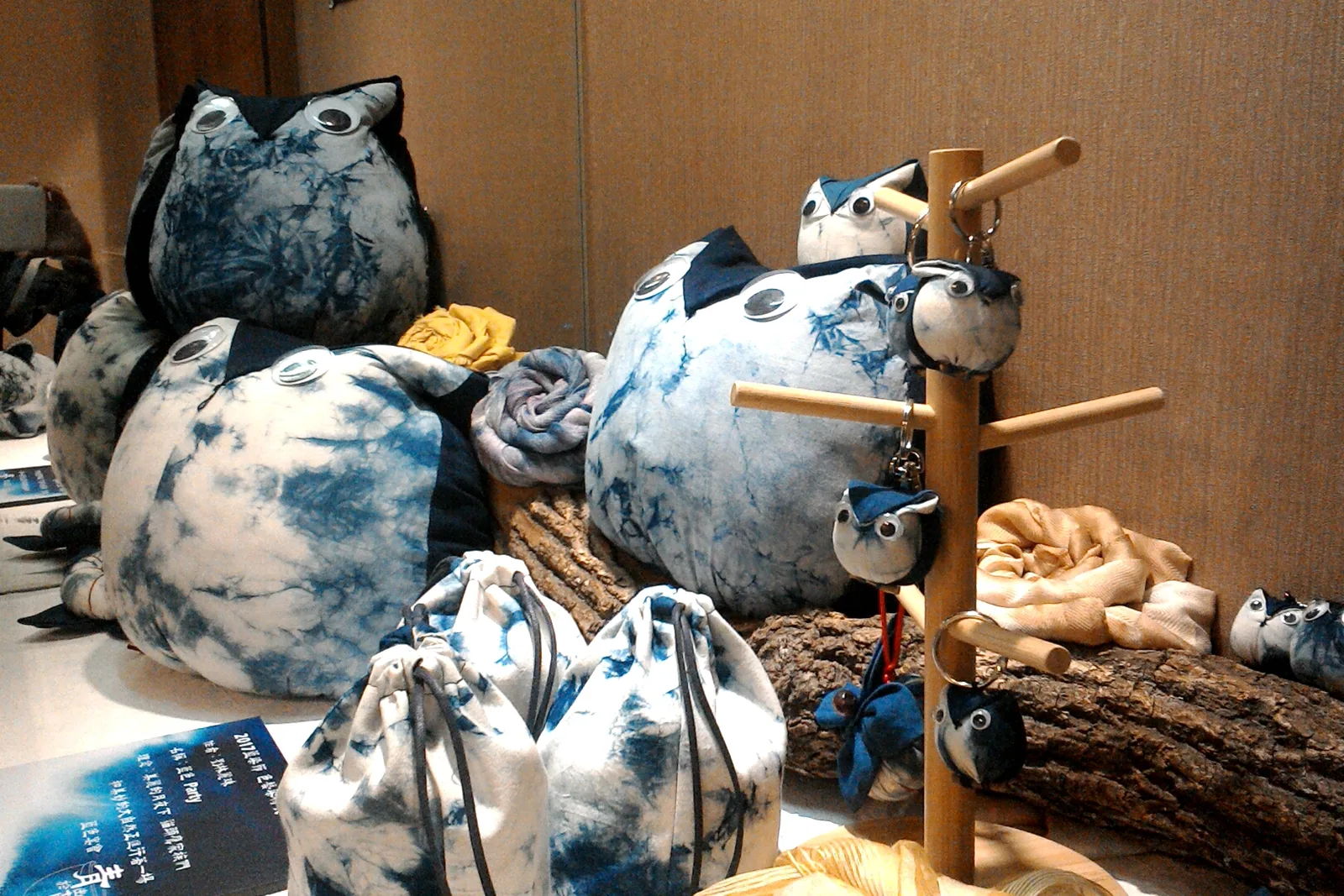
Sanxia District Historical Museum's indigo installation "Blue Party," a color revived back to life, now also entering contemporary art display spaces. Photo: Siren Mengzi, CC BY-SA 4.0.
Sanxia's Liu Mei-ling says revival took twenty years to wait for "a bit of a future"; Chen Li-yu still asks whether popularizing rapid indigo deviates from the original purpose of rebuilding this craft. These two sentences together represent the craft's true current state: four groups each holding the same unresolved question, continuing forward, none closing the story for the others.
The color in the dye vat has come alive. As for what form this vat of color will ultimately live into, Sanxia, Joye Hut, Taiping Blue, and Chingliao may never give the same answer. And this still-waiting, undecided color, perhaps, is its most honest form.
Further Reading
- Traditional Taiwanese Crafts and Intangible Cultural Heritage — Sanxia indigo revival's position within Taiwan's craft preservation system, and the larger context of "folk first, institutional ratification later"
- Sanxia Old Street — Sanxia Old Street's architectural preservation history; this article discusses the craft itself, that article discusses streets and monuments
- Hakka Culture and Language — The more complete ethnic cultural context behind Hakka blue shirts and big-front shirts
- Taiwan Floral Fabric — Another dyeing pattern once viewed as a Hakka symbol, later found to have a more complex origin
Image Sources
This article uses 5 public-licensed images, all cached in public/article-images/culture/ to avoid hotlinking source servers:
- Close-up of Sanxia indigo tie-dye cloud-pattern fabric — Photo: Presidential Office (Kenny Mori), 2020-08-23, CC BY 2.0
- Close-up of _Strobilanthes cusia_ (Da-chin) plant — Photo: HQ Aqiao, CC BY-SA 2.0
- Close-up of dye vat stirring splashes — Photo: Presidential Office (Kenny Mori), 2020-08-23, CC BY 2.0
- Hakka blue shirt displayed at Meinong Hakka Cultural Museum — Photo: WEI, WAN-CHEN, 2023-02-05, CC BY-SA 4.0
- "Blue Party" indigo installation art displayed inside Sanxia District Historical Museum — Photo: Siren Mengzi, 2017-08-16, CC BY-SA 4.0
References
- Taiwan Craft Quarterly: Development and Transformation of Sanxia Indigo Industry (Lin Hsiung-jen) — Firsthand timeline: Ma Fen-mei recruited to Maokong in May 1998; Chen Ching-lin guided dyeing the first blue scarf in 70+ years in August 1999↩
- Taiwan Indigo Dyeing Society Official Website — Verification confirms recent activities lean toward ecological education, no verified connection to the four communities↩
- Taiwan Environment Information Association: Strobilanthes cusia (Da-chin) — Strobilanthes cusia is Acanthaceae, Indigofera tinctoria is Fabaceae, distinguishing the two different families↩
- Joye Cultural Market: Chien-lan Process Diagram — Complete process mapping: planting/harvesting, ch'ing-k'uo soaking, ta-lan oxidation, chien-lan reduction↩
- ETtoday: Retired Teacher Plants a Field for Land Sustainability — Cheng Mei-shu's professional background (Chung Hsing University agronomy master, National Yuanlin Agricultural High School teacher/director) and 2001 indigo learning timeline↩
- Upstream/Downstream News: Living Indigo, Temperamental Dye Vats — Source of Cheng Mei-shu's verbatim quote↩
- Joye Cultural Market Official About Page — Data on indigo grass restoration area, annual indigo yield, and island-wide proportion↩
- Howdy.tw: Blurred Stone Carving in Sanxia Ancient Residence, Shockingly Hiding Last Century's Indigo Legend — 1990–1999 Sanxia revival timeline, Ma Fen-mei recruitment and Chen Ching-lin guidance verbatim reporting↩
- Ministry of Culture National Cultural Memory Bank: Sanxia Craft Indigo — "Finding Lost Sanxia Blue" 1990 launch and New Taipei City 2010 elevation administrative history↩
- Cosmic Care Magazine: Crossing Ancient and Modern Indigo Sentiments — One source of "Liu Mei-ling" name version↩
- PeoPo Citizen News: Blue Mystery, Dyeing Local Culture — Source of Liu Mei-ling's "actually no one was optimistic" verbatim quote↩
- Sanxia Cultural Association and Fu Jen Catholic University Textile Research Institute Collaboration Record — Sanxia Dye Workshop industry-academia collaboration background↩
- BeautiMode: Li-fen Hung Interview — Li-fen Hung apprenticing with craft masters, personally making indigo scarves specific scenes↩
- Joye Hut Official Website — Self-positioning as "Taiwan's largest plant-dye base, Asia's largest indigo dye base"↩
- udn Orange Generation: Persisting 20 Years After 921, Promoting Hakka Indigo to Create "Taiping Blue" Brand — Yeh Chin-yu background and 921 earthquake community reconstruction origin verbatim reporting↩
- udn Orange Generation: Persisting 20 Years After 921, Promoting Hakka Indigo to Create "Taiping Blue" Brand — Hakka indigo "using local materials" verbatim quote↩
- PeoPo Citizen News: Persisting 20 Soaks, Taiping Blue Dyes Community New Economy — Floral fabric shifting to indigo, 2012 Chan Ya-wen joining brand timeline↩
- Hakka Council English Version: Taiping Blue — Official data: 16 soaks, 12 gradient stages, 2017 Paris Maison & Objet, 2018 Golden Point Design Award↩
- Tainan Tourism Network: Molin Rural Cultural Exhibition Hall — Chingliao place name origin, 1717 Chuluo County Gazetteer record, current Indigo Bear Workshop status verbatim content↩
- Tainan Tourism Network: Molin Rural Cultural Exhibition Hall — Current description of daily open indigo Bear Workshop experience↩
- Taiwan Indigo Dyeing Society Official Website — Recent activity content verification↩
- Taiwan Master's and Doctoral Dissertation Knowledge Value System: From Dye to Workshop: Taiwan's Indigo Industry in 17th–19th Centuries (Tsai Cheng-hao, 2002) — Tsai Cheng-hao also published "Searching for Blue on Formosa" in Palace Museum Monthly Issue 444 (2020) detailing VOC's three-stage indigo industry management during Dutch rule (1624–1662), this thesis covers same period verification↩
- Taiwan Master's and Doctoral Dissertation Knowledge Value System: From Dye to Workshop: Taiwan's Indigo Industry in 17th–19th Centuries (Tsai Cheng-hao) — Chiang Yu-ying's Gazetteer of Taiwan Prefecture "especially fine in Taiwan" original quote↩
- Taiwan Craft Quarterly: Development and Transformation of Sanxia Indigo Industry (Lin Hsiung-jen) — Wang Shih-ching's "History of Haishan Volume I" (Taipei Literature Issue 37, 1976) "ramie, indigo second" and Qianlong 57 Balibao port opening major export verbatim quotes↩
- Wikipedia: Taiwan Camphor Industry — Post-port-opening standard export framework tea ~54% / sugar ~36% / camphor ~4%↩
- Taiwan Master's and Doctoral Dissertation Knowledge Value System: From Dye to Workshop (Tsai Cheng-hao, 2002) — 1870s export pattern shift from raw material export to finished cloth export turning point↩
- Taipei Times: Taiwan in Time - When Sansia was dyed blue — 1897 Baeyer inventing synthetic indigo mass production, 1913 reaching Taiwan precise year chain↩
- National Archives Taiwan Literature Museum Taiwan Literature Vol. 61 Issue 2: Transformation and New Development of Taiwan Indigo Craft Industry (Ma Fen-mei, 2010, pp. 153–188) — Key data: indigo industry shrinking from 3,000 households in Taisho era to just 10 by 1940↩
- Taiwan Craft Quarterly: Development and Transformation of Sanxia Indigo Industry (Lin Hsiung-jen) — 1886–1920 Sanxia dye golden years, record of twenty dye workshops on the street↩
- Jiang Mei-ling, Innovative Management of Traditional Indigo Craft: Taking Taiwan's Sanyi and Japan's Tokushima as Examples, National Pingtung University of Science and Technology Hakka Cultural Industry Institute Master's Thesis (2018) — Joye Hut chien-lan method field photos and traditional formula confirmation with wood ash water, maltose, etc.↩
- Ten Dye Workshop Product Page: Sodium Hydrosulfite — Sodium hydrosulfite product code and pricing info↩
- Wild at Heart Conservation Association: Indigo, This Path... (Chen Li-yu) — Source of "what is the true purpose of rebuilding indigo" verbatim quote↩
- Wild at Heart Conservation Association: Indigo, This Path... (Chen Li-yu) — Explanation of rapid vat-building method and tourist experience scenario needs↩
- Jiang Mei-ling, Innovative Management of Traditional Indigo Craft: Taking Taiwan's Sanyi and Japan's Tokushima as Examples, National Pingtung University of Science and Technology Hakka Cultural Industry Institute Master's Thesis (2018) — BUAISOU brand insisting on not using sodium hydrosulfite, sodium hydroxide comparison paragraph↩
- Tokushima Prefecture Traditional Industry Promotion Association: Awa-ai — Awa-ai peak agricultural land scale and remaining producer count↩
- Let's Go Shikoku: Awa-ai Introduction — Climate contrast: Taiwan indigo grass multiple harvests yearly, Japan single annual harvest↩
- Ministry of Education Taiwan Environment Information Association — Historical record of Strobilanthes cusia introduced by Quanzhou Anxi people for cultivation around Taipei Basin↩
- Culture Bank: Cutting出一片湛藍 — Chin Hsing Hsing Defending Hakka Blue Shirt's Resolute Spirit — Hakka blue shirt dyeing process "requiring eight dyes to achieve that depth" verbatim quote↩
- Culture Bank: Cutting出一片湛藍 — Chin Hsing Hsing Defending Hakka Blue Shirt's Resolute Spirit — Blue shirt stand collar seven-layer fabric hand-sewing and "hard neck" symbolic meaning verbatim quotes↩
- Liberty Times News: Hakka Blue Shirt Master 101-Year-Old National Treasure Hsieh Ching-lai Passes Away in Sleep — Hsieh Ching-lai biography and Chin Hsing Hsing remaining only traditional blue shirt shop confirmation↩
- Epoch Times: Hakka Heart Blue Shirt Sentiment — Wang Hui-ling's Cultural Root-Seeking Path — Wang Hui-ling interviewing old masters, publishing monographs experience↩
- Ministry of Culture National Cultural Memory Bank: Atayal Dyeing and Weaving Plants — Atayal blue series dye plants (Indigofera tinctoria, mountain indigo, Rothmannia) official archiving↩
- Executive Yuan Hakka Council Research Grant: Hakka Traditional Clothing Origin Investigation Research Report (Cheng Hui-mei, 2012) — Hsieh Chung-kuang (1999) "planting ch'ing and dyeing cloth learned from She people"考证 viewpoint quote↩
- ScienceDirect: Indigo dyes: Toxicity, teratogenicity, and genotoxicity studies in zebrafish embryos (2024) — Academic literature comparing natural vs. synthetic indigo toxicity, teratogenicity, genotoxicity in zebrafish embryos↩
- ScienceDirect: indigo dye sludge waste as agricultural nutrient source — Indigo dye sludge compost research (subject: international Indian indigo industry)↩
- World Sensorium: Exploring the Vibrant World of Indigo — Global denim industry water consumption and textile dyeing/finishing industrial water pollution proportion data↩