
30-Second Overview:
In the 1820s, the Hu family released the first sky lantern in Shifenliao as a signal to their relatives hiding in the mountains: "The bandits are gone."
Two hundred years later, on the morning after the Lantern Festival in 2019, 25 American volunteers collected 326.15 kilograms of sky lantern debris from the hillsides and riverbeds around the Pingxi railway in just two hours. That June, 72-year-old retired miner Hu Wei-ming's home of 50 years was destroyed by an unextinguished sky lantern.
Earning, paying, cleaning. The chairman of the Sky Lantern Association is surnamed Hu, and the victim is also surnamed Hu. Eighty-eight-year-old Mama Cai, a vendor on the Old Street, and Chen Chien-chih of the Keelung River Guardian Alliance drink from the same river. The 200-year transformation from a signal of peace to mountain waste is carried by the same Pingxi people bearing two identities.
On February 19, 2019, the morning after the Lantern Festival, 25 foreign volunteers followed Ryan Hevern, CEO of the Taiwanese outdoor experience company Taiwan Adventure Outings, into the hills and riverbeds surrounding the Pingxi railway1.
In two hours, they collected 326.15 kilograms of sky lantern debris from bamboo groves, river valleys, and both sides of the tracks — twisted wire frames, rain-soaked paper shells, half-burned joss paper, cigarette packs, plastic bottles and cans1 2. That Taipei Times report by Davina Tham was picked up by BBC Chinese, The Guardian, The New York Times, AFP, and numerous other international outlets. The label "an environmental disaster" was nailed to the Pingxi Sky Lantern Festival from that point on1 2.
That label was not created on the morning after the 2019 Lantern Festival. It had been accumulating since 2013, when CNN listed Pingxi among the "52 Places to Go in the World," reaching a peak of international exposure in 2016 when National Geographic selected it as one of the "Top 10 Winter Trips," and then landing with the concrete figure of 326 kilograms in 20193 4 5.
And 326 kilograms is neither the beginning nor the end of this story.
The 1820s: A Lantern Signaling Peace
The Pingxi sky lantern is not a continuation of Lantern Festival ritual — it is the evolution of a distress signal from 200 years ago.
During the Daoguang reign of the Qing dynasty, the Hu Dian-ch'i family from Anxi County, Quanzhou Prefecture, arrived to settle in the Shifenliao area (present-day Shifen Village, Pingxi District, New Taipei City). One local document records the Hu Dian-ch'i family crossing to Taiwan in 1778, welcoming the Mazu statue back in 1788, and building a small stone shrine in 17906. Another local account states that in 1795, the four Hu brothers — Hu Dian-ch'i, Hu Dian-xie, Hu Dian-ao, and Hu Wen-xun — crossed from Quanzhou to Shifenliao to cultivate indigo (a blue dye plant), welcomed Mazu from Fujian in 1798, and transported stone from the mainland in 1800 to build a small stone shrine (the predecessor of Cheng'an Temple)7 8. The two versions differ on exact dates, but both point to the same fact: the Hu family was the first generation to settle this valley as a human habitation.
At the time, bandits plagued the mountainous areas of northern Taiwan. Whenever bandits struck, residents fled with their families into the mountains. The able-bodied men remaining in the village released sky lanterns as a signal to their relatives in the hills that all was safe9. "The bandits are gone — you can come home" — the first lantern to rise over Shifenliao was not a prayer; the people in the village were waiting for their families to come home.
This distress-signaling function was linked to the existing sky lantern–releasing tradition in the ancestral homeland of Huian and Anxi in Fujian (presumably used as a communication tool)9.
📝 Curator's Note: The first meaning of the Pingxi sky lantern 200 years ago was not romance — it was survival. The act of "signaling peace" was later simplified to "prayer," but the underlying emotional connection is the same — concern for the safety of one's family. When people write their wishes today, they write about exams, health, relationships, careers; what the Hu family men wrote in the 1820s was probably something as simple as "we are still here."
In 1988 (ROC year 77), Pingxi held its first public sky lantern event — before that, this was purely a local custom9. In 1998, the name "Pingxi Sky Lantern Festival" was formally proposed. In 2008, it was registered as an intangible cultural asset of New Taipei City9.
From "South: Bee Rockets, North: Sky Lanterns" Brand to International Peak
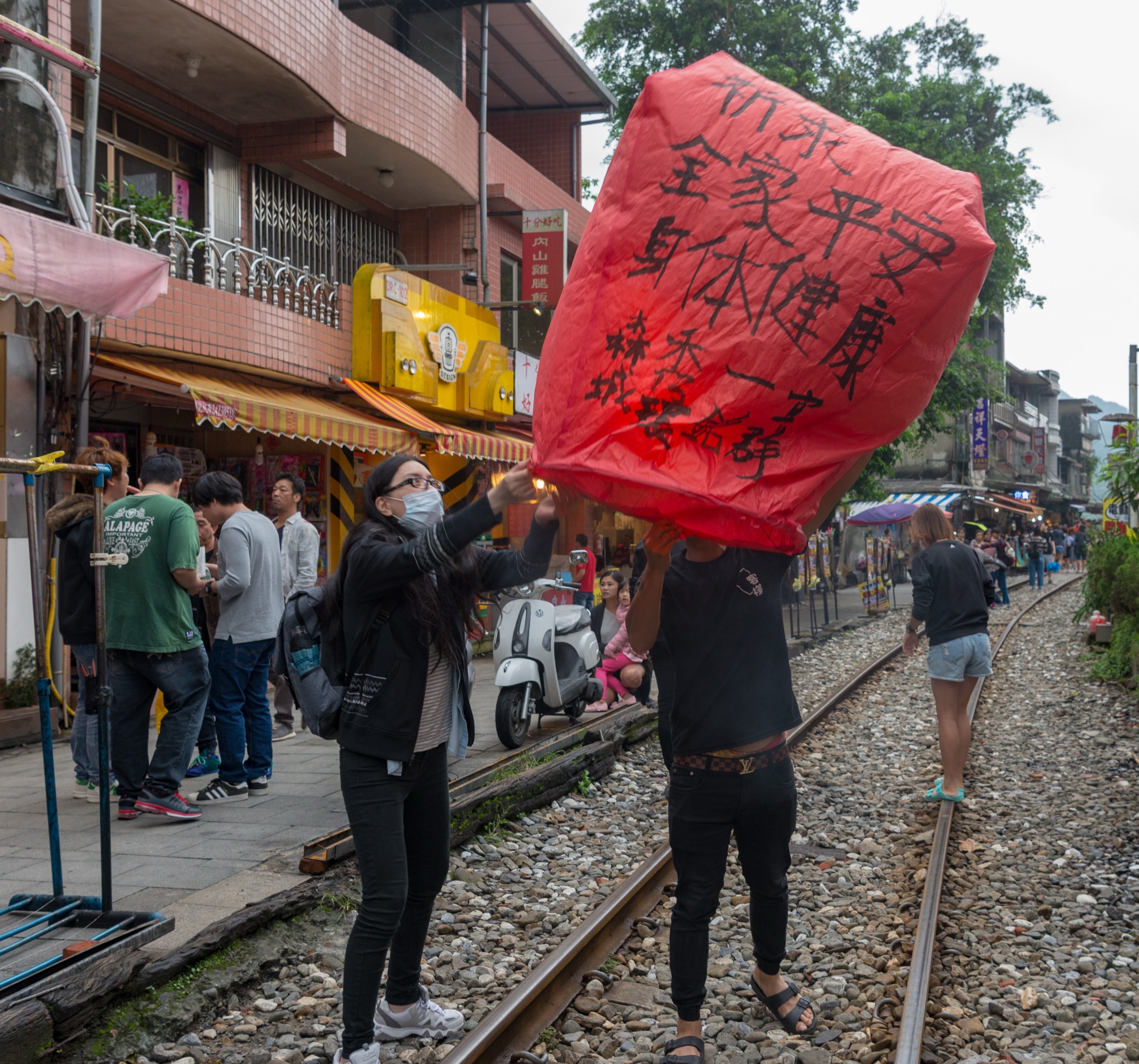
_Shifen Old Street in daytime, the Pingxi Line railway running through the center of the old street, with sky lantern vendors and shops lining both sides. The tourism economy along the railway is the local industry foundation accumulated over 30 years since the "South: Bee Rockets, North: Sky Lanterns" brand was established. Photo: Xiquinho Silva. CC BY 2.0 via Wikimedia Commons._
From 1988 to the 2010s, the Pingxi Sky Lantern Festival followed a classic trajectory: "local custom → city tourism brand → international media recommendation."
In the late 1990s, "South: Bee Rockets (Yanshui, Tainan), North: Sky Lanterns (Pingxi, New Taipei)" became Taiwan's north-south dual-city festival brand10.
In 2013, CNN Travel listed the Pingxi Sky Lantern Festival among the "52 Places to Go in the World"3. In January 2016, National Geographic Channel selected it as one of the "Top 10 Winter Trips"4. Fodor's Travel included Pingxi in the "14 Once-in-a-Lifetime Festivals Around the World"11. Discovery Channel and other international media continued to recommend the Pingxi Sky Lantern Festival with labels such as "the world's second-largest festival carnival"11.
This branding path brought not just tourists, but tourists at a concrete scale. New Taipei City Councilor Lin Yi-chi, citing Tourism Bureau statistics in June 2025, said: "Conservative estimates put at least 50,000 sky lanterns released in the Pingxi area each month, over 600,000 per year"12. Scholars estimate "as many as 400,000 per year"13.
Number baseline: 400,000–600,000 sky lanterns rise over the Pingxi valley each year. In May 2025, the New Taipei City Government announced a cumulative total of 2,030,417 recovered sky lantern papers12. That is an average of roughly 1,100–1,650 per day.
That railway, that Jingtong railway station, that Shifen Old Street, those sky lantern vendors — all of these transformed from local industry into a cultural symbol of Taiwan to the world over those 30 years.
326 Kilograms of Waste, and Hu Wei-ming's House
The 326-kilogram incident on February 19, 2019, pushed the "environmental disaster" label from academic papers and environmental group statements to the front pages of international media.
But a more concrete harm occurred in another incident in June 2019 — not fully reported by ETtoday until 202214.
Hu Wei-ming, a 72-year-old retired miner in Pingxi, had lived in his house for 50 years. That morning he left to get a heart stent implanted at the hospital. In the afternoon, a neighbor called to tell him "your house is on fire." The fire investigation confirmed the cause: an unextinguished sky lantern had fallen into the residence. Hidden in a shoe cabinet, NT$150,000 in retirement medical savings, and the ancestral memorial tablets of his parents — all reduced to ashes14.
"They earn the money, we suffer the consequences. Now when I see sky lanterns, I'm really pissed off," Hu Wei-ming told the ETtoday reporter14.
He applied to the district office for NT$1.8 million in reconstruction compensation and was denied — the "Sky Lantern Sustainable Development Fund" had already run dry, with only a little over NT$6,000 remaining in November 2019, and industry willingness to donate had dropped to near zero after consecutive payouts14. Mr. Hu now receives NT$4,700 per month in national pension, does not qualify for low-income household status, and his parents' memorial tablets are temporarily placed at a nearby temple — he can no longer maintain them himself.
📝 Curator's Note: The key to the line "They earn the money, we suffer the consequences" is not "them vs. us" — it is that "they" and "us" are both Pingxi people. The next section will untangle this knot.
The New Taipei City Government later announced that from 2018 to 2025, there were 35 sky lantern–related damage incidents, with 16 cases compensated totaling NT$1.45 million, and 15 cases pending approximately NT$950,00015. From 2020 to November 2023, Pingxi experienced 14 fires caused by sky lanterns (1 residential, 12 grassland)15.
Two People Surnamed Hu, Two Connected to Shifen Elementary School, Two Drinking from the Keelung River
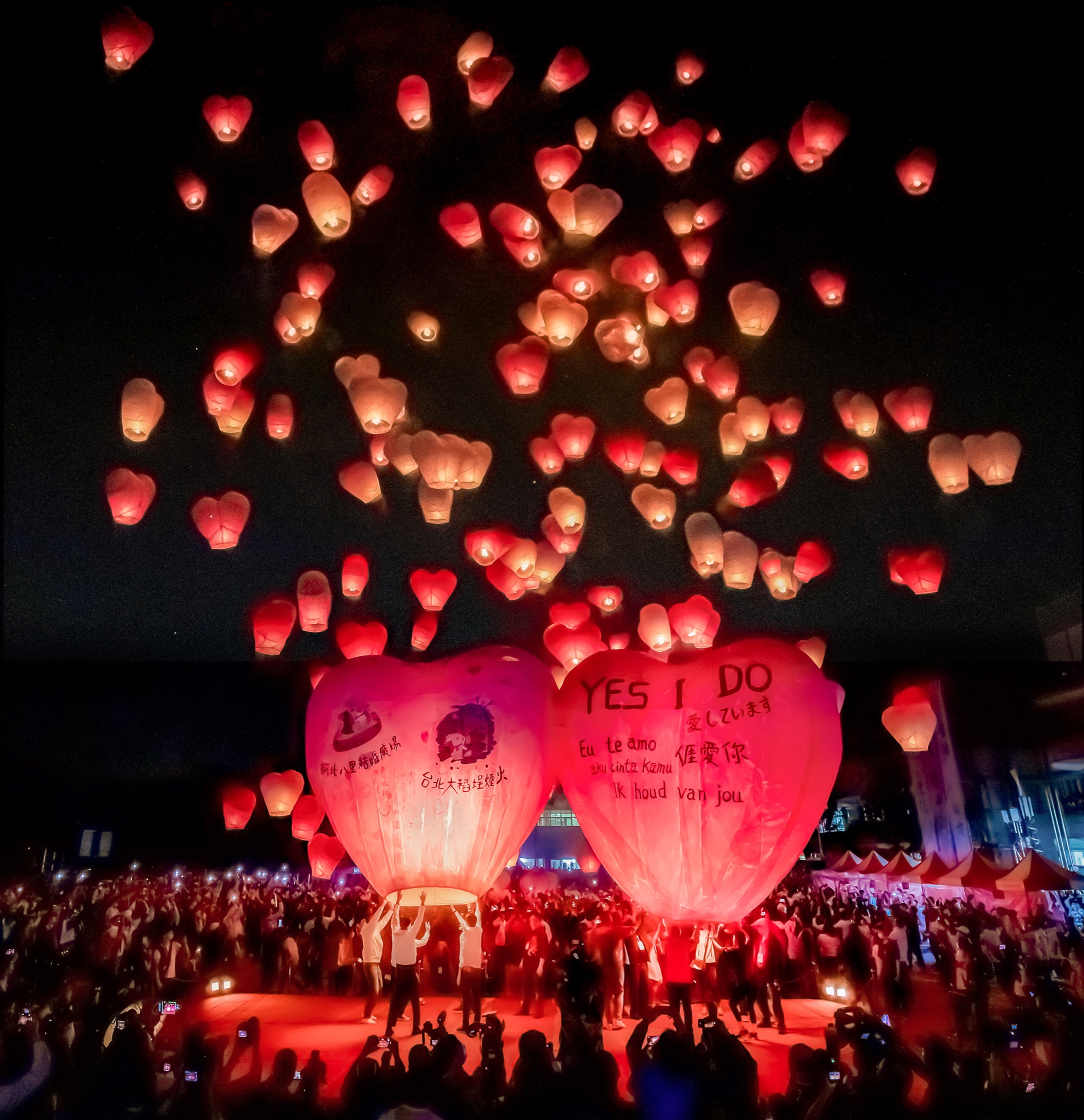
_Close-up of sky lanterns being released at the 2023 Pingxi Sky Lantern Festival, tourists personally lighting and releasing lanterns filled with written wishes. Behind every lantern that rises is a calligraphy brushstroke from a Shifen Old Street vendor, a paper shell, and a question of environmental responsibility. Photo: 鄭惠霙 Vickie399. CC BY-SA 4.0 via Wikimedia Commons._
If we stop at "326 kilograms" and "Hu Wei-ming's house," the story falls back into the standard "environmentalism vs. culture" frame.
But the true shape of this story is:
Two people surnamed Hu, on opposite sides.
Hu Min-shu, chairman of the Sky Lantern Association, representative of the Pingxi local industry camp. In interviews with NewsMarket and The News Lens, several of his remarks were particularly pointed: "The sky lanterns developed with pooled resources should help the local industry, not become something that harms it!" "Too many things in the world produce pollution — factories, vehicles, electricity use. Singling out sky lanterns as a target is like splitting hairs." "Sky lantern recycling pays NT$8 per lantern. From five- and six-year-old children to people in their eighties and nineties, everyone picks up lanterns. The recycling rate is over 95 percent."16 17
Hu Min-shu and Hu Wei-ming share the same surname. One earns, the other pays.
Two people connected to Shifen Elementary School, doing opposite things.
Lin Kuo-ho, Pingxi sky lantern craftsman, was a Shifen Elementary School teacher before retiring17. After retirement, he inherited his father's shop and, with his wife, hand-makes eco-friendly sky lanterns from nano paperboard. His attitude does not deny the problem: "Sky lanterns here do indeed have an environmental problem — this cannot be denied. But the 'bao' of environmental protection and the 'bao' of having a full stomach — how to balance these, that is the real question."17
At the same school from which Lin Kuo-ho retired, in March 2025, current president Wu Chung-lin launched a school-based special curriculum called "天 LIGHT" (Sky LIGHT). With fewer than 50 students in the entire school, they developed a sustainable sky lantern18. Student Chien Hung-che said: "Only after participating in making sustainable sky lanterns did I realize that releasing sky lanterns also affects the mountain forest environment."18 The sustainable sky lantern's first flight: the second session of the 2025 Pingxi Sky Lantern Festival on March 3, released simultaneously with traditional lanterns at Shifen Plaza. The "improved eco-friendly sustainable sky lantern," developed in cooperation with the Jinshan Technology Center, received a new-type patent from the Ministry of Economic Affairs18.
Lin Kuo-ho (retired teacher, sky lantern artisan) and Wu Chung-lin (current principal, sustainable education advocate) — two generations from the same school, doing the same thing from different positions.
Two people drinking from the Keelung River, at opposite poles.
Chen Hsiu-yueh, owner of the "Pingxi Sky Lantern Master" shop on the Old Street, 88 years old, called "Mama Cai" by customers19. Years earlier, when the government promoted "one specialty per township," Pingxi focused on sky lanterns. Chen Hsiu-yueh had just retired and discussed with her husband Cai Yi-hsiung opening a sky lantern shop at their home on the Old Street. She said business turned quiet after COVID-19, with many shops closing, and she tends the shop herself on ordinary days: "Keeping the shop open lets me interact with customers and keeps my mind sharp"19.
Chen Chien-chih, convener of the Keelung River Guardian Alliance, began participating in Tamsui River care activities in his university days in 1992, and later mobilized community colleges and environmental groups to form the Tamsui River Guardian Alliance16. He told NewsMarket: "Pingxi is the water source for Ruifang and the Keelung area. With 30,000 sky lanterns burned each month, under the premise that 100 percent recycling is impossible, environmental impact is inevitable." "Behind every sky lantern released are environmental and social costs that must be reflected in the price."16
Chen Hsiu-yueh has sold sky lanterns on Shifen Old Street for over 20 years. Chen Chien-chih has protected the Keelung River's water quality for over 30 years. Both drink from the same river — one's livelihood depends on continuing to release them, the other's values insist they must be regulated.
📝 Curator's Note: For 200 years, Pingxi people have carried two identities. First as those who signal peace, then as those who profit from tourism; now they are beginning to be those who clean the mountains. Earning, paying, cleaning.
Autonomous Ordinance, Penalties, and Sustainable Sky Lanterns
Starting in 2020, the "New Taipei City Sky Lantern Sustainable Development Autonomous Ordinance" was stalled in the New Taipei City Council for two years20. It was not until July 2025 that it passed its third reading21.
New Taipei City Mayor Hou You-yi expressed his opinion to udn: "Sky lanterns being released morning and night — it makes me 'a bit angry,' and it is also the pain of many Pingxi people." "The 'New Taipei City Sky Lantern Sustainable Development Autonomous Ordinance' is a priority bill I care deeply about." "I want it passed during my term." "Sky lanterns must have penalties."12
After the ordinance takes effect in the first half of 2026, the expected measures are:
- Restricted release zones: Lanterns may only be released in designated areas (parts of Shifen Old Street, parts of Jingtong)
- Restricted materials: Eco-friendly sky lanterns must be used
- Penalties: Violators fined NT$X (details to be announced with subsidiary regulations)
- Price as volume control: Traditional lanterns NT$100–150 / sustainable lanterns (single color) NT$350, with the price difference negotiated between local government and vendors22
- Total quantity control: Upper limit on the number of lanterns released per session
But this path faces two real-world headwinds.
The first is the cost problem of sustainable sky lanterns: Cultural Bank's sustainable sky lanterns cost NT$350 for a single-color unit, NT$200 more than traditional lanterns22. Master Lin Kuo-ho hand-makes and ships 7–8 sustainable lanterns per week, while Pingxi releases approximately 30,000 lanterns per month22 — sustainable lanterns currently account for less than one-thousandth of the total.
The second is local economic pressure: Pingxi District's population hit a record low of 3,882 in March 2025, with over 1,400 aged 65 and above, and only 11 newborns in 202423. The elderly proportion of 36 percent is the highest in the nation24. Shifen Village had over 1,300 residents more than 20 years ago; now only 799 remain, a decline of 40 percent23. During the coal mining era of the 1960s, there were still over 20,000 people and over 1,000 junior high school students — that was the last peak of Pingxi's "local economy"23.
Without sky lanterns, what is lost is not just tourism revenue. It is whether the next generation of the remaining 3,882 people in this valley still has a reason to stay. The 20,000 people gathered during the mining era relied on the black-gold industry; the tourism era relies on sky lanterns. If the next industry does not catch on, Pingxi's "village death" is not just a pessimistic scenario — it is the mathematical inevitability of the 2026 population curve continuing downward. This is also why the ordinance is designed not as a "total ban" but as three layers — "price as volume control + zone restriction + material requirements" — putting restraint into the industry rather than severing it, allowing the local economy and environmental responsibility to exist within the same financial cycle.
📝 Curator's Note: The Sustainable Development Fund had NT$6,000 left in November 2019, sustainable lanterns sell 7–8 per week, and Pingxi's population hit a record low of 3,882 — place these three numbers side by side, and the binary proposition of "preservation vs. environmentalism" collapses on its own. What remains is: how to enable 3,882 Pingxi people to carry both identities and survive.
Thailand Bans Flights, Korea Switches to LEDs, Portugal Uses Plastic Mallets
At least three other places face the same tension as Pingxi.
Thailand's Loi Krathong / Yi Peng in Chiang Mai: The November festival of hot-air balloons and floating lanterns. But in 2022, due to aviation safety, Thailand's Airports of Thailand banned sky lanterns around six major airports25. Six districts in Chiang Mai (including Muang Chiang Mai, Hang Dong, Saraphi) imposed a month-long ban, resulting in 53 flight cancellations and 24 diversions25. On the legal side, the Air Navigation Act stipulates that "releasing sky lanterns, rockets, fireworks, or lasers in aviation safety zones" is a criminal offense — "causing aircraft damage or endangering flight safety" is punishable by death or life imprisonment, plus a fine of 600,000–800,000 baht26. Thailand's solution is "hard prohibition on aviation safety grounds."
South Korea's Yeondeunghoe (Lantern-Lighting Festival): Inscribed on UNESCO's Intangible Cultural Heritage list in 202027. The evolution path is very specific — traditional candles illuminating lotus lanterns were replaced with LED + battery packs. The reasons are safety (no fire risk), durability, and maintaining the traditional appearance28. Over 100,000 lanterns parade through the streets of Seoul each year, every one of them LED — yet UNESCO recognizes it as intangible cultural heritage. "Ritual sense" and "physical pollution" can be decoupled; South Korea has proven this.
Portugal's Festa de São João do Porto: On the eve of the Feast of St. John on June 23, a tradition over 600 years old29. Traditions include jumping over bonfires (saltar a fogueira, purifying the soul) and releasing hot-air balloons (small hot-air balloons called balão). But in the 1960s, a local toy factory modified the traditional "head-bonking" ritual into soft plastic mallets (replacing real garlic flowers)29. A successful case of "retaining the symbol, replacing the material." Portugal did not cancel the St. John's Festival, did not ban hot-air balloons, did not ban bonfire jumping — but allowed certain details to evolve naturally into versions that do not harm people.
The three comparison cases correspond to three different paths: Thailand took legal compulsory prohibition, Korea took material electronic substitution, and Portugal took gradual ritual material evolution.
📝 Curator's Note: After the Pingxi autonomous ordinance takes effect in 2026, which path will Taiwan choose? It currently looks like a "Korea + Portugal hybrid" — material environmentalization (sustainable lanterns, Shifen Elementary School patent) + partial material replacement (electronic sky lantern hall trial) + zone/time restrictions (designated area release + penalties). Not Thailand's "total flight ban + death penalty threat."
Next to Jingtong Railway Station is an "Electronic Sky Lantern Hall" converted from a former police substation, fitted with 200,000 LEDs simulating the effect of sky lanterns rising, each unit costing NT$150, with 3 waves per hour and 10 lanterns per wave30. AR sky lanterns, drone recovery solutions (Huafan University tested a 3.5-kilogram drone capable of carrying 2 kilograms of debris, flying 350 meters / 4 kilometers, with 32 minutes of endurance, the most expensive unit under NT$20,000)31 — these are all candidate proposals for the "fourth path" that Taiwan is trying on its own.
Pingxi People Carry Two Identities
Returning to that fire in June 2019.
Hu Wei-ming, 72 years old; Hu Min-shu, chairman of the Sky Lantern Association — same surname.
Lin Kuo-ho taught at Shifen Elementary School before retiring; now Shifen Elementary School principal Wu Chung-lin leads students in developing sustainable sky lanterns — two generations from the same school.
88-year-old Mama Cai has sold sky lanterns on Shifen Old Street for over 20 years; Keelung River Guardian Alliance's Chen Chien-chih has protected the Keelung River for over 30 years — same river.
The 200-year transformation narrative, written up to 2026, contains no "environmentalists vs. culture," no "local vs. outsider" — only the same group of people carrying two identities.
The autonomous ordinance passed in 2025. Penalties arrive in 2026. The sky lanterns rising at the next Lantern Festival will no longer be the 326 kilograms of waste from 2019. But whether they are still the same lantern as the first one that lit up the valley in the 1820s depends on who the child writing the wish is, and what paper they write on.
These 200 years of sky lanterns are not a binary choice of "preservation vs. environmentalism." They are about whether Taiwan's festivals can find a fourth path — not pure preservation (accumulating pollution), not pure innovation (rupturing tradition), not pure termination (loss of cultural heritage).
The fourth path is: the same group of people carrying two identities. Local industry and environmental responsibility do not split or oppose each other, but advance simultaneously, correct each other, and pass down through generations.
South Korea's Yeondeunghoe proved it with LEDs + UNESCO. Portugal's Porto proved it with plastic mallets + bonfire jumping.
Pingxi is trying this fourth path. The valley at the next Lantern Festival will be the answer.
Further Reading:
- Taiwan Temple Festivals and Procession Culture — Like sky lanterns, another case of the tug-of-war between cultural heritage and environmental issues in folk festivals
- Traditional Festivals and Celebrations — The overall landscape of Taiwan's festivals, showing where sky lanterns sit among Lantern Festival and other celebrations
- Taiwan Religion and Temple Culture — From the Mazu faith at Cheng'an Temple to the continuity of blessing symbols
- History of Taiwan's Railways — Why the Pingxi Line railway was able to turn this valley's lantern festival into an international brand
- Taiwan's Forest Ecosystems — The actual impact of sky lantern debris on mountain forest systems
Image Credits
This article uses 3 Wikimedia Commons CC-licensed images, all cached in public/article-images/culture/ to avoid hotlinking:
- Pingxi Sky Lantern Festival night release (hero) — Photo by Jirka Matousek (Wikimedia Commons), 2014. License: CC BY 2.0.
- Shifen Old Street daytime (scene-mid 1) — Photo by Xiquinho Silva (Wikimedia Commons), 2017. License: CC BY 2.0.
- Sky lantern release close-up (scene-mid 2) — Photo by 鄭惠霙 Vickie399 (Wikimedia Commons), 2023. License: CC BY-SA 4.0.
References
- Taipei Times — What happens when sky lanterns fall? — Davina Tham's February 28, 2019 report on 25 American volunteers collecting 326.15 kg of waste in two hours, including Ryan Hevern's quotes and a record of the action.↩
- BBC Chinese — 撿到 326 公斤天燈殘骸的美國志工 — BBC Chinese's 2019 report on foreign volunteers cleaning up sky lantern debris, the source of the "environmental disaster" label cited by international media.↩
- CNN — At Pingxi Lantern Festival, wishes light up the Taiwan sky — CNN Travel's 2013 original listing of Pingxi among the "52 Places to Go in the World."↩
- Focus Taiwan — National Geographic best winter trips — CNA English edition, January 2016 report on National Geographic's "Top 10 Winter Trips" selection.↩
- Wikipedia — Pingxi Sky Lantern Festival — English Wikipedia entry for the Pingxi Sky Lantern Festival, compiling recommendation lists from CNN, National Geographic, Fodor's, Discovery, and other international media.↩
- 維基百科 — 十分寮成安宮 — Historical record of the Hu Dian-ch'i family crossing to Taiwan in 1778, welcoming Mazu in 1788, and building a small shrine in 1790.↩
- 嗨放 — 十分寮成安宮拜拜攻略 — In-depth local guide specifying the four Hu brothers crossing from Quanzhou in 1795, welcoming Mazu in 1798, and transporting stone from the mainland to build a small stone shrine in 1800.↩
- 台灣宗教文化地圖 — 平溪天燈節 — Ministry of the Interior official record of the origin of Pingxi sky lanterns: "According to elder oral accounts, they began during the Daoguang reign of the Qing dynasty" (primary government source).↩
- 台灣宗教文化地圖 — 平溪天燈節(同上) — Same source, containing the complete timeline of the first public event in 1988, naming in 1998, and registration as intangible cultural heritage in 2008.↩
- PanSci 泛科學 — 那些年,我們放的天燈從哪來? — PanSci in-depth report on the cultural festival-ization of the Pingxi Sky Lantern Festival, including the establishment of the "South: Bee Rockets, North: Sky Lanterns" brand.↩
- Wikipedia — Pingxi Sky Lantern Festival(同上) — Fodor's Travel "14 Once-in-a-Lifetime Festivals Around the World" + Discovery Channel "world's second-largest festival carnival" complete international media list compilation.↩
- udn — 平溪天燈一個月放五萬盞 侯友宜也看不下去 — June 12, 2025 udn report on Councilor Lin Yi-chi questioning Mayor Hou You-yi, including the figures of 50,000 lanterns per month / over 600,000 per year / cumulative recovery of 2.03 million lanterns / autonomous ordinance + penalties, with complete quotes.↩
- 倡議家 — 每年放 40 萬顆天燈,平溪山林成垃圾場 — Scholar estimates of 400,000 sky lanterns released annually and analysis of mountain forest pollution problems.↩
- ETtoday — 平溪人 50 年家被燒光 — April 11, 2022 complete report on 72-year-old Hu Wei-ming's house being destroyed by a sky lantern, including three direct quotes and details of the district office denying NT$1.8 million compensation and the Sustainable Fund running dry at NT$6,000.↩
- udn — 平溪天燈釀 35 件災損 永續發展資金見底 — New Taipei City Government announcement of 35 cumulative damage incidents from 2018–2025 + 14 fires from 2020–November 2023 (1 residential, 12 grassland) data.↩
- 上下游 — 天燈點燃的愛恨情仇,平溪環保天燈推不動 — NewsMarket in-depth report, presenting the complete quotes of Hu Min-shu (Association Chairman) + Lin Kuo-ho (artisan) + Chen Chien-chih (environmental group) side by side.↩
- 關鍵評論網 — 專訪平溪天燈老師傅 — Interview with Master Lin Kuo-ho on family heritage, including his former position at Shifen Elementary School and the complete original text of the "protection / full stomach" parallel argument.↩
- 自由時報 — 十分國小研發永續天燈今晚升空 — March 2025 report on Shifen Elementary School's "天 LIGHT" school-based curriculum and cooperation with Jinshan Technology Center to develop sustainable sky lanterns, including quotes from Principal Wu Chung-lin and student Chien Hung-che.↩
- udn — 天燈故鄉 3 商圈 — April 6, 2026 udn report on 88-year-old "Mama Cai" Chen Hsiu-yueh selling sky lanterns on Shifen Old Street for over 20 years, including the historical context of the "one specialty per township" policy promoting the sky lantern industry.↩
- udn — 天燈對環境衝擊 / 自治條例卡關 — udn report on the political history of the "New Taipei City Sky Lantern Sustainable Development Autonomous Ordinance" being stalled in the Council for two years before its third reading in 2020.↩
- udn — 平溪天燈自治條例三讀通過(2025/7) — The same udn report includes Mayor Hou You-yi's promise "I want it passed during my term" and the timeline of the 2025 autonomous ordinance passing its third reading.↩
- 關鍵評論網 — 第一顆零碳排環保天燈 2.0 要花多少錢 — Cost comparison of eco-friendly lanterns at NT$350 vs. traditional lanterns at NT$100–150 and analysis of the acceptance controversy.↩
- udn — 偏鄉空洞化 / 燈火散去 — Pingxi population hitting a record low of 3,882 in March 2025, Shifen Village declining by 40 percent, compared to over 20,000 during the 1960s coal mining era.↩
- udn — 平溪老人破 36% — Pingxi elderly proportion at 36 percent, the highest in the nation, with the aging index corresponding to local industry pressure.↩
- Bangkok Post — Festival lantern ban announced (2022) — 2022 Thailand Airports of Thailand ban on sky lanterns around six major airports, six Chiang Mai districts under month-long ban, 53 flight cancellations / 24 diversions specific data.↩
- Thaiger — Flying lanterns near airports punishable by death penalty — Thailand's Air Navigation Act stipulating that releasing sky lanterns near airports is punishable by death + 600,000–800,000 baht fine legal framework.↩
- UNESCO ICH — Yeondeunghoe lantern-lighting festival — UNESCO's 2020 inscription of South Korea's Yeondeunghoe on the Intangible Cultural Heritage list (primary international organization source).↩
- Wikipedia — Yeondeunghoe — South Korea's Yeondeunghoe evolution path from traditional candles to LED + battery packs, the current ritual status of over 100,000 LED lanterns parading through Seoul's streets.↩
- Wikipedia — Festa de São João do Porto — Portugal's Festa de São João do Porto over 600 years of history, the 1960s local toy factory modifying the "head-bonking" ritual into soft plastic mallets as an evolution case.↩
- 新北市觀光旅遊網 — 菁桐電子天燈館 — The Jingtong Electronic Sky Lantern Hall converted from a former police substation, with 200,000 LEDs simulating sky lanterns rising, each unit NT$150, 3 waves per hour, 10 lanterns per wave.↩
- 倡議家 — 華梵無人機回收天燈 — Huafan University's 3.5-kilogram drone capable of carrying 2 kilograms of debris, flying 350 meters / 4 kilometers, with 32 minutes of endurance, the most expensive unit under NT$20,000, as an innovative mountain forest cleanup solution.↩