
Aperçu en 30 secondes : Eswatini (renommé depuis « Swaziland » en 2018) est le seul allié diplomatique qu'il reste à Taïwan en Afrique ; les relations diplomatiques avec la République de Chine ont été établies en septembre 1968, ce qui fait 58 ans en 2026. Le roi Mswati III, né en avril 1968, a vu son pays accéder à l'indépendance et établir des relations avec Taïwan cinq mois plus tard, le même jour ; sa vie coïncide donc presque entièrement avec l'histoire des relations diplomatiques entre Taïwan et Eswatini, et il s'est rendu à Taïwan plus de 17 fois jusqu'en 20241. Après la rupture des relations diplomatiques du Burkina Faso en mai 2018, Eswatini est devenu l'unique allié de Taïwan en Afrique2. Le 2 mai 2026, Lai Ching-te s'est rendu en visite à Eswatini ; le départ était initialement prévu pour le 22 avril, mais les Seychelles, Maurice et Madagascar ont retiré sans préavis leurs autorisations de survol sous la pression de la Chine ; Mswati a alors dépêché l'Airbus A340 officiel d'Eswatini pour aller chercher personnellement sa vice-Premier ministre Thulisile Dladla à Taipei afin qu'elle accompagne Lai Ching-te, qui a ainsi pu voler directement de Taipei à Mbabane le 2 mai3. Le 1er mai de la même année, la Chine a accordé un traitement de droits de douane nuls sur 98 % des lignes tarifaires à 53 pays africains, en excluant uniquement Eswatini4. La plus grande incertitude qui pèse sur cette bouée de sauvetage diplomatique réside dans la capacité du successeur de Mswati à convaincre une génération confrontée à 56 % de chômage des jeunes de continuer à considérer Taïwan comme un ami (une question plus difficile que « combien d'argent la Chine offre-t-elle »).
Un président emprunte un avion
Le 2 mai 2026 à 9 heures du matin, Lai Ching-te a descendu la passerelle de l'Airbus A340 mis à sa disposition par le roi Mswati III d'Eswatini, à l'aéroport de Mbabane3.
Cet Airbus A340-313 n'est pas un avion taïwanais. C'est l'avion personnel de la famille royale d'Eswatini. La visite initialement prévue le 22 avril depuis Taipei avait été annulée en urgence le 21 avril, après que les Seychelles, Maurice et Madagascar avaient simultanément retiré sans préavis les autorisations de survol de l'avion présidentiel. Les analystes ont pointé du doigt la coercition économique chinoise exercée sur ces trois États insulaires africains, créant un « encerclement aérien »5.
La réponse de Mswati a été directe : il a envoyé sa vice-première ministre Thulisile Dladla à bord de l'avion royal depuis Mbabane jusqu'à Taipei, d'où elle a ramené Lai Ching-te au petit matin du 2 mai, avec arrivée à Mbabane à 9 heures.
« Le roi prête un avion au président taïwanais pour briser le blocus chinois » : c'est en cela que consistait cette visite. Le Wall Street Journal l'a qualifiée de « surprise visit » (visite surprise), Al Jazeera a titré « despite China's attempts to block trip » (malgré les tentatives de la Chine pour bloquer le voyage)6. L'agence de presse officielle CNA a également documenté l'intégralité du processus d'arrivée à bord de l'avion spécial à Eswatini.
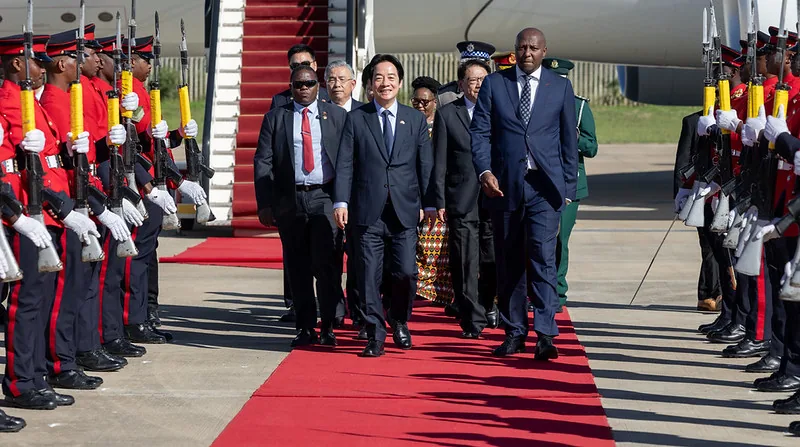
Le 2 mai 2026, Lai Ching-te reçoit les honneurs militaires à l'aéroport de Mbabane. Photo : Bureau de la président de la République de Chine (Taïwan). OGDL via le communiqué officiel du Bureau de la présidence.
La scène d'arrivée est simple mais lourde de sens : le Premier ministre Russell Dlamini, la ministre des Affaires étrangères et de la Coopération internationale Pholile Shakantu, l'ambassadeur de Taïwan en Eswatini Jeremy H.S. Liang, et le maître de cérémonies royal Khandlela Mdluli l'accueillent personnellement. Lai Ching-te reçoit les honneurs militaires, puis échange quelques mots avec le personnel de l'ambassade et les familles de la mission technique taïwanaise7. La chaîne officielle de CNA a documenté l'intégralité du voyage de Lai Ching-te en Eswatini pour une visite d'État.
Le sous-texte politique de cette scène aéroportuaire renvoie à un autre mois de septembre, celui de 1968.
Une naissance synchronisée
Mswati III, de son vrai nom Makhosetive Dlamini, est né le 19 avril 1968 dans le protectorat britannique du Swaziland. Cinq mois plus tard — le 6 septembre — le Swaziland accédait à l'indépendance et établissait des relations diplomatiques avec la République de Chine la même année18.
En d'autres termes, ce roi, aujourd'hui âgé de 58 ans, a une vie qui coïncide presque entièrement avec l'histoire des relations bilatérales entre Taïwan et Eswatini. À sa naissance, le lien avec Taïwan n'existait pas encore ; quand il a commencé à comprendre le monde, ce lien était déjà en place ; après son accession au trône (le 25 avril 1986, à 18 ans et 6 jours, devenant le plus jeune monarque régnant au monde9), il est devenu l'incarnation personnelle de cette relation.
La fréquence de ses visites à Taïwan est également frappante. Selon les archives de l'ambassade à Eswatini et du ministère des Affaires étrangères, en mai 2024, Mswati III avait déjà effectué plus de 17 visites à Taïwan1. Octobre 1989, octobre 1997, octobre 1998, mai 2000, juillet 2001, mai 2004, juin 2007, septembre 2008, mai 2010, juillet 2012, octobre 2013, mai 2015, mai 2016, juin 2018, octobre 2022, mai 2024 — en moyenne une visite tous les deux ans. Aucun autre chef d'État étranger ne se rend à Taïwan avec une telle régularité.
Le professeur Yang Hao, de l'Institut d'études sur l'Asie de l'Est de l'Université nationale de Chengchi, a souligné dans une interview avec BBC Chinese : « C'est précisément parce que le roi détient le pouvoir réel que tant qu'il est disposé à maintenir les relations diplomatiques, il n'y aura pas beaucoup de voix discordantes au sein du pays. »10
En d'autres termes, la dernière artère diplomatique de Taïwan en Afrique est suspendue à une seule personne. C'est à la fois ce qui la rend solide et ce qui la rend fragile.
L'exclusion délibérée d'Eswatini
Le 1er mai 2026 — la veille de la visite de Lai à Eswatini — la Chine a annoncé l'exonération de droits de douane sur 8 % des lignes tarifaires pour 53 pays africains. Eswatini en était le seul exclu411.
C'est une « exclusion délibérée ».
Sur 53 pays, en retirer un ne représente mathématiquement que 52/53, mais politiquement, c'est une déclaration sans ambiguïté : « se ranger du côté de Taïwan, c'est payer le prix de l'isolement. » Le site Storm Media, citant une analyse de BBC Chinese, a clairement exposé la logique de cette opération11. La chaîne officielle de BBC News Chinese a également réalisé une analyse approfondie des enjeux de la rivalité entre les deux rives du détroit autour de la visite de Lai Ching-te en Eswatini.
La stratégie de débauchage de la Chine ne se limite pas à cette seule initiative. Au cours des 30 dernières années, 10 pays africains ont rompu avec Taïwan pour se tourner vers Pékin, les deux plus récents étant Sao Tomé-et-Principe (2016) et le Burkina Faso (2018)2. Le mois même de la rupture avec le Burkina Faso, Tsai Ing-wen effectuait sa première visite en Eswatini, et Mswati réaffirmait publiquement son engagement envers les relations bilatérales12. C'était du 17 au 20 avril 2018.
En 2023, une filiale du groupe chinois Sinohydro a remporté un contrat de 146 millions de dollars américains pour le barrage de Pekisila au Eswatini. Storm Media, citant une analyse de BBC Chinese, y a vu une tentative ouverte d'« échanger des infrastructures contre des relations diplomatiques »11. Mswati n'a pas cédé.
Mais que cachent réellement ces quatre mots : « n'a pas cédé » ? Le 15 janvier 2024, Nauru — un petit État du Pacifique d'à peine 10 000 habitants — annonçait sa rupture diplomatique avec Taïwan, principalement en raison des promesses d'aide financière à long terme de la Chine13. C'était le troisième jour après l'élection présidentielle taïwanaise, Lai Ching-te venait d'être élu mais n'avait pas encore pris ses fonctions. Au moment de la rupture avec Nauru, le ministère des Affaires étrangères a fait passer le nombre de pays alliés de 13 à 12.
Eswatini est devenu la dernière pièce du puzzle africain.
La goyave à cœur rouge dans les rayons de SUPERSPAR
Lors de la conférence de presse du 3 mai, Lai Ching-te a ouvert son propos avec un fruit comme accroche : « La goyave à cœur rouge témoigne de l'amitié entre Taïwan et Eswatini. »14
Ce fruit n'est pas une figure de style.
La mission agricole du TaiwanICDF (Fonds de coopération et de développement international) en Eswatini opère depuis 1969. Il s'agissait à l'origine d'une des premières expériences de diplomatie agricole taïwanaise, aujourd'hui connue sous les noms de « Taiwan-Africa Vegetables Initiative (TAVI) » et « Emerging Fruit Tree Production and Marketing Guidance Plan »15. Concrètement, il s'agit d'introduire des variétés fruitières taïwanaises (goyave à cœur rouge, pitaya, fraise, papaye) et des techniques de culture dans le pays, afin que les agriculteurs locaux apprennent à les produire localement.
En mars 2024, la goyave à cœur rouge de variété taïwanaise a fait son entrée officielle dans les rayons des succursales de Mbabane et Ezulwini de SUPERSPAR, la plus grande chaîne de supermarchés du pays15. Un fruit qui passe d'un accord de coopération technique (le premier accord d'aide de 19691) aux rayons d'un supermarché aura mis 55 ans.
Lors de sa visite en Eswatini, Lai a apporté cette goyave sur la table de la conférence de presse. Son message : « la coopération, ça ressemble à ça » : concret, comestible, intégré dans un circuit commercial.
L'évolution des projets d'aide devient plus lisible sous cet angle. Coopération technique de 1969 → coopération agricole de 1984 → protocole d'entente médical de 2007 → santé maternelle et infantile de 2016 → accord de coopération économique (entré en vigueur en décembre 2018) → protocole d'entente sur l'autonomisation économique des femmes de 2019 → fonds de roulement de microcrédit pour l'entrepreneuriat féminin (signé personnellement par Tsai Ing-wen lors de sa visite en 2023) → accord d'assistance mutuelle douanière de 202617. Chaque accord est une coupe transversale d'une époque : les années 80 étaient celles de l'agriculture, les années 2000 ont vu l'entrée dans le médical, les années 2010 celles de l'autonomisation des femmes et des cadres commerciaux, les années 2020 celles de l'innovation industrielle et des chaînes d'approvisionnement.
Ce corpus de coopération évolue au gré des circonstances respectives des deux pays, dépassant le niveau statique du « cadeau diplomatique ».
Un taux de prévalence de 27 %
Mais au-delà de l'agriculture et de l'éducation, le volet médical est l'aspect le plus lourd et le plus concret de cette relation.
Le taux de prévalence du VIH chez les adultes (15-49 ans) en Eswatini est de 27,2 %, le plus élevé au monde16. Derrière ce chiffre se cache un pays dont une génération entière serait effacée sans les traitements antirétroviraux (ART).
Réduire l'aide médicale taïwanaise au cadre de la « diplomatie médicale » serait trop réducteur. La mission médicale à Eswatini, pilotée par le système de l'Université médicale de Taipei, comprend des médecins, des infirmiers, des pharmaciens et du personnel administratif. Leur champ d'action couvre les services cliniques, la formation du personnel, la santé publique, l'enseignement médical et l'introduction de solutions de santé connectée15. Concrètement : aide à la création d'un système d'examen national de médecine et d'un programme de formation en médecine générale, réalisation de la première opération de neurochirurgie du pays, un médecin de l'UMT servant de seul spécialiste en cardiologie dans un hôpital public d'Eswatini sur une longue période, plus de 10 000 consultations médicales par an. Ce sont des actions réelles, avec des noms, des dossiers opératoires et des numéros d'hospitalisation, qui dépassent le niveau abstrait de l'« aide ».
En avril 2025, le ministère des Affaires étrangères a annoncé le don d'un scanner, d'un fond d'œil et d'un simulateur de surveillance des patients à l'hôpital gouvernemental de Mbabane ; à partir de 2026, Taïwan aide à mettre en place une version nationale du système d'information hospitalier (HIS, aux normes taïwanaises) et du format international de dossiers médicaux FIRE (Fast Healthcare Interoperability Resources)15.
L'histoire la plus concrète remonte à janvier 2021. Mswati III a contracté la COVID-19. Le gouvernement de Tsai Ing-wen a envoyé des médicaments antiviraux à Eswatini par voie diplomatique (les médias internationaux ont supposé qu'il s'agissait de remdesivir, mais Mswati n'a jamais confirmé). Il a ensuite remercié publiquement : « J'étais guéri avant même de pouvoir annoncer mon hospitalisation. »17
À partir de ce moment, le « médicament diplomatique » a cessé d'être abstrait. Cette relation de 58 ans inclut un acte concret de sauvetage d'une vie.
C'est aussi grâce à ces accumulations d'aide multilatérale sur le long terme — PEPFAR, Fonds mondial, Taïwan, entre autres — qu'Eswatini est devenu en 2020 l'un des premiers pays d'Afrique à atteindre l'objectif 95-95-95 de l'ONUSIDA (95 % des personnes vivant avec le VIH diagnostiquées, 95 % des diagnostiquées sous traitement, 95 % des traitées avec une charge virale supprimée)18.
Les honneurs militaires au Mandvulo Grand Hall
Le 3 mai au matin, Lai Ching-te a tenu des bilatérales avec Mswati III au Mandvulo Grand Hall du palais royal de Lozitha7.
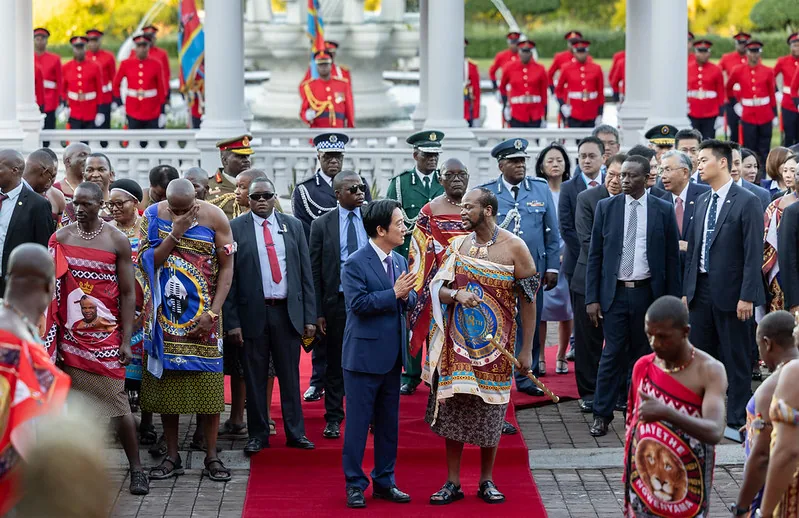
Le 3 mai 2026, Lai Ching-te et Mswati III lors des bilatérales au Mandvulo Grand Hall du palais royal de Lozitha. Photo : Bureau de la présidence de la République de Chine (Taïwan). OGDL via le communiqué officiel du Bureau de la présidence.
La cérémonie a compris les hymnes nationaux des deux pays, une revue de la garde d'honneur d'Eswatini, un salut d'artillerie et des danses traditionnelles. Deux documents importants ont été signés à l'issue de la rencontre :
- Communiqué conjoint : réaffirmant les « liens profonds, la confiance mutuelle et les valeurs partagées »
- Accord d'assistance mutuelle douanière : signé par le ministre taïwan des Affaires étrangères Lin Chia-lung et la ministre eswatinienne des Affaires étrangères Pholile Shakantu7
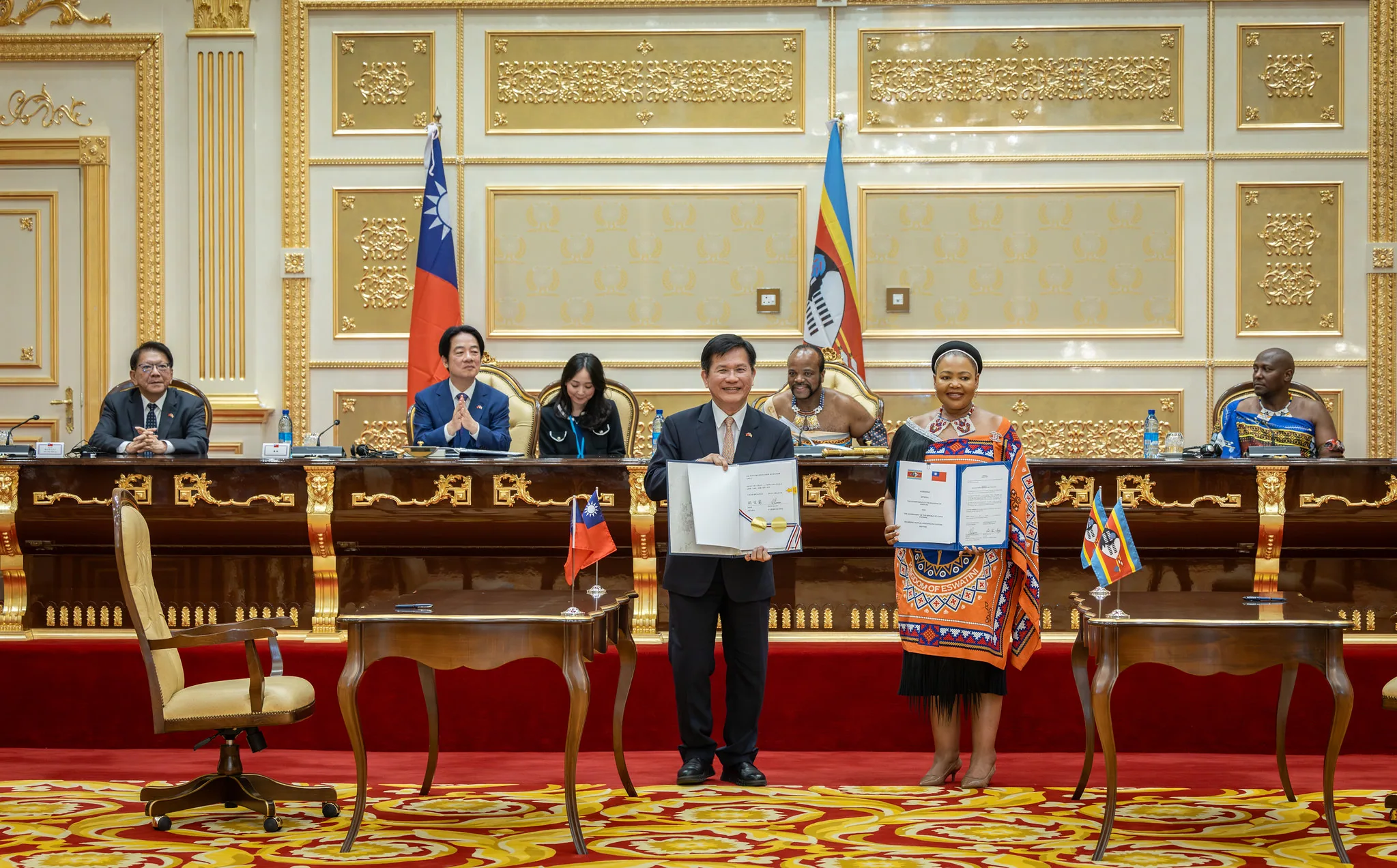
Le 3 mai 2026, les deux parties signent l'accord d'assistance mutuelle douanière et le communiqué conjoint au Mandvulo Grand Hall. Photo : Bureau de la présidence de la République de Chine (Taïwan). OGDL via le communiqué officiel du Bureau de la présidence.
La chaîne officielle de CNA a documenté l'intégralité de la signature du communiqué conjoint Taïwan-Eswatini approfondissant la coopération.
Les citations clés de Lai Ching-te (extrait du communiqué de presse en anglais du Bureau de la présidence) :
« The Republic of China (Taiwan) is a sovereign country that belongs to the world. » (La République de Chine (Taïwan) est un pays souverain qui appartient au monde.)
« No country has the right, nor should it obstruct Taiwan's contributions to the world. » (Aucun pays n'a le droit, ni ne devrait entraver les contributions de Taïwan au monde.)
« Taiwan and Eswatini are steadfast allies, who have together weathered many ups and downs. » (Taïwan et Eswatini sont des alliés indéfectibles, qui ont ensemble traversé bien des épreuves.)7
La réponse de Mswati III :
« We would like to assure you, as well as the government and people of Taiwan, that the Kingdom of Eswatini stands ready to support all the achievements Taiwan seeks, including its participation in the international community. » (Nous tenons à vous assurer, ainsi qu'au gouvernement et au peuple de Taïwan, que le Royaume d'Eswatini est prêt à soutenir toutes les aspirations de Taïwan, y compris sa participation à la communauté internationale.)7
Le poids de ces citations tient à celui qui les prononce. Lorsqu'un monarque absolu déclare publiquement, dans son propre palais, devant le chef d'État d'une autre démocratie, qu'il reconnaît un « État souverain », ce propos constitue un témoignage direct en contrepoint du discours chinois niant la souveraineté de Taïwan. Le ministère chinois des Affaires étrangères a ensuite qualifié Lai Ching-te de « rat », dénonçant une « escapade de contrebande » et une « risée internationale » (selon NBC News)19. La réponse du Département d'État américain a été plus sobre : « Taiwan is a trusted and capable partner » (Taïwan est un partenaire de confiance et compétent) et que cela « ne devrait pas être politisé »20.
L'après-midi du même jour, Lai Ching-te s'est rendu au Royal Science and Technology Park pour visiter deux projets phares de la coopération bilatérale : la réserve stratégique de pétrole (Strategic Oil Reserve) et le Parc d'innovation industrielle de Taïwan (Taiwan Industrial Innovation Park, TIIP), présentés par la Société d'investissement et de développement à l'étranger et la société de conseil en ingénierie Taiwan CEC21. Lai a qualifié ces deux projets de « la plus grande et la plus stratégiquement significative coopération depuis l'établissement des relations entre les deux pays ». « La réserve stratégique de pétrole représente la sécurité énergétique et la résilience nationale face aux crises ; le Parc d'innovation industrielle de Taïwan représente l'espoir du développement et la planification industrielle tournée vers l'avenir. Le premier protège la stabilité, le second ouvre la croissance »22.
Ce passage a donné une architecture concrète au récit de cette visite. La chaîne officielle de CNA a également consacré un reportage spécial à la plus grande coopération entre Taïwan et Eswatini : la réserve de pétrole et le parc d'innovation industrielle, à portée stratégique.
Les 46 vies humaines de 2021
Mais cette relation de 58 ans comporte une réalité lourde qu'il faut regarder en face.
Le 17 mai 2021, un étudiant en droit, Thabani Nkomonye, a été tué, vraisemblablement par la police, déclenchant des protestations nationales. Le 20 juin, environ 500 jeunes sont descendus dans les rues de Manzini pour réformer la démocratie ; le 25 juin, le Premier ministre par intérim a émis un décret interdisant les manifestations et les pétitions ; du 28 juin au 4 juillet, des émeutes ont éclaté dans tout le pays, des bâtiments ont été incendiés, des hélicoptères ont survolé le ciel, des coups de feu ont retenti jour et nuit. L'organisation Human Rights Watch (HRW) a confirmé au moins 46 morts, les estimations locales dépassant la centaine23.
En octobre 2025, le dernier rapport de HRW confirmait qu'aucun membre des forces de sécurité n'avait été poursuivi24.
C'est le coût le plus aigu de la « monarchie absolue », et c'est aussi la contradiction de valeurs à laquelle Taïwan est confronté. Notre seul allié africain est la dernière monarchie absolue d'Afrique, et ce régime a réprimé son propre peuple en 2021.
Écrire ce fait ne nuit pas aux relations diplomatiques, mais donne à cet article sa raison d'être. Les lecteurs taïwanais ont le droit de savoir que notre « dernier allié » est un pays réel dont le bilan de gouvernance inclut la répression violente, une épidémie de VIH dévastatrice et 56 % de chômage jeune (chiffre de 202325). L'expression diplomatique de « petit pays ami » ne peut pas contenir tout cela.
La vie personnelle de Mswati est une autre contradiction structurelle. Avec la reine mère Ntfombi, il est l'un des seuls environ 12 monarques absolus encore en exercice dans le monde. La Constitution lui confère un droit de veto sur tous les départements gouvernementaux et l'immunité de poursuites. Avions privés, flotte de Rolls-Royce, contrastant avec les 30 % de la population vivant sous le seuil de pauvreté : c'est un point de critique récurrent de la presse internationale9.
On peut tenir les deux vérités simultanément : premièrement, l'aide taïwanaise a effectivement sauvé des vies (traitement du VIH, coopération agricole, mission médicale) ; deuxièmement, les problèmes de gouvernance d'Eswatini ne sont pas des « affaires intérieures » qui ne nous regarderaient pas.
Après Mswati
La plus grande variable de l'avenir des relations bilatérales n'est pas en réalité le montant que la Chine est prête à offrir.
C'est la capacité du successeur de Mswati à convaincre une génération confrontée à 56 % de chômage jeune et qui ne soutient plus la monarchie absolue de continuer à considérer Taïwan comme une amie.
Au cours des 30 dernières années, la Chine a débauché 10 alliés africains de Taïwan. Chaque rupture a résulté de la combinaison de « tentation financière » et de « besoins politiques locaux ». Mais Eswatini diffère des autres allié sur un point : il n'est pas au cœur de l'arène des résolutions des Nations unies (contrairement aux États insulaires du Pacifique, directement liés au jeu sino-américain). Le coût politique de ses relations extérieures est relativement supporté par le roi à titre personnel, et la volonté personnelle de Mswati a jusqu'ici résisté à toutes les pressions.
Mais cette résistance a un plafond. Mswati est né en 1968 et a 58 ans en 2026. Sa succession aura lieu (ce n'est pas « si » mais « quand »), et le successeur fera face à un environnement politique intérieur radicalement différent de celui qui était le sien lors de son couronnement en 1986.
Après les 46 vies humaines de 2021, la patience de la jeune génération d'Eswatini envers la « gloire royale » est bien moindre que celle de leurs aînés ; le VIH continue de grever le budget de la santé ; les salaires sont comprimés par la concurrence sud-africaine ; le taux de chômage des jeunes approche les 60 %. Ce sont des pressions internes en cours, pas de simples prédictions sur l'avenir.
Le choix de l'itinéraire du retour de Lai Ching-te après cette visite révèle aussi quelque chose du contexte actuel. Le 4 mai, il a quitté Mbabane. L'avion a délibérément désactivé ses informations d'identité, empruntant une route déviée vers le sud de l'océan Indonésie via l'Indonésie et les Philippines pour éviter de s'approcher de l'espace aérien chinois et des zones sensibles de la mer de Chine méridionale, arrivant à l'aéroport de Taoyuan le 5 mai à 10 h 4026.
Un itinéraire détourné qui dit la tension de l'environnement. Mais le trajet a été accompli.
Un fruit et une question
Revenons à cette goyave à cœur rouge.
Elle est passée de l'accord de coopération technique de 1969 aux rayons de SUPERSPAR en 2024. Entre les deux, 55 ans se sont écoulés, au moins sept présidents taïwanais (Chiang Ching-kuo, Lee Teng-hui, Chen Shui-bian, Ma Ying-jeou, Tsai Ing-wen, Lai Ching-te), et Mswati III a grandi de 5 mois à 56 ans.
Elle est concrète, comestible, et coûte probablement quelques dizaines de dollars taïwanais pièce.
Cette goyave, les honneurs militaires au Mandvulo Grand Hall, les 46 vies humaines de 2021, l'exclusion ciblée d'Eswatini de la politique chinoise de droits nuls pour 53 pays africains le 1er mai, l'Airbus A340 de Mswati venu chercher Lai à Taipei : ce sont des points différents sur la même ligne narrative.
Ce qu'elle nous dit, c'est que les relations diplomatiques reposent sur un corpus de coopération accumulé pendant 58 ans, dépassant le niveau abstrait du symbole ; mais elle nous dit aussi que lorsque le jour d'après Mswati viendra, Taïwan aura-t-il accumulé suffisamment de profondeur relationnelle « indépendante d'une seule personne » pour que la chaîne d'approvisionnement de ce fruit ne disparaisse pas avec la place d'un seul ?
Cette question n'a pas encore de réponse. Mais l'existence même de la question est la posture la plus honnête de Taïwan en 2026 face à son « dernier allié ».
« The Republic of China (Taiwan) is a sovereign country that belongs to the world. » (La République de Chine (Taïwan) est un pays souverain qui appartient au monde.) — Lai Ching-te au Mandvulo Grand Hall, le 3 mai 2026.
La dernière artère diplomatique africaine, suspendue à une seule personne. C'est à la fois ce qu'elle a de plus émouvant, et le travail que la diplomatie taïwanaise doit préparer pour la prochaine décennie.
Pour aller plus loin :
- Les alliés diplomatiques de Taïwan et les relations internationales — l'architecture à trois niveaux : 12 alliés diplomatiques, 113 représentations à l'étranger, 177 destinations sans visa ; Eswatini est la pièce africaine la plus cruciale
- Lai Ching-te — de médecin de Tainan à président de la République de Chine, l'évolution du discours de Lai sur les relations extérieures depuis son entrée en fonction
- Tsai Ing-wen — la présidente qui a visité Eswatini à deux reprises, en 2018 et 2023, deux moments correspondant à deux phases des relations bilatérales
- Le mouvement du Tournesol — comment la rue de 2014 est devenue le socle du discours institutionnel vers l'extérieur en 2024-2025
- La rencontre Zheng-Xi de 2026 et la reprise de contact Kuomintang-Parti communiste — les dynamiques simultanées entre les deux rives, pour comprendre le contexte plus large de la pression chinoise sur Taïwan
- La guerre cognitive — un cadre plus systémique pour les opérations langagières chinoises comme « rat » ou « escapade de contrebande »
- Le Paraguay et Taïwan — le seul allié sud-américain, un autre type de relation maintenue sous pression chinoise grâce à une coopération de long terme
Crédits photographiques
Cet article utilise 3 photos officielles du Bureau de la présidence de la République de Chine (Taïwan), toutes mises en cache dans public/article-images/society/ pour éviter les liens directs vers les serveurs sources. Licence : données gouvernementales ouvertes (OGDL — Open Government Data License).
- taiwan-eswatini-military-honor-2026.jpg (image principale) — Le 2 mai 2026, le président Lai Ching-te reçoit les honneurs militaires à l'aéroport de Mbabane. Photo : Bureau de la présidence de la République de Chine (Taïwan).
- taiwan-eswatini-mandvulo-summit-2026.jpg — Le 3 mai 2026, Lai Ching-te et Mswati III lors des bilatérales au Mandvulo Grand Hall du palais royal de Lozitha. Photo : Bureau de la présidence de la République de Chine (Taïwan).
- taiwan-eswatini-joint-communique-2026.jpg — Le 3 mai 2026, les deux parties signent l'accord d'assistance mutuelle douanière et le communiqué conjoint au Mandvulo Grand Hall. Photo : Bureau de la présidence de la République de Chine (Taïwan).
Références
- Wikipédia : Relations entre la République de Chine et Eswatini — Chronologie complète des relations bilatérales depuis 1968, incluant les 17 visites de Mswati III à Taïwan, les dates de signature des accords bilatéraux successifs, et les données du CountryInfo du ministère des Affaires étrangères.↩2345
- UpMedia : En 2 ans après la rupture avec le Burkina Faso, 4 pays basculent vers Pékin — Reportage approfondi d'UpMedia documentant la chronologie et le contexte politique du passage de 10 pays africains de Taïwan à Pékin au cours des 30 dernières années, incluant les ruptures clés de Sao Tomé-et-Principe (2016) et du Burkina Faso (2018).↩2
- Bureau de la présidence de la République de Chine : Le président Lai Ching-te arrive en Eswatini — Communiqué de presse en anglais du Bureau de la présidence du 2 mai 2026, documentant l'arrivée de Lai Ching-te à Mbabane à bord de l'Airbus A340 d'Eswatini depuis Taipei, la cérémonie des honneurs militaires, les échanges avec le personnel de l'ambassade, ainsi que les photos officielles.↩2
- CNA : Le président Lai rencontre le roi d'Eswatini — Reportage officiel de CNA du 4 mai 2026, documentant les bilatérales entre Lai Ching-te et Mswati III, la signature du communiqué conjoint, ainsi que le contexte de l'exonération de droits de douane accordée par la Chine à 53 pays africains, excluant délibérément Eswatini.↩2
- PTS News : Les autorisations de survol annulées, la visite de Lai Ching-te reportée — Reportage officiel de la chaîne publique PTS sur l'annulation urgente de la visite initialement prévue le 22 avril, le 21 avril 2026, incluant les détails du retrait simultané des autorisations de survol par les Seychelles, Maurice et Madagascar, ainsi que l'analyse de la pression chinoise.↩
- Al Jazeera: Taiwan leader visits Eswatini despite China's attempts to block trip — Reportage international d'Al Jazeera du 3 mai 2026, adoptant le cadre de la « visite surprise », documentant l'épisode historique du roi prêtant son avion pour briser le blocus, ainsi que les réactions chinoises.↩
- Bureau de la présidence de la République de Chine : Le président Lai Ching-te tient des bilatérales avec le roi Mswati III d'Eswatini — Communiqué de presse en anglais du Bureau de la présidence du 3 mai 2026, documentant l'intégralité des bilatérales au Mandvulo Grand Hall du palais royal de Lozitha, la signature du communiqué conjoint et de l'accord d'assistance mutuelle douanière, les citations clés des deux chefs d'État, ainsi que les photos officielles.↩23456
- Wikipedia: Eswatini–Taiwan relations — Article en anglais sur les relations bilatérales, incluant la date d'établissement des relations, les accords signés au fil des ans, l'évolution des projets d'aide, et la chronologie des pressions de débauchage exercées par la Chine.↩
- Wikipedia: Mswati III — Biographie de Mswati III, incluant sa date de naissance (19 avril 1968), son couronnement le 25 avril 1986 comme plus jeune monarque régnant au monde, les pouvoirs constitutionnels de la monarchie absolue, sa coexistence avec la reine mère Ntfombi comme l'un des derniers monarques absolus, et ses visites à Taïwan.↩2
- Storm Media (citant BBC Chinese) : 140 millions de dollars d'infrastructures et la clé des relations bilatérales sous la monarchie absolue — Article de Storm Media reprenant une analyse approfondie de BBC Chinese, incluant l'analyse du professeur Yang Hao de l'Université nationale de Chengchi sur « la volonté personnelle de Mswati comme pilier des relations bilatérales », le contexte des manœuvres économiques chinoises envers Eswatini, et l'impact de la monarchie absolue sur les décisions diplomatiques.↩
- Liberty Times : BBC révèle la clé des relations diplomatiques — Article du Liberty Times documentant l'octroi par la Chine, le 1er mai 2026, de l'exonération de droits de douane sur 8 % des lignes tarifaires à 53 pays africains, excluant délibérément Eswatini, ainsi que la stratégie d'« échange d'infrastructures contre des relations diplomatiques » illustrée par le contrat de 146 millions de dollars remporté par Sinohydro pour le barrage de Pekisila en 2023.↩23
- Bureau de la présidence de la République de Chine : Dossier spécial des visites de Tsai Ing-wen en Eswatini en 2018 et 2023 — Page officielle du Bureau de la présidence regroupant les communiqués de presse complets des deux visites de Tsai Ing-wen en Eswatini, incluant la première visite du 17 au 20 avril 2018 et la deuxième du 5 au 8 septembre 2023 célébrant le 55e anniversaire des relations bilatérales, les déclarations conjointes et les accords signés.↩
- CommonWealth Magazine : Nauru rompt avec Taïwan, le nombre d'alliés tombe à 12 — Compte rendu officiel et analyse du contexte de la rupture diplomatique de Nauru le 15 janvier 2024, faisant passer le nombre d'alliés de Taïwan de 13 à 12, incluant les détails de l'aide financière à long terme promise par la Chine à Nauru.↩
- United Daily News : La goyave à cœur rouge témoigne de l'amitié Taïwan-Eswatini — Reportage du United Daily News sur la conférence de presse de Lai Ching-te du 3 mai 2026 en Eswatini, documentant son utilisation de « la goyave à cœur rouge dans les rayons de SUPERSPAR » comme accroche concrète pour illustrer plus de 40 ans de résultats de la mission agricole à Eswatini, les détails des circuits de commercialisation et de la production localisée.↩
- Focus Taiwan: Lai visits Royal Science and Technology Park, agriculture and medical aid — Reportage approfondi en anglais de CNA (Focus Taiwan), dressant un inventaire complet des projets d'aide : mission agricole du TaiwanICDF en Eswatini, mission médicale du système de l'Université médicale de Taipei, présentations de la réserve stratégique de pétrole et du Parc d'innovation industrielle de Taïwan.↩234
- Wikipedia: HIV/AIDS in Eswatini — Données épidémiologiques complètes sur le VIH en Eswatini, incluant le taux de prévalence adulte de 27,2 % (le plus élevé au monde), les disparités de genre, la répartition géographique, les chiffres détaillés par tranche d'âge, et les interventions des organisations d'aide multilatérale.↩
- Al Jazeera: Eswatini king recovers from COVID-19, takes drugs sent by Taiwan — Reportage d'Al Jazeera du 20 février 2021 documentant l'infection de Mswati III par la COVID-19, l'envoi de médicaments antiviraux par le gouvernement de Tsai Ing-wen via les canaux diplomatiques, et les remerciements publics de Mswati.↩
- The Global Fund: Eswatini meets global 95-95-95 HIV target — Rapport du Fonds mondial du 14 septembre 2020, documentant l'atteinte par Eswatini de l'objectif 95-95-95 de l'ONUSIDA, incluant une analyse de la contribution de l'ensemble d'aide multilatérale (PEPFAR, Fonds mondial, Taïwan, etc.).↩
- NBC News: Taiwan president defiant in Eswatini visit, China calls him 'rat' — Reportage international de NBC News sur les réactions du ministère chinois des Affaires étrangères après la visite de Lai Ching-te en Eswatini en mai 2026, documentant les expressions « rat », « escapade de contrebande » et « risée internationale » dans leur version anglaise.↩
- Liberty Times : Réponse américaine à la visite de Lai en Eswatini : « Taiwan is a trusted partner » — Article du Liberty Times sur la réponse officielle du Département d'État américain à la visite de Lai Ching-te en Eswatini, incluant la citation originale « Taiwan is a trusted and capable partner » et la position contre la politisation.↩
- CNA : Présentations de la réserve stratégique de pétrole et du Parc d'innovation industrielle de Taïwan — Reportage de CNA du 3 mai 2026 sur l'après-midi de Lai Ching-te au Royal Science and Technology Park, visitant les deux projets phares : la réserve stratégique de pétrole (Strategic Oil Reserve) et le Parc d'innovation industrielle de Taïwan (Taiwan Industrial Innovation Park, TIIP), incluant les détails des présentations de la Société d'investissement et de développement à l'étranger et de Taiwan CEC.↩
- United Daily News : Lai qualifie la coopération avec Eswatini de plus grande à ce jour — Reportage du United Daily News sur les propos de Lai Ching-te qualifiant la réserve stratégique de pétrole et le TIIP de « la plus grande et la plus stratégiquement significative coopération depuis l'établissement des relations entre les deux pays », incluant la formulation complète : « Le premier protège la stabilité, le second ouvre la croissance ».↩
- Wikipedia: 2021 Eswatini protests — Chronologie complète des protestations démocratiques en Eswatini de mai à juillet 2021, incluant l'étudiant en droit Thabani Nkomonye comme élément déclencheur, les 500 jeunes dans les rues de Manzini, le décret d'interdiction du Premier ministre par intérim le 25 juin, les émeutes nationales du 28 juin au 4 juillet, les 46 morts confirmés par HRW, et les estimations locales dépassant la centaine.↩
- Human Rights Watch: Eswatini — No Justice for June 2021 Security Force Violence — Rapport le plus récent de Human Rights Watch du 30 octobre 2025, confirmant qu'aucun membre des forces de sécurité n'a été poursuivi pour les violences de juin 2021, incluant des témoignages de familles, les blocages des procédures d'enquête, et les réponses de la communauté internationale.↩
- International Monetary Fund: Eswatini 2025 Article IV Consultation — Rapport de consultation au titre de l'article IV du FMI pour Eswatini en 2025, incluant le PIB, le taux de chômage (global 34 %, jeunes 56-58 %), le taux de pauvreté, les recettes de la SACU, la structure de l'industrie sucrière, et une analyse économique complète.↩
- United Daily News : Itinéraire de retour de Lai Ching-te évitant les espaces aériens sensibles chinois — Reportage du United Daily News sur les détails du retour de Lai Ching-te les 4 et 5 mai 2026, incluant la désactivation délibérée des informations d'identité de l'avion, l'itinéraire dévié vers le sud de l'océan Indonésie via l'Indonésie et les Philippines, et l'arrivée à l'aéroport de Taoyuan le 5 mai à 10 h 40.↩