
Braised Pork Rice (滷肉飯)
30-second overview: Braised pork rice is a core vessel of everyday Taiwanese food memory, born in the kitchens of military dependents' villages after 1949. The north calls it 滷肉飯 (lǔròu fàn); the south, 肉燥飯 (ròuzào fàn). The cuts, knife work, and seasoning all differ—a north-south naming war that masks a culinary divergence. In 2011, the English edition of the Michelin Guide mistranslated it as "Shandong-style," sparking a nationwide naming-correction movement; since then, "braised pork rice is an authentic, ordinary Taiwanese dish" has become the international consensus.
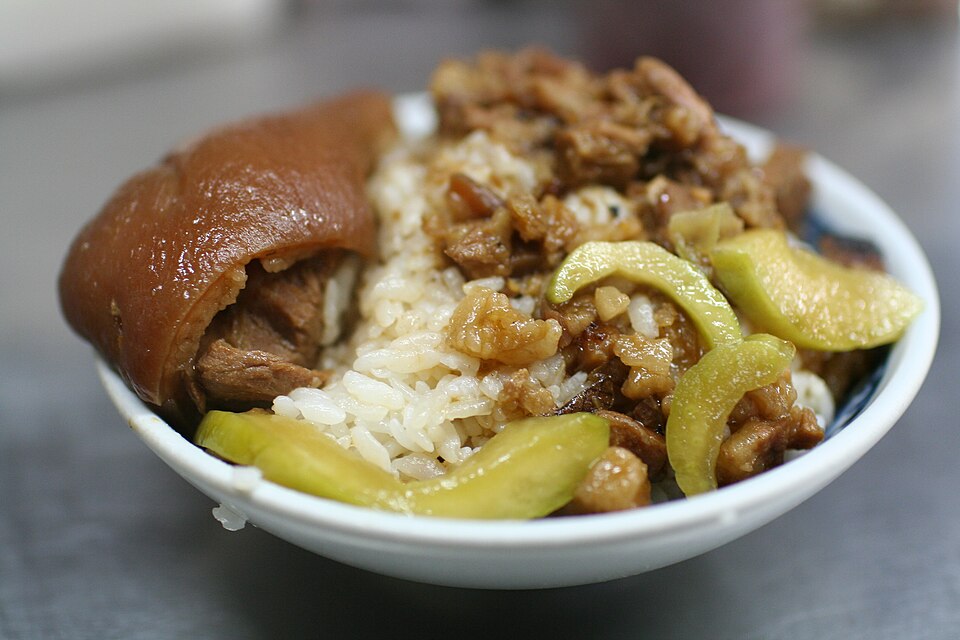
Image source: Wikimedia Commons | CC BY-SA | photographer unknown
A bowl of braised pork rice carries the collective memory of ordinary Taiwanese life. This seemingly humble dish has written a vivid chapter in Taiwan's culinary history. Beginning as a homesick taste in post-1949 military dependents' villages (眷村), it gradually grew into the island's national comfort food — and even sparked a north–south war over what counts as "authentic."1
The Naming War: 滷肉飯 vs. 肉燥飯
One of Taiwan's most charming food debates is over what to call this dish. Northerners insist on lǔròu fàn (滷肉飯); southerners argue it should be ròuzào fàn (肉燥飯).2 This is not merely a difference in vocabulary — it reflects fundamentally different ways of cooking.
Northern braised pork rice typically uses skin-on pork belly, cut into larger chunks and slow-simmered with soy sauce, rock sugar, and rice wine. The fat-and-lean cubes release rich collagen during long braising, producing a thick, glossy sauce. Southern ròuzào fàn prefers the pork much finer — sometimes even minced — with lighter seasoning that emphasizes the aroma of fried shallots (紅蔥頭).
There is no "correct answer" to this north–south war, and that's precisely the footnote it leaves on Taiwan's culinary diversity. The "Braised Pork Rice Festival" hosted by the Taipei City Government in 2011 was a concrete display of that regional pride.
The 2011 Michelin "Shandong Origin" Misreporting Incident
The most famous episode in the history of braised pork rice is the controversy triggered by the English edition of the 2011 Michelin Green Guide: Taiwan. The guide rendered the dish as "Lu (Shandong-style) Meat Rice," and claimed in its introduction that the dish originated in Shandong, China.3
The error stemmed from confusing the character 滷 ("braise") with the homophone 魯 (the abbreviation for Shandong cuisine, 魯菜). Because 魯 is the historical short name for Shandong Province, the editors made a false connection. The incident provoked strong pushback in Taiwanese society. Then-Taipei mayor Hau Lung-bin (郝龍斌) publicly insisted that "braised pork rice is authentic Taiwanese popular cuisine," and demanded a correction from Michelin. The episode became an important milestone in Taiwan's affirmation of its own culinary identity.
Origins in Military Dependents' Villages and Working-Class Memory
Braised pork rice's roots can be traced to the post-1949 culture of military dependents' villages. Large numbers of mainland-Chinese military families had relocated to Taiwan and faced economic hardship, and had to make the most filling meals from the cheapest ingredients. Pork was relatively affordable, and combined with white rice it could feed a whole family.
Mothers in these villages combined their hometown techniques with local Taiwanese ingredients to develop a distinctive way of braising pork. They added pork skin to boost collagen, used rock sugar for deeper sweetness, and reduced the sauce hard to deepen the color. These seemingly simple techniques carried generations of culinary wisdom.
As the villages were gradually demolished, these recipes scattered across Taiwan. Many of today's classic braised-pork-rice shops can trace their lineage back to the dependents' villages. The braised pork rice at the famous Liu Shandong Beef Noodle Shop in Taipei, for example, still carries a pronounced Shandong flavor.
The 2011 "National Dish" Debate
Also in 2011, an island-wide discussion broke out over what should count as "Taiwan's national dish." A media outlet ran a public poll, in which braised pork rice beat strong contenders like beef noodle soup (牛肉麵) and oyster omelet (蚵仔煎) and was crowned "national dish." The result drew fierce debate: supporters argued braised pork rice best represents Taiwan's everyday popular culture; critics questioned its mainland origins.
The heart of the dispute was the definition of "representativeness." Although braised pork rice originated with mainlander immigrants, decades of localization have integrated it deeply into Taiwanese daily life. From street stalls to convenience stores, from upscale restaurants to home dinner tables, braised pork rice is everywhere. That ubiquity and accessibility do confer the qualities of a true "national comfort food."
In the end, the controversy never reached a final answer — but it pushed Taiwanese society to think harder about culinary identity. What is "the Taiwanese flavor"? Is it pure-blooded Indigenous cuisine, or a creolized creation born from cultural fusion? The case of braised pork rice tells us that cultural identity is rarely a black-or-white multiple-choice question.
Globalization and Cultural Export
In recent years, the Taiwanese government has begun promoting the "Taiwan Braised Pork Rice Festival" (滷肉飯節) as a way to introduce Taiwan's food culture to the world via this national dish.4 From Los Angeles to Tokyo, Singapore to Melbourne, Taiwanese braised pork rice is gaining recognition in overseas Chinese communities.
These overseas Taiwanese restaurants often feature braised pork rice as a signature item alongside other Taiwanese street foods. Interestingly, the "authenticity" controversy is far less heated abroad: the northern and southern styles often coexist on the same menu, leaving the choice to the diner.5
The internationalization of braised pork rice also faces the challenges of localization. In Japan, some shops add yuzu zest to their seasoning; in the United States, some restaurants offer vegetarian versions. These adaptations may stray from the "tradition," but they also reflect the inclusiveness and adaptability of Taiwanese food culture.
Contemporary Reinventions
Today's braised pork rice is no longer confined to the traditional method. Some restaurants offer "premium" versions using wagyu beef or kurobuta pork; others go down a healthier route, cutting fat and increasing the proportion of vegetables.
The microwaveable braised pork rice in convenience stores is itself a portrait of modern life. The flavor cannot match a hand-made bowl, but the convenience is irreplaceable. This industrialized version has, in its own way, expanded the dish's reach.
The most interesting development is the "hipster" version of braised pork rice. Some new-wave restaurants repackage the dish with refined plating and literary-café decor to attract younger crowds. Critics call this "pretentious," but it has also injected fresh energy into a traditional dish.
From a village grandmother's homesick taste, to an office worker's healing lunch, to a tourist's first Taiwanese experience — every bowl of braised pork rice carries a different memory. This seemingly simple dish is, in fact, a microcosm of Taiwan's social transformation, and a concrete vessel for cultural identity.
Further Reading
- Beef Noodle Soup — Another national dish brought to Taiwan by 1949 mainlander immigrants; shares its military-dependents'-village lineage with braised pork rice
- Taiwanese Breakfast Culture — From shaobing and youtiao to burgers and rice balls, another facet of Taiwan's culinary fusion
- The KMT's Relocation to Taiwan and Postwar Reconstruction — The historical backdrop for braised pork rice's birth: 1.2 million troops and civilians arriving and reshaping the foodscape
References
- Wikipedia: Lu Rou Fan — Compiles the historical background of braised pork rice, including the interplay of early agrarian society and military dependents' village culture.↩
- Wikipedia: Lu Rou Fan — Documents the differences in name and preparation between northern Taiwan's "lǔròu fàn" and southern Taiwan's "ròuzào fàn."↩
- Wikipedia: Lu Rou Fan — A detailed record of the 2011 Michelin Guide "Shandong-origin" misreporting incident.↩
- Ministry of Economic Affairs Department of Commerce: 2019 Taiwan Braised Pork Rice Festival (YouTube) — The official promotional video for the government-organized "Taiwan Braised Pork Rice Festival," documenting how the state has used this festival to introduce a national dish to the global stage.↩
- CNN Travel: Taiwan's 40 best foods and drinks — CNN's selection of Taiwan's 40 most essential foods, with braised pork rice topping the list — confirming its international standing as Taiwan's national comfort food.↩