
30-Second Overview: On April 29, 2026, Chen Bin-hua, spokesperson for the Taiwan Affairs Office of the PRC, criticized the DPP government at a routine press conference for "openly abandoning the bottom line of food safety" and "serving 'poison potatoes' to the Taiwanese people's dining tables after opening up ractopamine pork." The trigger was the adjustment of import quarantine conditions for US processing potatoes under the Taiwan-US "Agreement on Reciprocal Trade" (ART), signed on January 16 and finalized on February 13: minor sprouting is changed from "whole batch return" to "individual removal," and potatoes with solanine levels below 200 ppm can be released. The Council for大陆 Affairs (CA), Ministry of Health and Welfare (MOHW), and Executive Yuan (EY) all refuted this on April 29. But the "truth" spans three layers. To see through this narrative war, one must look simultaneously at the scientific layer (what is 200 ppm? Behind it lies 30 ppm), the governance layer (28 days to sign a treaty + how 85 border personnel can "inspect every single potato"), and the trust layer (the 15-year scars from the 2011 melamine scandal to the 2024 ractopamine pork). The CCP narrative stepped precisely on this foundation—and the foundation is real.
The Morning of the "Test of Loyalty"
On April 29, 2026, at a routine press conference in Beijing, spokesperson Chen Bin-hua read out a criticism targeting Taipei:
"Facing the economic bullying and product dumping by the US through the so-called 'Taiwan-US Reciprocal Trade Agreement,' the DPP authorities have gone their own way against the wishes of the Taiwanese people, openly abandoning the bottom line of food safety. After opening up ractopamine pork, they are now serving 'poison potatoes' to the dining tables of the Taiwanese people, once again sacrificing the lives and health of the people as a 'test of loyalty' to flatter the US." 1
The three words "test of loyalty" (投名狀) are the key to this passage. For the past three years, this term has become the overall framing language used by the CCP for the entire series of "Taiwan-US Trade Agreements"—every time Taipei signs something with Washington, it is translated as "the DPP offering a test of loyalty to the US" 2.
It must be clarified first: "test of loyalty" itself is not a term exclusively monopolized by the CCP. Its etymology comes from the story of Lin Chong joining Liangshan in Water Margin to offer a "test of loyalty." In modern political contexts, both the Blue and Green camps use it. Earlier that same week, the DPP also used "test of loyalty" to criticize the KMT—on April 28, during the negotiation of the Military Procurement Act, the DPP caucus spokesperson stated, "The Blue-White camp uses supervision as a pretext, but is actually offering a test of loyalty to the opposite shore" 3. The power of a framing word lies not in monopolizing vocabulary, but in the conditioned reflex formed by repeated application. The特殊性 of the CCP version lies in framing consistency: for three years, every Taiwan-US agreement has been translated as "the DPP offering a test of loyalty to the US." The same word, different directions, but only one direction has a cross-year cumulative narrative.
A few hours later, Taipei responded. The spokesperson for the Council for大陆 Affairs (CA) used equally direct wording:
"The government will take responsibility for ensuring the health of the Taiwanese people; there is no need for the Taiwan Affairs Office to speak nonsense." 4
The Ministry of Health and Welfare (MOHW), Ministry of Agriculture and Fisheries (MAF), and Executive Yuan (EY) issued a joint three-party statement on the same day, roughly stating: the government has not opened up sprouting, rotting, or moldy potatoes; a double-check mechanism exists; "we will not allow unqualified or toxic potatoes to enter the market" 5. Premier Chuo Rong-tai had already spoken a week earlier at the Legislative Yuan's Health Committee: "If the Executive Yuan did such a thing, how dare I stand here today?" 6
The narrative walls between the two sides are clear—one side is "poison potatoes on the dining table, the DPP abandoning the bottom line," the other is "scientific evidence, strict quarantine, ensuring food safety." On the surface, it looks like another cross-strait verbal war. But if you look one layer deeper, this narrative war is no longer binary.
200 ppm is an Arithmetic Problem
Let's start with chemistry. Let everything have a common foundation.
When potatoes sprout or their skin turns green, they accumulate a natural defense toxin called "solanine" (Solanine, more precisely total glycoalkaloids), primarily composed of solanine and chaconine. It is a chemical weapon evolved by Solanaceae plants to combat insects and pathogens, first isolated from nightshade berries by French pharmacist Desfosses in 1820 7.
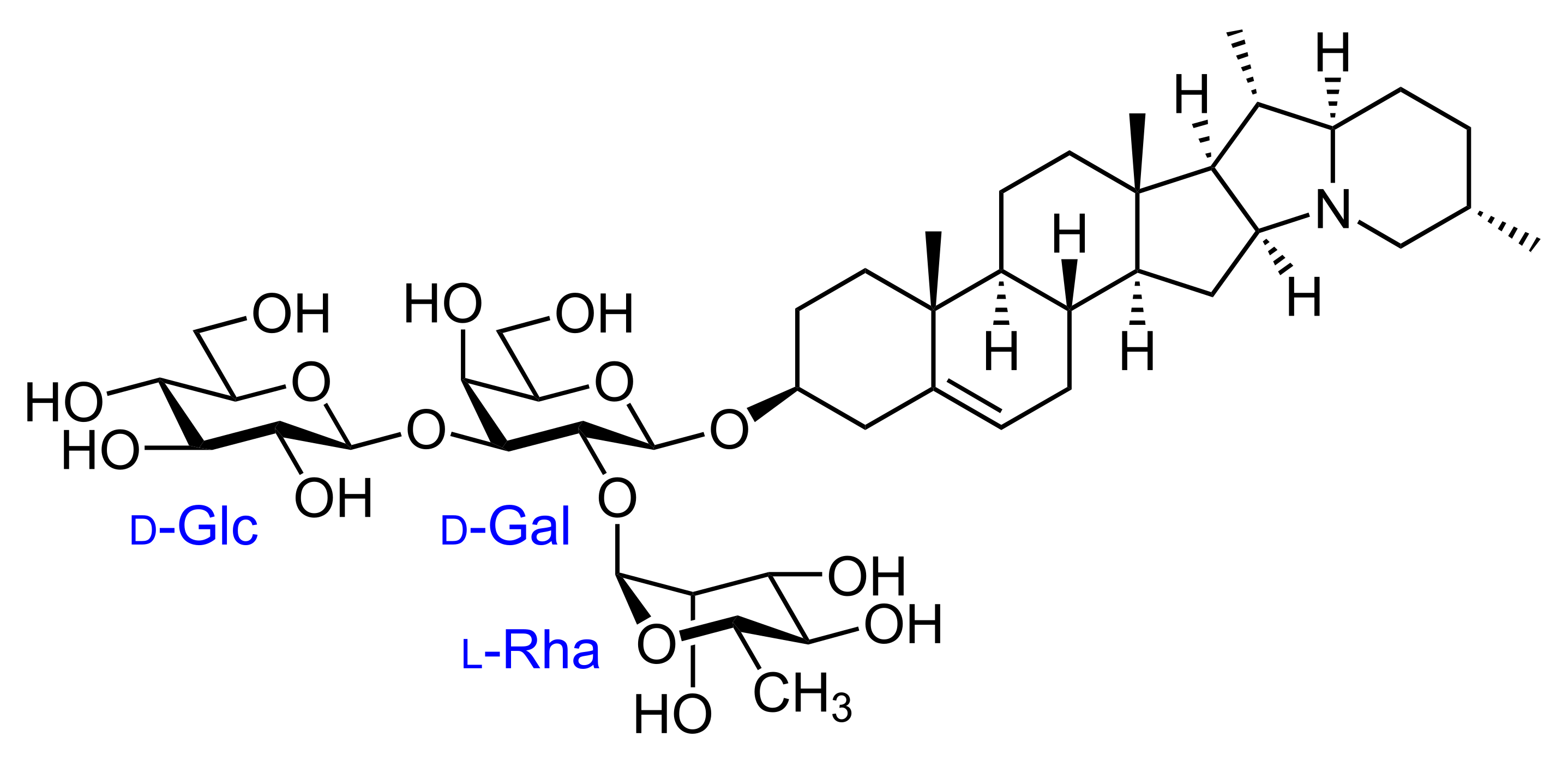
Countries basically align on the upper limit for solanine in edible potatoes: Taiwan's Hygienic Standards for Pollutants and Toxins in Food sets it at 200 ppm 8. The wording used by the Executive Yuan when refuting the CCP's accusations is "200 ppm aligns with international standards," "consistent with CODEX" 9.
But this statement of "international standard" itself has a translation flaw. Codex Alimentarius does not set a food safety standard for solanine 10. The true source of "200 mg/kg" is national legislation from the Swedish National Food Administration in 1990 and Health Canada in the early 1990s. Health Canada's own 2021 update proposal verbatim states: "The current 200 ppm TGA upper limit is jointly announced by the Department of Health and the Department of Agriculture from over thirty years ago" 11.
The EFSA 2020 scientific opinion (DOI 10.2903/j.efsa.2020.6222) provides the intake dose "Lowest Observed Adverse Effect Level" (LOAEL): 1 mg total glycoalkaloids / kg body weight / day 12—this is a different dimensional indicator from concentration standards (mg/kg potato). Converting back: for a 70 kg adult, consuming 70 mg of total glycoalkaloids reaches the LOAEL; if potatoes are at the 200 ppm boundary, this is equivalent to 350 g.
The same EFSA report explicitly states: "The MOE for young groups (children) shows health concerns at both the highest average intake survey and the P95 intake of all surveys" 12. In other words, for the P95 exposure (high intake group) of children, EFSA has officially marked health concerns—this is far from the common sense intuition of "absolutely safe below 200 ppm."
The academic consensus on toxic doses (synthesizing EFSA 2020, JECFA 1992, Mensinga 2005 human ascending dose studies):
| Indicator | Value (per kg body weight) |
|---|---|
| Safe intake | < 1 mg |
| LOAEL | 1 mg/day (EFSA 2020) |
| Toxic dose | 1.2–5.1 mg (JECFA human cases) |
| Lethal dose | 3–6 mg |
So, do the arithmetic: for a 70 kg adult, to reach the "immediately lethal" dose requires 210–420 mg of solanine. If potatoes are at the 200 ppm boundary, one would need to eat approximately 1.05 kg of potatoes at once to reach an acute lethal dose 13. But this arithmetic only answers the dimension of "acute poisoning"—the risk of chronic exposure to children, EFSA has officially marked as a concern.
This arithmetic is not to say "so eat with confidence." The point is in the other direction—the six words "poison potatoes on the dining table" compress the imagination into a danger level of "will kill people immediately." But the 200 ppm boundary + lethal dose arithmetic says something else: under strict adherence to the boundary, the risk of acute poisoning will not reach the level that collapses the social medical system. The true risk spectrum is things other than acute poisoning—chronic exposure to children P95, acrylamide formation after processing, CIPC residues—these scientific branches are not suitable for "test of loyalty" level political mobilization, but they are real.
However, speaking of "under strict adherence to the boundary" has a premise—the government's stance must be consistent across years.
Here lies an internal contradiction rarely mentioned. The Food and Drug Administration (FDA) of Taiwan released an official health education article on May 17, 2016, titled "Potatoes Sprouting are Toxic: Heard that as long as you cut out the sprouted eyes, other parts can still be eaten, is this true?" This article is still hanging on the FDA website's rumor-busting zone (fda.gov.tw) today (2026-04-30), and was maintained once on November 24, 2022. Its core conclusion is written very firmly [^33]:
"Once potatoes sprout, they should not be eaten; even if the sprouted eyes are cut out or heated, they will still contain solanine." "The whole potato produces large amounts of solanine, especially concentrated in the sprouted eyes and potato skin." "It is not edible after cutting out the sprouted eyes; even high-temperature heating cannot remove the toxicity."
Putting this together with Food and Drug Administration Food Group Director Hsu Chao-kai's "discard the whole potato" "send to processing sites for removal" in April 2026, you see something strange—the same FDA, the 2016 health education website says "not edible after cutting out sprouted eyes," the 2026 policy says "circulate after processing selection." Ten years pass, old pages not removed, no updates issued, no time limits marked.
This is the second structural contradiction beyond the 28-day signing—the government's internal stance is misaligned across years. Legislator Chen Ching-hui used this 2016 official page as evidence in her inquiry on April 23 14; the opposing camp cited government-published health education, not some expired old rumor.
What about scientists' concerns? Not in this internal contradiction—in another more technical place.
The Real Gap is Not 200 ppm, It's Called CIPC
To see the scientific core of the ART Agreement controversy, one must bypass 200 ppm and look at the sprout inhibitors.
Imported potatoes need to be immersed in "sprout inhibitors" after harvest for long-distance transport to prevent sprouting. Taiwan, the US, and Japan currently mostly use Chlorpropham, chemical name chlorpropham, industry abbreviation CIPC. CIPC slowly decomposes into the metabolite 3-chloroaniline (3-chloroaniline) at room temperature 15.
This is where the real story lies.
The EU announced under Regulation 989/2019 that it "would not renew CIPC authorization," revoked member state authorization on January 8, 2020, and cleared all inventory by October 8, 2020 16. The reason must be found in the EFSA 2017 chlorpropham peer review report (DOI 10.2903/j.efsa.2017.4903). This report gives three numbers that make people sit up: 17
- Dutch children's chronic chlorpropham dietary exposure reached 180% of the ADI (Acceptable Daily Intake)
- 3-chloroaniline chronic exposure reached 195% of the ADI
- Single potato acute chlorpropham exposure reached 797% of the ARfD (Acute Reference Dose)
- 3-chloroaniline acute exposure reached 2360% of the ARfD
EFSA's conclusion verbatim: "Due to multiple data gaps and uncertainties in food crop uses, a final consumer dietary intake risk assessment cannot be performed," "Experts could not exclude an endocrine-mediated mode of action for Leydig cell and thyroid effects" 17. The recital of EU 2019/989 Regulation directly cites this EFSA conclusion as the legal basis 16—it is scientific numbers pushing it forward, cannot be dismissed with a single word "political decision."
Regarding the carcinogenic classification of 3-chloroaniline, here we must clarify a detail often misattributed: the International Agency for Research on Cancer (IARC) classified 4-chloroaniline (para-chloroaniline) as Group 2B "possibly carcinogenic to humans," but IARC did not individually assess 3-chloroaniline (meta-chloroaniline, the metabolite of CIPC) 18. They are isomers, structurally similar but toxicological behavior may differ. The accurate statement is: 3-chloroaniline is a metabolite identified by EFSA as having significant dietary exposure risks and endocrine disruption concerns; IARC did not give this molecule a direct classification. Media reports often confuse the two as "3-chloroaniline IARC 2B"—this simplification makes the narrative useful, but lacks precision.
Taiwan / US / Japan / South Korea / Canada / Australia / Codex have not followed the EU. The current CIPC residue limits for various countries [^13]:
| Country/Region | CIPC Residue Limit |
|---|---|
| Codex Alimentarius | 30 ppm |
| Taiwan | 30 ppm |
| US (40 CFR 180.181) | 30 ppm |
| Japan | 50 ppm |
| EU (post-2020) | 0.01 ppm (default MRL) |
The actual gap between the EU and Taiwan/US is 3000 times (0.01 vs 30). The default MRL after EU 2019/989 Regulation is 0.01 ppm, which substantially means "US CIPC-treated potatoes cannot be exported to the EU" 19—USDA FAS data shows exports to the EU after 2020 are near zero.
This gap was never a problem "fabricated out of thin air by the Taiwan Affairs Office." It is a scientific decision already made by the EU, a choice the Taiwan FDA currently chooses not to follow. But it is rarely discussed in this controversy—the DPP government's refutation focus is on "aligning with international standards" (i.e., the US/Codex 30 ppm route); the Taiwan Affairs Office's spread stops at the emotional impact of the three words "poison potatoes." Both sides avoid CIPC, this more technical but more substantial gap.
The EU banning CIPC is not a political decision. From the EU starting review in 2015 to clearing inventory by October 2020, the whole process took 5 years. The most critical node in between was February 2019: the EU Standing Committee on Plants, Animals, Food and Feed (SCoPAFF) got 16 countries voting in favor of the ban in the 28 member states, but stalled at the threshold requiring "favoring countries' total population must reach 65% of the EU." On June 17, 2019, the EU Appeal Committee directly decided not to renew authorization; on June 18, 2019, Regulation 2019/989 was officially announced; on January 8, 2020, member state authorization was revoked; on October 8, 2020, inventory clearing deadline 20. 5 years. This is the result of EFSA pushing up the number of acute ARfD exceeding 2360%, accumulated sequentially.
If this article only wants to do one thing, this is it: pull CIPC out of the blind spot of this narrative war.
The 28 Days from January 16 to February 13
Looking from another dimension—governance.
The timeline is indeed very rushed. Economic Minister Cheng Li-chun went to Washington to sign the Taiwan-US Trade Negotiation MOU on January 16, 2026. On January 21, the Ministry of Agriculture and Fisheries announced the proposed adjustment of US potato import quarantine conditions, shortening the notice period from the original 60 days to 14 days. On February 6, the announcement procedure was completed. On February 13, the "Agreement on Reciprocal Trade" (ART) was formally signed in Washington 21.
From MOU signing to ART completion signing, a total of 28 days. The notice period shortened by 46 days.
Premier Chuo Rong-tai answered this timeline question at the Legislative Yuan general inquiry on April 28:
"There is no direct relationship, the text only mentions importing potatoes from the US, if changing current related content requires mutual agreement." 22
"This did not form overnight... unrelated to this negotiation, talked for a long time before." 23
The statement "unrelated to negotiation" was questioned on the same day. KMT legislator Niu Hsiu-ting revealed a detail at the same inquiry: the ART agreement text explicitly states "future quarantine conditions if to be further modified, cannot be modified unilaterally, must be discussed by bilateral representatives" 24.
If unrelated to negotiation, why lock future quarantine changes into a bilateral treaty with the US? Minister of Agriculture and Fisheries Chen Jun-ji supplemented at the same session: "Continuously discussed with the US over the past two or three years, all standards have not been relaxed." 25
The two statements are not contradictory, but put together present an image: technical details (200 ppm + processing procedures + individual removal) discussed for years; finally writing these technical details into a bilateral treaty with the US and completing signing, happened within 28 days. The former is fact, the latter is a political decision.
The point is not what conspiracy is here, but in the structural fact that "no decision is truly unrelated to negotiation." When Chuo Rong-tai says "unrelated to negotiation," he might be saying "substantive discussion predates negotiation," while Niu Hsiu-ting hears "result happened to be written into the treaty"—both are talking about things that are true, but sound like they are fighting.
"Inspect Every Single Potato" and 85 Border Inspectors
The third layer is a more concrete governance issue: border inspection capacity.
The Executive Yuan's official version says: if border quarantine finds potatoes with severe sprouting conditions, "we can still adopt whole batch return processing"; if only minor sprouting, "send to processing sites for removal" 26.
Premier Chuo Rong-tai's original words are more intense. His verbatim commitment on April 24 was:
"Will inspect the whole container, take every single potato out to inspect." 27
The four words "take every single potato out to inspect" triggered internal Green camp backlash on the same day. "Card God" Yang Hui-ru's Facebook post directly wrote:
"Chuo Rong-tai this saying that potatoes must be inspected for sprouting one by one, why is it the Premier?" 27
Blue and Green both do not buy it. Why? Look at the numbers.
DPP legislator Wang Shih-chieh revealed two numbers at the Legislative Yuan inquiry on April 15: "Only 2 companies in Taiwan have solanine inspection certification" 28. Legislator Chen Ching-hui then revealed border inspection manpower—established 105, actually employed 85 14.
KMT legislator Luo Ting-wei (transmitter Wu Tien-jung Storm Media column) did an arithmetic:
"A 40-foot container has about 150,000 potatoes, if turning over each to inspect only takes 2 seconds, one container takes about 83 hours (3.5 days) of non-stop working hours, moreover Taiwan imports up to 300 million potatoes annually." 29
150,000 potatoes / container × 2 seconds / potato = 83 hours. One border inspector's weekly working hours is 40 hours. Just looking at the physical time of one container, it exceeds 2 inspectors' whole week working hours. Annual import of 300 million potatoes converts to 2,000 40-foot containers.
The commitment "take every single potato out to inspect" is physically impossible.
But more noteworthy is another thing—the wording "one by one" (逐顆) is record-breaking in past Taiwan government food safety commitments. During the ractopamine pork period (2020-2021), government wording was "batch sampling," "100% border sampling"; during the food safety period (2022), it was "batch inspection for radioactivity"; during the egg import controversy (2023), it was "batch inspection, batch release." Every time was "batch." Only this 2026 upgrade to "one by one," "every single potato."
The upgrade of commitment wording often corresponds to political pressure. The upgrade behind this is: Blue camp calling the tune + Green internal backlash + Taiwan Affairs Office simultaneous pressure + media spokesperson spread chain full spectrum—pressure is stronger than previous times, commitment therefore pushed to a physically impossible position.
Chuo Rong-tai himself changed his words on April 28 at the Legislative Yuan to "sampling." From "every single potato" back to "sampling" spans 4 days.
Here worth detouring to the neighbor—how Japan and South Korea handle the same thing.
Japan's answer is: not open at all. Japan's Ministry of Agriculture, Forestry and Fisheries (MAFF)细则 negotiated with the US for 19 years, to 2026 still only allows US chipping potato (processing use) import, does not allow table stock (fresh food) 30. MAFF细则 Article 5 verbatim writes "inspect more than 1% of the export container unit, pay special attention to damage, deformities, etc., cut open to inspect when appropriate, confirm no quarantine harmful animals and plants (especially nematodes)"—the inspection core is nematodes, no sprouting inspection text. But Japan's safety guarantee comes from "imported varieties already limited to processing use," not "not inspecting sprouting." Agriculture and Fisheries Deputy Minister Hu Chung-i quoted "Japan does not inspect sprouting at all" as defense on 4-22, only said half the truth.
South Korea's answer is: mandatory standardization. On January 23, 2026, South Korea expanded US potato access to 11 states, but conditions include "mandatory use of CIPC as sprout inhibitor (per defined specifications)," "packing shed registration," "psyllid trapping, zebra chip bacterial disease inspection" 31. South Korea is stricter than Taiwan not in "lower CIPC limit," but putting responsibility forward to the upstream packing stage—US batches potentially not using CIPC cannot enter South Korea.
Comparing down, Taiwan is another path: border sampling + post-processing selection, did not do South Korea's packing shed registration upstream management, did not do Japan's table stock refusal to open. The physical impossibility of "inspect every single potato" is because Taiwan chose a middle path without upstream management and without use restrictions. Premier Chuo Rong-tai's words "take every single potato out to inspect" when spoken, the political burden is essentially trying to use one sentence to make up for this structural gap.
What about the processing plant side? Wu Tien-jung wrote more directly in Storm Media column:
"The government actively abandons the quarantine power to block sprouting potatoes at the border... not blocking at the border, but letting processed food operators self-select, government supervision is almost none." 32
This criticism is not directly responded to in the government version. Food and Drug Administration Food Group Director Hsu Chao-kai's explanation is: "If found to be rotten, or solanine content exceeds health standard limits, etc., violating health standard matters, should discard the whole potato, ensure safety before entering subsequent processing or circulation" 33—but this describes the border stage. After entering the processing plant, the operator self-management supervision mechanism, is currently public data blank.
These are not problems that disappear automatically with CCP accusations.
From 2011 Melamine to 2024 Ractopamine Pork
The fourth layer—perhaps the most important one—is time.
To understand why the three words "poison potatoes" in April 2026 exploded such a large reaction in Taiwanese society, must return to 2011.
That March, when Yang Ming-yu, a senior official at the Food and Drug Administration of the Department of Health, executed the "Strengthen Crackdown on Counterfeit and Substandard Drugs Project," he unexpectedly discovered plasticizers DEHP when testing a probiotic product; on May 23, the Department of Health held a press conference publicly. Digging along this line, found that Taiwan's food industry upstream "cloud agent" (legal food additive) was long illegally mixed with industrial plasticizers by Yushen Flavor and Binhan Company. DEHP was subsequently detected in beverages, juice, pastries, health foods, medicines—manufacturers possibly using Yushen or Binhan toxic cloud agents expanded from 119 to 155 34. Taiwanese people discovered that the things they had been drinking for the past twenty years, the source had a toxic additive.
September 4, 2014, the swill oil incident. Pingtung Guo Lie-cheng's recycling oil factory recycled swill oil, made finished products sold to Ch'uan Kuan Enterprise with a ratio of "33% low-quality oil + 67% lard," making "Ch'uan Kuan Fragrant Lard" entering downstream food supply chains 35. That same year, another 759 tons of non-edible lard imported from Hong Kong and Japan was exposed; estimated over 200 tons of gutter oil flowed into the market.
2020 to 2021, ractopamine pork. The Tsai Ing-wen government announced opening up US pork containing ractopamine for import, the KMT initiated a referendum to oppose. December 18, 2021 referendum result: "Anti-Ractopamine Pork" Case 18 agreed 3,936,386 votes (48.79%) against disagreed 4,131,371 votes (51.21%), failed by about 195,000 votes 36. During the ractopamine pork period, IORG (Taiwan Information Environment Research Center) organized 8 key arguments from the CCP on the referendum issues, among which 7 are related to ractopamine pork 37—this proportion itself is data evidence for "food safety issues as the main axis of cognitive warfare."
The legal outcomes all drag for a long time. The melamine case was finalized on August 3, 2018, civil joint liability compensation 3.95 million yuan—distributed to 561 consumers, each about 7,000 yuan. Lai Chun-chieh (Yushen responsible person) 15 years finalized, Jian Ling-yuan 12 years, Wang Fen 10 years; Chen Che-hsiung (Binhan responsible person) already dead, public prosecution not accepted 38. The swill oil case: Ch'uan Kuan Ye Wen-hsiang 22 years finalized in September 2017, Guo Lie-cheng 20 years finalized in February 2020—longer than common sentences for robbery and murder. Ch'uan Kuan Enterprise fined 120 million yuan then dissolved in 2017 39.
Ractopamine pork is another outcome. After the referendum failed, over 4 years: 2021 (referendum year) US pork imported 922 metric tons, 2023 surged to 16,313 metric tons, growth 17 times. No collective acute poisoning events—but Consumer Foundation tested 600 market foods, only 2 items labeled containing US pork ingredients 40. Health risks did not explode, trust gap did not heal. This is the question the following article will return to.
The common point between the 2011, 2014, 2020 events: none were exposed by foreigners, all were discovered by Taiwanese society that they were deceived. Melamine was discovered by a Department of Health inspector by accident; swill oil was reported by citizens to Pingtung County Police; ractopamine pork is the structural contradiction of Taiwan-US trade negotiations.
After each event, the "lesson" Taiwanese society learned is in the same direction: government and food industry promises are untrustworthy.
Dr. Shen Cheng-nan used a concept in his April 29 YouTube commentary on the poison potato controversy:
"It is a collective narcissism, it is a part of over-valuing health preservation." "No country is worried about eating sprouting potatoes causing poisoning!" 41
The sentence "no country is worried" is untenable at the factual level.
The US FDA's official guidance on fda.gov Acrylamide and Diet explicitly writes: "Should use the freshest, no green spots or sprouted, stored above 6°C (not in refrigerator) potatoes" 42. EU 2017/2158 acrylamide regulation mandates food operators "long-term stored potatoes must inhibit sprouting" 43. Health Canada sets a 200 ppm statutory upper limit and attaches "minimising exposure to glycoalkaloids" official guidance 11. JECFA 1992 warns: "Existing epidemiological and experimental data insufficient to determine safe intake level," "lethal dose 1.2-5.1 mg/kg bw" 44. EFSA 2020 gives health concern judgment for children P95 exposure 12.
Advanced countries are not "not afraid." The difference is in handling mechanisms: using sprout inhibitors (CIPC, 1,4-DMN) + 200 mg/kg statutory concentration upper limit + acrylamide prevention guidance + storage protocol multi-layer defense lines to disperse risks. The core of this Taiwan controversy is not "should be afraid or not," but which of these defense lines Taiwan did, which it missed.
Dr. Shen Cheng-nan's medical description itself ("no country argues like this over this") is too far from actual regulatory gaps—when he uses words like "collective narcissism," "over-valuing health preservation," unintentionally does the thing of psychologizing citizens' food safety distrust: translating it from "reasonable suspicion of institutions" to "excessive anxiety about one's own body."
This translation direction is problematic. The 2011 melamine was a real twenty-year deception; the swill oil was a real 645 tons of gutter oil; the ractopamine pork is a real bilateral negotiation structure. When citizens in 2026 hear "US potatoes relaxed" and immediately become alert, the memory they mobilize comes from the 2011 Department of Health FDA's accidental discovery.
The scars accumulated over 15 years are real. It is not written by the CCP, but it has become the foundation the CCP narrative can step into.
How "Test of Loyalty" Stepped In Precisely
Putting the previous four layers together, the precision of the "test of loyalty" narrative becomes clear.
The framework of CCP cross-strait cognitive warfare academia (Shen Po-yang, IORG, Taiwan Democracy Lab) research is roughly like this [^31]:
Food Safety Concerns (Physiological Layer)
   → Government Incompetence (Governance Layer)
     → DPP Abandoning Sovereignty (Political Layer)
       → "Flattering the US," "Test of Loyalty" (Diplomatic Layer)
         → Unification Narrative: Only cross-strait unification can protect Taiwanese people's health (Ultimate Framework)
Chen Bin-hua's April 29 sentence "once again sacrificing the lives and health of the people as a 'test of loyalty' to flatter the US" is exactly the compression of the above five layers—from food safety concerns pushing all the way to the diplomatic framework. The word "test of loyalty" is particularly important, is the CCP's overall framing for the past few years for the Taiwan-US trade agreement family (ractopamine pork, chips, ART, arms sales): every agreement = the DPP offering a test of loyalty to the US.
Shen Po-yang, who has studied CCP cross-strait public opinion warfare for 8 years, gave a quantitative judgment:
"The public opinion warfare China conducts against Taiwan, 80% has nothing to do with 'true or false,' instead mostly 'narrative attacks,' that is, fabricating a perspective." 45
Poison potatoes is a textbook example. 200 ppm, solanine, CIPC, 85 border inspectors, EU 0.01 ppm, Chuo Rong-tai "take every single potato out to inspect," MOHW 2016 health education article—every one is a real fact. But after being strung together by the narrative framework of "test of loyalty," "Lai government flattering the US," it becomes material for the Taiwan Affairs Office April 29 press conference. Shen Po-yang's analysis of the CCP's five cross-strait lines is clear: "The information warfare initiated by the Communist Party has 5 lines, respectively National Security Bureau, United Front Work Department, Taiwan Affairs Office, PLA, and Communist Youth League" 46—this poison potato is the specific task of the Taiwan Affairs Office line.
Shen Po-yang also mentioned the concept of "online and offline, top and bottom pincer attack": "For a cognitive warfare to produce effect in Taiwan, online and offline must both do... the 'confirmation bias' caused by top and bottom pincer attack is something that later cannot be stopped at all." 47 Comparing this sentence to the current spread chain—CTV April 17 "US forced to relax" → media spokesperson chain (Kuo Cheng-liang / Hou Han-ting / Wu Chiu-feng) → Threads netizens "don't talk nonsense" → Taiwan Affairs Office April 29 harvest—this is Shen Po-yang's top and bottom pincer attack; once confirmation bias is established, it cannot go back.
But here is a timeline issue easily misunderstood.
Pulling out the media spread timeline: CTV "Must Watch Daily" April 17, 2026 video title already wrote "US forced to relax sprouting potato import?! Doctor: carcinogen high temperature cannot remove!"—12 days earlier than the Taiwan Affairs Office Chen Bin-hua April 29 "poison potatoes" 48. The two words "US forced" align with the Taiwan Affairs Office's later "flattering the US" framing, but the timeline is domestic media first, CCP later.
The framing chain is more complex than "CCP orders → KMT spreads → media amplifies." It is "anxiety foundation (Taiwan's 15-year food safety scars) → domestic media and media spokespersons first amplify → CCP borrows force to harvest" multi-directional structure. What the CCP does in this framing is not generating from zero; it repackages the concerns already swirling in Taiwanese society into an attack carrier for cross-strait relations.
The success of this framing is not at the factual level, but at the emotional foundation. It stepped precisely on:
- Accumulated food safety distrust since the 2011 melamine—citizens have historical immunity to the phrase "government guarantees safety"
- Real governance tension (28-day signing, notice period shortened, 85 border people, CIPC misalignment)—these are governance problems with factual basis
- Processing plant selection power delegated down, inspection energy structurally insufficient—these are facts brought out by Taiwan's own legislators' inquiries
But the narrative itself has structural dishonesty:
- Skipping scientific details: Solanine and ractopamine are not the same type of substance, analogy is political convenience not scientific consensus
- Omitting the real gap: The 150-fold gap of CIPC can be talked about, but not suitable to talk about—it is too technical, cannot make emotional mobilization
- "Immediately lethal" imagination: Compressed in the three words "poison potatoes" is "will die if eaten," not "long-term accumulation controversy of residues"
- Cross-domain analogy: The "ractopamine pork → poison potatoes" narrative chain's goal is to construct the cumulative narrative of "every DPP concession to the US = sacrifice to Taiwanese people's health," food safety itself is just the carrier
Chen Bin-hua at the same April 29 press conference also talked about peaceful unification, Lai Ching-te's visit to Africa, Amap App restrictions, Fujian Super Football League (Min Super) 50,000 audience 49. "Poison potatoes" is just one front in multi-front. Framework tactics are not single-point strikes, are permeation covering the daily life spectrum—today you hear food safety, tomorrow maybe map App, day after sports events, same press conference hits five directions.
This structure makes the "test of loyalty" narrative extremely hard to refute in Taiwanese society. If the government only says "CCP smears," it equals denying the 15-year food safety scars are real. But if admitting "governance indeed has gaps" (rushed timeline, CIPC misalignment, insufficient border manpower), it equals confirming part of the Taiwan Affairs Office narrative—even if the Taiwan Affairs Office does not care about these technical details at all.
Russia's similar playbook against Ukraine, China's against Hong Kong all start from food entry. The common structure is: downgrade trade sovereignty issues to "food entry," because food is the most intuitive body anxiety. This downgrade is psychologically extremely effective—people are 100 times more sensitive to "eating down" than to "signing agreements."
So What is the Question
Returning to the true shape of this controversy.
Scientifically, the 200 ppm solanine boundary + processing selection + sampling—for acute poisoning risk, the gap between the new system and the old system is smaller than the degree of worry. But scientific assessment is not the true battlefield of this controversy.
In governance, 28-day signing + 60-day notice period shortened to 14 days + executive order before treaty approval + 85 border people + processing plant selection delegated down + CIPC differs from EU by 150 times—these belong to the level of governance and trust, scientific assessment cannot help. They will not disappear automatically because of any side's political discourse.
At the cognitive warfare level, the "test of loyalty" narrative stepped precisely on the 15-year food safety scars—but the origin of these scars is not the CCP. It is accumulated from the 2011 melamine, 2014 swill oil, 2020 ractopamine pork. If cognitive warfare can hit precisely, it is because the target is real. IORG 2021 public opinion manipulation report's 8 arguments, the 6th is "CCP official media cites netizens' words, comparing ractopamine pork to drugs" 37. The three words "poison potatoes" had a prototype as early as the 2021 ractopamine pork "drug" framework—the same framing applied to different substances, every time stepping on the same foundation.
Dr. Shen Cheng-nan said "no country is worried about sprouting potatoes"—this holds medically. But he attributes citizens' food safety anxiety to "collective narcissism," "over-valuing health preservation," deconstructing reasonable suspicion of institutions into personal pathology. This critique direction and the Taiwan Affairs Office's "test of loyalty" stand at different positions, but structurally do similar things—translate the other party's worries into the other party's problems.
The two reductions together squeeze out the things this controversy should truly be discussed about: Why not follow the EU on CIPC sprout inhibitors? Why not let the Legislative Yuan see the 28-day treaty signing first? How can 85 border people inspect 300 million potatoes one by one? Where is the public data on the supervision mechanism after processing plant selection is delegated down?
These questions have no sharp answers. They are uncomfortable. They are not suitable for political spread, nor for political counterattack.
But they are the true shape.
The most honest description of this controversy might be like this: Scientifically there are no "immediately lethal poison potatoes" entering the Taiwanese dining table; in governance there are real relaxations and supervision breaks; cognitive warfare precisely hits the 15-year food safety scars; and the scars themselves—should not be treated as emotions, nor as evidence. It is just a history that has not yet healed.
Another thing worth placing next to this controversy: Shen Po-yang himself was filed for investigation by the Chongqing Public Security Bureau of the PRC on October 28, 2025, for the crime of "splitting the country." The reason is he "engaged in splitting the country criminal activities by initiating, establishing the 'Taiwan independence' splitting organization 'Black Bear Academy'" 50. Shen Po-yang responded on Facebook that day: "Solving the person who raises the problem, solving the person who defends Taiwan, indeed very Communist," "Doesn't matter, anyway Taiwanese people are not afraid" 51. The same Taiwan Affairs Office system, half a year later uses "test of loyalty," "poison potatoes" to frame the same logic for the Lai government—from individual to government, from Black Bear Academy to food safety policy, is the same cognitive warfare line (Taiwan Affairs Office + United Front Work Department) different tactical deformations.
Wang Hong-en wrote a sentence in Thought Tank that can serve as a footnote for this controversy: "'Wolf warrior diplomacy' is essentially part of internal propaganda." 52 The true audience of the Taiwan Affairs Office April 29 press conference is not only Taiwan, but also China domestically—this "test of loyalty" press conference helps Beijing explain to its own people "how pathetic Taiwan is." The same press conference also covers peaceful unification, Lai Ching-te's visit to Africa, Amap App, Min Super sports events, every one is multi-front material.
Shen Po-yang said another higher-level sentence: "Establishing the consciousness of enemy and self is absolutely the most important key to responding to war," "Condensing the Taiwanese community consciousness is the primary task" 53. Placing this sentence in the context of the poison potato controversy is like this—citizens worrying about sprouting potatoes is real, government governance has gaps is also real, the Taiwan Affairs Office narrative is indeed stepping on the scars. The true countermeasure is not in the single-layer action of "rumor-busting," but in piecing these real things together letting readers see the shape themselves. Seeing the shape itself is closer to community consciousness than believing any side's one-sided narrative.
Further Reading
- Cognitive Warfare — The overall framework of CCP information manipulation and Taiwan society's countermeasures
- 2026 Cheng-Hsi Meeting and the Ten-Year Reunion of KMT-CCP — Another inflection point in cross-strait relations during the same period
- Taiwan Strait Crisis and the Development of Cross-Strait Relations — The long-term historical context of the "test of loyalty" narrative
- Tsai Ing-wen — The decision-maker of the 2020-2021 ractopamine pork policy, the layer before the scars
- Lai Ching-te — The presidential term when the ART Agreement was signed
- Think Tank — After Tsai Ing-wen's 2025 revamp, the flagship column "Annual China Observation Report" covers similar cognitive warfare issues
References
Image Sources
- Hero: Children gathering potatoes on a large farm, vicinity of Caribou, Aroostook County, Me. Schools do not open until the potatoes are harvested — US Farm Security Administration/Office of War Information / 1940 / Public Domain (PD-USGov, NARA / Library of Congress FSA-OWI Collection)
- Inline §200 ppm Section: Solanine.svg — Public Domain (simple structural formula, ineligible for copyright; via Wikimedia Commons)
- Liberty Times Net: China's Taiwan Affairs Office Says 'Poison Potatoes' Served on Taiwanese Tables, CA Hammers: No Need to Speak Nonsense — April 29, 2026 Taiwan Affairs Office spokesperson Chen Bin-hua original words complete transcription (multi-source comparison: Ta Kung Wen Wei, Newtalk, ETtoday verbatim consistent).↩
- Newtalk: Lai Ching-te 'Diplomatic Breakthrough' Rejected? Taiwan Affairs Office Again Talks Poison Potatoes — Same press conference "test of loyalty" framework historical usage analysis.↩
- United Daily News: Military Procurement Act Negotiation Stalled Again, Green: Blue-White Use Supervision as Pretext, Actually Offering Test of Loyalty to Opposite Shore — DPP caucus April 28, 2026, evidence of "test of loyalty" cross-party universal word.↩
- SETN News: CA Responds to Taiwan Affairs Office 'Poison Potatoes' — CA April 29, 2026 "no need to speak nonsense" wording.↩
- Newtalk: CA: Government Will Ensure People's Health, No Need for Taiwan Affairs Office to Speak Nonsense — CA April 29, 2026 complete statement + double-check mechanism description.↩
- PChome News: Chuo Rong-tai: If the Executive Yuan Does Such a Thing, How Dare I Stand Here — Chuo Rong-tai April 23, 2026 Legislative Yuan Health Committee speech.↩
- China Medical University Hospital Health Education: Sprouting Potatoes and Solanine — Solanine chemical structure, historical isolation, toxicological mechanism.↩
- MyGoPen Fact Check Report: Opening Up Import of Solanine Poison Potatoes? — Verification of 200 ppm upper limit aligning with CODEX + MOHW stance summary.↩
- foodNEXT: FDA: Solanine Upper Limit 200 ppm Aligns with CODEX International Standards — FDA official stance summary.↩
- Codex Alimentarius Pesticides Database — Query glycoalkaloids / solanine result is null. Codex Alimentarius does not set food safety standards for solanine; the "200 ppm aligns with international standards" mentioned in the Executive Yuan's refutation is actually Canada + Nordic 1990s national legislation, later informally referenced by many countries.↩
- Health Canada: Proposal to Update the Maximum Levels for Glycoalkaloids in Potato Tubers (2021) — Verbatim "Current 200 ppm TGA upper limit is jointly announced by the Department of Health and the Department of Agriculture from over thirty years ago." Health Canada admits 200 ppm is 1990s national legislation, attaches "minimising exposure" official guidance (Canadian Food Inspection Agency food storage suggestions).↩
- EFSA CONTAM Panel: Risk assessment of glycoalkaloids in feed and food, in particular in potatoes and potato‐derived products (2020) — DOI 10.2903/j.efsa.2020.6222; EFSA Journal 18(8):e06222; Published August 11, 2020. LOAEL 1 mg TGA/kg bw/day; MOE ≥ 10 considered no health concern; Children P95 exposure explicitly marked health concern verbatim "The MOEs for the younger age groups indicate a health concern for the food consumption surveys with the highest mean exposure, as well as for the P95 exposure in all surveys".↩
- Common Health Magazine: Sprouting Potatoes Absolutely Cannot Be Eaten? Doctor Analyzes Toxic Dose — Citing lethal dose 3-6 mg/kg calculation.↩
- ETToday: Chen Ching-hui Reveals Border Inspection Manpower Established 105 Actually Employed 85 — April 23, 2026 Legislative Yuan inquiry expose.↩
- PotatoPro: CIPC chemical profile and metabolite 3-chloroaniline — CIPC chemical structure and metabolite description.↩
- Spudman magazine: EU formally bans CIPC effective January 2020 — 2019 Regulation 989, January 8, 2020 revocation of authorization, October 8, 2020 inventory clearing timeline.↩
- EFSA: Conclusion on the peer review of the pesticide risk assessment of the active substance chlorpropham (2017) — DOI 10.2903/j.efsa.2017.4903; EFSA Journal 15(7):e04903; Published July 26, 2017. Dutch children chronic chlorpropham exposure reached ADI 180% / 3-chloroaniline reached ADI 195% / acute chlorpropham reached ARfD 797% / acute 3-chloroaniline reached ARfD 2360%. Verbatim "A final consumer risk assessment through dietary intake cannot be performed due to several data gaps and uncertainties identified for the food crop uses" + "Experts could not exclude an endocrine-mediated mode of action for Leydig cell and thyroid effects". EU 2019/989 Regulation legal basis.↩
- IARC Monograph Volume 57 (1993): para-Chloroaniline — IARC evaluated 4-chloroaniline as Group 2B "possibly carcinogenic to humans," animal experiments have sufficient evidence (male and female mouse hemangiosarcoma, male mouse liver adenoma/carcinoma, male rat spleen sarcoma). 3-chloroaniline isomer IARC did not individually assess or classify. Media often confuses the two as "3-chloroaniline IARC 2B" is an inaccurate transcription; accurate statement: 3-chloroaniline is a metabolite identified by EFSA as having significant dietary exposure risks and endocrine disruption concerns, IARC did not directly classify.↩
- USDA FAS: EU MRL for chlorpropham reduced to default 0.01 ppm post-2020 ban — EU 2019/989 Regulation after default MRL 0.01 ppm; 2020-2024 tMRL (temporary MRL) gradually lowered; US CIPC treated potatoes (highest residue 24 ppm) far exceed 0.01 ppm limit; USDA FAS data shows US fresh ware potato exports to EU near zero after 2020.↩
- PotatoPro: Not enough support for European ban on potato sprout inhibitor chlorpropham (CIPC) — EU CIPC ban detailed timeline: 2015 start review, February 2019 SCoPAFF 16/28 countries favor stall at 65% population threshold, June 17, 2019 Appeal Committee decide not to renew, June 18, 2019/989 Regulation announced, January 8, 2020 revoke authorization, October 8, 2020 inventory clear.↩
- CNA: Taiwan-US Reciprocal Trade Agreement ART Signing Process — January 16 MOU, January 21 announcement, notice period shortened from 60 days to 14 days, February 6 completion, February 13 signing complete timeline.↩
- ETtoday News Cloud: Chuo Rong-tai Legislative Yuan General Inquiry Answers ART and Potato Relationship — April 28, 2026 Legislative Yuan General Inquiry answers "unrelated to negotiation," "talked for a long time before" full text.↩
- ETtoday Same — Chuo Rong-tai "not overnight" response to Niu Hsiu-ting inquiry.↩
- ETtoday Same — Legislator Niu Hsiu-ting reveals ART text "future quarantine condition changes must be discussed by bilateral representatives" clause.↩
- ETToday Same — Agriculture Minister Chen Jun-ji answers "continuously discussed with the US over the past two or three years, all standards have not been relaxed."↩
- MyGoPen Fact Check: MOHW Minister Shih Chung-liang April 15, 2026 Legislative Yuan Inquiry Pre-Interview — "Whole batch return," "send to processing sites for removal" original verbatim.↩
- TVBS News: Chuo Rong-tai Commits 'Will Inspect Whole Container, Every Single One' Yang Hui-ru Hammers 'Why is it the Premier?' — April 24, 2026 Chuo Rong-tai original verbatim "Will inspect whole container, take every single potato out to inspect" + Yang Hui-ru Facebook backlash "Chuo Rong-tai this saying that potatoes must be inspected for sprouting one by one, why is it the Premier?" + Green camp internal dissatisfaction with "one by one" wording.↩
- Storm Media: Wang Shih-chieh Inquiry Reveals Only 2 Companies Have Solanine Inspection Certification — April 15, 2026 Legislative Yuan inquiry full text.↩
- Storm Media: Wu Tien-jung Column: Arithmetic Behind Government Unlocking Double Locks — Citing KMT legislator Luo Ting-wei on "inspect every single potato" physical time arithmetic expose.↩
- Japan Ministry of Agriculture, Forestry and Fisheries MAFF: Plant Quarantine Implementation细则 No. 194 United States Produced Potato Fresh Tubers — Japan's US potato import quarantine细则 verbatim: "Inspect more than 1% of the export container unit, pay special attention to damage, deformities, etc., cut open to inspect when appropriate, confirm no quarantine harmful animals and plants (especially nematodes)". Designated 16 US states chipping potato access; does not allow table stock. Hu Chung-i April 22 "Japan does not inspect sprouting at all" claim partially true but only said half—Japan handles it with "variety and use limitation," not "not inspecting so can."↩
- Capital Press: States outside the Pacific Northwest get access to South Korean potato market (2026-02-02) — Verbatim "Requirements include the use of certified seed from approved seed states ... use of sprout suppressant Chloropropham (CIPC) per defined specifications, and registration of packing sheds". South Korea January 23, 2026 expands US potato access to 11 states, but mandatory use of CIPC + packing shed registration + zebra chip bacterial disease inspection + psyllid monitoring. Subverts the linear imagination that "South Korea is stricter than Taiwan so bans CIPC"—South Korea's strictness is standardization requirements, not banning.↩
- Storm Media: Wu Tien-jung Column Same — "Government actively abandons border quarantine power to block sprouting potatoes" criticism.↩
- PTS News Network: FDA Food Group Director Hsu Chao-kai Explains Border Quarantine Procedures — "Discard whole potato" original verbatim.↩
- Wikipedia: 2011 Melamine Incident — DEHP cloud agent substitution + 217 manufacturers involved + Department of Health FDA discovery process.↩
- Wikipedia: Swill Oil — Ch'uan Kuan Enterprise + Ch'uan Kuan Fragrant Lard + Hong Kong Japan imported 759 tons non-edible lard + 200+ tons gutter oil downstream impact.↩
- Wikipedia: 2021 Taiwan Nationwide Referendum § Case 18 Anti-Ractopamine Pork — Agreed 3,936,386 votes (48.79%) against Disagreed 4,131,371 votes (51.21%) official results.↩
- Liberty Times Net: IORG 2021 Public Opinion Manipulation Report — 8 CCP cross-strait arguments 7 related to ractopamine pork.↩
- Apple Daily News: Melamine Case Civil Second Instance Changed Judgment 18 Manufacturers Compensate 3.95 Million Finalized — Melamine case August 3, 2018 Supreme Court dismisses appeal finalized; Yushen responsible person Lai Chun-chieh 15 years, Jian Ling-yuan 12 years, Wang Fen 10 years; Chen Che-hsiung already dead, public prosecution not accepted; Consumer Foundation represents 561 consumers suing 37 manufacturers for 2.4 billion, finally 18 manufacturers joint liability compensation 3.95 million.↩
- Wikipedia: 2014 Swill Oil Incident § Judicial Judgment — Ch'uan Kuan Ye Wen-hsiang 22 years finalized (September 2017 Supreme Court) + Dai Chi-chuan 18 years; Ch'uan Kuan Enterprise fined 120 million then dissolved in 2017; Pingtung underground oil factory Guo Lie-cheng 20 years finalized (February 12, 2020 Supreme Court).↩
- Upstream and Downstream News Market: Ractopamine Pork Open 4 Years Import from 922 Metric Tons to 16,313 Metric Tons Consumer Foundation Tested 600 Items Only 2 Labeled US Pork — MOHW FDA 2024 tested 23,327 market pork items, 489 items used US pork (2.1%); Consumer Foundation 600 food items only 2 labeled US pork ingredients; Ractopamine pork actual import volume annual growth trajectory.↩
- Storm Media: Shen Cheng-nan April YouTube Commentary on Poison Potato Controversy — "Collective narcissism," "over-valuing health preservation," "no country is worried" original words.↩
- FDA: Acrylamide and Diet, Food Storage, and Food Preparation — US FDA official guidance verbatim "potatoes should be used that are as fresh as possible, have no green spots or sprouts, and are stored above 6 °C (not in the refrigerator)" (Chinese translation: Should use the freshest, no green spots or sprouted, stored above 6°C not in refrigerator potatoes). Directly refutes Shen Cheng-nan "no country is worried" claim official iron evidence.↩
- Commission Regulation (EU) 2017/2158: establishing mitigation measures and benchmark levels for the reduction of the presence of acrylamide in food — EU 2017 acrylamide regulation Annex II mandates food operators "long-term stored potatoes must inhibit sprouting" (sprouting shall be suppressed in long term stored potatoes). Legal mandatory, not suggestion.↩
- JECFA 1992 (38th meeting) Monograph 764: Solanine and chaconine — WHO Food Additives Series 30 verbatim "the available epidemiological and experimental data from human and laboratory animal studies did not permit the determination of a safe level of intake" + "Human poisonings were documented at estimated doses of 1.2-5.1 mg/kg body weight". JECFA did not establish ADI is the official stance of the international scientific committee on solanine.↩
- The News Lens: Shen Po-yang Interview — New Form of China's Public Opinion Warfare Against Taiwan — Shen Po-yang 2023 interview verbatim "China's public opinion warfare against Taiwan, 80% has nothing to do with 'true or false,' instead mostly the aforementioned 'narrative attacks,' that is, fabricating a perspective." This article's "target is real" core point academic anchor.↩
- Wikipedia: Shen Po-yang — Shen Po-yang research framework summary: CCP information warfare five lines (National Security Bureau, Central United Front Work Department, Central Taiwan Affairs Office, PLA, Communist Youth League). Originates from Taiwan Democracy Lab research project.↩
- United Daily News Langlang Reading: Shen Po-yang — Influencers, Neighborhood Chiefs Also Penetrated? — Shen Po-yang December 2023 verbatim "For a cognitive warfare to produce effect in Taiwan, online and offline must both do... the 'confirmation bias' caused by top and bottom pincer attack is something that later cannot be stopped at all." Corresponds to media spokesperson spread chain section.↩
- CTV "Must Watch Daily" YouTube Video: US Forced to Relax Sprouting Potato Import?! Doctor: Carcinogen High Temperature Cannot Remove! — Published April 17, 2026, 12 days earlier than Taiwan Affairs Office Chen Bin-hua April 29 "poison potatoes" wording, "US forced" two words framing aligns with Taiwan Affairs Office "flattering the US."↩
- ETToday: Taiwan Affairs Office April 29 Press Conference: Peaceful Unification, Lai Ching-te Visit to Africa, Poison Potatoes, Amap, Min Super Multi-Front — Evidence of same press conference covering multiple issues (Chen Bin-hua same press conference talks peaceful unification, Lai Ching-te diplomatic failure, poison potatoes, Amap App restrictions, Min Super 51,000 audience), verifying framing is multi-front not single-point.↩
- Xinhua Net: Chongqing Public Security Bureau Files Investigation Against Shen Po-yang — Chongqing Public Security Bureau October 28, 2025 police situation bulletin verbatim "To resolutely strike Shen Po-yang for engaging in splitting the country criminal activities by initiating, establishing the 'Taiwan independence' splitting organization 'Black Bear Academy', the bureau decides to file investigation against Shen Po-yang for suspected splitting the country crime, investigate criminal responsibility according to law." CCP judicial means cognitive warfare specific case (Central News Agency October 28, 2025 cna.com.tw/news/aipl/202510280086.aspx simultaneous report).↩
- CNA: Shen Po-yang Facebook Response to Chongqing Police Filing — Solving the Person Who Raises the Problem — Shen Po-yang October 28, 2025 Facebook verbatim "Solving the person who raises the problem, solving the person who defends Taiwan, indeed very Communist," "Doesn't matter, anyway Taiwanese people are not afraid," "This is the 6th action against me within a year, this time directly filed by police for investigation, next step probably arrest, trial in absentia".↩
- Wang Hong-en: Grand External Propaganda or Stability Maintenance Means? The Public Opinion Logic of China's 'Wolf Warrior Diplomacy' (Thought Tank / Mingren Hall) — UNLV Political Science Assistant Professor Wang Hong-en verbatim "'Wolf warrior diplomacy' is essentially part of internal propaganda." Taiwan Affairs Office press conference internal propaganda logic analogy academic anchor.↩
- The News Lens: Shen Po-yang Interview Same — Shen Po-yang verbatim "Establishing the consciousness of enemy and self is absolutely the most important key to responding to war," "Condensing the Taiwanese community consciousness is the primary task." Corresponds to ending section "true countermeasure" narrative.↩