
30 segundos para ver: El programa Cuna de Taipéi de AAMA es una presencia poco común en Taiwán: un programa de mentoría para emprendedores que no invierte, no toma acciones ni cobra matrícula. Iniciado en 2012 por Jang Hung-tze, editor de Digital Times, y el consultor de contabilidad jubilado Charles Yen, permite a empresarios experimentados acompañar a un emprendedor en crecimiento durante dos años, de uno a uno. Solo acepta alrededor de veinte personas al año; tras trece años, se ha llegado a la decimoquinta cohorte, acumulando nombres como Appier, Sheqiliu (Social Enterprise Stream) y Portaly. Lo más contraintuitivo de este proyecto es una elección: un grupo de personas que podían jubilarse y disfrutar de la vida eligió el método más lento, sin economías de escala, para entregar a mano la difícil de verbalizar habilidad de «cómo hacer crecer una empresa» a la siguiente generación, sin pedir nada a cambio.
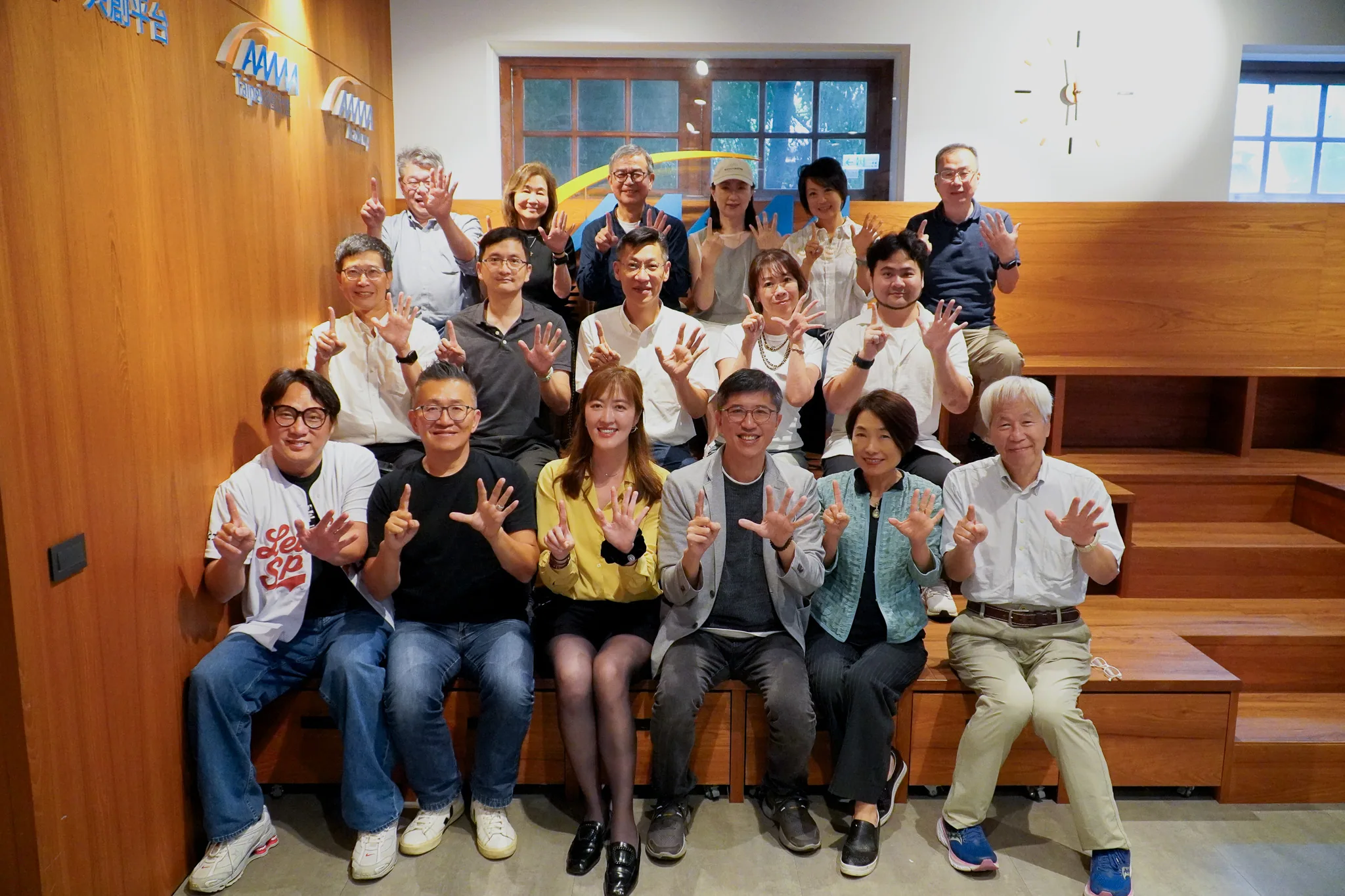
Group photo of the 15th cohort selected entrepreneurs and mentors. Photo: AAMA Taipei Cradle Program official website (fair use editorial commentary).
The impression Taiwanese people have of the AAMA Taipei Cradle Program probably stops at the large group photo published every June in Digital Times — a group of people squeezed together, making the gesture for the current cohort number. This "reveal moment" has not stopped for thirteen years, but it has never been a brand everyone recognizes. It does not appear on the front pages as often as AppWorks or Meet Taipei; rather, it lives in the memory of people in the startup circle: a one-on-one, two-year, no-equity place1.
To understand why it is strange, we must first look at how it started.
Beijing did it once; Taipei is the second time
To trace where this model comes from, we must first dispel an easy misconception arising from the name. The name AAMA comes from an Asian technology association founded in Silicon Valley in 1979 (Asia America MultiTechnology Association), which has global hubs in Silicon Valley, Beijing, Shanghai, Seoul, Hong Kong, among others2. However, the Silicon Valley parent body never had a "Cradle Program". Its core activities are traditional industry association affairs: annual conferences and monthly regular meetings3.
The two-year, one-on-one mentorship system was not the original design of 1979. It was "invented" in 2004 when Charles Yen was stationed in Beijing, transplanting Deloitte's internal corporate culture of "assigning a senior mentor to each new employee" into the startup mentoring field4.
Charles Yen's own story is dramatic in itself. He spent thirty years in an accounting firm, serving as President of Deloitte Taiwan from 1995 to 2003. In 2004, he was sent to Beijing, where he expanded the team from 400 to 2,000 people5. This is someone who led a large team and saw the financials of countless companies. After retiring, he could have played golf or enjoyed time with grandchildren, but he chose the most time-consuming path of startup mentoring. And he had already done a Cradle Program once in Beijing; in 2009, he was even selected as China's "Entrepreneurship Philanthropist of the Year"6. Taipei is the second time he brought a model experimented with elsewhere back to his hometown.
When the same system was brought back to Taiwan, the personality it grew into was quite different. Reports indicate that Charles Yen compared the differences between the two versions: the Beijing side was highly competitive, goal-oriented, carrying a flavor of hunting for opportunities; the Taiwan side added more components of companionship and sharing7. This is actually not hard to understand: the temperature of a system is ultimately determined by the local people and culture. The same "senior accompanying the junior" changes from a competition to a support system when the soil changes. This makes Taipei's Cradle Program more than a copy-paste of Beijing.
As for Jang Hung-tze's role, it is often misread as "co-inventor", but it is not. Jang Hung-tze himself spoke clearly during the tenth anniversary: "When Principal Yen (Charles Yen) mentioned this program, I thought it was a very good idea."8 It was Charles Yen who brought the idea, already tested in Beijing, to him. Jang Hung-tze's role was to acknowledge it and connect the exposure of the Digital Times media platform. One person had the method, the other had the stage; their roles complemented each other, leaving no record of ideological conflict9.
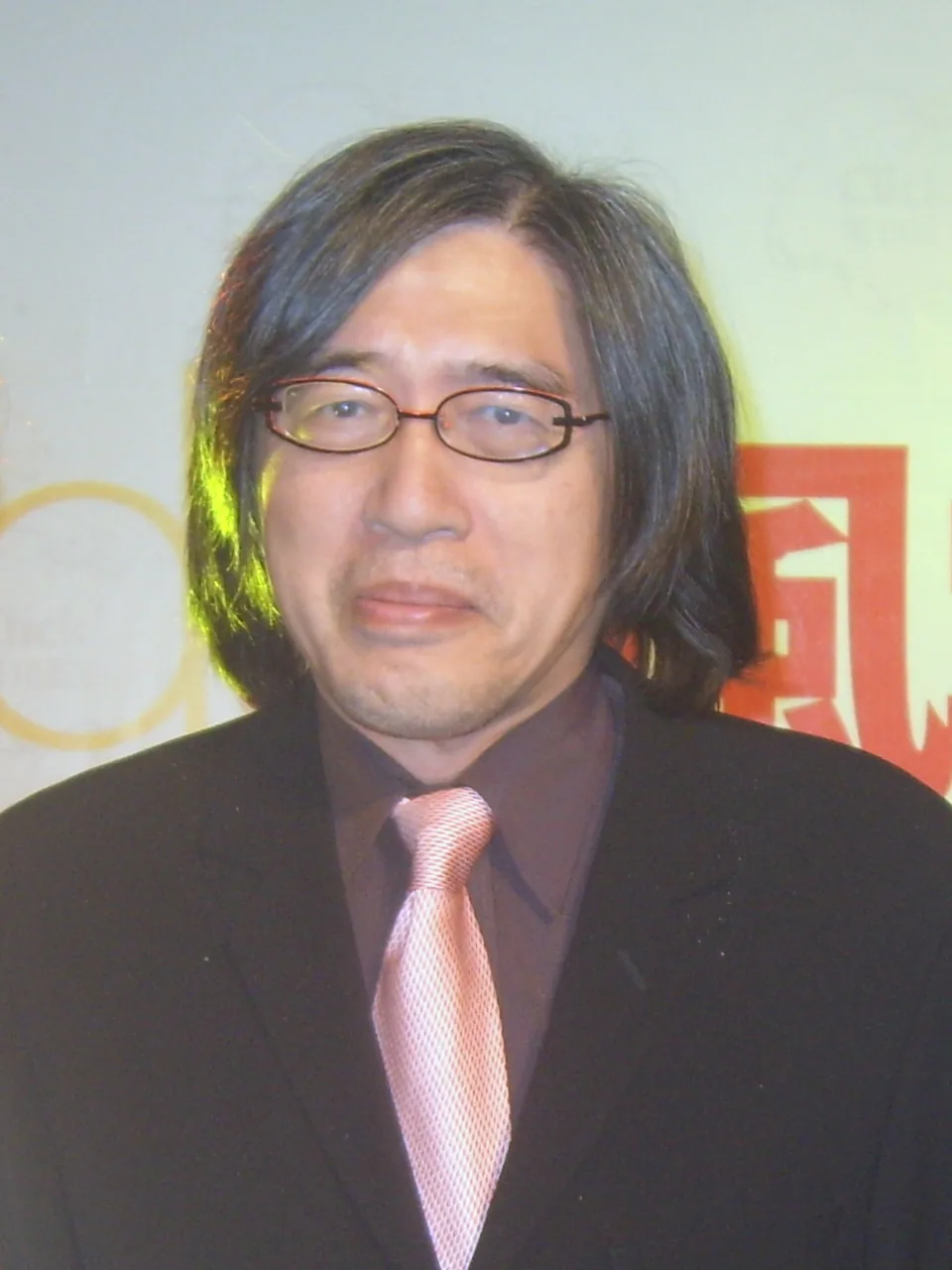
Jang Hung-tze, taken at the 2009 Web Golden Finger Awards, then Chairman of PChome and Citygroup (unrelated to AAMA directly, as AAMA was not yet established at that time). Photo: Rico Shen. License via Wikimedia Commons, CC BY-SA 4.0.
The slowest way, written in the system
In May 2012, when this program was officially established, it was not yet a formally registered organization. It was an experiment held together by Jang Hung-tze and Charles Yen relying on their respective networks10. They brought in Chu Ping, Fang Zheng, Fan Youwei, Chang Jung-kuei, Chen Yi-chiang, Pan Chien-cheng, Chien Li-feng, Su Li-mei, plus the two founders themselves, making ten mentors to pair with the twenty entrepreneurs recruited for the first cohort11.
The operation of the mentorship system is very different from the common imagination of "finding successful people to give speeches". Each student is paired with a "primary mentor" for one-on-one deep talks, while also interacting with other non-primary mentors, forming a one-to-many, many-to-many network12. The official term used is "co-learning", not "guidance": mentors and students set learning goals together, review progress together, and meet continuously over two years. The relationship gained over two years is far more precious than a single lecture.
Selection is not drawing names from a hat. Four steps — application, written preliminary selection, final interview, announcement — with the preliminary selection guarded by external venture capital, professional consultants, and the executive committee, filtering applicants down to about forty; at the final stage, the twelve mentors of that cohort personally interview to decide the final twenty to twenty-four accepted13. In other words, the mentor intervenes from the moment of acceptance: he personally chose you, so he will spend the next two years accompanying you. This keeps the role of "mentor" responsible from start to finish.
📝 Curator's Note
When people talk about "startup accelerators", what comes to mind is the Silicon Valley Y Combinator model: rapid iteration, Demo Day on stage to raise funds from investors, batches every few months. AAMA reverses every single one of these: the cycle is extended to two years, the scale shrinks to about twenty people, and it fundamentally lacks a Demo Day. In the official vocabulary, there is no word for "graduation ceremony", only "selection announcement"14. Because it does not invest, does not take equity, students have no structural need to present fundraising to investors; the logic of the entire ceremonial design is different from that of an accelerator.
This slowness is deliberate. A relationship that can truly transmit judgment cannot be fast.
No equity taken, then what for?
This is the question everyone asks the first time they hear about AAMA. No investment, no equity, no tuition fees for profit, then how does this program operate? What are the mentors spending their time for?
First, money. For the first ten years, it operated as an informal community relying on personal connections, until a board resolution at the end of 2019 and a formal donation of 10 million NTD in April 2020 to establish the foundation "Taipei Entrepreneurs Co-creation Platform Foundation"15. The list of donors is interesting: Chusi Culture (Jang Hung-tze's media group, parent company of Digital Times), the研華 (Advantech) Cultural Foundation, Wistron, Xinyi Real Estate founder Chou Chun-chi, Charles Yen himself, and twenty alumni of the program16.
Did you see that last item? Among those who paid to turn this program into a formal legal entity, twenty are people who were accompanied by it. This connects to the answer from the mentor side. Charles Yen puts it plainly: "AAMA is not a social platform, but a learning platform... these mentors are willing to share life experience and management wisdom."17 And a more complete loop is that alumni themselves also come back. The "AAMA NEXT Alumni Alliance" established in 2019, with Ye Guan-yi (1st cohort) as the first president and You Zhiwei (2nd cohort) as vice president, had alumni themselves form the governance structure18. Starting from the 14th cohort, alumni returning as mentors has become the norm rather than the exception19.
Thus the whole line grows into a loop: mentors accompany you, you graduate and become an alumnus, alumni form an alliance, some alumni return to be mentors, some alumni donate money to keep the program alive. Money and human resources circulate from within the community; a community raises itself. As for corporate cooperation, the only one found with a specific amount is the "AIoT Corporate Co-creation Project" co-hosted by Advantech and Chunghwa Telecom, providing cloud resources worth millions of NTD20.
So many people come back to give, partly because the relationships here are unvarnished. AAMA's own official alumni interview series is frankly unlike a press release — Jian Shijie, founder of UNT nail polish, said: "Cross-border at the beginning is definitely burning money! ... Like our nail polish has a high market penetration rate, but half is luck."21 An entrepreneur who can say "half is luck" and a mentor willing to sit down and accompany him for two years are neither acting out successology. This space to admit vulnerability and the component of luck is itself one of the reasons this community sticks people together.
✦ "Today, regardless of whether you are an entrepreneur, as long as you come to AAMA, you will feel love, patience, and empathy."
A caveat that should be clarified: philanthropy does not equal entirely free. The official website writes clearly that the program itself "will not charge students fees for profit purposes", but "some learning activities and cooperation with external professional consultants require self-payment"22. It is a philanthropic project that honestly marks its boundaries, not a paradise where you pay nothing.
The names on the wall, still on the road
Back to the first cohort list of 2012. Among those twenty people, there was one named You Zhihan. The company he later co-founded, Appier, became Taiwan's first AI company listed overseas (on the Tokyo Stock Exchange)23. And his current identity is a mentor for the 14th cohort of AAMA: from the accompanied person to the one accompanying others24.
This "first cohort alumnus returning as mentor" contrast is real, and beautiful. But here we must carefully draw a line: this is a symbolic connection, only symbolic. It does not constitute a causal chain of "AAMA created Appier". In a public interview, the two key figures You Zhihan thanked were Andrew Ng of the Stanford AI Lab and Masayoshi Son of Softbank, neither of whom were mentors paired by AAMA for him. When talking about how he approached Andrew Ng, he said: "I printed a thick stack of my own background materials and research results, went to every professor's office related to AI research and knocked on the door, using my awkward English..."25 This has nothing to do with AAMA.
So, what can be said is: You Zhihan is the most famous alumnus of the first cohort, now returning as a mentor; this cycle itself is evidence of the program's stickiness. What cannot be said, and for which there is no evidence, is: "The advice he received at AAMA helped him build Appier". Treating symbols as causality is deification; honestly admitting we cannot find that causal chain is realism.
Other alumni also support a cross-industry list: Lin Yihan of Sheqiliu (Social Enterprise Stream) (3rd cohort), Zhang Weixuan of Womanism (2nd cohort), TapPay Qiaorui Technology (6th cohort, acquired by a PChome Group subsidiary in 2022), Kneron (9th cohort), ChaZi Tang (Tea Seed Hall) which transformed traditional industry, and Lin Qiwei of the 13th cohort — his Portaly later became the largest creator business platform in Taiwan26.
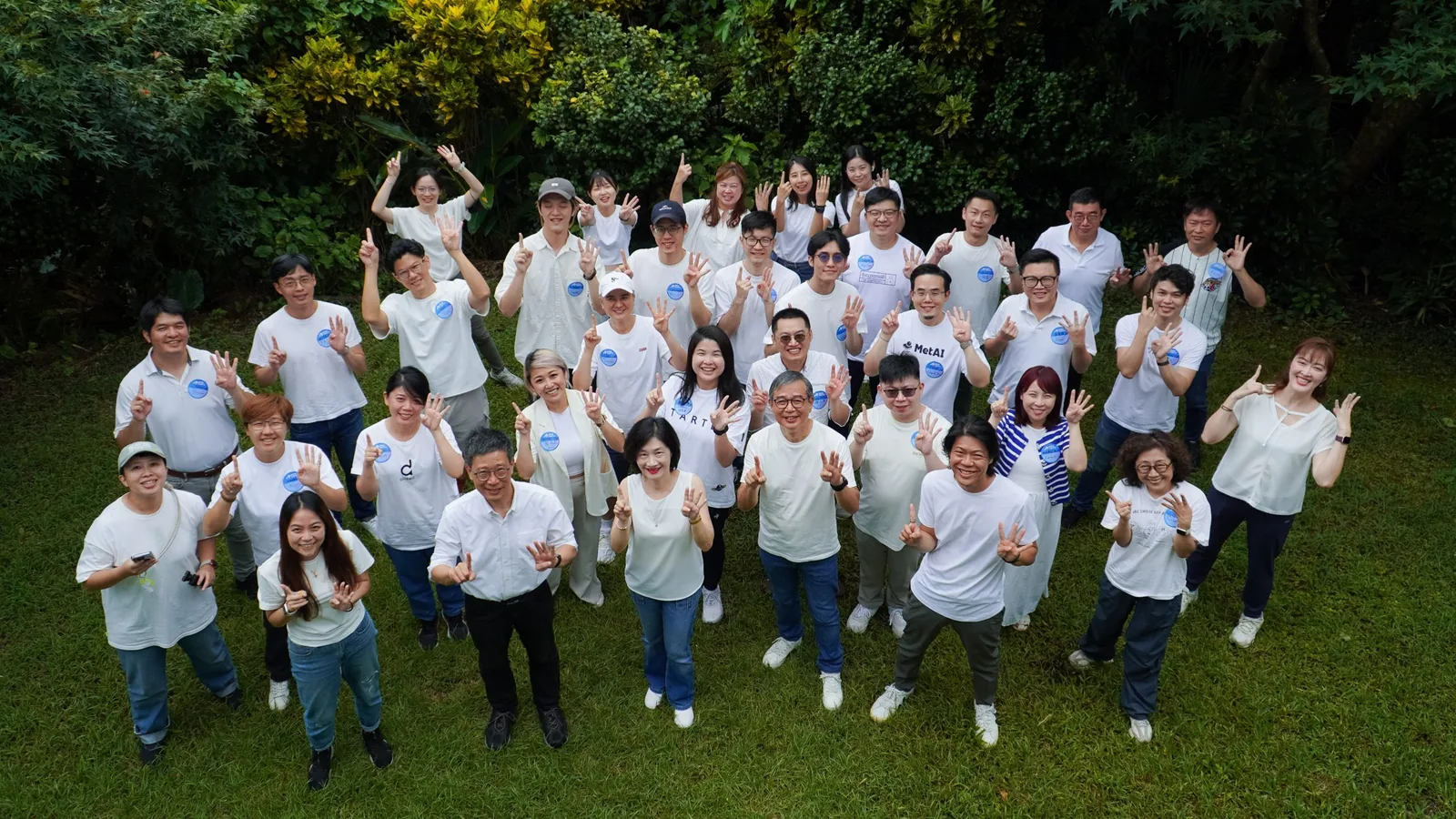
14th cohort mentors and entrepreneurs outdoor group photo. Photo: AAMA Taipei Cradle Program official website (fair use editorial commentary).
Mentors returning three times. If mentors were merely honorary titles, this program would have no soul. But its stickiness can be proven by two people.
Shen Fangzheng, CEO of the Grand Hotel Group, returned as a mentor three times (1st, 8th, 13th cohorts), spanning thirteen years27. Huang Liyan, founder of WAVE Brand Marketing, also returned three times, respectively the 5th, 8th, and 12th cohorts28. A person willing to repeatedly return to the same program over ten-plus years, repeatedly spending two years accompanying a young person they do not know, speaks for itself: what they come back to get is something that cannot be exchanged elsewhere. A resume title is far from enough to explain this stickiness.
Charles Yen has a comment on the characteristics of entrepreneurs they are looking for, which actually speaks in reverse to why mentors are willing to give. He said that an entrepreneur "knowing their own deficiencies, learning with discipline... is a very uncommon and quite precious trait"29. A person who led a team of 2,000 and saw countless rises and falls does not want to transmit "how I succeeded back then", because that is not replicable; he wants to transmit judgment, that craft that is hard to write into textbooks, only to be talked out one by one.
📝 Curator's Note
The sentence Charles Yen repeatedly says is "success cannot be replicated, but wisdom can be inherited"30. Breaking this down, it hides the foundational argument of this entire program. The Silicon Valley model believes in scalable methodology, standardizing processes, taking hundreds of companies per batch. AAMA believes exactly the opposite of methodology: the truly valuable part of judgment is precisely that which cannot be standardized or scaled, so it can only be transmitted in the oldest way, that is, master-apprentice, face-to-face, slowly. Its scale of about twenty people seems limited, but is actually deliberate: what it believes in cannot be mass-produced.
If mentors were merely honorary titles, this program would have no soul. But its stickiness can be proven by two people.
Shen Fangzheng, CEO of the Grand Hotel Group, returned as a mentor three times (1st, 8th, 13th cohorts), spanning thirteen years27. Huang Liyan, founder of WAVE Brand Marketing, also returned three times, respectively the 5th, 8th, and 12th cohorts28. A person willing to repeatedly return to the same program over ten-plus years, repeatedly spending two years accompanying a young person they do not know, speaks for itself: what they come back to get is something that cannot be exchanged elsewhere. A resume title is far from enough to explain this stickiness.
Charles Yen has a comment on the characteristics of entrepreneurs they are looking for, which actually speaks in reverse to why mentors are willing to give. He said that an entrepreneur "knowing their own deficiencies, learning with discipline... is a very uncommon and quite precious trait"29. A person who led a team of 2,000 and saw countless rises and falls does not want to transmit "how I succeeded back then", because that is not replicable; he wants to transmit judgment, that craft that is hard to write into textbooks, only to be talked out one by one.
📝 Curator's Note
The sentence Charles Yen repeatedly says is "success cannot be replicated, but wisdom can be inherited"30. Breaking this down, it hides the foundational argument of this entire program. The Silicon Valley model believes in scalable methodology, standardizing processes, taking hundreds of companies per batch. AAMA believes exactly the opposite of methodology: the truly valuable part of judgment is precisely that which cannot be standardized or scaled, so it can only be transmitted in the oldest way, that is, master-apprentice, face-to-face, slowly. Its scale of about twenty people seems limited, but is actually deliberate: what it believes in cannot be mass-produced.
The road is only half done
Up to here, it is all warm. But an honest group portrait must accommodate its own tension.
AAMA likes to talk about "finishing the program but not graduating", Charles Yen's original words are: "We often say AAMA is finishing the program but not graduating."31 The meaning is that you will not have a day where you "graduate" and leave; you stay in this community for life. This is its most moving narrative: a relationship that does not end.
But the same program, on the application page, explicitly requires students to maintain "over 80% participation in learning activities" during the two-year period32. On one side is the warm promise of a "lifetime community", on the other is the concrete governance threshold of "80% attendance rate". These two are not so contradictory that they need to argue, but they do exist simultaneously. A community held together by personal connections and emotion, once it formalizes, must be responsible to donors, must be sustainable, must grow quantitative rules. This is the growing pain all organizations face moving from "a group of friends" to "an institution".
There is another honest blank that must be addressed: this article cannot find any public record of any alumnus company going bankrupt or exiting. Searching from multiple angles multiple times, the results are all stories of growth and success. But this does not mean AAMA alumni have "zero failure". Media willingness to report on failure cases is inherently low; AAMA has never publicly released exit rate statistics; the only "exit" case found (TapPay acquisition) was a successful acquisition rather than liquidation33. So a more accurate statement is: the samples we see tend towards survivors. This report card truly presents a landscape selectively illuminated by media, not a guarantee of 100% success rate.
Official short film "From a Program to a Community" produced by the AAMA official channel "AAMA Community Culture".
In Taiwan's startup support system, AAMA is often compared to AppWorks. The differences between the two can be organized into a clear comparison: AppWorks has a batch every half year, 30-40 teams per batch, manages four venture capital funds, invests from seed to Series C, it is an "accelerate plus invest" model; AAMA is two years one-on-one, about twenty people per year, no investment no equity, focusing on "growth stage" rather than earliest-stage entrepreneurs34.
Interestingly, the founders of these two institutions, with completely different positioning yet often mentioned together, actually participate in each other's ecosystems. Lin Zhichen, founder of AppWorks, is listed on the AAMA official website's mentor list35. Rather than confrontation, this is more like the natural overlap of familiar faces in a small ecosystem. Taiwan government official census (FINDIT Ecosystem Survey) also classifies AAMA as a "comprehensive startup base", explicitly not placing it in the "accelerator" classification system. It was never the same thing from the beginning36.
What is truly worth stopping to look at is another contrast. AAMA has a sister program (SLP, Taipei Startup Leadership Program) with highly overlapping target audiences, also not focusing on investment and equity. Logically, these two programs should often be discussed together. But flipping through both official websites and media reports, one finds a thing: they are two parallel worlds, never mentioning each other publicly.
This "zero intersection" itself explains the landscape of Taiwan's startup support system better than any competition story: it is more like a galaxy of small systems operating independently, not interacting with each other, rather than an integrated market. Every program is on its own orbit, in its own believed way, catching a small group of entrepreneurs.
In 2022, AAMA turned ten. This is a moment suitable for self-praise: accumulated 106 mentors, accompanied 299 entrepreneurs, interaction hours reached 10,000 hours37. By 2024, the official website statistics showed alumni companies' annual revenue combined exceeded 57 billion NTD; in 2026, the 15th cohort, 158 applications set a new high in five years, female application ratio reached 34%, annual revenue breaking 100 million NTD application companies doubled from 9 to 1938. These numbers are beautiful.
But at the tenth anniversary forum, Charles Yen did not choose to celebrate. He quoted the argument from the book Startup Communities, saying a sentence: "Operating a startup community requires accumulating at least 20 years to exert true influence, so we are only halfway there."39
This sentence is the "unfinished" framework drawn by the founder himself, coming from inside rather than external criticism. A person with ten years of achievements, standing at a celebration occasion, choosing to say "we are only halfway there", contains a rare clarity. It admits a thing: the inheritance of judgment is inherently a slow work where results cannot be seen clearly in ten years, requiring twenty, thirty years to measure.
So looking back, the most counter-intuitive thing about the AAMA Taipei Cradle Program has never been how many unicorns it produced. It was thirteen years ago, a group of people who could have retired and enjoyed life, in an era where everyone was pursuing "faster, bigger, more", chose the slowest, least scalable, least cost-effective path: two years, one-on-one, no equity, to do something where results are only visible after twenty years. Among those twenty people in the first cohort, some have now returned to sit in the mentor's position, waiting to accompany the next young person who is still stumbling, temporarily unable to see the end. Craft is like this, handed from one pair of hands to another.
Further Reading:
- Startup Ecosystem: The panorama of Taiwan's startup ecosystem, from early challenges to accelerators, venture capital, and the pursuit of unicorns, see where AAMA sits in the landscape
- Lin Qiwei: From an Internationally Awarded Physical Board Game Brand to a Software Platform for 200,000 Creators: AAMA 13th cohort alumnus, Portaly founder, a profile of an entrepreneur who "resets and relearns every time"
- Taiwan Enterprise: Advantech: One of the AAMA Foundation donors, and also a partner in the "AIoT Corporate Co-creation Project"
- SLP Taipei Startup Leadership Program: Another sister track not focusing on equity
- Taiwan Self-media Creator Economy: Understand the creator economy wave in which AAMA's recent alumni (like Portaly) are situated
Image Sources
This article uses 3 images, all cached in public/article-images/economy/ to avoid hotlinking the source server:
- AAMA Taipei Cradle Program 15th cohort selected entrepreneurs and mentors group photo — AAMA Taipei Cradle Program official website, Fair use editorial commentary
- Portrait of Jang Hung-tze (2009 Web Golden Finger Awards) — Photo: Rico Shen, Wikimedia Commons, CC BY-SA 4.0
- AAMA Taipei Cradle Program 14th cohort outdoor group photo — AAMA Taipei Cradle Program official website, Fair use editorial commentary
References
- AAMA Taipei Cradle Program Official Website — Official website of the Taipei Entrepreneurs Co-creation Platform Foundation, primary source, listing past mentors and entrepreneur lists, program philosophy, and current statistics (application numbers, revenue figures cited in this article are based on the official website and corresponding cohort reports).↩
- Wikipedia: Asia America Multitechnology Association — English Wikipedia entry (as an index), recording AAMA founded in 1979 in Silicon Valley, global hubs including Silicon Valley, Beijing, Shanghai, Seoul, Hong Kong, monthly fourth Tuesday regular meetings.↩
- AAMA Silicon Valley Chapter Official Website — Silicon Valley parent body primary source, its history and activity pages clarify the core is traditional industry association affairs (annual Business Tech Conference, regular meetings), verified word-for-word, no content related to "Cradle Program" found.↩
- Commercial Times: Startup Promoter AAMA Principal Charles Yen — Financial media report (original blocked by 403, content indirectly obtained via search engine summary), recording the two-year one-on-one mentorship system was developed during Charles Yen's 2004 stationing in Beijing, transplanting Deloitte's internal "new employee mentor" corporate culture into the startup mentoring field.↩
- GVM Magazine: Charles Yen's Career and Turn — GVM profile report, recording Charles Yen's 30-year audit consulting experience, 2004 stationing in Beijing as Deloitte China North China Region Head, team expanded from 400 to 2,000 people during his term, referred to as "Principal Yen" in the startup circle after retirement.↩
- GVM Magazine: Charles Yen and China's "Entrepreneurship Philanthropist of the Year" — Same report as above, recording Charles Yen was founder of AAMA Beijing/Shanghai Cradle Program, selected as China's "Entrepreneurship Philanthropist of the Year" in 2009, Taipei is the second place he promoted.↩
- INSIDE: AAMA Founder Charles Yen Interview (Differences between Two Versions) — According to media reports, Charles Yen compared the personality differences between Beijing and Taipei Cradle Programs: Beijing highly competitive, goal-oriented, carrying a flavor of hunting for opportunities, Taiwan added more companionship and sharing. This quote obtained via report summary, original word-for-word source not locked to a single page, thus paraphrased as "according to reports" rather than direct quotation.↩
- Digital Times: Jang Hung-tze on AAMA Origins — In the 10th anniversary special, Jang Hung-tze's word-for-word quote "When Principal Yen mentioned this program, I thought it was a very good idea", establishing Charles Yen as the original idea person, Jang Hung-tze as the recognizer and platform provider.↩
- INSIDE: AAMA Founder Charles Yen Interview — Tech media interview with Charles Yen, presenting Jang Hung-tze's偏向 "connection and求知" (seeking knowledge), Charles Yen's偏向 "learning platform not social platform" role division, complementary not conflicting.↩
- Digital Times: AAMA Taipei Cradle Program 10th Anniversary — Digital Times 2022 10th anniversary special report, recording the process of initiation as an informal organization in March 2012 and official establishment in May of the same year, and Charles Yen's complete argument of "the road is only halfway".↩
- INSIDE: First AAMA Taipei Cradle Program 20 Entrepreneurs List — Tech media INSIDE report on the first cohort selection list, including ten first-term mentors (Jang Hung-tze, Charles Yen, Chu Ping, Fang Zheng, Fan Youwei, Chang Jung-kuei, Chen Yi-chiang, Pan Chien-cheng, Chien Li-feng, Su Li-mei) and twenty entrepreneurs.↩
- AAMA Taipei Cradle Program: Registration Page — Official website registration instruction page, primary source, specifying mentor pairing is divided into "primary mentor one-on-one" and "non-primary mentor interaction (one-to-many/many-to-many)" two layers, students and mentors jointly set learning goals and interaction frequency.↩
- Meet Startup Gathering: AAMA 8th Cohort Selection Process — Digital Times subsidiary Meet Startup Gathering report, recording the four-step selection and the mechanism of "preliminary selection guarded by external reviewers, final selection personally interviewed by the 12 mentors of that cohort", the 8th cohort finally accepted 24 entrepreneurs.↩
- AAMA Taipei Cradle Program: About Us — Official website philosophy page, primary source, elaborating on "finishing the program but not graduating" and continuous learning community positioning; the official replaces the vocabulary of "graduation ceremony" with "selection announcement", echoing the institutional logic of no investment no equity.↩
- Ministry of Justice Legal Entity Registration Announcement: Taipei Entrepreneurs Co-creation Platform Foundation — Official legal entity registration data, primary source, recording April 23, 2020 legal entity registration, Chairman Charles Yen, total assets 10 million NTD, purpose "assist entrepreneurs to succeed, co-create a better society".↩
- Digital Times: AAMA Independently Establishes Foundation — Report on foundation donor list "Chusi Culture, Advantech, Wistron, Xinyi Real Estate founder Chou Chun-chi and Cradle Program Principal Charles Yen and 20 startup enterprises' joint donation", recording the community's key turning point towards formal legal entity status.↩
- Digital Times: Charles Yen on Learning Platform Positioning — In the 10th anniversary special, Charles Yen's word-for-quote "AAMA is not a social platform, but a learning platform... these mentors are willing to share life experience and management wisdom".↩
- Digital Times: AAMA NEXT Alumni Alliance Established — Recording the October 2019 established alumni alliance set three working groups "Learning Exchange / Resource Connection / Community Activation", first president Ye Guan-yi (1st cohort), vice president You Zhiwei (2nd cohort).↩
- Meet Startup Gathering: AAMA 14th Cohort Selection Announcement — Meet Startup Gathering report, recording alumni returning as mentors from the 14th cohort's first example becoming the norm, forming the complete inheritance loop "Mentor → Mentoring → Graduate into Alumnus → Some Return as Mentors".↩
- AAMA Taipei Cradle Program Official Website: Corporate Co-creation Project — Official website primary source, recording "AAMA AIoT Corporate Co-creation Project" co-hosted by Advantech and Chunghwa Telecom, providing cloud resources worth millions of NTD, the only corporate cooperation case found with a specific amount.↩
- AAMA Taipei Cradle Program: UNT Jian Shijie Alumnus Interview — Official website alumnus interview series, UNT nail polish founder Jian Shijie's word-for-word self-statement "Cross-border at the beginning is definitely burning money! ... Like our nail polish has a high market penetration rate, but half is luck", more honest material closer to the entrepreneur's perspective outside of official press releases.↩
- AAMA Taipei Cradle Program: Registration Page Fee Explanation — Official website registration page word-for-word records "AAMA Taipei Cradle Program is a philanthropic project, will not charge students fees for profit purposes", but "some learning activities and cooperation with external professional consultants require self-payment".↩
- AAMA Taipei Cradle Program: You Zhihan Alumnus Page — Official website alumnus introduction, recording You Zhihan as 1st cohort entrepreneur, Appier CEO and Co-founder (Harvard Computer Science PhD, Stanford AI Lab Master), currently Director of the Entrepreneurs Co-creation Platform Foundation.↩
- AAMA Taipei Cradle Program Official Website: 14th Cohort Selection Announcement — Official website primary source, 14th cohort announcement page lists You Zhihan returning as 14th cohort mentor in the capacity of 1st cohort alumnus, forming a symbolic connection "Accompanied Person → Accompanying Person".↩
- AAMA Taipei Cradle Program: Chien Li-feng × You Zhihan Dialogue — Dialogue article published on the official website, You Zhihan word-for-word talks about how he sought teaching from Andrew Ng (Stanford AI Lab): "I printed a thick stack of my own background materials and research results, went to every professor's office related to AI research and knocked on the door" — this is a non-AAMA context mentorship, used to explain his success does not stem from AAMA paired mentors.↩
- Digital Times: AAMA 9th Cohort and Past Alumnus Cases — 9th cohort report, corroborating cross-industry alumnus list (including Kneron, VoiceTube, AsiaYo, etc.); Sheqiliu Lin Yihan (3rd cohort), Womanism Zhang Weixuan (2nd cohort), TapPay (6th cohort), Lin Qiwei (13th cohort, Portaly) etc. seen on official website each cohort list and related reports.↩
- AAMA Taipei Cradle Program: Shen Fangzheng Mentor Page — Official website mentor page primary source, recording Grand Hotel Group CEO Shen Fangzheng returning as mentor three times (1st, 8th, 13th cohorts), spanning 13 years, proving mentors are not one-time honorary positions.↩
- AAMA Taipei Cradle Program: Cradle Mentors (Past Selection Page) — Official website mentor page primary source, recording WAVE Brand founder Huang Liyan returning as mentor three times (5th, 8th, 12th cohorts), same as Shen Fangzheng, concrete evidence of institutional stickiness.↩
- 500 Episodes: Charles Yen Interview — United Daily News System's "500 Episodes" profile interview, Charles Yen on precious entrepreneur traits: "knowing their own deficiencies, learning with discipline... is a very uncommon and quite precious trait".↩
- Digital Times: Charles Yen "Wisdom Can Be Inherited" — 10th anniversary special, Charles Yen's repeatedly used spiritual slogan "success cannot be replicated, but wisdom can be inherited", word-for-word source.↩
- Digital Times: Charles Yen on "Finishing the Program but Not Graduating" — 10th anniversary special, Charles Yen's word-for-quote "We often say AAMA is finishing the program but not graduating", elaborating on its core philosophy of continuous learning community.↩
- AAMA Taipei Cradle Program: Registration Page Participation Requirements — Official website registration page primary source, recording program period requires students to maintain "over 80% participation in learning activities", concrete governance threshold outside the warm narrative of "finishing the program but not graduating".↩
- Manager / PChome Group Acquires TapPay Related Reports — Corroborating 6th cohort alumnus TapPay (Qiaorui Technology) acquired by PChome Group subsidiary in 2022; this is the only "exit" case found and is a successful acquisition, explaining existing visible samples tend towards survivors, not evidence of zero failure rate.↩
- AppWorks Accelerator Application FAQ — AppWorks official website primary source, explaining its half-year per batch, 30-40 teams per batch, managing four venture capital funds, investing from seed to Series C model, contrasting with AAMA's two years one-on-one, no investment no equity positioning.↩
- AAMA Taipei Cradle Program: Lin Zhichen Mentor Page — Official website mentor page primary source, listing AppWorks founder Lin Zhichen as AAMA mentor, corroborating two institutions with different positioning founders mutually participating in each other's ecosystems, non-confrontational overlap.↩
- FINDIT: Taiwan Startup Ecosystem Census Report — National Development Council FINDIT platform official policy database, classifying AAMA as "comprehensive" startup base, explicitly separated from Taiwan's 84 accelerators (divided into investment function/resource mentoring/enterprise connection/academic research value-added four categories).↩
- Digital Times: AAMA 10th Anniversary Milestone Numbers — 10th anniversary special, recording up to 2022 accumulated 106 mentors, 299 entrepreneurs, interaction hours reached 10,000 hours (this set is 2022 point-in-time numbers, different cohort numbers vary).↩
- Meet Startup Gathering: AAMA 15th Cohort Selection Announcement — Meet Startup Gathering report, recording 15th cohort (2026) 158 applications set new high in five years, female application ratio 34% (last year 27%), annual revenue breaking 100 million NTD application companies increased from 9 to 19; official website also carries 2024 alumni companies annual revenue combined over 57 billion NTD.↩
- Digital Times: Charles Yen "Road is Only Half Done" — 10th anniversary special, Charles Yen quoting argument from book Startup Communities: "Operating a startup community requires accumulating at least 20 years to exert true influence, so we are only halfway there", founder's self-drawn "unfinished" framework.↩