
Resumen en 30 segundos: Eswatini (renombrado de "Suazilandia" en 2018) es el único país diplomático africano de Taiwán. Estableció relaciones con la República de China (Taiwán) en septiembre de 1968, cumpliendo 58 años en 2026. El rey Mswati III nació en abril de 1968; cinco meses después, el país declaró su independencia y estableció relaciones con Taiwán. Su vida se ha superpuesto casi por completo a la historia diplomática de Taiwán. Hasta 2024, ha visitado Taipéi más de 17 veces1. Tras la ruptura con Botsuana en mayo de 2018, Eswatini se convirtió en el único país diplomático africano de Taiwán2. El 2 de mayo de 2026, Lai Ching-te visitó Eswatini. Originalmente planeado para el 22 de abril, su viaje fue cancelado sin previo aviso por presión china sobre Seychelles, Mauricio y Madagascar. Posteriormente, Mswati envió un Airbus A340 real de Eswatini para recoger a su viceprimer ministro Thulisile Dladla en Taipéi, y Lai Ching-te llegó directamente a Mbabane desde Taipéi el 2 de mayo3. El 1 de mayo del mismo año, China otorgó trato arancelario cero al 98% de los países africanos, excluyendo específicamente a Eswatini4. La variable más grande en este lazo diplomático es si el sucesor de Mswati puede convencer a una generación con un 56% de desempleo juvenil para que siga viendo a Taiwán como amigo (una pregunta más difícil de responder que "¿cuánto dinero usa China?").
El presidente pide prestado un avión
¿Sabes qué? A las 9 de la mañana del 2 de mayo de 2026, Lai Ching-te bajó de un Airbus A340 prestado por el rey Mswati III de Eswatini en el aeropuerto de Mbabane3.
Este A340-313 no es un avión taiwanés. Es un jet privado perteneciente a la realeza de Eswatini. La visita original de Lai Ching-te estaba programada para partir de Taipéi el 22 de abril, pero fue cancelada de emergencia el 21 de abril: Seychelles, Mauricio y Madagascar cancelaron sin previo aviso los permisos de vuelo del avión. El análisis apunta a que China ejerció una "embotellamiento aéreo" mediante la coerción económica sobre estos tres países insulares africanos5.
Mswati actuó con gran determinación: envió a su viceprimer ministro Thulisile Dladla en un jet real de Eswatini desde Mbabane a Taipéi, y el 2 de mayo recogió a Lai Ching-te para regresarlo a Eswatini esa misma mañana.
"El rey de Eswatini presta un avión al presidente taiwanés para romper el bloqueo chino" fue la esencia de esta visita. El Wall Street Journal lo calificó como una "visita sorpresa", y Al Jazeera tituló: "a pesar de los intentos de China por bloquear el viaje"6. La agencia Central News también documentó el proceso del aterrizaje en Eswatini con un jet privado.
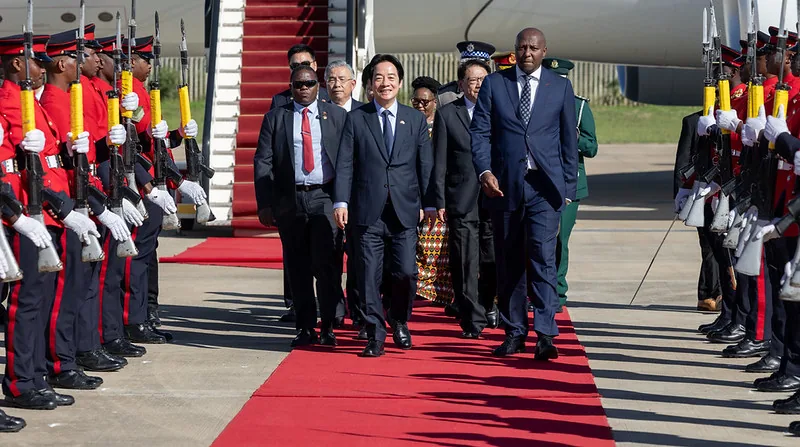
El 2 de mayo de 2026, Lai Ching-te recibió honores militares en el aeropuerto de Mbabane, Eswatini. Foto: Oficina Presidencial de la República de China (Taiwán). OGDL a través del comunicado oficial de la oficina presidencial.
La escena de la llegada fue sencilla pero significativa: fueron recibidos por el ministro Russell Dlamini, la ministra de Asuntos Exteriores y Cooperación Internacional Pholile Shakantu, el embajador taiwanés en Eswatini Jeremy H.S. Liang, y el invitado real Khandlela Mdluli. Lai Ching-te recibió honores militares y saludó a los miembros de la embajada y a las familias del grupo técnico taiwanés7. La agencia Central News documentó todo el viaje de Lai Ching-te para visitar el Reino de Eswatini.
El subtexto político de esta llegada se relaciona con otro septiembre en 1968.
Un cumpleaños sincronizado
Mswati III, cuyo nombre real es Makhosetive Dlamini, nació el 19 de abril de 1968 en Suazilandia, entonces un protectorado británico. Cinco meses después, el 6 de septiembre, Suazilandia declaró su independencia y estableció relaciones con la República de China (Taiwán) en el mismo año18.
En otras palabras, este rey, que tiene 58 años, ha tenido una vida casi perfectamente superpuesta a la historia diplomática de Taiwán. Cuando nació, aún no había relación con Taiwán; cuando era joven, esta relación ya existía; y tras ascender al trono (el 25 de abril de 1986, a los 18 años y 6 días, el más joven monarca reinante del mundo9), se convirtió en la encarnación de esa relación.
La frecuencia de sus visitas a Taiwán es asombrosa. Según registros de la embajada y el ministerio de asuntos exteriores, hasta mayo de 2024, Mswati III ha visitado Taipéi más de 17 veces1. Sus viajes fueron en octubre de 1989, octubre de 1997, octubre de 1998, mayo de 2000, julio de 2001, mayo de 2004, junio de 2006, septiembre de 2007, mayo de 2008, julio de 2010, octubre de 2012, mayo de 2013, mayo de 2015, mayo de 2016, junio de 2018, octubre de 2022 y mayo de 2024; en promedio, una vez cada dos años. Esta densidad no tiene par entre los líderes extranjeros que visitan Taiwán con la misma frecuencia.
Yang Hao, profesor del Instituto de Estudios Asiáticos de la Universidad Nacional de Tainan, señaló en una entrevista con BBC Chinese: "Es precisamente porque el rey posee poder real, y mientras quiera mantener las relaciones diplomáticas, no habrá demasiados ruidos internos"10.
En otras palabras, el último lazo diplomático de Taiwán en África pende de un hombre. Esto es tanto su fortaleza como su fragilidad.
Saltarse a Eswatini intencionalmente
El 1 de mayo de 2026, un día antes de la visita de Lai Ching-te, China anunció que otorgaría trato arancelario cero al 98% de los países africanos. Excluyó específicamente a Eswatini411.
Esto fue un "salto intencional".
De 53 países, faltó uno. Matemáticamente era solo 52/53, pero políticamente fue una declaración cruda: "el costo de estar al lado de Taiwán es el aislamiento". Medios especializados citaron análisis de BBC Chinese que explicaron llanamente esta lógica11. El canal oficial de noticias en chino de BBC News también realizó un análisis profundo sobre la lucha bilateral detrás de la visita de Lai Ching-te a Eswatini.
La historia de China "reclutando" no se detiene ahí. En los últimos 30 años, 10 países africanos han cambiado su lealtad de Taiwán a Beijing; los dos más recientes son Santo Tomé y Príncipe (2016) y Botsuana (2018)2. Cuando Botsuana rompió relaciones en el mismo mes, Tsai Ing-wen visitó Eswatini públicamente, y Mswati reafirmó su compromiso diplomático12. Esto fue del 17 al 20 de abril de 2018.
En 2023, una subsidiaria del Grupo de Construcción Hidroeléctrica China ganó la presa Pekisila Dam en Eswatini por $146 millones, y medios especializados citaron análisis de BBC Chinese que lo calificaron como una "prueba pública de intercambio de infraestructura por relaciones diplomáticas"11. Mswati no se inmutó.
Pero, ¿cuál era la verdadera presión detrás de las palabras "sin inmutarse"? El 15 de enero de 2024, Noruega —una pequeña nación del Pacífico con solo unos 10,000 habitantes— declaró la ruptura con Taiwán debido a la promesa de ayuda financiera a largo plazo por parte de China13. Esto ocurrió tres días después de las elecciones presidenciales taiwanesas; Lai Ching-te acababa de ser elegido pero aún no había asumido su cargo. En el momento de la ruptura con Noruega, el Ministerio de Asuntos Exteriores redujo el número de países diplomáticos de 13 a 12.
Eswatini se convirtió en la última pieza del rompecabezas africano.
El corazón de la sandía en SUPERSPAR
Al comenzar su conferencia de prensa el 3 de mayo, Lai Ching-te usó una fruta como anzuelo: "La sandía roja es testigo de la amistad Taiwán-Eswatini"14.
Esta sandía no era una metáfora.
El grupo técnico agrícola de TaiwanICDF en Eswatini ha estado operativo desde 1969, siendo un experimento temprano de diplomacia agrícola taiwanesa, y ahora se llama "Iniciativa de Vegetales Taiwán-África (TAVI)" y "Plan de Producción y Comercialización de Frutas Emergentes"15. Lo que hacen concretamente es llevar variedades de frutas taiwanesas (sandía roja, pitahaya, fresa, papaya) y técnicas de cultivo a Eswatini para que los agricultores locales aprendan la producción localizada.
En marzo de 2024, la sandía roja de variedad taiwanesa entró oficialmente en las tiendas Mbabane y Ezulwini del supermercado más grande de Eswatini, SUPERSPAR15. Una fruta pasó de un acuerdo de cooperación técnica (el primer acuerdo de ayuda en 19691) a un estante de supermercado en 55 años.
Lai Ching-te llevó esta sandía al podio de la conferencia de prensa. Quería decir: "la cooperación es así": concreta, comestible y que llega a canales comerciales.
La evolución del proyecto de ayuda se entiende mejor desde este ángulo. Cooperación técnica en 1969 → Cooperación agrícola en 1984 → Memorando de entendimiento sanitario en 2007 → Salud materna e infantil en 2016 → Acuerdo de cooperación económica en 2018 (vigente en diciembre del mismo año) → MOU de empoderamiento económico femenino en 2019 → Fondo de microcréditos para emprendedoras femeninas en 2023 (firmado por Tsai Ing-wen durante su visita en 2023) → Acuerdo de asistencia aduanera en 202617. Cada acuerdo es una sección transversal de un tema de la época: los años 80 fueron sobre agricultura, los 2000 sobre salud, los 2010 sobre empoderamiento femenino y sistemas económicos, y los 2020 sobre innovación industrial y cadena de suministro.
Esta percepción de la cooperación ha evolucionado lentamente con las circunstancias de ambos países, superando el nivel de un simple "regalo diplomático" estático.
Tasa de prevalencia del 27%
Pero más allá de la agricultura y la educación, la sanidad es el aspecto más pesado y concreto de esta relación.
La tasa de prevalencia del VIH en adultos (15-49 años) de Eswatini es del 27.2%, la más alta del mundo16. Detrás de este número hay un país que, sin tratamiento antirretroviral (ART), podría ser borrado de la faz de la Tierra.
La ayuda médica de Taiwán sería demasiado superficial si solo se entiende bajo el marco de "diplomacia sanitaria". El grupo médico en Eswatini, dirigido por el sistema de la Universidad Médica de Taipéi, incluye médicos, enfermeras, farmacéuticos y personal administrativo, abarcando servicios clínicos, capacitación de personal, salud pública, educación médica e introducción de medicina inteligente15. Los hechos concretos son: ayudar a Eswatini a establecer un sistema nacional de exámenes para médicos y un sistema de formación de médicos generales; realizar la primera cirugía neuroquirúrgica en el país; los médicos del sistema taiwanés han sido los únicos especialistas cardiológicos en hospitales públicos de Eswatini durante mucho tiempo, brindando más de 10,000 servicios sanitarios. Estas son acciones reales con nombres, registros quirúrgicos y números de hospitalización, superando la abstracción de "ayuda".
En abril de 2025, el Ministerio de Asuntos Exteriores donó un escáner CT, una cámara de retina y un simulador de monitoreo de pacientes al Hospital Gubernamental de Mbabane; a partir de 2026, ayudan a construir el HIS (Sistema de Información Hospitalaria) y FIRE (Formato Internacional de Recursos Rápidos de Atención Médica) para Eswatini15.
Una historia particularmente concreta es la de enero de 2021. Mswati III contrajo COVID-19, y el gobierno taiwanés de Tsai Ing-wen envió medicamentos antivirales a Eswatini a través de canales diplomáticos (los medios extranjeros especularon que era remdesivir, pero Mswati no lo nombró). Más tarde, él dio las gracias públicamente: "me recuperé antes de poder anunciar mi hospitalización"17.
El "medicamento diplomático" dejó de ser abstracto en ese momento. Esta relación de 58 años incluyó un evento concreto que salvó vidas.
También fue gracias a esta acumulación de ayuda multilateral a largo plazo —PEPFAR, Global Fund, Taiwán, etc.— que Eswatini se convirtió en uno de los primeros países africanos en alcanzar el objetivo global UNAIDS 95-95-95 (95% de pacientes con VIH diagnosticados, 95% de los diagnosticados tratados, 95% de los tratados con supresión viral) en 202018.
Honores militares en Mandvulo Grand Hall
El 3 de mayo, Lai Ching-te sostuvo una reunión bilateral con Mswati III en el Salón Real Mandvulo del Palacio Real Lozitha7.
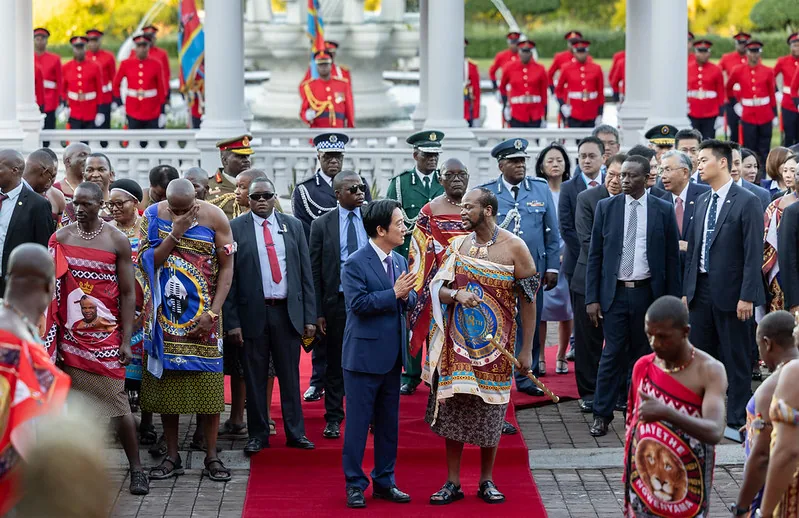
El 3 de mayo de 2026, Lai Ching-te y Mswati III se reunieron en el Salón Real Mandvulo del Palacio Real Lozitha. Foto: Oficina Presidencial de la República de China (Taiwán). OGDL a través del comunicado oficial de la oficina presidencial.
La ceremonia incluyó los himnos nacionales de ambos países, una inspección de la guardia real de Eswatini, disparos y actuaciones de danza tradicional. Después de la reunión, se firmaron dos documentos importantes:
- Comunicado Conjunto: Reafirmando "profunda amistad, confianza y valores comunes".
- "Acuerdo de Asistencia Aduanera": Firmado por el ministro de asuntos exteriores taiwanés Lin Chia-lung y la ministra de asuntos exteriores de Eswatini Pholile Shakantu7.
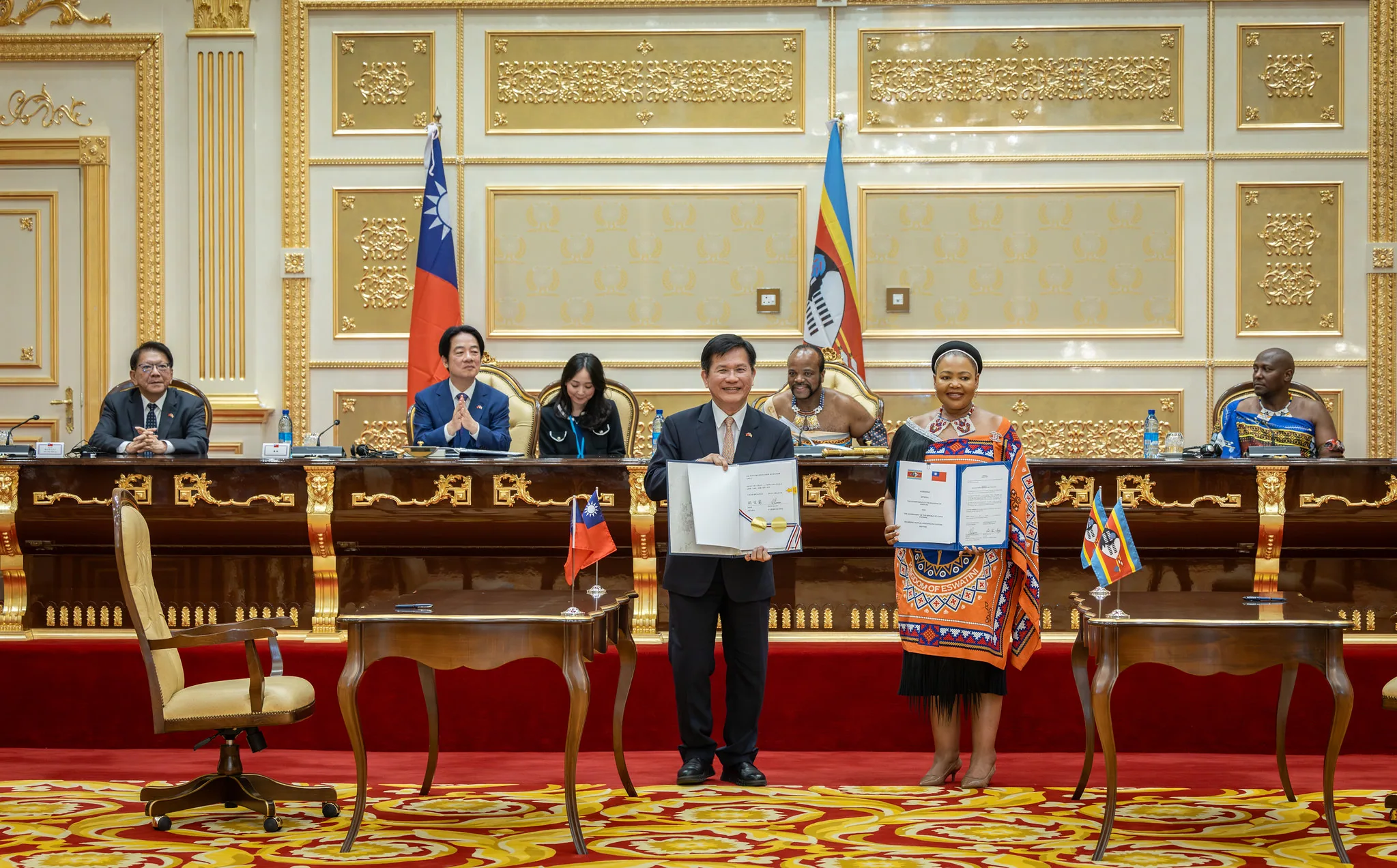
El 3 de mayo de 2026, Taiwán y Eswatini firmaron el "Acuerdo de Asistencia Aduanera" y el Comunicado Conjunto en Mandvulo Grand Hall. Foto: Oficina Presidencial de la República de China (Taiwán). OGDL a través del comunicado oficial de la oficina presidencial.
El canal oficial de noticias Central News documentó completamente la firma del comunicado conjunto y el fortalecimiento de la cooperación Taiwán-Eswatini.
La cita clave de Lai Ching-te (texto original del comunicado de prensa en inglés de la oficina presidencial):
"The Republic of China (Taiwan) is a sovereign country that belongs to the world." (La República de China (Taiwán) es un país soberano que pertenece al mundo).
"No country has the right, nor should it obstruct Taiwan's contributions to the world." (Ningún país tiene derecho, ni debería obstaculizar las contribuciones de Taiwán al mundo).
"Taiwan and Eswatini are steadfast allies, who have together weathered many ups and downs." (Taiwán y Eswatini son aliados firmes que han superado muchos altibajos juntos)7.
La respuesta de Mswati III:
"We would like to assure you, as well as the government and people of Taiwan, that the Kingdom of Eswatini stands ready to support all the achievements Taiwan seeks, including its participation in the international community." (Queremos asegurarles a ustedes, así como al gobierno y al pueblo de Taiwán, que el Reino de Eswatini está listo para apoyar todos los logros que Taiwán busca, incluida su participación en la comunidad internacional)7.
La importancia de esta cita radica en quién la dijo. Cuando un monarca absoluto declara públicamente "país soberano" ante el jefe de estado de otro país democrático en su propio palacio, esto es una refutación directa a la narrativa china de "Taiwán sin soberanía". El Ministerio de Asuntos Exteriores de China posteriormente llamó a Lai Ching-te "rata", calificando el acto como un "viaje clandestino" y una "burla internacional" (NBC News)19. La respuesta del Departamento de Estado de EE. UU. fue más simple: "Taiwán es un socio confiable y capaz"; "no debería politizarse"20.
Esa tarde, Lai Ching-te visitó el Parque Científico y Tecnológico Real para inspeccionar dos proyectos insignia de cooperación bilateral: el Almacén Estratégico de Petróleo (Strategic Oil Reserve) y el Parque de Innovación Industrial Taiwán (TIIP), donde presentaron empresas de inversión extranjera y la consultora taiwanesa Seixi21. Lai Ching-te calificó ambos como "los proyectos de cooperación más grandes e importantes desde el establecimiento de relaciones diplomáticas entre los dos países". El "Almacén Estratégico de Petróleo" representa la seguridad energética y la resiliencia nacional frente a crisis, mientras que el "Parque de Innovación Industrial Taiwán" representa la visión futura del desarrollo industrial; uno protege la estabilidad y el otro abre la vía al crecimiento22.
Esta sección proporcionó una estructura concreta para el discurso de Lai Ching-te durante esta visita. El canal oficial de noticias Central News también informó sobre la cooperación más grande entre Taiwán y Eswatini: el almacén de petróleo y el parque de innovación tienen significado estratégico.
Las 46 vidas en 2021
Pero hay una verdad muy pesada que esta relación de 58 años debe enfrentar.
El 17 de mayo de 2021, un estudiante de derecho de Eswatini llamado Thabani Nkomonye fue presuntamente asesinado por la policía, lo que desencadenó protestas nacionales. El 20 de junio, unos 500 jóvenes salieron a las calles en Manzini exigiendo reformas democráticas; el 25 de junio, el viceprimer ministro interino prohibió las protestas y la presentación de peticiones; del 28 de junio al 4 de julio hubo disturbios nacionales, con edificios quemados, helicópteros patrullando y disparos día y noche. Human Rights Watch (HRW) confirmó al menos 46 muertes, mientras que estimaciones civiles superaron los cien23.
Hasta octubre de 2025, el informe más reciente de HRW confirmó que ningún miembro de las fuerzas de seguridad había sido responsabilizado24.
Este es el precio más amargo del "régimen absoluto", y la contradicción de valor que Taiwán no puede evitar. Nuestro único país diplomático africano es una monarquía absoluta, la última en África, y este régimen reprimió a su propio pueblo en 2021.
Escribir esto no daña las relaciones diplomáticas, pero hace que el artículo sea honesto. Los lectores taiwaneses tienen derecho a saber que nuestro "último amigo" es un país real con registros de represión violenta, tsunami del VIH y un 56% de desempleo juvenil (cifras de 202325). El paquete diplomático de "pequeño país amigable" no puede contenerlo.
La vida personal de Mswati también es una contradicción estructural. Él y su madre, Ntfombi, son dos de los aproximadamente 12 monarcas absolutos existentes en el mundo. La constitución les otorga poder de veto sobre todos los organismos gubernamentales y exención de cargos penales. El contraste entre sus jets privados, la flota de Rolls-Royce y el hecho de que el 30% de la población vive por debajo del umbral de pobreza es un punto de crítica constante de los medios internacionales9.
Podemos sostener dos cosas a la vez: primero, la ayuda de Taiwán salvó vidas (tratamiento del VIH, cooperación agrícola, grupo médico); segundo, los problemas de gobernanza de Eswatini no son asuntos internos que debamos ignorar.
Después de Mswati
La mayor variable futura en las relaciones diplomáticas Taiwán-Eswatini no es cuánto dinero usa China.
Es si el sucesor de Mswati puede convencer a una generación con un 56% de desempleo juvenil y sin defender la monarquía absoluta para que siga viendo a Taiwán como amigo.
En los últimos 30 años, China ha reclutado a 10 países diplomáticos africanos de Taiwán; cada ruptura fue impulsada por la combinación del "atractivo monetario" y las "necesidades políticas locales". Pero Eswatini es diferente de otros países diplomáticos: no está en el centro de un voto de la ONU (como sí lo están los países insulares del Pacífico, cuya dinámica con EE. UU. y China está directamente relacionada); su costo político externo recae relativamente sobre la persona del rey, y la voluntad individual de Mswati ha sido tan fuerte que ha resistido toda presión hasta ahora.
Pero esta fuerza tiene un límite. Mswati nació en 1968 y tendrá 58 años en 2026. Su sucesión ocurrirá (no es una cuestión de "si", sino de "¿cuándo?"), y el entorno político interno que enfrentará su sucesor será completamente diferente al que enfrentó él en 1986.
Después de las 46 vidas perdidas en 2021, la juventud de Eswatini tiene mucha menos paciencia por "la gloria real" que la generación de su padre; el VIH sigue ocupando el presupuesto sanitario; los salarios son presionados por Sudáfrica; y la tasa de desempleo juvenil ronda el 60%. Estas son presiones internas en curso, no solo predicciones del futuro.
La elección de regreso de Lai Ching-te después de esta visita también revela algo sobre el momento actual. Partiendo de Mbabane el 4 de mayo, su avión cerró intencionalmente la información de identidad y tomó una ruta desviada por el Océano Índico Sur a través de Indonesia y Filipinas para regresar a Taiwán, evitando las áreas sensibles cercanas al espacio aéreo chino y el Mar del Sur de China. Aterrizó en Taoyuan a las 10:40 am del 5 de mayo26.
El viaje fue tortuoso, lo que indica la tensión del entorno. Pero se completó.
Una sandía y una pregunta
Volviendo a esa sandía roja.
Pasó del acuerdo técnico de 1969 al estante del supermercado SUPERSPAR en 2024. En el medio, pasó 55 años, involucrando a al menos siete presidentes taiwaneses (Chiang Ching-kuo, Lee Teng-hui, Chen Shui-bian, Ma Ying-jeou, Tsai Ing-wen, Lai Ching-te), y a Mswati III desde los cinco meses hasta los 56 años.
Es concreta, comestible y cuesta aproximadamente unas decenas de NT$ por unidad.
Esta sandía, el homenaje militar en Mandvulo Grand Hall, las 46 vidas perdidas en 2021, la operación precisa del arancel cero chino para 53 países excluyendo a Eswatini el 1 de mayo, y el jet privado A340 que recogió a Mswati en Taipéi, son puntos diferentes en la misma narrativa.
Lo que nos dice es: la cooperación concreta acumulada durante 58 años trasciende el nivel abstracto del estatus diplomático; pero también nos dice que cuando llegue el día después de Mswati, ¿habrá Taiwán acumulado suficiente grosor relacional "sin depender de una sola persona" para que la cadena de suministro de esta sandía no desaparezca con la persona?
Esta pregunta aún no tiene respuesta. Pero la existencia de la pregunta es la postura más honesta de Taiwán al enfrentar a su "último amigo" en 2026.
"The Republic of China (Taiwan) is a sovereign country that belongs to the world." (La República de China (Taiwán) es un país soberano que pertenece al mundo) — Lai Ching-te, en Mandvulo Grand Hall, el 3 de mayo de 2026.
El último lazo diplomático de África pende de una sola persona. Esto es lo más conmovedor y también la tarea que Taiwán debe preparar para los próximos diez años en su política exterior.
Lecturas relacionadas:
- Países diplomáticos de Taiwán y diplomacia internacional — Una estructura de tres niveles: 12 países diplomáticos vs 113 bases en el extranjero vs 177 destinos sin visado; Eswatini es la pieza africana más crucial.
- Lai Ching-te — La evolución del discurso exterior de Lai Ching-te, desde médico en Tainan hasta presidente de la República de China (Taiwán).
- Tsai Ing-wen — La presidenta que visitó Eswatini dos veces: los dos períodos, 2018 y 2023, corresponden a dos fases del establecimiento de relaciones diplomáticas Taiwán-Eswatini.
- Movimiento estudiantil de Tainan (Taiyanghua) — Cómo la protesta callejera de 2014 se convirtió en la base del discurso institucional exterior en 2024-2025.
- Reunión Zheng-Xiang en 2026 y el reencuentro de China y la República de China (Taiwán) por diez años — La dinámica bilateral simultánea, para comprender el contexto más amplio de la presión china sobre Taiwán.
- Guerra cognitiva — Un marco más sistemático para las operaciones lingüísticas chinas como "rata" o "viaje clandestino".
- Paraguay y Taiwán — El único país diplomático sudamericano, otra relación que se sostiene gracias a la cooperación a largo plazo bajo presión china.
Fuentes de imágenes
Este artículo utiliza 3 fotografías del comunicado oficial de la Oficina Presidencial de la República de China (Taiwán), todas cacheadas en public/article-images/society/ para evitar servidores de enlaces calientes. Licencia: Datos públicos gubernamentales (OGDL).
- taiwan-eswatini-military-honor-2026.jpg (hero) — El presidente Lai Ching-te recibiendo honores militares en el aeropuerto de Mbabane, Eswatini, el 2 de mayo de 2026. Foto: Oficina Presidencial de la República de China (Taiwán).
- taiwan-eswatini-mandvulo-summit-2026.jpg — La reunión bilateral entre Lai Ching-te y Mswati III en el Salón Real Mandvulo del Palacio Real Lozitha, Eswatini, el 3 de mayo de 2026. Foto: Oficina Presidencial de la República de China (Taiwán).
- taiwan-eswatini-joint-communique-2026.jpg — Taiwán y Eswatini firmando el "Acuerdo de Asistencia Aduanera" y el Comunicado Conjunto en Mandvulo Grand Hall, el 3 de mayo de 2026. Foto: Oficina Presidencial de la República de China (Taiwán).
Referencias
- Wikipedia: Relaciones Eswatini-República de China (Taiwán) — Cronología completa de las relaciones diplomáticas bilaterales desde 1968, incluyendo el registro de las 17 visitas de Mswati III a Taipéi, las fechas de los acuerdos bilaterales y la información citada por el CountryInfo del Ministerio de Asuntos Exteriores.↩2345
- Shentao News: 4 países cambian su lealtad de Taiwán a Beijing en dos años — Reportaje profundo de Shentao News que registra la cronología y el contexto político de los 10 países africanos que cambiaron su lealtad de Taiwán a Beijing en los últimos 30 años, incluyendo eventos clave como Santo Tomé y Príncipe (2016) y Botsuana (2018).↩2
- Oficina Presidencial de la República de China (Taiwán): Llegada del presidente Lai Ching-te al Reino de Eswatini — Comunicado oficial en inglés de la oficina presidencial el 2 de mayo de 2026, que registra la llegada de Lai Ching-te a Mbabane en un jet privado de Eswatini desde Taipéi, los honores militares y las interacciones con el personal de la embajada.↩2
- Central News: Reunión del presidente Lai con el rey de Eswatini — Reportaje oficial de Central News el 4 de mayo de 2026, que registra la reunión bilateral entre Lai Ching-te y Mswati III, la firma del comunicado conjunto y el contexto comparativo del arancel cero de China para los 53 países africanos excluyendo a Eswatini.↩2
- CCTV News: Cancelación del permiso de vuelo; visita de Lai Ching-te en espera — Reportaje oficial de CCTV sobre la cancelación urgente de la visita programada para el 22 de abril de 2026, que incluye detalles y análisis de la retirada de los tres países (Seychelles, Mauricio, Madagascar).↩
- Al Jazeera: Líder taiwanés visita Eswatini a pesar de los intentos de China por bloquear el viaje — Reportaje internacional de Al Jazeera del 3 de mayo de 2026, que incluye el marco de "visita sorpresa", la escena histórica del rey prestando un jet y la reacción china.↩
- Oficina Presidencial de la República de China (Taiwán): Reunión bilateral entre el presidente Lai Ching-te y el rey de Eswatini Mswati III — Comunicado oficial en inglés de la oficina presidencial del 3 de mayo de 2026, que registra la reunión bilateral completa en Mandvulo Grand Hall del Palacio Real Lozitha, la firma del comunicado conjunto y el "Acuerdo de Asistencia Aduanera", y las citas clave de los dos jefes de estado.↩23456
- Wikipedia: Relaciones Eswatini-Taiwán — Artículo en inglés sobre relaciones bilaterales que contiene datos históricos, fechas de acuerdos, evolución de proyectos de ayuda y la cronología de la presión de reclutamiento por parte de China.↩
- Wikipedia: Mswati III — Biografía personal de Mswati III, incluyendo su fecha de nacimiento (1968-04-19), su coronación como el más joven monarca reinante del mundo (1986-04-25), los poderes constitucionales del monarca absoluto y sus registros de visitas a Taiwán.↩2
- Xinhe Times (citando BBC Chinese): La clave de las relaciones diplomáticas Taiwán-Eswatini: la tentación de $140 millones en infraestructura y el poder absoluto — Reportaje reenviado por Xinhe Times, que incluye el análisis de Yang Hao sobre "la voluntad individual de Mswati sosteniendo las relaciones diplomáticas", el contexto de la operación económica china hacia Eswatini y la influencia del régimen absoluto en la toma de decisiones diplomáticas.↩
- Liberty Times: BBC revela la clave diplomática — Reportaje de Liberty Times que registra la coerción económica cruda del 1 de mayo de 2026, donde China otorgó arancel cero al 98% de los países africanos excluyendo a Eswatini, y la operación "intercambio de infraestructura por relaciones diplomáticas" con la presa Pekisila Dam de $146 millones en 2023.↩23
- Oficina Presidencial de la República de China (Taiwán): Especial sobre las visitas de Tsai Ing-wen a Eswatini en 2018/2023 — Página del comunicado oficial de la oficina presidencial con los detalles de las dos visitas de Tsai Ing-wen a Eswatini, incluyendo el primer viaje del 17 al 20 de abril de 2018 y la segunda visita del 5 al 8 de septiembre de 2023 para celebrar el 55 aniversario del establecimiento de relaciones diplomáticas.↩
- Xinhe Times: Noruega rompe relaciones con Taiwán; el número de países diplomáticos baja a 12 — Registro oficial y análisis del contexto de la reducción del número de países diplomáticos de 13 a 12 después de la ruptura con Noruega el 15 de enero de 2024, incluyendo el trasfondo de la ayuda financiera a largo plazo de China a Noruega.↩
- United Daily News: La sandía roja es testigo de la amistad Taiwán-Eswatini — Reportaje de United Daily News sobre la conferencia de prensa del 3 de mayo de 2026, donde Lai Ching-te usó "la sandía roja en SUPERSPAR" como un anzuelo concreto para los más de 40 años de resultados del grupo técnico agrícola en Eswatini, detallando los canales de cooperación y la producción localizada.↩
- Focus Taiwan: Lai visita el Parque Científico y Tecnológico Real, ayuda agrícola y médica — Reportaje profundo en inglés de Focus Taiwan (Central News), que incluye un inventario completo de los proyectos de ayuda del grupo técnico agrícola en Eswatini, el grupo médico del sistema taiwanés, el almacén estratégico de petróleo y el Parque de Innovación Industrial Taiwán.↩234
- Wikipedia: VIH/SIDA en Eswatini — Datos epidemiológicos completos sobre el VIH en Eswatini, incluyendo la tasa de prevalencia adulta del 27.2% como la más alta del mundo, las diferencias por sexo, la distribución geográfica y los detalles por edad, junto con la intervención de organizaciones internacionales multilaterales.↩
- Al Jazeera: El rey de Eswatini se recupera del COVID-19 y recibe medicamentos enviados por Taiwán — Reportaje de Al Jazeera del 20 de febrero de 2021 sobre el caso en que Mswati III contrajo COVID-19 y el gobierno taiwanés de Tsai Ing-wen le envió medicamentos antivirales a través de canales diplomáticos, incluyendo la cita pública de agradecimiento de Mswati.↩
- The Global Fund: Eswatini alcanza el objetivo global 95-95-95 del VIH — Informe del Fondo Mundial del 14 de septiembre de 2020, que registra cómo Eswatini se convirtió en uno de los primeros países africanos en alcanzar el objetivo UNAIDS 95-95-95, y analiza la contribución de la combinación de ayuda multilateral como PEPFAR, Global Fund y Taiwán.↩
- NBC News: El presidente taiwanés desafiante en su visita a Eswatini; China lo llama "rata" — Reportaje internacional de NBC News sobre la reacción del Ministerio de Asuntos Exteriores chino después de la visita de Lai Ching-te, incluyendo el registro en inglés de las operaciones lingüísticas como "rata", "viaje clandestino" y "burla internacional".↩
- Liberty Times: Respuesta estadounidense a la visita de Lai a Eswatini: Taiwán es un socio confiable — Reportaje de Liberty Times sobre la respuesta oficial del Departamento de Estado de EE. UU. a la visita de Lai Ching-te, incluyendo la cita original "Taiwan is a trusted and capable partner" y la declaración hacia China de que "no debería politizarse".↩
- Central News: Presentación del Almacén Estratégico de Petróleo + Parque de Innovación Industrial Taiwán — Reportaje de Central News sobre la inspección el 3 de mayo de 2026 por Lai Ching-te en el Parque Científico y Tecnológico Real, donde se presentaron los dos proyectos insignia: el Almacén Estratégico de Petróleo (Strategic Oil Reserve) y el Parque de Innovación Industrial Taiwán (TIIP), incluyendo detalles de la presentación de las empresas extranjeras y la consultora taiwanesa Seixi.↩
- United Daily News: Lai Ching-te define la cooperación más grande con Eswatini — Reportaje de United Daily News sobre la cita completa del discurso de Lai Ching-te al calificar el Almacén Estratégico de Petróleo y TIIP como "los proyectos de cooperación más grandes e importantes desde el establecimiento de relaciones diplomáticas entre los dos países", y su argumento de que "uno protege la estabilidad y el otro abre la vía al crecimiento".↩
- Wikipedia: Protestas en Eswatini en 2021 — Cronología completa de las protestas por la democratización en Eswatini entre mayo y julio de 2021, incluyendo el incidente que desencadenó a Thabani Nkomonye, la salida de los 500 jóvenes a Manzini, la prohibición del viceprimer ministro interino el 25 de junio, los disturbios nacionales del 28 de junio al 4 de julio, la confirmación de HRW sobre las 46 muertes y las estimaciones civiles superiores a cien.↩
- Human Rights Watch: Eswatini — Sin justicia por la violencia de las fuerzas de seguridad de junio de 2021 — Informe más reciente de Human Rights Watch del 30 de octubre de 2025, que confirma que ningún miembro de las fuerzas de seguridad ha sido responsabilizado por los incidentes violentos de junio de 2021 hasta octubre de 2025, incluyendo detalles sobre entrevistas con familiares y el estancamiento de la investigación.↩
- Fondo Monetario Internacional: Consulta del Artículo IV de Eswatini en 2025 — Informe del FMI de 2025 que contiene un análisis económico completo, incluyendo PIB, tasas de desempleo (34% general, 56-58% juvenil), tasa de pobreza y estructura industrial de la caña de azúcar.↩
- United Daily News: Lai Ching-te evita zonas sensibles cercanas a China en su viaje de regreso — Reportaje de United Daily News sobre los detalles del viaje de regreso de Lai Ching-te el 4 y 5 de mayo de 2026, incluyendo que el avión cerró intencionalmente la información de identidad, tomó una ruta desviada por el Océano Índico Sur a través de Indonesia y Filipinas para regresar a Taiwán, y aterrizó en Taoyuan a las 10:40 am del 5 de mayo.↩